Axolotl Facts
| Feature | Detail |
|---|---|
| Common Name | Axolotl |
| Scientific Name | Ambystoma mexicanum |
| Class | Amphibia |
| Order | Urodela (Salamanders) |
| Family | Ambystomatidae |
| Native Habitat | Lake Xochimilco, Mexico City, Mexico |
| Lifespan (Wild) | 10–15 years |
| Lifespan (Captivity) | Up to 15–20 years |
| Adult Length | 15–45 cm (6–18 inches) |
| Weight | 60–227 grams |
| Diet | Carnivore (worms, insects, small fish) |
| Conservation Status | Critically Endangered (IUCN Red List, 2026) |
| Unique Trait | Neoteny — retains larval features for life |
| Superpower | Full limb and organ regeneration |
1. Introduction: What is Axolotl?
Imagine a creature that never truly grows up, can regrow a lost limb in weeks, and has been roaming the waters of Mexico for millions of years. Meet the axolotl (Ambystoma mexicanum) — one of the most fascinating, unusual, and scientifically important animals on Earth.
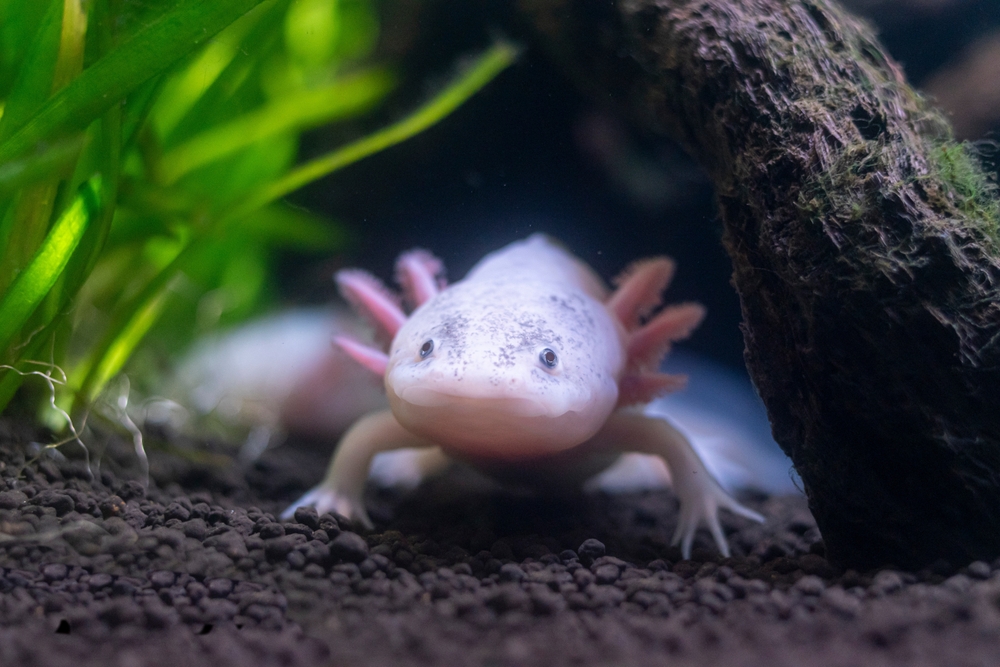
The axolotl is a type of salamander, but unlike most amphibians, it never undergoes full metamorphosis. While a typical frog or salamander transforms from a water-dwelling larva into a land-living adult, the axolotl stays in its juvenile aquatic form for its entire life. This remarkable biological trait is called neoteny, and it gives the axolotl its eternally “baby-faced” appearance — including those iconic, feathery external gills that fan out from behind its head like a living crown.
Species Classification Table
| Classification Level | Name |
|---|---|
| Kingdom | Animalia |
| Phylum | Chordata |
| Class | Amphibia |
| Order | Urodela |
| Family | Ambystomatidae |
| Genus | Ambystoma |
| Species | A. mexicanum |
The axolotl is closely related to the tiger salamander (Ambystoma tigrinum), and the two species can even interbreed in captivity. However, the axolotl remains uniquely distinct — particularly because of its permanent aquatic lifestyle and extraordinary regenerative abilities.
2. Axolotl Physical Description & Unique Features
The axolotl looks like something straight out of a fantasy novel. At first glance, you might not even believe it’s a real animal.
Size and Build: Adult axolotls typically grow between 15 and 45 centimeters (6 to 18 inches) in length, with most captive individuals averaging around 23–30 cm. They have wide, flat heads, lidless eyes, and a long tail flattened for swimming. Their four stubby legs are small but fully functional.
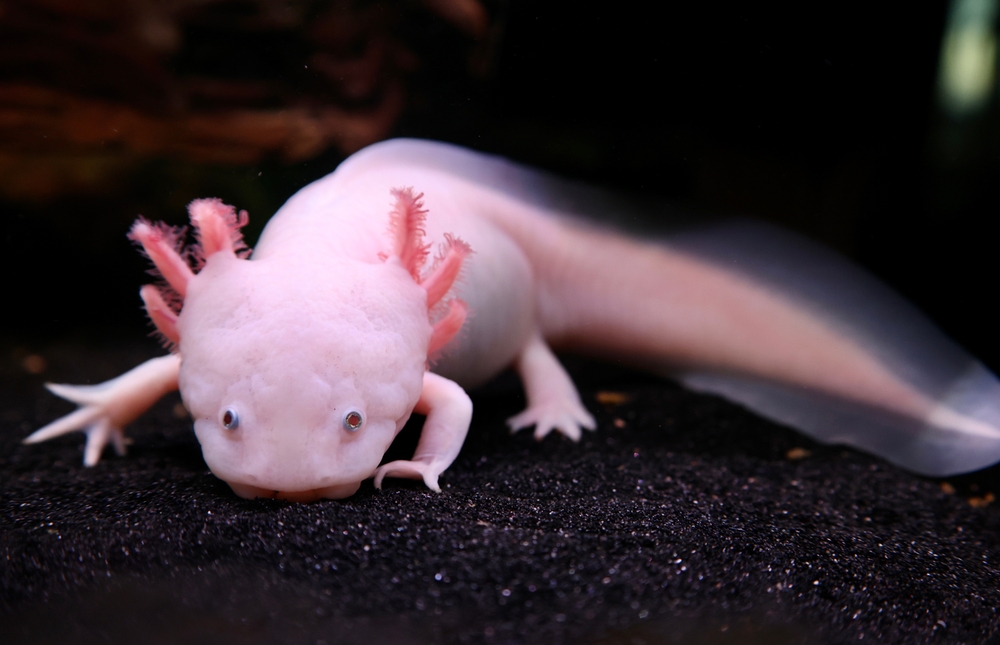
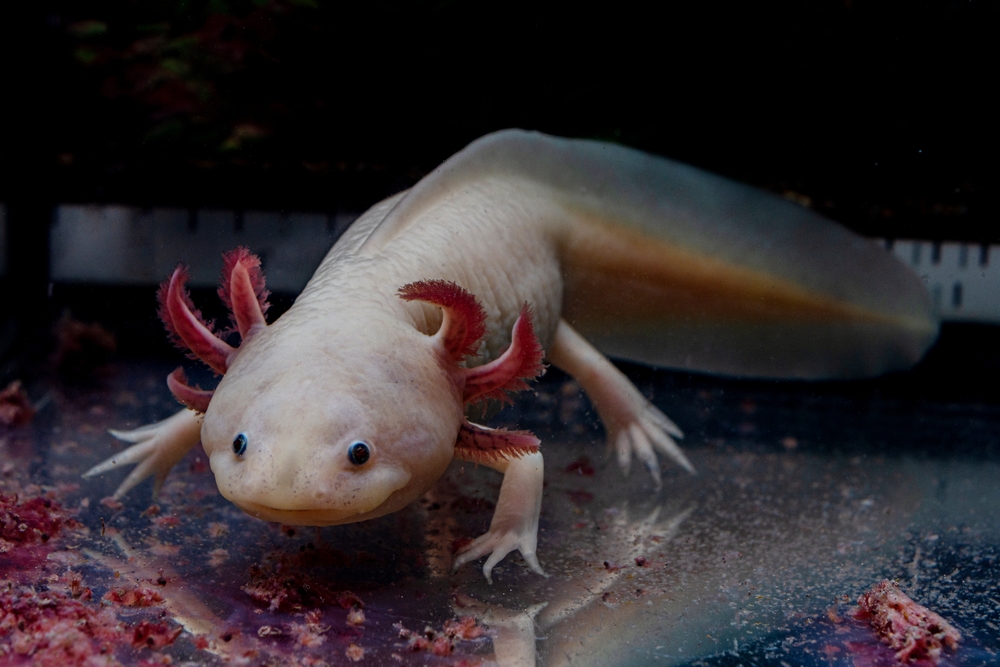
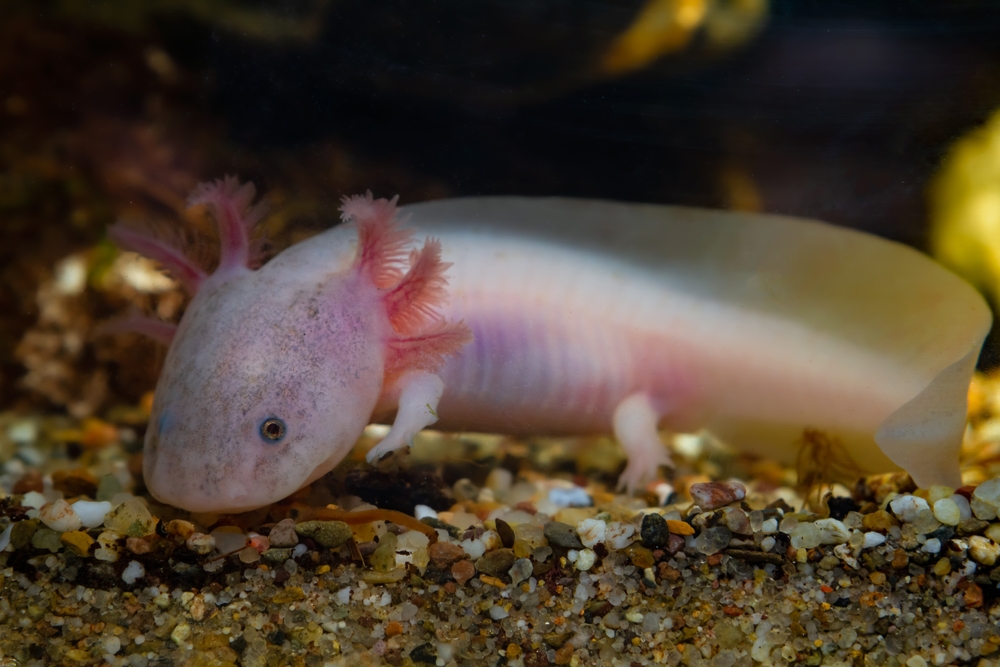
Gills: The most distinctive feature is their three pairs of external gill stalks, which branch out like feathery plumes on either side of the head. These gills are richly supplied with blood vessels, giving them a reddish or pink color — and they visibly flutter in water, making the axolotl look almost otherworldly.
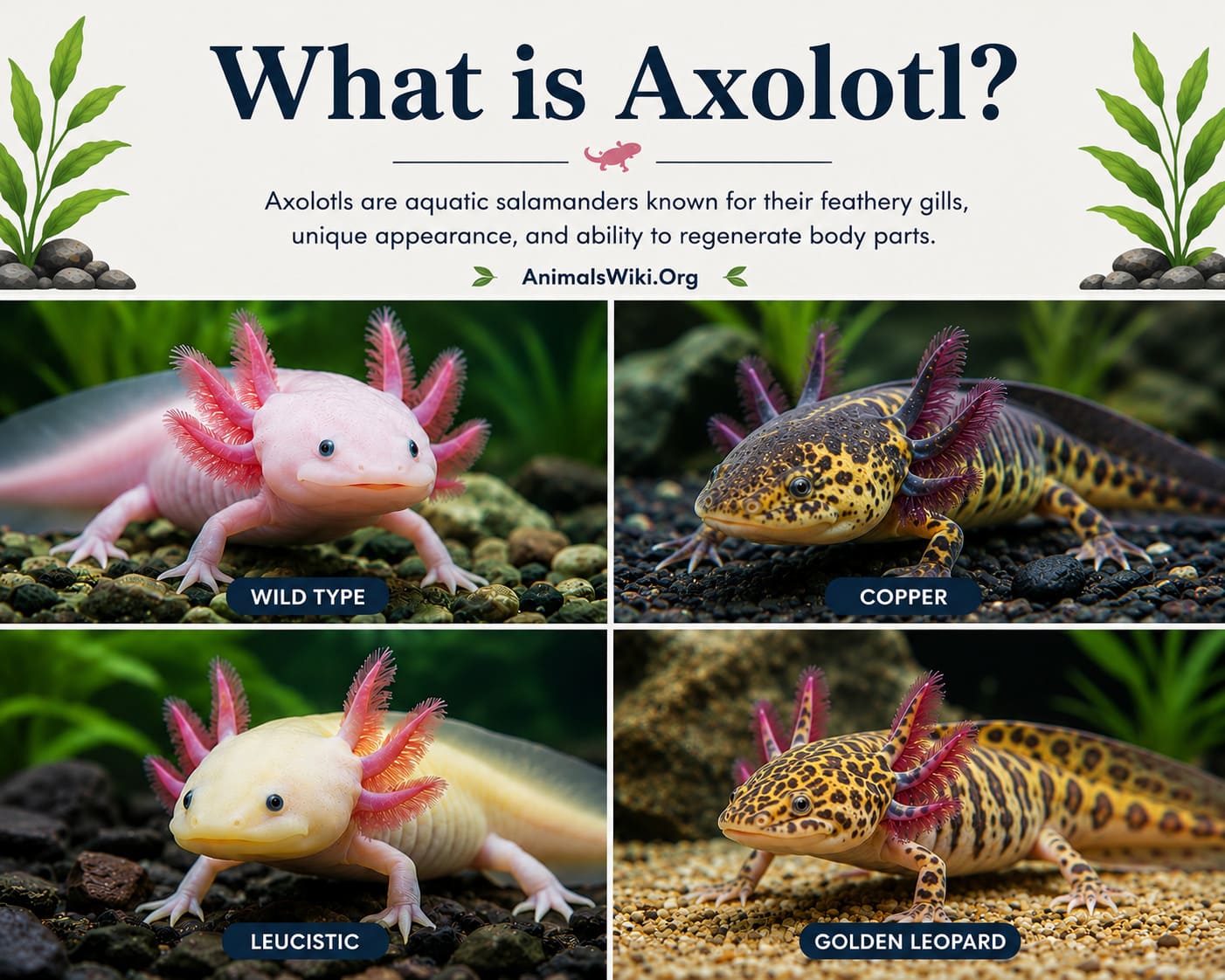
Color Variations: In the wild, most axolotls are dark — ranging from mottled brown to olive-black with golden speckles. In captivity, however, selective breeding has produced a dazzling variety of colors including:
- Leucistic (pale pink with black eyes) — the most popular pet variety
- Albino (white/yellow with red eyes)
- Golden albino (bright yellow)
- Melanoid (entirely black, no gold speckles)
- Piebald (mixed patches of dark and light)
Regeneration: Perhaps the axolotl’s most jaw-dropping feature. It can fully regenerate lost limbs, tail sections, heart tissue, portions of the brain and spinal cord, and even parts of its eyes — all without scarring. No other vertebrate on Earth can match this level of regenerative ability, making it a superstar of biomedical research.
🔬 Did You Know? The axolotl can regenerate a limb in as little as 3 to 4 weeks, and the regrown limb is fully functional — complete with bones, muscles, nerves, and blood vessels. Scientists around the world are studying its DNA in hopes of unlocking regeneration abilities in humans.
3. Natural Habitat & Geographic Range
The axolotl is one of the most geographically restricted animals on the planet. In the wild, it is found in only one place on Earth: the ancient lake system of Xochimilco (pronounced sho-chee-MEEL-ko), a network of canals and artificial islands (called chinampas) located in the southern part of Mexico City, Mexico.
Historically, axolotls also lived in the nearby Lake Chalco, but this lake was drained during the 20th century for urban development, eliminating that population entirely.
Habitat Range by Continent
| Continent | Wild Population | Captive/Zoo Population |
|---|---|---|
| North America (Mexico) | Yes — Lake Xochimilco only | Yes |
| Europe | No wild population | Yes (zoos & research labs) |
| Asia | No wild population | Yes (popular pet trade) |
| North America (USA/Canada) | No wild population | Yes (pets & aquariums) |
| Australia | No wild population | Yes (limited) |
| Africa | No wild population | No |
Axolotls thrive in cold, freshwater environments with temperatures between 14–20°C (57–68°F). They prefer shallow, slow-moving or still water with plenty of aquatic vegetation, mud bottoms, and hiding spots. Xochimilco’s canal system — once part of a vast network of Aztec waterways — has provided this habitat for thousands of years.
Sadly, rapid urbanization, pollution, and water extraction have dramatically reduced and degraded this habitat in recent decades.
4. Axolotl Diet & Feeding Behavior
The axolotl is a carnivore with a surprisingly voracious appetite for its size. In the wild, it feeds primarily at night, using a combination of smell, movement detection, and a specialized lateral line system (a sensory organ that detects vibrations in water) to locate prey.
Diet Breakdown Table
| Food Source | Frequency | Notes |
|---|---|---|
| Worms (earthworms, bloodworms) | Primary | Favorite food in wild and captivity |
| Small insects & larvae | Common | Mosquito larvae, water beetles |
| Small fish & fish eggs | Occasional | Opportunistic hunters |
| Mollusks & small crustaceans | Occasional | Snails, tiny shrimp |
| Zooplankton | Juvenile diet | Young axolotls feed on microscopic organisms |
Axolotls feed using a technique called suction feeding — they rapidly open their wide mouths, creating a vacuum that sucks prey in whole. Their small, rudimentary teeth (called pedicellate teeth) are not used for chewing but help grip slippery prey before it’s swallowed.
In captivity, axolotls are commonly fed earthworms, bloodworms, brine shrimp, and specially formulated axolotl pellets. They are fed every 2–3 days, as overfeeding can lead to obesity and health issues.
Did You Know? Axolotls are known to cannibalize each other when hungry or kept in cramped conditions — particularly targeting the feathery gills and limbs of their tank mates. This is why juvenile axolotls are often housed separately until they are large enough to coexist safely.
5. Reproduction & Life Cycle of Axolotl
The axolotl’s reproductive strategy is as fascinating as everything else about it.
Sexual Maturity: Axolotls reach sexual maturity at 18–24 months of age in captivity, though this may vary slightly in the wild depending on water temperature and food availability.
Mating Behavior: Mating is triggered by changes in water temperature and day length (photoperiod). The male performs an elaborate courtship “dance,” nudging the female and depositing small packets of sperm called spermatophores on the lake bottom. The female picks these up with her cloaca (reproductive opening), fertilizing her eggs internally.
Egg Laying: A single female can lay 100 to 1,000 eggs in one breeding event, attaching them individually to aquatic plants or rocks. The eggs are wrapped in a clear jelly-like coating.
Hatching & Growth: Eggs hatch after approximately 2–3 weeks, depending on water temperature. The tiny hatchlings are fully independent from birth — no parental care is provided. They grow rapidly, reaching adult size within 12–18 months.
The Neoteny Phenomenon: Unlike virtually all other salamanders, axolotls never metamorphose under natural conditions. Their thyroid gland does not produce enough thyroxine (the hormone that triggers metamorphosis) to cause transformation. Interestingly, scientists CAN force metamorphosis by administering iodine or thyroid hormones — but the resulting “transformed” axolotl has a significantly shortened lifespan and typically dies within months.
6. Social Behavior & Communication
Axolotls are largely solitary animals. In the wild, they tend to maintain loose territories around prime feeding spots and retreat to hidden areas — beneath rocks, vegetation, or in the muddy substrate — during daylight hours.
They do not communicate through sound. Instead, they rely on chemical signals (pheromones) dissolved in the water — particularly important during mating season — and their mechanosensory lateral line, which detects movements and vibrations caused by other animals nearby.
In captivity, axolotls can be kept together, but care must be taken. Adults of similar size generally coexist peacefully, but size differences can lead to nipping and injury. They are not aggressive in the traditional sense — most “attacks” are simply mistaken feeding responses rather than territorial aggression.
They show surprisingly individual personalities in captivity — some are bold and curious, swimming to the front of their tanks when their owners approach, while others are shy and reclusive.
7. Axolotl’s Predators & Defense Mechanisms
In their native habitat, adult axolotls have few natural predators. However, they do face threats from:
- Large birds such as herons and egrets, which wade into shallow water
- Introduced fish species — particularly tilapia and carp, which were introduced into the Xochimilco waterways in the 1970s and 1980s and have decimated axolotl populations by eating juveniles and eggs
- Larger axolotls (cannibalism, particularly of juveniles)
Defense Mechanisms: The axolotl’s primary defense strategy is camouflage and concealment — blending into the muddy, vegetation-rich bottom of the lake. Their dark, mottled coloring in the wild helps them blend into their surroundings effectively.
Their most remarkable “defense” is arguably their regenerative ability — if a predator bites off a limb or damages an organ, the axolotl can simply regrow it.
Did You Know? The introduction of non-native carp and tilapia into Lake Xochimilco is considered one of the top two causes of the wild axolotl’s dramatic population collapse — the other being water pollution and habitat destruction.
8. Axolotl Relationship with Humans
Historical Relationship
The axolotl holds a deeply important place in Aztec culture and mythology. The Aztec people of the Valley of Mexico considered it a sacred and mysterious creature. According to Aztec legend, the axolotl was the god Xolotl — the dog-headed deity of lightning and death — who transformed himself into a salamander to escape sacrifice. The name “axolotl” itself comes from the Nahuatl language, combining atl (water) and xolotl (dog or monster), meaning roughly “water dog” or “water monster.”
Historically, axolotls were also consumed as food by the Aztec people and later by local populations around Mexico City. They were considered a delicacy — reportedly tasting similar to white fish — and were sold in local markets well into the 20th century.
Modern Relationship
Today, the axolotl’s relationship with humans operates on several levels:
Scientific Research: The axolotl is arguably the most important research animal in regenerative medicine. Scientists worldwide study its genome — which is 10 times larger than the human genome — in hopes of understanding the mechanisms behind its regenerative abilities. Research published through institutions like the Research Institute of Molecular Pathology (IMP) in Vienna has decoded significant parts of the axolotl genome.
Pet Trade: Axolotls have become enormously popular as exotic pets worldwide, particularly in the United States, Japan, South Korea, and Europe. Their alien appearance, relative ease of care, and interactive personalities make them appealing aquarium animals.
Cultural Icon: The axolotl has become a symbol of Mexican national identity and biodiversity. Its image appears on the 50-peso Mexican banknote, on national postage stamps, and in countless artworks.
9. Axolotl Conservation Status & Threats
The axolotl is listed as Critically Endangered on the IUCN Red List — just one step away from extinction in the wild. Population surveys conducted in recent years paint an alarming picture: where thousands of axolotls once populated the lakes and canals of Mexico City, fewer than 50–1,000 individuals may remain in the wild today, and some estimates are even lower.
Primary Threats
1. Habitat Destruction: The explosive growth of Mexico City — one of the largest urban agglomerations on Earth — has led to the draining, pollution, and filling-in of vast areas of the original lake system. Lake Xochimilco is now a fraction of its historical size.
2. Water Pollution: Agricultural runoff, industrial waste, and urban sewage have severely degraded the water quality of the remaining canal system.
3. Invasive Species: As noted above, tilapia and common carp introduced into the waterways compete directly with axolotls for food and prey heavily on their eggs and juveniles.
4. Water Extraction: Mexico City draws enormous quantities of groundwater and surface water to supply its population of over 20 million people, steadily reducing water levels in the Xochimilco system.
5. Illegal Harvesting: Despite legal protections, axolotls are still occasionally illegally harvested for food and the pet trade.
Conservation Efforts
Multiple organizations are working to save the wild axolotl, including:
- UNAM (National Autonomous University of Mexico) — runs captive breeding programs and habitat restoration projects in Xochimilco
- WWF Mexico — supports wetland conservation initiatives
- Axolotl Sanctuary Projects — community-based efforts to create pollution-free “axolotl refuges” within the canal system
- IUCN Amphibian Specialist Group — coordinates international conservation strategy
Did You Know? In 2023, researchers from UNAM reported detecting a tiny but encouraging uptick in axolotl sightings in specific restored sections of the Xochimilco canal network — the first glimmer of hope in years. Sustained conservation work continues into 2026.
10. Famous Axolotls & Pop Culture Appearances
Famous Named Axolotls
- “Gollum” — a long-lived research axolotl at the University of Kentucky, used extensively in regeneration studies and kept for over 17 years
- Various UNAM Research Axolotls — several individually tracked wild axolotls in Xochimilco have been documented in conservation surveys, though typically identified by number rather than name
Pop Culture Appearances
The axolotl has become a global pop culture phenomenon in recent years:
- Minecraft (2021): Axolotls were added as aquatic mobs in the Caves & Cliffs update, introducing them to hundreds of millions of players worldwide and igniting mass public interest
- Encanto (2021): While not a central character, the axolotl makes appearances as part of the Colombian magical world — a nod to Latin American biodiversity
- Aggretsuko (Netflix): Features an axolotl-inspired character
- Video Games: Featured in Animal Crossing, Stardew Valley (inspired characters), and numerous indie games
- Social Media: Axolotls are among the most shared exotic animals on TikTok, YouTube, and Instagram, with videos of pet axolotls regularly accumulating millions of views
- Mexican 50-Peso Banknote: Perhaps the most official pop culture appearance — the axolotl is featured on Mexico’s 50-peso bill, cementing its status as a national icon
11. Role in Ecosystem & Food Chain
Despite its small size, the axolotl plays a meaningful role in the Xochimilco ecosystem.
As a Predator: Axolotls help regulate populations of insects, worms, small crustaceans, and fish in the lake bottom. Their feeding keeps populations of mosquito larvae in particular in check — an important ecosystem service.
As Prey: Juveniles and eggs are important food sources for birds, larger fish, and other predators. Their historic abundance would have supported a significant portion of the food web in the Valley of Mexico lake system.
As Bioindicators: Axolotls are highly sensitive to water quality changes, making them an excellent indicator species. A healthy axolotl population signals a healthy aquatic ecosystem; their decline is a direct warning signal of environmental degradation.
12. Myths & Cultural Significance
Across Mesoamerican culture, the axolotl occupies a unique spiritual space.
The Xolotl Legend: In Aztec cosmology, Xolotl was the god of lightning, fire, and the guide of the dead through the underworld. When the gods decided to sacrifice themselves to create the sun and moon, Xolotl — terrified — fled and transformed himself first into a maize plant, then a maguey cactus, and finally into an axolotl (the atl-xolotl, or water-dog) before being captured and sacrificed. This myth imbued the axolotl with an aura of magic, transformation, and the boundary between life and death.
Modern Mexican Identity: Today, the axolotl is embraced as a symbol of Mexico’s unique biodiversity and pre-Columbian heritage. It appears in museums, folk art, school textbooks, and is the subject of a major national conservation campaign. Mexico has declared the axolotl a national symbol of biological heritage.
Global Fascination: In Japan and South Korea, the axolotl — known as Wooper Rooper in Japanese (borrowed from an early 1980s marketing name) — is a beloved cultural mascot, featured in everything from plush toys to café menus.
13. Axolotl Fun Facts
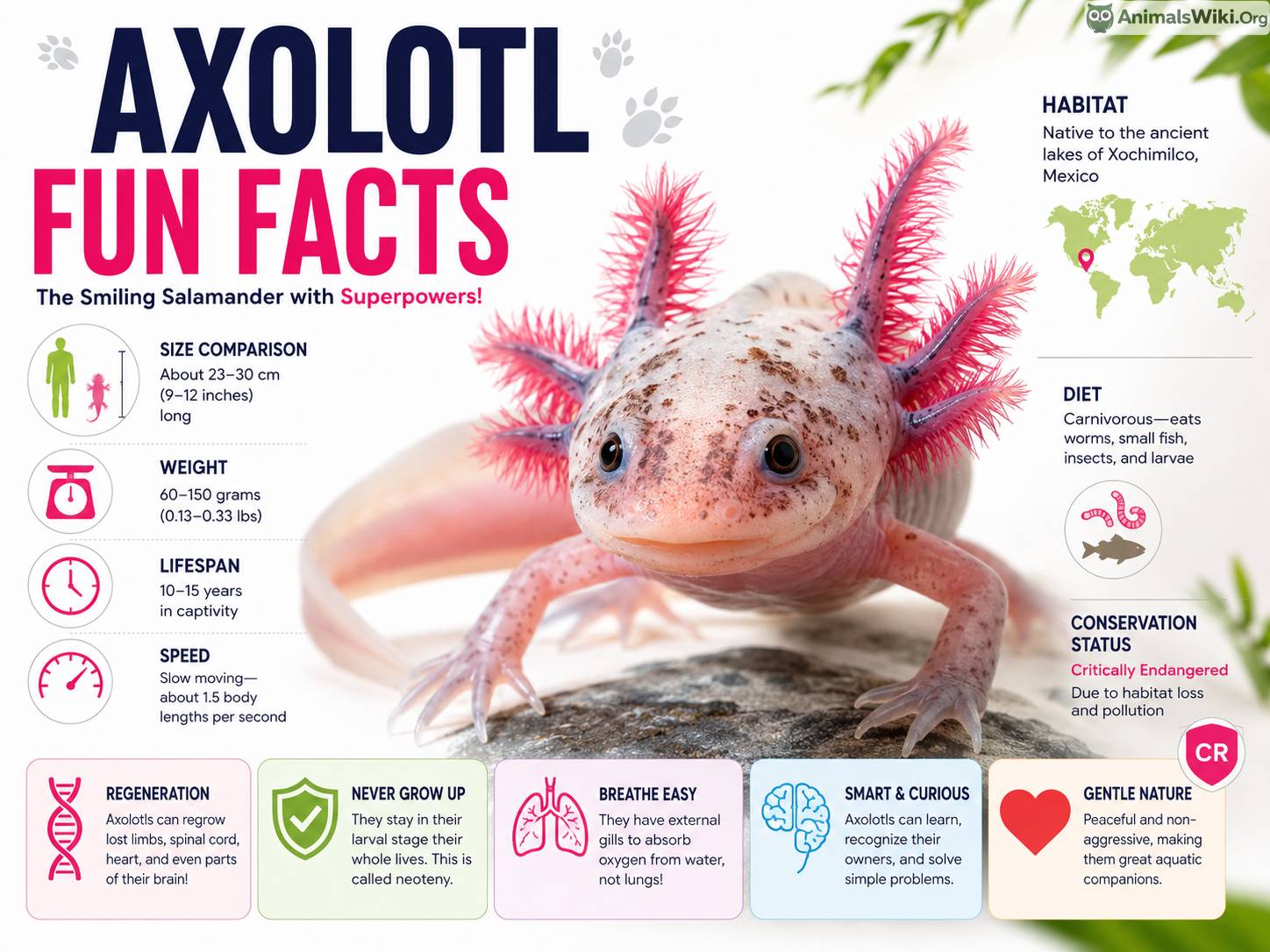
- The axolotl genome has 32 billion base pairs — about 10 times the size of the human genome
- An axolotl can regrow the same limb multiple times without any loss of function
- It can regenerate portions of its own brain — the only vertebrate known to do so
- Scientists have successfully transplanted axolotl eye tissue onto blind axolotls, restoring partial vision
- Axolotls are cold-sensitive — water above 24°C (75°F) causes severe stress and can be fatal
- A female axolotl can lay up to 1,000 eggs in a single breeding event
- The Minecraft axolotl mob helped drive a measurable increase in Google searches and donations to axolotl conservation organizations in 2021
- The word “axolotl” has been used in the Spanish language since at least the 16th century
- Axolotl tissue studies have contributed to research on cancer, heart disease, and spinal cord injuries
- There are estimated to be millions of captive axolotls worldwide — but perhaps fewer than 1,000 left in the wild
14. Axolotl Species Evolution & Discovery Timeline
~150 Million Years Ago — The ancient ancestors of salamanders first appear in the fossil record
~30 Million Years Ago — The genus Ambystoma begins diverging from other salamander lineages
~10,000 Years Ago — The Valley of Mexico lakes form their modern configuration; axolotl populations establish in the area
1200s–1500s CE — Aztec civilization thrives in the Valley of Mexico; axolotls are consumed as food and woven into Aztec mythology
1521 — Spanish conquest of the Aztec Empire; the axolotl and its mythology are documented by Spanish chroniclers
1787 — European naturalist Francisco Hernández provides one of the first detailed European descriptions of the axolotl
1863 — A shipment of six live axolotls arrives at the Natural History Museum in Paris — the first live specimens ever seen in Europe. The scientific community is stunned
1864 — French zoologist Auguste Duméril documents the first successful captive breeding of axolotls in Europe
1865 — Scientists witness captive axolotls spontaneously metamorphosing for the first time, leading to years of debate about the species’ true identity
1870s–1900s — Axolotls enter research laboratories worldwide; their regenerative properties begin attracting scientific interest
1970s–80s — Tilapia and carp are introduced to Xochimilco waterways; axolotl population collapse begins
2009 — Scientists at the University of Kentucky publish the first detailed axolotl genome research
2018 — An international team publishes the complete axolotl genome sequence — then the largest animal genome ever sequenced
2021 — Minecraft axolotl update brings global mainstream attention to the species
2023 — UNAM researchers report encouraging signs of partial recovery in restored canal sections in Xochimilco
2026 — Conservation programs continue; axolotl remains Critically Endangered but captive populations ensure the species will not go globally extinct
15. How You Can Help
The good news is that you don’t have to live in Mexico to make a difference for the axolotl.
1. Donate to Conservation Organizations
- Adopt an Axolotl Program (UNAM): The National Autonomous University of Mexico runs an official adoption program where your donation funds habitat restoration in Xochimilco
- WWF Mexico: Supports broader wetland and amphibian conservation initiatives
- Amphibian Survival Alliance (ASA): Global coalition working on amphibian conservation
2. If You Keep Pet Axolotls
- Always source from responsible, licensed breeders — never from wild-caught stock
- Never release pet axolotls into local waterways — this can damage ecosystems and introduce disease
- Join axolotl keeper communities to share best practices
3. Spread Awareness
- Share articles like this one, follow axolotl conservation accounts on social media, and talk to friends and family about the species’ plight
4. Support Sustainable Practices
- Support environmentally responsible agriculture and businesses that help reduce water pollution flowing into sensitive aquatic ecosystems
5. Sign Conservation Petitions
- Multiple ongoing petitions support the protection of the Xochimilco waterway system — a quick web search will connect you with active campaigns
You may also like: Top 10 Critically Endangered Animals in Latin America | How Amphibians Are Warning Us About Climate Change
16. Best Places to See Axolotls
In the Wild
| Location | Details |
|---|---|
| Lake Xochimilco, Mexico City | The only natural wild habitat; guided conservation tours available |
| Xochimilco Ecological Park | Offers educational tours focused on wetland restoration |
Seeing a wild axolotl in Xochimilco today requires patience and a guided tour with local conservation experts. Your tour fees directly support habitat preservation work.
In Captivity (Zoos & Aquariums)
| Location | Institution |
|---|---|
| Mexico City, Mexico | UNAM’s Biology Institute — the world’s most important axolotl research center |
| Vienna, Austria | Research Institute of Molecular Pathology (IMP) |
| San Diego, USA | San Diego Zoo |
| London, UK | ZSL London Zoo |
| Berlin, Germany | Berlin Zoological Garden |
| Tokyo, Japan | Sunshine Aquarium |
17. Top Documentaries & Books {#documentaries}
Documentaries
- “Xolotl: The Water Monster” (Various Mexican broadcasters) — Several Spanish-language documentaries on the axolotl’s conservation crisis have aired on Mexican television
- “Racing Extinction” (2015, Discovery Channel) — Covers the global amphibian crisis, featuring the axolotl’s story
- “Life in Cold Blood” (BBC, David Attenborough) — Covers amphibian biology broadly, touching on remarkable species like the axolotl
- “The Axolotl: Mexico’s Magical Salamander” — Featured segments on various National Geographic Wild broadcasts
Books
- “The Amphibians and Reptiles of Mexico” by H.M. Smith & E.H. Taylor — Classic scientific reference
- “Axolotl” by Juan José Arreola — Famous Mexican short story inspired by Julio Cortázar’s celebrated 1952 story “Axolotl,” exploring themes of transformation and identity
- “Axolotls as Pets” by Lolly Brown — Popular care guide for axolotl owners
- IUCN Amphibian Conservation Action Plan — Key reference for conservation professionals
18. Comparison with Similar Species
| Feature | Axolotl (A. mexicanum) | Tiger Salamander (A. tigrinum) | Mudpuppy (Necturus maculosus) |
|---|---|---|---|
| Metamorphosis | Never (neotenic) | Yes (full metamorphosis) | Never (neotenic) |
| External Gills | Permanent | Lost after metamorphosis | Permanent |
| Native Range | Mexico only | North America (widespread) | Eastern North America |
| Size | 15–45 cm | 17–33 cm | 20–43 cm |
| Habitat | Freshwater canals | Varied (land and water) | Rivers, lakes |
| Conservation Status | Critically Endangered | Least Concern | Least Concern |
| Regeneration Ability | Exceptional | Moderate | Limited |
| Pet Popularity | Very High | Moderate | Low |
19. Quotes from Wildlife Experts
“The axolotl is not merely a curiosity — it is a window into the future of medicine. Understanding how it rebuilds complex tissues could fundamentally transform how we treat human injuries and disease.” — Dr. Elly Tanaka, Regenerative Biologist, Research Institute of Molecular Pathology, Vienna
“Losing the axolotl from Xochimilco would not simply be an ecological tragedy. It would be the erasure of a living connection to one of the world’s great ancient civilizations.” — Dr. Luis Zambrano, UNAM Ecology Institute
“Every time I watch an axolotl regenerate a limb, I am reminded that nature has already solved problems we are only beginning to ask.” — Dr. Randal Voss, University of Kentucky Axolotl Research Program
Did You Know? The axolotl appears on Mexico’s 50-peso banknote — a national recognition of its cultural and biological significance that few other animals in the world can claim.
Did You Know? The axolotl’s genome — at 32 billion base pairs — was, at the time of its sequencing in 2018, the largest animal genome ever decoded by science.
20. Frequently Asked Question About Axolotl
Q1: Is an axolotl a fish or a salamander?
The axolotl is absolutely a salamander — a type of amphibian — not a fish. It is commonly mistaken for a fish because it lives entirely in water and has external gills, but it belongs to the order Urodela and is closely related to land-dwelling salamanders and newts.
Q2: Can axolotls really regenerate their entire body?
Almost. Axolotls can regenerate limbs, tail, portions of heart and lung tissue, parts of the brain and spinal cord, and eye tissue. They cannot regenerate an entirely new body from a single piece, but their regenerative capabilities far exceed any other vertebrate animal on the planet.
Q3: Are axolotls good pets?
Axolotls can make fascinating and rewarding pets for those willing to meet their specific needs — cold, clean, well-filtered water (14–20°C), a spacious tank (minimum 20 gallons for one adult), and an appropriate diet. They are not beginner pets, but they are not extraordinarily difficult either. Their interactive personalities and unique appearance make them beloved by their owners.
Q4: How many axolotls are left in the wild?
This is difficult to determine precisely, but population surveys suggest fewer than 1,000 individuals may remain in the wild in Xochimilco — some estimates are considerably lower. Captive populations worldwide number in the millions, which means the species is in no danger of total extinction, but the wild population is critically threatened.
Q5: Is it legal to own an axolotl as a pet?
Laws vary by country and region. In Mexico, wild axolotls are legally protected and cannot be caught or sold. Captive-bred individuals may be kept legally. In most of the United States, axolotls are legal to own, except in California, Maine, New Jersey, and Virginia, where they are prohibited. In Canada, they are legal in most provinces. Always verify local laws before acquiring one.
Q6: Do axolotls feel pain?
Yes. Like all vertebrates, axolotls have a nervous system capable of detecting and responding to harmful stimuli — this is the scientific definition of nociception. Whether they experience subjective pain in the way humans do is harder to determine, but best practices in axolotl care assume they can feel pain and treat them accordingly with proper husbandry and, when necessary, veterinary anesthesia.
Q7: Why don’t axolotls metamorphose like other salamanders?
Axolotls have a genetic mutation that causes their thyroid gland to be unresponsive to thyroid-stimulating hormone at normal levels, meaning they don’t produce enough thyroxine to trigger metamorphosis. This condition — neoteny — appears to have been permanently fixed in the species over thousands of years of evolution, possibly because the lake environment made metamorphosis (and life on land) unnecessary or disadvantageous.
Q8: What is being done to save wild axolotls?
The main conservation efforts include: habitat restoration in Xochimilco (removing invasive fish, cleaning water, creating protected refuges), captive breeding programs at UNAM and other institutions, public education campaigns, and ecotourism initiatives that give local communities a financial incentive to protect the waterway. International scientific attention has also helped mobilize funding and global awareness.
21. Sources Researched
The information in this article was researched and compiled from the following authoritative sources:
- Axolotl Images — shutterstock.com
- IUCN Red List — iucnredlist.org (Conservation status, population data)
- National Geographic — nationalgeographic.com (Species biology, habitat)
- WWF (World Wildlife Fund) — wwf.org (Conservation efforts)
- UNAM (National Autonomous University of Mexico) — unam.mx (Research, captive breeding programs)
- Smithsonian’s National Zoo — nationalzoo.si.edu (Species care, biology)
- Encyclopedia Britannica — britannica.com (Historical and biological facts)
- Research Institute of Molecular Pathology (IMP), Vienna — imp.ac.at (Genome research, regeneration studies)
- University of Kentucky Ambystoma Genetic Stock Center — uky.edu (Axolotl genome research)
- AmphibiaWeb — amphibiaweb.org (Taxonomy, species data)
- Mexican Government Environmental Agency (SEMARNAT) — gob.mx/semarnat (Conservation law, protected species status)
- Nature Journal / Scientific American — nature.com / scientificamerican.com (Peer-reviewed research)
22. Axolotl Images (Shutterstock)