
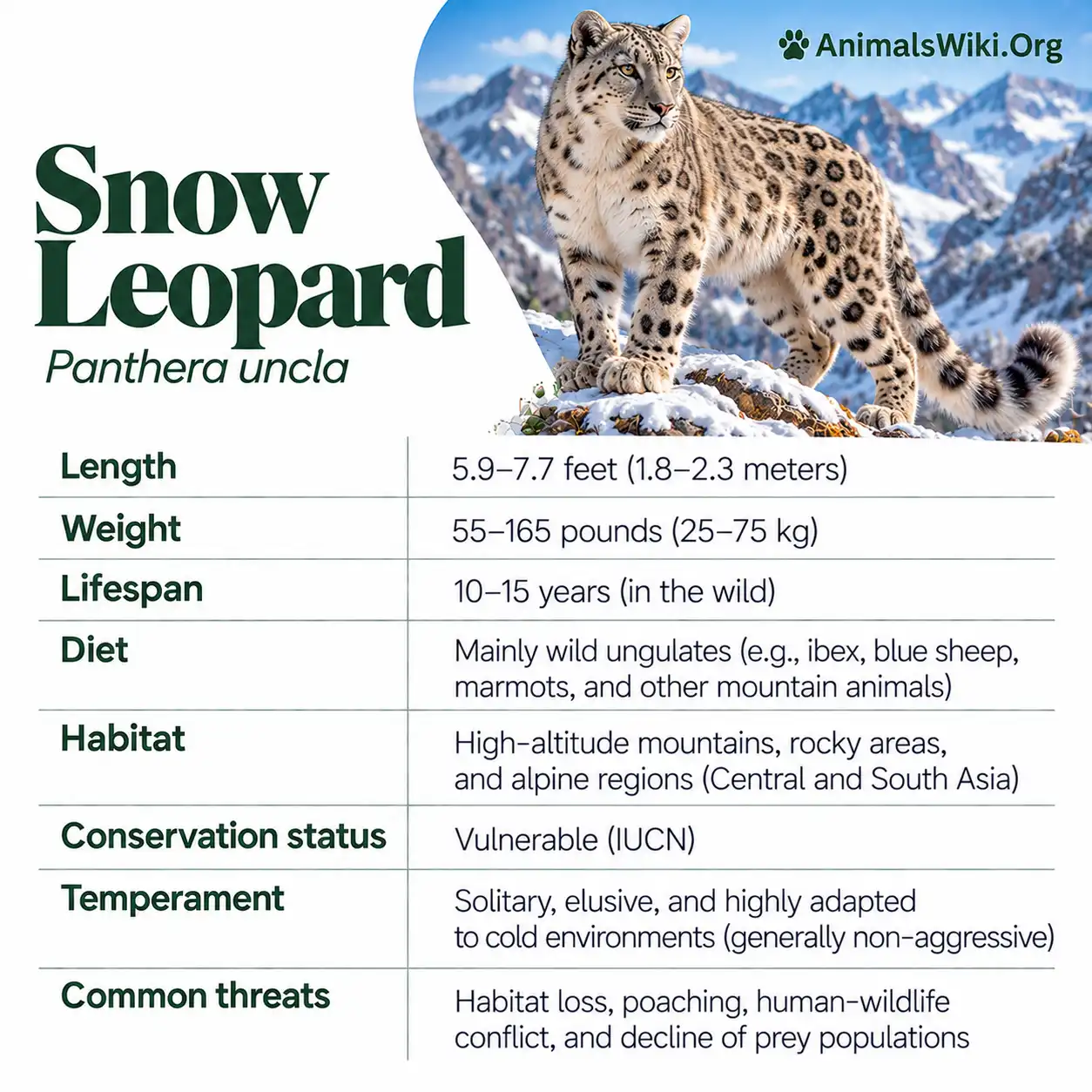
The snow leopard is one of the world’s most mysterious and beautifully adapted wild cats. Famous for its thick smoky-gray coat, dark rosettes, enormous furry paws, powerful hind legs, and exceptionally long tail, the snow leopard is perfectly equipped for life among the steep, cold mountains of Central and South Asia.
Scientifically known as Panthera uncia, the snow leopard belongs to the cat family Felidae and the genus Panthera. Despite its name, it is not simply a leopard that lives in snow. The snow leopard is a distinct species with specialized physical and behavioral adaptations that allow it to survive in some of Earth’s harshest mountain environments.
Snow leopards inhabit rugged landscapes containing cliffs, rocky slopes, deep valleys, alpine meadows, and high-altitude mountain systems. Their pale coats provide remarkable camouflage among snow-covered rocks and gray mountain terrain, earning them the popular nickname “ghost of the mountains.”
Unlike lions, snow leopards do not live in prides. They are primarily solitary predators that travel across enormous mountain home ranges searching for prey. Their powerful hind limbs allow them to navigate steep slopes, while their long tails provide balance when crossing rocky terrain.
Wild snow leopards occur across parts of countries including China, Mongolia, India, Pakistan, Nepal, Bhutan, Afghanistan, Russia, Kazakhstan, Kyrgyzstan, Tajikistan, and Uzbekistan.
Despite living in remote environments, snow leopards face significant conservation challenges. Habitat degradation, declining natural prey, retaliatory killing following livestock losses, infrastructure development, illegal wildlife trade, and climate-related environmental change can all affect their populations.
This comprehensive guide explores snow leopard facts, habitat, diet, size, weight, lifespan, behavior, hunting, speed, reproduction, cubs, adaptations, predators, geographic range, conservation, and differences between snow leopards and other big cats.
Snow Leopard Facts
| Feature | Information |
|---|---|
| Common Name | Snow Leopard |
| Scientific Name | Panthera uncia |
| Kingdom | Animalia |
| Phylum | Chordata |
| Class | Mammalia |
| Order | Carnivora |
| Family | Felidae |
| Subfamily | Pantherinae |
| Genus | Panthera |
| Species | Panthera uncia |
| Animal Type | Mammal |
| Diet | Carnivore |
| Native Range | Central and South Asia |
| Habitat | High mountains, rocky slopes, alpine and subalpine environments |
| Lifestyle | Primarily solitary |
| Body Length | Roughly 90–115 cm (35–45 in), excluding tail |
| Tail Length | Approximately 80–105 cm (31–41 in) |
| Weight | Commonly around 25–55 kg (55–121 lb), with males generally larger |
| Famous Feature | Thick pale coat and exceptionally long tail |
| Hunting Style | Stealth and ambush |
| Reproduction | Live birth |
| Young | Cub |
| Lifespan | Commonly around 10–15 years in the wild |
| Climbing Ability | Excellent |
| Conservation Status | Vulnerable |
| Main Threats | Habitat pressures, prey decline, retaliatory killing and illegal trade |
What Is a Snow Leopard?
A snow leopard is a medium-sized wild cat specially adapted to cold, mountainous environments.
Its scientific name is Panthera uncia.
Snow leopards belong to the same genus as lions, tigers, leopards, and jaguars, but their lifestyle is dramatically different.
They inhabit some of the highest and most rugged landscapes occupied by any large cat.
A typical snow leopard spends much of its life traveling through steep valleys, cliffs, rocky ridges, and alpine terrain.
Its physical characteristics—including thick fur, broad paws, powerful hind limbs, short rounded ears, and a long furry tail—are closely associated with survival in these environments.
Scientific Classification of the Snow Leopard
| Classification | Name |
|---|---|
| Kingdom | Animalia |
| Phylum | Chordata |
| Class | Mammalia |
| Order | Carnivora |
| Family | Felidae |
| Subfamily | Pantherinae |
| Genus | Panthera |
| Species | Panthera uncia |
The snow leopard was historically placed in the genus Uncia, but modern genetic evidence places it within Panthera.
What Does a Snow Leopard Look Like?
The snow leopard has one of the most distinctive appearances among wild cats.
Its coat is usually pale gray, whitish, or smoky gray with darker spots and rosettes.
The underside is generally lighter.
Important physical characteristics include:
- Thick insulating fur
- Dark rosettes and spots
- Broad furry paws
- Powerful hind legs
- Long thick tail
- Relatively short front legs
- Rounded ears
- Broad nasal region
- Strong chest
- Muscular body
- Pale eyes that can appear gray-green
The snow leopard’s body is built for navigating cold, uneven mountain terrain rather than open plains or tropical forests.
Why Do Snow Leopards Have Spots?
Snow leopard spots and rosettes provide highly effective camouflage.
Their mountain habitats contain a complex mixture of:
- Gray rocks
- Dark shadows
- Pale cliffs
- Snow
- Sparse vegetation
The snow leopard’s pale coat and irregular markings break up its body outline against this background.
A motionless snow leopard can be extremely difficult to detect even when it is visible in an open photograph.
This camouflage is essential for both hunting and avoiding detection.
Why Is the Snow Leopard Called the Ghost of the Mountains?
The snow leopard is frequently called the “ghost of the mountains” because it is secretive, well camouflaged, and difficult to observe.
Its pale coat blends almost perfectly with rocky mountain terrain.
Snow leopards also inhabit remote regions where relatively few people live.
Their low population density and enormous home ranges make encounters uncommon.
A snow leopard can therefore live in a mountain valley without being seen regularly by humans.
How Big Is a Snow Leopard?
Snow leopards are smaller than tigers, lions, and many jaguars.
Adults commonly have a head-and-body length of approximately 90–115 centimeters (35–45 inches).
Their extraordinarily long tails may measure another 80–105 centimeters (31–41 inches).
Adults commonly weigh around 25–55 kilograms (55–121 pounds), although larger males can exceed this range.
Males are generally heavier than females.
Their thick fur can make snow leopards appear larger than their actual body weight suggests.
Male Snow Leopard vs. Female Snow Leopard
| Feature | Male Snow Leopard | Female Snow Leopard |
|---|---|---|
| Size | Generally larger | Generally smaller |
| Lifestyle | Solitary | Solitary except with cubs |
| Home Range | Often larger | Usually smaller |
| Hunting | Independent | Independent and hunts for cubs |
| Cub Care | Little direct involvement | Primary caregiver |
| Territorial Movement | Extensive | Extensive |
Both sexes are highly capable mountain predators.
Where Do Snow Leopards Live?
Snow leopards are native to the mountainous regions of Central and South Asia.
Their range extends across portions of approximately a dozen countries.
Snow leopard range countries include:
- Afghanistan
- Bhutan
- China
- India
- Kazakhstan
- Kyrgyzstan
- Mongolia
- Nepal
- Pakistan
- Russia
- Tajikistan
- Uzbekistan
China contains a particularly large portion of the species’ remaining habitat.
Snow leopards occupy major mountain systems including the Himalayas, Karakoram, Hindu Kush, Pamirs, Tian Shan, and Altai Mountains.
Snow Leopard Habitat
Snow leopards are strongly associated with rugged mountainous environments.
Typical snow leopard habitat includes:
- Rocky slopes
- Cliffs
- Mountain ridges
- Alpine meadows
- Subalpine areas
- High valleys
- Ravines
- Broken rocky terrain
- Cold deserts
They often occupy elevations of several thousand meters, although altitude varies considerably by region and season.
Rocky terrain provides concealment and gives snow leopards opportunities to approach prey without being detected.
Snow Leopards in the Himalayas
The Himalayas provide some of the best-known snow leopard habitat.
Snow leopards occur in high-altitude areas of India, Nepal, Bhutan, and neighboring regions.
The Himalayan environment presents extreme challenges.
Temperatures can fall dramatically, vegetation can be sparse, oxygen levels are lower than at sea level, and prey may be widely distributed.
Snow leopards survive through a combination of physical adaptations, energy-efficient behavior, and remarkable mobility.
Snow Leopards in Pakistan
Pakistan contains important snow leopard habitat, particularly across its northern mountain regions.
Suitable landscapes occur within mountain systems including the Karakoram, Hindu Kush, and Himalayas.
These rugged landscapes can support wild ungulates that form important components of the snow leopard’s natural diet.
Community-based conservation is particularly important because snow leopards may occasionally prey on domestic livestock.
Reducing livestock losses and helping mountain communities coexist with predators can directly support snow leopard conservation.
What Do Snow Leopards Eat?
Snow leopards are carnivores.
Their diet varies according to geographic location and prey availability.
Important natural prey can include:
- Blue sheep or bharal
- Siberian ibex
- Himalayan tahr
- Argali
- Markhor
- Urial
- Marmots
- Pikas
- Hares
- Other mountain mammals
- Birds
Snow leopards can sometimes kill prey substantially larger than themselves.
They may also attack domestic livestock when natural prey is scarce or livestock is readily accessible.
How Do Snow Leopards Hunt?
Snow leopards are ambush predators.
Their mountain environment makes long-distance high-speed pursuit impractical.
Instead, they use rocky terrain as natural cover.
A snow leopard may move quietly along:
- Cliffs
- Ridges
- Rock formations
- Ravines
- Mountain slopes
until it gets close to its prey.
It then launches a powerful attack.
Its muscular hind legs provide explosive acceleration, while its large paws and long tail help maintain control on uneven terrain.
Can Snow Leopards Hunt Animals Larger Than Themselves?
Yes.
Snow leopards are capable of killing surprisingly large mountain ungulates.
Their muscular bodies, powerful hind limbs, strong jaws, sharp claws, and ability to attack from advantageous terrain allow them to tackle prey that can outweigh them.
However, large prey also presents greater danger.
An unsuccessful attack can result in serious injury.
Snow leopards therefore depend heavily on stealth and careful positioning.
How Fast Can a Snow Leopard Run?
Snow leopards can move quickly when necessary, but they are not specialized sprinters like cheetahs.
Their environment rewards agility, balance, jumping ability, and sure-footed movement more than maximum running speed.
Rocky slopes and cliffs make sustained high-speed running difficult.
For a snow leopard, being able to leap between rocks and control its body on steep terrain is far more useful than achieving the extreme speed of a cheetah.
How Far Can a Snow Leopard Jump?
Snow leopards are famous for extraordinary jumping ability.
Their powerful hind legs allow them to make impressive leaps across rocky gaps and uneven terrain.
Popular accounts sometimes cite jumps of around 15 meters (50 feet), although exact maximum distances in wild conditions are difficult to verify consistently.
What is certain is that jumping is an essential part of snow leopard movement and hunting.
Their long tails help stabilize the body during these leaps.
Why Does a Snow Leopard Have a Long Tail?
The snow leopard has one of the longest tails relative to body size among large cats.
Its tail serves several important purposes.
Balance
The tail acts as a counterbalance when the cat moves across narrow ledges, rocks, and steep slopes.
Turning
It helps control body position during jumps and rapid changes in direction.
Warmth
A resting snow leopard can wrap its thick furry tail around its body and face, providing additional insulation in cold conditions.
Fat Storage
The tail can also store some fat reserves.
The tail is therefore one of the snow leopard’s most important mountain adaptations.
Why Do Snow Leopards Have Big Paws?
Snow leopards have unusually broad paws covered with fur.
These paws help distribute body weight over soft snow, functioning somewhat like natural snowshoes.
The fur provides additional insulation and helps protect the feet from cold surfaces.
Broad paws also improve stability and grip on rocky terrain.
This adaptation allows the snow leopard to move through environments that would be challenging for many other large cats.
How Do Snow Leopards Survive the Cold?
Several adaptations protect snow leopards from severe mountain temperatures.
Thick Fur
Dense fur provides excellent insulation.
Furry Paws
Hair covering the paws reduces heat loss and protects against snow and ice.
Small Rounded Ears
Relatively small ears reduce exposed surface area and may help conserve heat.
Long Thick Tail
The tail can be wrapped around the face and body while resting.
Stocky Body
A relatively compact build helps reduce heat loss.
Together, these features make Panthera uncia highly specialized for cold climates.
Snow Leopard Nose and Breathing Adaptations
Snow leopards live in high-altitude environments where the air is colder and oxygen availability is lower than at sea level.
Their nasal region is relatively broad, and their respiratory anatomy supports life in demanding mountain conditions.
Large nasal passages can help warm and humidify cold air before it reaches deeper parts of the respiratory system.
Mountain adaptation involves multiple physiological and anatomical characteristics rather than a single feature.
Are Snow Leopards Solitary?
Yes.
Adult snow leopards are primarily solitary animals.
They normally travel and hunt alone.
Individuals maintain large home ranges that can overlap to some degree.
Because prey can be widely dispersed in mountain environments, snow leopards may need to travel substantial distances.
Females temporarily live with their cubs until the young animals become independent.
Snow Leopard Territory
Snow leopard home ranges can be enormous.
Their size depends heavily on:
- Prey availability
- Terrain
- Season
- Habitat quality
- Sex
- Population density
Where prey is abundant, individuals may require less space.
In landscapes where prey is scarce, snow leopards may travel across very large areas.
This makes habitat connectivity particularly important.
Roads, settlements, mining, fencing, and other development can interfere with movement between mountain habitats.
How Do Snow Leopards Communicate?
Snow leopards use several forms of communication.
They leave scent marks and scrape the ground at frequently used locations.
They may also rub their cheeks against rocks and leave other chemical signals.
Vocal communication includes:
- Growls
- Hisses
- Moans
- Yowls
- Meows
- Chuff-like sounds
These signals help individuals communicate territorial and reproductive information even when they rarely encounter one another directly.
Can Snow Leopards Roar?
Snow leopards belong to the genus Panthera, but they do not produce the same full roar associated with lions and tigers.
Their vocal anatomy differs in ways that affect sound production.
Instead, snow leopards use a range of other vocalizations, including growls, moans, yowls, and softer contact calls.
Snow Leopard Reproduction
Snow leopard breeding is relatively seasonal compared with that of many tropical cats.
Mating commonly occurs during the winter months.
After a gestation period of approximately three to three and a half months, the female gives birth in a protected den.
The den may be located among rocks, caves, or other sheltered areas.
Females line den sites with fur and other available material.
Snow Leopard Cubs
Baby snow leopards are called cubs.
A litter commonly contains around two or three cubs, although litter size varies.
Newborn cubs are small and helpless.
Their mother provides:
- Milk
- Warmth
- Protection
- Shelter
- Food
- Hunting instruction
The cubs remain in the den during their earliest stage of development.
As they grow stronger, they begin exploring the surrounding mountain environment.
How Do Snow Leopard Cubs Learn to Hunt?
Young snow leopards learn survival skills gradually.
Play helps develop balance, coordination, stalking behavior, jumping ability, and strength.
As cubs mature, they accompany their mother.
They observe how she moves across difficult terrain and approaches prey.
Eventually, young snow leopards participate increasingly in hunting activities before becoming independent.
How Long Do Snow Leopard Cubs Stay With Their Mother?
Snow leopard cubs generally remain with their mother for around 18–22 months, although the exact timing can vary.
During this period, they learn how to:
- Navigate mountain terrain
- Locate prey
- Hunt
- Find shelter
- Recognize threats
- Survive severe weather
Eventually, young snow leopards disperse to establish home ranges of their own.
Snow Leopard Lifespan
Wild snow leopards commonly live approximately 10–15 years, although precise lifespan varies.
Their survival is influenced by:
- Prey availability
- Injuries
- Disease
- Climate
- Competition
- Human activity
- Livestock conflict
- Habitat quality
Under professional managed care, snow leopards can live for 20 years or longer in some cases.
Snow Leopard Adaptations
The snow leopard possesses an extraordinary collection of adaptations for mountain survival.
Thick Fur
Dense fur protects against freezing temperatures.
Pale Camouflage
Gray-white coloration and rosettes blend with rocky terrain.
Broad Paws
Large furry feet distribute body weight across snow.
Powerful Hind Legs
Strong rear limbs support jumping and climbing.
Long Tail
The tail provides balance and additional insulation.
Small Rounded Ears
Small ears reduce heat loss.
Strong Chest
A robust chest supports demanding movement in high-altitude terrain.
Excellent Eyesight
Strong vision helps detect prey across large mountain landscapes.
Stealth
Camouflage and quiet movement allow close approaches before an attack.
Together, these features make the snow leopard one of the world’s most specialized mountain predators.
Snow Leopard Predators
Healthy adult snow leopards have few natural predators.
Their remote habitat and position as major carnivores provide substantial protection.
However, cubs are more vulnerable than adults.
Potential dangers to snow leopards include:
- Other snow leopards
- Large carnivores where ranges overlap
- Injuries
- Disease
- Humans
Today, many of the species’ most significant threats are connected directly or indirectly with human activities.
Are Snow Leopards Apex Predators?
Snow leopards function as major predators within high-mountain ecosystems.
In many areas, they occupy the upper levels of the food web.
By hunting wild sheep, goats, and other animals, snow leopards contribute to predator-prey relationships within mountain environments.
Their presence can also indicate that an ecosystem retains enough habitat and prey to support a large carnivore.
Snow Leopard vs. Leopard
Despite their names, snow leopards and leopards are separate species.
| Feature | Snow Leopard | Leopard |
|---|---|---|
| Scientific Name | Panthera uncia | Panthera pardus |
| Main Habitat | High mountains | Forests, savannas, mountains and other habitats |
| Range | Central and South Asia | Africa and Asia |
| Coat | Thick, pale gray | Usually golden or yellowish |
| Tail | Exceptionally long and thick | Long but thinner |
| Paws | Very broad and furry | Smaller |
| Build | Adapted to cold mountains | Highly adaptable |
| Climbing | Excellent on rocks and cliffs | Exceptional tree climber |
| Full Roar | No | Produces roaring-type calls |
The snow leopard is much more specialized for cold, mountainous conditions.
Snow Leopard vs. Cheetah
Snow leopards and cheetahs represent two dramatically different forms of feline specialization.
Cheetahs are built for extreme speed on relatively open terrain.
Snow leopards are built for balance, jumping, climbing, and survival in steep mountains.
Cheetahs have:
- Long slender legs
- Lightweight bodies
- Solid spots
- Tear marks
Snow leopards have:
- Thick fur
- Broad paws
- Rosettes
- Powerful hind legs
- Extremely long tails
Both are remarkable predators, but their environments have shaped them in very different ways.
Snow Leopard vs. Tiger
Snow leopards and tigers both belong to Panthera, but tigers are much larger.
Tigers possess:
- Heavier bodies
- Striped coats
- Greater overall strength
- Strong swimming ability
Snow leopards possess:
- Lighter mountain-adapted bodies
- Pale rosette-covered coats
- Broad snowshoe-like paws
- Extremely long tails
- Exceptional jumping ability
Their natural ranges can occur within the same broad parts of Asia, but they generally occupy very different habitats.
Snow Leopard vs. Mountain Lion
The mountain lion, also called a cougar or puma, is not closely equivalent to a snow leopard despite both being associated with mountainous terrain.
Mountain lions are native to the Americas.
Snow leopards are native to Central and South Asia.
Adult cougars usually have plain tawny coats, whereas snow leopards have thick pale fur covered with rosettes.
The cougar belongs to the genus Puma, while the snow leopard belongs to Panthera.
Snow Leopard vs. Jaguar
Jaguars and snow leopards both have rosette-patterned coats, but their habitats could hardly be more different.
Jaguars are associated strongly with tropical forests, wetlands, and rivers in the Americas.
Snow leopards inhabit cold Asian mountain systems.
Jaguars are heavier and possess exceptionally powerful jaws.
Snow leopards are lighter and specialized for climbing, leaping, and moving through steep terrain.
Are Snow Leopards Dangerous to Humans?
Snow leopards are powerful wild predators and should never be approached.
However, documented attacks on humans are extremely rare.
Snow leopards generally avoid people whenever possible.
Their remote habitat, secretive behavior, and relatively low population density reduce direct encounters.
Conflict is much more commonly associated with snow leopards killing domestic livestock than attacking people.
Snow Leopard Conservation Status
The snow leopard is classified as Vulnerable on the IUCN Red List.
Estimating the exact number of wild snow leopards is difficult because the animals inhabit enormous, remote, and rugged landscapes.
Modern conservation research increasingly uses:
- Camera traps
- Genetic sampling
- Satellite tracking
- Field surveys
- Community observations
These methods help scientists understand population distribution and movement.
Why Are Snow Leopards Threatened?
Snow leopards face several interconnected threats.
Declining Natural Prey
Hunting and competition with domestic livestock can reduce populations of wild sheep and goats.
Retaliatory Killing
Snow leopards may kill domestic sheep, goats, or other livestock.
Herders who suffer economic losses may retaliate.
Habitat Degradation
Overgrazing, development, and resource extraction can alter mountain ecosystems.
Illegal Wildlife Trade
Snow leopards can be illegally killed for their skins, bones, and other body parts.
Infrastructure Development
Roads, mining operations, settlements, and other projects can fragment habitat.
Climate Change
Changing temperature and vegetation patterns may alter mountain ecosystems and potentially affect snow leopard habitat and prey.
Snow Leopards and Livestock
Human-snow leopard conflict is one of the most important conservation issues across the species’ range.
Mountain communities often depend heavily on sheep, goats, yaks, and other livestock.
A single snow leopard entering an inadequately protected livestock enclosure can cause significant economic loss.
Conservation approaches can include:
- Predator-resistant livestock corrals
- Improved herding practices
- Livestock insurance programs
- Community conservation initiatives
- Compensation systems
- Protection of natural prey
- Education and local participation
Successful conservation therefore often depends on improving outcomes for both people and wildlife.
Why Are Snow Leopards Important?
Snow leopards play an important ecological role as mountain predators.
Their presence can indicate that high-altitude ecosystems still support healthy populations of wild prey.
Protecting snow leopard landscapes can also conserve habitat for numerous other species.
These mountain ecosystems additionally contain watersheds that supply water to large human populations downstream.
For this reason, protecting snow leopard habitat can have ecological significance far beyond a single predator.
Cultural Importance of Snow Leopards
Snow leopards have long held cultural significance for communities living across the mountains of Central and South Asia.
Their elusive behavior and remote habitat have made them symbols of:
- Wilderness
- Strength
- Mystery
- Mountain survival
- Beauty
- Resilience
Today, the snow leopard is also an internationally recognized symbol of mountain wildlife conservation.
40 Interesting Snow Leopard Facts
- The scientific name of the snow leopard is Panthera uncia.
- Snow leopards belong to the cat family Felidae.
- They belong to the genus Panthera.
- Snow leopards are native to Central and South Asia.
- They inhabit high mountain environments.
- They are sometimes called ghosts of the mountains.
- Their pale coats provide excellent camouflage.
- Their bodies are covered with dark spots and rosettes.
- Snow leopards have extremely thick fur.
- Their paws are large and furry.
- Broad paws help them move across snow.
- Their tails can be nearly as long as their bodies.
- The tail provides balance.
- Snow leopards can wrap their tails around themselves for warmth.
- Their hind legs are exceptionally powerful.
- They are excellent jumpers.
- Snow leopards are carnivores.
- Blue sheep are important prey in parts of their range.
- They also hunt ibex and other mountain ungulates.
- Snow leopards can kill prey larger than themselves.
- They hunt mainly through stealth and ambush.
- Adult snow leopards are primarily solitary.
- They can travel across very large home ranges.
- They communicate using scent marks.
- They also scrape the ground as a communication signal.
- Snow leopards do not roar like lions.
- Baby snow leopards are called cubs.
- Females raise their cubs.
- Cubs learn mountain survival skills from their mothers.
- Snow leopards can live in extremely cold conditions.
- Small rounded ears help reduce heat loss.
- Their nasal region is adapted to cold mountain conditions.
- Snow leopards occur in about a dozen countries.
- China contains a large proportion of their habitat.
- Snow leopards also occur in Pakistan.
- The snow leopard and common leopard are different species.
- Snow leopards rarely attack humans.
- Livestock conflict is an important conservation challenge.
- Habitat and prey protection are essential for their survival.
- The snow leopard is classified as Vulnerable.
Did You Know?
A snow leopard’s enormous tail is effectively a multipurpose mountain survival tool.
When the animal walks along a narrow rocky ledge, the tail helps maintain balance.
During a powerful leap, it helps control body position.
When the snow leopard rests in freezing conditions, it can curl its thick tail around its face and body for additional warmth.
Combined with broad furry paws, powerful hind legs, dense fur, and exceptional camouflage, this adaptation helps explain how the snow leopard survives in some of the harshest environments occupied by any cat.
Frequently Asked Questions About Snow Leopards
What is a snow leopard?
A snow leopard is a mountain-dwelling wild cat native to Central and South Asia. Its scientific name is Panthera uncia.
Where do snow leopards live?
Snow leopards live in mountain systems across Central and South Asia, including the Himalayas, Karakoram, Hindu Kush, Pamirs, Tian Shan, and Altai.
Do snow leopards live in Pakistan?
Yes. Snow leopards occur in the mountainous regions of northern Pakistan.
What do snow leopards eat?
They eat wild sheep, wild goats, ibex, blue sheep, marmots, pikas, hares, and other animals. They may also prey on livestock.
How big is a snow leopard?
Adults commonly have a head-and-body length of around 90–115 cm, excluding their exceptionally long tails.
How much does a snow leopard weigh?
Adults commonly weigh around 25–55 kg, although large males can be heavier.
How long is a snow leopard’s tail?
The tail commonly measures approximately 80–105 cm and can be nearly as long as the animal’s body.
Why do snow leopards have long tails?
Their tails provide balance on steep terrain and can be wrapped around the body for warmth.
Why do snow leopards have big paws?
Their broad furry paws distribute body weight across snow, provide grip, and insulate their feet.
Why do snow leopards have thick fur?
Their thick fur provides insulation against extremely cold mountain temperatures.
Why are snow leopards called ghosts of the mountains?
Their excellent camouflage, solitary lifestyle, low population density, and remote habitat make them extremely difficult to observe.
Can snow leopards climb?
Yes. They are exceptional climbers adapted to cliffs, rocks, and steep mountain slopes.
How far can snow leopards jump?
Snow leopards can make very long leaps using their powerful hind legs, although exact maximum-distance claims vary.
How fast can snow leopards run?
They can move rapidly over short distances, but their primary adaptations are agility, balance, jumping, and climbing rather than extreme speed.
Can snow leopards swim?
Snow leopards are physically capable of swimming, although swimming is not a defining feature of their mountain lifestyle.
Can snow leopards roar?
They cannot produce the same full roar associated with lions and tigers.
Do snow leopards live in groups?
No. Adults are primarily solitary except during mating and when females raise cubs.
What is a baby snow leopard called?
A baby snow leopard is called a cub.
How many cubs do snow leopards have?
A female commonly gives birth to around two or three cubs, although litter size varies.
How long do snow leopard cubs stay with their mother?
Young snow leopards commonly remain with their mother for around 18–22 months.
How long do snow leopards live?
Wild snow leopards commonly live around 10–15 years, while individuals under managed care can sometimes live longer.
Are snow leopards the same as leopards?
No. Snow leopards (Panthera uncia) and leopards (Panthera pardus) are separate species.
Are snow leopards bigger than leopards?
Not generally. Common leopards can be heavier, depending on sex and population. Snow leopards often appear large because of their extremely thick fur.
Are snow leopards bigger than tigers?
No. Tigers are substantially larger.
Are snow leopards dangerous?
They are powerful wild predators, but attacks on humans are extremely rare. Snow leopards generally avoid people.
What animals hunt snow leopards?
Healthy adults have few natural predators. Humans and other snow leopards can represent greater threats than regular predation by another species.
Are snow leopards endangered?
The snow leopard is currently classified as Vulnerable on the IUCN Red List.
Why are snow leopards threatened?
Threats include declining wild prey, retaliatory killing, habitat degradation, illegal wildlife trade, infrastructure development, and environmental change.
How many snow leopards are left?
Obtaining a precise global count is extremely difficult because snow leopards live at low densities across vast and inaccessible mountain regions. Population estimates therefore contain substantial uncertainty.
Why are snow leopards important?
They are major predators in mountain ecosystems. Protecting their habitat can also conserve other wildlife and important high-altitude landscapes.
Conclusion
The snow leopard (Panthera uncia) is one of the most remarkable examples of an animal evolving to survive an extreme environment.
Almost every part of its body reflects life in the mountains.
Its thick fur provides insulation against freezing temperatures. Broad furry paws help it move across snow and rocky surfaces. Powerful hind legs allow extraordinary leaps, while its exceptionally long tail provides balance and can be wrapped around the body for warmth.
Its pale rosette-covered coat makes the snow leopard extraordinarily difficult to detect against cliffs and mountain rocks—a characteristic that helped earn it the famous nickname “ghost of the mountains.”
But physical adaptations alone do not guarantee survival.
Snow leopards must locate widely dispersed prey across enormous landscapes while dealing with severe weather and difficult terrain. Increasing human activity adds further challenges through habitat degradation, livestock conflict, infrastructure development, illegal killing, and changes to natural prey populations.
Conserving the snow leopard therefore requires protecting more than individual cats.
Healthy populations depend on connected mountain landscapes, abundant wild prey, safe movement corridors, effective protection from illegal hunting, and conservation programs that support the people sharing these environments.
Protecting the snow leopard can also benefit entire mountain ecosystems—from wild sheep and goats to smaller mammals, birds, plants, and the watersheds upon which millions of people depend.
Hidden among the towering mountains of Central and South Asia, the snow leopard remains one of nature’s most elusive predators and one of the clearest symbols of survival in the world’s highest wild landscapes.



