
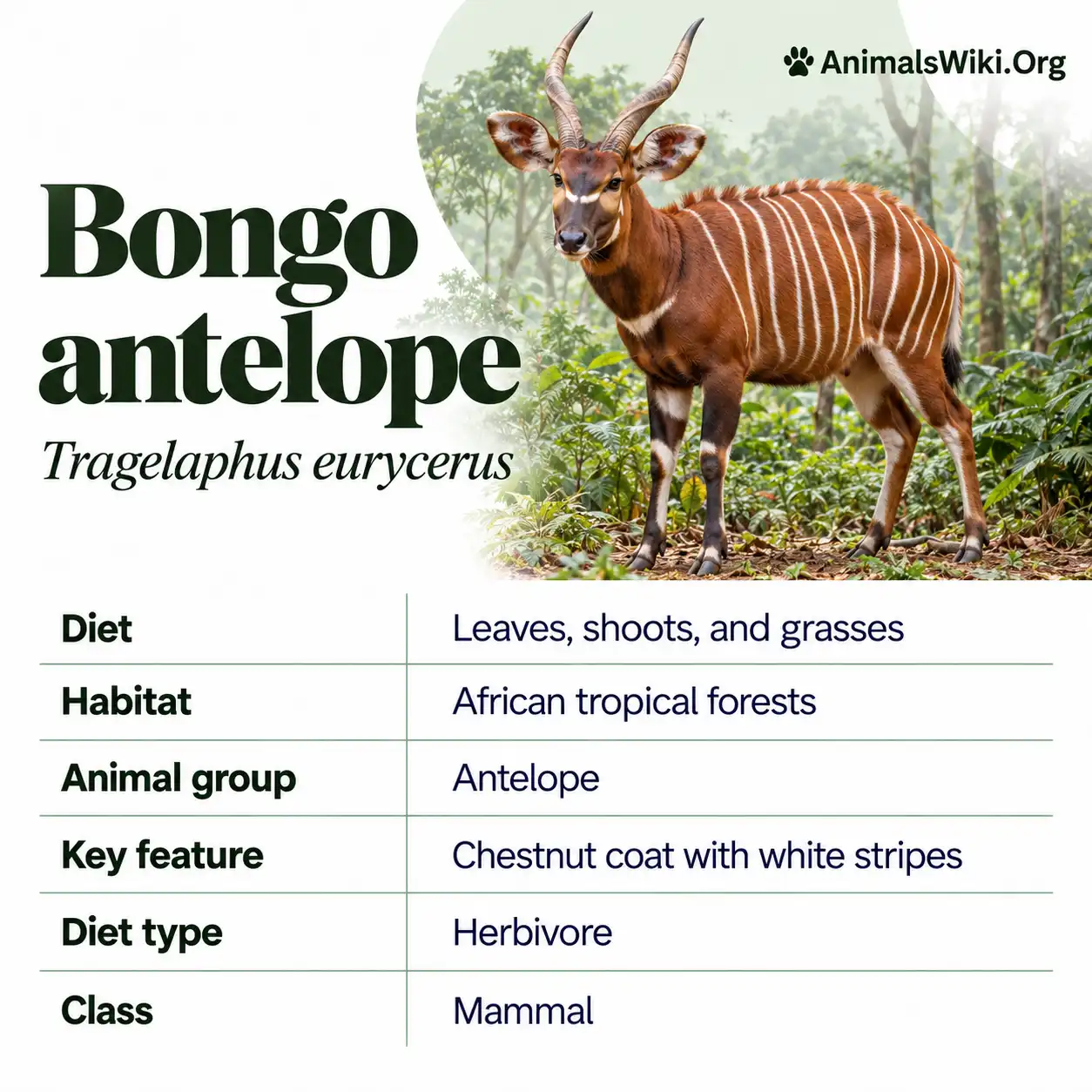
Bongo, The Colorful Giant of Africa’s Tropical Forests
The bongo is one of Africa’s most striking antelopes. With its rich reddish-brown coat, bright vertical stripes, large ears, and elegant spiral horns, this powerful forest mammal looks remarkably colorful against the deep greens and shadows of tropical vegetation. It is also the largest and heaviest forest-dwelling antelope in Africa, making it an impressive inhabitant of the continent’s wooded landscapes.
Bongos are shy, elusive animals that depend on dense vegetation for food and protection. They live mainly in tropical forests and forest-edge habitats in western and central Africa, while the rare eastern or mountain bongo survives in fragmented highland forests in Kenya. Although these forms share the same species name, their conservation situations differ substantially.
One especially interesting bongo fact is that both males and females grow horns. Their horns curve into a spiral, while their bodies are decorated with pale stripes that vary in number and appearance. These antelopes also have large ears that help them detect sounds in thick forest environments.
Bongos are herbivores that browse on leaves, shoots, flowers, vines, and other plant material. They often visit natural mineral licks, where they obtain salts and minerals that may be limited in their regular diet. Their secretive habits, dependence on forest habitat, and vulnerability to hunting make them important animals in African forest conservation.
In this comprehensive guide, you will learn about bongo classification, distribution, habitat, appearance, diet, behavior, reproduction, predators, adaptations, and conservation status, along with fascinating facts and answers to common questions.
Facts About the Bongos
| Fact | Details |
|---|---|
| Common name | Bongo |
| Scientific name | Tragelaphus eurycerus |
| Animal group | Mammal |
| Family | Bovidae |
| Order | Artiodactyla |
| Type | Large forest antelope |
| Native region | Tropical Africa |
| Main habitat | Tropical rainforest, dense woodland, and forest edges |
| Diet | Leaves, shoots, herbs, vines, flowers, bark, and fruit |
| Coat color | Chestnut, reddish-brown, or dark brown |
| Body markings | Usually 10–15 pale vertical stripes |
| Horns | Both sexes have spiral horns |
| Shoulder height | Approximately 1.1–1.3 m |
| Adult weight | Varies by sex and population; large males may exceed 300 kg |
| Social behavior | Females may form groups; adult males are often solitary |
| Activity | Often most active around dusk and nighttime |
| Gestation period | Approximately nine months |
| Typical offspring | One calf |
| Western or lowland bongo status | Near Threatened in the cited assessment |
| Eastern or mountain bongo status | Critically Endangered |
| Main threats | Habitat loss, hunting, snaring, and population fragmentation |
Measurements vary among references and populations. The conservation categories above distinguish the lowland or western bongo from the eastern or mountain bongo; the latter is particularly threatened.
1. What Is a Bongo?
The bongo is a large African antelope belonging to the family Bovidae. Its scientific name is Tragelaphus eurycerus, and it is recognized for its colorful coat, pale stripes, large ears, and spiral horns.
Unlike antelopes that favor open grasslands, bongos are strongly associated with forest environments. They inhabit tropical rainforests, dense woodland, and areas where forests meet more open vegetation. These habitats offer the leaves and shoots they eat as well as cover that helps them avoid predators and human disturbance.
The bongo is particularly well adapted to moving through dense undergrowth. When startled, it may flee into thick vegetation rather than leap over obstacles. Its horns can be held back along its body as it moves through tangled branches, reducing the chance of becoming caught.
Both sexes grow horns, a feature that distinguishes bongos from many other antelopes in which females are usually hornless. The horns generally grow longer and become more robust in males.
Bongos are often difficult to observe in the wild because they are shy and tend to remain concealed in vegetation. They may feed during the night or at low-light times, although activity patterns vary between populations and habitats.
Despite their large size, bongos can be surprisingly elusive. Their striped coats break up the outline of the body in the dappled light of a forest, helping explain why these colorful animals can be difficult to spot.
2. Scientific Classification of the Bongo
The bongo belongs to the family Bovidae, which includes antelopes, cattle, goats, and sheep. It is part of a group of African antelopes known for their robust bodies and spiral-shaped horns.
Taxonomic classification
| Classification | Name |
|---|---|
| Kingdom | Animalia |
| Phylum | Chordata |
| Class | Mammalia |
| Order | Artiodactyla |
| Family | Bovidae |
| Genus | Tragelaphus |
| Species | Tragelaphus eurycerus |
The scientific name Tragelaphus eurycerus is widely used by conservation organizations, zoos, and wildlife references. Two commonly recognized subspecies are the western or lowland bongo, Tragelaphus eurycerus eurycerus, and the eastern or mountain bongo, Tragelaphus eurycerus isaaci.
Why is the bongo classified as an antelope?
Bongos have cloven hooves, horns that are retained throughout life, and a plant-based diet. These traits are consistent with other members of the family Bovidae.
Their large body, striped coat, and forest-dwelling habits make them distinctive among African antelopes, but they share important anatomical features with related species such as nyalas and kudus.
Is the bongo related to cattle?
Yes. Bongos and cattle both belong to the family Bovidae. However, bongos are wild antelopes with specialized adaptations for forest life, while domestic cattle have been shaped by domestication and selective breeding.
Their evolutionary relationship does not mean that bongos are simply wild cattle. They are a distinct species with their own ecological requirements and behavior.
3. Types of Bongo
Wild bongos are commonly divided into two subspecies: the western or lowland bongo and the eastern or mountain bongo. They share many physical characteristics, but their geographic ranges and conservation situations differ significantly.
Western or lowland bongo
The western bongo is associated with lowland forests and forest-edge habitats in western and central Africa. Its range includes parts of the Congo Basin and surrounding tropical forest regions.
It is generally classified as Near Threatened in the cited conservation assessments. Hunting for bushmeat and habitat loss are important concerns in parts of its range.
Eastern or mountain bongo
The eastern bongo, also known as the mountain bongo, is found naturally in isolated highland forests of central Kenya. It is adapted to forested mountain environments and is much rarer than the western form.
The eastern bongo is classified as Critically Endangered. Habitat loss, illegal hunting, population fragmentation, and disease-related concerns have contributed to its precarious situation. A 2025 census reported an estimate of approximately 86 eastern bongos remaining in the wild, underscoring the urgency of conservation work.
How are the two forms different?
| Feature | Western or lowland bongo | Eastern or mountain bongo |
|---|---|---|
| Scientific name | T. e. eurycerus | T. e. isaaci |
| Main range | West and Central Africa | Highland forests of central Kenya |
| Typical habitat | Lowland tropical forest and forest edges | Montane and highland forest |
| Conservation status in cited assessments | Near Threatened | Critically Endangered |
| Main concerns | Hunting, habitat loss, and fragmentation | Very small population, habitat loss, hunting, and disease concerns |
Both forms have reddish coats, pale stripes, and spiral horns in males and females. Their differences are more significant geographically and genetically than a simple comparison of coat color might suggest.
4. Where Do Bongos Live?
Bongos are native to tropical Africa, but their distribution is closely tied to suitable forest habitat.
Western and Central Africa
Western bongos inhabit forest regions across parts of West and Central Africa. Their range includes areas of the Congo Basin and other tropical forest landscapes. They can use dense forest, forest edges, and patches of fresh vegetation where leaves and shoots are plentiful.
Kenya
Eastern bongos survive naturally in isolated highland forests in central Kenya. Their remaining wild populations are associated with forest areas such as the Aberdare Range, Mount Kenya, and the Mau and Eburu forest complexes.
These populations are fragmented, meaning that suitable habitat is separated into distinct patches rather than forming one continuous forest.
Are bongos found throughout Africa?
No. Bongos do not live throughout the entire continent. They depend on suitable forest and woodland habitats and are absent from many arid regions and extensive open grasslands.
Their distribution is therefore more limited than that of some widespread savanna antelopes.
Do bongos live outside Africa?
Bongos are kept in zoos and managed wildlife facilities outside their native range. Some conservation programs also maintain breeding populations under human care to support the survival of the eastern bongo.
A captive population can provide an important safeguard against extinction, but it is not a substitute for preserving the forests that wild bongos need.
5. Bongo Habitat and Environment
Bongos favor dense vegetation that provides food, shelter, and protection. Their habitat is not limited to undisturbed rainforest: they can also use forest edges and areas where new plant growth appears after natural or human-caused disturbance.
Tropical rainforests
Lowland bongos inhabit tropical forests with a wide range of plant species. These forests provide leaves, shoots, vines, fruits, and other foods.
Dense vegetation offers concealment, but it can also make travel challenging. Bongos use established paths and openings where possible and may move carefully through thick undergrowth.
Forest edges and clearings
Forest edges can provide particularly good feeding opportunities because shrubs, herbs, and young plants often grow abundantly where sunlight reaches the ground.
Bongos may also visit clearings where new vegetation has grown following treefalls or other disturbances. These areas can offer nutritious browse that is less accessible beneath a closed forest canopy.
Highland forests
Eastern bongos occupy highland forests in Kenya. These environments contain dense undergrowth and a different mix of plants from the lowland forests inhabited by western bongos.
The eastern bongo’s survival depends on protecting the remaining forest patches and maintaining the ecological conditions that support the population.
Why is dense vegetation important?
Dense vegetation provides several benefits:
-
It offers leaves, shoots, and other plant foods.
-
It conceals bongos from predators and people.
-
It provides shaded areas for resting.
-
It allows females to hide newborn calves.
-
It creates sheltered routes through the forest.
When forests are cleared or fragmented, bongos can lose both their food resources and their protection. Habitat conservation is therefore central to their long-term survival.
6. What Does a Bongo Look Like?
The bongo is one of the most colorful large mammals in African forests. Its body is deep reddish-brown or chestnut, usually marked by a series of pale vertical stripes.
Coat color
Bongos typically have a chestnut, reddish-brown, or dark brown coat. Adult males may become darker with age, while females often retain brighter reddish coloring. The exact shade varies between individuals and populations.
White or yellowish stripes
The bongo’s most recognizable feature is its set of pale vertical stripes running down the sides of the body. Many animals have approximately 10–15 stripes, although the number and prominence can vary.
These stripes break up the outline of the animal in the dappled light of the forest. The markings may also help bongos recognize one another in dense vegetation, where visibility is limited.
Large ears
Bongos have large ears that help them detect sounds in their surroundings. In dense forests, where vegetation can block a clear view, hearing is useful for detecting movement and possible danger.
Facial markings
Their faces can feature pale markings around the muzzle, eyes, and forehead. The exact pattern varies among individuals.
The tail
Bongos have a relatively long tail with a tuft at the end. It can move as the animal walks or reacts to its surroundings.
Spiral horns
Both male and female bongos have horns. The horns are usually lyre-shaped and spiral, sweeping backward from the head. Males tend to have larger, heavier horns, and exceptionally long horns may approach or exceed one meter.
Unlike deer antlers, bongo horns are permanent structures and are not shed each year.
7. Bongo Size and Weight
The bongo is the largest and heaviest forest antelope in Africa. Its muscular body and long legs help it move through dense vegetation, while its horns give it an imposing appearance.
| Measurement | Approximate information |
|---|---|
| Shoulder height | About 1.1–1.3 m |
| Adult male weight | Commonly reported around 240–405 kg |
| Adult female weight | Commonly reported around 210–253 kg |
| Body length | Often around 2–2.5 m, depending on measurement |
| Horn length | Can approach or exceed 1 m in some individuals |
These are broad reference ranges rather than strict limits. Measurements vary by source, sex, and population, so not every bongo will fall within the figures shown.
Why are bongos so large?
Their large size is part of their evolutionary history as forest-dwelling herbivores. A substantial body allows them to process a varied plant diet and provides strength when moving through thick vegetation.
Males are generally heavier than females, although both sexes are large compared with many other forest antelopes.
Are bongos good runners?
Yes. Bongos can move rapidly when frightened. Rather than remaining in an exposed clearing, they often flee into thick cover.
They are also capable jumpers, but in dense undergrowth they may prefer to move beneath or around obstacles rather than leap over them.
Their strategy emphasizes rapid escape into familiar vegetation instead of prolonged running across open ground.
8. Differences Between Male and Female Bongos
Unlike many antelopes in which only males have horns, both male and female bongos grow them. However, adult males usually have larger, thicker horns and a heavier body.
Male bongos
Adult males are usually more muscular and heavier than females. Their coats may become darker with age, and their horns often appear more substantial.
Males commonly live alone or in loose associations rather than remaining permanently with female groups. They may meet other males during social interactions and compete over access to females.
Female bongos
Females are generally lighter in build and often have brighter reddish coats. Their horns are usually thinner and less robust than those of mature males.
Females may form groups and raise calves in forested habitats where concealment is available.
Male and female comparison
| Feature | Male bongo | Female bongo |
|---|---|---|
| Body size | Usually larger and heavier | Generally smaller and lighter |
| Coat color | Often darker with age | Often brighter reddish-brown |
| Horns | Usually thicker and larger | Usually thinner and smaller |
| Social behavior | Often solitary | May live in groups with other females |
| Reproductive role | Competes for mating opportunities | Gives birth and nurses calves |
The fact that both sexes have horns is one of the easiest ways to distinguish bongos from many other antelopes.
9. What Do Bongos Eat?
Bongos are herbivores and primarily browsers. They feed on a variety of plant material, including leaves, young shoots, vines, flowers, herbs, bark, roots, and fruits. They may also graze on grasses when suitable vegetation is available.
Leaves and young shoots
Leaves and shoots are important components of the bongo’s diet. The animals browse on shrubs and trees, selecting plant parts that are accessible and nutritious.
New growth can be especially attractive because young leaves and shoots are often softer and may contain more moisture than mature foliage.
Vines and herbs
Bongos also feed on vines and herbaceous plants. These food sources are common in forest understory and along forest edges, where sunlight supports fresh vegetation.
Flowers and fruits
Flowers and fruits provide additional food when available. The exact diet depends on the plants growing in the local habitat and the season.
Bark, roots, and grasses
Bongos may consume bark, roots, and grasses as part of their varied diet. Seasonal grazing can occur even though browsing is their main feeding strategy.
Do bongos eat meat?
No. Bongos are herbivores and naturally eat plant material rather than hunting other animals.
Do bongos need water?
Yes. Bongos require water, and forest environments can provide access to streams, pools, and other water sources. Their precise drinking patterns depend on local conditions and the moisture content of their food.
They also visit mineral licks, which provide access to salts and minerals that may be limited in ordinary vegetation.
10. Why Do Bongos Visit Salt Licks?
One of the most fascinating bongo facts is their attraction to natural salt and mineral licks. These are places where animals consume mineral-rich soil or water, often to supplement nutrients that are scarce in their usual diet.
What is a mineral lick?
A mineral lick is a natural site where animals obtain salts and minerals from soil, sediment, or mineral-rich water. In tropical forests, these locations may attract many kinds of wildlife.
Bongos may visit mineral licks to obtain sodium and other minerals that help support normal body functions.
Why is sodium important?
Sodium plays important roles in fluid balance, nerve signaling, and muscle function. Herbivores may not obtain enough sodium from all plants, so visiting a mineral-rich location can help supplement their diet.
The mineral composition of licks varies, and animals may select sites based on their particular needs.
When do bongos visit mineral licks?
Bongos are often reported visiting mineral licks during nighttime hours. These sites may also provide opportunities for animals to encounter one another in otherwise dense forest.
Why are mineral licks important to conservation?
Mineral licks can be important wildlife sites, attracting bongos and other forest animals. Protecting these locations and the surrounding forest helps preserve important feeding and social resources.
However, predictable wildlife gathering points can also expose animals to hunters. Effective protection of mineral licks may therefore contribute to broader conservation efforts.
11. Bongo Behavior and Daily Activity
Bongos are shy, alert animals that often avoid open spaces. They use dense vegetation to conceal themselves and can disappear quickly into the forest when startled.
Are bongos nocturnal?
Bongos are often described as nocturnal or crepuscular, meaning they may be most active at night and during twilight around dawn and dusk. Their activity can vary with location, disturbance, and food availability.
Low-light activity may allow them to feed while reducing their exposure to people and some predators. However, it would be inaccurate to claim that every bongo population is active only at night.
How do bongos react to danger?
When startled, a bongo usually attempts to escape into dense vegetation. It may run rapidly through the undergrowth and then stop in a concealed location to assess the situation.
The animal can angle its head so that its horns lie closer to the line of its back, reducing the chance of catching them on branches while fleeing.
Are bongos aggressive?
Bongos are generally shy rather than aggressive toward people. However, they are large, powerful wild animals with substantial horns, and they may defend themselves if cornered or threatened.
Males may also engage in displays or sparring with other males. These interactions are part of their natural social behavior.
Do bongos migrate?
Bongos are not known for the long-distance seasonal migrations seen in some open-country herbivores. They move within forest habitats in response to food, water, social interactions, and local conditions.
The movement of eastern bongos is particularly constrained by the fragmented highland forests in which they survive.
12. Social Structure and Communication
Bongo social behavior differs between males and females. Females may form small groups, sometimes with young animals, while adult males are often solitary. Groups can vary in size and composition according to habitat and local conditions.
Female groups
Female bongos may associate in groups that provide opportunities for social contact and shared vigilance. A group may include calves and younger animals.
These associations are not necessarily permanent. Individuals may separate or join others as they move through the forest.
Male behavior
Adult males commonly spend time alone, particularly outside mating periods. Males may avoid others of similar size and age, reducing the need for repeated confrontations.
When two males meet, they may display their size and horns before deciding whether to withdraw or spar.
How do bongos communicate?
Bongos use vocalizations, body posture, and other signals to communicate. Reported sounds include grunts, snorts, and bleat-like alarm calls. Their large ears help them detect sounds in dense vegetation.
Do bongos mark territory?
Bongos are generally described as relatively nonterritorial compared with some other antelopes. Adult males may use ritualized displays when they meet, but they do not always defend exclusive territories.
This flexible social structure allows individuals to use forest areas where food and shelter are distributed unevenly.
13. Bongo Reproduction and Mating
Bongos reproduce sexually, and females typically give birth to a single calf following a long pregnancy. Their reproductive biology is adapted to life in forest environments, where concealment is especially valuable for newborn animals.
Mating behavior
Males seek out females during mating periods. Encounters between males can involve displays, posturing, and occasional sparring with their horns. These interactions can help establish which animal is dominant without requiring a serious fight every time.
Gestation period
A bongo’s gestation period is approximately nine months, with some references giving a range approaching nine and a half months.
How many calves does a bongo have?
Females usually give birth to one calf at a time. A single newborn is typical, and the calf’s survival depends on the mother’s care and the availability of secure hiding places.
When do bongos reach maturity?
Bongos generally reach sexual maturity at around two to three years of age, although maturation and successful breeding can vary between individuals and populations.
Do bongos breed throughout the year?
Breeding timing can vary by location. Some populations may reproduce throughout the year, while local environmental conditions can influence when calves are born.
The availability of nutritious food and safe habitat can affect the condition of females and the survival of young animals.
14. Bongo Calves and Parental Care
Bongo calves are vulnerable when they are first born, so mothers use concealment to reduce the risk of predation.
Birth and early life
A female generally gives birth in a sheltered location within dense vegetation. After birth, the calf remains hidden while the mother leaves to feed and returns periodically to nurse it.
Why do mothers hide their calves?
A newborn calf is less capable than an adult of escaping predators. Remaining motionless among vegetation can make it difficult to detect.
This strategy is particularly useful in forests, where dense undergrowth provides numerous hiding places.
How quickly do calves grow?
Bongo calves grow rapidly. As they become stronger and more mobile, they gradually spend more time moving with their mothers and may join other young animals.
The timing of these changes varies, but calves can begin accompanying their mothers within the first few weeks in some reported observations.
How long are calves nursed?
Bongo calves nurse for several months. Some zoo and wildlife references report weaning at around six months, although timing may vary.
The mother’s milk supports growth while the calf gradually learns to feed on vegetation.
15. Bongo Lifespan and Survival
A bongo’s lifespan depends on its health, environment, access to food, and exposure to predators and human activity.
How long do bongos live?
Bongos have been recorded living for approximately 19–21 years under human care. Their average lifespan in the wild is less certain because these animals are difficult to observe and monitor in dense forests.
Captive longevity should not be treated as the expected lifespan of a wild bongo. Animals in the wild face different risks, including predation, disease, habitat disturbance, and hunting.
Factors that affect survival
Several factors influence bongo survival:
-
Predation: Leopards and other predators can kill bongos, particularly young or vulnerable individuals.
-
Food availability: Adequate browse and access to mineral resources support health.
-
Habitat quality: Dense forest provides food, cover, and places for calves to hide.
-
Disease: Illness can affect individual animals and, in some circumstances, entire populations.
-
Human activity: Hunting, snaring, logging, and forest clearance can reduce survival.
Why is survival especially difficult for eastern bongos?
Eastern bongos survive in small, fragmented highland populations. A small population is more vulnerable to additional deaths, disease outbreaks, loss of genetic diversity, and environmental changes.
For this subspecies, protecting habitat and carefully managing breeding and reintroduction programs are important components of conservation.
16. Natural Predators of the Bongo
Despite their size, bongos can be prey for large carnivores. Their dense forest habitat offers some protection, but predators can still hunt them, especially when they are young or caught away from cover.
Leopards
Leopards are important predators in many forested areas where bongos live. They can approach quietly through vegetation and ambush prey at close range.
Lions
Lions can threaten bongos in locations where their ranges overlap, although the importance of lions as predators varies by region and habitat.
Hyenas and other carnivores
Hyenas and other large carnivores may prey on bongos or their calves in suitable environments. The predators present depend on the local ecosystem.
Humans
Humans are a major source of risk for bongos. Hunting for meat and trophies, along with accidental capture in snares, can cause direct mortality. Habitat destruction can compound these threats by forcing animals into smaller or more exposed areas.
How do bongos avoid predators?
Bongos rely on several strategies:
-
Staying close to dense vegetation.
-
Using their hearing to detect possible danger.
-
Fleeing rapidly when startled.
-
Moving through undergrowth rather than remaining exposed.
-
Concealing newborn calves in sheltered locations.
-
Adjusting their activity to local conditions.
These behaviors help reduce risk, but they cannot eliminate the threats faced by wild animals.
17. Adaptations That Help Bongos Survive
Bongos possess a combination of physical and behavioral adaptations that help them live in tropical forests.
1. Striped camouflage
Their pale stripes break up the outline of their reddish bodies in the changing light of the forest. This can make it harder to distinguish a stationary bongo from the surrounding vegetation.
2. Large ears
Large ears help bongos detect sounds and monitor their surroundings. Hearing is valuable when thick vegetation limits visibility.
3. Flexible feeding habits
Bongos browse on leaves, shoots, vines, flowers, fruits, and other plant material. Their ability to use different foods helps them respond to seasonal changes in vegetation.
4. Strong legs and rapid escape
Their powerful legs allow them to run quickly when startled. They often escape through dense vegetation rather than crossing large open spaces.
5. Horns that can be held back
Bongos can position their heads so that their horns lie closer to their backs while moving through thick undergrowth. This can reduce the likelihood of their horns catching on branches during flight.
6. Mineral-seeking behavior
Visiting natural mineral licks helps bongos supplement their diet with salts and minerals that may be limited in ordinary vegetation.
7. Concealment of calves
Females leave newborn calves hidden in dense vegetation and return to nurse them. This reduces the amount of time a vulnerable calf spends moving through exposed areas.
Together, these adaptations make bongos well suited to forest life, but they cannot protect them from extensive habitat destruction or unsustainable hunting.
18. Bongo Conservation Status
The conservation status of the bongo depends on which subspecies is being considered. The western or lowland bongo is classified as Near Threatened, while the eastern or mountain bongo is Critically Endangered in the cited assessments.
Western or lowland bongo
Western bongos remain distributed across parts of western and central Africa, but their populations face pressure from hunting and forest loss.
Logging, agricultural expansion, and human settlement can reduce or fragment their habitat. Hunting for bushmeat and trophies also contributes to population decline in some areas.
Eastern or mountain bongo
Eastern bongos face a much more severe conservation crisis. Their remaining wild population is confined to fragmented highland forests in Kenya.
A 2025 census reported an estimated 86 individuals remaining in the wild. This figure is an estimate associated with that census, not a guarantee of the exact number alive today.
The subspecies faces several threats, including habitat loss, illegal hunting, and disease concerns. Its small population also increases its vulnerability to further environmental changes and random events.
What does Critically Endangered mean?
Critically Endangered is a category used by the IUCN for species or subspecies facing an extremely high risk of extinction in the wild. It is a more serious category than Endangered or Vulnerable.
The classification reflects the severity of the threat, not a prediction that extinction is inevitable. Conservation action can improve a population’s prospects if it is effective and sustained.
How can bongos be protected?
Important conservation measures include:
-
Protecting remaining forest habitat.
-
Preventing illegal hunting and reducing snaring.
-
Maintaining connections between suitable forest patches.
-
Monitoring populations and disease risks.
-
Supporting carefully managed captive breeding programs.
-
Improving local involvement in forest conservation.
For eastern bongos in particular, maintaining a viable wild population is an urgent priority.
19. Threats Facing Bongo Populations
Bongos face a combination of threats that can affect their habitat, survival, and ability to reproduce.
Habitat loss and fragmentation
Forest clearance for agriculture, settlements, roads, and commercial activities reduces the area available to bongos.
Fragmentation is especially damaging when large areas of forest are divided into small, isolated patches. This can limit movement and make populations more vulnerable to local disturbances.
Logging
Commercial logging can alter forest structure, remove cover, and create access routes that make previously remote areas easier for hunters to reach.
Although some bongos use fresh growth along disturbed forest edges, extensive or poorly managed logging can destroy the habitat features they depend on.
Hunting and snaring
Bongos are hunted for bushmeat and, in some places, trophies. Snares can kill or injure them, and hunting pressure may be particularly damaging when populations are already small.
For eastern bongos, even a limited number of additional deaths can have serious consequences because so few remain in the wild.
Disease
Disease can affect individual bongos and may pose a serious threat to small or isolated populations. Eastern bongos are related to domestic bovids and can be susceptible to certain livestock-associated diseases. Conservation programs therefore need to consider disease monitoring and appropriate management around livestock and wildlife.
Small population size
A very small population can face problems such as reduced genetic diversity, difficulty finding mates, and increased vulnerability to random events.
For eastern bongos, protecting individual animals is important, but long-term survival also depends on maintaining suitable habitat and supporting a population capable of reproducing successfully.
What conservation organizations are doing
Conservation initiatives include habitat protection, population monitoring, captive breeding, and efforts to establish or strengthen breeding populations for future conservation work. Zoo-based programs can serve as an insurance population, although successful recovery ultimately depends on suitable habitat and effective protection in the wild.
20. The Bongo’s Role in the Ecosystem
Bongos contribute to forest ecosystems through browsing, nutrient cycling, seed movement, and their relationships with predators.
Browsing and vegetation
Bongos consume leaves, shoots, vines, flowers, and other plant material. Their feeding can influence plant growth and the composition of forest-edge vegetation.
The extent of this influence depends on local population density, the available plant species, and the condition of the habitat.
Seed dispersal
When bongos consume fruit, some seeds may be transported and deposited elsewhere in their droppings. This can contribute to seed dispersal, although its importance varies with the fruits they eat and the plants involved.
Nutrient cycling
Like other herbivores, bongos return nutrients to the environment through dung and urine. These materials contribute to nutrient cycling and can support soil organisms and plant growth.
Supporting predators
Bongos are prey for some large carnivores, including leopards and, in suitable areas, lions and hyenas. Their presence contributes to the food web of forest ecosystems.
Why does the bongo matter for forest conservation?
The bongo depends on healthy forests and can serve as an important focus for conserving forest biodiversity. Protecting the habitat required by bongos can also benefit other mammals, birds, plants, and invertebrates that share the same environment.
Their conservation is therefore about more than saving one striking antelope. It also involves maintaining the ecological health of African forest landscapes.
21. Bongo vs. Other African Antelopes
Bongos share some features with other African antelopes, particularly spiral-horned species. However, their colorful coat, forest habitat, and horns in both sexes make them distinctive.
Bongo vs. nyala
| Feature | Bongo | Nyala |
|---|---|---|
| Scientific name | Tragelaphus eurycerus | Tragelaphus angasii |
| Main habitat | Tropical and montane forests | Woodland, thickets, and riverine vegetation |
| Coat | Chestnut or reddish-brown with pale stripes | Males dark gray-brown; females reddish-brown |
| Horns | Both sexes have horns | Normally only males have horns |
| Size | Generally larger and heavier | Medium-sized antelope |
| Conservation concern | Eastern subspecies is Critically Endangered | Least Concern in the cited regional assessment |
The bongo is generally much larger and is especially associated with forest habitats. Its females have horns, unlike female nyalas, which are normally hornless.
Bongo vs. greater kudu
| Feature | Bongo | Greater kudu |
|---|---|---|
| Main habitat | Dense tropical and highland forests | Woodlands, bushveld, and scrub |
| Coat | Reddish-brown with numerous pale stripes | Gray-brown with white vertical stripes |
| Horns | Both sexes have horns | Normally only males have horns |
| General build | Large, heavy forest antelope | Large, long-legged antelope |
| Behavior | Secretive, often associated with forest cover | Often uses more open woodland and scrub |
Both species have spiral horns, but the bongo’s forest adaptation and distinctive coat make it easier to distinguish from the greater kudu.
Bongo vs. sitatunga
| Feature | Bongo | Sitatunga |
|---|---|---|
| Preferred habitat | Forests and forest edges | Swamps, marshes, and wetland vegetation |
| Coat | Reddish-brown with pale stripes | Brown, often with pale markings |
| Horns | Both sexes have horns | Males have horns; females are normally hornless |
| Hooves | Adapted for terrestrial forest movement | Specialized for soft, wet ground |
| Main habitat challenge | Forest cover and hunting pressure | Wetland loss and disturbance |
Both species are secretive and closely associated with dense vegetation. The sitatunga, however, is more specialized for wetland environments.
Bongo vs. eland
| Feature | Bongo | Eland |
|---|---|---|
| Main habitat | Tropical forests and forest edges | Savannas, grasslands, and open woodland |
| Coat | Reddish-brown with pale vertical stripes | Usually tan to gray-brown |
| Horns | Both sexes have spiral horns | Both sexes have horns |
| Lifestyle | Shy and forest-associated | Often uses more open landscapes |
| Body size | Large forest antelope | One of the largest antelopes overall |
The eland can be heavier than a bongo, but the bongo is widely recognized as Africa’s largest forest antelope.
22. Interesting Facts About Bongos
Here are 15 fascinating facts about these colorful forest antelopes.
1. Bongos are the largest forest antelopes in Africa. Their substantial bodies make them impressive inhabitants of tropical forests.
2. Both males and females have horns. This distinguishes them from many antelopes whose females are hornless.
3. Their coats have pale vertical stripes. Many individuals display around 10–15 stripes along their sides.
4. Their coat color can darken with age. Adult males often become darker than females.
5. Bongos have large ears. These help them detect sounds in dense vegetation.
6. They are shy and elusive. Their preference for thick cover makes them difficult to observe in the wild.
7. They are skilled at moving through undergrowth. When fleeing, they can angle their horns back to reduce the chance of catching them on branches.
8. They visit natural mineral licks. These sites provide access to salts and minerals that may be scarce in their normal diet.
9. Their diet is varied. Bongos browse on leaves, shoots, vines, flowers, fruit, and other plant material.
10. Females may form groups. Adult males are often solitary, especially outside mating periods.
11. A bongo pregnancy lasts about nine months. Females generally give birth to one calf.
12. Newborn calves hide in vegetation. Mothers return periodically to nurse their young.
13. There are two commonly recognized subspecies. The western or lowland bongo and eastern or mountain bongo occupy different regions and habitats.
14. Eastern bongos are extremely rare. A 2025 census estimated approximately 86 remaining in the wild.
15. Captive breeding supports conservation. Managed populations can serve as an insurance population while efforts continue to protect wild habitat.
23. Frequently Asked Questions About Bongos
1. What is a bongo?
A bongo is a large forest antelope native to tropical Africa. Its scientific name is Tragelaphus eurycerus, and it is known for its reddish coat, pale stripes, and spiral horns.
2. Where do bongos live?
Bongos live in forest habitats in parts of western, central, and eastern Africa. Western bongos inhabit lowland forests, while eastern bongos are naturally found in highland forests in central Kenya.
3. What is the scientific name of the bongo?
The scientific name is Tragelaphus eurycerus. Two commonly recognized subspecies are the western or lowland bongo and the eastern or mountain bongo.
4. What do bongos eat?
Bongos mainly browse on leaves, shoots, herbs, vines, flowers, and other plant material. They may also eat bark, roots, fruits, and grasses when available.
5. Are bongos herbivores?
Yes. Bongos are herbivores and obtain their food from plants.
6. How big is a bongo?
Bongos stand approximately 1.1–1.3 meters at the shoulder. Adult males can weigh around 240–405 kilograms in published reference ranges, although measurements vary.
7. Do female bongos have horns?
Yes. Both male and female bongos grow horns. Males generally have larger and thicker horns, while female horns are usually more slender.
8. How long are bongo horns?
Bongo horns can approach or exceed one meter in some individuals. Length varies with sex, age, and the individual animal.
9. Why do bongos have white stripes?
The stripes help break up the outline of the body in the dappled light of forests. They may also help individuals recognize one another in dense vegetation.
10. Are bongos nocturnal?
Bongos are often most active at night and around dawn and dusk. Their activity patterns can vary with local conditions, food availability, and disturbance.
11. How long do bongos live?
Bongos have been recorded living approximately 19–21 years under human care. Their lifespan in the wild is less well documented.
12. How long is a bongo’s pregnancy?
Gestation lasts approximately nine months, although some references report a period closer to nine and a half months.
13. How many calves does a bongo have?
A female usually gives birth to one calf at a time. The calf remains concealed in vegetation while the mother returns periodically to nurse it.
14. What are the predators of bongos?
Leopards are among their important natural predators. Lions and hyenas can also pose risks in areas where their ranges overlap. Humans are a major threat through hunting and habitat destruction.
15. Are bongos endangered?
The conservation status depends on the subspecies. Western or lowland bongos are classified as Near Threatened in the cited assessment, while eastern or mountain bongos are Critically Endangered.
16. How many eastern bongos are left in the wild?
A 2025 census reported an estimate of approximately 86 eastern bongos remaining in the wild. This is a census estimate rather than a live count of the population today.
17. Why do bongos visit salt licks?
Mineral licks provide salts and minerals that may be limited in their regular plant diet. Sodium is important for normal fluid balance, nerve function, and muscle activity.
18. Can bongos jump?
Yes. Bongos are capable jumpers, but in thick forest they may prefer to move beneath or around obstacles rather than leap over them.
19. Why do bongos hide their calves?
Newborn calves are vulnerable to predators. Staying hidden in dense vegetation helps reduce their chances of being detected while their mothers leave to feed and return to nurse.
20. What is the difference between a western bongo and an eastern bongo?
Western bongos are associated with lowland forests in western and central Africa. Eastern bongos inhabit isolated highland forests in Kenya and face a much greater risk of extinction.
21. Are bongos related to kudus?
Yes. Both belong to the family Bovidae and are members of the broader group of spiral-horned African antelopes. They differ in their preferred habitats, coat patterns, and other physical characteristics.
22. Do bongos live in herds?
Females may form groups with other females and young animals, while adult males are often solitary. Group size and social arrangements vary with local conditions.
23. Can bongos survive outside forests?
Bongos depend strongly on forest and forest-edge habitats that provide food and cover. They may use clearings or areas of new growth, but extensive open grassland or arid habitat is generally unsuitable.
24. What is the biggest threat to bongos?
Habitat loss and hunting are major threats. Eastern bongos are particularly vulnerable because their remaining wild population is small and fragmented.
25. How can people help protect bongos?
Supporting forest conservation, anti-poaching efforts, habitat restoration, and responsible wildlife management can help. Raising awareness about the eastern bongo’s critical status can also encourage support for conservation programs.
Bongo Antelope (Tragelaphus eurycerus)
The bongo is one of Africa’s most striking forest mammals. Its chestnut coat, pale stripes, large ears, and spiral horns make it distinctive, while its size makes it the largest and heaviest forest antelope on the continent.
Bongos are adapted to life in dense vegetation. They browse on a wide range of plants, visit mineral licks to supplement their diet, and rely on concealment and rapid escape to avoid danger. Females typically give birth to a single calf and hide it in vegetation during its vulnerable early life.
The species’ two commonly recognized subspecies face different conservation situations. Western bongos remain distributed across parts of western and central Africa but face hunting and habitat loss. Eastern bongos, restricted to fragmented highland forests in Kenya, are Critically Endangered and require urgent conservation attention.
Protecting bongos means protecting the forests they depend on. Preserving habitat, reducing hunting, monitoring disease, and supporting well-managed breeding and recovery programs can all contribute to their future.



