
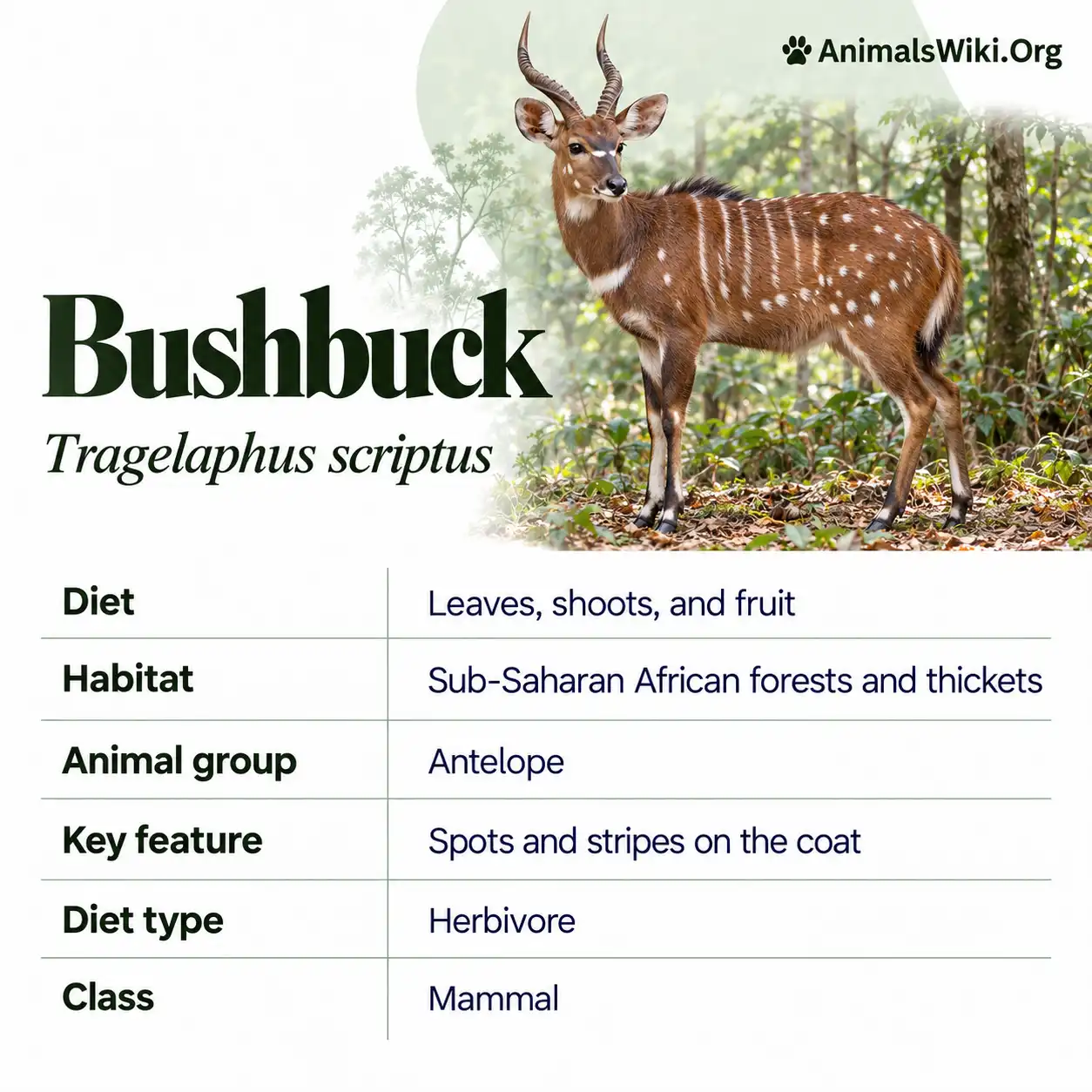
Bushbuck, The Secretive Antelope of Africa’s Woodlands
The bushbuck is a secretive African antelope known for its attractive coat, pale spots and stripes, and remarkable ability to disappear into thick vegetation. It lives across a broad area of sub-Saharan Africa, occupying habitats such as woodland edges, riverbanks, dense shrubland, and forest margins. Although it belongs to the same family as cattle, goats, and other antelopes, the bushbuck has a distinctive appearance and a lifestyle that sets it apart from many larger, herd-forming African mammals.
One of the most interesting bushbuck facts is that these antelopes are generally solitary. Instead of gathering in enormous herds, individual bushbucks often spend much of their time alone within home ranges that may overlap with those of other animals. They rely heavily on dense vegetation for shelter and commonly become more active during the evening, at night, and around dawn.
Bushbucks are also adaptable feeders. They mainly browse on leaves, herbs, shoots, flowers, and twigs, but they may consume grass, fallen fruit, and other plant material when available. Their spotted and striped markings vary considerably between regions, making some populations look quite different from others.
In this comprehensive guide, you will learn about bushbuck classification, distribution, habitat, physical characteristics, diet, behavior, reproduction, predators, adaptations, and conservation. You will also discover how bushbucks differ from nyalas, kudus, and other African antelopes.
Facts About the Bushbuck
| Fact | Details |
|---|---|
| Common name | Bushbuck |
| Scientific name | Tragelaphus scriptus |
| Animal group | Mammal |
| Family | Bovidae |
| Order | Artiodactyla |
| Type | Spiral-horned antelope |
| Native region | Sub-Saharan Africa |
| Preferred habitat | Dense bush, woodland edges, forest margins, and riverine vegetation |
| Diet | Leaves, herbs, shoots, flowers, twigs, and other plant material |
| Adult male weight | Often around 40–80 kg in broad reference ranges |
| Adult female weight | Often around 25–60 kg in broad reference ranges |
| Horns | Normally present only in males |
| Typical horn shape | Short to moderately long, usually with a spiral |
| Activity | Often most active at night, dawn, and dusk |
| Social behavior | Usually solitary |
| Gestation period | About six months |
| Typical offspring | One calf |
| Lifespan | Around 15 years in captivity has been reported |
| Conservation status | Least Concern in the cited global IUCN assessment |
| Main threats | Habitat loss, hunting, and trapping |
| Geographic range | Much of sub-Saharan Africa |
Bushbuck measurements vary between populations. The species shows substantial regional differences in body size, horn shape, and coat markings. The global IUCN assessment dates to 2016, while the Endangered Wildlife Trust’s 2025 regional assessment lists southern bushbuck as Least Concern with a stable regional trend.
1. What Is a Bushbuck?
The bushbuck is a medium-sized antelope native to sub-Saharan Africa. It is a member of the family Bovidae, which includes antelopes, cattle, sheep, and goats. Its scientific name is Tragelaphus scriptus, and it belongs to a group of African antelopes that includes the nyala and kudu relatives.
Bushbucks are especially associated with habitats that provide dense cover. They often live around forest edges, tangled shrubs, riverbanks, and patches of woodland. Unlike many grazing antelopes that spend much of their time in open grassland, bushbucks tend to remain near vegetation that can hide them from predators.
Their appearance varies widely. Many have reddish-brown or light-brown coats decorated with white spots and vertical stripes. Others, particularly in some southern populations, may be much darker and show fewer body markings.
Adult males generally have horns, while females are normally hornless. Males are usually larger and may have darker coats than females, although the degree of difference varies among populations.
Bushbucks are often described as solitary animals, but this does not mean they never associate with one another. Their home ranges can overlap, and small temporary groups may form. Females may also be seen with their young.
Their secretive behavior, adaptable diet, and ability to use varied habitats have helped make the bushbuck one of the most widespread antelope species in Africa.
2. Scientific Classification of the Bushbuck
The bushbuck belongs to the mammalian family Bovidae. Its classification is generally listed under the scientific name Tragelaphus scriptus. However, the taxonomy of bushbuck populations has been debated because animals from different parts of Africa can vary greatly in appearance and genetic history.
Taxonomic classification
| Classification | Name |
|---|---|
| Kingdom | Animalia |
| Phylum | Chordata |
| Class | Mammalia |
| Order | Artiodactyla |
| Family | Bovidae |
| Genus | Tragelaphus |
| Species | Tragelaphus scriptus |
The name Tragelaphus scriptus remains in use by major biodiversity and conservation references. Research published in 2023 examined the genetic and physical differences between major bushbuck lineages and discussed the history of proposed classifications that split populations into multiple species.
Why is bushbuck taxonomy complicated?
Bushbucks occur across a large part of Africa, and their appearance changes geographically. Differences in coat color, white markings, body size, and horns have led researchers to propose various subspecies and alternative species classifications.
Genetic studies have also identified substantial differences between some regional populations. Scientists continue to examine how these differences should be reflected in classification, and not all proposed divisions are universally accepted.
For a general animal facts article, Tragelaphus scriptus is a widely used scientific name. When discussing a particular regional population, it is sensible to identify the location rather than assume every bushbuck looks the same.
3. Where Do Bushbucks Live?
Bushbucks are widely distributed across sub-Saharan Africa. Their range extends through many countries in western, central, eastern, and southern Africa, although they are absent from some very arid regions and extensive areas of closed-canopy forest.
West and Central Africa
Bushbucks occur in many countries of West and Central Africa, where suitable woodland, forest margins, and thick vegetation provide shelter.
In these regions, coat markings can be especially noticeable. Some populations have prominent white spots and stripes, though local variation is considerable.
East Africa
In East Africa, bushbucks occupy suitable habitats in countries including Kenya, Tanzania, Uganda, Rwanda, and Ethiopia. Their distribution is linked to the availability of dense vegetation, watercourses, and other sheltered habitats.
They can occur in different environments and elevations, provided there is enough cover and suitable food.
Southern Africa
Bushbucks are found in parts of southern Africa, including South Africa, Mozambique, Zimbabwe, Zambia, Malawi, Botswana, and Eswatini.
The southern form is often darker than some western and northern populations. In certain areas, adults may have very dark brown coats with relatively few white markings.
Are bushbucks found throughout Africa?
No. Although they are widespread, they are not evenly distributed across the continent. Very dry environments, such as extensive arid and semi-arid landscapes, may not provide the cover they need.
Bushbucks are most successful in places where shrubs, trees, or forest-edge vegetation offer shelter. Their range reflects the distribution of suitable habitats rather than simply the boundaries of countries.
Do bushbucks live near people?
Bushbucks can sometimes survive in landscapes influenced by human activity, including agricultural areas and places near settlements, if sufficient vegetation remains. However, human disturbance, habitat clearance, and hunting can affect their safety and local abundance.
Their ability to use some modified environments should not be interpreted as proof that habitat loss is harmless. Dense cover remains an important part of their ecology.
4. Bushbuck Habitat and Environment
Bushbucks are highly dependent on vegetation that provides shelter. Although they can live in several kinds of African landscape, dense cover is one of the most important features of suitable habitat.
Dense bush and thickets
Thickets are among the most useful habitats for bushbucks. Tangled shrubs and bushes provide places to hide, rest, and feed on leaves and shoots.
When danger approaches, a bushbuck may freeze among the vegetation or retreat quickly into cover. Its coat markings help break up the outline of its body, making it harder to spot in patches of light and shadow.
Forest edges
Bushbucks commonly use the edges of forests, where trees meet more open vegetation. These areas can provide a mixture of shade, browse, and access to clearings.
They generally benefit from having thick vegetation nearby rather than living entirely in exposed grassland.
Riverbanks and streams
Riverbanks often support dense vegetation and a wide range of plant foods. These areas can provide water and shelter while allowing bushbucks to feed near the edge of thicker woodland.
Bushbucks are capable swimmers and may use water to escape danger or cross rivers when necessary.
Woodlands and savannas
Bushbucks can live in wooded savannas and some more open landscapes, provided adequate cover remains. They may feed near the boundary between thickets and grassland, where shrubs and herbs are available.
They generally avoid habitats that lack enough concealment. Extensive dry landscapes and some large areas of closed-canopy forest are naturally unsuitable or support few bushbucks.
Can bushbucks live near farms?
Yes. Some bushbucks use agricultural landscapes where hedges, woodland patches, or riverside vegetation remain. They may also feed on crops, which can lead to conflict with farmers.
However, agricultural development can also remove the cover they depend on. Whether a modified landscape is suitable depends on the availability of shelter, food, and safe movement routes.
5. What Does a Bushbuck Look Like?
The bushbuck has a compact, muscular body, relatively slender legs, large rounded ears, and a short, bushy tail. Its coat ranges from reddish chestnut to dark brown, and its markings vary substantially among populations.
Coat color
Many bushbucks have reddish-brown or light-brown coats, while some males—especially in southern populations—can be very dark brown, almost black. Females are often lighter in color than males, although the difference is not identical in every population.
This variation is an important identification clue. A bushbuck with obvious white stripes may look quite different from a dark southern animal with faint markings.
White spots and stripes
Bushbucks can have white vertical stripes and geometrically shaped spots along the sides of the body. White patches may also occur on the ears, chin, throat, legs, and tail.
The number and visibility of these markings differ geographically. Some animals have strong patterns, while others show only a few pale spots or almost no obvious white markings along their flanks.
The face and ears
The bushbuck has large, rounded ears that help it detect sounds in its surroundings. Some individuals have a pale stripe running down the face toward the muzzle, while others have less conspicuous facial markings.
Its hearing and sense of smell are useful for detecting potential danger in thick vegetation.
The tail
The tail is relatively short and bushy, with a pale underside. When alarmed, a bushbuck may raise its tail as it moves toward cover.
The horns
Only males normally develop horns. Bushbuck horns are relatively short compared with those of larger spiral-horned antelopes. They generally sweep backward and may form a spiral, with ridges along their surface. Reported lengths vary; SANBI gives an average of approximately 26 centimeters, with some reaching around 45 centimeters or more.
The horns grow from the skull and remain throughout the animal’s life rather than being shed annually like the antlers of many deer.
6. Bushbuck Size and Weight
Bushbucks are medium-sized antelopes, but they are generally smaller and more compact than species such as the greater kudu. Adult males are usually larger than females.
| Measurement | Adult males | Adult females |
|---|---|---|
| Typical weight range | About 40–80 kg in broad references | About 25–60 kg in broad references |
| Average weight in one SANBI account | Around 45 kg | Around 30 kg |
| Shoulder height | Often approximately 70–100 cm | Often approximately 65–85 cm |
| Horns | Usually present | Normally absent |
| General build | Heavier and more muscular | Lighter and smaller |
These figures are approximate. The wide geographic range and differences between populations mean that not every bushbuck fits neatly into the same measurements.
Why are males larger?
Differences in body size are associated with the species’ reproductive biology. Males may compete with one another for mating opportunities, and size can contribute to displays of strength and dominance.
Nevertheless, bushbucks do not always engage in direct fighting. Threat displays and avoidance can reduce the need for dangerous physical contests.
How does their size help them survive?
Their compact build and relatively slender legs help them negotiate tangled undergrowth. Bushbucks can move carefully through narrow paths between shrubs and may rely more on concealment and sudden escape than on sustained high-speed running.
Their size does not protect them from large predators. Leopards and other carnivores can hunt bushbucks, particularly when an animal is surprised or caught away from cover.
7. Differences Between Male and Female Bushbucks
Male and female bushbucks share many features, but several physical differences help distinguish them.
Male bushbucks
Adult males are usually heavier and more muscular. They normally have horns that curve backward and form a spiral, although horn shape and length vary among regional populations.
Some males have very dark coats and relatively faint white body markings. Their horns are used in social interactions and can become important during competition over females.
Female bushbucks
Females are generally smaller and do not normally have horns. Their coats are often lighter brown or reddish, although regional color variation can make identification less straightforward.
Females give birth to calves and provide milk and protection during the early stages of their offspring’s lives.
Young males
Young males may begin developing horns at around seven to ten months, according to wildlife reference accounts. Their horns continue growing as they mature, and they do not immediately reach the size of an adult male’s horns.
Male and female bushbuck comparison
| Feature | Male | Female |
|---|---|---|
| Body size | Usually larger | Usually smaller |
| Coat color | Can be dark brown or nearly black in some populations | Often lighter brown or reddish |
| Horns | Usually present | Normally absent |
| Body markings | Variable; may be reduced in some southern populations | Variable; may be prominent |
| Reproductive role | Competes for mating opportunities | Gives birth and nurses calves |
Coat color alone is not always enough to identify sex because bushbucks vary considerably between regions. Horns and body size are often more useful clues when observing mature animals.
8. What Do Bushbucks Eat?
Bushbucks are herbivores and are primarily browsers. Their diet consists mainly of leaves, herbs, shoots, flowers, and twigs. They may also eat fruits, seed pods, roots, and fresh grass when these foods are available.
Leaves and shoots
Leaves and tender shoots make up an important part of the bushbuck’s diet. The animal selects plant material from shrubs, small trees, and other vegetation.
Fresh growth can be particularly valuable because it may contain more moisture and nutrients than older plant material.
Herbs and flowers
Bushbucks feed on a variety of herbs and flowering plants. The availability of these foods depends on the habitat and season.
Their preference for diverse plant foods helps them make use of the vegetation found along woodland edges and in thickets.
Fruit and seed pods
Bushbucks may eat fallen fruits and seed pods when they are available. They have also been observed feeding on plant material dropped by monkeys and baboons, which can create feeding opportunities beneath trees.
Grass
Grass is usually a smaller part of the bushbuck’s diet than browse. However, the animals sometimes eat fresh grass or other low-growing plants, especially when preferred leaves and shoots are scarce.
Do bushbucks eat meat?
No. Bushbucks are herbivores. Their natural diet consists of plant material rather than the flesh of other animals.
Does their diet change with the seasons?
Yes. Rainfall affects the availability of leaves, shoots, herbs, and fruit. When plants produce fresh growth, bushbucks can take advantage of these nutritious foods. During drier periods, they may rely more heavily on the plant species that remain accessible.
This dietary flexibility is one reason bushbucks can occupy a variety of habitats across Africa.
9. How Do Bushbucks Find Food?
Bushbucks are selective feeders. Rather than consuming every plant they encounter, they choose available foods according to their preferences and the condition of the surrounding vegetation.
Feeding along vegetation edges
Bushbucks often feed along the boundary between dense cover and more open areas. These edges can provide access to herbs and shoots while keeping shelter nearby.
The ability to retreat quickly into cover is especially valuable when feeding in places where predators may be present.
Browsing at different heights
Their feeding behavior allows them to take leaves and shoots from a range of plants and heights. They can reach accessible foliage on shrubs and low branches without needing the open grasslands favored by many grazing species.
Nighttime foraging
Bushbucks commonly forage during the evening and night, although they may also be active during daylight. Nighttime feeding can allow them to use more open patches while reducing their exposure to people or some other sources of disturbance.
Finding food in changing conditions
Bushbucks adapt their diet when preferred foods are unavailable. They may consume different leaves, flowers, fruit, or grass depending on local conditions.
Their ability to feed on a variety of plants helps them cope with seasonal changes, but it does not remove their dependence on suitable vegetation. If thick cover and nutritious plants disappear, a habitat may become less suitable.
10. Bushbuck Behavior and Daily Activity
Bushbucks are known for their secretive behavior and preference for remaining near cover. They tend to avoid unnecessary exposure and often rest in dense vegetation during the day.
Are bushbucks nocturnal?
Bushbucks are often most active during the evening, night, and early morning. However, they are not strictly nocturnal in every location. Their activity patterns vary with habitat, disturbance, and local conditions.
Where people frequently disturb them during daylight, bushbucks may become more nocturnal.
Resting during the day
During daylight, bushbucks often shelter in dense bushes or other concealed areas. Remaining still can make them difficult to detect, particularly when their coat color matches the surrounding vegetation.
They may also feed or move during the day when conditions are quiet.
How do bushbucks react to danger?
A bushbuck may freeze when it senses danger. If the threat approaches, it may lie low or dash into nearby vegetation.
When fleeing, bushbucks can produce a loud, hoarse bark. This alarm call may alert other animals to a possible threat.
Are bushbucks fast runners?
Bushbucks can move quickly over short distances, especially when escaping into cover. However, they generally rely on concealment, sudden movement, and knowledge of their habitat rather than long-distance pursuit or sustained high-speed running.
Can bushbucks swim?
Yes. Bushbucks are capable swimmers and can cross water when necessary. Swimming may help them cross rivers or escape a threat.
Their swimming ability is a useful trait, although their usual lifestyle is associated with terrestrial habitats rather than aquatic environments.
11. Social Structure and Communication
Bushbucks are generally less social than many other African antelopes. They are commonly seen alone, although females may associate with their calves and small temporary groups can form. Their social behavior varies with habitat and local conditions.
Do bushbucks live alone?
Often, yes. Individual bushbucks usually spend much of their time within a home range and may avoid unnecessary contact with other adults.
However, solitary behavior does not mean that each animal lives in a completely separate area. Home ranges may overlap, allowing neighboring bushbucks to use some of the same feeding areas and shelter.
Male interactions
Mature males often avoid one another outside periods of competition over females. When rivals meet, they may use body posture, horn displays, and other signals to assess each other.
Direct fighting can occur, but it may be risky because their horns can cause serious injuries. Threat displays and avoidance can sometimes prevent escalation.
How do bushbucks communicate?
Bushbucks use vocalizations, scent, and body language to communicate.
-
Barking: A loud, hoarse bark can signal alarm when a bushbuck detects a possible threat.
-
Snorting: Short, sharp snorts may occur when the animal is startled or disturbed.
-
Scent marking: Chemical signals can communicate information about an individual’s presence and reproductive condition.
-
Courtship sounds: Males may produce grunts and groans during mating displays.
-
Posture: Body position and movements can communicate agitation, alertness, or social intent.
Do other animals respond to bushbuck calls?
Some primates and other wildlife may react to the bushbuck’s alarm bark. In certain environments, monkeys and baboons can benefit from the warning that a predator may be nearby. Bushbucks, in turn, may benefit from the vigilance of animals that spend time in trees.
These interactions illustrate how species living in the same habitat can indirectly influence one another’s behavior.
12. Bushbuck Reproduction and Mating
Bushbucks can breed throughout the year in many areas, although some populations show seasonal peaks in mating or births. Rainfall, food availability, and regional conditions can influence reproductive timing.
How do bushbucks attract mates?
Males use scent and behavioral displays during courtship. They may investigate a female’s scent, approach her carefully, and use body movements to demonstrate their interest.
Displays can include circling, parallel walking, rubbing, and other close interactions. Competition between males may occur when a female is receptive.
Gestation period
The bushbuck’s gestation period is approximately six months, commonly reported at around 180 days. Some references give a broader range, reflecting variation in reported measurements and populations.
How many calves does a bushbuck have?
A female usually gives birth to a single calf. Twins are possible but uncommon.
A newborn calf typically weighs around 4 kilograms, although individual birth weights vary. The calf is relatively well developed and can stand and walk shortly after birth.
When do bushbucks breed?
Bushbucks do not have one universal breeding season across their entire range. In some environments, births are more frequent during or around the rainy season, when fresh vegetation is more available. In other locations, reproduction occurs throughout the year without a pronounced seasonal peak.
When do bushbucks reach sexual maturity?
Females may reach sexual maturity at around 14–19 months, according to wildlife references. Males may become sexually mature earlier than the age at which they regularly reproduce successfully, because social competition can limit their mating opportunities.
13. Bushbuck Calves and Parental Care
Bushbuck calves depend on their mothers for milk, protection, and support during early development. One of the species’ most notable behaviors is the mother’s use of dense vegetation to conceal her newborn.
Birth in concealed vegetation
The female usually gives birth in a sheltered location, such as a thick patch of bush. After birth, she cleans the calf and leaves it concealed while she moves away to feed.
The calf’s stillness and the surrounding vegetation can make it difficult for predators to locate. The mother returns periodically to nurse and groom her young.
Why does the calf stay hidden?
A newborn is small and vulnerable to predators. Staying hidden reduces the chance of being detected and allows the mother to feed without continuously leading the calf through exposed areas.
The strategy does not make the calf completely safe, but it can improve its chances of survival.
How does the mother protect the calf?
The mother returns to nurse the calf and continues to care for it as it grows. Some wildlife accounts describe females consuming the newborn’s dung during visits, which may reduce scent cues around the hiding place. This behavior is reported as part of the bushbuck’s maternal care, although its exact contribution to calf survival is difficult to quantify.
When does the calf follow its mother?
The calf may remain concealed for several months rather than accompanying its mother on every feeding trip. Wildlife references commonly report that it begins accompanying her for longer periods at around four months of age.
As it grows, the calf gradually learns where to find food and shelter and becomes more capable of moving through its habitat.
How long does a young bushbuck depend on its mother?
Maternal care continues as the calf develops. It gradually becomes more independent, although the timing varies between individuals and environmental conditions.
The survival of young bushbucks depends on several factors, including suitable cover, adequate nutrition, and avoiding predators during their vulnerable early months.
14. Bushbuck Lifespan and Survival
Bushbuck lifespan varies with habitat, food availability, health, predation, and human pressure.
How long do bushbucks live?
A lifespan of approximately 15 years in captivity has been reported in wildlife references. SANBI describes wild bushbucks as typically living around 10–12 years, although some individuals may live longer when conditions are favorable.
These figures should be treated as approximate rather than guaranteed lifespans. An individual living in a protected environment may face different risks from one living in a heavily hunted or disturbed landscape.
Factors affecting survival
Several factors influence how long a bushbuck survives:
-
Predation: Leopards and other carnivores can kill bushbucks, particularly animals caught away from cover.
-
Food availability: Nutritious vegetation supports body condition and reproduction.
-
Shelter: Dense vegetation provides hiding places and protection from extreme weather.
-
Disease and injury: Health problems can reduce survival and reproductive success.
-
Human activity: Habitat clearance, hunting, and snaring may affect local populations.
Why is camouflage important?
Bushbucks often respond to danger by remaining still rather than immediately running away. Their coat patterns can help them blend into vegetation, making them harder to see when they are motionless.
If a predator detects them, they may sprint toward thick cover. Combining camouflage with rapid escape gives them more than one way to avoid danger.
15. Natural Predators of the Bushbuck
Bushbucks are prey animals, despite their horns and muscular bodies. They face threats from several large carnivores, with predation risk varying according to location, habitat, and the age of the antelope.
Leopards are frequently identified as important bushbuck predators because they use many of the same wooded and brushy habitats. Lions, hyenas, wild dogs, and crocodiles can also pose risks in areas where their ranges overlap.
Leopards
Leopards are stealthy predators that can hunt in dense vegetation. Their ability to approach quietly makes them particularly dangerous to an antelope that depends on cover for concealment.
A bushbuck may be especially vulnerable when feeding in an exposed area or moving through a narrow path where escape options are limited.
Lions
Lions can prey on bushbucks, although larger ungulates may form a more prominent part of their diet in many habitats.
The risk to bushbucks depends on the number of lions nearby, the availability of other prey, and whether the antelope can retreat into dense vegetation.
Spotted hyenas
Spotted hyenas are versatile predators and scavengers. They can hunt live prey, and bushbucks may be vulnerable when caught in exposed areas or during a pursuit.
African wild dogs
African wild dogs hunt cooperatively and can pursue prey over considerable distances. A bushbuck that becomes separated from cover may have difficulty escaping a coordinated chase.
Crocodiles
Crocodiles can threaten bushbucks when the antelopes approach or cross water in habitats where crocodiles are present. Bushbucks are capable swimmers, but swimming does not make them safe from aquatic predators.
How do bushbucks avoid predators?
Bushbucks use several survival strategies:
-
They stay close to dense vegetation.
-
They freeze when they detect a possible threat.
-
Their coat markings help conceal them in woodland.
-
They retreat quickly into cover if detected.
-
They may bark when alarmed.
-
They can swim across water when necessary.
These behaviors help reduce risk but cannot eliminate it. Predation is a natural part of the ecosystems where bushbucks live.
16. Adaptations That Help Bushbucks Survive
Bushbucks have physical and behavioral adaptations suited to life in thick vegetation.
1. Camouflage
Their reddish-brown, dark-brown, spotted, and striped coats can blend into woodland shadows and patches of vegetation. The degree of camouflage depends on the animal’s color and the environment.
2. Large ears and keen senses
Large, rounded ears help bushbucks detect sounds in their surroundings. Hearing and smell are useful for identifying potential danger when visibility is limited by dense foliage.
3. A flexible plant-based diet
Bushbucks mainly browse, but they can also consume fruit, herbs, flowers, and some grass. This flexibility lets them exploit different food sources when preferred plants are unavailable.
4. Concealment behavior
Freezing in place can make a bushbuck difficult to detect. If remaining still is no longer safe, it can dash toward nearby cover.
5. Ability to navigate undergrowth
Their compact body and relatively slender legs help them move through tangled shrubs and narrow passages. This is particularly valuable when escaping a predator.
6. Swimming ability
Bushbucks are capable swimmers and may cross rivers or use water to escape danger.
Hluhluwe Game Reserve+1
7. Maternal hiding behavior
Females hide newborn calves in dense vegetation and return to nurse them. This reduces the amount of time a young calf spends following its mother through exposed areas.
8. Flexible activity patterns
Bushbucks can change when they feed and move in response to disturbance. In areas with frequent human activity, they may become more active at night and less visible during the day.
Together, these adaptations help bushbucks survive in habitats where predators, changing food supplies, and human disturbance create different challenges.
17. Bushbuck Conservation Status
The bushbuck is listed as Least Concern in the global IUCN Red List assessment published in 2016, which reported a stable population trend at that time. The Endangered Wildlife Trust’s 2025 assessment also lists the southern bushbuck as Least Concern, with a stable regional trend.
These assessments refer to different assessment scopes and dates. They should not be interpreted as proof that every bushbuck population is stable.
Why is the bushbuck classified as Least Concern?
The bushbuck has a broad distribution across sub-Saharan Africa and can survive in a variety of habitats where sufficient vegetation remains. It also occurs in protected areas and landscapes that retain woodland, thickets, and riverine cover.
The 2016 global assessment estimated approximately 1 million to 1.5 million mature individuals, although such estimates carry uncertainty and should not be treated as a current census.
Are bushbuck populations declining?
Some local populations may be affected by habitat destruction, hunting, and trapping, even though the overall species is not currently classified as globally threatened. The South African assessment identifies habitat fragmentation and localized hunting pressure as concerns.
Why does regional variation matter?
Bushbuck populations differ in appearance and may also differ in ecological and genetic characteristics. Research into their classification is ongoing, so conservation assessments of particular regional forms should be interpreted with care.
Protecting the species requires attention to local populations and their habitats, not just a broad global category.
18. Threats Facing Bushbuck Populations
Bushbucks remain widespread, but several factors can harm local populations.
Habitat loss
Clearing woodland and thickets for agriculture, roads, settlements, and other land uses removes the cover bushbucks need.
Even when some vegetation remains, development can fragment habitat into small, isolated patches. This can reduce safe movement between feeding and resting areas.
Hunting and snaring
Bushbucks are hunted in some regions for meat and hides. Snares can injure or kill them, and hunting pressure may cause local declines.
The effects depend on the intensity of hunting, enforcement, and whether populations can sustain the number of animals removed.
Agricultural conflict
Bushbucks may feed on crops or garden plants where agricultural land borders their habitat. This can lead to conflict with farmers or residents.
Protecting remaining vegetation, reducing opportunities for crop damage, and using locally appropriate wildlife management can help limit conflict.
Habitat degradation
Overgrazing by livestock, changes in fire patterns, and the loss of dense vegetation can make habitat less suitable. The impact depends on how these pressures change the structure and availability of plants.
Climate and aridity
Bushbucks are less suited to extensive arid and semi-arid environments. Increasing aridity or the loss of suitable vegetation can contribute to local disappearance from the drier parts of their range.
What can help protect bushbucks?
Conservation measures include:
-
Protecting dense woodland, thickets, and riverbank vegetation.
-
Maintaining connected habitat patches and wildlife corridors.
-
Reducing illegal hunting and trapping.
-
Monitoring populations where local declines are suspected.
-
Managing human-wildlife conflict near farms and settlements.
-
Supporting protected areas and community-based conservation.
Because bushbucks depend heavily on cover, maintaining the structure and quality of vegetation is particularly important.
19. The Bushbuck’s Role in the Ecosystem
Bushbucks contribute to African ecosystems through browsing, seed dispersal, nutrient cycling, and their relationships with predators.
Browsing and vegetation
Bushbucks consume leaves, shoots, flowers, and other plant material. Their feeding can influence plant growth and vegetation structure, particularly where local populations are numerous.
However, the ecological effect depends on habitat conditions and the density of animals. Browsing can influence vegetation without necessarily improving it in every circumstance.
Seed dispersal
When bushbucks eat fruit, some seeds may pass through their digestive systems and be deposited elsewhere in their droppings. This can contribute to seed movement, although the importance of the effect varies with the plants eaten and the habitat.
Nutrient cycling
Bushbucks return nutrients to the environment through dung and urine. These materials become part of the nutrient cycle and can support soil processes and plant growth.
Supporting predators
Bushbucks are prey for several African carnivores. They form part of the food web that links herbivores to predators in woodland and forest-edge habitats.
Relationships with other wildlife
Bushbucks sometimes feed near monkeys and baboons, taking advantage of fruit and leaves dropped from trees. They may also benefit from the alarm behavior of other animals that detect predators.
These interactions demonstrate that bushbucks are connected to many other species, even though they often live alone.
20. Bushbuck vs. Other African Antelopes
Bushbucks can be confused with other antelopes, particularly those with brown coats and pale markings. Comparing their horns, body shape, habitat, and social behavior can help distinguish them.
Bushbuck vs. nyala
Bushbucks and nyalas are related African antelopes, but they differ in appearance and typical behavior.
| Feature | Bushbuck | Nyala |
|---|---|---|
| Scientific name | Tragelaphus scriptus | Tragelaphus angasii |
| General size | Medium-sized, relatively compact | Medium-sized, often heavier in males |
| Male horns | Usually shorter, with a spiral | Generally longer and more prominently spiral-shaped |
| Male coat | Varies from reddish brown to very dark brown | Typically dark gray-brown |
| Female coat | Often lighter brown with variable spots and stripes | Usually chestnut or reddish brown with conspicuous white stripes |
| Social behavior | Often solitary | Females and young may form small groups |
| Main habitat | Dense bush, forest edges, and riverine vegetation | Woodland, thickets, and riverine vegetation |
The nyala generally has a more conspicuous difference between adult male and female coats. Bushbucks show considerable regional variation, and some dark males may have relatively few visible body markings.
Bushbuck vs. greater kudu
| Feature | Bushbuck | Greater kudu |
|---|---|---|
| Body size | Smaller | Larger |
| Male horns | Relatively short | Very long and widely spiraled |
| Coat markings | Spots and stripes vary by population | Distinct white vertical stripes are common |
| Preferred cover | Dense bush and forest edges | Woodlands, bushveld, and scrub |
| Social behavior | Often solitary | Females may form groups; males may form bachelor groups |
The greater kudu is generally much larger and has more impressive horns. Bushbucks are better known for their secretive habits and use of dense vegetation.
Bushbuck vs. sitatunga
The sitatunga is another African antelope associated with dense vegetation, but it is much more specialized for wetland environments.
| Feature | Bushbuck | Sitatunga |
|---|---|---|
| Main habitat | Woodland, thickets, forest margins | Swamps, marshes, and wetland vegetation |
| Feet | Adapted for terrestrial movement | Specialized, elongated and splayed hooves for soft wet ground |
| Coat | Brown with variable white markings | Brown, often with pale markings |
| Male horns | Usually relatively short and spiral-shaped | Longer and more prominently spiraled |
| Lifestyle | Often solitary | Secretive and closely associated with wetlands |
Both species use cover to avoid predators, but the sitatunga’s body and feet are more specialized for wetland living.
Bushbuck vs. impala
| Feature | Bushbuck | Impala |
|---|---|---|
| Habitat | Dense cover and woodland edges | Open savannas and lightly wooded grasslands |
| Male horns | Usually spiral-shaped | Curved, lyre-shaped |
| Female horns | Normally absent | Normally absent |
| Social behavior | Often solitary | Commonly forms herds |
| Feeding | Mainly browsing | Mixed feeding, with substantial grazing in many conditions |
Impala are often seen in larger groups in open landscapes. Bushbucks usually remain closer to dense vegetation and are more difficult to spot.
21. Interesting Facts About Bushbucks
Here are 15 interesting facts about this secretive African antelope.
1. Bushbucks occur across much of sub-Saharan Africa. They occupy a wide range of countries wherever suitable cover is available.
2. They are usually solitary. Unlike many antelopes, bushbucks commonly spend much of their time alone.
3. Only males normally have horns. Their horns curve backward and generally form a spiral.
4. Their coat patterns vary by region. Some bushbucks have conspicuous white stripes and spots, while others are very dark.
5. They are primarily browsers. Leaves, herbs, shoots, and flowers form much of their diet.
6. They sometimes eat fruit. Fallen fruits and seed pods can provide additional food.
7. They are good swimmers. Bushbucks can cross water and may use swimming as a means of escape.
8. They often feed at night. Evening and nighttime activity can reduce exposure to people and other disturbances.
9. They can freeze when alarmed. Remaining still may help them blend into surrounding vegetation.
10. They have a distinctive alarm bark. A loud, hoarse call can signal that a possible threat has been detected.
11. Females hide their newborn calves. The young may remain concealed for several months while the mother returns to nurse.
12. A bushbuck pregnancy lasts about six months. Females generally give birth to a single calf.
13. Leopards are important predators. Their use of wooded habitats brings them into contact with bushbucks.
14. Bushbuck taxonomy has been debated. Researchers have investigated substantial regional differences in appearance and genetics.
15. The species is classified as Least Concern in the cited assessments. This does not mean every local population is free from habitat loss or hunting pressure.
22. Frequently Asked Questions About Bushbucks
1. What is a bushbuck?
A bushbuck is a medium-sized African antelope with the scientific name Tragelaphus scriptus. It is known for its secretive behavior, variable coat markings, and preference for dense vegetation.
2. Where do bushbucks live?
Bushbucks occur across much of sub-Saharan Africa, including parts of West, Central, East, and Southern Africa. They favor habitats with enough vegetation to provide shelter.
3. What is the scientific name of the bushbuck?
The widely used scientific name is Tragelaphus scriptus. Some taxonomic research has examined whether geographically distinct bushbuck populations should be classified differently.
4. What do bushbucks eat?
Bushbucks mainly eat leaves, shoots, herbs, flowers, and twigs. They may also consume fruits, seed pods, roots, and small amounts of grass.
5. Are bushbucks herbivores?
Yes. Bushbucks are herbivores and obtain their food from plants.
6. How big is a bushbuck?
Adult males commonly weigh around 40–80 kilograms in broad reference ranges, while females often weigh around 25–60 kilograms. Actual size varies among populations and individuals.
7. Do female bushbucks have horns?
Female bushbucks normally do not have horns. Adult males generally develop backward-curving horns with a spiral shape.
8. How long are bushbuck horns?
Horn length varies, but SANBI reports an average of about 26 centimeters, with some horns reaching around 45 centimeters or more.
9. Are bushbucks nocturnal?
Bushbucks are often active at night, around dawn, and at dusk. They may also be active during the day, depending on local conditions and disturbance.
10. How long do bushbucks live?
SANBI reports a typical wild lifespan of around 10–12 years, while approximately 15 years in captivity has been recorded in wildlife references. Lifespan varies with individual circumstances.
11. How long is a bushbuck’s pregnancy?
Gestation lasts approximately six months, commonly reported at around 180 days.
12. How many calves does a bushbuck have?
A female usually gives birth to one calf at a time. Twins are possible but uncommon.
13. Why do bushbuck mothers hide their calves?
Newborn calves are vulnerable to predators. Concealment in dense vegetation reduces the chance of detection while the mother goes away to feed and returns to nurse.
14. What are the predators of bushbucks?
Leopards are important predators, and bushbucks can also be hunted by lions, hyenas, wild dogs, and crocodiles where their habitats overlap.
15. Can bushbucks swim?
Yes. Bushbucks are capable swimmers and may cross rivers or use water to escape danger.
16. Are bushbucks dangerous to humans?
Bushbucks generally avoid people and are not usually aggressive. However, any wild animal may react defensively if cornered or threatened. Adult males have sharp horns, so they should be observed from a safe distance.
17. Why do bushbucks have white spots and stripes?
Their markings may help break up the outline of the body against vegetation and shifting light. The patterns also vary geographically and can be useful for identifying different regional populations.
18. Do bushbucks live in herds?
They usually live alone, although females may stay with their young and temporary groups can occur. Their social behavior differs from that of antelopes that regularly form large herds.
19. Are bushbucks endangered?
The global IUCN assessment published in 2016 classified the bushbuck as Least Concern. The Endangered Wildlife Trust’s 2025 assessment also lists southern bushbuck as Least Concern with a stable regional trend. Local populations can still face threats.
20. What is the difference between a bushbuck and a nyala?
Bushbucks are generally more solitary and show greater regional variation in coat markings. Nyalas have particularly strong differences between adult males and females, and mature male nyalas typically have longer horns and a shaggy underside.
21. Are bushbucks related to kudus?
Yes. Bushbucks and kudus belong to the family Bovidae and are part of the broader group of African spiral-horned antelopes. They differ in body size, horn development, and habitat use.
22. Can bushbucks live near farms?
They can live in some agricultural landscapes where sufficient vegetation remains. However, they may feed on crops, and farming can remove or fragment the dense cover they need.
23. Why are bushbucks difficult to see?
They tend to stay in thick vegetation, often move during low-light hours, and may freeze when they sense danger. Their coat color and markings can make them difficult to distinguish from the background.
24. What is the role of a bushbuck in the ecosystem?
Bushbucks influence vegetation through browsing, contribute to nutrient cycling, may disperse some seeds, and provide prey for carnivores.
25. What is the most unusual bushbuck fact?
One particularly interesting feature is the way bushbuck mothers hide their newborn calves in dense vegetation and return periodically to nurse them. This behavior helps reduce the young animal’s exposure to predators during its most vulnerable stage.
Bushbuck (Tragelaphus scriptus)
The bushbuck is a remarkable African antelope whose survival depends on camouflage, careful behavior, and access to dense vegetation. Its coat can range from reddish brown to almost black, and the white markings that decorate many individuals vary considerably across its wide geographic range.
Unlike many antelopes that live in large herds, bushbucks are usually solitary. They browse mainly on leaves, shoots, herbs, flowers, and other plant material, often feeding during the evening or night. When threatened, they may freeze among the bushes, retreat rapidly into cover, or produce a loud alarm bark.
Bushbucks are currently classified as Least Concern in the cited conservation assessments, but habitat destruction, hunting, and trapping can affect individual populations. Protecting thickets, woodland edges, and riverbank vegetation is therefore important for maintaining suitable habitat.
Understanding bushbucks provides a closer look at the diversity of African antelopes and the ecological relationships that sustain woodland environments. These elusive animals may be difficult to spot, but their adaptations and behavior make them an important part of Africa’s wildlife.



