
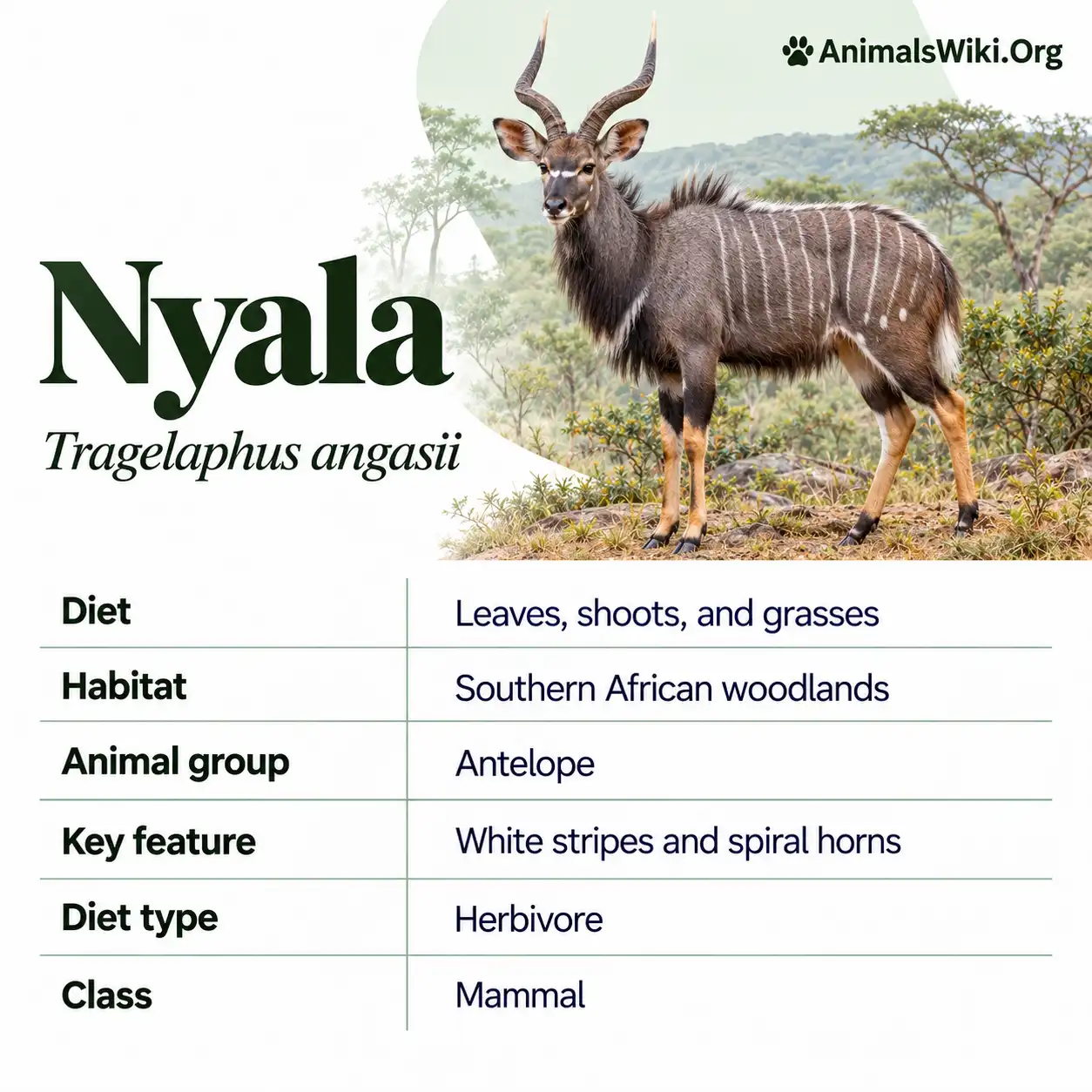
Nyala, The Striking Antelope of African Woodlands
The nyala is a distinctive African antelope known for its beautiful coat, elegant spiral horns, and preference for thick woodland vegetation. Native to southeastern Africa, this shy mammal lives among dense bushes, riverine forests, and wooded savannas, where its coloring helps it blend into the surrounding landscape.
One of the most fascinating things about the nyala is the dramatic difference between adult males and females. Males usually develop dark gray-brown coats, long curved horns, and shaggy hair along their undersides. Females, in contrast, are generally smaller, reddish chestnut in color, and hornless. Young males initially resemble females, making them less conspicuous while they mature.
Nyalas are members of the antelope family and belong to the same broader group of spiral-horned antelopes as kudus and bushbucks. They feed on a mixture of leaves, shoots, fruit, flowers, and grasses, adapting their diet to the vegetation available in different seasons. Although they can be found in protected reserves and on managed wildlife properties, they remain naturally associated with areas offering dense cover and access to water.
In this comprehensive guide, you will discover essential nyala facts, including their scientific classification, physical characteristics, habitat, diet, social behavior, reproduction, predators, ecological importance, and conservation status.
Nyala Facts
| Fact | Details |
|---|---|
| Common name | Nyala |
| Scientific name | Tragelaphus angasii |
| Animal group | Mammal |
| Family | Bovidae |
| Order | Artiodactyla |
| Type | Spiral-horned antelope |
| Native region | Southeastern Africa |
| Preferred habitat | Dense woodland, thickets, and riverine vegetation |
| Diet | Leaves, shoots, fruit, flowers, and grasses |
| Adult male color | Dark gray-brown to slate-gray |
| Adult female color | Reddish or chestnut brown |
| Horns | Usually present only in males |
| Male horn length | Commonly around 60–83 cm |
| Male weight | Often approximately 90–125 kg, depending on the source |
| Female weight | Often approximately 55–68 kg |
| Gestation period | About 220 days |
| Typical offspring | One calf |
| Social behavior | Females and young form small groups; males may be solitary or form temporary groups |
| Conservation status | Least Concern |
| Main threats | Localized habitat loss, hunting, and snaring |
| Typical lifespan | Can reach around 19 years in captivity |
Measurements vary between references, populations, and individuals. The Endangered Wildlife Trust’s 2025 regional assessment classifies the nyala as Least Concern and reports a stable regional population trend.
1. What Is a Nyala?
The nyala is a medium-sized antelope native to parts of southeastern Africa. It is particularly recognizable for its strong sexual dimorphism, meaning that adult males and females have noticeably different physical appearances.
The male is usually larger and darker, with impressive spiral horns and a shaggy coat. The female is smaller, reddish brown, and typically lacks horns. These differences make the two sexes look surprisingly unlike one another, even though they belong to the same species.
Nyalas are generally cautious animals that depend on vegetation for both food and shelter. They often stay close to dense thickets, especially when predators or people are nearby. Their ability to feed on a wide range of plants helps them survive in environments where food availability changes with the seasons.
Unlike highly specialized grazers that spend much of their time feeding on open grasslands, nyalas frequently browse on shrubs and trees. They may also venture into grassy clearings to feed on tender grass when conditions are favorable.
The species is important to wildlife tourism in southern Africa. Its distinctive appearance and relatively secretive behavior make it an interesting animal for visitors exploring suitable woodland reserves.
2. Scientific Classification of the Nyala
The nyala belongs to the family Bovidae, a large group of hoofed mammals that includes antelopes, cattle, goats, and sheep.
Its scientific name is Tragelaphus angasii. The genus Tragelaphus includes several African antelopes with characteristic body markings and, in many species, spiral-shaped horns.
Taxonomic classification
| Classification | Name |
|---|---|
| Kingdom | Animalia |
| Phylum | Chordata |
| Class | Mammalia |
| Order | Artiodactyla |
| Family | Bovidae |
| Genus | Tragelaphus |
| Species | Tragelaphus angasii |
The nyala is a mammal because females give birth to live young and nurse their calves with milk. It is an even-toed ungulate, meaning its weight is supported mainly by two principal toes on each foot.
Its horns and body shape place it among Africa’s familiar antelopes, but the contrast between male and female appearance makes the nyala particularly easy to distinguish from many other species when both sexes are seen together.
The common name should not be confused with the mountain nyala, Tragelaphus buxtoni. Despite the similar name, the mountain nyala is a different species native to the Ethiopian highlands.
3. Where Do Nyalas Live?
Nyalas are native to southeastern Africa, where suitable woodland and thicket habitats provide food, concealment, and access to water. Their natural distribution includes parts of South Africa, Mozambique, Malawi, Eswatini, and Zimbabwe. Their presence and abundance vary across these countries, and nyalas have also been introduced to managed wildlife properties outside parts of their historical range.
South Africa
South Africa is an important stronghold for the species. Nyalas occur in suitable habitats in the country’s northeast and east, including parts of KwaZulu-Natal and the Lowveld region.
Protected areas, game reserves, and privately managed wildlife properties support many animals. Their value for wildlife viewing and conservation management has helped encourage the maintenance and expansion of some populations.
Mozambique
Mozambique forms an important part of the nyala’s natural range. The species is associated with wooded landscapes and thickets, particularly in areas south of the Zambezi River. The amount of suitable habitat and the level of protection vary from one location to another.
Eswatini
Nyalas also occur in Eswatini, where suitable woodland and protected landscapes provide habitat. The country’s population is smaller than the major populations in South Africa, according to regional assessment information.
Malawi and Zimbabwe
Nyalas are also associated with parts of Malawi and Zimbabwe. Local distribution depends on habitat conditions, conservation history, and the availability of suitable vegetation.
Are nyalas found outside Africa?
Yes. Nyalas may be kept in zoos and managed wildlife properties outside their native range. They have also been introduced to some properties within Africa beyond their historical distribution.
However, an animal being present in a country does not necessarily mean it is native there. Distinguishing natural populations from introduced or managed populations is important when discussing the species’ range.
4. Nyala Habitat and Environment
Nyalas prefer environments that combine abundant vegetation with places to hide. They are commonly associated with dense thickets, wooded savannas, dry forests, and riverine woodland. Areas close to water can be especially suitable because they often support a variety of plants throughout the year.
Dense thickets
Thickets are among the most important habitats for nyalas. Thick shrubs and tangled vegetation provide cover from predators and allow these cautious antelopes to move without being easily detected.
When startled, a nyala may quickly disappear into dense vegetation rather than remain exposed in the open. This behavior makes it difficult to observe the species in heavily wooded areas.
Wooded savannas
Wooded savannas combine trees, shrubs, and patches of grassland. This mixed environment provides both browse and grass, allowing nyalas to adjust their feeding behavior as the seasons change.
The tree cover also offers shade during hot weather and provides additional concealment.
Riverine forests
Riverine forests develop alongside rivers and other watercourses. These habitats often contain dense vegetation and a relatively diverse range of plants.
They can provide nyalas with food, shelter, and access to drinking water. During dry periods, river corridors may remain valuable refuges when other parts of the landscape become less productive.
Grasslands and open clearings
Although nyalas are not exclusively grassland animals, they may visit open patches to feed on fresh, short grasses. They generally benefit from having nearby thickets into which they can retreat if threatened.
Open areas can provide good feeding opportunities, but remaining in exposed locations for too long may increase the risk of encountering predators.
How does the environment affect nyala behavior?
The amount of cover in a habitat can influence when and where nyalas feed. In relatively undisturbed environments, they may be seen feeding during daylight hours. Where disturbance or perceived danger is greater, they can become more secretive and restrict their movement in open areas, sometimes using them mainly at night.
A suitable nyala habitat therefore needs more than food alone. A combination of browse, water, shelter, and connected patches of vegetation is important for supporting the species.
5. What Does a Nyala Look Like?
The nyala has a slender but sturdy body, relatively long legs, large ears, and a narrow face. Its coat, markings, and horns vary according to sex and age.
The most noticeable feature is the striking difference between adult males and females. Adult males develop darker coats and horns, while females generally retain a reddish-brown coat and white vertical stripes.
Coat color
Adult male nyalas usually have dark brown, slate-gray, or gray-brown fur. Some males develop a bluish tinge in their coat, while the hair along the underside of the body can appear particularly long and shaggy.
Females are generally chestnut, reddish brown, or rusty in color. Their warmer coloring can help them blend into woodland vegetation and patches of dry grass.
Young males initially resemble females in appearance. As they grow older, their coats gradually become darker and their bodies develop more masculine features.
White stripes and markings
Females and young males usually have multiple pale vertical stripes along their sides. These stripes break up the outline of the body and may help the animal blend into a background of branches, grasses, and shifting patches of light.
Adult males generally lose much of this conspicuous striping as they mature, although some markings may remain.
Nyalas also have white markings on parts of the face and body. A pale chevron between the eyes is a characteristic feature, while additional markings may occur on the throat, flanks, and thighs.
The dorsal crest
Both sexes have a line of longer hair running along the back. This dorsal crest extends from the head toward the rear of the body and is one of the species’ recognizable features.
Males also have longer hair along the chest and underside, giving them a shaggy appearance.
The tail
A nyala’s tail is bushy and has a pale underside. It can be raised or moved during ordinary activity and may be visible when the animal walks away through vegetation.
The horns
Horns are normally present only in male nyalas. They curve upward in a spiral, commonly with one or two twists, and often have yellowish tips. Horn length varies, but reported measurements commonly fall around 60–83 centimeters.
These horns are permanent structures attached to the skull, unlike antlers, which are shed and regrown by many deer species.
6. Nyala Size and Weight
Nyalas are medium-sized antelopes, although adult males can be considerably heavier and taller than females. The difference in body size is another example of sexual dimorphism.
| Measurement | Adult males | Adult females |
|---|---|---|
| Typical weight | Approximately 90–125 kg | Approximately 55–68 kg |
| General appearance | Larger, heavier, and more muscular | Smaller and more lightly built |
| Coat | Dark gray-brown to slate-gray | Chestnut or reddish brown |
| Horns | Usually present | Normally absent |
| Body hair | Often shaggy, especially underneath | Generally shorter and less shaggy |
These figures are approximate rather than strict limits. Published measurements differ among populations and references, and some adult males can exceed the common weight range. The Endangered Wildlife Trust’s assessment reports a male shoulder height of around 106 cm and a female shoulder height of around 92 cm in its life-history information.
Why are males larger than females?
Larger body size can be advantageous to males during competition for access to females. Mature males use posture and displays to communicate their size and condition to rivals.
However, nyalas do not depend exclusively on violent fights to establish dominance. Displays can allow males to assess one another and sometimes avoid the risks of direct combat.
Females have different biological demands, including pregnancy and nursing. Their smaller body size does not make them less adapted to their habitat; it reflects the different pressures that shape the two sexes.
How does size help a nyala survive?
A nyala’s body size allows it to browse on vegetation that may be unavailable to smaller herbivores. Its relatively long legs also help it move through woodland and thickets.
Nevertheless, the species is not too large to be vulnerable to predators. Lions, leopards, African wild dogs, spotted hyenas, and cheetahs are among the predators reported to hunt nyalas, with the level of risk depending on location and circumstances.
7. Differences Between Male and Female Nyalas
The difference between male and female nyalas is so pronounced that someone seeing them separately might initially mistake them for different species.
Male nyalas
Adult males usually have a dark, heavy-looking coat, a shaggy mane-like fringe along the underside, and long spiral horns. They are generally taller and heavier than females.
Their darker coloring becomes more apparent with maturity. Older males may have less visible white striping than females and young animals.
Males use their horns and body displays during social interactions, particularly when assessing dominance or competing for mating opportunities.
Female nyalas
Females are typically smaller and have a reddish-brown or chestnut coat. They are normally hornless and have distinct white stripes along the sides.
Their coloring can help them blend into the dappled light and vegetation of their woodland habitat. Females are also responsible for gestation, giving birth, and nursing calves.
Young males resemble females
One of the most interesting nyala facts is that young males initially look much more like females than adult males. Their coat becomes darker as they mature, and their horns develop over time.
This gradual change may reduce the visibility of young males to dominant adults, although the exact role of coloration in social interactions should not be overstated. The Endangered Wildlife Trust and SANParks both describe the resemblance between young males and females.
Male and female nyala comparison
| Feature | Male | Female |
|---|---|---|
| Body size | Larger | Smaller |
| Coat color | Dark gray-brown or slate-gray | Reddish or chestnut brown |
| Horns | Usually long and spiral-shaped | Normally absent |
| White side stripes | Often reduced with age | Usually prominent |
| Underside hair | Longer and shaggier | Less pronounced |
| Main reproductive role | Competes for mating opportunities | Bears and nurses calves |
These differences make sex identification relatively straightforward when observing mature animals. Young males are more difficult to distinguish from females because their coat coloration and body shape remain similar during early development.
8. What Do Nyalas Eat?
Nyalas are herbivores with a flexible diet that includes leaves, shoots, flowers, fruits, twigs, and grasses. They are commonly described as mixed feeders because they browse on woody plants and also graze when suitable grass is available.
Leaves and shoots
Leaves and tender shoots are important components of the nyala’s diet. The animals browse on shrubs and trees, selecting plant parts that are nutritious and accessible.
Young shoots can be especially useful when plants produce fresh growth after rainfall. Browsing also allows nyalas to find food in habitats where tall grass is sparse or seasonal.
Flowers and fruits
Nyalas eat flowers and fruits when available. These foods can provide energy and variety in their diet, although their availability changes throughout the year.
Fallen fruits may be consumed on the ground, while other plant foods are picked directly from vegetation.
Grasses
Although nyalas are strongly associated with browsing, they also eat grass, particularly when it is fresh, short, and nutritious. After rainfall, young grass may become more abundant and contribute a greater share of their food intake.
This ability to switch between browse and grass helps the species cope with seasonal changes in vegetation.
Twigs and other plant material
Nyalas may consume small twigs and other accessible plant parts, especially when preferred leaves or grasses are less abundant.
The precise mixture of foods depends on habitat, rainfall, season, and local plant communities.
Do nyalas eat meat?
No. Nyalas are herbivores and naturally eat plant material rather than hunting other animals.
They obtain energy and nutrients from vegetation, using their digestive system to process a varied plant-based diet.
Do nyalas need water every day?
Nyalas often drink regularly when water is available. However, regional ecological information indicates that they can survive in some conditions where surface water is unavailable for parts of the year.
Their water requirements depend on environmental conditions, the moisture content of their food, and the availability of drinking sites. Access to water remains an important consideration in suitable habitat management.
9. How Do Nyalas Find Food?
Nyalas use their senses, experience, and knowledge of their surroundings to locate vegetation. They feed selectively rather than consuming every plant they encounter.
Selective browsing
When browsing, a nyala chooses leaves, flowers, and shoots from bushes or trees. Its narrow muzzle helps it pick out individual plant parts from among branches and foliage.
Selective feeding can help the animal obtain nutritious food without needing to consume large quantities of less suitable vegetation.
Seasonal feeding
Food availability changes throughout the year. Rainfall may trigger new growth and create a temporary abundance of green grass, leaves, and shoots. During drier periods, nyalas may rely more heavily on woody browse and other plants that remain available.
This flexibility is important in southeastern African landscapes, where the quality and quantity of vegetation can vary considerably between seasons.
Feeding near cover
Nyalas often feed close to vegetation that provides shelter. A thicket offers more than food: it also provides a place to retreat if a predator appears.
In exposed areas, they may feed cautiously, repeatedly lifting their heads to check their surroundings. Their behavior reflects the need to balance feeding with avoiding danger.
Competition with other herbivores
Nyalas share their habitats with many other plant-eating animals, including impalas, bushbucks, and other antelopes. Some overlap in diet is inevitable, but differences in feeding preferences and habitat use can reduce direct competition.
Because nyalas consume both browse and grass, their feeding habits are relatively flexible. Still, high densities of herbivores in a limited area can affect vegetation, especially when habitat management does not account for the needs of different species.
10. Nyala Behavior and Daily Activity
Nyalas are generally shy, alert animals that often remain near dense cover. They may be active during daylight, but their activity patterns can change in response to disturbance, weather, food availability, and perceived danger.
Are nyalas active during the day or at night?
Nyalas can be active during both daylight and darkness. In suitable, relatively undisturbed areas, they may feed and move around during the day. In locations where they feel vulnerable, they may become more secretive and make greater use of open areas at night.
It is therefore inaccurate to describe every nyala population as strictly nocturnal or strictly diurnal. Local conditions influence when the animals are most visible.
Resting and sheltering
During periods of heat or disturbance, nyalas may rest in shaded areas and dense vegetation. Such places reduce exposure to the sun and help conceal them from predators.
Their preference for cover can make them difficult to spot, even in areas where their population is healthy.
How do nyalas react to danger?
When a nyala senses a threat, it may freeze, watch carefully, and then retreat into thick vegetation. Sudden flight can occur if the danger approaches too closely.
Its coat markings and the irregular shadows of woodland vegetation may make the animal harder to detect. However, camouflage is not a guarantee of safety, and nyalas still rely on vigilance, movement, and suitable shelter to avoid predators.
Do nyalas migrate?
Nyalas are generally considered non-migratory. They tend to use overlapping home ranges rather than undertaking long seasonal migrations like some large herbivores.
Their movements can still change in response to water, food, disturbance, or local environmental conditions. Non-migratory does not mean completely stationary; it means that long-distance seasonal migration is not their usual strategy.
11. Social Structure and Communication
Nyalas have a flexible social structure. Females and their young may form small groups, while males are often solitary or found in temporary groups. These associations can change over time, depending on local conditions and social interactions.
Female groups
A female may be accompanied by her calf or other young animals. Small groups can provide some advantages, including increased opportunities to detect danger.
However, nyalas do not always gather in large, tightly organized herds. Their use of dense vegetation and relatively dispersed feeding resources often favors smaller groupings.
Male behavior
Adult males may spend time alone or associate temporarily with other males. During the breeding season, males can assess one another through displays of body size, posture, and horn development.
A male’s appearance can communicate information about maturity and physical condition without requiring a fight.
Dominance displays
When males encounter potential rivals, they may stand broadside to one another, making their body size and horns more visible. Such displays can help establish which animal is dominant.
Physical fighting can occur, but displays may help reduce the need for dangerous confrontations. The result of these interactions can influence which male gains access to mating opportunities.
How do nyalas communicate?
Nyalas use body posture, movement, scent, and vocal signals as part of their communication. Their behavior can convey alertness, agitation, or social intent.
Scent marking is also relevant to their biology. SANParks reports that glands on the feet leave scent as the animal walks, potentially contributing to chemical communication.
The exact meaning of a particular sound or movement depends on context, and it is best to avoid assuming that every behavior has only one explanation.
12. Nyala Reproduction and Mating
Nyalas can breed throughout the year, although breeding and birth rates may show seasonal peaks in some populations. Reproductive timing is influenced by local environmental conditions and food availability.
When do nyalas breed?
There is no single short breeding season that applies to every nyala population. Regional information describes mating throughout the year, with peaks reported in autumn and spring in some areas.
The timing of births can also vary. The Endangered Wildlife Trust’s assessment reports a major birth peak from August to December and a smaller peak around May in the populations covered by its cited ecological research. These patterns should not be treated as identical across the species’ entire range.
How do males compete for females?
Males may compete through displays of dominance and physical condition. Their horns, body size, and posture are important features during these encounters.
A mature male that establishes dominance may have better opportunities to mate, but the social situation can differ between locations and individuals.
Gestation period
The gestation period of a nyala is approximately 220 days, or a little over seven months. After this period, a female typically gives birth to a single calf. Twins are possible but rare.
How often do nyalas give birth?
Females can reproduce repeatedly when conditions allow. SANParks reports an average interval between births of about 297 days in its species account, although actual intervals depend on the individual and environment.
Successful reproduction requires adequate nutrition, suitable shelter, and survival through the vulnerable early stages of life.
At what age can nyalas reproduce?
Females may reach sexual maturity at approximately 14 months, according to regional assessment information. Male nyalas can develop reproductive capacity earlier than the age at which they typically achieve substantial social breeding success; males may not commonly breed until around five years old.
Biological maturity and actual access to mating opportunities are different things. A young male may be physically capable of reproduction but still be disadvantaged by the presence of older, dominant males.
13. Nyala Calves and Parental Care
Nyala calves begin life in a vulnerable stage, and their survival depends heavily on their mother’s care and the availability of safe habitat.
Birth and early development
Females generally give birth to one calf after a gestation period of about 220 days. Birth usually takes place in sheltered vegetation, where dense cover can help reduce the chance of the newborn being detected by predators.
Newborn calves are much smaller than adults. The regional assessment cites a typical birth weight of roughly 4.2–5.6 kg, although individual measurements can vary.
Why do calves need hiding places?
Young antelopes are vulnerable because they are small, inexperienced, and unable to defend themselves effectively against large predators.
Dense vegetation helps conceal calves while they rest. Remaining hidden can reduce detection, although it does not eliminate the risks posed by predators.
The mother’s role
The mother nurses her calf and provides protection during its early development. Lactation has been reported to continue for around seven months, although the exact duration can vary.
As the calf grows, it gradually becomes more capable of moving around and feeding on vegetation. It continues to benefit from maternal care while developing the skills and physical condition needed for independent survival.
When do young nyalas become independent?
The timing of independence varies according to the calf’s development and local conditions. Young animals gradually spend more time feeding on their own as they mature.
Young males remain especially interesting because they initially resemble females in coat color and pattern. Their adult male appearance develops later, helping explain why age and sex can be difficult to determine from a brief observation.
Why is early survival important?
Even in populations that are stable overall, individual calves face risks from predators, disease, poor nutrition, and environmental conditions. Conservation assessments identify natural mortality among young animals as an important part of nyala population dynamics.
The survival of enough young animals to reach adulthood helps maintain a healthy population over time.
14. Nyala Lifespan and Survival
The lifespan of a nyala depends on its environment, access to food, health, and exposure to predators. Animals living in protected conditions may experience different survival rates from those living in areas with heavy hunting pressure or habitat disturbance.
How long do nyalas live?
Nyalas have been recorded living for approximately 18–19 years in captivity. Their lifespan in the wild can be shorter and is influenced by predation, disease, injuries, and environmental conditions.
It is important to distinguish a recorded maximum from an average lifespan. Not every nyala will reach its late teens, and survival rates differ between populations.
Factors that affect lifespan
Several factors influence how long a nyala survives:
-
Predation: Large carnivores can kill adults and young animals.
-
Food availability: Adequate vegetation helps maintain body condition and supports reproduction.
-
Water and shelter: Access to suitable habitat helps animals cope with changing environmental conditions.
-
Disease and injury: Illness and injuries may reduce survival or reproductive success.
-
Human activities: Hunting, snaring, and habitat disturbance can affect local populations.
Can nyalas survive in captivity?
Yes. Nyalas are maintained in zoos and managed wildlife facilities. Their welfare depends on appropriate nutrition, sufficient space, vegetation or other environmental enrichment, shelter, veterinary care, and opportunities to behave naturally.
Captive lifespan records can provide useful information, but they should not be assumed to represent typical survival in the wild.
15. Natural Predators of the Nyala
Despite their size and horns, nyalas are prey animals. Several large African carnivores can hunt them, and young calves are especially vulnerable.
The Endangered Wildlife Trust identifies lions, leopards, cheetahs, African wild dogs, and spotted hyenas among the nyala’s predators. The importance of each predator varies with local wildlife communities and habitat conditions.
Lions
Lions are powerful predators capable of killing adult nyalas. Their impact depends on the density of lions, the availability of other prey, and the characteristics of the habitat.
A nyala may reduce its exposure by remaining close to dense vegetation, but cover cannot guarantee escape from a determined predator.
Leopards
Leopards are particularly well adapted to hunting in wooded and bushy environments. Their ability to move quietly through vegetation can make them dangerous to animals that rely on cover for protection.
Young nyalas are especially vulnerable, although leopards can also prey on larger individuals.
Cheetahs
Cheetahs are fast predators that typically hunt by pursuing prey across relatively open ground. They are among the predators reported to take nyalas, although the circumstances of such encounters vary.
A nyala’s preference for dense vegetation can offer protection by limiting the space available for a high-speed chase.
African wild dogs
African wild dogs hunt cooperatively, using teamwork and endurance to pursue prey. Their hunting behavior can create risks for antelopes in suitable habitats.
An animal that escapes one predator may still be vulnerable if it becomes separated from cover or is pursued by a coordinated group.
Spotted hyenas
Spotted hyenas are versatile carnivores that can hunt live prey as well as scavenge. They may prey on nyalas, particularly where their ranges overlap.
How do nyalas avoid predators?
Nyalas use several strategies to reduce their risk:
-
Remaining close to dense vegetation.
-
Listening and watching for signs of danger.
-
Retreating rapidly into cover when threatened.
-
Using camouflage to make detection more difficult.
-
Becoming more cautious or changing activity patterns in disturbed areas.
These strategies improve their chances of survival, but they do not make them invulnerable. Predation is a natural part of the ecosystem and helps shape the behavior and population dynamics of prey species.
16. Adaptations That Help Nyalas Survive
Nyalas have several physical and behavioral characteristics that help them live in wooded African environments.
1. Camouflaged coat patterns
The reddish coat and white stripes of females and young males can break up the outline of the body against vegetation and dappled light.
Mature males have darker coats that may blend with shaded woodland and dense thickets.
2. A flexible diet
Nyalas can feed on leaves, shoots, flowers, fruits, and grasses. This dietary flexibility allows them to make use of different food sources as vegetation changes with the seasons.
3. Preference for dense cover
Their tendency to remain near thickets provides shelter from predators and places to rest away from direct sunlight.
When threatened, a nyala may use nearby vegetation to escape rather than attempt to outrun every predator in the open.
4. Sensitive awareness of danger
Nyalas are alert animals that use their senses to monitor their surroundings. Watching, listening, and reacting to movement can provide valuable warning of an approaching predator.
5. Strong legs and hooves
Their legs and hooves help them move through woodland, cross uneven ground, and retreat through dense vegetation. Their mobility is particularly useful when escaping sudden threats.
6. Horns in adult males
The spiral horns of males are used in social interactions and can play a role in contests between rivals. Horns may also provide some defensive capability, but they are not a guarantee against predators.
7. Flexible activity patterns
Nyalas can adjust when they move and feed in response to disturbance. In areas where they feel unsafe, they may limit their activity in exposed locations and use open areas more often at night.
Together, these adaptations help the nyala survive in habitats where food, shelter, and predator risk can vary considerably.
17. Nyala Conservation Status
The nyala is classified as Least Concern in the Endangered Wildlife Trust’s 2025 regional assessment. That assessment describes the regional population trend as stable and reports no change in status compared with 2016.
Least Concern means the species does not currently meet the criteria for a higher threatened category in that assessment. It does not mean every population is secure or that habitat protection is unnecessary.
Why is the nyala not currently considered threatened?
The species occurs across parts of southeastern Africa, and some populations are supported by protected areas and managed wildlife properties.
The Endangered Wildlife Trust reports that nyalas are maintained on private land in South Africa and that some managed populations have increased. However, managed populations and animals introduced outside their historical range must be considered carefully when assessing the conservation condition of naturally occurring populations.
Are nyala populations increasing?
The answer depends on the region and the population being considered. The 2025 regional assessment reports a stable trend, while some privately managed populations have increased.
A stable overall assessment does not establish that every local population is growing. Habitat conditions, land management, and human pressure can produce different outcomes in different areas.
Why is conservation still important?
Nyalas depend on suitable habitat and can be affected by hunting, snaring, and changes to woodland ecosystems. Introduced populations can also create management concerns if they spread into areas where they may compete with native wildlife or affect local vegetation.
Protecting suitable habitat and monitoring local populations remain important, even when a species is not currently classified as threatened.
18. Threats Facing Nyala Populations
Although the nyala is assessed as Least Concern, several factors can affect individual populations and the ecosystems they inhabit.
Habitat loss and fragmentation
Clearing woodland for agriculture, settlements, roads, or other land uses can reduce the amount of suitable habitat available to nyalas.
Fragmentation can also separate groups of animals and limit movement between habitat patches. When suitable cover becomes isolated, populations may become more vulnerable to local environmental changes.
Hunting and snaring
Nyalas may be hunted for meat or trophies. The impact depends on the scale and management of hunting, whether it is legal and regulated, and whether removals remain compatible with population sustainability.
Illegal hunting and snares can cause injury or death and may affect wildlife beyond the intended target species. The Endangered Wildlife Trust documents hunting and trade as part of the species’ use and management context.
Changes in vegetation
Changes in fire patterns, grazing pressure, and land management can alter the balance between woodland, grassland, and thicket. Such changes may affect the availability of food and shelter.
In some landscapes, woody vegetation expands; in others, natural cover may be lost. The consequences for nyalas depend on the type and degree of change.
Poorly managed introductions
Introducing nyalas into areas outside their natural range can create ecological concerns. The regional assessment notes that nyalas can contribute to habitat degradation and may affect bushbuck populations in some areas beyond their natural distribution.
Wildlife introductions therefore require careful evaluation rather than assuming that adding animals automatically benefits biodiversity.
Human disturbance
Frequent disturbance can cause nyalas to alter their activity patterns and avoid certain areas. Roads, settlements, and intense human activity may reduce the usefulness of otherwise suitable habitat.
What can help protect nyalas?
Useful conservation measures include:
-
Protecting natural woodland and thicket habitats.
-
Maintaining connected areas of suitable vegetation.
-
Preventing illegal hunting and reducing snaring.
-
Monitoring local populations and habitat conditions.
-
Managing wildlife introductions responsibly.
-
Supporting well-managed protected areas and conservation programs.
These actions can help maintain healthy nyala populations while supporting the wider biodiversity of southeastern African ecosystems.
19. The Nyala’s Role in the Ecosystem
Nyalas contribute to their environment through feeding, movement, reproduction, and their interactions with predators and other herbivores.
Controlling plant growth
As browsers and mixed feeders, nyalas consume leaves, shoots, flowers, and other plant material. Their feeding can influence the growth and structure of vegetation, although the scale of this effect depends on population density and habitat conditions.
In some managed landscapes, nyalas are considered useful browsers where woody vegetation has become dense. However, excessive browsing can also damage vegetation, so their ecological effects depend on context.
Supporting predators
Nyalas form part of the prey base for several African carnivores. Their presence contributes to the feeding opportunities available to lions, leopards, wild dogs, hyenas, and other predators in habitats where these species overlap.
A functioning ecosystem depends on many interactions between herbivores, carnivores, plants, and environmental conditions.
Contributing to nutrient cycling
Like other herbivores, nyalas return nutrients to the environment through dung and urine. These materials can contribute to soil nutrient cycling and support decomposers and other organisms.
Their movement also redistributes organic material across the areas they use.
Supporting wildlife tourism
Nyalas are attractive animals for wildlife viewing because of their striking appearance and the strong differences between adult males and females.
Responsible wildlife tourism can create economic incentives for protecting natural habitats and maintaining wildlife populations. The benefits depend on appropriate management and on ensuring that tourism does not cause excessive disturbance.
20. Nyala vs. Other African Antelopes
Nyalas are sometimes confused with other antelopes because many species share similar body shapes, coat patterns, and habitats. Comparing their features helps distinguish them.
Nyala vs. greater kudu
Both species belong to the broader group of spiral-horned African antelopes, but they differ in size and appearance.
| Feature | Nyala | Greater kudu |
|---|---|---|
| General size | Medium-sized antelope | Generally larger |
| Male horns | Spiral-shaped, often around 60–83 cm | Very long, widely spiraled horns |
| Female horns | Normally absent | Normally absent |
| Male coat | Dark gray-brown, often shaggy | Gray-brown with conspicuous white body stripes |
| Female coat | Reddish or chestnut | Usually gray-brown to reddish-brown |
| Habitat | Dense thickets and wooded habitats | Woodlands, bushveld, and scrub |
The greater kudu is generally larger and its adult male horns can be particularly impressive. Nyalas are often associated with denser cover and have a distinctive shaggy appearance in mature males.
Nyala vs. bushbuck
Nyalas and bushbucks can be difficult to distinguish at a distance, particularly when viewing females or young animals.
| Feature | Nyala | Bushbuck |
|---|---|---|
| General size | Usually larger | Generally smaller |
| Male horns | Often long, with one or two spiral twists | Usually shorter, with a spiral shape |
| Female coat | Chestnut with white stripes | Highly variable, often reddish or brown with pale markings |
| Habitat | Thickets, wooded savannas, riverine vegetation | Forests, thickets, and dense cover |
| Social behavior | Females may form small groups | Often more solitary or less group-oriented |
Both species use dense vegetation and can be secretive. Their ranges may overlap, and habitat details are useful when identifying an animal.
Nyala vs. impala
The impala is another familiar African antelope, but it differs from the nyala in body shape, social behavior, and horn structure.
| Feature | Nyala | Impala |
|---|---|---|
| Male horns | Spiral-shaped | Curved, lyre-shaped |
| Female horns | Normally absent | Normally absent |
| Male coat | Dark gray-brown | Generally reddish-brown |
| Feeding | Mixed feeder, often browsing | Primarily a grazer-browser |
| Social groups | Often smaller and less tightly organized | Often forms larger herds |
Impala are frequently seen in open savannas, while nyalas are strongly associated with dense woodland and thickets. Both species can adjust their diet according to seasonal conditions.
Nyala vs. mountain nyala
Despite their similar common names, the nyala and mountain nyala are different species.
| Feature | Nyala | Mountain nyala |
|---|---|---|
| Scientific name | Tragelaphus angasii | Tragelaphus buxtoni |
| Native region | Southeastern Africa | Ethiopian highlands |
| Typical habitat | Woodland, thickets, and riverine vegetation | Montane woodland and highland habitats |
| Male horns | Spiral-shaped | Spiral-shaped |
| Conservation context | Least Concern in the EWT’s 2025 regional assessment | A distinct species with a different conservation profile |
The mountain nyala is native to Ethiopia and is not simply a high-altitude population of the ordinary nyala.
21. Interesting Facts About Nyalas
Here are 15 interesting facts that highlight what makes the nyala a distinctive African antelope.
1. Males and females look very different. Adult males are usually dark and horned, while females are reddish brown and normally hornless.
2. Young males resemble females. Their coat becomes darker as they mature, making age and sex identification more difficult in young animals.
3. Nyalas have spiral horns. Mature males develop long, curved horns that can measure more than 80 centimeters.
4. Their habitat includes dense thickets. Thick vegetation provides shelter and helps them avoid predators.
5. They eat more than grass. Their diet includes leaves, flowers, fruit, shoots, twigs, and grasses.
6. They are mixed feeders. Nyalas can browse and graze, allowing them to take advantage of different food sources.
7. They are usually non-migratory. Instead of undertaking long seasonal migrations, they use overlapping home ranges.
8. Females often form small groups. These groups may include young animals, while adult males can spend time alone.
9. Males use displays during competition. Body posture and apparent size can help establish dominance without immediate fighting.
10. Nyalas are not strictly nocturnal. Their activity patterns can shift according to disturbance and local conditions.
11. A nyala pregnancy lasts about 220 days. This is a little over seven months.
12. Females usually give birth to one calf. Twins are possible but rare.
13. Calves benefit from dense cover. Sheltered vegetation helps reduce their visibility to predators.
14. Several large carnivores prey on nyalas. Reported predators include lions, leopards, cheetahs, wild dogs, and spotted hyenas.
15. Their conservation status is Least Concern. The Endangered Wildlife Trust’s 2025 regional assessment reports a stable trend, though local habitat management remains important.
22. Frequently Asked Questions About Nyalas
1. What is a nyala?
A nyala is a medium-sized African antelope with the scientific name Tragelaphus angasii. It is native to southeastern Africa and is known for the striking differences between adult males and females.
2. Where do nyalas live?
Nyalas are native to parts of South Africa, Mozambique, Malawi, Eswatini, and Zimbabwe. They inhabit wooded savannas, dense thickets, dry forests, and riverine vegetation.
3. What is the scientific name of the nyala?
The scientific name is Tragelaphus angasii. It belongs to the family Bovidae, which includes antelopes, cattle, goats, and sheep.
4. What do nyalas eat?
Nyalas eat leaves, shoots, flowers, fruits, twigs, and grasses. Their diet changes with the availability of nutritious vegetation and seasonal rainfall.
5. Are nyalas herbivores?
Yes. Nyalas are herbivores, meaning they obtain their food from plants rather than hunting other animals.
6. How big is a nyala?
Adult males are generally larger than females. Males often weigh approximately 90–125 kilograms, while females commonly weigh around 55–68 kilograms, although measurements vary.
7. Do female nyalas have horns?
Female nyalas normally do not have horns. Long spiral horns are characteristic of adult males.
8. How long are nyala horns?
Male nyala horns commonly measure around 60–83 centimeters, although horn length varies between individuals. The horns curve upward in a spiral and often have yellowish tips.
9. Why do male and female nyalas look different?
The species displays strong sexual dimorphism. Adult males develop larger bodies, dark coats, shaggy hair, and horns, while females remain smaller, reddish brown, and usually hornless.
10. Do young male nyalas have dark coats?
Not initially. Young males resemble females and typically have reddish coats and visible white stripes. Their coloring changes as they mature.
11. How long do nyalas live?
Nyalas have been recorded living approximately 18–19 years in captivity. Wild lifespan varies according to predation, health, food availability, and habitat conditions.
12. How long is a nyala’s pregnancy?
A nyala’s gestation period is approximately 220 days, or slightly more than seven months.
13. How many calves does a nyala have?
A female usually gives birth to one calf at a time. Twins have been recorded but are rare.
14. What are the predators of nyalas?
Predators reported to hunt nyalas include lions, leopards, cheetahs, African wild dogs, and spotted hyenas. The risks vary by location and age of the animal.
15. Are nyalas dangerous to humans?
Nyalas are generally shy and tend to avoid people. However, like any wild animal, they can behave unpredictably if cornered, threatened, or approached too closely. Adult males also have sharp horns, so wildlife should always be observed from a safe distance.
16. Can nyalas swim?
Nyalas may be capable of swimming when necessary, as many hoofed mammals can cross water, but they are not especially known for aquatic behavior. Their main habitat is woodland and thicket rather than water.
17. Are nyalas active at night?
They can be active at night, but they are not strictly nocturnal. Their activity patterns depend on local conditions, including disturbance, food availability, and perceived danger.
18. Do nyalas live in herds?
Females and young may form small groups. Males are often solitary or form temporary groups, so nyalas do not always live in large herds.
19. Are nyalas endangered?
The Endangered Wildlife Trust’s 2025 regional assessment lists the nyala as Least Concern and reports a stable regional population trend. This does not mean that every local population is free from threats.
20. What is the difference between a nyala and a mountain nyala?
The nyala, Tragelaphus angasii, is native to southeastern Africa. The mountain nyala, Tragelaphus buxtoni, is a different species native to the Ethiopian highlands.
21. Are nyalas related to kudus?
Yes. Nyalas and kudus are both members of the family Bovidae and belong to the broader group of African spiral-horned antelopes. They differ in body size, appearance, and habitat use.
22. Can nyalas survive without water?
They can survive in some conditions where surface water is unavailable for parts of the year. However, they often drink when water is accessible, and their water requirements depend on environmental conditions and the moisture content of their food.
23. Why do nyalas hide in bushes?
Dense vegetation provides concealment, shelter, and protection from predators. It also offers access to leaves and shoots that form part of their diet.
24. Do nyalas have a role in their ecosystem?
Yes. They influence vegetation through browsing and grazing, contribute to nutrient cycling, and provide prey for large carnivores. Their presence also supports wildlife tourism in some regions.
25. What is the most unusual fact about nyalas?
One of the most unusual features is the difference between adult males and females. Their contrasting colors, body sizes, and horns make them a particularly striking example of sexual dimorphism among African antelopes.
Nyala (Tragelaphus angasii)
The nyala is one of southeastern Africa’s most distinctive antelopes. Its dark, horned adult males and reddish, striped females make the species immediately recognizable, while its preference for dense woodland and thickets sets it apart from many antelopes associated mainly with open grasslands.
Nyalas survive through a combination of camouflage, alert behavior, sheltered habitat, and a flexible plant-based diet. They browse on leaves, shoots, flowers, and fruits, while also feeding on grass when conditions are favorable. Their social structure is adaptable, with females and young often forming small groups and males sometimes living alone.
Although the nyala is currently assessed as Least Concern in the Endangered Wildlife Trust’s 2025 regional assessment, protecting suitable habitat and managing wildlife populations responsibly remain important. Habitat loss, hunting, snaring, and poorly managed introductions can create problems in particular areas.
Learning about nyalas helps us understand not only this remarkable antelope but also the wider woodland ecosystems of southeastern Africa. Their survival depends on the continued availability of appropriate habitat, healthy vegetation, and effective wildlife management.



