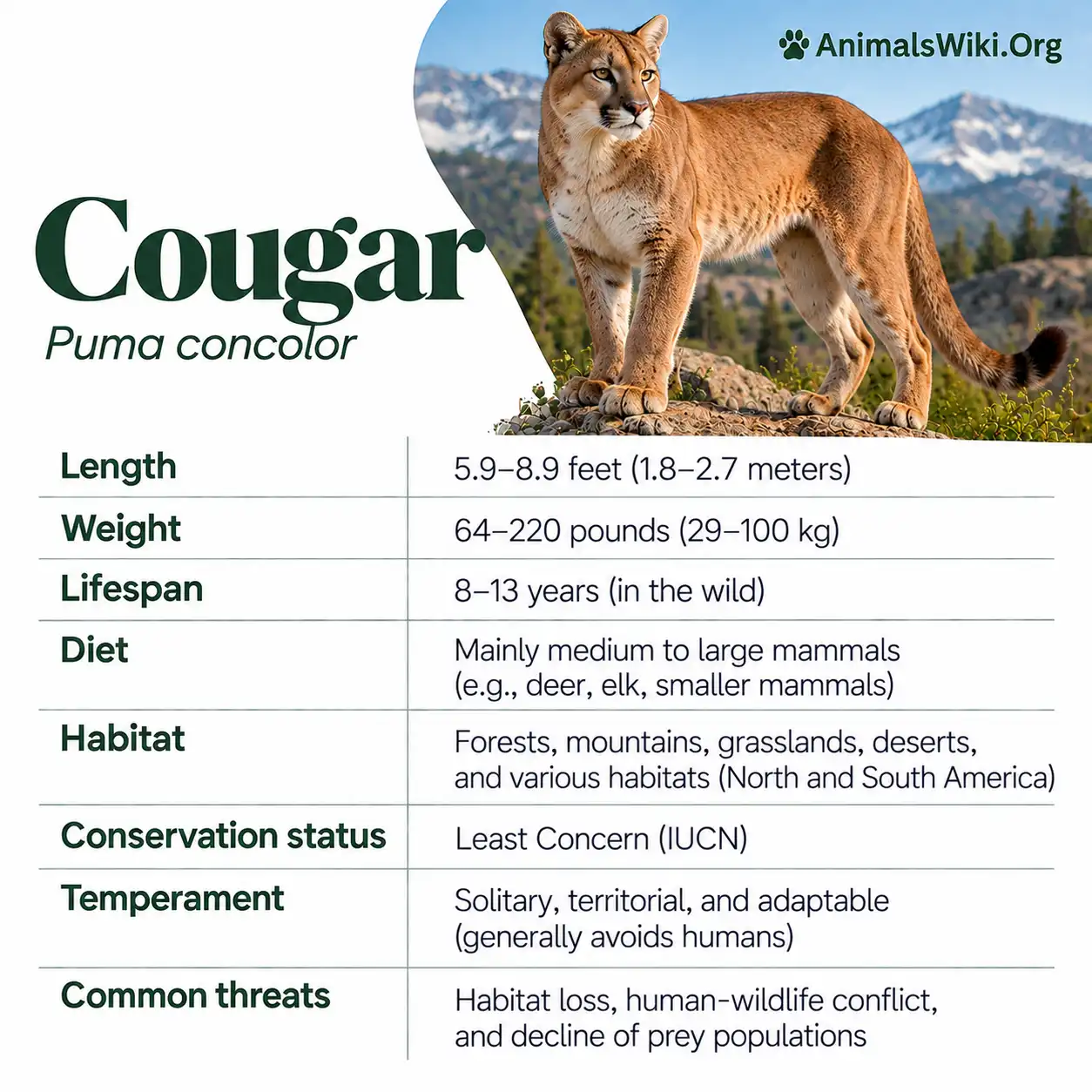
The cougar is one of the most adaptable, powerful, and widely distributed wild cats in the Americas. Known for its muscular body, tawny coat, long tail, exceptional jumping ability, and secretive behavior, this impressive predator can survive in environments ranging from Canadian forests and rugged mountains to deserts, grasslands, wetlands, and tropical landscapes.
Scientifically known as Puma concolor, the cougar is also widely called the mountain lion, puma, panther, catamount, and by several other regional names. Despite the name “mountain lion,” the cougar is not a true lion. It belongs to the genus Puma rather than Panthera, the genus containing lions, tigers, jaguars, and leopards.
One of the most remarkable cougar facts is its enormous geographic range. Cougars occur from parts of western Canada through the United States, Mexico, Central America, and much of South America. This gives the species one of the broadest distributions of any terrestrial mammal in the Western Hemisphere.
Cougars are primarily solitary ambush predators. They use camouflage, patience, powerful hind legs, and short bursts of speed to approach and capture prey. Deer form an important part of their diet in many regions, but cougars are opportunistic carnivores capable of eating animals ranging from small mammals to large ungulates.
Unlike lions and tigers, cougars cannot produce the classic deep roar of Panthera cats. They communicate through growls, hisses, chirps, whistles, and famously intense screams or yowls.
This comprehensive guide explores cougar facts, habitat, diet, size, weight, lifespan, speed, jumping ability, hunting behavior, reproduction, cubs, adaptations, predators, geographic range, conservation, and differences between cougars and other wild cats.
Cougar Facts
| Feature | Information |
|---|---|
| Common Name | Cougar |
| Scientific Name | Puma concolor |
| Other Names | Mountain lion, puma, catamount, panther |
| Kingdom | Animalia |
| Phylum | Chordata |
| Class | Mammalia |
| Order | Carnivora |
| Family | Felidae |
| Genus | Puma |
| Species | Puma concolor |
| Animal Type | Mammal |
| Diet | Carnivore |
| Native Range | North, Central and South America |
| Habitat | Forests, mountains, deserts, grasslands, scrublands and wetlands |
| Lifestyle | Primarily solitary |
| Body Length | Roughly 1–1.5 m (3.3–4.9 ft), excluding tail |
| Tail Length | Commonly about 60–90 cm (24–35 in) |
| Weight | Highly variable; males commonly much heavier than females |
| Top Speed | Approximately 64–80 km/h (40–50 mph) in short bursts |
| Famous Feature | Powerful hind legs and extraordinary jumping ability |
| Hunting Style | Stealth and ambush |
| Main Prey | Deer and other mammals |
| Reproduction | Live birth |
| Young | Kitten or cub |
| Lifespan | Commonly around 8–13 years in the wild |
| Conservation Status | Least Concern globally |
| Main Threats | Habitat fragmentation, conflict with humans, hunting and road mortality |
What Is a Cougar?
A cougar is a large wild cat native to the Americas.
Its scientific name is Puma concolor.
Cougars have slender but muscular bodies, rounded heads, strong jaws, powerful legs, and extremely long tails.
Adult coats are generally plain rather than spotted.
Typical coloration ranges from tawny and sandy brown to grayish or reddish-brown.
The underside is usually paler.
Cougars are extremely adaptable and can survive in an impressive range of environments.
Their combination of stealth, strength, speed, and jumping ability makes them highly effective predators.
Cougar, Puma, or Mountain Lion?
Cougar, puma, and mountain lion generally refer to the same species: Puma concolor.
Different names became common in different regions.
Other names include:
- Catamount
- Painter
- Panther
- Mountain screamer
The large number of common names reflects the cougar’s enormous geographic distribution and long history alongside different human cultures.
For scientific purposes, Puma concolor removes the ambiguity.
Scientific Classification of the Cougar
| Classification | Name |
|---|---|
| Kingdom | Animalia |
| Phylum | Chordata |
| Class | Mammalia |
| Order | Carnivora |
| Family | Felidae |
| Subfamily | Felinae |
| Genus | Puma |
| Species | Puma concolor |
An interesting feature of cougar taxonomy is that this large predator belongs to Felinae, rather than Pantherinae.
It is therefore more closely related within modern cat classification to certain smaller cat lineages than its large body might initially suggest.
What Does a Cougar Look Like?
Adult cougars have relatively uniform coats without the dramatic rosettes of jaguars and leopards or stripes of tigers.
Important physical characteristics include:
- Tawny coat
- Muscular shoulders
- Powerful hind legs
- Rounded head
- Short rounded ears
- Strong jaws
- Large paws
- Retractable claws
- Long heavy tail
- Pale underside
Their long tails are especially noticeable and help distinguish cougars from shorter-tailed wild cats such as bobcats and lynx.
Cougar Size
Cougar body size varies substantially according to sex, geographic region, prey availability, and individual genetics.
Adult males are generally much larger than females.
The head-and-body length of an adult can commonly fall around 1–1.5 meters (3.3–4.9 feet), excluding the tail.
The tail can add another 60–90 centimeters (24–35 inches).
Some exceptionally large males can weigh more than 90 kilograms (200 pounds), although most are considerably lighter.
Northern populations often average larger than cougars from some tropical regions.
Male Cougar vs. Female Cougar
| Feature | Male Cougar | Female Cougar |
|---|---|---|
| Size | Larger | Smaller |
| Weight | Usually substantially heavier | Generally lighter |
| Home Range | Usually larger | Generally smaller |
| Lifestyle | Solitary | Solitary except with young |
| Cub Care | Little direct involvement | Raises kittens |
| Hunting | Independent | Independent and hunts for young |
Both sexes are highly capable predators.
Where Do Cougars Live?
Cougars have an extraordinary geographic range extending through large portions of the Americas.
They occur from parts of western Canada south through the United States and Mexico, across Central America, and through much of South America.
Countries within their range include:
- Canada
- United States
- Mexico
- Belize
- Costa Rica
- Panama
- Colombia
- Venezuela
- Brazil
- Peru
- Bolivia
- Chile
- Argentina
- Several other countries of the Americas
Historically, cougars occupied an even larger portion of North America.
Cougar Habitat
Few large terrestrial predators can occupy as many habitat types as the cougar.
Cougar habitats include:
- Mountain forests
- Temperate forests
- Tropical forests
- Grasslands
- Deserts
- Scrublands
- Wetlands
- Rocky canyons
- Mountain slopes
- Woodland
- Coastal landscapes
Rather than depending on one particular habitat, cougars require sufficient prey, cover, and enough connected territory to move and reproduce.
This ecological flexibility is one of the major reasons for their broad geographic distribution.
Why Are Cougars Called Mountain Lions?
The name mountain lion reflects the animal’s association with mountainous and rugged landscapes.
However, the name can be misleading in two ways.
First, cougars are not true lions.
Second, they do not live exclusively in mountains.
They can occupy forests, deserts, grasslands, wetlands, and numerous other environments.
“Mountain lion” is simply one common name for Puma concolor.
What Do Cougars Eat?
Cougars are obligate carnivores, meaning they depend on animal-based food.
Deer are among their most important prey in many parts of North America.
Depending on region, cougar prey can include:
- Deer
- Elk calves
- Bighorn sheep
- Wild pigs
- Guanacos
- Peccaries
- Capybaras
- Raccoons
- Rabbits
- Hares
- Rodents
- Porcupines
- Other mammals
Cougars can adjust their diets to locally available prey.
This flexibility contributes significantly to their success across different environments.
How Do Cougars Hunt?
Cougars are primarily ambush predators.
Instead of pursuing prey across long distances, they use vegetation, rocks, terrain, darkness, and other forms of cover to approach without being noticed.
A typical hunt involves:
- Locating potential prey.
- Quietly approaching.
- Remaining concealed.
- Closing the distance.
- Launching a sudden attack.
- Using powerful forelimbs and claws to control the prey.
- Delivering a killing bite.
Their powerful hind legs allow explosive acceleration during the final stage of an attack.
Do Cougars Hunt at Night?
Cougars can be active throughout the day and night, but activity often peaks around dawn, dusk, and nighttime.
Their schedule varies according to:
- Prey activity
- Temperature
- Human disturbance
- Habitat
- Season
- Individual behavior
In areas with considerable human activity, cougars may shift more activity toward nighttime.
Their excellent low-light vision makes them effective hunters after sunset.
How Fast Can a Cougar Run?
Cougars can sprint at approximately 64–80 km/h (40–50 mph) over short distances.
They cannot maintain this speed for long.
Their hunting strategy therefore depends on getting close to prey before attacking.
A cougar is slower than a cheetah but combines respectable sprinting speed with considerably greater strength and powerful jumping ability.
How High Can a Cougar Jump?
Cougars are exceptional jumpers.
Their muscular hind legs allow them to make impressive vertical and horizontal leaps.
They can leap approximately 5–6 meters (16–20 feet) horizontally under favorable conditions and are capable of powerful vertical jumps.
Even more impressive is their ability to jump down from considerable heights and remain agile.
Exact maximum distances vary with terrain, individual size, motivation, and how a jump is measured.
Why Can Cougars Jump So Far?
Several anatomical features contribute to cougar jumping ability.
Powerful Hind Legs
Large rear-leg muscles generate explosive force.
Flexible Spine
The spine contributes to stride length and body extension.
Long Tail
The tail helps stabilize the body in midair and during landings.
Strong Paws
Large paws help absorb impact and provide traction.
Athletic Build
A relatively lightweight body compared with lions and tigers improves agility.
These adaptations make jumping one of the cougar’s most impressive abilities.
Why Do Cougars Have Long Tails?
The cougar’s long tail is an important balancing tool.
It helps the animal maintain stability while:
- Running
- Jumping
- Climbing
- Turning sharply
- Moving across rocky terrain
- Pursuing prey
The tail can represent a substantial proportion of the animal’s total length.
Can Cougars Climb Trees?
Yes.
Cougars are capable climbers.
Their powerful legs and sharp retractable claws allow them to climb trees when necessary.
Young cougars may use trees to avoid threats, while adults can climb to escape danger or investigate their surroundings.
However, cougars are predominantly terrestrial predators rather than specialized tree climbers like some smaller cats.
Can Cougars Swim?
Yes.
Cougars are capable swimmers and can cross rivers and other bodies of water.
Swimming is not as famous a part of cougar behavior as it is for jaguars and tigers, but water does not create an absolute barrier to their movement.
Are Cougars Solitary?
Yes.
Adult cougars are primarily solitary animals.
They generally travel and hunt alone.
Individuals maintain home ranges that can overlap to varying degrees.
Male home ranges are usually larger and may overlap the ranges of several females.
Females become temporarily social while raising kittens.
Cougar Territory
Cougars can occupy extremely large home ranges.
The amount of space required depends on:
- Prey density
- Habitat quality
- Sex
- Population density
- Terrain
- Human development
Males generally require more territory than females.
Habitat connectivity is therefore essential.
Roads, cities, fences, agricultural development, and other barriers can isolate cougar populations and make dispersal more dangerous.
How Do Cougars Communicate?
Cougars communicate through scent, physical markings, vocalizations, and body language.
They may leave:
- Urine marks
- Feces
- Scrapes
- Scent deposits
- Claw marks
Cougars also produce several sounds, including:
- Growls
- Hisses
- Chirps
- Whistles
- Yowls
- Screams
These sounds can serve different purposes during mating, conflict, communication between mothers and kittens, or encounters with other cougars.
Why Do Cougars Scream?
One of the cougar’s most famous sounds is a loud scream or yowl.
Female cougars may produce intense vocalizations during reproductive periods.
Other vocalizations can occur during territorial encounters or communication.
The sound can travel through forests and mountainous terrain and may be startling to people who hear it unexpectedly.
Despite their intimidating vocalizations, cougars generally prefer avoiding humans.
Can Cougars Roar?
No.
Cougars cannot produce the classic full roar associated with lions, tigers, jaguars, and leopards.
Those animals belong to the subfamily Pantherinae.
Cougars belong to Felinae.
Instead, cougars can produce sounds including purrs, growls, hisses, chirps, whistles, and screams.
Can Cougars Purr?
Yes.
Cougars can produce purring sounds.
This is another characteristic that distinguishes them from the classic roaring cats.
Mothers and kittens can also use softer vocalizations to communicate with one another.
Cougar Reproduction
Cougars can breed at different times of year depending on location and environmental conditions.
After mating, the female undergoes a gestation period of approximately three months.
She gives birth in a protected den or secluded location.
Potential den sites include:
- Rock shelters
- Dense vegetation
- Caves
- Fallen timber
- Hidden areas among cliffs
The female raises the young without routine assistance from the male.
Cougar Cubs or Kittens
Young cougars are commonly called kittens or cubs.
A litter frequently contains around two to four kittens, although litter size varies.
Unlike adults, cougar kittens are born with visible spots.
These markings gradually fade as they mature.
Young kittens are dependent on their mother for food, warmth, protection, and education.
Why Do Cougar Kittens Have Spots?
Cougar kittens have dark spots on their coats, even though adults are usually plain tawny.
The markings provide additional camouflage when kittens are small and vulnerable.
Their tails may also show darker rings.
As the young cougar matures, these juvenile patterns gradually disappear.
Eventually, the animal develops the relatively uniform adult coat.
How Do Cougar Cubs Learn to Hunt?
Young cougars learn hunting skills gradually.
Play develops:
- Coordination
- Strength
- Stalking
- Pouncing
- Balance
- Reaction speed
As they become older, they follow their mother and observe her hunting behavior.
Eventually, she introduces them to increasingly realistic hunting opportunities.
Young cougars must learn how to locate prey, approach silently, attack effectively, and avoid injury.
How Long Do Cougar Cubs Stay With Their Mother?
Young cougars commonly remain with their mother for approximately 12–24 months, although independence varies.
During this period, they learn essential survival skills.
Eventually, juveniles disperse in search of territories of their own.
Young males often travel particularly long distances.
Dispersal can expose them to roads, cities, established adult cougars, and other hazards.
Cougar Lifespan
Wild cougars commonly live around 8–13 years, although some survive longer.
Factors influencing lifespan include:
- Food availability
- Hunting
- Territorial conflict
- Disease
- Injuries
- Road collisions
- Habitat conditions
- Human conflict
Under professional managed care, cougars can live 20 years or longer in some cases.
Cougar Adaptations
Cougars possess numerous adaptations that make them successful predators.
Tawny Camouflage
Their coat blends with dry vegetation, rocks, forest floors, and shadows.
Powerful Hind Legs
Strong rear limbs support jumping and explosive attacks.
Retractable Claws
Sharp claws help grip prey and provide traction.
Long Tail
The tail improves balance during running and jumping.
Excellent Low-Light Vision
Cougars can hunt effectively under dim conditions.
Sensitive Hearing
Strong hearing helps detect prey.
Flexible Spine
The spine improves running and jumping performance.
Broad Diet
Dietary flexibility allows cougars to survive on different prey.
Habitat Adaptability
They can live in an extraordinary range of environments.
These characteristics help explain why cougars have such an extensive geographic distribution.
Cougar vs. Mountain Lion
There is no species difference between a cougar and a mountain lion.
Both names refer to Puma concolor.
“Cougar” is widely used in many areas, while “mountain lion” is especially familiar in North America.
The animal may also be called a puma or catamount.
Cougar vs. Puma
Cougar and puma are also two common names for exactly the same species.
Scientific classification:
Puma concolor
The word “puma” is especially common in Latin America and international scientific or wildlife contexts.
Cougar vs. Panther
The word panther can create confusion.
In some parts of the United States, “panther” is used as a regional name for cougars.
For example, the Florida panther is a cougar population.
However, “black panther” usually refers to a melanistic leopard or jaguar rather than a cougar.
Context therefore matters.
Cougar vs. Jaguar
| Feature | Cougar | Jaguar |
|---|---|---|
| Scientific Name | Puma concolor | Panthera onca |
| Range | Americas | Americas |
| Coat | Mostly plain tawny | Rosettes |
| Build | Athletic and relatively slender | Stocky and muscular |
| Genus | Puma | Panthera |
| Roar | No | Yes |
| Purr | Yes | Different vocal anatomy |
| Main Strength | Jumping, agility and adaptability | Powerful bite and strength |
| Water Association | Capable swimmer | Strongly associated with water in many habitats |
The two species overlap in parts of Central and South America.
Cougar vs. Leopard
Cougars and leopards live on different continents.
Cougars are native to the Americas.
Leopards are native to Africa and Asia.
Adult cougars have plain tawny coats, while leopards have dark rosettes.
Leopards belong to Panthera and can produce roaring-type vocalizations, whereas cougars belong to Puma and cannot roar like a leopard.
Both are solitary ambush predators with excellent climbing ability.
Cougar vs. Cheetah
| Feature | Cougar | Cheetah |
|---|---|---|
| Scientific Name | Puma concolor | Acinonyx jubatus |
| Main Range | Americas | Primarily Africa |
| Coat | Plain tawny | Solid black spots |
| Body | Muscular | Lightweight and slender |
| Hunting | Ambush | High-speed pursuit |
| Maximum Speed | Fast | Much faster |
| Jumping | Exceptional | Athletic but speed-specialized |
| Claws | Retractable | Less fully retractable |
| Facial Tear Marks | No | Yes |
A cheetah is built primarily for extreme speed, while a cougar combines power, agility, jumping ability, and adaptability.
Cougar vs. Lion
Despite the name “mountain lion,” cougars and lions are very different cats.
Lions are much larger.
They belong to Panthera leo and frequently live socially in prides.
Cougars are Puma concolor and are primarily solitary.
Male lions typically have manes, while male and female cougars share a similar tawny appearance.
Lions can roar; cougars cannot produce the same type of roar.
Cougar vs. Tiger
Tigers are substantially larger and heavier than cougars.
Tigers have striped coats and belong to Panthera.
Cougars have mostly plain coats and belong to Puma.
Both species are solitary ambush predators, but they occupy different continents.
Tigers are native to Asia, while cougars are native to the Americas.
Cougar vs. Bobcat
Cougars are substantially larger than bobcats.
The easiest visual difference is the tail.
A cougar has a very long tail.
A bobcat has the characteristic short “bobbed” tail that inspired its name.
Bobcats also frequently have spotted or streaked coats and prominent facial fur.
Cougar vs. Lynx
Lynx species have relatively short tails, long legs, large paws, and prominent ear tufts.
Cougars have long tails and lack the exaggerated ear tufts associated with lynx.
Adult cougars are also considerably larger than most lynx species.
Florida Panther
The Florida panther is not a separate type of black panther.
It is a cougar population occurring in Florida.
Scientifically, it belongs to Puma concolor.
The Florida population became extremely small because of habitat loss, persecution, road mortality, and isolation.
Conservation programs have worked to increase genetic diversity and support population recovery.
It remains one of the best-known examples of large-carnivore conservation in North America.
Black Cougar
Reports of black cougars occasionally appear in stories and folklore.
However, melanism has not been reliably documented in cougars in the way it has in leopards and jaguars.
There is currently no well-established scientific evidence for a naturally occurring population of genuinely melanistic black cougars.
Dark lighting, wet fur, distance, mistaken identity, and other factors can contribute to reports.
Are Cougars Apex Predators?
Cougars function as major predators across much of their range.
In many ecosystems, they occupy a high position in the food web.
However, their ecological relationships vary.
They may share landscapes with:
- Jaguars
- Wolves
- Bears
- Coyotes
- Other cougars
Larger competitors can sometimes steal kills or threaten cougars.
Their role therefore depends on the predator community in a particular ecosystem.
Do Cougars Have Natural Predators?
Healthy adult cougars have relatively few regular predators.
However, they can be killed during conflicts with:
- Other cougars
- Jaguars
- Wolves
- Bears
Young kittens face greater risks.
Humans are one of the most significant sources of adult cougar mortality in many landscapes through hunting, vehicle collisions, and conflict-related killing.
Are Cougars Dangerous to Humans?
Cougars are powerful predators capable of seriously injuring or killing a person.
However, attacks on humans are relatively uncommon.
Cougars generally avoid people.
Risk can vary according to location and circumstances.
People living or hiking in cougar habitat should follow guidance from local wildlife authorities, particularly regarding children, pets, food sources, and what to do during a close encounter.
Cougar Conservation Status
At the global level, the cougar is classified as Least Concern on the IUCN Red List.
However, global status does not mean every cougar population is secure.
Regional populations can face significant pressures from:
- Habitat loss
- Habitat fragmentation
- Roads
- Hunting
- Human-wildlife conflict
- Population isolation
Some populations are healthy and widespread, while others are geographically restricted or vulnerable.
Why Are Cougars Threatened in Some Areas?
Habitat Fragmentation
Roads, cities, farms, and development divide natural landscapes.
Vehicle Collisions
Cougars can be killed while crossing roads.
Human-Wildlife Conflict
Predation on livestock or pets can lead to retaliatory killing.
Hunting
Cougars are legally hunted in some jurisdictions and illegally killed in others.
Loss of Connectivity
Isolated populations can lose access to mates and suitable habitat.
Declining Prey
Changes in prey populations can affect cougar survival and reproduction.
Wildlife Corridors and Cougars
Habitat connectivity is particularly important for cougars because juveniles may travel long distances when establishing territories.
Wildlife corridors can connect otherwise isolated habitat patches.
Crossing structures such as wildlife bridges and underpasses can also help animals move across major roads.
These conservation strategies can benefit cougars as well as many other wildlife species.
Why Are Cougars Important to Ecosystems?
Cougars influence ecosystems through predation.
By hunting deer and other animals, they contribute to complex predator-prey relationships.
Cougar kills can also provide food for scavengers.
Animals that may benefit from cougar carcasses include birds and smaller carnivores.
Protecting enough habitat for cougars can additionally protect many other species that share the same landscapes.
40 Interesting Cougar Facts
- The cougar’s scientific name is Puma concolor.
- Cougar, puma, and mountain lion refer to the same species.
- Cougars belong to the family Felidae.
- They belong to the genus Puma.
- They are native to the Americas.
- Their range extends from North America into South America.
- Cougars live in many different habitats.
- They can survive in mountains.
- They also inhabit forests.
- Some populations live in deserts.
- Cougars are carnivores.
- Deer are important prey in many regions.
- They are primarily ambush predators.
- Cougars rely heavily on stealth.
- Their hind legs are exceptionally powerful.
- Cougars are outstanding jumpers.
- Their long tails provide balance.
- They can climb trees.
- They can swim.
- Adult cougars are primarily solitary.
- Males generally have larger home ranges than females.
- Cougars cannot roar like lions.
- They can purr.
- Cougars can produce screams and yowls.
- Baby cougars can be called kittens or cubs.
- Cougar kittens are born spotted.
- Adult cougars usually have plain tawny coats.
- Females raise the kittens.
- Young cougars learn hunting skills from their mothers.
- Juveniles may travel long distances when dispersing.
- Cougars and jaguars can share parts of the same range.
- Cougars are much larger than bobcats.
- A mountain lion is not a true lion.
- A Florida panther is a cougar.
- A black panther is usually not a cougar.
- Confirmed melanistic cougars are not established scientifically.
- Cougars generally avoid humans.
- Habitat corridors are important for isolated populations.
- Cougars play an important ecological role as predators.
- The species is globally classified as Least Concern.
Did You Know?
The cougar holds an unusual position among the world’s large wild cats.
It can grow much larger than many cats that belong to the same broad feline subfamily, yet it cannot roar like a lion or tiger.
Instead, a cougar can purr, chirp, whistle, hiss, growl, and produce extraordinary screams.
Its physical abilities are equally remarkable.
Powerful hind legs allow explosive jumps, while its long tail provides balance as it races across uneven ground or changes direction.
Combined with stealth, a broad diet, and the ability to survive from forests and mountains to deserts and grasslands, these adaptations have helped Puma concolor become one of the most widely distributed terrestrial mammals in the Americas.
Frequently Asked Questions About Cougars
What is a cougar?
A cougar is a large wild cat native to the Americas. Its scientific name is Puma concolor.
Is a cougar the same as a mountain lion?
Yes. Cougar and mountain lion are different common names for Puma concolor.
Is a cougar the same as a puma?
Yes. Puma is another widely used name for the cougar.
Is a cougar a panther?
“Panther” is sometimes used regionally for cougars, especially in names such as Florida panther. However, “black panther” usually refers to a melanistic leopard or jaguar.
Where do cougars live?
Cougars occur from portions of western Canada through the United States, Mexico and Central America into much of South America.
What is a cougar’s habitat?
Cougars can inhabit mountains, forests, deserts, grasslands, scrublands, wetlands, canyons, and other environments.
What do cougars eat?
Cougars eat deer and numerous other mammals. Their exact diet depends on prey availability and geographic location.
Do cougars eat deer?
Yes. Deer are among the most important cougar prey species in many North American ecosystems.
How big is a cougar?
Adults commonly have head-and-body lengths around 1–1.5 meters, excluding the long tail, although size varies considerably.
How much does a cougar weigh?
Weight varies according to sex and geographic region. Adult males are substantially heavier than females, and exceptionally large males can exceed 90 kg.
How fast can a cougar run?
Cougars can reach roughly 64–80 km/h during short sprints, but they are not endurance runners.
How high can a cougar jump?
Cougars have exceptionally powerful hind legs and can make impressive vertical and horizontal leaps.
Can cougars climb trees?
Yes. Cougars are capable tree climbers.
Can cougars swim?
Yes. Cougars can swim and cross waterways.
Are cougars nocturnal?
Cougars can be active at different times but frequently show substantial activity around dusk, dawn, and nighttime.
Do cougars live in packs?
No. Adult cougars are primarily solitary.
Can cougars roar?
No. Cougars cannot produce the classic roar of lions and tigers.
Can cougars purr?
Yes. Cougars can produce purring sounds.
Why do cougars scream?
Cougars use loud screams or yowls as part of their communication, particularly in reproductive contexts.
What is a baby cougar called?
A young cougar can be called a kitten or cub.
Are cougar kittens spotted?
Yes. Young kittens have spots that gradually disappear as they mature.
How many kittens does a cougar have?
Litters frequently contain around two to four kittens, although litter size varies.
How long do cougar kittens stay with their mother?
Young cougars commonly remain with their mother for approximately 12–24 months before becoming independent.
How long do cougars live?
Wild cougars commonly live around 8–13 years, although some survive longer.
Are cougars bigger than leopards?
Body size overlaps, and both species vary substantially by sex and region. Large male cougars can be comparable in size to substantial leopards.
Are cougars bigger than jaguars?
Jaguars are generally more robust and heavier, particularly large males.
Are cougars faster than cheetahs?
No. Cheetahs are considerably faster.
Are cougars stronger than cheetahs?
Cougars have more muscular builds and are adapted for strength and powerful jumping, while cheetahs are highly specialized for speed.
Are cougars related to lions?
Both belong to the cat family Felidae, but cougars are not true lions. Cougars belong to Puma, while lions belong to Panthera.
What is the difference between a cougar and a bobcat?
Cougars are substantially larger and have long tails. Bobcats are smaller and have short bobbed tails.
What is a Florida panther?
The Florida panther is a cougar population living in Florida and belongs to the species Puma concolor.
Are black cougars real?
Confirmed melanism has not been scientifically established in cougars in the same way it has in leopards and jaguars.
Are cougars dangerous to humans?
Cougars can be dangerous, but attacks are uncommon. They generally avoid people.
What animals compete with cougars?
Depending on region, cougars can interact or compete with jaguars, wolves, bears, coyotes, and other cougars.
Are cougars endangered?
Globally, Puma concolor is classified as Least Concern, but individual regional populations can face serious conservation pressures.
Why are cougars important?
Cougars are major predators that influence prey populations and broader ecological relationships.
Conclusion
The cougar (Puma concolor) is one of the most adaptable large predators in the Western Hemisphere.
Known variously as the mountain lion, puma, catamount, and panther, this remarkable wild cat has managed to survive across an enormous geographic range stretching from North America through Central America and deep into South America.
Its success comes from versatility.
Powerful hind legs provide extraordinary jumping ability. A long tail maintains balance during high-speed turns and leaps. Sharp claws and strong forelimbs help control prey, while excellent camouflage allows the cougar to disappear into forests, mountains, grasslands, deserts, and rocky terrain.
Unlike the cheetah, it does not depend on extreme speed. Unlike the lion, it does not depend on a pride. And unlike the jaguar, it does not rely on an exceptionally heavy body and crushing bite.
The cougar’s strategy is stealth, explosive power, agility, patience, and adaptability.
Yet even an adaptable predator requires connected habitat.
Roads, expanding development, habitat fragmentation, hunting, and conflict with people can isolate populations and make long-distance dispersal increasingly dangerous.
Conservation therefore depends not only on protecting individual cougars but also on maintaining the landscapes and wildlife corridors connecting their populations.
From snow-covered mountains and dense forests to dry deserts and South American grasslands, the cougar has demonstrated an extraordinary ability to survive.
Its immense range, powerful athleticism, secretive behavior, and ecological importance make the cougar one of the most fascinating wild cats of the Americas.