
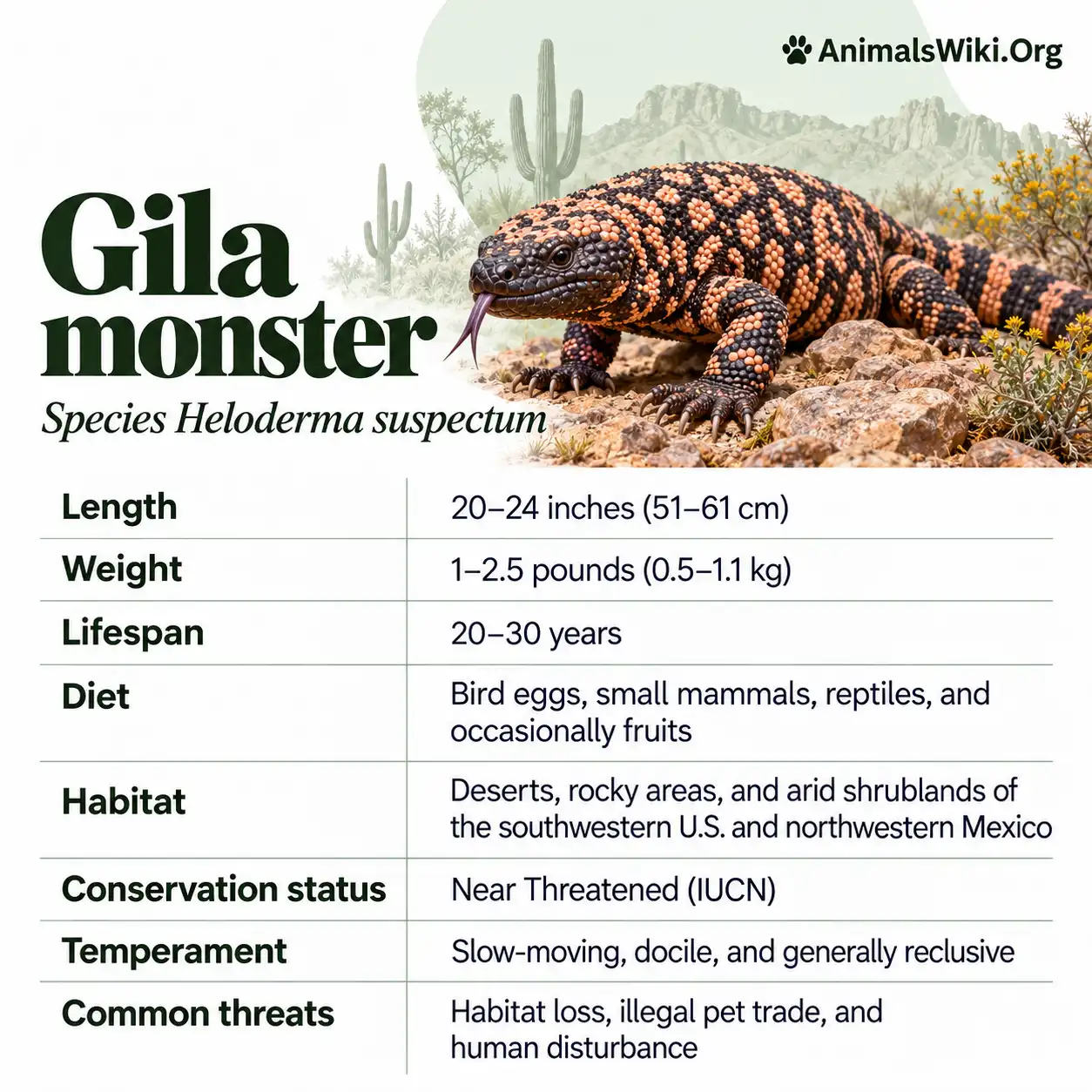
Gila Monster, The Venomous Desert Lizard of North America
The Gila Monster is one of the most extraordinary reptiles living in the deserts of North America.
Its body is thick and powerful. Its skin is covered with bead-like scales. Its striking black and pink, orange, or yellow patterns make it one of the most recognizable lizards in the world.
Unlike most lizards, the Gila Monster possesses a particularly unusual adaptation:
Venom.
Its scientific name is Heloderma suspectum, and it belongs to a small group of venomous lizards known as helodermatids.
Although its appearance can seem intimidating, the Gila Monster is generally slow-moving, secretive, and reluctant to confront humans.
It spends much of its life underground, emerging primarily when environmental conditions are suitable for feeding, mating, or moving between shelters.
The Gila Monster is also famous for its remarkable ability to survive long periods without food. Its large tail stores fat, providing an important energy reserve during periods when prey is scarce.
Perhaps even more fascinating, a hormone-like compound discovered in Gila Monster venom helped inspire an important class of medications used in the treatment of type 2 diabetes.
From its powerful jaws and venom-delivering teeth to its desert adaptations, reproduction, and ecological importance, the Gila Monster represents one of evolution’s most unusual reptilian success stories.
This comprehensive guide explores Gila Monster facts, scientific classification, appearance, size, habitat, distribution, venom, bite, diet, hunting behavior, reproduction, eggs, lifespan, predators, desert adaptations, conservation, comparisons with other lizards, and frequently asked questions.
Gila Monster Facts
| Feature | Information |
|---|---|
| Common name | Gila Monster |
| Scientific name | Heloderma suspectum |
| Animal group | Reptile |
| Order | Squamata |
| Family | Helodermatidae |
| Native range | Southwestern United States and northwestern Mexico |
| Habitat | Desert scrub, rocky foothills, washes, and semi-arid landscapes |
| Average adult length | Approximately 35–50 cm |
| Maximum length | Around 55–60 cm |
| Weight | Commonly several hundred grams; large adults can exceed 1 kg |
| Diet | Eggs, nestlings, small mammals, reptiles, and other animal prey |
| Activity | Seasonal; often active during cooler parts of the day |
| Venomous | Yes |
| Venom delivery | Grooved teeth in the lower jaw |
| Reproduction | Egg-laying |
| Typical clutch | Approximately 2–12 eggs |
| Lifespan | Often around 20 years or more; longer in managed care |
| Tail function | Fat storage |
| Conservation concern | Habitat loss, road mortality, persecution, and illegal collection |
What Is a Gila Monster?
The Gila Monster is a large, heavy-bodied venomous lizard native to arid regions of the southwestern United States and northwestern Mexico.
Its scientific name is Heloderma suspectum.
It belongs to the family Helodermatidae, which also includes other venomous beaded lizards.
The Gila Monster is distinguished by its broad head, powerful jaws, relatively short legs, thick tail, and distinctive bead-like scales.
Despite being venomous, it is not an aggressive hunter of large animals. Much of its food consists of eggs and relatively defenseless prey.
Scientific Classification of the Gila Monster
| Classification | Name |
|---|---|
| Kingdom | Animalia |
| Phylum | Chordata |
| Class | Reptilia |
| Order | Squamata |
| Family | Helodermatidae |
| Genus | Heloderma |
| Species | Heloderma suspectum |
What Does Heloderma suspectum Mean?
The genus name Heloderma comes from Greek roots associated with studded or nail-like skin, referring to the lizard’s distinctive bead-like scales.
The species name suspectum reflects the historical uncertainty surrounding the animal’s venomous nature when it was scientifically described.
Why Is It Called the Gila Monster?
The name comes from the Gila River Basin of the American Southwest, where the species was historically encountered.
The word “monster” reflects the animal’s unusual appearance and the fear it inspired among early observers.
However, the Gila Monster is not a monster in any scientific sense.
It is a specialized desert reptile with an important ecological role.
Gila Monster Appearance
The Gila Monster has a distinctive combination of physical characteristics.
Its most recognizable features include:
- Thick, muscular body
- Broad, flattened head
- Short, powerful limbs
- Strong claws
- Heavy tail
- Bead-like scales
- Black and brightly colored markings
- Powerful jaws
- Grooved venom-delivering teeth
Why Does the Gila Monster Have Bead-Like Skin?
The skin is covered with rounded scales containing small bony deposits called osteoderms.
These give the animal its characteristic armored appearance.
The osteoderms provide structural protection and contribute to the lizard’s tough exterior.
What Color Is a Gila Monster?
Gila Monsters commonly display combinations of black with pink, orange, yellowish, or salmon-colored markings.
Patterns vary between individuals and populations.
Some have broad bands, while others display more irregular or reticulated markings.
Are All Gila Monsters the Same Color?
No.
Coloration varies naturally.
Differences in markings have historically been used to distinguish geographic forms, although modern classification does not necessarily treat those forms as separate subspecies.
Gila Monster Size and Weight
Gila Monsters are among the largest native lizards in the United States.
Most adults measure approximately 35–50 centimeters in total length.
Exceptionally large individuals may approach 55–60 centimeters.
How Much Does a Gila Monster Weigh?
Many adults weigh several hundred grams.
Large, well-fed individuals can exceed one kilogram, particularly when substantial fat reserves are stored in the tail.
Are Male Gila Monsters Bigger Than Females?
Males and females overlap considerably in size.
Males may have broader heads and more robust body proportions, but appearance alone is not always sufficient to determine sex.
Why Is the Gila Monster So Fat?
Its thick appearance comes from its muscular body, heavy skin, and energy reserves.
The tail is particularly important because it stores fat.
This helps the animal survive when food is unavailable.
Where Do Gila Monsters Live?
Gila Monsters are native to the southwestern United States and northwestern Mexico.
Their range includes parts of:
- Arizona
- New Mexico
- Nevada
- Utah
- California
- Sonora, Mexico
- Nearby regions of northwestern Mexico
They are strongly associated with warm, dry environments.
Do Gila Monsters Live in the Sonoran Desert?
Yes.
The Sonoran Desert is one of their best-known habitats.
Do Gila Monsters Live in the Mojave Desert?
They occur in suitable parts of the Mojave Desert region, particularly near the edges of their distribution.
Do Gila Monsters Live Underground?
They spend a substantial proportion of their lives in underground shelters.
These may include rodent burrows, rock crevices, and other protected spaces.
Underground refuges help reduce exposure to extreme temperatures and dehydration.
Gila Monster Habitat
Gila Monsters inhabit a variety of arid and semi-arid landscapes.
Typical environments include desert scrub, rocky slopes, foothills, dry washes, and areas with suitable shelter.
They generally favor habitats where underground refuges and seasonal prey are available.
Although associated with deserts, they are not usually found wandering continuously across completely exposed sand dunes.
What Do Gila Monsters Eat?
Gila Monsters are carnivorous reptiles.
Their diet includes:
- Bird eggs
- Reptile eggs
- Nestling birds
- Young rodents
- Small mammals
- Lizards
- Other small vertebrates
Eggs and young animals are particularly important food sources.
Do Gila Monsters Eat Eggs?
Yes.
Eggs are among their characteristic foods.
Their strong jaws and excellent sense of smell help them locate and consume eggs from nests.
Do Gila Monsters Eat Snakes?
Small snakes may occasionally be consumed, but snakes are not generally considered a primary dietary component.
Do Gila Monsters Eat Insects?
Insects are not the principal food source of adult Gila Monsters.
Their diet is more strongly associated with vertebrate prey and eggs.
Do Gila Monsters Eat Plants?
No.
They are carnivores.
How Often Do Gila Monsters Eat?
They can survive on relatively infrequent large meals.
Because they store energy in their tails and have relatively low energy requirements, they do not need to feed every day.
How Do Gila Monsters Hunt?
Gila Monsters rely heavily on chemical sensing.
Their forked tongues collect chemical particles from the environment.
These particles are transferred to a specialized sensory structure called the vomeronasal or Jacobson’s organ.
This allows them to investigate scent trails and locate concealed food.
Unlike fast pursuit predators, Gila Monsters typically search slowly and methodically.
They can use their strong jaws to seize prey or break into eggs.
Are Gila Monsters Venomous?
Yes. Gila Monsters are venomous lizards.
Their venom system differs significantly from that of many venomous snakes.
The venom glands are located in the lower jaw.
Venom passes through ducts into the mouth and travels along grooves in specialized teeth during a sustained bite.
How Does a Gila Monster Inject Venom?
Gila Monsters do not have hollow, syringe-like fangs.
Instead, they have grooved teeth that help deliver venom into bite wounds.
They often maintain a firm grip while biting, allowing venom to enter damaged tissue.
Is Gila Monster Venom Dangerous?
Yes.
A bite can cause severe pain and significant systemic symptoms.
Possible effects include:
- Intense local pain
- Swelling
- Nausea
- Vomiting
- Weakness
- Dizziness
- Sweating
- Changes in blood pressure
- Allergic reactions
Although confirmed human deaths are extraordinarily rare and modern fatal cases are not well documented, a bite is a medical emergency.
Anyone bitten by a Gila Monster should seek urgent professional medical care. Do not attempt to cut the wound, suck out venom, apply a tourniquet, or handle the animal further.
Can a Gila Monster Kill a Human?
Its venom can cause serious illness, and severe allergic or cardiovascular complications are possible.
However, fatal attacks on humans are exceptionally uncommon.
The species does not hunt people.
Are Gila Monsters Aggressive?
Generally, no.
They usually avoid confrontation.
Most bites occur when the animal is handled, restrained, harassed, or otherwise threatened.
Gila Monster Venom and Diabetes Medicine
One of the most fascinating scientific discoveries involving the Gila Monster concerns a peptide called exendin-4.
Exendin-4 was identified in Gila Monster venom-related secretions and acts on the glucagon-like peptide-1 receptor.
Research into this compound contributed to the development of exenatide, a medication used to treat type 2 diabetes.
Exenatide belongs to the class of GLP-1 receptor agonists.
These medications help regulate blood glucose through several physiological mechanisms.
Is Ozempic Made From Gila Monster Venom?
No.
This is a common misunderstanding.
Exenatide was developed from research involving exendin-4, a Gila Monster peptide.
Ozempic contains semaglutide, a different, engineered GLP-1 receptor agonist. It is not extracted from Gila Monsters.
The scientific connection is the broader GLP-1 drug pathway, not that every modern GLP-1 medication is made from Gila Monster venom.
Gila Monster Behavior
Gila Monsters are generally solitary and secretive.
They spend much of their time sheltered underground.
Their activity varies with season, temperature, and rainfall.
They may be active during the day in cooler weather and shift toward twilight or nighttime activity during hotter conditions.
Are Gila Monsters Nocturnal?
They can be nocturnal or crepuscular during certain periods.
However, they are not exclusively nocturnal throughout the year.
Are Gila Monsters Slow?
They generally move slowly compared with many other lizards.
They are adapted for searching for food rather than chasing fast-moving prey.
Can Gila Monsters Climb?
Yes.
Although mainly terrestrial, they can climb low vegetation, rocks, and other structures when searching for food or moving through their habitat.
Can Gila Monsters Swim?
They are capable of swimming when necessary, although they are not aquatic specialists.
Why Do Gila Monsters Have Fat Tails?
The tail serves as an energy-storage organ.
Fat reserves accumulated after successful feeding can support the animal through long periods of inactivity or food scarcity.
This is particularly important in desert ecosystems where prey availability can fluctuate seasonally.
A thick tail often indicates substantial energy reserves, although body condition must be evaluated more broadly.
Gila Monster Reproduction
Gila Monsters reproduce sexually and lay eggs.
Breeding generally occurs during spring or early summer, depending on local conditions.
Do Male Gila Monsters Fight?
Yes.
Males may engage in wrestling contests during the breeding season.
These encounters can involve pushing, twisting, and attempts to overpower rivals.
Such behavior is associated with reproductive competition.
Do Gila Monsters Lay Eggs?
Yes.
Females deposit eggs in protected underground locations.
How Many Eggs Does a Gila Monster Lay?
A clutch commonly contains approximately 2–12 eggs.
Clutch size varies with the female’s condition and other factors.
How Long Do Gila Monster Eggs Take to Hatch?
Development is unusually prolonged compared with many familiar lizards.
Eggs laid during warmer months may produce hatchlings the following year after overwintering underground.
The precise timing depends on environmental conditions and reproductive biology.
Do Gila Monsters Care for Their Babies?
There is no prolonged parental care after hatching.
Young Gila Monsters must survive independently.
Baby Gila Monsters
A newborn Gila Monster is called a hatchling.
Hatchlings already possess the characteristic beaded skin and contrasting color patterns.
They also have functional venom systems.
Young individuals are vulnerable to predators and environmental extremes.
Their survival depends on finding shelter, avoiding threats, and locating suitable food.
How Long Do Gila Monsters Live?
Gila Monsters are relatively long-lived reptiles.
Individuals may survive for two decades or more.
In managed care, some have lived beyond 30 years.
Wild lifespan is more difficult to measure because individuals spend so much time concealed underground.
Gila Monster Adaptations
Venomous Bite
Provides a defensive weapon and may assist in prey handling.
Fat-Storing Tail
Supports survival during prolonged periods without food.
Beaded Scales
Provide physical protection.
Underground Sheltering
Reduces exposure to extreme temperatures and water loss.
Strong Chemical Senses
Help locate concealed eggs and prey.
Powerful Jaws
Allow the animal to grip prey and deliver sustained defensive bites.
Seasonal Activity
Reduces energy expenditure during unfavorable environmental conditions.
Efficient Energy Use
Supports a lifestyle based on relatively infrequent feeding.
What Animals Eat Gila Monsters?
Potential predators include:
- Birds of prey
- Coyotes
- Large snakes
- Other carnivorous mammals
Young Gila Monsters face additional risks because of their smaller size.
Their venom, tough skin, and secretive behavior provide important defenses.
How Do Gila Monsters Defend Themselves?
When threatened, a Gila Monster may:
- Remain still
- Retreat into shelter
- Hiss
- Open its mouth
- Bite defensively
- Maintain a strong grip
Its venomous bite is an important defense, but avoiding encounters is generally preferable.
Gila Monster vs. Komodo Dragon
| Feature | Gila Monster | Komodo Dragon |
|---|---|---|
| Scientific name | Heloderma suspectum | Varanus komodoensis |
| Family | Helodermatidae | Varanidae |
| Native region | North America | Indonesia |
| Size | Up to ~60 cm | Can exceed 3 m |
| Diet | Eggs and small vertebrates | Larger vertebrate prey and carrion |
| Venom system | Lower-jaw glands | Oral venom glands |
| Lifestyle | Secretive desert forager | Large terrestrial predator |
| Danger to humans | Usually defensive | Can inflict life-threatening attacks |
Both are venomous lizards, but they differ enormously in size, ecology, and behavior.
Gila Monster vs. Mexican Beaded Lizard
Gila Monsters and Mexican beaded lizards are close relatives.
Both belong to the genus Heloderma.
| Feature | Gila Monster | Mexican Beaded Lizard |
|---|---|---|
| Scientific name | Heloderma suspectum | Heloderma horridum |
| General distribution | Southwestern US and northwestern Mexico | Parts of Mexico |
| Appearance | Often pink/orange and black | Often darker with yellowish markings |
| Venomous | Yes | Yes |
| Tail | Fat storage | Fat storage |
| Family | Helodermatidae | Helodermatidae |
Taxonomic treatments of Mexican beaded lizard relatives have changed, and several related forms are recognized as separate species in modern classifications.
Gila Monster vs. Thorny Devil
Although both are unusual reptiles of dry environments, they are very different.
| Feature | Gila Monster | Thorny Devil |
|---|---|---|
| Scientific name | Heloderma suspectum | Moloch horridus |
| Native region | North America | Australia |
| Family | Helodermatidae | Agamidae |
| Venomous | Yes | No |
| Main diet | Eggs and small vertebrates | Ants |
| Main defense | Venomous bite | Spines, camouflage, false head |
| Body | Thick and heavy | Small and spiny |
| Special adaptation | Fat-storing tail | Water-transporting skin |
Gila Monster vs. Frilled Lizard
The Frilled Lizard relies heavily on a spectacular expandable neck frill to intimidate predators.
The Gila Monster instead relies on its tough body, secretive behavior, powerful jaws, and venomous bite.
The Frilled Lizard can sprint rapidly on its hind legs, while the Gila Monster generally moves more slowly.
Are Gila Monsters Dangerous to Humans?
Gila Monsters are venomous and should never be handled casually.
However, they are not aggressive predators of people.
The risk of being bitten is much lower when humans observe them from a safe distance and leave them undisturbed.
If one is encountered in the wild, the safest response is to give it space and allow it to move away.
Are Gila Monsters Protected?
Gila Monsters receive legal protection in several parts of their range.
Rules vary by jurisdiction.
Collecting, transporting, possessing, or disturbing wild individuals may be prohibited or require permits.
Wildlife protection laws should always be checked locally.
Gila Monster Conservation
Gila Monsters face several human-related threats.
Habitat Loss
Urban development, agriculture, and land alteration can reduce suitable habitat.
Road Mortality
Slow-moving reptiles are vulnerable when crossing roads.
Illegal Collection
Their distinctive appearance makes them targets for wildlife collectors.
Human Persecution
Fear and misunderstanding sometimes cause people to kill them unnecessarily.
Climate Change
Changing temperatures, drought patterns, and ecological conditions may affect their activity, shelter availability, and prey.
Conservation Measures
Effective protection includes preserving desert habitat, maintaining connected landscapes, reducing road mortality, enforcing wildlife laws, and educating the public.
The species’ current global conservation category should be checked against the latest IUCN Red List assessment before publishing a dated status claim.
Why Are Gila Monsters Important?
Gila Monsters contribute to desert food webs by consuming eggs and small vertebrates.
They also serve as prey for larger predators.
Their evolutionary history and venom chemistry provide important scientific insights.
The discovery of exendin-4 illustrates how studying unusual wildlife can contribute to biomedical research.
Protecting the Gila Monster therefore preserves both ecological diversity and opportunities for future scientific discovery.
50 Interesting Gila Monster Facts
- The Gila Monster’s scientific name is Heloderma suspectum.
- It is a venomous lizard.
- It belongs to the family Helodermatidae.
- It is native to North America.
- It occurs in the southwestern United States.
- It also inhabits northwestern Mexico.
- Its name comes from the Gila River region.
- It is among the largest native lizards in the United States.
- Large individuals can approach 60 cm in length.
- Its body is thick and muscular.
- Its scales have a bead-like appearance.
- Small bony deposits reinforce many of its scales.
- Its markings can be pink, orange, yellowish, and black.
- Individuals have distinctive patterns.
- It has a broad head.
- It possesses powerful jaws.
- Its venom glands are located in the lower jaw.
- Its venom travels along grooved teeth.
- It does not possess hollow snake-like fangs.
- Its bite can cause severe pain.
- Human fatalities are exceptionally rare.
- It does not normally attack humans.
- It spends much of its life underground.
- Underground shelters help regulate body temperature.
- It is a carnivore.
- Eggs are important in its diet.
- It also eats nestlings.
- Young rodents can be prey.
- It has an excellent chemical-sensing system.
- Its forked tongue helps investigate scents.
- Its tail stores fat.
- Stored fat helps it survive food shortages.
- It can go long periods without feeding.
- It is generally a slow-moving lizard.
- It may climb when necessary.
- Its activity changes seasonally.
- It can be active at twilight or night in hot weather.
- Males may wrestle during breeding season.
- Females lay eggs underground.
- A clutch may contain several eggs.
- Hatchlings emerge after prolonged development.
- Young Gila Monsters are already venomous.
- They can live for decades.
- Birds of prey may hunt them.
- Coyotes are potential predators.
- Habitat loss threatens local populations.
- Road traffic can kill Gila Monsters.
- Illegal collection is a conservation concern.
- Exendin-4 research contributed to the development of exenatide.
- The Gila Monster is one of North America’s most remarkable desert reptiles.
Did You Know?
The Desert Lizard That Helped Inspire Diabetes Medicine
Imagine a reptile moving slowly across a rocky desert landscape.
Its body is covered in black and pink scales.
Its thick tail swings behind it.
It stops beside a burrow.
Then its forked tongue flicks into the air.
Again.
And again.
The animal is searching for chemical traces of food.
It is a Gila Monster.
Most of the time, this remarkable reptile remains hidden beneath rocks or underground.
It does not need to hunt every day.
When it finds a substantial meal, it can store energy that helps sustain it through periods of scarcity.
But hidden inside this lizard is something even more extraordinary.
Its venom contains biologically active compounds.
One of them, exendin-4, attracted scientific attention because of its effects on pathways involved in blood glucose regulation.
Researchers developed a related medication called exenatide.
The medicine became part of an important therapeutic approach for type 2 diabetes.
A reptile once feared as a dangerous desert monster had contributed to a major chapter in modern medical research.
The discovery did not make the Gila Monster harmless.
Its bite remains painful and potentially serious.
Nor does it mean that all diabetes or weight-management medications come from its venom.
But it demonstrates an extraordinary truth:
The biological adaptations of wild animals can inspire medical discoveries far beyond their natural habitats.
The Gila Monster evolved its venom as part of its own survival strategy.
Humans later discovered that studying one of its compounds could help address a completely different biological problem.
That is one of the most fascinating Gila Monster facts of all.
Frequently Asked Questions About Gila Monsters
What is a Gila Monster?
A Gila Monster is a large venomous lizard native to the southwestern United States and northwestern Mexico.
What is the scientific name of the Gila Monster?
Heloderma suspectum.
Is the Gila Monster a reptile?
Yes.
Is the Gila Monster a lizard?
Yes.
Is the Gila Monster a snake?
No.
Is the Gila Monster a dinosaur?
No. It is a modern squamate reptile.
Why is it called a Gila Monster?
Its name refers to the Gila River region and its historically intimidating appearance.
Where do Gila Monsters live?
In desert and semi-arid habitats of the southwestern United States and northwestern Mexico.
Are Gila Monsters found in Arizona?
Yes. Arizona is one of their best-known locations.
Are Gila Monsters found in California?
Yes, in suitable southeastern desert regions.
Do Gila Monsters live in Nevada?
Yes, in portions of southern Nevada.
Do Gila Monsters live in Utah?
Yes, near the northern edge of their range.
Do Gila Monsters live in Mexico?
Yes.
Are Gila Monsters found in the Sonoran Desert?
Yes.
Do Gila Monsters live underground?
They spend substantial periods in underground shelters.
How big is a Gila Monster?
Adults commonly measure around 35–50 cm, with some approaching 60 cm.
How much does a Gila Monster weigh?
Typically several hundred grams, although large adults can exceed one kilogram.
Why do Gila Monsters have thick tails?
Their tails store fat reserves.
Are Gila Monsters venomous?
Yes.
Are Gila Monsters poisonous?
They are venomous rather than poisonous in the usual distinction between injected toxins and toxins delivered by ingestion or contact.
How does a Gila Monster deliver venom?
Through grooved teeth connected functionally to venom glands in the lower jaw.
Does a Gila Monster have fangs?
It has specialized grooved teeth rather than hollow snake-like fangs.
How painful is a Gila Monster bite?
A bite can cause extremely severe pain.
Can a Gila Monster kill a human?
Life-threatening complications are possible, but documented human fatalities are extraordinarily rare.
What should you do if a Gila Monster bites you?
Seek urgent medical attention. Avoid unproven first-aid techniques and do not attempt to handle the animal further.
Do Gila Monsters attack humans?
They do not normally seek out humans to attack.
Are Gila Monsters aggressive?
Generally, they avoid confrontation unless threatened or handled.
Can Gila Monsters spit venom?
No.
Can Gila Monsters spray venom?
No.
Do Gila Monsters chase people?
No. They are not pursuit predators of humans.
What do Gila Monsters eat?
Eggs, nestlings, young mammals, reptiles, and other small animal prey.
Do Gila Monsters eat bird eggs?
Yes.
Do Gila Monsters eat snakes?
Small snakes may occasionally be consumed, but they are not a primary food source.
Do Gila Monsters eat insects?
Insects are not a major dietary component of most adults.
Do Gila Monsters eat plants?
No. They are carnivores.
How do Gila Monsters find food?
They rely heavily on chemical sensing with their forked tongues and vomeronasal organs.
How often do Gila Monsters eat?
They can survive on relatively infrequent meals.
Can Gila Monsters survive without food?
Yes. Fat reserves help sustain them through extended periods.
Are Gila Monsters nocturnal?
They may be active at night or twilight during hotter periods, but their activity varies seasonally.
Can Gila Monsters run fast?
They are generally slow-moving compared with many other lizards.
Can Gila Monsters climb trees?
They can climb low vegetation and other structures when necessary.
Can Gila Monsters swim?
Yes, although they are not aquatic specialists.
Do Gila Monsters lay eggs?
Yes.
How many eggs does a Gila Monster lay?
Commonly around 2–12 eggs.
Where do Gila Monsters lay eggs?
In protected underground locations.
How long does it take Gila Monster eggs to hatch?
Development can extend through winter, with hatchlings emerging the following year.
What is a baby Gila Monster called?
A hatchling.
Are baby Gila Monsters venomous?
Yes.
Do Gila Monsters care for their babies?
There is no prolonged parental care after hatching.
How long do Gila Monsters live?
They can live for decades, with some managed-care individuals exceeding 30 years.
What animals eat Gila Monsters?
Potential predators include birds of prey, coyotes, and large snakes.
Do coyotes eat Gila Monsters?
Coyotes are potential predators.
Do hawks eat Gila Monsters?
Large birds of prey may attack them.
Why are Gila Monsters black and orange?
Their distinctive coloration is part of their natural appearance and may function as a warning signal to predators.
Do Gila Monsters have scales?
Yes. Their scales have a distinctive beaded texture.
Why is Gila Monster skin bumpy?
Many scales are supported by small bony deposits called osteoderms.
Is the Gila Monster related to the Komodo Dragon?
Both are squamate reptiles, but they belong to different families and have distinct evolutionary histories.
Is the Gila Monster related to the Mexican Beaded Lizard?
Yes. They are close relatives within Heloderma.
Is the Gila Monster related to the Thorny Devil?
Only distantly. They belong to different lizard families.
Is Gila Monster venom used in medicine?
Research on exendin-4 helped lead to the development of exenatide.
Is Ozempic made from Gila Monster venom?
No. Ozempic contains semaglutide, not Gila Monster venom.
What diabetes drug was inspired by Gila Monster research?
Exenatide.
Can Gila Monsters be kept as pets?
Ownership is restricted or regulated in many places, and venomous reptile keeping requires specialized expertise.
Is it legal to catch a wild Gila Monster?
Wild collection may be illegal or require permits, depending on jurisdiction.
Are Gila Monsters endangered?
They face conservation pressures, but the latest IUCN assessment should be consulted for the current formal category.
What threatens Gila Monsters?
Habitat destruction, road mortality, persecution, illegal collection, and environmental change.
Why are Gila Monsters important?
They contribute to desert ecosystems and have provided important insights into venom biology and medical research.
What is the most interesting Gila Monster fact?
A compound discovered through research on Gila Monster venom helped inspire exenatide, an important medication for type 2 diabetes.
Conclusion
The Gila Monster is one of North America’s most remarkable reptiles.
Its heavy body, beaded scales, bright warning colors, and powerful jaws give it an unmistakable appearance.
Yet behind that intimidating exterior is a highly specialized desert survivor.
It spends much of its life hidden underground, conserving energy and avoiding extreme environmental conditions.
When it emerges, it searches carefully for eggs, nestlings, and other small prey.
Its thick tail stores fat, allowing it to endure periods when food is scarce.
Its venom provides a formidable defense, although it rarely poses a threat to people who leave it undisturbed.
And perhaps most remarkably, scientific research into its venom helped inspire a medicine used in the treatment of diabetes.
The Gila Monster is therefore much more than a venomous lizard.
It is a powerful example of desert adaptation, ecological specialization, and the unexpected scientific value of wildlife.
Protecting the Gila Monster means preserving one of the most distinctive and scientifically important reptiles of the American Southwest.



