
Krill, The Small Crustaceans Supporting Giants of the Ocean
Krill are small, shrimp-like marine crustaceans that help sustain some of the largest animals on Earth. Individually, many are only a few centimeters long. Together, their swarms provide concentrated food for whales, penguins, seals, fish, squid, and seabirds.
Their importance extends beyond being eaten. Krill consume microscopic organisms, recycle nutrients, and transport carbon through the ocean. Their movements connect surface waters with deeper habitats, while their reproductive success influences the animals that depend on them.
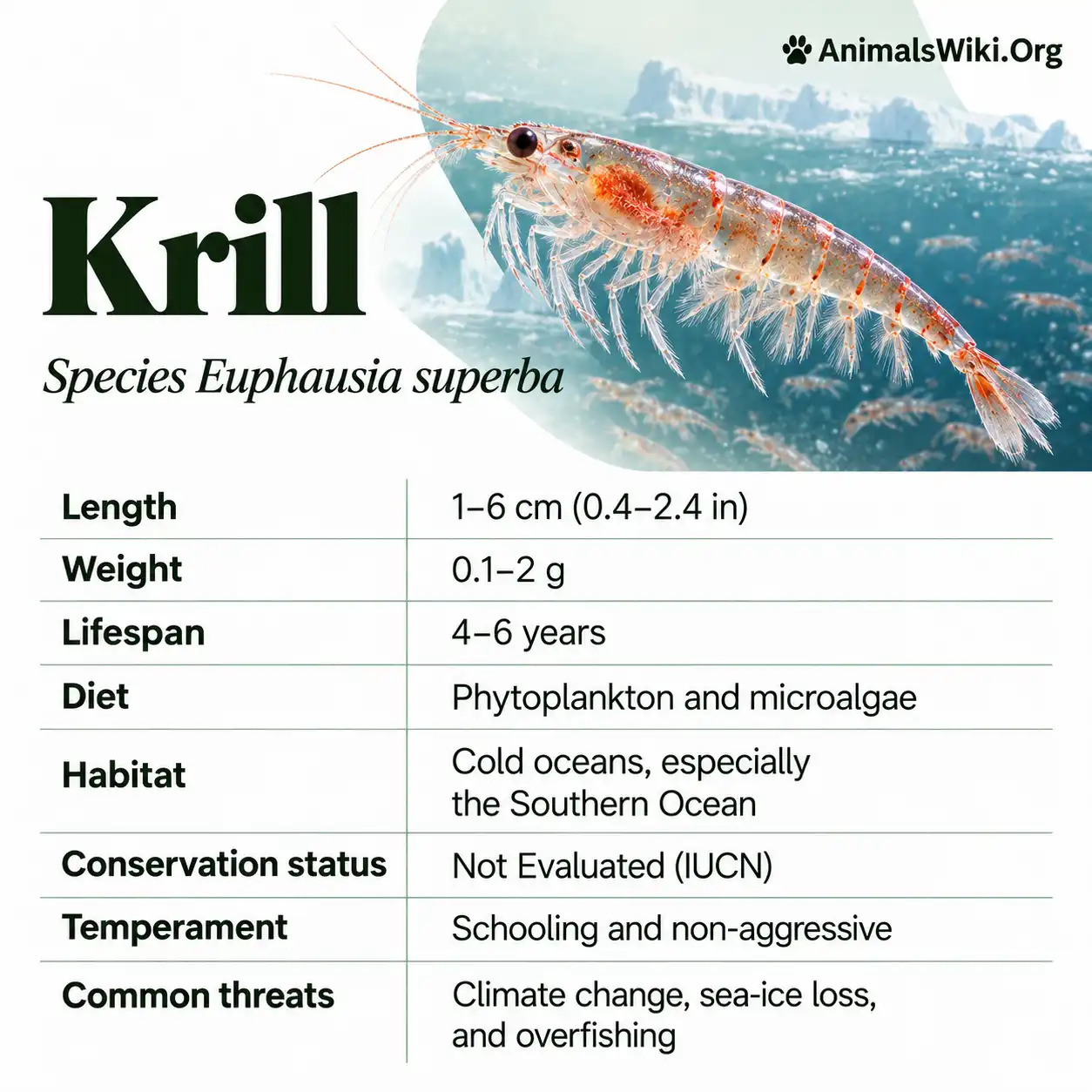
The best-known species is Antarctic krill, scientifically named Euphausia superba. It inhabits the Southern Ocean around Antarctica and forms a foundation of many regional food webs. However, krill are not exclusively Antarctic. Different species occur throughout the world’s oceans.
Krill also possess surprising abilities. Many produce their own light. They swim using coordinated appendages, respond rapidly to danger, and pass through a series of distinct developmental stages. Antarctic krill can even become smaller under conditions that restrict growth.
Understanding krill means looking beyond the image of a whale swallowing a pink cloud. These animals have complex lives, varied diets, and relationships with ocean conditions that change across species, regions, and seasons.
This guide explores what krill are, where they live, how they survive, and why their future matters to marine ecosystems.
Krill Facts
| Feature | Information |
|---|---|
| Common name | Krill |
| Scientific order | Euphausiacea |
| Class | Malacostraca |
| Animal type | Marine crustaceans |
| Best-known species | Antarctic krill, Euphausia superba |
| Distribution | Oceans worldwide |
| Size | Varies from small species under one centimeter to much larger deep-water forms |
| Antarctic krill size | Can reach approximately six centimeters |
| Appearance | Shrimp-like, often transparent with reddish pigmentation |
| Eyes | Prominent compound eyes |
| Diet | Phytoplankton, small animals, and other food, depending on species and conditions |
| Movement | Active swimming, often in schools or swarms |
| Reproduction | Sexual reproduction with eggs and multiple developmental stages |
| Antarctic krill lifespan | Several years; individuals can live beyond five years |
| Predators | Whales, seals, penguins, other seabirds, fish, and squid |
| Notable feature | Light-producing organs in most species |
| Ecological role | Connect microscopic food resources with larger marine animals |
1. What Are Krill?
Krill are marine crustaceans belonging to the order Euphausiacea. The name describes a group of species, not one single animal.
They share broad ancestry with other crustaceans, including shrimp, crabs, and lobsters. However, they form their own scientific order and have a distinctive combination of anatomical features.
Krill are commonly included among the zooplankton: animals living in the water column whose distribution is influenced strongly by currents.
This does not mean they simply drift without control. Krill swim actively, form coordinated groups, and move between depths. Their swimming abilities are an important part of how they obtain food and avoid predators.
The distinction between an individual and a population is essential. One small krill contains little food for a large whale, but a dense aggregation changes the economics of feeding.
By concentrating into swarms, krill become an accessible energy source for animals that could not efficiently collect scattered microscopic particles.
That connection helps explain their extraordinary ecological importance.
2. Krill Classification
A simplified classification places krill within the following groups.
| Classification level | Group |
|---|---|
| Kingdom | Animalia |
| Phylum | Arthropoda |
| Broad animal group | Crustaceans |
| Class | Malacostraca |
| Order | Euphausiacea |
| Example genus | Euphausia |
| Example species | Euphausia superba |
The order includes more than one family. Most familiar krill belong to Euphausiidae, while a distinctive deep-water lineage belongs to Bentheuphausiidae.
Scientific names help prevent confusion. “Antarctic krill” refers to a particular species, whereas “krill” covers a broader range of animals.
This matters when reading about temperature preferences, reproduction, size, or fisheries. Those details may concern one species rather than the entire order.
It also matters when comparing photographs. Several small marine crustaceans have shrimp-like bodies, and a general resemblance does not establish that an animal is krill.
Reliable identification uses features of the eyes, appendages, carapace, and other structures, sometimes supported by genetic information.
3. Important Krill Species
Different species contribute to different marine ecosystems.
| Species | Common association |
|---|---|
| Euphausia superba | Antarctic krill in the Southern Ocean |
| Euphausia crystallorophias | Ice krill associated with Antarctic coastal and shelf environments |
| Euphausia pacifica | North Pacific ecosystems |
| Meganyctiphanes norvegica | Northern krill in North Atlantic waters and neighboring seas |
| Thysanoessa spinifera | Productive northeastern Pacific waters |
| Nyctiphanes australis | Waters around parts of southern Australia and New Zealand |
These examples show why the term should not be treated as another name for Antarctic wildlife alone.
They also illustrate the importance of local ecology. A species living in a temperate coastal current faces different seasonal conditions from one developing near Antarctic sea ice.
Even where several species occur together, their size, timing, preferred depth, and feeding can differ.
For predators, those differences influence which prey are available and when.
For scientists, identifying the species is therefore the beginning of understanding the system, rather than a minor naming exercise.
4. What Do Krill Look Like?
Krill have an elongated body with a recognizable front region, segmented abdomen, and tail fan.
Their bodies are often mostly transparent, with reddish pigment spots. The digestive tract may be visible, and recently consumed microscopic algae can give it a green appearance.
Large, dark compound eyes stand out against the clearer tissues.
Beneath the front body are appendages involved in feeding. Along the abdomen are swimming appendages that beat rhythmically.
The transparent appearance can make internal structures easier to observe, but it does not mean the body lacks protection. Krill possess an external skeleton like other arthropods.
Their coloration also changes the way they appear under different lighting. A specimen photographed against a dark background may look quite different from the same animal viewed in a net sample.
Close-up photographs can exaggerate apparent size, so educational images benefit from scale bars or clear measurements.
A krill’s delicate appearance conceals an actively swimming animal with specialized sensory, feeding, and reproductive systems.
5. How Big Are Krill?
Krill vary considerably in size.
Some small species measure less than one centimeter, while Antarctic krill can reach around six centimeters. Unusually large deep-water forms grow substantially longer than that.
These differences make the phrase “all krill are tiny” imprecise.
They are small compared with the whales that consume them, but not necessarily microscopic. Adult Antarctic krill can be seen clearly without a microscope.
Measurements also depend on convention. Researchers must specify the landmarks used to measure length so that results can be compared consistently.
Age is not the only influence on size. Food conditions, season, reproductive state, and the species involved all matter.
A long individual is therefore not automatically older than every shorter individual.
This becomes especially important in Antarctic krill, whose growth does not follow a simple pattern of continuous enlargement.
Their biology demonstrates why body size, age, and condition should be measured separately whenever possible.
6. Krill Anatomy: A Body Built for Swimming and Feeding
The front body region combines the head and thorax into a cephalothorax, covered by a carapace. Behind it lies a segmented abdomen.
Krill have antennae, compound eyes, mouthparts, thoracic appendages, and abdominal swimming limbs called pleopods.
One important identification feature is their externally visible gills. These differ from the more enclosed gill arrangement familiar in many decapod shrimp.
| Structure | Main function |
|---|---|
| Antennae | Sensory contact with the surroundings |
| Compound eyes | Visual information |
| Carapace | Protection and structural support |
| Thoracic appendages | Food collection and handling |
| Gills | Gas exchange |
| Pleopods | Sustained swimming |
| Abdomen and tail fan | Movement, including rapid escape |
| Photophores in most species | Light production |
The body functions as an integrated system. Swimming affects food encounters, feeding supplies resources for reproduction, and sensory information helps coordinate movement.
Anatomical specialization is therefore directly connected to ecological performance rather than simply providing features for identification.
7. Krill Versus Shrimp: What Is the Difference?
Krill and familiar shrimp share a crustacean body plan, but they belong to different scientific orders.
Many animals commonly called shrimp are decapods. Krill belong to Euphausiacea.
Their exposed gills are a useful distinguishing feature, although identifying a small specimen accurately can require magnification.
| Feature | Krill | Familiar decapod shrimp |
|---|---|---|
| Scientific group | Euphausiacea | Decapoda |
| General appearance | Shrimp-like | Highly variable, often shrimp-like |
| Gills | Externally visible | Usually enclosed beneath the carapace |
| Typical ecological role | Often schooling marine zooplankton | Includes many swimming and bottom-associated forms |
| Size | Commonly small, with exceptions | Extremely variable |
| Light production | Present in most krill species | Present in some shrimp groups, absent in many others |
Size alone is not a reliable identification test.
A small shrimp does not become krill simply because it is small, and a large krill does not cease to be krill because it exceeds a familiar size range.
Their evolutionary classification and anatomy provide the meaningful distinction.
8. Where Do Krill Live?
Krill occur throughout the world’s oceans.
Different species inhabit polar, temperate, tropical, coastal, and offshore environments. Their distribution reflects water temperature, depth, circulation, productivity, and evolutionary history.
Some are especially abundant around continental shelves or in regions where nutrients support productive food webs.
Antarctic krill occupy the Southern Ocean around Antarctica. Other species help support ecosystems far from polar ice.
This global distribution is important because popular photographs often focus almost entirely on Antarctica.
Krill in a North Pacific food web are not misplaced Antarctic animals. They are members of species adapted to those waters.
Nor do all species occupy the same depth throughout the day.
An animal may feed in one layer, avoid predators in another, and be carried horizontally by currents while making those vertical movements.
A useful habitat description therefore includes more than a map point. It considers depth, season, water properties, and the species being observed.
9. Why Antarctic Krill Are Especially Important
Antarctic krill combine enormous abundance with a central position in many Southern Ocean food webs.
They consume resources unavailable directly to many large predators and package those resources into relatively large, concentrated prey.
Whales, penguins, seals, fish, squid, and flying seabirds all participate in krill-centered feeding relationships.
Calling krill the “foundation” of these systems emphasizes their widespread role. It does not mean every Antarctic animal eats krill directly or depends on them equally.
Some predators obtain much of their food from fish or squid, which may themselves have consumed krill.
This creates both direct and indirect dependence.
Their ecological importance is therefore greater than a simple list of animals photographed eating them.
A change in krill availability can influence foraging distances, breeding performance, prey switching, and competition.
The Southern Ocean remains a complex food web, but krill provide one of its most consequential connections between microscopic production and larger animals.
10. How Do Krill Swim?
Krill use coordinated movements of their abdominal pleopods for sustained swimming.
The appendages beat in an organized sequence, moving water and generating propulsion. This allows individuals to maintain position, travel, and coordinate with neighboring animals.
They are not restricted to one speed or movement pattern.
Routine swimming differs from an escape response. When threatened, a krill can rapidly flex its abdomen and flip its tail, producing a powerful backward movement.
A hydrodynamic study of Antarctic krill measured the flow and acceleration associated with such an escape.
The distinction matters because normal swimming and emergency movement solve different problems.
Steady propulsion must be maintained over time, while an escape response prioritizes immediate separation from a threat.
Both depend on the interaction between anatomy and water.
A krill’s small size does not make its movement mechanically simple. Researchers study its appendages and surrounding flow to understand how effective swimming is achieved at that scale.
11. Why Do Krill Form Swarms?
Krill often occur in aggregations called swarms or schools.
These groups vary in density, shape, depth, and behavior. A swarm is not necessarily one uniform cloud of identical individuals.
Grouping can involve interactions among swimming animals, environmental conditions, and the movement of water.
Dense aggregations may provide advantages in some circumstances, but they also attract predators able to exploit concentrated prey.
The behavior therefore involves trade-offs rather than guaranteed safety.
To understand a swarm, scientists ask several questions: how far apart are individuals, how are they oriented, how do they react to neighbors, and how does the group respond to disturbance?
Three-dimensional observations are especially valuable because a flat photograph can hide the spacing and movement within a group.
Research using underwater camera systems has followed individuals responding to objects and rejoining swarms.
These observations help connect small-scale behavior with larger questions about how krill are distributed and how their abundance should be measured.
12. Do Krill Glow in the Dark?
Most krill species have light-producing organs called photophores.
The production of light by a living organism is bioluminescence. It differs from fluorescence, which requires illumination from another source.
Krill photophores occur at particular positions on the body rather than making every tissue glow evenly.
Research on northern krill has investigated the structures and nervous connections involved in controlling these organs.
Possible functions include communication, orientation, and reducing visibility through forms of light matching. However, the behavioral significance is still debated and may not be explained by one universal function.
It is therefore better to describe these as investigated possibilities than claim scientists have settled the purpose of every flash.
Their light production also differs from the reflection seen when a bright camera illuminates a transparent animal.
A photograph containing bright spots does not, by itself, establish that the camera captured active bioluminescence.
Special observation conditions help researchers distinguish emitted light from reflected illumination.
13. What Do Krill Eat?
Krill diets vary among species, developmental stages, seasons, and habitats.
Phytoplankton are important food for many species. These microscopic photosynthetic organisms use light to build organic material.
However, krill should not all be described as strict herbivores.
Research on Antarctic krill has documented a diet containing algae, protozoans, and small animals. Copepods can form a regular component rather than serving only as emergency food.
Some krill species are more strongly predatory than others.
This flexibility matters because the ocean does not offer one constant food supply. A spring bloom, a winter water column, and an area beneath sea ice present different resources.
Food in a stomach is also only one piece of evidence. Researchers can examine fatty acids and other markers to investigate feeding over longer periods.
The useful general description is that many krill are flexible feeders capable of exploiting plant-like and animal resources.
Their diets connect several pathways within the plankton community.
14. How Do Krill Collect Their Food?
In familiar filtering species, the thoracic appendages form a food-collecting basket.
These appendages carry fine bristles called setae, which interact with water and suspended particles.
Movements of the basket help concentrate food, while mouthparts handle and process it.
This is an active feeding system, not simply a passive net hanging beneath the body.
The movement of the animal, the operation of the appendages, and the characteristics of the particles all influence collection.
Different-sized food items can also require different handling.
Detailed observations of Antarctic krill describe pumping movements in which the feeding basket opens and closes in coordination with other activity.
The distinction between collecting and digesting is important. Capturing a particle does not guarantee that it provides useful nutrition.
Food quality, abundance, and accessibility jointly influence the value of a feeding area.
A swarm may therefore occupy waters that offer a favorable combination of resources, not merely the highest number of visible particles.
15. Which Animals Eat Krill?
Many marine animals consume krill, but the degree of dependence differs.
| Predator group | Relationship with krill |
|---|---|
| Baleen whales | Some species exploit dense krill aggregations |
| Penguins | Several species consume substantial quantities in appropriate regions |
| Seals | Krill are especially important to particular Antarctic species |
| Fish | Numerous species consume krill directly |
| Squid | Can feed on krill within broader diets |
| Flying seabirds | Some use krill directly or consume animals supported by krill |
The phrase “whales eat krill” needs qualification. Baleen whales and toothed whales have different feeding systems, and even baleen whale diets differ.
Likewise, not every penguin population depends on the same prey.
Season, location, age, and breeding condition can change dietary needs.
The important ecological feature is that krill are shared prey. Several consumers may depend on the same productive areas at the same time.
This makes local availability important.
A large regional population does not guarantee that a predator can find enough food within the distance it can travel.
16. How Can a Huge Whale Live on Small Krill?
A whale does not need each individual prey item to be large if it can collect many efficiently.
Dense krill aggregations provide concentrated energy. Baleen whales exploit this concentration using feeding structures and behaviors adapted to taking numerous small prey.
The energetic calculation depends on prey density, search time, capture efficiency, and the costs of feeding.
This explains why the existence of krill somewhere in an ocean is not sufficient. Their spatial concentration matters.
A scattered population can be harder to exploit than the same number of animals assembled into dense patches.
The relationship also shows why body size does not determine ecological importance.
Microscopic producers support small consumers, which can then support an enormous predator when energy is concentrated through the food web.
Krill do not create that energy. They transform and transfer resources acquired through feeding.
Their significance lies in how effectively they connect otherwise distant scales of marine life.
17. Do Krill Migrate Between Ocean Depths?
Many krill undertake diel vertical migration, moving between depths over a daily cycle.
A familiar pattern involves occupying deeper water during daylight and moving toward upper layers at night.
This can reduce exposure to visually hunting predators while allowing access to food nearer the surface.
However, the pattern is not universal.
Species, season, food, oxygen, reproductive condition, and the predator community can alter behavior.
Some krill also use near-bottom habitats. Antarctic krill have been documented feeding on seafloor material, challenging the idea that they remain exclusively near the surface.
Vertical movement connects environments with different conditions and resources.
It also exposes krill to different predators along the route.
Research in Monterey Bay has examined the threats encountered by migrating krill and other animals, showing that migration is not a simple movement from danger into safety.
It is a changing balance of feeding opportunities and predation risks through the water column.
18. How Do Krill Reproduce?
Krill reproduce sexually.
Reproductive structures, timing, egg production, and early development differ among species.
Antarctic krill reproduce during a season associated with favorable feeding and environmental conditions. Females can produce multiple batches containing thousands of eggs.
However, an egg count should remain tied to the species, individual condition, and study involved.
Different krill species do not follow one identical reproductive calendar.
Research in the Gulf of Alaska, for example, documented different seasonal patterns of egg production in Thysanoessa inermis and Euphausia pacifica.
Temperature and food conditions also influence development and reproductive performance.
Krill reproduction is therefore more than an annual event that happens automatically on a fixed date.
Adults must obtain resources, develop reproductive tissues, encounter suitable conditions, and produce viable offspring.
The success of that process determines whether new individuals enter later stages of the population.
A large number of adults does not guarantee strong recruitment in every year.
19. The Remarkable Journey of Antarctic Krill Eggs
Antarctic krill have a striking early developmental pattern.
After eggs are released into the water, they sink while development proceeds. Hatching can occur at substantial depth, after which the larvae begin a developmental ascent.
This journey moves the young animals through different temperatures, pressures, and chemical conditions.
It also helps explain why surface observations alone cannot describe the full habitat of the species.
The conditions experienced by an egg deep in the water column may differ from those experienced by an adult feeding above.
Not every egg hatches, and not every larva completes the journey successfully.
Early survival depends on several linked processes rather than only the number of eggs produced.
This is important in environmental research. A population may contain many apparently healthy adults while changes at the embryonic stage reduce future replenishment.
Antarctic krill eggs are not the same kind of long-lasting dry resting stages familiar from some temporary-pool crustaceans. Their survival strategy is adapted to a marine developmental cycle.
20. Krill Larvae and Development
Krill pass through several developmental stages before becoming juveniles and adults.
Names used for these stages include nauplius, metanauplius, calyptopis, and furcilia, with details depending on the species.
These stages involve changes in appendages, swimming ability, and feeding biology.
A newly hatched larva is not simply a miniature adult with all the same capabilities.
Scientists distinguish developmental stages because each may face different environmental constraints.
An early stage may depend on stored resources, while later stages must collect sufficient food. Changes in swimming ability also affect where a larva can remain and which currents it experiences.
The amount of time spent developing varies with conditions.
Laboratory observations are useful for establishing stage sequences and testing environmental effects, but natural conditions include variable food, predators, and transport.
A life-cycle diagram should therefore show the broad sequence without implying that every larva completes each stage on exactly the same day.
Development is a process shaped by both inherited biology and the surrounding ocean.
21. Molting, Growth, and Shrinking
Krill grow by molting, replacing their external skeleton as their bodies change.
However, Antarctic krill do not always become larger after each molt.
Under unfavorable feeding conditions, they can shrink. Seasonal changes can also include regression of reproductive characteristics.
This makes body length an imperfect measure of age.
Two individuals of similar length may have different histories, while the same individual may not follow a continuously increasing size trajectory.
Shrinking does not mean the animal is becoming young again.
It reflects changes in body condition and growth under particular circumstances.
Research aquariums have helped scientists investigate these processes by following krill under controlled conditions.
Such work is important for population models, which need realistic relationships among food, growth, survival, and reproduction.
A model that assumes all animals grow steadily at the same rate would miss an important part of krill biology.
Their flexibility helps adults endure seasonal shortages, but it does not remove the need for adequate resources over the full life cycle.
22. How Long Do Krill Live?
Krill lifespan varies among species.
Antarctic krill are relatively long-lived for animals of their size and can survive beyond five years.
This allows an individual to experience several seasonal cycles rather than completing its entire life during one productive summer.
However, lifespan estimates are difficult because size does not provide a simple age scale.
Seasonal growth, shrinking, and repeated molting complicate interpretation.
Researchers therefore investigate additional methods for estimating age and comparing the results with known-age animals.
The distinction between maximum lifespan, average survival, and the age structure of a population is also important.
A species capable of living for several years may still experience high mortality during particular stages.
Many eggs and larvae fail to reach adulthood, and adults face predators and environmental pressures.
Longevity describes a biological capability, not a guarantee for every individual.
It also should not be generalized from Antarctic krill to all tropical, temperate, and deep-water krill species.
23. How Do Antarctic Krill Survive Winter?
Winter in the Southern Ocean brings strong changes in light and food production.
Antarctic krill use different combinations of physiological and feeding responses to cope.
Adults may reduce activity and feeding effort, use stored resources, exploit alternative foods, and undergo changes in growth.
Larvae face different constraints because they have different energy reserves and developmental requirements.
Research has documented winter feeding on resources beyond a simple diet of open-water phytoplankton, including small animals and material associated with ice.
The balance varies among regions.
An animal overwintering near a productive shelf does not necessarily experience the same conditions as one in a different ocean sector.
It is therefore inaccurate to describe winter survival as all krill entering a uniform sleep.
They remain part of an active ecosystem with food, predators, currents, and changing habitat.
Understanding overwinter survival requires examining life stage, local conditions, and the availability of suitable feeding opportunities rather than relying on one generalized behavior.
24. Why Sea Ice Matters to Krill
Sea ice can provide an important habitat for Antarctic krill, especially during early life.
Its underside contains structures, surfaces, and associated food that differ from the open water column.
Ice can also provide shelter and concentrate organic material.
However, the relationship is more complex than “more ice always means more food.”
Research has shown that some winter pack-ice environments can be food-poor, while marginal ice areas may offer better feeding conditions.
Other work has found that characteristics of ice habitat and transport differ among regions and influence recruitment.
The timing, structure, and location of ice can therefore matter alongside its total extent.
This complexity does not make sea ice unimportant. It makes accurate predictions more demanding.
A useful comparison is to think of ice as habitat rather than simply frozen water.
Changing the habitat’s seasonal timing or physical structure can alter food access, shelter, and movement even when some ice remains present.
25. Ocean Currents, Recruitment, and Population Change
Krill populations are shaped by the movement of the ocean.
Currents can transport eggs, larvae, juveniles, and adults, linking spawning areas with later feeding habitats.
Active swimming allows some control, but it does not eliminate transport over large distances.
This makes a local aggregation part of a wider system.
A productive breeding area may contribute individuals elsewhere, while a predator feeding ground may depend partly on transport from another location.
Scientists use the term recruitment for the addition of individuals to a defined population stage.
Strong recruitment can replenish a population, while repeated weak recruitment may change its age structure.
An increase in average body size does not necessarily mean that all individuals are thriving. It can also indicate fewer young animals.
Research in the southwest Atlantic has documented changes in distribution and recruitment associated with regional environmental change.
Such findings should remain attached to the region and period studied rather than being presented as a uniform global trend for every krill species.
26. Krill and the Ocean Carbon Cycle
Krill help move carbon through the ocean.
Phytoplankton use carbon dioxide during photosynthesis. When krill eat them, some of that carbon enters krill tissues and waste.
Their fecal pellets can sink, carrying carbon below the surface layer. Krill movements, respiration, and mortality provide additional pathways through which material is redistributed.
This forms part of the biological carbon pump.
However, carbon leaving surface waters is not automatically stored away from the atmosphere for the same length of time.
Depth, circulation, decomposition, and the destination of particles influence persistence.
Research has estimated a substantial carbon-storage contribution from Antarctic krill fecal pellets, while newer field observations continue to investigate where pellets are produced and how they move.
The important point is that krill influence both food webs and biogeochemistry.
Their ecological value cannot be measured only by the number of whales they feed.
They also affect the movement of material through an ocean system that helps regulate Earth’s climate.
27. Krill and Nutrient Recycling
Krill also participate in nutrient cycling.
Elements consumed in food can be retained in tissues, released in waste, transferred to predators, or moved between habitats.
Iron is especially important in parts of the Southern Ocean because its availability can limit phytoplankton growth.
Studies have examined how krill and the animals that eat them contribute to iron recycling.
Feeding near the seabed and returning to upper waters can also connect nutrient resources at different depths.
These processes are not equivalent to krill creating nutrients from nothing.
They change where existing material is located and how accessible it becomes to other organisms.
The connection with predators is similarly important. A whale consuming krill can return nutrients to water through excretion, helping link feeding with further biological production.
This complicates the simplistic idea that predators only subtract prey from an ecosystem.
Consumption also redistributes matter.
The resulting effects depend on movement, feeding locations, and how released resources interact with light and other requirements for growth.
28. Climate Change and Ocean Chemistry
Krill experience environmental change through several pathways.
Warming can alter suitable habitat, food production, currents, and the timing or structure of sea ice.
Ocean acidification changes seawater chemistry and can affect sensitive developmental processes.
These pressures do not necessarily produce identical responses across species or life stages.
Antarctic krill embryos, larvae, and adults have different vulnerabilities, so observing one stage cannot establish the condition of the whole population.
Experiments have also investigated combined stressors.
Research exposing krill embryos to particular nanoplastic and acidification treatments found poorer development under the combined treatment than under the study’s control conditions.
That result provides evidence of a possible interaction, not a direct measurement of every embryo in the Southern Ocean.
Laboratory treatments must be interpreted alongside environmental measurements and field observations.
The broader lesson is that animals encounter several changing conditions at once.
Studying each pressure separately is useful, but understanding their combined effects is essential for realistic predictions.
29. Why Krill Are Harvested
Krill are commercially harvested for products including aquaculture feed ingredients, food products, and oils.
The existence of a market creates an additional consumer within the food web: people remove biomass that would otherwise remain available to predators, reproduction, and other ecological processes.
This does not mean every harvest has an identical effect.
The species, location, timing, quantity, and fishing method all influence the outcome.
A product label also cannot establish ecological sustainability by itself.
Understanding a fishery requires looking at the population being harvested, the needs of dependent animals, and the rules and evidence guiding management.
Krill oil should be distinguished from the animal itself. It is a processed product, not a biological name or a complete description of krill nutrition.
This article concerns krill ecology rather than evaluating medical claims about supplements.
For understanding the ocean, the central question is how commercial demand interacts with natural population variability and the needs of other consumers.
30. Krill Fisheries, Conservation, and Research
Antarctic krill fisheries are managed within the framework of the Commission for the Conservation of Antarctic Marine Living Resources, commonly called CCAMLR.
An ecosystem approach considers more than whether enough adult krill remain to reproduce. It also considers animals that depend on krill.
Spatial concentration is especially important.
A relatively small regional catch can matter if fishing and predators concentrate in the same restricted area.
NOAA research has documented relationships between local fishing pressure and measures of penguin performance, demonstrating why broad abundance totals do not answer every management question.
Scientists combine net samples, acoustic surveys, underwater observations, experiments, and mathematical models to investigate these issues.
Each method has limitations. Nets sample particular depths and times, acoustic signals require interpretation, and models depend on their inputs and assumptions.
Using several methods provides a stronger assessment than relying on one estimate.
Effective conservation therefore requires continued monitoring, realistic treatment of uncertainty, and attention to where and when krill are available—not only how many may exist across a large ocean region.
31. Common Krill Myths
| Myth | More accurate explanation |
|---|---|
| Krill are baby shrimp. | They are members of their own crustacean order. |
| All krill live in Antarctica. | Different species occur throughout the oceans. |
| All krill eat only algae. | Diets can include small animals and other resources. |
| Krill cannot swim because they are plankton. | They are active swimmers, although currents influence distribution. |
| Every whale eats krill. | Whale diets differ substantially among species. |
| Krill remain near the surface all the time. | Many move between depths, and some feed near the seabed. |
| A larger krill must always be older. | Growth and shrinking complicate the relationship between size and age. |
| Their glow has one completely proven purpose. | Several functions are investigated, and questions remain. |
| High regional abundance prevents local food shortages. | Predators need accessible prey in particular places and seasons. |
| All sinking carbon remains stored permanently. | Storage depends on depth, circulation, and biological processing. |
These distinctions reveal a more interesting animal than the simplified image of an identical swarm floating beneath Antarctic ice.
32. Frequently Asked Questions About Krill
1. What are krill in simple words?
Krill are small marine crustaceans with shrimp-like bodies. They belong to the order Euphausiacea. Many feed on microscopic organisms and are eaten by larger animals. Their importance comes from both their abundance and their position connecting different levels of ocean food webs.
2. Is krill a single species?
No. Krill is a common name covering many species. Antarctic krill, Euphausia superba, is one particularly well-known example. Other species inhabit the North Pacific, North Atlantic, and many additional marine environments. Their biology should not be treated as identical.
3. Are krill the same as shrimp?
No. They share a broad crustacean body plan but belong to different scientific groups. Externally visible gills are one useful feature of krill. Size alone cannot distinguish them because small shrimp and larger krill can overlap in overall appearance.
4. Can you see krill without a microscope?
Yes. Many adult krill are easily visible, including Antarctic krill. Magnification helps reveal their appendages and detailed anatomy, but the animals are not all microscopic. Very small larvae and smaller species require closer examination than large adults.
5. Where do Antarctic krill live?
Antarctic krill live in the Southern Ocean around Antarctica. Their distribution changes across regions, seasons, depths, and developmental stages. They are not permanently attached to sea ice, and adults and early stages can use different parts of the marine environment.
6. Do krill live outside polar waters?
Yes. Krill species occur in temperate and tropical oceans as well as polar regions. North Pacific krill and northern krill are familiar examples outside Antarctica. The common name describes an animal group, not one particular climate or geographical location.
7. What do krill eat?
Their diets depend on species and circumstances. Phytoplankton are important for many, but small animals, protozoans, and other resources also contribute. Antarctic krill should not be described as strict plant-eaters throughout their entire lives.
8. Do krill eat other animals?
Yes. Animal prey can be part of krill diets, and some species are strongly predatory. Research on Antarctic krill has documented regular consumption of copepods. This feeding flexibility helps connect several pathways within marine plankton communities.
9. Why do krill gather in swarms?
Swarming involves interactions among individuals and environmental conditions. Grouping may offer benefits, but dense prey also attract predators. Scientists investigate orientation, spacing, movement, and responses to disturbance to understand how swarms form and remain coordinated.
10. Can krill escape from predators?
They have several responses, including changes in swimming and rapid tail-flip escape movements. These can reduce capture risk but do not guarantee survival. Krill remain prey for a wide range of animals despite their mobility and group behavior.
11. Do krill really produce light?
Most species have photophores that generate bioluminescence. The organs occur at specific body locations. Proposed functions include communication, orientation, and forms of camouflage, but their significance remains an active research topic rather than one completely settled explanation.
12. How do krill reproduce?
Krill reproduce sexually and develop from eggs through several larval stages. Reproductive timing and egg production vary among species and environments. Antarctic krill can produce several batches containing thousands of eggs, but those numbers should not be applied to every krill species.
13. Why do Antarctic krill eggs sink?
Sinking is part of their early developmental pattern after spawning. Embryos develop while descending, and larvae later begin an ascent. This exposes early stages to conditions different from those experienced by adults near the surface and helps define the species’ full habitat.
14. How long do Antarctic krill live?
They can live for several years, with individuals surviving beyond five years. Age is difficult to infer from length because growth varies and shrinking can occur. A species’ potential lifespan also differs from the survival experienced by the average egg or larva.
15. Can krill become smaller?
Antarctic krill can shrink under particular conditions, including restricted feeding. This does not mean they reverse aging or become larvae again. It reflects changes in growth and body condition, making size an imperfect guide to age.
16. Why is sea ice important to young krill?
Sea ice can provide shelter, surfaces, and associated food. Its structure and timing affect habitat quality. However, not every ice-covered area offers equally good feeding, and the relationship varies by region. Sea ice is habitat with several functions, not simply a frozen food store.
17. Which whales eat krill?
Several baleen whales consume krill, with some relying heavily on them in particular regions. Whale diets vary, so it is inaccurate to say all whales eat the same food. Dense prey patches are especially important for efficient feeding.
18. Why do penguins need krill nearby?
Breeding penguins must obtain food while also returning to their colonies. Krill located far away may be less accessible than a smaller amount nearby. This is why local distribution and seasonal availability can matter more than a large abundance estimate covering an entire region.
19. Do krill help store carbon?
They contribute to carbon transport through feeding, waste production, movement, and mortality. Sinking fecal pellets are an important pathway. The duration of storage depends on where the carbon goes and how it is processed, so not all exported carbon remains isolated equally long.
20. Are krill threatened by climate change?
Environmental change can affect habitat, food, sea ice, development, and distribution. Effects differ among species and regions. For Antarctic krill, research has documented changes in recruitment and distribution in parts of the Southern Ocean, along with experimental evidence of sensitivity at early life stages.
21. Does abundant krill mean fishing has no ecological effect?
No. Predators require food in accessible places and at appropriate times. Fishing concentrated near important feeding areas can matter even when the regional catch is a small fraction of estimated biomass. Management therefore needs spatial and seasonal information as well as total abundance.
22. Why should people care about such small animals?
Krill help sustain marine predators, move carbon, and recycle nutrients. Their lives connect microscopic production with some of the largest animals on Earth. Understanding and protecting these connections supports whole ecosystems rather than only one conspicuous or commercially valuable species.
WordPress publishing checklist — keep this outside the article
- Headings: Use one H1 for the title, H2 for main sections, and H3 for individual questions.
- Table of contents: Generate working jump links from the headings.
- Internal links: Link naturally to your articles about whales, penguins, crustaceans, plankton, seals, and ocean food webs.
- Featured image filename:
antarctic-krill-euphausia-superba.webp - Suggested alt text: “Antarctic krill showing its transparent body, dark compound eyes, and swimming appendages.”
- Image accuracy: Identify the species when possible and avoid using a generic shrimp photograph.
- Author details: Include an accurate byline and publication date.
- Schema: Use Article or BlogPosting through your SEO plugin.
- Indexing: Keep the page public and indexable, include it in your sitemap, and link to it from an existing relevant page. Length alone does not guarantee indexing or rankings.



