
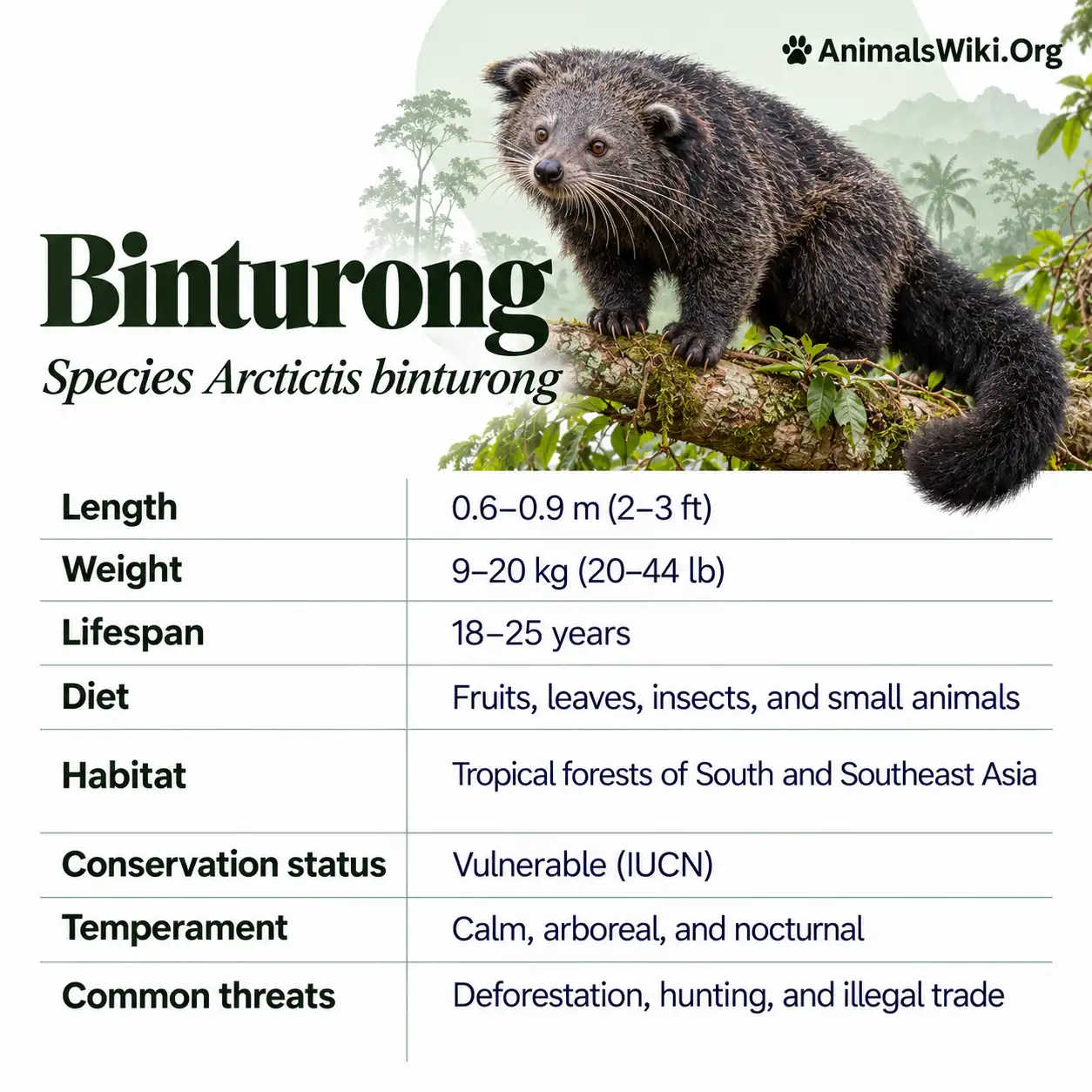
Binturong, The Popcorn-Scented Bearcat of Asia’s Forests
The binturong is a shaggy, tree-dwelling mammal with a remarkable combination of features: a bear-like body, long whiskers, tufted ears, and a muscular tail that can grip branches. It is often called a bearcat, although it belongs to neither the bear family nor the cat family.
Its unusual appearance is only the beginning of its story. Binturongs eat large amounts of fruit, help disperse seeds, and produce a distinctive scent frequently compared with buttered popcorn. Their movements through tropical forests connect feeding trees, resting places, and potential sites for new plants to grow.
Despite these memorable characteristics, binturongs remain relatively unfamiliar. Their canopy-dwelling habits make them difficult to observe, and important details of their wild lives are still being investigated.
They also face serious pressures. Forest conversion, hunting, and capture for trade threaten populations across parts of their range. Protecting them requires more than saving individual animals: it requires maintaining the forests and ecological relationships that support them.
This guide explores binturong classification, appearance, distribution, climbing adaptations, food, communication, reproduction, conservation, and frequently asked questions. It also explains what research tells us about their popcorn-like smell and their importance to tropical forests.
Information checked: October 18, 2026.
Binturong Facts
| Feature | Details |
|---|---|
| Common name | Binturong |
| Alternative name | Bearcat |
| Scientific name | Arctictis binturong |
| Animal group | Mammal |
| Order | Carnivora |
| Suborder | Feliformia |
| Family | Viverridae |
| Main distribution | Parts of South and Southeast Asia |
| Typical habitat | Tropical forests |
| Main lifestyle | Primarily tree-dwelling |
| Diet | Fruit-dominated, with other foods also recorded |
| Notable adaptation | Prehensile, or grasping, tail |
| Distinctive scent | Often compared with popcorn |
| Main scent compound identified | 2-acetyl-1-pyrroline |
| Typical pregnancy length reported | Approximately three months |
| Young | Commonly called cubs, kits, or bintlets |
| Global conservation category | Vulnerable |
1. What Is a Binturong?
A binturong is a large, fruit-eating member of the civet family that spends much of its life in trees.
Its scientific name is Arctictis binturong. Although it belongs to the order Carnivora, fruit is especially important in its diet.
This combination can seem surprising because people often associate carnivorans with animals that primarily hunt other animals. However, scientific classification reflects evolutionary relationships rather than a rule about every meal.
The binturong’s body is long, heavy, and covered with coarse fur. Its tail contributes substantially to its total length and provides an additional point of support when climbing.
Its face is framed by conspicuous whiskers, while tufts of hair project from the ears.
These features create an unmistakable appearance once the animal is seen clearly. In the wild, however, a binturong may be partly hidden among branches and leaves, making even this distinctive mammal surprisingly difficult to detect.
2. Is a Binturong a Bear or a Cat?
The nickname bearcat describes a resemblance, not a biological combination.
A binturong is not a bear, a cat, or a hybrid of the two. It belongs to Viverridae, a separate family within the carnivore order.
Its broad body and shaggy coat can suggest a small bear, while its whiskered face and some vocalizations may seem catlike.
These similarities explain why the nickname is memorable, but they should not replace its actual classification.
Common names often create this kind of confusion. An animal may be named after something it resembles without being closely related to it.
The binturong also should not be confused with a raccoon or a red panda. Those animals have their own evolutionary histories and adaptations.
For identification and conservation, the scientific name is especially useful. It ensures that information concerns the same species even when local names or popular nicknames differ.
3. Binturong Scientific Classification
The binturong’s classification can be summarized as follows:
| Classification level | Name |
|---|---|
| Kingdom | Animalia |
| Phylum | Chordata |
| Class | Mammalia |
| Order | Carnivora |
| Suborder | Feliformia |
| Family | Viverridae |
| Subfamily | Paradoxurinae |
| Genus | Arctictis |
| Species | Arctictis binturong |
Membership in Feliformia places the binturong within the catlike branch of carnivorans. This does not make it a type of cat.
Its position among viverrids helps explain its relationship with civets, including several other Asian mammals that consume fruit.
The binturong nevertheless has its own distinctive anatomy and ecology.
Its grasping tail is especially unusual among carnivorans, while its heavy dependence on fruit separates its feeding strategy from that of many meat-eating relatives.
Classification provides the family framework. Understanding the animal itself requires looking at how it moves, feeds, communicates, and interacts with its environment.
4. What Does a Binturong Look Like?
A binturong has a low, muscular body covered with long, shaggy hair.
The coat is generally dark brown to black, sometimes with lighter tips that create a grizzled appearance. Its face has a broad muzzle, a dark nose, and long whiskers that stand out against the surrounding fur.
Small, rounded ears carry noticeable hair tufts.
The tail is thick near the base and tapers toward the end. When the animal is resting, it may curl the tail around part of its body.
Appearance changes with posture. Stretched along a branch, a binturong looks long and substantial. Curled into a resting position, it can resemble a dark bundle of fur.
Age, individual variation, and lighting also affect how the coat appears.
For wildlife identification, the combination of shaggy fur, tufted ears, long whiskers, and a grasping tail is more useful than color alone.
5. How Big Is a Binturong?
A binturong is roughly comparable in body size to a medium-sized dog, although the long tail makes its total length greater than that comparison suggests.
Published measurements vary across individuals and sources. Head-and-body length is commonly around 60–90 centimeters, with a tail approaching the length of the body.
Body mass varies considerably, and females tend to be larger than males.
It is important to distinguish typical measurements from unusually large individuals.
An upper weight reported from an animal under human care should not automatically be treated as the normal weight of a wild binturong.
Length measurements also require attention. “Body length” usually excludes the tail, while “total length” includes it.
Confusing the two can produce dramatic errors in comparisons.
The practical impression is of a robust mammal built for deliberate climbing rather than a lightweight animal that leaps freely between narrow branches.
6. Where Do Binturongs Live?
Binturongs occur across parts of South and Southeast Asia.
Their distribution includes areas of northeastern India and neighboring countries, mainland Southeast Asia, and parts of Indonesia, Malaysia, and the Philippines.
Within the Philippines, Palawan is particularly important to their distribution.
This broad geographic range should not be interpreted as continuous occupancy. Suitable forests are unevenly distributed, and populations can become separated by cleared or heavily altered land.
A country listed within the range may contain only limited areas where binturongs remain.
Likewise, the existence of records from a region does not establish that the species is common there.
Range maps summarize occurrence at a broad scale. Conservation requires more detailed information about habitat, hunting, reproduction, and whether animals can move between suitable areas.
For an elusive canopy mammal, establishing these details can take considerable field effort.
7. Binturong Habitat: A Forest Specialist
The binturong is strongly associated with forest environments.
Trees provide food, shelter, climbing routes, resting locations, and places where scent can be deposited.
A useful habitat must offer more than a collection of trunks. The arrangement of branches, availability of fruit, surrounding cover, and connections to other forest patches all influence its value.
A fruiting tree may be important during one period but provide little food later. Binturongs therefore need access to a wider landscape rather than a single feeding site.
Forest structure also affects movement.
Connected branches and climbing vegetation can provide routes above the ground, while large gaps may require a different approach.
However, binturongs are not confined to completely untouched forest. Research has documented their presence in some disturbed landscapes when sufficient forest remains.
Their ability to use such areas offers conservation opportunities, but it does not mean extensive forest removal is harmless.
8. The Binturong’s Prehensile Tail
One of the binturong’s most remarkable adaptations is its prehensile tail.
Prehensile means capable of grasping. The tail can curl around a support and help stabilize the animal while it climbs or reaches for food.
It works alongside the feet rather than replacing them.
A binturong may anchor its tail around a branch while changing its footing or extending its body toward fruit.
Research comparing carnivoran tails has identified skeletal features associated with grasping ability, including differences in the proportions and robustness of tail vertebrae.
These features support strength and controlled movement.
The binturong and kinkajou are particularly notable examples of prehensile-tailed carnivorans, despite belonging to different families and living on different continents.
Their similarities illustrate evolutionary convergence: related functional challenges can produce comparable adaptations in animals with separate evolutionary histories.
9. Can a Binturong Hang by Its Tail?
A binturong’s tail can grip strongly, but it should not be imagined as an unlimited suspension device.
Young, lighter individuals may support themselves in ways that are less practical for heavy adults.
An adult commonly combines tail support with one or more feet.
This distinction matters because photographs capture a moment rather than the animal’s complete movement.
A binturong appearing to hang beneath a branch may still be using a foot or another support outside the clearest part of the image.
The tail’s everyday value is stability.
It provides another attachment point when the animal reaches, turns, or changes position. That can be extremely useful in a three-dimensional environment where supports vary in angle and thickness.
The ability remains impressive without assuming the tail always carries the entire body.
Its function is best understood as part of an integrated climbing system involving the tail, claws, feet, muscles, and balance.
10. Feet, Claws, and Climbing Down Headfirst
Binturongs use padded feet and strong claws to maintain contact with tree surfaces.
Their feet are plantigrade, meaning they can place much of the sole against the supporting surface.
This contributes to their bear-like appearance when walking on the ground.
Flexible hind-foot positioning also helps during descent. A binturong can orient its rear feet so the claws maintain useful purchase while it moves down a trunk headfirst.
For a heavy animal, descending safely can be as important as climbing upward.
Moving headfirst allows it to inspect the route ahead rather than backing down without the same view.
These abilities do not make it equivalent to a monkey. Binturongs tend to move deliberately and rely on secure contact with supports.
Their climbing style emphasizes grip and controlled placement rather than frequent long leaps.
That strategy suits a substantial fruit-eating mammal moving through complex forest structure.
11. Do Binturongs Ever Come to the Ground?
Yes. Although binturongs are primarily tree-dwelling, they can travel on the ground.
Coming down may help them move between trees or cross places where the canopy does not provide a continuous route.
This flexibility is important, but ground movement should not be taken as evidence that canopy structure is irrelevant.
An animal capable of crossing a gap may still face additional exposure, disturbance, or energetic costs when suitable connections disappear.
The distinction is between being able to do something and doing it without consequence.
Binturongs can walk with a deliberate, flat-footed gait, but their most distinctive adaptations reflect an arboreal life.
For observers, a ground sighting may be unusual without necessarily signaling that an animal is injured.
Its behavior, surroundings, and condition provide better information than the simple fact that it is outside a tree.
Wildlife responses should therefore be based on the situation rather than assumptions drawn from the label “tree-dwelling.”
12. Are Binturongs Nocturnal?
Binturongs are often described as nocturnal, but their activity is more flexible than that label suggests.
They can be active at night, around dawn and dusk, and sometimes during daylight.
A radio-tracking study in Thailand found activity distributed across the daily cycle, with stronger crepuscular and nocturnal tendencies.
This means a single universal timetable would be misleading.
Location, disturbance, food, and individual circumstances may influence when movement occurs.
Animals under human care also experience feeding schedules and environments that differ from those in the wild.
A binturong resting during a daytime visit is therefore not necessarily inactive every day until sunset.
Likewise, a daylight observation does not contradict its tendency toward nighttime activity.
The most accurate description recognizes a general pattern while allowing variation.
Activity studies are valuable because they show what animals actually do rather than simply repeating a category assigned in an older species summary.
13. Home Ranges and Daily Movements
A binturong must connect several resources across its surroundings.
These include fruiting trees, resting sites, potential mates, and routes that allow movement between them.
The area used over time is called a home range.
Home range is not identical to territory. An animal can use an area without excluding every other individual from it.
Published tracking studies have found overlap between binturong ranges, and estimated sizes differ with location, individuals, and analytical methods.
Consequently, one study’s average should not become a fixed space requirement for every wild animal.
Movements can change as food availability changes.
A tree that is valuable during fruiting may become less important afterward, while another location becomes worth visiting.
This creates a changing landscape of opportunities.
Understanding movement requires knowing not only where trees stand but also when they provide food and whether the animal can reach them safely.
14. What Do Binturongs Eat?
The binturong diet is strongly associated with fruit, especially figs in several studied populations.
Other foods have also been recorded, including animal material, but the broad description “omnivore” can obscure how fruit-dominated the diet may be in the wild.
A study using chemical evidence from hair found a low trophic position consistent with a strongly plant-based diet in the sampled binturongs.
The authors connected this result with extensive field observations in which figs were especially important.
This is a useful correction to the assumption that a large mammal with sharp teeth must primarily eat meat.
However, evidence from a particular population should not be treated as proof that no binturong ever consumes animal food.
The important distinction is between dietary capability and usual dietary contribution.
An animal may be capable of eating many things while obtaining most of its energy from a narrower selection.
15. Why Figs Matter So Much
Figs can be important feeding resources for binturongs.
Field research in Borneo recorded numerous fig species among their foods and found that fig trees accounted for most recorded feeding sites in the study.
The distribution of fruiting trees influenced short-term movements.
This does not mean every fig tree provides food continuously. Individual trees have fruiting cycles, and different species can contribute at different times.
A binturong benefits from access to a variety of feeding locations rather than relying on one permanent source.
Remembering where productive trees occur could be useful, although detailed claims about memory require direct testing.
The ecological relationship also runs in both directions.
The animal receives food, while seeds swallowed with the fruit can later be deposited elsewhere.
This makes figs central to both the binturong’s feeding ecology and its contribution to the forest.
16. Why Is a Fruit-Eating Animal in Carnivora?
The order Carnivora is an evolutionary group, while carnivorous describes a diet.
These terms are related historically but are not interchangeable.
Members of Carnivora include animals with varied feeding strategies. Some consume mostly animal foods, while others rely heavily on plant material.
The binturong’s ancestry places it within this order even when fruit dominates its meals.
Its classification does not change each time it eats a fig.
This distinction is useful beyond binturongs because everyday language often encourages a diet-based interpretation of scientific names.
Teeth also tell a more complicated story than a single label suggests.
An animal can retain teeth useful for cutting or processing animal material while using much of its feeding time on fruit.
To understand what an animal eats, researchers therefore combine anatomy with direct observations, dietary samples, and other evidence.
Classification provides context; feeding studies establish the actual diet.
17. Why Do Binturongs Smell Like Popcorn?
The binturong’s popcorn-like scent has a chemical basis.
Researchers analyzing urine from animals under human care identified 2-acetyl-1-pyrroline, commonly shortened to 2-AP.
The same compound contributes to the familiar aroma of popcorn and some other cooked foods.
In the study, it was detected in every sampled animal.
This finding is more precise than the general statement that a binturong “sweats popcorn smell” or produces it because it eats popcorn.
The scent is associated with compounds in urine, which can reach the feet and tail and be transferred onto surfaces as the animal moves.
The research also found differences between males and females in the chemical profiles.
These results support a role for scent in communication, potentially including information about sex or reproductive condition.
However, identifying a compound does not mean scientists have fully decoded every message that another binturong receives from it.
18. How Scent Works in a Forest
For an animal that often moves without companions, scent can provide information without a face-to-face encounter.
A mark can remain on a branch after its maker has left.
Another binturong may investigate it later, obtaining information that would be unavailable from a brief visual encounter.
This makes chemical communication useful in a forest where vegetation restricts sight and individuals may be separated.
The persistence of a scent also matters. A signal that fades immediately serves a different purpose from one that remains detectable.
Still, the popcorn comparison is a human description.
It tells us how the odor resembles something familiar, rather than proving what the animal experiences.
A binturong’s sensory world is shaped by its own biology and behavior.
The scientifically useful questions concern which compounds are present, how they vary, how long they remain, and whether they change the behavior of other animals.
19. Binturong Sounds and Social Behavior
Binturongs can produce several vocalizations, including grunts, hisses, wails, and other sounds.
Calls are only one part of communication. Posture, proximity, scent, and the circumstances of an encounter also matter.
A sound should not automatically be translated into a fixed human emotion based only on resemblance.
Descriptions from professional care can provide valuable observations, but wild social relationships are less thoroughly documented.
Binturongs are often described as largely solitary, with mothers and young forming an obvious exception.
Their use of overlapping space also means “solitary” should not be confused with having no contact or social information.
An animal can travel alone while responding to the scents, calls, and movements of others.
Claims that all binturongs live in permanent pairs or form a single standard family arrangement therefore go beyond what should be assumed.
Their social lives deserve the same careful study as their movements and feeding.
20. Binturong Reproduction
Much reproductive information comes from animals under human care.
A classic study combining direct observations with zoo records reported breeding across the year and an average gestation of approximately 91 days.
Litters averaged around two young in that dataset, although a wider range occurred.
These are useful reference points, not a promise that every birth follows the same schedule.
Sexual maturity also varies between individuals.
Descriptions of reproductive behavior should distinguish the capacity to breed from the timing of successful reproduction in a particular environment.
Food availability, condition, and management can all influence outcomes.
Several zoo accounts also report delayed implantation, but it should not be described as a conscious decision by the female.
Physiological processes and environmental responses differ from deliberate planning.
For a general understanding, the most secure points are that binturongs have a pregnancy lasting roughly three months in documented records and produce small litters requiring maternal care.
21. Baby Binturongs and Early Development
Young binturongs are variously called cubs, kits, or bintlets.
Newborns are small compared with adults and are born with their eyes closed.
They initially depend on maternal milk, warmth, and protection.
As they develop, they become more mobile, investigate their surroundings, and gradually begin eating solid food.
The transition to independence involves more than increasing body weight.
A young binturong must learn to coordinate its feet and tail, assess supports, handle food, and respond appropriately to unfamiliar situations.
Observations from breeding facilities can document these stages closely.
However, a schedule recorded for a hand-reared animal should not automatically be treated as an exact timetable for every wild youngster.
Development takes place within a particular physical and social environment.
The broad pattern is a gradual progression from dependence toward the climbing, feeding, and self-maintenance abilities needed for an arboreal life.
22. Maternal Care and the Role of Professional Support
A mother’s care is central to early development.
Her young depend on successful nursing and a secure environment during their most vulnerable period.
Professional breeding facilities sometimes need to intervene when normal care cannot meet a youngster’s needs.
Nashville Zoo, for example, has reported hand-rearing kits when a mother did not produce sufficient milk.
Such cases demonstrate the practical demands of neonatal care rather than suggesting that hand-rearing is the preferred natural arrangement.
Feeding, temperature, development, and behavior must all be monitored by trained staff.
A successful birth alone does not establish that a breeding program has achieved its conservation goals.
The young must survive, develop appropriately, and contribute meaningfully to a managed population.
These experiences can improve knowledge of the species, but conservation in the wild still depends on reducing the pressures affecting forests and free-ranging animals.
23. How Long Do Binturongs Live?
Binturongs can be long-lived mammals, with individuals under human care surviving beyond 20 years.
However, longevity records should be interpreted carefully.
The oldest documented individual is not the same as the average lifespan.
Wild survival is harder to measure because following animals from birth to death is difficult, especially in dense canopy habitat.
An animal that disappears from a study may have moved rather than died.
Professional care also changes the risks. Reliable feeding, veterinary attention, and protection from hunting differ from wild conditions.
Consequently, a single number cannot fully describe lifespan.
Age also influences the challenges an animal faces.
A youngster must develop effective climbing and feeding skills, while an older individual may experience changes in mobility or health.
For conservation, the important questions include how long adults remain reproductively active and whether enough young survive to replace losses.
24. Binturongs as Seed Dispersers
When a binturong eats fruit, some swallowed seeds can pass through its digestive system and be deposited away from the original plant.
This is seed dispersal.
Moving seeds can help plants reach new sites and reduce dependence on conditions immediately beneath the parent tree.
However, dispersal is more than transportation.
A seed must remain viable, arrive in a suitable location, germinate, and survive as a seedling.
Different animals deposit seeds in different ways, creating different opportunities.
The binturong’s use of trees can make its contribution especially relevant for plants that establish above the ground.
Its role therefore depends not only on how much fruit it eats but also on where it leaves the seeds.
This connects ordinary feeding and movement with future forest structure.
A binturong searching for its next meal can also be moving the potential beginnings of new plants through the canopy.
25. Binturongs and Strangler Figs
Some figs begin life in elevated locations such as tree forks or places where organic material accumulates.
These sites are very different from the forest floor.
A study in Borneo compared seed dispersal by binturongs, gibbons, and helmeted hornbills for particular fig species.
The researchers found that binturongs frequently deposited seeds in canopy locations that matched important establishment sites.
In that study, they were especially effective dispersers for the figs examined.
This does not mean binturongs are the only animals capable of spreading fig seeds, or that every seed they deposit survives.
It shows that the location of deposition can make a substantial difference.
A large quantity of seeds dropped into unsuitable conditions may achieve less than fewer seeds placed where establishment is possible.
This is a strong example of how an animal’s behavior can influence the quality, not merely the quantity, of an ecological service.
26. Why Seed Dispersal Matters to the Wider Forest
The consequences of seed dispersal can extend beyond one animal and one plant.
A successfully established tree may eventually provide fruit, shade, shelter, and other resources.
Those resources can support additional animals, creating connections across the food web.
This is one reason fruit-eating mammals can matter even when they are rarely seen.
Their influence may become visible only over long periods as plants establish and mature.
Nevertheless, the contribution should not be overstated.
Forest regeneration depends on many processes, including seed availability, soil, moisture, disturbance, herbivory, and survival after germination.
Binturongs participate in this network rather than controlling it alone.
The most useful conservation message is that retaining ecological interactions matters.
Protecting trees while losing their seed dispersers can change how a forest renews itself. Protecting dispersers without maintaining suitable forest also leaves the relationship incomplete.
Both organisms and the processes linking them deserve attention.
27. Can Binturongs Survive in Logged or Disturbed Forests?
Research has shown that binturongs can persist in some degraded forests.
A large-scale study found them using disturbed areas and forest edges where sufficient surrounding forest remained.
The authors also identified shifts toward more nocturnal activity in disturbed settings.
These findings offer an important correction to the idea that only completely untouched forest has conservation value.
However, the results do not establish that any amount of logging or clearing is acceptable.
Persistence depends on the broader landscape and the type of disturbance.
A forest retaining cover, fruiting trees, and connections differs from a small isolated patch surrounded by extensive non-forest land.
The study also distinguished use of forest from use of plantations.
The practical lesson is to protect intact forests while recognizing the value of retaining and restoring degraded ones.
Such areas can still support binturongs and their ecological functions when managed appropriately.
28. The Palawan Binturong
Palawan is an important part of the binturong’s Philippine distribution.
Animals from the island are often called Palawan binturongs, and the name Arctictis binturong whitei appears in many zoo and older references.
However, the taxonomic interpretation is not as settled as those labels may suggest.
A genetic study found Palawan animals closely related to Bornean binturongs and did not support recognizing them as a separate species or subspecies.
The researchers nevertheless identified the lineage as worth preserving.
This distinction matters: conservation importance does not disappear when a proposed subspecies is not supported.
A geographically restricted population can retain ecological, genetic, and management value.
Taxonomy helps organize information, while protection also considers threats, isolation, and the condition of the population.
For public writing, “Palawan binturong” remains a useful geographic description as long as its taxonomic status is not presented as unquestioned.
29. Are Binturongs Endangered?
The binturong is globally classified as Vulnerable.
In the formal IUCN system, Vulnerable and Endangered are different categories, although both belong to the threatened group.
Calling it Vulnerable does not mean its situation is minor.
The classification reflects an elevated risk of extinction in the wild and the need to address significant pressures.
Risk also differs among locations.
A broad species distribution can contain populations that are declining sharply, poorly protected, or increasingly isolated.
Conversely, a record from one protected forest does not establish the condition of the entire species.
Reliable conservation reporting should distinguish category, trend, geographic scale, and assessment date.
There is also no well-supported reason to invent a precise current global population count when comprehensive surveys are lacking.
For an elusive arboreal mammal, uncertainty about abundance is itself a reason to improve monitoring rather than assume security.
30. Habitat Loss and Fragmentation
Forest conversion can affect binturongs in several connected ways.
It removes feeding trees, reduces resting cover, and changes the routes available for movement.
Fragmentation separates remaining habitat into patches.
Even when individual patches retain trees, their size and isolation may limit access to food or other animals.
The quality of the surrounding landscape therefore matters.
A narrow belt of vegetation is not automatically an effective connection. Its usefulness depends on structure, disturbance, resources, and whether animals actually use it.
Likewise, planting trees does not immediately replace the functions of a mature forest.
Food availability and physical complexity take time to develop.
Conservation planning should therefore prioritize avoiding unnecessary loss while restoring links where appropriate.
Protecting a binturong’s habitat means preserving a functioning network of resources rather than counting trees alone.
This broader view connects forest protection with the animal’s daily needs.
31. Hunting and the Wildlife Trade
Binturongs are captured or killed for several purposes, including trade in live animals and use of animal products.
The scale of these activities can be difficult to measure because detected incidents represent only part of the trade.
A study of Indonesian records documented dozens of seizure incidents between 2015 and 2023, involving more than 100 binturongs.
Most seized animals were alive.
These records demonstrate demand and enforcement activity, but they do not provide a complete count of animals removed from the wild.
An increase in seizures can reflect increased trade, improved detection, or both.
That distinction is important when interpreting trends.
The conservation concern remains clear: removing individuals adds pressure to populations already affected by habitat change.
Reducing demand, improving investigation, supporting appropriate enforcement, and addressing the circumstances that enable capture all belong within the response.
32. Climate Change and Future Habitat
Climate can influence binturongs through changes in vegetation, food, and the suitability of different landscapes.
Researchers have used distribution models to explore how future conditions might change potential habitat.
Such models can identify areas that deserve attention and help compare scenarios.
However, a projection is not a direct count of future animals.
Its outcome depends on assumptions about climate, available data, dispersal, land use, and how suitability is defined.
A modeled percentage of habitat loss should therefore not be repeated as a guaranteed prediction of population decline.
The practical value is in planning.
Potential changes can inform decisions about connectivity, protected-area networks, and the importance of retaining options for movement.
Climate also interacts with existing pressures.
An animal facing changing conditions may have fewer alternatives if surrounding forests have already been cleared or divided into isolated patches.
33. How Scientists Study an Elusive Canopy Mammal
Binturongs are difficult to study because they can remain high above observers and move when visibility is poor.
Ground-based camera traps may miss animals that rarely pass through their detection zone.
Researchers have therefore tested cameras placed in trees.
A Palawan study obtained encouraging detection results using arboreal camera trapping, demonstrating the importance of matching the method to the species.
Radio tracking provides a different kind of information, allowing researchers to follow movement beyond a single camera position.
Diet studies, genetics, and chemical analysis answer additional questions.
Each method has limits.
A camera photograph establishes a detection but may reveal little about the individual’s reproductive success. A tracking study can provide detailed movement data while involving only a few animals.
Combining approaches builds a stronger understanding than expecting one technique to answer every conservation question.
34. Binturongs Under Professional Care
Professional care can support research, managed breeding, public education, and the welfare of animals that cannot live independently in the wild.
A suitable environment must account for climbing, resting, feeding, sensory behavior, and individual needs.
Providing food alone is not sufficient.
The way food is offered can create opportunities to investigate and manipulate objects, while varied structures provide choices about movement and rest.
Research on enrichment has explored these questions, but small studies must be interpreted cautiously.
For example, an exploratory study involving two juveniles found behavioral trends that differed among food and scent treatments, without establishing a universal enrichment formula.
Good care therefore requires continued observation rather than assuming one item benefits every animal equally.
Managed populations also require attention to genetics and breeding recommendations.
These activities complement field conservation, but they cannot substitute for protecting wild habitat and reducing capture.
35. Helping Binturongs and Watching Them Responsibly
Supporting binturongs begins with protecting forests and reducing incentives to capture wild animals.
Conservation organizations also work on research, local partnerships, education, and improved care for rescued wildlife.
For visitors, responsible observation means allowing animals to continue normal behavior.
Keep an appropriate distance, avoid crowding, and do not offer food.
A wild binturong should not be encouraged to approach for a photograph or handled because it appears calm.
Likewise, a human-raised animal shown in a video is not evidence that binturongs make suitable household pets.
Tameness describes an individual’s response to people; domestication is a different process.
Choose wildlife experiences that explain the species accurately and support appropriate care.
The most useful attention goes beyond its unusual smell or appealing face and helps people understand its forest dependence, seed-dispersal role, and conservation needs.
36. Binturong Myths and Facts
| Common claim | More accurate explanation |
|---|---|
| A binturong is a bear–cat hybrid | It is a viverrid |
| Bearcat is its scientific name | Its scientific name is Arctictis binturong |
| Every carnivoran mainly eats meat | Binturongs can have strongly fruit-dominated diets |
| The popcorn smell comes from eating popcorn | A key aroma compound has been identified in urine |
| Its tail always supports the entire animal | Tail support commonly works with the feet |
| It spends its entire life in trees | It can also travel on the ground |
| It is active only at night | Activity can include twilight and daylight |
| It lives in permanent family groups everywhere | Wild social organization is less fully documented |
| All fig seeds need a binturong to germinate | Effects depend on the plant and circumstances |
| Disturbed forests have no value for it | Some retain value when sufficient forest remains |
| Vulnerable means almost safe | Vulnerable is a threatened conservation category |
| A tame binturong is a domesticated pet | Tameness and domestication are different |
The most interesting facts survive careful explanation. The binturong does not need exaggerated claims to be an exceptional mammal.
37. Frequently Asked Questions About Binturongs
What is the scientific name of the binturong?
The scientific name is Arctictis binturong. It belongs to the family Viverridae and is the only living species in its genus. Its classification connects it with civets and genets rather than bears or domestic cats.
Why is a binturong called a bearcat?
The nickname reflects its appearance. Its shaggy body can look bear-like, while the face, whiskers, and some sounds seem catlike. The name does not indicate mixed ancestry. A binturong is a distinct species within the civet family.
Is a binturong a real bear?
No. Bears belong to Ursidae, while binturongs belong to Viverridae. Their resemblance results from features such as body shape, fur, and flat-footed movement. These similarities should not be mistaken for close family membership.
Where are binturongs naturally found?
They occur in parts of South and Southeast Asia, including mainland forests and several island regions. Their distribution is fragmented rather than continuous. A country within the range may contain only limited suitable habitat or isolated populations.
Are binturongs found in the Philippines?
Yes. Palawan is important to their Philippine distribution. The term Palawan binturong is widely used geographically, although genetic research has questioned its traditional recognition as a separate subspecies. The population remains important for conservation.
What do binturongs eat most often?
Fruit is central to their diet, particularly figs in studied wild populations. Other foods have also been recorded. The ability to consume animal material does not mean it forms the main part of every binturong’s diet.
Why do binturongs smell like popcorn?
Researchers identified 2-acetyl-1-pyrroline in their urine. The compound also contributes to popcorn’s familiar aroma. Its presence helps explain the scent, while its exact production and communication roles remain subjects for further investigation.
Does their whole body naturally smell like popcorn?
The familiar odor is associated with scent compounds that can be distributed through contact with urine and marked surfaces. Describing the entire body as a popcorn-producing organ would be inaccurate. The scent is part of a chemical communication system.
What is a prehensile tail?
A prehensile tail can grasp a support. In binturongs, it helps with stability and positioning during climbing. It works together with the feet and claws, providing another point of contact in a complex three-dimensional environment.
Can an adult binturong hang entirely by its tail?
Adults commonly combine tail grip with foot support. The tail should not be treated as a device that always carries the full body weight. Age, size, position, and available supports influence how it is used.
Are binturongs nocturnal?
They often show nighttime and twilight activity, but they are not universally restricted to darkness. Field studies have recorded more flexible patterns. Disturbance, location, food, and individual circumstances can influence when they move.
Do binturongs climb down trees headfirst?
Yes. Their flexible hind-foot positioning helps maintain claw contact during headfirst descent. This is useful for controlling movement down a trunk and viewing the route ahead. It forms part of their wider climbing adaptations.
What is a baby binturong called?
Young are called cubs or kits, and bintlet is another commonly used term. Terminology varies between institutions. More important biologically is that newborns depend on maternal milk and gradually develop effective movement and feeding skills.
How many babies does a binturong have?
Small litters are typical, with around two young reported as an average in a classic reproductive dataset. Larger litters have occurred. Individual records should not be confused with the most common outcome across all births.
How long is a binturong pregnant?
Documented records commonly place gestation at roughly three months. A classic study reported an average close to 91 days. Pregnancy length should be presented as an approximate biological measure rather than an exact schedule followed by every female.
Are binturongs social animals?
They are often described as largely solitary, with mothers and dependent young forming an important exception. Solitary movement does not mean a complete absence of communication. Scent and other signals allow information exchange without constant physical association.
How long do binturongs live?
Individuals under professional care can live beyond 20 years. Wild lifespan is harder to establish because animals are difficult to follow throughout life. Maximum longevity and average survival are different measures and should not be used interchangeably.
Are binturongs dangerous?
They are strong wild mammals with teeth and claws and can injure someone who handles or corners them. Their usually deliberate movement does not make close contact appropriate. Observation should follow the guidance of trained staff or local wildlife authorities.
Can a binturong be a pet?
Binturongs are unsuitable as ordinary household pets. They require specialized environments and care, and demand for live animals can contribute to wildlife capture. Familiarity with people does not remove their needs as wild, climbing mammals.
Are binturongs endangered?
Their global IUCN category is Vulnerable. This is different from the specific category Endangered, but it still means they are threatened. Local populations can face more severe circumstances than the broad global category alone suggests.
Why are binturongs important to forests?
They move seeds while feeding and traveling. Research has shown that their deposition of fig seeds into certain canopy locations can be particularly valuable. Their ecological role depends on both what they eat and where viable seeds are left.
Do figs need binturongs to grow?
Not all figs depend exclusively on binturongs. Many animals disperse fig seeds, and outcomes differ among plant species. Binturongs can nevertheless provide especially effective dispersal for particular figs by placing seeds in suitable elevated locations.
Can binturongs survive in secondary forest?
Some can persist in disturbed or regenerating forests when broader conditions remain suitable. This does not mean any small forest remnant is sufficient. Surrounding cover, resources, connectivity, and hunting pressure influence the conservation value of the habitat.
What is the biggest threat to binturongs?
There is no single answer for every population. Habitat loss, fragmentation, hunting, and capture for trade are major concerns. Conservation work must identify which pressures operate locally rather than assuming the same threat dominates everywhere.
How can people help protect binturongs?
Support credible forest and wildlife conservation, avoid products and experiences that encourage wild capture, and observe animals responsibly. Accurate education also matters: understanding their ecological role helps shift attention from novelty toward long-term protection.



