
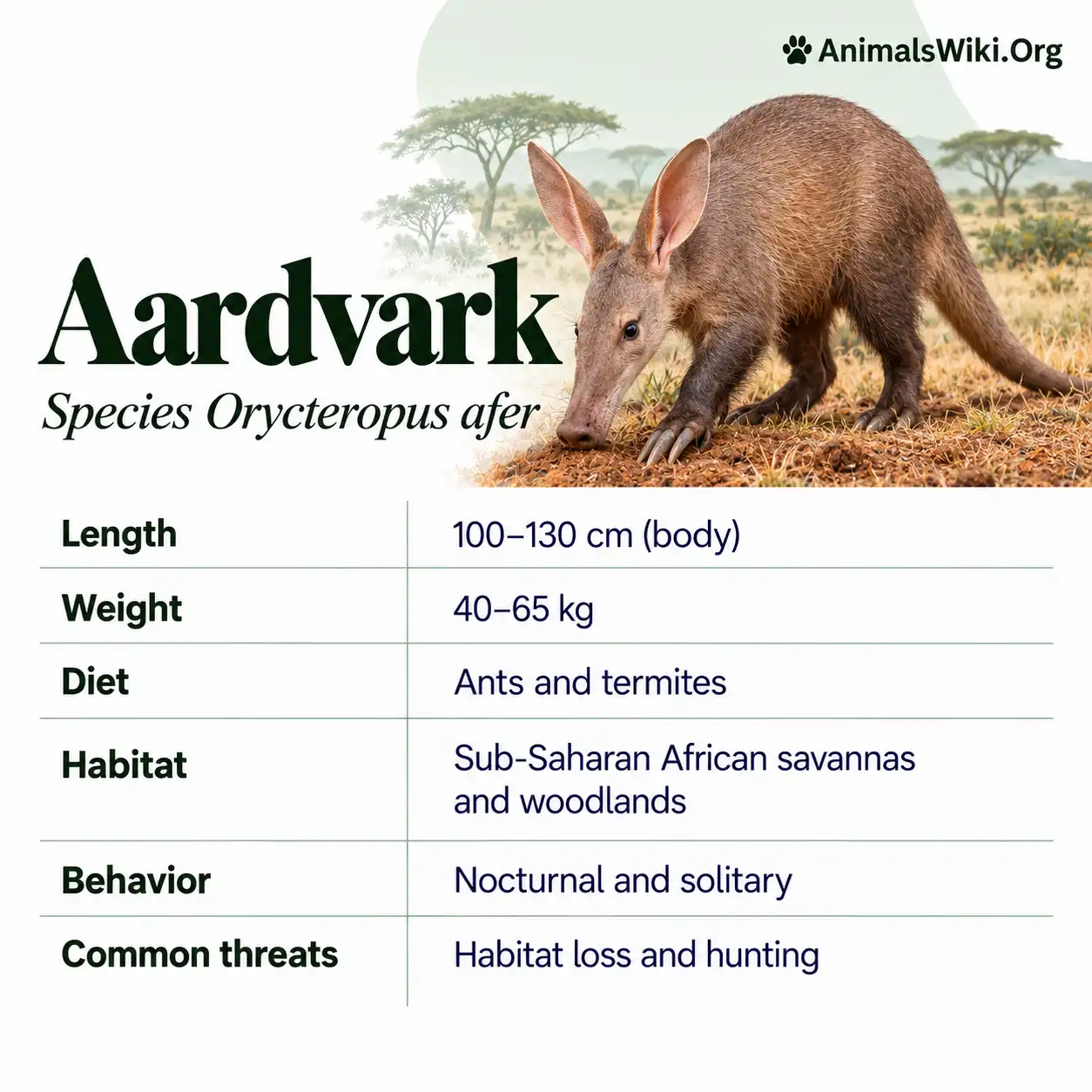
Aardvark, Africa’s Remarkable Underground Engineer
The aardvark is one of Africa’s most distinctive mammals. With its long snout, oversized ears, thick tail, and powerful digging feet, it looks like a combination of several familiar animals. However, it belongs to an evolutionary lineage of its own.
Its name means “earth pig,” but an aardvark is not a pig. It eats ants and termites, but it is not a true anteater. Its unusual appearance reflects a highly specialized way of life built around locating underground food and excavating shelter.
Much of that life unfolds after dark. An aardvark may spend the night moving between insect colonies, digging into the soil, and collecting prey with its sticky tongue. During the day, it usually rests underground.
Its digging also benefits other wildlife. Abandoned burrows provide shelter for mammals, birds, reptiles, and amphibians. The disturbed soil creates different growing conditions for plants, making the aardvark an important ecosystem engineer.
Despite its broad African distribution, the species remains difficult to study. Its secretive habits can conceal local losses, and research has revealed vulnerability to drought and food shortages.
This guide explores aardvark classification, appearance, habitat, feeding, reproduction, burrows, ecological importance, and conservation. It also explains how aardvarks differ from anteaters, pangolins, and aardwolves.
Information checked: October 18, 2026.
Aardvark Facts
| Feature | Details |
|---|---|
| Common name | Aardvark |
| Alternative name | Antbear |
| Scientific name | Orycteropus afer |
| Animal group | Mammal |
| Order | Tubulidentata |
| Family | Orycteropodidae |
| Evolutionary group | Afrotheria |
| Native distribution | Sub-Saharan Africa |
| Main foods | Ants and termites |
| Feeding specialization | Myrmecophagy |
| Typical activity | Mainly nocturnal |
| Social organization | Mostly solitary |
| Shelter | Underground burrows |
| Usual number of young | One |
| Young | Commonly called a cub or calf |
| Distinctive teeth | Tubular internal structure and no enamel |
| Major ecological role | Burrowing ecosystem engineer |
| Global conservation category | Least Concern |
1. What Is an Aardvark?
An aardvark is a large, burrowing African mammal specialized for eating ants and termites.
Its scientific name is Orycteropus afer. The first part refers to its digging feet, while the second identifies its African association.
Although it has a pig-like snout, the resemblance does not indicate a close relationship with pigs.
Its body combines several features suited to underground work: strong limbs, substantial claws, a sturdy neck, and a long nose used to investigate potential feeding sites.
The aardvark uses excavation for two essential purposes. It opens insect nests to obtain food and creates burrows for shelter.
These activities connect its survival with the condition of the soil and the availability of prey.
An area may contain abundant vegetation yet be unsuitable if the ground is too difficult to excavate or the right insect resources are missing.
Understanding the aardvark therefore requires looking below the surface as well as across the visible landscape.
2. Scientific Classification
The aardvark’s classification reflects its distinct evolutionary history.
| Classification level | Name |
|---|---|
| Kingdom | Animalia |
| Phylum | Chordata |
| Class | Mammalia |
| Major placental group | Afrotheria |
| Order | Tubulidentata |
| Family | Orycteropodidae |
| Genus | Orycteropus |
| Species | Orycteropus afer |
There is only one living aardvark species, although its lineage includes extinct relatives known from fossils.
Being the sole surviving representative of an order makes the aardvark evolutionarily distinctive.
However, that does not mean it has remained unchanged through time. Modern aardvarks are living animals shaped by evolution, not frozen remnants of an ancient stage.
Older references may discuss numerous subspecies, but their boundaries and validity require careful evaluation.
For a general account, the most reliable starting point is the recognized species Orycteropus afer.
Local variation can still matter biologically even when it is not assigned a separate formal name.
3. What Are Aardvarks Related To?
Aardvarks belong to Afrotheria, a major group of placental mammals that also includes elephants, hyraxes, sea cows, sengis, tenrecs, and golden moles.
These animals do not all look alike. Their relationship was clarified through evidence that extends beyond outward appearance.
The aardvark’s resemblance to an anteater is an example of convergent evolution.
Animals from different lineages can independently develop similar features when they face similar challenges.
A long sticky tongue, strong digging limbs, and a narrow feeding apparatus are useful for obtaining ants and termites. Comparable solutions therefore occur in animals that are not especially close relatives.
This distinction helps explain why appearance can mislead.
An aardvark may resemble an anteater more than an elephant, yet broad evolutionary relationships do not follow that visual impression.
Its ancestry and its feeding specialization tell different, complementary parts of the story.
4. What Does an Aardvark Look Like?
An aardvark has a heavy body, arched back, long head, large ears, and a thick tail that narrows toward the end.
Its skin is usually grayish, pinkish-gray, or brownish, although soil can stain it reddish or darker.
The coat is sparse compared with the dense fur of many mammals. Hair distribution and visibility vary across the body and between individuals.
The hindquarters are relatively high, with the rear legs longer than the front ones.
Its nose is elongated, and the small mouth is positioned at the end of a narrow muzzle.
The ears stand prominently when the animal is alert but can be folded back during digging.
An aardvark’s overall appearance becomes easier to understand when each feature is connected with its function.
It is built to investigate the ground, break into insect colonies, move excavated soil, and spend long periods in underground shelter.
5. Aardvark Size and Weight
An adult aardvark is a substantial animal rather than a small insect hunter.
Published adult weights commonly fall around 40–80 kilograms, although individuals can lie outside that broad range.
Head-and-body length is roughly 1–1.5 meters, with the tail adding considerable length.
Measurements vary with age, sex, condition, and the population studied.
They also vary according to how length is defined. A head-and-body measurement excludes the tail, while total length includes it.
A source reporting a two-meter aardvark may therefore be describing total length rather than an exceptionally long torso.
Body mass can change with nutritional condition as well.
For a specialized feeder, a period of poor prey availability may affect condition even when the animal continues searching for food.
The most useful size description presents a range and identifies the measurement rather than implying that every adult has one standard weight.
6. Where Do Aardvarks Live?
Aardvarks occur across much of Africa south of the Sahara.
Their range includes parts of western, central, eastern, and southern Africa, but occupancy is not continuous.
They are absent from environments that do not provide suitable combinations of food and digging conditions.
Extremely dry deserts are different from the semi-arid landscapes where aardvarks can occur.
This distinction is important because photographs from dry regions sometimes create the impression that the species is a true desert specialist.
Its presence depends heavily on ant and termite resources.
Distribution is also imperfectly documented in some areas because the animals are difficult to detect.
A lack of sightings can reflect low abundance, unsuitable conditions, inadequate survey methods, or simply limited observation.
Consequently, a broad range map is a starting point rather than a complete account of where populations are thriving.
Conservation work needs more detailed information within that range.
7. Aardvark Habitat Requirements
Aardvarks use several habitat types, including savanna, grassland, woodland, scrub, and some forest environments.
Two requirements are especially important: accessible prey and soil suitable for excavation.
Very rocky terrain can limit digging, while persistent flooding can make underground shelter unsuitable.
The presence of ants or termites alone is not sufficient. The prey must occur in forms and locations the aardvark can exploit effectively.
Habitat quality can also vary seasonally.
Rainfall affects vegetation, which influences the insects, while changes in soil condition alter the effort required to reach them.
An aardvark therefore experiences habitat as a combination of aboveground and underground conditions.
This helps explain why a landscape that looks unchanged to a casual observer can become less suitable.
Its plant cover may remain visible while food accessibility or soil moisture changes in ways that matter greatly to a digging insectivore.
8. Powerful Feet and Digging Claws
The aardvark’s feet are among its most important tools.
The forefeet have four toes, while the hind feet have five. Strong nails form broad digging structures that are often described as shovel-like.
The front limbs break and move soil, while the rest of the body supports the effort.
This equipment allows the aardvark to open insect nests and excavate shelter.
Digging performance nevertheless depends on the substrate.
Loose soil, compact ground, roots, and hard termite structures create different demands.
For that reason, dramatic claims that an aardvark always digs a particular distance in a few seconds should be treated cautiously.
The biological achievement is clear without a universal speed record.
Aardvarks can move substantial amounts of material and create spaces large enough to shelter their bodies.
Their limbs are not simply strong in isolation; they form part of a coordinated system involving claws, muscles, posture, and body support.
9. Feeding Excavations and Sleeping Burrows
Not every hole made by an aardvark serves the same purpose.
A feeding excavation may be relatively shallow and focused on reaching an insect colony.
A shelter burrow provides enough space for the animal to enter and rest.
Some burrows are used briefly, while others remain useful for longer periods.
This variety creates a landscape containing structures of different sizes and ages.
A hole discovered during a walk therefore cannot automatically be interpreted as an occupied sleeping burrow.
Researchers examine shape, dimensions, tracks, fresh excavation, and other evidence to understand its likely use.
The distinction matters for population surveys.
Counting every excavation as one animal would greatly overestimate abundance.
One aardvark can create or use multiple structures, and old burrows may remain after the original excavator has moved away.
The visible evidence records activity over time, not a simple census.
10. What Is Inside an Aardvark Burrow?
An aardvark burrow is more than an entrance in the ground.
It can include a tunnel leading to a resting space, and some systems become more complex through repeated use or modification.
Underground conditions differ from those at the surface.
The burrow offers darkness, physical cover, and reduced exposure to rapid weather changes.
However, burrows are not all identical.
Depth, soil, orientation, vegetation, and age influence the environment inside.
A dry burrow in one habitat should not be assumed to have the same temperature or humidity as another elsewhere.
For the aardvark, the burrow is a practical refuge between feeding periods.
For other species, it can become a ready-made resource after the aardvark leaves.
This continuing usefulness is central to its ecological importance: the effects of digging can persist beyond the immediate needs of the animal that created the space.
11. How Burrows Buffer Temperature
Underground shelter can reduce exposure to daily temperature extremes.
A study comparing aardvark burrows with nearby surface conditions found lower maximum temperatures and higher minimum temperatures inside the burrows.
In other words, the interior environment was less extreme.
Humidity also differed.
Such conditions can benefit an aardvark resting through the day and other animals using the structure later.
The advantage is especially relevant where surface temperatures change sharply between day and night.
However, a burrow is not an unlimited solution to environmental stress.
An aardvark must eventually leave to feed, and shelter cannot replace the energy obtained from prey.
This creates an important distinction between avoiding exposure and meeting nutritional needs.
The animal’s success depends on both.
A suitable burrow may protect it from immediate weather extremes while poor food conditions elsewhere continue to affect its body condition and survival.
12. What Do Aardvarks Eat?
Aardvarks specialize in eating ants and termites.
This feeding strategy is called myrmecophagy.
The relative importance of ants and termites varies by location and season. The common description “termite eater” therefore tells only part of the story.
A field study in South Africa’s Nama Karoo found ants predominating throughout the study, with termites becoming more important during particular conditions.
This illustrates why diet should be established from evidence rather than assumed from familiar images of termite mounds.
Aardvarks may investigate underground nests that are not obvious above the surface.
Their feeding landscape includes many small resource patches rather than only large visible structures.
A productive area must provide enough accessible insects across repeated nights.
Finding one rich colony does not necessarily meet the animal’s longer-term needs, particularly when weather and seasonal changes alter the distribution of prey.
13. How an Aardvark Finds Its Food
An aardvark searches with its snout near the ground, using smell to investigate potential prey locations.
Once it identifies a useful site, its claws allow access through soil or nest material.
The long snout is therefore part of a two-stage system: locate the food, then excavate it.
This is more efficient than digging randomly across the landscape.
An animal feeding on concealed prey must also judge whether continued effort is worthwhile.
Accessibility changes as excavation proceeds, insects respond, and easily reached individuals are removed.
The aardvark may then leave and search elsewhere.
Its nightly activity can consequently involve repeated short searches and feeding bouts.
This pattern is less dramatic than opening one enormous mound, but it may better represent much routine foraging.
Understanding the process requires attention to the small decisions that connect sensory information, physical effort, and energy gained from food.
14. The Long, Sticky Aardvark Tongue
The aardvark’s tongue is long, narrow, and coated with sticky saliva.
It can extend into spaces where the mouth itself cannot reach, collecting insects from exposed passages.
Published descriptions commonly give an extended length approaching 30 centimeters.
The exact appearance depends on how far it is protruded, so it should not be imagined as hanging outside the mouth continuously.
Large salivary glands support this feeding method.
The tongue’s usefulness becomes apparent after the claws have opened access to the nest.
Digging and collecting are complementary activities: powerful feet expose the resource, while the tongue extracts small prey efficiently.
This combination allows a large mammal to obtain energy from insects.
The physical challenge is not capturing one large target but gathering sufficient numbers of small ones without spending more energy than the food provides.
15. Does an Aardvark Have Teeth?
Yes. An aardvark has teeth, although its adult dentition is unusual.
Adults lack the prominent front incisors and canines familiar from many other mammals.
Their remaining cheek teeth have an internal structure containing numerous dentine tubules and lack a protective enamel covering.
The teeth continue growing.
This anatomy gives the order Tubulidentata its name, referring to tubular teeth.
The aardvark should therefore not be called toothless simply because its mouth is adapted to collecting small insects.
Its dental structure also differs from that of true anteaters.
Specialized anatomy can create clinical challenges under human care. The long mouth and tongue make examination difficult, while dental problems may require careful imaging.
For general biology, the main point is that aardvarks possess a distinctive feeding system rather than a reduced version of an ordinary carnivore’s mouth.
16. Digestion and the Challenge of Eating Insects
Aardvarks do relatively little chewing compared with mammals that grind tough plant material before swallowing.
Their digestive system must process large quantities of small prey, including hard external insect structures.
A muscular stomach contributes to mechanical processing.
This arrangement fits the way food is collected: insects arrive rapidly on the tongue rather than being individually captured and thoroughly chewed.
Specialization brings advantages, but it also limits flexibility.
A generalist mammal may switch among fruit, seeds, meat, and insects when conditions change. An aardvark depends much more strongly on a particular prey base.
The consequences become apparent during food shortages.
An animal can retain strong claws and an effective tongue yet struggle if suitable prey becomes inaccessible.
Its adaptations solve the problem of exploiting ants and termites; they do not eliminate dependence on those insects remaining available.
17. How Many Insects Does an Aardvark Eat?
Aardvarks are often said to eat tens of thousands of insects in a night.
Such figures communicate the scale required to support a large insectivorous mammal, but they should not be treated as a fixed nightly count.
Actual intake varies with the animal, prey size, colony density, activity, and feeding success.
Counting insects is also different from measuring energy obtained.
Two prey types can differ in body size and nutritional value, so equal numbers do not necessarily provide equal benefits.
For scientists, the more useful questions concern diet composition, time spent feeding, and whether the animal maintains condition.
A night with many feeding attempts can still be unsuccessful if each provides little food.
The aardvark’s appetite is impressive, but reliable interpretation goes beyond repeating one maximum number.
Its survival depends on the relationship between effort and usable energy.
18. Do Aardvarks Destroy Entire Colonies?
Not necessarily.
An aardvark can damage a nest and consume many insects without eliminating the whole colony.
Feeding may stop while insects remain because the remaining prey is less accessible or the returns no longer justify the effort.
This is consistent with a predator using part of a concentrated resource rather than deliberately destroying it.
However, it would also be too simple to claim that every colony always survives unchanged.
The outcome depends on nest structure, the extent of excavation, and the insects involved.
The important distinction is that an aardvark is feeding, not managing a colony according to a future plan.
Repeated access to productive areas can occur without requiring such intentional conservation.
Its behavior emerges from immediate opportunities and costs, while the broader pattern influences how prey resources remain distributed across the landscape.
19. Are Aardvarks Always Nocturnal?
Aardvarks are mainly nocturnal, but their timing changes with season and conditions.
Research in the Karoo found earlier emergence and shorter activity periods in winter compared with summer.
Some individuals occasionally fed before sunset.
This means a daylight sighting is not automatically evidence of illness.
However, extensive daytime activity during drought can signal a different problem.
Researchers have linked such shifts with energy shortages and changes in body-temperature regulation.
Context is essential.
The same outward behavior can occur under different circumstances, so a single photograph cannot establish the animal’s condition.
Repeated observations, weather information, and body-condition data provide a stronger interpretation.
For visitors, the appropriate response is to observe without disturbance rather than assume every daytime aardvark needs intervention.
For researchers, unusual timing can be a useful clue when combined with other evidence.
20. Social Life and Communication
Aardvarks are generally solitary.
Adults usually forage independently rather than moving in stable packs or family groups.
Mothers with dependent young are an important exception.
Solitary living does not mean an animal has no communication or encounters.
Smell, sounds, and direct investigation can provide information about other individuals.
Aardvarks are relatively quiet compared with highly vocal social mammals, although grunts and other sounds are reported.
Their long periods underground also shape how encounters occur.
Home ranges can overlap without requiring the occupants to travel together or occupy the same burrow at the same time.
Understanding this distinction prevents a common mistake: interpreting shared space as proof of group living.
Aardvark society is better described through individual movements and occasional interactions than through a permanent social unit comparable to a hyena clan or mongoose group.
21. How Far Do Aardvarks Travel?
An aardvark must connect feeding sites with suitable shelter, and the distance required depends on the landscape.
Home-range estimates from individual studies should not become universal values.
Methods, prey distribution, habitat, and sample size influence the result.
Newer genetic work has also shown that individuals can be detected at separated locations, adding information beyond what a short tracking period reveals.
Home range, nightly travel, and dispersal are different measurements.
Home range describes the area used during routine life. Nightly travel describes movement over a shorter period. Dispersal involves moving away from an original area, often during the transition to an independent breeding life.
Mixing these concepts produces misleading claims.
For conservation, each matters in a different way.
Feeding habitat must support everyday movement, while broader connectivity allows individuals and genes to move between areas over longer periods.
22. Water and Moisture Requirements
Aardvarks obtain substantial moisture from their food.
This helps explain how they can occupy some dry environments without requiring the same drinking pattern as many large herbivores.
However, the claim that aardvarks never drink water is too absolute.
Drinking has been documented, including in field observations.
Their water balance depends on environmental conditions, food moisture, activity, and physiological losses.
Dry conditions can create problems indirectly by reducing food rather than simply removing access to surface water.
This connection is especially important for a specialist insectivore.
An animal may remain near a water source yet be unable to meet its energy needs if prey availability declines.
Likewise, a habitat without permanent open water can still be useful when food supplies sufficient moisture.
The aardvark’s requirements are therefore best understood through its whole energy and water budget rather than one drinking rule.
23. The Aardvark Cucumber Connection
Aardvarks have a remarkable association with the underground fruit of Cucumis humifructus, often called the aardvark cucumber or aardvark melon.
Although ants and termites dominate the diet, this plant provides a documented exception.
Its fruits develop beneath the soil.
A 2025 study in Namibia used cameras, observations, seed examinations, and scent analysis to investigate the relationship.
Aardvarks excavated naturally buried fruits, consumed the contents, and passed intact seeds in their droppings.
The researchers found seedlings originating from those droppings.
The relationship shows how a feeding specialist can still perform a distinctive seed-dispersal role.
It should not be expanded into a claim that aardvarks routinely eat many kinds of fruit.
The significance lies in the particular interaction: digging and smell allow access to a buried food source, while the plant benefits when its seeds are moved and deposited.
24. Aardvark Reproduction
Aardvarks usually produce a single youngster after a relatively long pregnancy.
Recent research provides useful detail beyond the rounded figures often repeated in animal summaries.
A 2026 case report examined reproductive physiology in one female through hormone monitoring, behavior, and ultrasound.
The estimated pregnancy lasted 231 days, consistent with previously reported lengths of 213–258 days.
Because this was a detailed study of one female, it should not be treated as a complete description of reproductive variation across Africa.
Its value lies in documenting processes that had received limited study.
Understanding pregnancy can help professional care teams recognize reproductive stages and make better management decisions.
In the wild, successful reproduction also depends on the mother obtaining enough food and maintaining suitable shelter.
A birth is only one stage in the process; raising the youngster requires continued investment.
25. Baby Aardvarks and Development
A baby aardvark is commonly called a cub or calf.
Newborns have wrinkled skin, prominent developing ears, a long snout, and claws already suited to their distinctive body plan.
They initially depend on maternal milk and shelter.
As they grow, they begin accompanying their mother and developing feeding and digging abilities.
Professional observations have recorded young showing digging movements very early, but early behavior is different from full independence.
A youngster still needs growth, coordination, experience, and reliable access to food.
Reports commonly describe solid food being introduced during the first few months and nursing continuing for several months.
Exact timing varies and should not be presented as a compulsory schedule.
The transition involves several milestones: leaving the burrow, traveling with the mother, eating insects, excavating effectively, and eventually living independently.
These stages do not all occur at the same moment.
26. How Long Do Aardvarks Live?
Aardvarks can survive into their twenties under professional care, but wild lifespan is less securely established.
This distinction matters because an animal rarely followed throughout life cannot easily be assigned a precise average age at death.
Maximum longevity, average lifespan, and generation length are different concepts.
An unusually old individual demonstrates what is possible under particular conditions, not what every aardvark can expect.
Wild survival depends on food, predators, injuries, hunting, and environmental stress.
Age also changes the challenges faced.
A youngster must develop independence, while an adult female must support reproduction without losing condition.
For population conservation, survival across these life stages is more informative than a single lifespan number.
A population can contain long-lived adults yet struggle if too few young survive, or experience losses that remain hidden because routine monitoring is difficult.
27. Predators and Natural Defenses
Aardvarks can be prey for large African predators.
Lions, leopards, and hyenas are among the animals reported to attack them, although risk varies by region and circumstances.
Young aardvarks face different vulnerabilities from substantial adults.
Their defenses include vigilance, retreat, powerful digging, and the physical protection of a burrow.
Strong claws may also make a threatened aardvark difficult to handle.
However, it should not be described as invulnerable because it can dig quickly.
A suitable escape site may not always be available, and excavation requires time.
Natural defenses reduce risk rather than eliminating it.
The aardvark’s nocturnal schedule and cautious behavior also belong within this defensive system.
Much predator avoidance occurs before a chase or confrontation becomes visible.
For observers, quiet investigation at a burrow entrance may appear uneventful while serving an important survival function.
28. Why Aardvarks Are Ecosystem Engineers
An ecosystem engineer changes the physical environment in ways that affect other organisms.
Aardvarks fit this description because excavation creates structures and alters soil.
The effect does not depend on deliberate assistance to other species.
An aardvark digs to meet its own needs, but the result can benefit animals and plants afterward.
This separates ecosystem engineering from feeding relationships such as predation or pollination.
The physical structure itself becomes part of the ecological effect.
A burrow can remain useful after its creator leaves, extending the influence through time.
This is why losing an aardvark population can mean more than losing one insect-eating species.
It can also reduce the ongoing creation of shelter and disturbance patches.
The full consequence depends on which other excavators and shelter resources occur locally, making the role important but context-dependent.
29. Which Animals Use Aardvark Burrows?
Many animals use aardvark burrows for shelter, resting, breeding, or escape.
Documented users include mammals, birds, reptiles, and amphibians.
A study across three South African sites recorded 27 vertebrate species using the structures, while other compilations report additional users.
These counts describe particular studies rather than a fixed global total.
An animal photographed at an entrance also may be visiting, hunting, or investigating rather than living inside.
Researchers therefore distinguish simple occurrence from prolonged use or dependence.
The burrows can be especially valuable to species unable to excavate a comparable refuge themselves.
For some occupants, protection from temperature extremes may matter most. For others, concealment or a breeding location may be the main benefit.
One physical structure can consequently provide different services to different animals.
30. Aardvarks and Blue Swallows
The relationship between aardvark burrows and birds is especially interesting.
Blue swallows can use underground cavities, including aardvark-excavated holes, as nesting locations in suitable grassland environments.
These are not ordinary tree nests or open nests on the ground.
The cavity provides a distinct physical setting.
Research comparing nest and ambient temperatures found that underground sites experienced less variation than the surrounding environment.
However, aardvark holes are not the only natural cavities used, and nesting success depends on more than temperature.
Predation, weather, availability, and other conditions also matter.
The example illustrates how a mammal’s excavation can create opportunities for an animal with very different biology.
It also encourages conservation planning across species.
Protecting a grassland bird may require attention to the mammals that help create nesting structures, alongside vegetation, disturbance, and the wider habitat.
31. Digging Changes Soil and Vegetation
Aardvarks alter more than underground shelter.
Excavation removes soil from one location and deposits it elsewhere, creating differences between entrances, mounds, and undisturbed ground.
Research has found changes in soil conditions and vegetation associated with these features.
The effects also change with age.
A fresh excavation may disrupt existing plants, while an older abandoned feature can provide different establishment opportunities.
This means it is inaccurate to claim that every aardvark hole immediately increases plant diversity.
The result depends on the stage of disturbance and the surrounding ecosystem.
Studies across different biomes have found that the direction and magnitude of effects are not identical everywhere.
The broader pattern is increased small-scale variation.
By continually creating and abandoning excavations, aardvarks contribute to a shifting mosaic of conditions rather than producing one uniform outcome across the landscape.
32. Aardvark vs. Anteater, Pangolin, and Aardwolf
These animals share some features or names but belong to different groups.
| Animal | Main classification | Natural distribution | Important distinction |
|---|---|---|---|
| Aardvark | Tubulidentata | Africa | Burrowing mammal with unusual tubular teeth |
| True anteaters | Vermilingua within Pilosa | Central and South America | Separate lineage of ant- and termite-eating mammals |
| Pangolins | Pholidota | Africa and Asia | Covered in overlapping keratin scales |
| Aardwolf | Hyaenidae | Africa | Member of the hyena family |
The aardwolf causes particular confusion because its name resembles aardvark.
Both consume insects, but an aardwolf has the body form and ancestry of a small hyena.
Likewise, calling an aardvark an “African anteater” may describe its feeding style informally but should not imply membership among true anteaters.
The similarities demonstrate how different mammals can exploit related food resources.
The differences reveal the separate anatomical and evolutionary solutions each lineage developed.
33. Are Aardvarks Endangered?
The aardvark is globally classified as Least Concern, rather than Endangered.
However, this category should not be translated into “all populations are stable.”
Its broad range contributes to the assessment, while its secretive behavior makes abundance and trends difficult to establish.
Regional assessments emphasize the need for better population estimates.
An animal can be difficult to see because it is nocturnal and underground, because it occurs at low density, or because it is declining.
These possibilities require different evidence.
Likewise, many burrows do not necessarily mean many aardvarks.
One animal uses several, and abandoned structures can remain visible.
The sound conservation approach is to maintain monitoring and address documented threats without inventing a precise global count.
Least Concern describes assessed extinction risk at a particular scale; it does not remove the value of protecting local populations.
34. Habitat Change, Hunting, and Human Conflict
Aardvarks face several human-related pressures.
Habitat conversion can reduce prey, remove suitable digging areas, or expose animals to more disturbance.
Hunting for meat and use of body parts can create additional losses in some regions.
Conflict also occurs where burrows interfere with fences, roads, crops, or livestock management.
These concerns should be taken seriously without treating the animal’s entire ecological contribution as harmful.
Practical conservation requires understanding where damage occurs and which responses reduce it without unnecessary killing.
The aardvark’s dependence on insect prey also makes changes in the wider food web relevant.
However, a claim that one pressure is the main cause of decline everywhere would exceed the evidence.
Threats differ geographically, and their effects can combine.
A population coping with altered habitat may be less able to withstand hunting or severe drought than one experiencing either pressure alone.
35. Drought, Climate Change, and Hidden Starvation
Research in the Kalahari has revealed an important vulnerability.
During severe drought, aardvarks struggled to obtain enough food, showed major changes in body-temperature regulation, and suffered deaths.
The problem was not simply that a hot environment made them overheat.
Reduced energy intake undermined their ability to maintain normal physiology.
Some shifted toward daytime activity, potentially reducing the energetic costs associated with cold nighttime conditions.
Later work connected these changes with food availability and broader environmental conditions.
The finding shows how climate can affect an animal indirectly through its prey.
A sturdy digger may appear physically well equipped yet remain vulnerable when the resource it specializes in becomes scarce or inaccessible.
These results come from particular populations and should not be converted into a precise prediction for every aardvark.
They nevertheless provide a strong reason to investigate climate-related risks more widely.
36. What Research Reveals About Conservation
Scientists use several approaches to study aardvarks.
Camera traps can document activity, tracking reveals movements, and physiological loggers provide information that is invisible from appearance alone.
Genetic material from droppings offers another route.
A landscape-genetics study found that arid conditions were associated with greater genetic separation among sampled aardvarks, suggesting reduced movement or gene flow through drier areas.
This adds a connectivity concern to the direct effects of drought.
Each method has limitations.
A camera records only what passes its detection zone, while a small tracking study may not represent the whole range.
Combining evidence improves the picture.
The practical goals are to identify where animals remain, understand which conditions support them, monitor losses, and retain connections between suitable areas.
Protecting aardvarks also helps preserve the burrows and soil processes on which other wildlife may depend.
37. Aardvark Myths and Facts
| Common claim | More accurate explanation |
|---|---|
| An aardvark is a pig | It belongs to a separate mammalian order |
| It is a true anteater | The resemblance reflects convergent evolution |
| It eats only termites | Ants can dominate its diet |
| It has no teeth | Adults have specialized cheek teeth |
| Every hole contains an aardvark | Animals use multiple burrows, and old holes persist |
| It never appears during daylight | Activity can change with season and condition |
| A daytime sighting always means illness | Context and additional evidence are needed |
| It never drinks water | Drinking has been documented |
| Every feeding event destroys a colony | Colonies may remain after feeding |
| Least Concern means confirmed population stability | Trends and abundance remain poorly known |
| Its digging benefits only itself | Other animals and plant communities are affected |
| It is perfectly adapted to increasing drought | Research has documented serious vulnerability |
The accurate account is already remarkable: a specialized insect eater can reshape habitat for organisms far beyond its own food supply.
38. Frequently Asked Questions About Aardvarks
What is the scientific name of the aardvark?
The scientific name is Orycteropus afer. It belongs to the family Orycteropodidae and is the only living species in the order Tubulidentata. Its distinctive classification reflects an evolutionary history separate from pigs and true anteaters.
What does the word aardvark mean?
Aardvark comes from Afrikaans and means “earth pig.” The name reflects its pig-like appearance and digging behavior. It should not be interpreted as a statement that the animal belongs to the pig family.
Is an aardvark an anteater?
It is an ant-eating mammal, but it is not a true anteater. True anteaters belong to a different lineage in the Americas. Similar feeding demands have produced comparable features, including a long tongue and digging adaptations.
Are aardvarks related to elephants?
They share membership in Afrotheria, a broad group of placental mammals. This does not mean an aardvark is a small elephant. Their outward differences illustrate how diverse animals can share deeper evolutionary relationships.
Where are aardvarks naturally found?
They occur across much of sub-Saharan Africa where prey and soil conditions are suitable. They are not present everywhere within that broad region. Extremely dry deserts, difficult rocky ground, and unsuitable flooded areas can limit occurrence.
What do aardvarks eat most often?
Ants and termites form the main diet. Their relative importance varies with place and season. Some studied aardvarks have eaten more ants than termites, so describing the species only as a termite eater is incomplete.
Do aardvarks eat fruit?
They have a documented association with the buried fruit of Cucumis humifructus. Research has shown them excavating and consuming it and dispersing seeds. This specific relationship does not make the aardvark a general fruit-eating mammal.
How long is an aardvark’s tongue?
It can extend to roughly 30 centimeters according to commonly reported measurements. The tongue is narrow and coated in sticky saliva, allowing insects to be collected from openings exposed by digging.
Does an aardvark have teeth?
Yes. Adults have cheek teeth with unusual tubular internal anatomy and no enamel covering. They lack the prominent front incisors and canines familiar from many mammals. Their teeth also differ from the completely toothless condition of true anteaters.
How much does an aardvark weigh?
A broad adult range is approximately 40–80 kilograms, with variation between individuals. Weight depends on age, sex, and condition. An upper recorded weight should not be presented as the normal mass of every adult.
Are aardvarks nocturnal?
They are mainly nocturnal, but activity can begin earlier in cold conditions or change during food shortages. Daylight activity is therefore possible. Its meaning depends on season, local conditions, and the animal’s broader behavior.
Why might an aardvark appear during the day?
Possible explanations include seasonal timing and responses to energy limitations. Drought research has linked increased daytime activity with food shortages and altered body temperature. One sighting alone is insufficient to diagnose the animal’s condition.
What is a baby aardvark called?
A baby is commonly called a cub or calf. Both terms appear in professional descriptions. Young initially rely on maternal care and gradually develop the feeding, movement, and digging abilities required for independence.
How long is an aardvark pregnant?
Pregnancy lasts roughly seven to eight and a half months in documented reports. A 2026 case study estimated 231 days in one female, consistent with an earlier reported range of 213–258 days.
How many babies does an aardvark have?
A single youngster is usual. The mother invests in nursing and supporting its development over several months. This relatively low reproductive output is one reason losses of breeding adults can matter to local populations.
Do aardvarks live in groups?
They are generally solitary. Adults usually forage independently, while mothers remain with dependent young. Overlapping home ranges or use of the same area at different times should not be mistaken for permanent group living.
How long do aardvarks live?
Individuals can live into their twenties under professional care. Wild lifespan is less certain because long-term survival is difficult to measure. Maximum recorded age and average lifespan are different values.
What animals use aardvark burrows?
Various mammals, birds, reptiles, and amphibians use them. The occupants differ by region and habitat. Some use burrows briefly, while others rest or breed inside. A visitor at an entrance is not necessarily a permanent resident.
Are aardvarks dangerous to people?
They are powerful wild animals with strong claws and should not be handled or cornered. Their usual secretive behavior does not make close contact appropriate. Give them space and follow the guidance of trained wildlife personnel.
Can aardvarks be kept as pets?
They are unsuitable as ordinary household pets. Their specialized diet, digging behavior, size, nocturnal schedule, and care requirements demand professional facilities and expertise. Familiarity with people does not make an aardvark domesticated.
Are aardvarks endangered?
Their global category is Least Concern, rather than Endangered. However, abundance and trends are poorly known, and local populations face threats. The category does not establish that every population is stable or adequately protected.
What is the difference between an aardvark and an aardwolf?
An aardvark is a burrowing member of Tubulidentata. An aardwolf belongs to the hyena family. Both eat insects, but they differ substantially in ancestry, body form, feeding behavior, and the kinds of shelter they create or use.
Do aardvarks destroy termite populations?
They consume termites but do not necessarily eliminate entire colonies. Feeding can stop while insects remain. The ecological effect depends on prey availability, nest structure, feeding frequency, and conditions rather than one universal outcome.
Why are aardvarks important?
They influence ecosystems through feeding, excavation, shelter creation, and particular seed-dispersal interactions. Their abandoned burrows can support other species, while soil disturbance creates varied local conditions for plants and other organisms.
How can people help protect aardvarks?
Support habitat protection, research, and practical coexistence measures. Avoid disturbing burrows or encouraging close approaches for photographs. Conservation also needs better monitoring because a secretive species can experience changes that remain unnoticed for years.



