
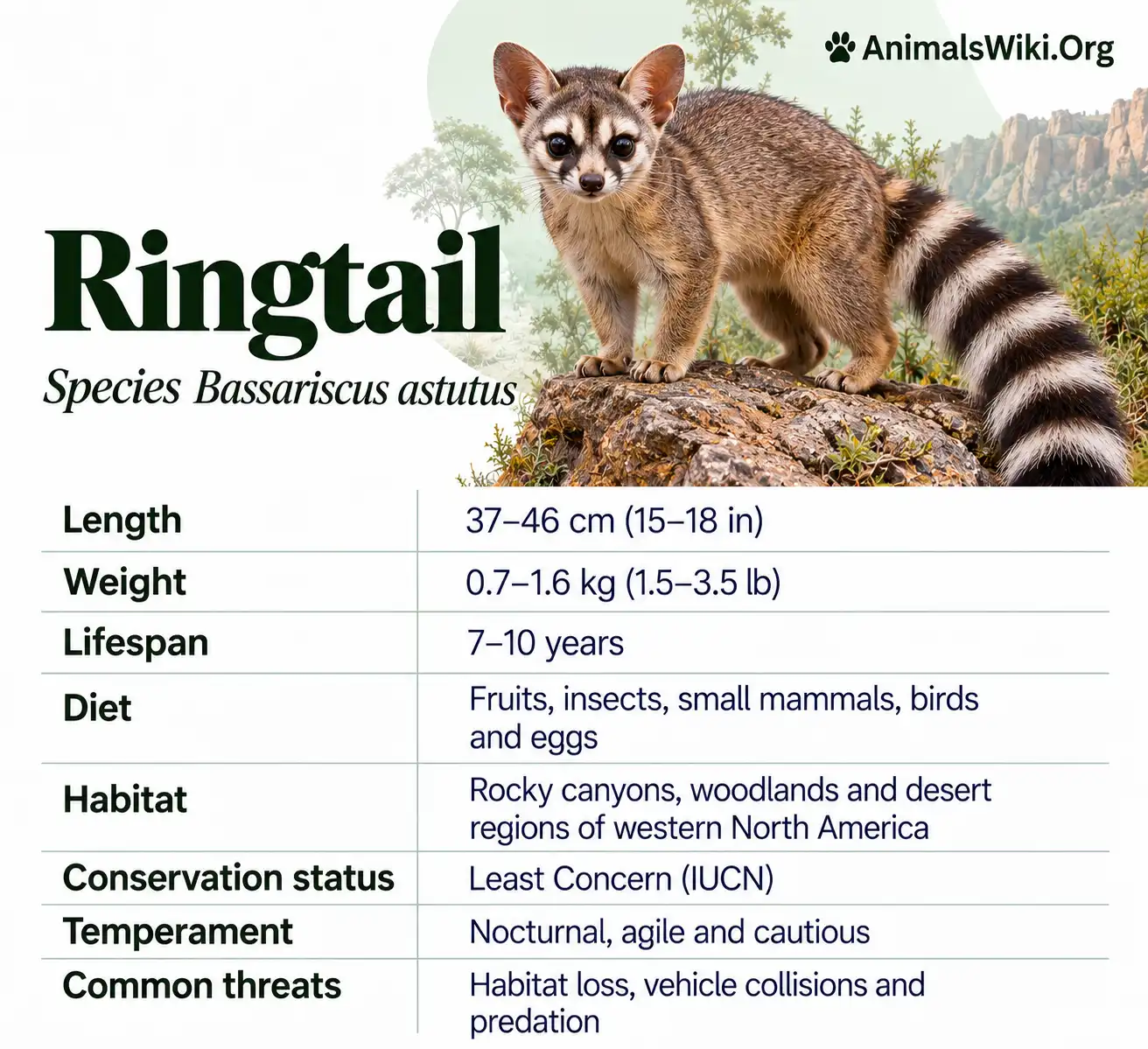
Ringtail, A Complete Guide to the Remarkable Ring-Tailed Cat
The ringtail is a small, agile mammal recognized by its enormous eyes, pointed muzzle and long tail marked with alternating dark and pale bands. Often called the ring-tailed cat, this elusive animal belongs to the raccoon family. Its appearance combines features that may remind people of a fox, a squirrel and a cat, but its identity is entirely its own.
Scientifically known as Bassariscus astutus, the ringtail inhabits parts of the United States and Mexico. It is especially associated with rocky country, where narrow ledges, deep crevices and steep slopes provide places to hunt, travel and rest. Its climbing ability helps it move through terrain that would challenge many larger mammals.
Most people living within ringtail territory never see one. These animals are mainly active at night, and their small size allows them to disappear into remarkably inconspicuous hiding places. A brief glimpse beside a canyon trail or a nighttime photograph may be the only evidence of a nearby resident.
The name “ringtail” can also describe unrelated animals with banded tails. This guide focuses on the North American ringtail, Bassariscus astutus, rather than ring-tailed lemurs or Australian ringtail possums. Its scientific classification places it in Procyonidae, alongside raccoons and their relatives.
Ringtail Facts
| Feature | Details |
|---|---|
| Common name | Ringtail |
| Other names | Ring-tailed cat, miner’s cat |
| Scientific name | Bassariscus astutus |
| Animal group | Mammal |
| Family | Procyonidae |
| Native distribution | United States and Mexico |
| Head and body length | Approximately 30.5–42 centimeters |
| Tail length | Approximately 31–44 centimeters |
| Typical adult weight | Approximately 0.82–1.3 kilograms |
| Main activity period | Night |
| Diet | Small animals, insects, fruit and other plant foods |
| Social pattern | Generally solitary |
| Pregnancy length | Approximately 51–54 days |
| Litter size | Commonly two to four young |
| Global conservation category | Least Concern |
| Distinctive feature | Long, banded tail and exceptional climbing ability |
1. What Is a Ringtail?
A ringtail is a small mammal whose long, boldly marked tail accounts for a substantial part of its overall length. Its slender body, flexible movements and large sensory features suit a life spent exploring complicated environments after dark.
Although it belongs to the mammalian order Carnivora, the ringtail eats both animal and plant material. This distinction matters because the name of a scientific order does not describe every meal its members consume. Ringtails can hunt small prey while also taking advantage of seasonal fruit.
The animal’s combination of features makes more sense when considered together. A lightweight body helps it negotiate narrow supports. Its tail assists balance. Large ears and eyes are useful during nighttime activity, while a pointed muzzle helps it investigate small openings.
Knowing these features also improves identification. A banded tail alone is insufficient, because several other mammals share that characteristic. The ringtail’s body shape, face and proportions complete the picture.
2. Why Is It Called a Ring-Tailed Cat?
The name ring-tailed cat describes an impression, rather than a scientific relationship. A ringtail may appear catlike because it is agile, has a long tail and moves confidently over difficult surfaces. However, it belongs to a different mammal family.
Its other familiar name, miner’s cat, comes from historical accounts of miners and settlers keeping ringtails around cabins as mousers. An animal that hunted rodents could be welcomed in places where stored food attracted mice.
Those historical relationships do not make the ringtail a domesticated animal. A wild mammal becoming accustomed to a building or a person is different from a species undergoing domestication across many generations.
For readers encountering several common names, the scientific name provides a reliable reference. “Ringtail,” “ring-tailed cat” and “miner’s cat” may all refer to Bassariscus astutus. Using that name prevents confusion when discussing its biology, identifying photographs or comparing information from different regions.
3. Ringtail Classification and Close Relatives
The ringtail belongs to Procyonidae, the family containing raccoons, coatis and several other American mammals. Family membership reflects evolutionary relationships, even when relatives differ greatly in appearance.
A raccoon has a broader body and a conspicuous facial mask. A ringtail is more slender, with a more pointed muzzle and a tail that appears especially long in relation to its body. These differences can obscure their relationship at first glance.
The ringtail’s genus, Bassariscus, also includes the southern cacomistle, Bassariscus sumichrasti. These two species are more closely related to each other than either is to a domestic cat.
Common names require care here. The name “cacomixtle” is also used for B. astutus in Mexico, so a name alone may not establish which species a source describes. For comparisons between the two Bassariscus species, scientific names are particularly helpful. They keep regional naming traditions from becoming a source of mistaken identification.
4. What Does a Ringtail Look Like?
A ringtail has a grayish, buff or brownish upper body, with lighter fur underneath. Its face combines a pointed muzzle, large rounded ears and pale markings around dark eyes.
The tail is the most immediately recognizable feature. Dark and pale bands extend along its length, creating a strong pattern that stands out even when the body blends into surrounding rocks or vegetation.
A good identification photograph should ideally show more than the tail. Rounded ears, a slender torso and the pointed face help distinguish a ringtail from other animals in its environment.
Lighting can change its apparent color. A nighttime camera image may make the animal look nearly gray, while a daylight photograph can reveal warmer tones. Infrared photographs may conceal much of the coat’s natural coloration altogether.
For that reason, body structure is often more dependable than color alone. Look at the relative lengths of the body and tail, the shape of the ears and the arrangement of the facial markings.
5. How Big Is a Ringtail?
Adult ringtails are lightweight mammals. A commonly reported head and body length is about 30.5–42 centimeters, with a tail measuring roughly 31–44 centimeters. Typical body mass is approximately 0.82–1.3 kilograms.
These measurements explain why photographs can be misleading. A tail extending behind the animal makes its total silhouette appear much larger than its torso would suggest. Thick fur can further exaggerate its apparent size.
It is useful to distinguish body length from total length. A description of an animal measuring around 80 centimeters may include the entire tail. That does not mean its body alone is that long.
The phrase “cat-sized” can also create the wrong impression. Many domestic cats weigh considerably more than a ringtail.
When comparing animals, weight and separate body measurements provide a clearer picture than a familiar comparison alone. The ringtail is a slender, lightweight climber whose reach and overall outline are expanded considerably by its tail.
6. What Does the Ringtail’s Tail Do?
The ringtail’s long tail helps it maintain balance while moving over narrow, uneven and steep surfaces. This is especially useful when the animal travels across branches, boulders or canyon ledges.
Balance is a changing problem during movement. A surface may slope, shift in width or require a sudden change of direction. The tail contributes to the animal’s control as its body moves through these situations.
Watching the whole animal is more informative than looking at the tail in isolation. Foot placement, body posture and the position of the tail work together. A successful climb depends on coordination across the entire body.
The striking bands make the tail visually memorable, but its practical importance extends beyond appearance. For a small mammal crossing exposed supports, stability can affect access to food, escape routes and resting places.
It is therefore better to describe the tail as part of the ringtail’s climbing system than as a decorative feature attached to an otherwise ordinary animal.
7. How Can Ringtails Climb Down Headfirst?
One of the ringtail’s most remarkable abilities is descending steep surfaces headfirst. Its hindfeet can rotate outward through at least 180 degrees, allowing them to maintain useful contact while the body points downward.
Research on ringtail locomotion documented this movement using anatomical examination and observations of climbing. The rotation involves the hind limb’s joints, making the familiar phrase “reversible ankles” an oversimplification.
Headfirst descent offers an obvious practical advantage. An animal investigating a tree or rock face does not always need to turn around and back down. It can continue looking in the direction it is moving.
The ability also illustrates how a modest difference in joint movement can produce a substantial change in behavior. The ringtail does not need an unusually large body or long limbs to achieve impressive climbing performance.
Its movements depend on a combination of flexibility, grip and coordination. The result is an animal capable of traveling confidently through three-dimensional terrain.
8. Other Remarkable Ringtail Climbing Techniques
Ringtails can do more than ascend and descend trees. Their climbing repertoire includes jumping, changing direction on narrow supports and negotiating spaces between nearby vertical surfaces.
One technique is often described as chimney stemming. In a sufficiently narrow gap, the animal can brace against opposing surfaces, using the available space to support upward movement.
This is particularly relevant in rocky landscapes. A crack that appears like an obstacle to a large animal may provide both shelter and a climbing route for a ringtail.
Anatomical research also shows why explanations should go beyond the claim that ringtails simply possess exceptional muscles. A study of hind limb anatomy emphasized the importance of skeletal and joint structure in understanding their unusual foot movements.
The broader lesson is that climbing ability emerges from several interacting features. Body size, limb mobility, surface contact and movement patterns all contribute. The ringtail’s agility becomes easier to understand when these features are considered as a coordinated system.
9. Where Do Ringtails Live?
Ringtails are native to the United States and Mexico. They are particularly associated with western and southwestern North America, although their distribution extends beyond the desert landscapes most commonly linked with them.
A species’ geographic range is not a statement that it occupies every location inside a broad boundary. Suitable shelter, food and local environmental conditions influence where animals actually occur.
This is especially important for an elusive species. A ringtail may live in an area for years without being observed by many residents. Conversely, one photograph does not reveal how many animals use the surrounding landscape.
Useful distribution information combines museum records, field observations, camera surveys and other verified evidence. Together, these records provide a more dependable picture than isolated anecdotes.
For visitors hoping to see a ringtail, understanding its local habitat is generally more useful than knowing that a state or region falls somewhere within its overall range.
10. What Did the 2026 Idaho Study Reveal?
A study published in April 2026 provided evidence that ringtails have expanded northward into southern Idaho.
Researchers placed 49 camera traps in canyon habitats during winter 2023. They recorded nine ringtail detections at six cameras. Those results added targeted survey evidence to incidental sightings reported over more than two decades.
The researchers concluded that ringtails appear to have expanded into southern Idaho and could be considered resident there. They also identified further questions about reproduction, persistence from year to year and possible threats.
This finding adds an important detail to the species’ distribution without rewriting its entire history. The animals were not necessarily new arrivals in the year the paper appeared. Publication brought together evidence collected earlier.
The study also demonstrates the value of investigating reports systematically. Carefully placed cameras can turn scattered observations into stronger evidence about where a secretive species occurs, particularly near the edge of its known range.
11. What Is the Ringtail’s Habitat?
Rocky habitats are strongly associated with ringtails, but the species uses a broader selection of environments. These include canyons, scrublands, woodlands, riparian areas and several kinds of forest.
Shelter helps explain part of this flexibility. A suitable resting place may occur in a rock formation, a hollow tree or another protected cavity. Different landscapes can therefore provide some of the same essential resources.
Rocky country offers numerous small spaces that larger animals cannot easily enter. Trees add elevated travel routes and cavities. Vegetation can provide fruit, cover and habitat for small prey.
The useful question is not simply whether a landscape looks like a desert. It is whether that landscape offers accessible food and secure places to rest.
This distinction prevents a common misunderstanding. A photograph of a ringtail among dry canyon walls represents one genuine setting, but it does not define every environment the species can occupy.
12. Where Do Ringtails Sleep?
Ringtails rest in sheltered places during the day. Known den sites include rock crevices, hollow trees, abandoned burrows and suitable spaces in buildings.
They do not necessarily rely on one permanent den. In a study from central New Mexico, ringtails used individual dens for an average of about 1.3 days. Researchers recorded shelter sites associated with rocks, trees, shrubs and holes.
That average describes the study population rather than a strict rule for every animal. Nevertheless, it illustrates that a ringtail’s shelter network can contain several resting places.
Multiple options may be useful when the animal travels through different parts of its home range. The location of food and the suitability of individual shelters can change across seasons.
For conservation, this makes habitat structure important. Protecting an area means considering the collection of usable cavities, crevices and cover within it. A landscape can contain vegetation while still offering few suitable places for a small mammal to hide.
13. Why Are Ringtails So Rarely Seen?
Ringtails are mainly nocturnal, meaning their activity usually occurs after dark. During daylight hours, they often remain in shelters that conceal them completely.
Their behavior creates a difference between presence and visibility. A person may regularly walk through ringtail habitat at midday without ever encountering one.
Even at night, a sighting can be brief. A small animal crossing a trail or disappearing between rocks may offer only a moment for recognition. Dense vegetation, uneven terrain and limited light make observation harder.
An occasional daytime sighting should be interpreted in context. Activity schedules describe a general pattern rather than an absolute rule that no individual can ever break.
For naturalists, the practical lesson is to value several kinds of evidence. Camera images and repeated observations may reveal more than a single visit. An animal’s absence from view does not automatically mean it is absent from the surrounding habitat.
14. What Do Ringtails Eat?
The ringtail diet includes both animal and plant foods. Depending on location and availability, meals may contain insects, rodents, birds, reptiles, fruit and other edible material.
Dietary flexibility helps explain why ringtails occupy different environments. A rocky canyon and a wooded area may offer different foods while both supporting an animal able to switch among resources.
It is misleading to imagine one standard meal that represents the species everywhere. The importance of particular foods changes with season, habitat and local opportunity.
Fruit can become a meaningful part of the diet rather than an incidental curiosity. Similarly, small animals may be important without making every ringtail an exclusive meat eater.
When interpreting diet descriptions, pay attention to their geographic setting. A list compiled across the species’ range describes potential foods. A study of one location describes what researchers found there. Both are useful, but they answer different questions about feeding ecology.
15. How Does a Ringtail Find Food?
Ringtails explore the kinds of spaces that can contain small prey or other food: cracks among rocks, vegetation, branches and accessible structures.
Their physical abilities expand the area available for searching. A food item on a ledge or beyond a narrow gap may remain accessible to a ringtail even when a larger mammal cannot reach it.
In Zion National Park, descriptions of the species highlight its pursuit of insects, lizards and small mammals among rock layers and crevices. Its small size and agility help it investigate these complicated spaces.
This feeding behavior does not depend on one specialized hunting method. The animal can combine searching for prey with taking fruit or other available foods.
For observers, it is helpful to distinguish movement from purpose. A ringtail passing over a wall might be traveling, hunting or approaching shelter. Watching where it pauses and what it investigates can provide more information than its route alone.
16. How Does Ringtail Diet Change Between Habitats?
Studies from different places reveal substantial variation in ringtail feeding.
Research on San José Island documented a diet containing numerous animal and plant taxa. Invertebrates and reptiles were particularly prominent in spring samples, showing how island conditions can shape available food.
A study from Sierra de Santa Catarina in Mexico City found plant material to be dominant in the analyzed samples. Seeds, stems and bark were recorded, while insects and mammals were less prominent.
These findings should not be forced into one universal ranking of foods. Instead, they demonstrate the species’ ability to use different resources.
They also show why study methods matter. Finding a food item in many droppings does not necessarily establish that it contributed the same percentage of total food weight.
For a general reader, the most useful conclusion is straightforward: ringtails are flexible omnivores, and local evidence provides a better guide to their actual meals than a single range-wide dietary slogan.
17. Do Ringtails Help Spread Seeds?
Yes. Ringtails can disperse seeds after eating fruit and depositing the seeds elsewhere in their droppings.
A 2024 study in an urban landscape in Mexico documented germination from seeds of 20 plant species associated with ringtail feces. The research examined sites across an urbanization gradient and demonstrated that the animals can move viable seeds through such environments.
Seed dispersal connects feeding behavior with plant ecology. The animal consumes a food resource, while some seeds may reach a new location.
However, the outcome depends on which plants are involved and where the seeds arrive. Dispersal can include introduced species as well as native ones. A seed also needs appropriate conditions to survive and establish.
The ringtail’s role is therefore more interesting than a simple label such as “forest gardener.” Its movements participate in a network of relationships involving fruiting plants, suitable germination sites and other animals that may encounter the deposited seeds.
18. Are Ringtails Social Animals?
Adult ringtails are generally solitary. A mother accompanied by young is an important exception to that pattern.
Solitary living does not mean that animals never encounter one another or use overlapping areas. It describes their usual social organization, rather than a complete absence of interaction.
The distinction is useful when interpreting camera footage. Two ringtails photographed in one location might be associated temporarily, moving independently through the same route or part of a family group.
The Arizona-Sonora Desert Museum describes maternal care as central to raising young, while noting observations of males interacting with offspring. Such observations do not establish that ringtails normally maintain permanent family groups.
For readers familiar with highly social mammals, the ringtail offers a different model. Much of its daily activity can occur individually, with interactions becoming especially relevant around breeding and the care of dependent young. Its social life is less visible than that of animals that routinely gather in groups.
19. How Do Ringtails Communicate?
Ringtails communicate through both sounds and scent. Reported vocalizations include barking sounds, high calls and more intense screams. Young animals also produce calls.
Scent marking provides another means of leaving information in the environment. For a mainly nocturnal mammal, communication does not depend entirely on seeing another animal directly.
A sound heard at night can be difficult to identify. Several mammals and birds produce unfamiliar calls, and the surrounding terrain may change how a sound carries. A description such as “a strange scream” is rarely enough to establish the species.
Similarly, observing a ringtail near a particular location does not reveal the meaning of every movement or marking behavior.
The most reliable interpretations come from combining context with repeated observations. Season, the presence of other animals and the behavior immediately before or after a call can all be relevant. Communication is part of the ringtail’s biology, but individual signals should not be assigned precise meanings without evidence.
20. How Large Is a Ringtail’s Home Range?
A ringtail’s home range is the area it uses during its normal activities. Its size can differ considerably between individuals, locations and seasons.
A study in the Trans-Pecos region of Texas reported estimated ranges of about 0.28 square kilometers in summer and 0.63 square kilometers in winter for the animals included in that analysis.
The researchers also documented overlap between individual ranges. This provides a useful reminder that solitary behavior does not automatically mean exclusive ownership of every place an animal visits.
Home-range figures depend partly on how data are collected and analyzed. An estimate based on a limited number of locations may differ from one based on longer tracking.
For practical interpretation, a home range should be viewed as a description of space use. It is not a fence on the landscape, and its measured boundary does not mean an animal can never move beyond it.
21. When Do Ringtails Breed?
Ringtail breeding generally occurs from late winter into spring, with timing varying across their range.
After mating, pregnancy lasts approximately 51–54 days. Births commonly occur in spring or early summer, and a female usually produces one litter annually.
A secure den is important during this period because newborns are dependent on maternal care. Rock crevices, hollow trees and other protected spaces can serve as places to give birth.
The seasonal pattern places early development within a particular part of the year, but local conditions should be considered before assigning every population the same schedule.
For people managing buildings or observing wildlife, the practical point is that a sheltered space may contain young that are not immediately visible. An adult entering a cavity repeatedly may be using it for more than daytime rest.
Understanding the reproductive cycle helps explain why disturbing or sealing an occupied shelter can have consequences beyond displacing one adult animal.
22. What Are Baby Ringtails Like?
Newborn ringtails are small, dependent and unlike the agile adults they will become. Their eyes and ear canals are closed at birth, and their early appearance is much paler and less fully developed.
Development unfolds over several weeks. Accounts describe the ears opening by around a month, with the eyes opening at a similar stage. Young begin taking solid food at approximately six to seven weeks.
Walking and climbing ability develop gradually. Descriptions of early growth place competent walking at about six weeks and climbing at around eight weeks.
These milestones show how much development occurs inside or near the shelter before a young ringtail resembles an independent traveler.
The mother provides the main care. As the young grow, their relationship with the surrounding environment changes from dependence on a protected den to exploration and foraging.
The dramatic contrast between newborn and adult makes the denning stage an essential part of understanding the species’ life cycle.
23. How Long Do Ringtails Live?
Published summaries commonly describe a wild ringtail lifespan of about seven years. Animals in managed care may live longer; a recent zoo-data summary reported a median life expectancy of approximately 11.4 years.
These figures describe different conditions and should not be treated as interchangeable.
Wild animals encounter hazards associated with finding food, escaping predators and moving through their environment. Managed populations receive regular care and protection from some of those hazards.
It is also useful to separate a median, a typical estimate and a maximum recorded age. The oldest known individual does not show how long most animals live.
For a general species profile, the main point is that ringtails can survive for several years, while individual outcomes vary. A precise lifespan cannot be predicted from appearance alone, and a brief field sighting offers little information about an animal’s age beyond broad distinctions such as juvenile or adult.
24. What Animals Prey on Ringtails?
Known ringtail predators include great horned owls, coyotes and bobcats.
The combination is revealing. Potential threats can come from the air as well as the ground, and the danger associated with a location may change as an animal moves between cover and open space.
A ringtail’s agility does not make it invulnerable. Climbing ability can provide access to escape routes, but larger predators may still capture it under suitable circumstances.
Predator lists should also be interpreted carefully. A documented predator-prey relationship does not establish that the same predator is equally important in every population.
For observers, a ringtail’s sudden movement into a crevice may have several possible explanations. Avoiding an approaching person, seeking shelter or responding to another animal can look similar from a distance.
Understanding predation adds context to the species’ secretive behavior. Secure resting places and routes through complicated terrain are part of the environment in which it survives.
25. What Role Do Ringtails Play in Ecosystems?
Ringtails connect several parts of a food web. They consume small animals, use plant foods and can become prey for larger predators.
Their ecological role changes with their diet. When eating insects or rodents, they participate as predators. When consuming fruit, they interact with plants and may contribute to seed movement.
These relationships are better understood as several overlapping activities than as one fixed job. The animal does not exist solely as a “pest controller” or a seed disperser.
Diet evidence also does not prove a particular effect on prey populations. Demonstrating that ringtails eat rodents is different from measuring how much they reduce rodent abundance across a landscape.
The same caution applies to fruit consumption. Eating fruit creates opportunities for dispersal, but plant establishment depends on later conditions.
The ringtail’s value as a wildlife species extends beyond any single benefit to people. Its feeding, movement and shelter use are part of the broader functioning of the habitats it occupies.
26. Why Is the Ringtail Arizona’s State Mammal?
Arizona designated the ringtail as its state mammal in 1986.
The choice highlights a native animal that many people rarely encounter. Familiarity with a state symbol can introduce residents to wildlife that remains largely unseen because of its nighttime activity.
The ringtail also fits the popular image of Arizona’s rocky landscapes, although its actual habitat associations are broader than desert scenery alone.
State recognition does not mean the species occurs exclusively within that state. Ringtails inhabit a much larger geographic area, and political boundaries do not define their ecological requirements.
Its designation can nevertheless provide a useful starting point for education. A student learning the state mammal may go on to explore classification, nocturnal behavior, habitat protection and the difference between common names and scientific identity.
The ringtail is particularly effective for that purpose because its catlike nickname invites curiosity, while its actual relationship to raccoons offers a memorable lesson in mammal diversity.
27. Is the Ringtail Endangered?
The ringtail is classified globally as Least Concern. This category reflects its assessed extinction risk across its range.
It does not mean that every population is well studied or that the species faces no threats. Available summaries note that its total wild population is unknown and that information about population trends is limited.
A global category also differs from local wildlife rules. An animal’s legal treatment may vary between jurisdictions, independently of its overall conservation assessment.
This distinction helps avoid two opposite mistakes: assuming a widespread species never needs attention, or interpreting every local concern as evidence of imminent global extinction.
For ringtails, conservation questions include the quality of local habitat, road exposure and gaps in distribution data.
A useful species account can therefore state its Least Concern classification clearly while also recognizing that research and habitat management remain relevant. Security across a broad range does not remove the value of understanding what happens in particular places.
28. How Do Roads and Development Affect Ringtails?
Roads can expose ringtails to vehicle collisions while dividing the landscapes they use.
The San Diego Natural History Museum includes work on reducing ringtail roadkill among its conservation projects. This reflects an effort to understand how human infrastructure affects a small, elusive mammal.
Development can also alter the availability of shelter and the arrangement of habitat patches. The effects of a road cannot be evaluated only by counting the area covered by pavement. Its position relative to useful habitat and animal movement routes matters.
At the same time, an ongoing research project should not be presented as if all its questions have already been answered.
The practical value of such work is that it can identify where better information is needed and where management may be most useful.
For a nocturnal species that is easy to overlook, documenting mortality and movement can make a previously hidden conservation issue visible to land managers and the public.
29. How Do Scientists Study Ringtails?
Camera traps are especially useful for studying animals that are difficult to observe directly. They can record visits without requiring a person to remain beside a trail all night.
Verified photographs and location records also help researchers map distribution. The California Ringtail Project brings together different kinds of records to improve understanding of where ringtails occur.
The project has also described work on genetic markers, illustrating how field records and laboratory methods can contribute different information.
A camera photograph establishes that an animal visited a location at a particular time. Repeated detections, individual identification where possible and additional evidence can support more detailed questions.
Genetic tools may help investigate relationships that photographs alone cannot resolve.
For community observers, accurate location, date and clear images increase the usefulness of a report. The strongest contribution is a well-documented observation, rather than an elaborate interpretation of what one animal’s presence might mean for the entire population.
30. Can Ringtails Live Near People?
Yes. Ringtails can use environments containing buildings and other human structures.
Texas wildlife descriptions include buildings among the shelters they may occupy. Their presence near people can reflect access to cavities, food or suitable travel routes.
However, using a human-modified area does not reveal exactly what the animal eats. A ringtail near a house may be hunting naturally occurring prey rather than relying on discarded food.
This distinction matters when describing urban wildlife. The label “urban” covers many conditions, from heavily built areas to neighborhoods beside extensive natural habitat.
A quiet sighting can also be temporary. One animal passing through a yard does not necessarily indicate a den inside the nearest building.
For residents, the useful response is to observe the situation before drawing conclusions. Note whether the animal repeatedly enters a particular opening, whether food is accessible and whether there is a practical issue requiring attention.
31. What Should You Do If You See a Ringtail?
Give the animal space and allow it to move away. A brief encounter can be enjoyed without approaching closely, offering food or trying to handle it.
If you want a photograph, remain at a distance and avoid blocking its route. The animal may be moving between feeding areas and shelter, so prolonged pursuit can turn an observation into a disturbance.
At campsites, secure food and close rubbish containers. National Park Service accounts document ringtails taking food from packs, bins and other accessible sources.
Around a building, investigate repeated activity carefully before sealing an entrance. A shelter may contain dependent young. If removal or exclusion is necessary, a qualified local wildlife professional can assess the situation.
For an injured animal, keep people and pets back while contacting an appropriate wildlife rescue service.
The most useful encounter leaves the observer with a better understanding of the species and allows the animal to continue its normal activity with minimal interference.
32. Ringtail vs. Cacomistle: What Is the Difference?
The ringtail and the southern cacomistle belong to the same genus, but they are separate species.
The southern cacomistle, Bassariscus sumichrasti, occurs from southern Mexico into Central America and is associated with tropical and montane forest environments. It is generally larger than B. astutus.
Differences in ear shape and the soles of the feet can also assist identification. Ringtails have rounded ears, while the southern cacomistle’s ears are more pointed.
| Feature | Ringtail | Southern cacomistle |
|---|---|---|
| Scientific name | Bassariscus astutus | Bassariscus sumichrasti |
| General distribution | United States and Mexico | Southern Mexico into Central America |
| Ear shape | More rounded | More pointed |
| General size comparison | Usually smaller | Usually larger |
| Habitat associations | Rocky country and several other habitats | Strongly associated with forest habitats |
Common names remain a potential source of confusion because Mexican usage can include “cacomixtle” for the ringtail itself. When identifying a photograph or reading a regional account, check the scientific name before assuming the common name identifies the southern species.
33. How to Recognize a Ringtail Without Disturbing It
A useful identification begins with several visible features together: a slender body, pointed muzzle, rounded ears, pale facial markings and a long banded tail.
Try to observe proportions rather than relying on apparent size. Distance, darkness and the lack of familiar objects can make a small mammal look unexpectedly large.
Record what you actually saw. A note such as “long ringed tail, rounded ears, crossing rocks after dark” is more useful than an uncertain statement about an animal’s age or behavior.
Footprints require additional caution. Ringtails have five toes, but the visibility of individual toes depends on the surface and the quality of the impression. One incomplete print may be difficult to distinguish confidently.
Photographs, several tracks and habitat context provide a stronger basis for identification than one clue alone. Good observation involves patience and restraint: the animal does not need to be approached or cornered for the encounter to be informative.
34. Common Myths About Ringtails
Several recurring misconceptions make ringtails harder to understand.
The first is that a ring-tailed cat is a type of cat. Its nickname reflects appearance and history, while its classification places it with raccoon relatives.
The second is that a ringtail is exclusively a desert animal. Rocky desert landscapes are important, but the species also uses wooded and other environments.
Another mistake is assuming its diet consists entirely of rodents. Field studies show that plants and invertebrates can be highly important, depending on the location.
People may also assume an elusive animal must be rare everywhere. Low visibility can result from nighttime activity and effective concealment.
Finally, impressive agility does not remove the need for conservation. A capable climber can still be affected by roads, habitat changes and other hazards.
Correcting these misconceptions produces a more coherent picture: a small, adaptable mammal whose behavior is shaped by local conditions and whose distinctive appearance represents only one part of its natural history.
Frequently Asked Questions About Ringtails
Is a ringtail a cat?
No. The ringtail belongs to Procyonidae, the raccoon family. “Ring-tailed cat” is a common name based on its appearance and historical familiarity around buildings. Its scientific name is Bassariscus astutus.
Is a ringtail related to a raccoon?
Yes. Ringtails and raccoons belong to the same mammal family. A ringtail has a more slender build, a pointed muzzle and a particularly long tail, which can make the relationship less obvious at first glance.
What is another name for a ringtail?
Common alternatives include ring-tailed cat and miner’s cat. Regional names can vary. The scientific name Bassariscus astutus is the clearest way to specify the animal when common names might be ambiguous.
Why is it called a miner’s cat?
Historical accounts describe miners and settlers keeping ringtails around cabins because they hunted rodents. The nickname reflects that association. It does not mean the species is a domestic cat or that ringtails have become domesticated.
Where are ringtails found?
Ringtails occur in the United States and Mexico, particularly in western and southwestern regions. Their distribution includes a variety of habitats. Research published in 2026 also supported their presence as apparent residents in southern Idaho.
Do ringtails live only in deserts?
No. Ringtails use rocky desert environments, but they also occur in scrublands, woodlands, riparian areas and forests. Shelter and food availability help determine which parts of a landscape are useful to them.
Are ringtails active during the day?
They are mainly nocturnal and generally rest in sheltered places during daylight. An occasional daytime observation can occur. A general activity pattern should not be interpreted as an absolute rule governing every individual encounter.
What does a ringtail eat?
Its diet can include insects, small mammals, birds, reptiles, fruit and other plant material. The importance of each food varies. Local studies provide a better picture of actual feeding than a single universal diet list.
Do ringtails eat fruit?
Yes. Fruit can be an important component of the ringtail diet. The amount and kinds consumed depend on local availability. Research has also demonstrated that some seeds passed by ringtails remain capable of germination.
Do ringtails help control rodents?
Ringtails eat rodents and therefore participate in predator-prey relationships involving them. However, demonstrating rodent consumption does not establish how much ringtails reduce rodent populations. They should not be treated as a guaranteed solution to an infestation.
Why is a ringtail’s tail so long?
The long tail assists balance while the animal moves across branches, rocks and narrow supports. Its position works together with foot placement and body movement. The bold bands also make it one of the species’ clearest identifying features.
Can a ringtail climb down a tree headfirst?
Yes. Its hindfeet can rotate extensively, helping it maintain contact during headfirst descent. This ability depends on the movement of several joints and the coordination of the limbs, rather than a simple backward-facing ankle.
Where does a ringtail sleep?
Ringtails use protected places such as rock crevices, hollow trees, abandoned burrows and building cavities. An individual may use several resting places. A den is not necessarily one permanent location occupied throughout the year.
Do ringtails live in groups?
Adults are generally solitary. Mothers remain with dependent young, and breeding creates other temporary associations. Animals may also use overlapping areas without regularly traveling or resting together as a social group.
How many babies does a ringtail have?
Litters commonly contain two to four young, although reported numbers vary. Females generally produce one litter each year. The newborns depend on maternal care and a sheltered den during their early development.
How long is a ringtail pregnant?
Pregnancy lasts approximately 51–54 days. Breeding generally occurs from late winter into spring, with births commonly taking place in spring or early summer. Exact seasonal timing can differ between locations.
Are baby ringtails born with open eyes?
No. Their eyes and ear canals are closed at birth. They open during the following weeks as development continues. Young also acquire walking, climbing and feeding abilities gradually rather than immediately after birth.
How long do ringtails live?
Wild lifespan is commonly summarized as about seven years. Managed populations can live longer, with a recent summary reporting a median life expectancy of about 11.4 years. Individual survival varies with conditions and circumstances.
What predators eat ringtails?
Documented predators include great horned owls, coyotes and bobcats. Their importance may differ between locations. Ringtails remain vulnerable despite their agility, particularly when traveling through exposed spaces or encountering larger predators.
Is the ringtail endangered?
Its global conservation classification is Least Concern. That does not mean every population is fully understood or free from threats. Local habitat conditions, roads and gaps in monitoring remain relevant conservation considerations.
Is the ringtail Arizona’s state mammal?
Yes. Arizona designated the ringtail as its state mammal in 1986. The species also lives outside Arizona. State recognition highlights its connection with the region without defining the limits of its natural distribution.
Can ringtails live in attics?
They can use suitable spaces in buildings, including attics. Repeated activity should be assessed before an entrance is closed, especially during the breeding season. An occupied shelter may contain dependent young that are difficult to see.
Should you feed a wild ringtail?
Avoid offering food. Keep stored food, pet food and rubbish inaccessible where possible. You can appreciate a ringtail by observing quietly and allowing it to continue moving through its habitat without encouraging close contact.
Is a ringtail the same as a ring-tailed lemur?
No. They are different animals. The ringtail discussed here is Bassariscus astutus, a North American member of the raccoon family. Sharing a descriptive common name does not make two animals closely related.
What is the best way to observe a ringtail?
Watch from a distance, avoid blocking its route and record clear identification details if possible. A photograph taken without pursuit can be valuable. Secure food at campsites and let the animal choose when to leave.



