
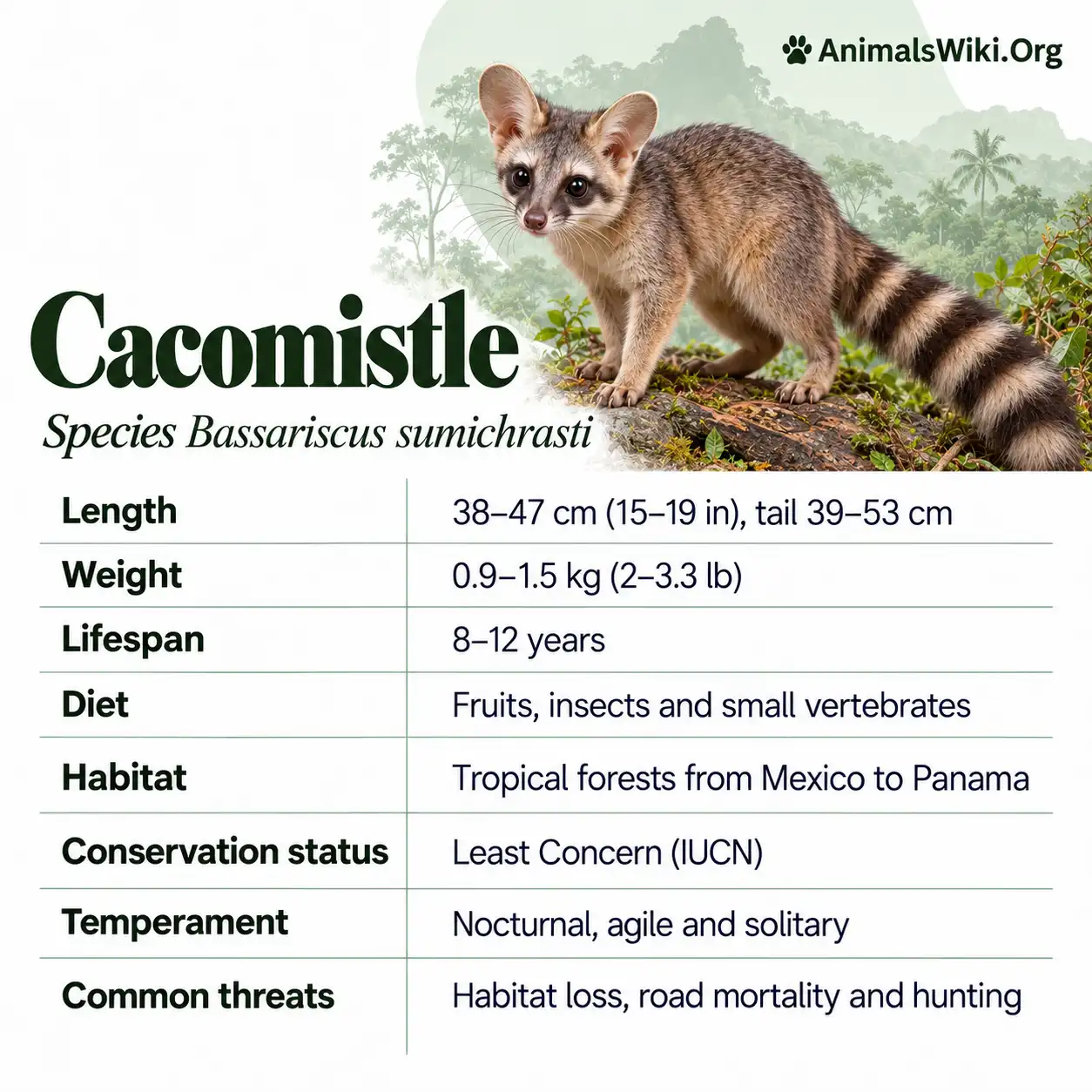
Cacomistle, The Secretive Forest Mammal with a Remarkable Ringed Tail
The cacomistle is a slender, tree-dwelling mammal recognized by its pointed ears, large eyes and long, banded tail. It moves through tropical forests after dark, searching for fruit, insects and other food while remaining hidden from most daytime visitors.
Scientifically known as Bassariscus sumichrasti, the cacomistle belongs to the raccoon family. Its appearance may suggest a mixture of cat, fox and squirrel, but it is a distinct animal with its own evolutionary history.
Cacomistles occur from parts of Mexico through Central America to western Panama. Their association with forests makes them especially interesting examples of mammals whose lives unfold above the ground.
The name can be confusing. In English, “cacomistle” usually identifies Bassariscus sumichrasti. In Mexican usage, related names such as “cacomixtle” may also refer to the ringtail, Bassariscus astutus. These are closely related but separate species.
This guide focuses on the Central American or tropical cacomistle, Bassariscus sumichrasti. It explains its appearance, habitat, diet, reproduction and conservation, while separating established facts from details that remain poorly studied.
Understanding this elusive mammal requires looking beyond its attractive tail. Its feeding, movement, shelter and relationships with forest plants reveal an animal closely connected to the structure of its habitat.
Cacomistle Facts
| Feature | Details |
|---|---|
| Common name | Cacomistle |
| Other names | Central American cacomistle, tropical cacomistle |
| Scientific name | Bassariscus sumichrasti |
| Animal group | Mammal |
| Family | Procyonidae |
| Closest familiar comparison | Ringtail, Bassariscus astutus |
| Native distribution | Parts of Mexico and Central America to western Panama |
| Typical head and body length | Approximately 38–50 centimeters |
| Tail length | Approximately 39–55 centimeters |
| Typical weight | Approximately 0.7–1.2 kilograms |
| Main activity period | Night |
| Lifestyle | Predominantly arboreal |
| Diet | Fruit, insects and other opportunistically obtained foods |
| Pregnancy | Approximately 63–67 days in published accounts |
| Young | Usually one in documented breeding observations |
| Global conservation category | Least Concern |
| Distinctive features | Pointed ears, slender body and long banded tail |
1. What Is a Cacomistle?
A cacomistle is a small mammal adapted to moving and feeding among trees. Its long body and tail create a slender outline, while its pointed face and conspicuous ears give it an alert appearance.
It belongs to Procyonidae, the family containing raccoons, coatis, kinkajous and their relatives.
Family membership does not mean these animals live in identical ways. A raccoon investigating the ground and a cacomistle traveling through branches face different movement and feeding challenges.
The cacomistle’s biology reflects its forest lifestyle. Climbing provides access to food and shelter, and nighttime activity reduces how often people see it.
The animal is therefore easily overlooked even in places where it occurs.
A useful introduction combines identity with lifestyle: the cacomistle is a nocturnal, predominantly tree-dwelling raccoon relative.
That description provides a clearer starting point than calling it a strange cat or a miniature fox.
2. Why Are Cacomistle Names Confusing?
Common names vary across regions and languages.
“Cacomistle” is widely used in English for Bassariscus sumichrasti, while “cacomixtle tropical” is one Spanish name for the same species.
However, cacomixtle also appears in names for Bassariscus astutus, the ringtail.
This creates a practical problem when searching for photographs or natural-history information. Two pages using similar names may describe different species.
The safest solution is to check the scientific name.
A photograph labeled Bassariscus sumichrasti should be compared with tropical cacomistle characteristics. A page about Bassariscus astutus concerns the northern relative.
The distinction matters especially for habitat and reproduction, where borrowing information from the wrong species can create errors.
Common names remain useful and culturally meaningful. Scientific names simply provide a shared reference when local terminology overlaps.
For this article, “cacomistle” consistently means Bassariscus sumichrasti.
3. Cacomistle Classification and Scientific History
The cacomistle belongs to the genus Bassariscus, alongside the ringtail.
Its accepted scientific name is Bassariscus sumichrasti. The original description used the combination Bassaris sumichrasti, and modern databases preserve that history.
Older literature may also use other combinations, including Jentinkia sumichrasti.
These changes do not mean that each name describes a newly discovered animal. They reflect how scientists have organized and interpreted relationships over time.
For readers exploring older research, recognizing synonyms helps connect useful observations with the modern species name.
Classification also prevents an appearance-based mistake. The cacomistle’s catlike face does not place it in Felidae, the cat family.
Its identity comes from biological relationships rather than resemblance.
The historical record is useful because much of the detailed information about this elusive species comes from older publications. Knowing which names refer to the same animal makes that research easier to follow.
4. What Does a Cacomistle Look Like?
Cacomistles have a slender body, relatively long neck, pointed ears and a long, well-furred tail.
Their coat is generally grayish-brown to brown, with lighter or warmer tones underneath.
The tail carries alternating dark and pale bands, although the pattern becomes less distinct toward the far end. The distal portion can appear extensively dark.
These features distinguish the animal from the more familiar image of a raccoon with a stockier body and prominent facial mask.
A good photograph should show more than the tail. Ear shape, facial proportions and the body’s outline provide useful supporting details.
Lighting can also change the apparent color. A flash photograph may emphasize pale markings, while an infrared image can conceal the coat’s natural tones.
For identification, concentrate on structural features as well as color.
A banded tail is memorable, but it should be one part of the identification rather than the entire basis for it.
5. How Big Is a Cacomistle?
A cacomistle is a lightweight mammal rather than a large forest carnivore.
Reference measurements commonly place head-and-body length around 38–50 centimeters, with the tail measuring approximately 39–55 centimeters.
Typical body mass is approximately 0.7–1.2 kilograms.
The tail contributes substantially to overall length. An animal described as approaching a meter in total length does not have a meter-long torso.
This distinction is especially important when comparing photographs.
A long tail stretched along a branch can make a cacomistle appear much larger than its body mass suggests.
Size descriptions also vary because references may use different individuals or measurement conventions.
The clearest comparison separates body length, tail length and weight.
Calling the animal “cat-sized” can be misleading because many domestic cats are considerably heavier. The cacomistle is better understood as a slender, lightweight climber whose tail greatly extends its visible outline.
6. What Does the Cacomistle’s Tail Do?
The long tail helps a cacomistle balance while moving through branches.
This matters because the supports available in a tree are irregular. A branch may slope, narrow or require a change of direction.
The animal’s feet, body posture and tail work together as it negotiates those conditions.
The tail should not be confused with the gripping tail of a kinkajou.
A cacomistle does not use its tail as an extra hand to wrap around a branch and suspend its body in the same way.
Its value lies primarily in balance and coordination.
That function is less spectacular than hanging entirely by the tail, but it is important during ordinary movement.
A stable body position can determine whether an animal reaches a food item safely, crosses a narrow support or changes direction without falling.
The cacomistle’s tail is therefore a working part of its climbing anatomy, not simply a decorative feature.
7. Cacomistle vs. Ringtail: What Is the Difference?
The cacomistle and ringtail are separate species in the same genus.
The ringtail, Bassariscus astutus, has a broad association with western North American landscapes, including rocky country. The cacomistle, Bassariscus sumichrasti, is more strongly associated with tropical and subtropical forests.
Their appearance also differs.
| Feature | Cacomistle | Ringtail |
|---|---|---|
| Scientific name | Bassariscus sumichrasti | Bassariscus astutus |
| General habitat association | Tropical and subtropical forests | Rocky habitats and several other environments |
| Ears | More pointed | More rounded |
| Overall appearance | Often browner, with less sharply contrasting markings | Often paler, with conspicuous facial and tail markings |
| Tail near the tip | Bands can become less distinct | Usually retains a more conspicuously banded appearance |
| Broad distribution | Southern Mexico through Central America | United States and Mexico |
These are identification aids rather than a substitute for checking the full animal.
Where their distributions approach or overlap, scientific names and careful observation become especially important.
8. Cacomistle vs. Kinkajou
Cacomistles and kinkajous are both forest-dwelling procyonids, but they are easy to distinguish in a clear view.
A kinkajou typically has a golden-brown coat, rounded ears and an unbanded, prehensile tail.
A cacomistle has a more slender appearance, pointed ears and a prominently banded tail used for balance.
Their feeding emphasis also differs. Kinkajous are strongly associated with fruit, while cacomistles use a broader mixture that includes fruit and insects.
The comparison demonstrates how members of one family can develop different ways of using trees.
The kinkajou’s gripping tail expands the range of supported feeding positions. The cacomistle relies on its own combination of body proportions, feet and balancing movements.
A nighttime glimpse can make the two seem similar, especially when only part of an animal is visible.
A full view of the tail and ears usually provides a much stronger starting point for identification.
9. Where Do Cacomistles Live?
Cacomistles occur from parts of Mexico through Central America to western Panama.
Their recorded distribution includes countries such as Belize, Guatemala, Honduras, El Salvador, Nicaragua and Costa Rica.
This range should not be interpreted as continuous occupation of every landscape between its endpoints.
Suitable forest, local conditions and gaps in knowledge influence the actual pattern.
A country can contain extensive areas where the species is absent or has not been documented.
The distinction is useful for wildlife watching. Knowing that cacomistles occur in a country does not establish that a particular park or trail offers a strong chance of seeing one.
Local records provide the detail missing from a broad range map.
They also help researchers identify places needing further surveys.
For an elusive animal, distribution is built gradually from specimens, photographs, verified observations and systematic fieldwork rather than from frequent public sightings.
10. What Is the Cacomistle’s Habitat?
Cacomistles are associated with forests, including moist tropical lowlands, mountain forests and some seasonally dry environments.
They use the middle and upper portions of forest vegetation, where branches provide routes between feeding and resting locations.
This does not mean every forest patch is equally useful.
Food plants, shelter opportunities and the arrangement of trees affect what the habitat offers.
A forest can appear continuous on a map while containing substantial differences in usable structure.
Conversely, secondary vegetation may provide resources that are not obvious from a simple label such as “disturbed habitat.”
The useful question is what the animal can actually do there.
Can it find food, remain concealed while resting and travel between important places?
Thinking about habitat in terms of these functions gives a clearer understanding than imagining one idealized rainforest scene.
Cacomistles depend on forest resources even when their local surroundings vary.
11. Do Cacomistles Live in Cloud Forests?
Yes. Cloud forests are among the environments where cacomistles have been studied.
A Costa Rican investigation in the Barva Volcano region used radio telemetry to examine activity, range size and habitat use.
The animals occupied a landscape containing several vegetation types rather than one uniform block of untouched forest.
Cloud forests are especially relevant because they demonstrate that the species is not confined to hot lowland rainforest.
Elevation changes temperature, moisture and vegetation, creating different conditions for food and movement.
However, one study location cannot establish that all populations use habitat in exactly the same way.
Its value is to show what the species can do under those particular conditions.
For readers, the practical correction is simple: the cacomistle is a forest mammal with a broader ecological setting than the phrase “tropical lowland animal” might suggest.
Mountain forests form part of that story.
12. Can Cacomistles Use Secondary Forest and Coffee Landscapes?
Published records show cacomistles in landscapes containing secondary vegetation and tree-covered agricultural areas.
A 2023 study of distribution in Honduras documented records from protected areas, unprotected tree-covered places and coffee farms.
This suggests that some modified landscapes retain resources the species can use.
It does not mean that all plantations substitute for natural forest.
Agricultural systems differ greatly in shade, tree diversity, surrounding vegetation and disturbance.
A farm retaining substantial tree cover presents different opportunities from an exposed field.
The important distinction is between evidence of use and proof of equivalent habitat quality.
A sighting establishes presence. Understanding long-term survival requires more information about feeding, shelter and reproduction.
For land management, the finding still matters: conservation opportunities can extend beyond reserve boundaries.
Maintaining trees and connections in working landscapes may contribute to a broader network of usable habitat.
13. Why Is the Canopy Important to Cacomistles?
The canopy is a network of branches and crowns, not simply the top surface of a forest.
For a cacomistle, that network contains routes, feeding opportunities and places to remain hidden.
Its three-dimensional structure changes the meaning of distance.
Two trees may stand close together on the ground but offer no convenient branch connection. Another route may appear longer on a map while being easier to travel above ground.
This is why counting trees alone gives an incomplete picture.
The placement of branches and the size of gaps can affect movement.
The same principle helps explain why forest fragmentation matters even when patches remain nearby.
An animal may need to change its normal route or descend to a less familiar level.
For an arboreal species, maintaining connections is part of maintaining habitat function.
The relevant landscape includes the spaces between trees as well as the trees themselves.
14. How Do Cacomistles Move Through Trees?
Cacomistles are agile climbers that use their feet, claws, flexible movements and long tails while negotiating branches.
Their slender build allows them to investigate routes that would not suit a heavier mammal.
Movement includes more than jumping.
Careful foot placement, changes in posture and controlled transitions between supports are important parts of climbing.
The tail helps maintain balance as the animal shifts its weight.
An observer may notice one quick leap and miss the many deliberate movements leading up to it.
That is why video or repeated observation can reveal more than a single still photograph.
A successful crossing depends on the shape of the support and the animal’s position, not just raw athletic ability.
It is also important not to assign every documented ringtail adaptation automatically to cacomistles. Close relatives can share broad abilities while differing in details that require their own evidence.
15. Are Cacomistles Nocturnal?
Cacomistles are mainly active at night.
This helps explain why they remain unfamiliar even in regions where they occur.
A person walking through suitable forest during daylight may pass beneath resting animals without seeing them.
Nighttime observation adds another challenge: foliage, height and darkness conceal much of the animal.
Calls may reveal activity before a clear view is possible.
“Nocturnal” should nevertheless describe the dominant pattern rather than a claim that no individual ever makes a sound or moves during daylight.
Biological schedules can include exceptions.
For wildlife watchers, the useful lesson is that lack of daytime sightings provides limited information about presence.
A well-designed survey samples the periods and places relevant to the animal’s behavior.
The cacomistle’s apparent invisibility is partly a consequence of how humans observe forests, rather than a direct measurement of how many animals live there.
16. How Large Is a Cacomistle’s Home Range?
A home range is the area an animal uses during normal activities.
It contains feeding places, resting sites and routes connecting them.
Costa Rican research reported an average total home range of approximately 19.8 hectares for six studied cacomistles, with differences between males and females.
That figure should be treated as a study result rather than a universal requirement.
Range estimates depend on habitat, individuals, observation period and analytical method.
A home-range boundary is also not a physical fence.
An animal can move beyond an estimated outline, and the area used most intensively may occupy only part of the total.
For readers, the most useful implication is that cacomistles require a collection of resources distributed through space.
One productive tree is valuable, but it does not necessarily supply every need.
Movement links those resources into a functioning environment.
17. Where Do Cacomistles Rest?
Cacomistles use protected places in trees, including shelters associated with nesting and denning.
For a mother, a secure location is especially important during the early development of her young.
The visible entrance or opening provides only a small part of the story.
An observer usually cannot tell from below how much interior space exists, whether another exit is available or whether dependent young remain hidden.
This is why a resting site should not be approached closely or investigated physically.
Shelter is also an important conservation resource.
A forest may provide abundant foliage while lacking suitable cavities or protected resting locations.
Food and shelter are different requirements, and preserving one does not automatically preserve the other.
For anyone studying cacomistles, repeated observations of where animals disappear can be useful, provided the observations do not turn a secure hiding place into a site of repeated disturbance.
18. What Do Cacomistles Eat?
The cacomistle diet is omnivorous.
Fruit and insects are important, while accounts also include small vertebrates and other opportunistically obtained foods.
Wild figs are among the best-documented plant foods.
The importance of particular items changes with local availability. A food list describes what the animal can consume, not an equal proportion of every meal.
A productive fruiting tree offers a concentrated resource. Insects provide a different kind of opportunity, often distributed through vegetation or concealed in small spaces.
This mixture helps explain why cacomistles investigate their surroundings rather than following one simple feeding routine.
The order Carnivora does not mean an exclusive meat diet.
Classification identifies evolutionary relationships, while observed feeding identifies the resources an animal actually uses.
For the cacomistle, both plant and animal foods belong in an accurate description.
19. Why Are Figs Important to Cacomistles?
Figs connect cacomistles with a wider community of forest fruit eaters.
Research at a strangler fig in Los Tuxtlas, Mexico, documented visits by birds, bats and nonflying mammals.
Cacomistles were among the animals removing substantial quantities of fruit.
A fruiting tree creates a temporary concentration of food. That can draw animals that otherwise spend much of their time apart.
The tree is therefore more than a meal location. It can become a meeting point between species and a place where seeds arrive from elsewhere.
The study followed one tree through its fruiting period, providing a detailed view of that local event.
It should not be used to assign a fixed percentage of figs to every cacomistle diet.
Its broader significance lies in showing how one plant can connect multiple feeding schedules, movement patterns and ecological relationships.
20. Do Cacomistles Hunt Other Animals?
Cacomistles can consume animal prey as part of their omnivorous diet.
Natural-history accounts include insects and small vertebrates such as frogs, lizards and birds.
This does not mean the species should be pictured as a large predator dominating the canopy.
Its body size limits the scale of prey it can handle, and fruit remains an important resource.
The most useful description is opportunistic feeding.
An animal moving through branches encounters several potential food types and can respond according to opportunity.
For observers, simply seeing a cacomistle investigate a tree does not reveal whether it is searching for insects, approaching fruit or traveling toward shelter.
Feeding identification requires more specific evidence, such as visible handling or consumption.
This distinction keeps a wildlife account grounded in behavior rather than assigning a purpose to every movement.
The animal’s flexibility is interesting without exaggerating its hunting role.
21. Do Cacomistles Help Disperse Seeds?
Fruit eating creates opportunities for seed dispersal.
When an animal carries fruit, swallows seeds or deposits seeds away from the parent plant, its movements can affect where those seeds arrive.
Research at the Los Tuxtlas fig tree documented seed deposition associated with the visiting frugivore community, which included cacomistles.
The important ecological connection is between feeding in one place and depositing material elsewhere.
However, dispersal and successful plant establishment are different stages.
A seed must remain viable, reach suitable conditions and survive the hazards affecting seedlings.
A cacomistle does not guarantee a new tree each time it eats fruit.
Its contribution is better understood as part of a larger process involving plants, other animals and the physical environment.
That process continues after dark, reminding us that daytime observations reveal only part of the forest’s seed-moving activity.
22. Are Cacomistles Solitary?
Cacomistles are generally described as solitary, but individuals can gather around concentrated food resources.
Several animals at one fruiting tree do not necessarily form a permanent social group.
A large resource may temporarily reduce competition enough to allow feeding near one another.
The distinction between living alone, meeting and maintaining a stable group is important.
These are different patterns that cannot be established from one photograph.
Likewise, solitary behavior does not mean animals never communicate or interact.
Breeding, parental care and shared use of feeding locations create occasions for contact.
For readers familiar with social mammals such as meerkats, cacomistles offer a different example of organization.
Much activity can occur individually while important interactions remain scattered through time and space.
Understanding those relationships requires repeated observations rather than assuming that one animal seen alone tells the whole story.
23. How Do Cacomistles Communicate?
Cacomistles produce conspicuous calls, and published accounts also describe scent-related communication.
Calls can help animals remain aware of one another without approaching directly.
That is useful in dark, leafy surroundings where visual contact is limited.
The meaning of a particular call should not be assumed from sound alone.
A repeated vocal exchange may relate to spacing or another interaction, but an observer needs context before assigning a precise explanation.
The same caution applies to scent.
Chemical information can persist after an animal leaves, making communication possible across different times.
For naturalists, the most useful record includes when the sound occurred, whether another animal responded and what could actually be seen.
Describing the evidence carefully preserves information.
Inventing a detailed conversation between unseen animals may be entertaining, but it contributes less to understanding their behavior.
24. How Do Cacomistles Reproduce?
Detailed reproductive information comes partly from observations of animals in managed settings.
A published study documented pregnancy lengths of approximately 64–66½ days and found single offspring to be the usual outcome in the observed births.
This provides a firmer basis than copying an unexplained number from a general animal chart.
The female supplies the main care, with the young sheltered during early development.
Breeding information should also be separated from the assumption that every population follows one rigid calendar.
Local environmental conditions can differ across the species’ range.
For a general profile, the dependable points are a pregnancy of roughly two months, a usually small litter and substantial maternal involvement.
A nearby adult male should not automatically be described as a permanent mate or equal caregiver.
Observed association and demonstrated parental care are different kinds of evidence.
25. What Are Baby Cacomistles Like?
Newborn cacomistles are small and dependent.
Published accounts describe closed eyes at birth, followed by gradual development of vision, movement and feeding ability.
The change from sheltered newborn to capable climber takes time.
Walking, reaching and climbing are separate achievements, and they do not appear fully formed at birth.
Young eventually begin taking solid food while continuing through a period of maternal dependence.
The exact timing of every milestone is less secure than the broad developmental pattern.
For readers, the important point is that early life depends on both care and shelter.
A tree cavity used by a mother can contain an animal that has never been visible outside.
This is why disturbing a den can affect more than the adult occasionally seen entering it.
The absence of visible young does not establish that none are present.
26. How Long Do Cacomistles Live?
Reliable information about typical wild cacomistle lifespan is limited.
The AnAge database records a maximum captive lifespan of about 24 years, based on a wild-born individual that later lived in captivity.
This is a longevity record, not an average for animals in the forest.
The distinction matters because some summaries mix those categories.
A maximum shows what happened to one individual under particular conditions. An average describes a population and requires a different kind of evidence.
Wild survival can be affected by food availability, injury, predators and human pressures.
For an accurate article, it is better to acknowledge the uncertainty than to supply a precise but unsupported wild lifespan.
The available record shows considerable longevity potential.
It does not establish that a typical cacomistle lives two decades in nature, nor does it allow an observer to estimate an adult’s age from a brief sighting.
27. What Animals Prey on Cacomistles?
Natural-history accounts identify owls, forest cats and snakes among potential cacomistle predators.
The significance of each predator depends on location and circumstances.
A predator capable of taking a cacomistle is not necessarily responsible for most deaths in every population.
Young animals may also experience different risks from adults.
Climbing ability offers useful routes but does not make life above ground completely safe.
Some predators hunt in trees, while others can encounter animals during movement at lower levels.
The relevant picture is a forest containing overlapping paths and activities.
A cacomistle must find food within that environment while also using concealment and escape opportunities.
For readers, this is a useful correction to the idea that an agile mammal can always avoid capture.
Its adaptations improve its chances within a challenging environment; they do not remove the challenges entirely.
28. What Is the Cacomistle’s Ecological Role?
Cacomistles participate in several ecological relationships.
They consume fruit and animal foods, interact with other visitors at feeding trees and can become prey for larger animals.
Their movements connect resources distributed through the forest.
These activities should not be compressed into one job such as “pest control” or “forest gardening.”
Eating insects does not automatically demonstrate a measurable reduction in a particular insect population.
Similarly, moving seeds does not guarantee successful regeneration.
The animal’s role is broader than any single benefit to people.
A useful way to picture it is as one participant in a changing network.
A fruiting tree draws visitors. Visitors move among trees. Predators respond to prey. Seeds encounter new locations.
The cacomistle contributes to those processes through ordinary feeding and travel, even when its own movements remain almost invisible to a human observer.
29. Is the Cacomistle Endangered?
The cacomistle is globally classified as Least Concern.
The current IUCN assessment also identifies the population trend as unknown.
Those two statements are compatible.
A species can have a broad enough distribution to receive a relatively low global extinction-risk category while still lacking strong information about population change.
Least Concern does not mean every local population is abundant or unaffected by habitat loss.
Likewise, an unfamiliar or rarely photographed animal is not automatically globally endangered.
The most useful conservation description names the category while explaining the limits of the available information.
For the cacomistle, distribution records and ecological studies continue to matter because they improve understanding of where populations occur and what conditions they use.
A secure-sounding label should support continued attention rather than replace it.
The animal’s dependence on forest resources remains relevant regardless of its category.
30. What Threatens Cacomistles?
Deforestation and forest fragmentation are major concerns identified in conservation accounts.
Clearing can remove food plants, shelter sites and the routes connecting them.
The effect is not limited to the area physically cut down.
A gap can alter how an animal reaches resources that remain standing on either side.
Hunting for meat or fur adds another pressure in parts of the range.
The consequences depend on local intensity, habitat conditions and the animals’ ability to persist.
For conservation planning, protecting isolated trees may be less effective than preserving a functioning arrangement of food, cover and movement routes.
This does not mean every modified landscape is useless.
Records from secondary forest and tree-covered farms show that some resources remain available outside intact forest.
The challenge is to understand which arrangements support sustained use rather than assuming that any green patch provides the same ecological value.
31. What Have Recent Records Revealed?
Recent publications continue to refine knowledge of cacomistle distribution.
A 2023 Honduras study assembled records across multiple departments and habitat settings.
A 2024 paper from Puebla, Mexico, examined a museum specimen that added information about occurrence near the northern Balsas Basin.
In July 2026, a paper reported the first photographic record for Tabasco, Mexico. The photographed animal had been observed in March 2024 at Cerro de las Flores in the Agua Selva Ecological Reserve.
These findings do not necessarily mean the species had just arrived.
They show that documentation improved.
That distinction is especially important for elusive mammals. A first photograph can be the first strong evidence available to researchers without being the first time the animal lived there.
Each record contributes a small but valuable piece to a distribution pattern that remains incompletely known.
32. How Do Scientists Study Cacomistles?
Researchers use several approaches, each answering different questions.
Radio tracking helps reveal movement and space use.
Camera traps document visits and activity without requiring an observer to remain beside the animal.
Museum specimens preserve evidence of identity and occurrence that can be reconsidered later.
Genomic resources provide opportunities to investigate evolutionary and biological questions.
DNA Zoo has released a chromosome-length assembly for the cacomistle, adding another tool for future research.
No method supplies a complete picture by itself.
A camera image establishes presence at a particular time. Tracking adds movement between locations. A specimen can support detailed identification.
Combining these sources makes the overall account stronger.
For a secretive forest mammal, progress often comes through connecting many modest pieces of evidence rather than relying on one dramatic discovery.
33. Why Do Canopy Surveys Matter?
Ground-level surveys can miss animals whose activity occurs above them.
A camera placed along a trail samples a different space from one placed on a branch.
Research on arboreal mammals elsewhere in tropical forests has demonstrated the usefulness of cameras positioned in the canopy.
This broader methodological lesson is relevant when planning studies of cacomistles.
It does not mean results from another species or country should be assigned directly to them.
Instead, it shows why survey design must match the animal’s behavior.
If the objective is to detect a tree-dwelling mammal, researchers need to consider height, branch placement and the routes available within the camera’s view.
An absence of photographs may otherwise reflect poor sampling rather than true absence.
The forest is three-dimensional, and a survey that ignores that structure can leave an important part of the wildlife community underrepresented.
34. How Can People Help Protect Cacomistles?
Useful action begins with protecting the resources the animal needs.
That includes forest cover, important shelter trees and connections between feeding areas.
In working landscapes, retaining appropriate tree cover can complement protected forests.
For residents near habitat, secure poultry and stored food rather than encouraging close contact or feeding wildlife.
A visiting cacomistle should not be captured simply because it is unfamiliar.
If an animal is injured or trapped, contact an appropriate local wildlife professional.
Tourism can also support conservation when observation remains respectful and does not disturb dens or repeatedly draw animals toward people.
The central principle is practical: preserve the animal’s ability to live as a wild forest mammal.
Its appeal does not depend on taming it.
A cacomistle moving naturally through branches provides a more meaningful encounter than one forced into close contact for a photograph.
35. How to Observe a Cacomistle Responsibly
Patience and distance are more useful than pursuit.
Choose permitted routes, follow local guidance and allow an animal to remain above or away from you.
At night, avoid prolonged illumination and unnecessary noise.
A local guide may recognize suitable habitat or calls, but no responsible guide can guarantee a sighting.
If you see an animal, note the time, location, visible features and behavior.
A record such as “one cacomistle crossing branches beside a fruiting tree” is useful without guessing its age or purpose.
Photographs can strengthen identification, especially when they show the ears, face and tail.
Do not chase the animal to obtain a clearer image.
The best observation preserves normal activity.
A brief view can still be valuable when it leaves the animal free to continue traveling, feeding or returning to shelter.
Frequently Asked Questions About Cacomistles
What kind of animal is a cacomistle?
A cacomistle is a small mammal in Procyonidae, the raccoon family. This article concerns Bassariscus sumichrasti, a predominantly tree-dwelling species found in parts of Mexico and Central America.
What is the scientific name of the cacomistle?
The scientific name is Bassariscus sumichrasti. Older literature may use different combinations. Checking the scientific name helps separate this species from the closely related ringtail.
Is a cacomistle a cat?
No. Its face may look catlike, but it does not belong to the cat family. It is related to raccoons, coatis, kinkajous and other procyonids.
Is a cacomistle the same as a ringtail?
No. The tropical cacomistle is Bassariscus sumichrasti. The ringtail is Bassariscus astutus. Regional common names can overlap, which makes scientific names especially useful.
Where do cacomistles live?
They occur from parts of Mexico through Central America to western Panama. Their actual distribution depends on suitable habitat and is not continuous across every country where they are recorded.
Do cacomistles live in rainforests?
Yes. They use moist tropical forests, but rainforest is not their only habitat. Records also include mountain forests, seasonal forests and some modified landscapes retaining tree cover.
Can cacomistles live in cloud forests?
Yes. Costa Rican research has examined them in a cloud-forest landscape. This demonstrates that the species is not restricted to hot lowland environments.
How big is a cacomistle?
Typical reference figures give a body length of approximately 38–50 centimeters and a tail of roughly 39–55 centimeters. Weight is commonly around 0.7–1.2 kilograms.
Why is the cacomistle’s tail so long?
The tail helps with balance during movement through branches. It works alongside the feet and body posture. Its length also makes the animal appear larger than its lightweight torso suggests.
Can a cacomistle hang by its tail?
Its tail is not used as a gripping support like a kinkajou’s prehensile tail. Cacomistles rely on their feet and climbing movements while the tail contributes to balance.
Are cacomistles active at night?
They are mainly nocturnal. Their activity and position above the ground make them difficult to observe. A lack of daytime sightings provides limited evidence about whether they occupy an area.
What do cacomistles eat?
Their diet includes fruit, insects and other opportunistically obtained foods. Accounts also describe small vertebrates. The relative importance of foods varies with local availability.
Do cacomistles eat figs?
Yes. They have been documented feeding at fig trees. Fruiting trees can attract several species and sometimes multiple individuals, creating temporary concentrations of feeding activity.
Do cacomistles eat other animals?
Yes. Insects and some small vertebrates are included in published accounts. Their diet is omnivorous, so animal foods should be considered alongside fruit.
Do cacomistles disperse seeds?
Fruit feeding can contribute to seed movement. Successful plant establishment still depends on seed survival and conditions at the destination. Dispersal creates opportunities rather than guaranteeing new trees.
Are cacomistles solitary?
They are generally described as solitary, although individuals may gather around productive food sources. Temporary feeding near one another does not necessarily indicate a permanent social group.
How do cacomistles communicate?
They produce calls and use chemical communication. Interpreting a particular signal requires context. A single sound should not be assigned a detailed meaning without supporting observations.
How long is a cacomistle pregnant?
Documented pregnancies last roughly 63–67 days, with detailed captive observations supporting approximately 64–66½ days. These are species-specific figures and should not be replaced with ringtail pregnancy lengths.
How many babies do cacomistles have?
Single offspring are usual in documented breeding observations. General databases sometimes differ, so it is better to identify the evidence than to present one unexplained litter figure as universal.
How long do cacomistles live?
A maximum captive record of about 24 years is documented. Typical wild lifespan is less well established. A longevity record should not be presented as an average for animals in nature.
What predators eat cacomistles?
Accounts identify owls, forest cats and snakes among potential predators. Their importance varies between locations. Climbing ability reduces some risks without making the animal invulnerable.
Is the cacomistle endangered?
Its global category is Least Concern, while its population trend is listed as unknown. Local habitat loss and other pressures remain relevant despite that global classification.
Can cacomistles live near farms?
Records include some coffee farms and other tree-covered landscapes. That does not mean every farm provides suitable habitat. Shade, vegetation structure and connections to forest all matter.
Are cacomistles suitable pets?
They are wild, nocturnal mammals adapted to forest life. Their attractive appearance does not make them domesticated. Observation and habitat conservation are more appropriate ways to appreciate them.
What should you do if you see a cacomistle?
Give it space, keep pets away and avoid feeding or chasing it. Record visible features if possible. Contact local wildlife assistance if the animal is injured or trapped.



