
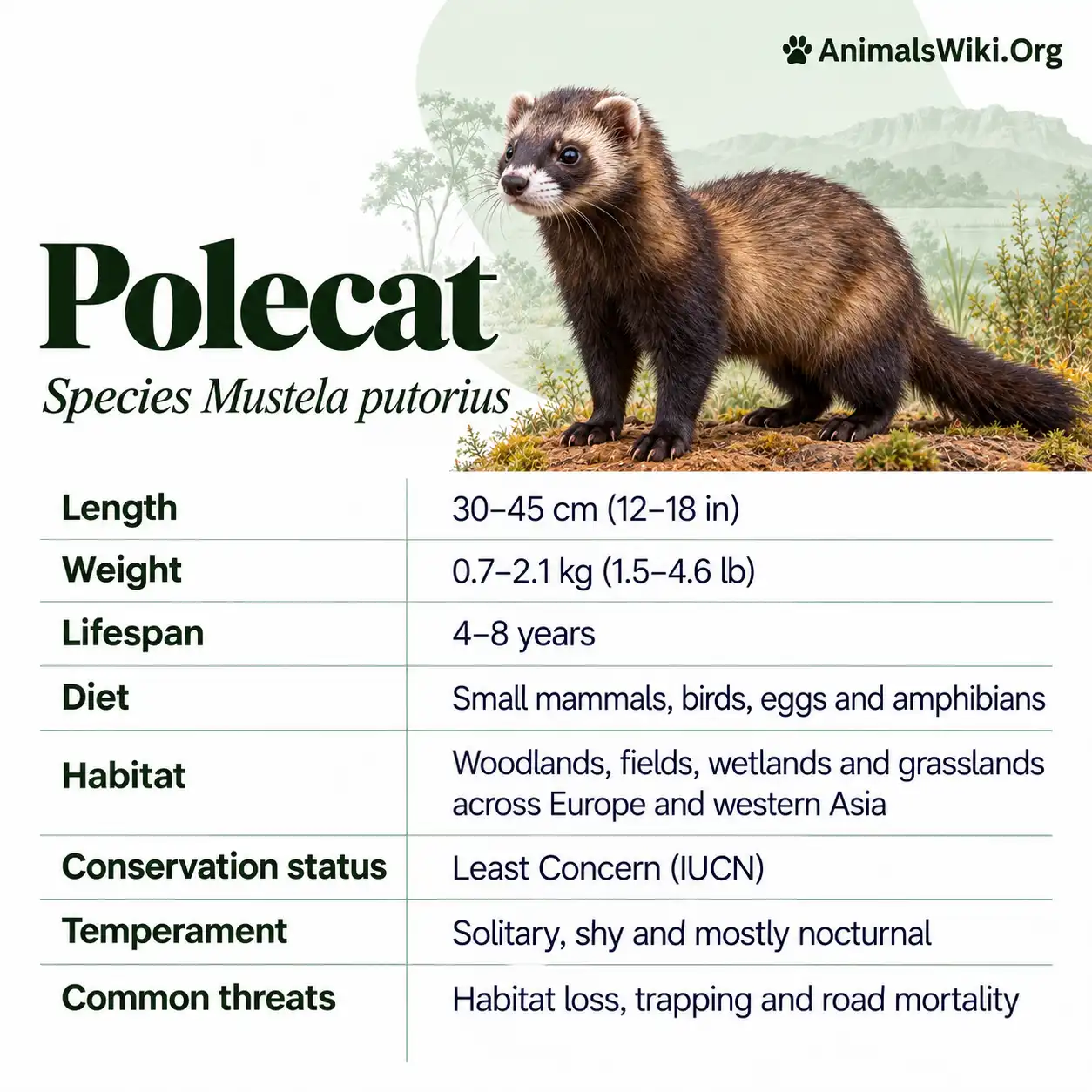
Polecat, The Secretive Hunter Behind the Dark Facial Mask
The polecat is a small, powerful mammal known for its elongated body, short legs, dark facial mask and strong-smelling defensive secretion. Usually moving quietly through vegetation or exploring sheltered places, it is often present without being noticed.
The name most commonly refers to the European polecat, Mustela putorius. However, several other mammals carry the name, including the steppe polecat, marbled polecat and striped polecat.
These animals share some broad characteristics, but they do not have identical appearances, distributions or conservation needs.
European polecats belong to Mustelidae, the family containing weasels, stoats, otters, badgers and wolverines. They are also closely connected with the history of the domestic ferret.
Their story combines natural history with a complicated relationship with people. Polecats have been persecuted around poultry and game management, have recovered in parts of Britain, and continue to face threats associated with roads, contaminated prey and habitat change.
This guide focuses primarily on the European polecat while explaining the other major animals bearing the name. It covers identification, diet, shelter, reproduction and conservation, with particular attention to the distinctions between wild polecats, domestic ferrets and similar-looking mammals.
Polecat Facts
| Feature | Details |
|---|---|
| Main species covered | European polecat |
| Scientific name | Mustela putorius |
| Animal group | Mammal |
| Family | Mustelidae |
| Close domestic relative | Ferret |
| Typical body length | Approximately 32–45 centimeters |
| Tail length | Approximately 12–19 centimeters |
| Male weight | Commonly around 0.8–1.9 kilograms |
| Female weight | Commonly around 0.5–1.1 kilograms |
| Main diet | Rabbits, rodents, amphibians and other small animals |
| Activity | Predominantly nocturnal, with flexibility |
| Social pattern | Generally solitary |
| Pregnancy | Approximately 42 days |
| Young | Called kits |
| Main identifying feature | Dark facial mask contrasting with pale markings |
| Global conservation category | Least Concern |
1. What Is a Polecat?
A polecat is a carnivorous mammal with a long body, relatively short legs and adaptations for investigating dense cover and enclosed spaces.
The European polecat is the animal most often intended when the word appears without another description.
Its slender shape allows it to follow prey into burrows and move through vegetation that would restrict a larger predator.
However, it is more robust than the smallest weasels. The head, neck and body give an impression of strength despite the animal’s modest size.
Polecats spend much of their lives searching for food, using sheltered resting places and moving between productive parts of their surroundings.
Their reputation often emphasizes smell or poultry predation, but those features represent only part of their biology.
Understanding the animal requires considering its ordinary activities: how it finds prey, where it rests and how its movements change with season and local conditions.
2. Main Types of Polecats
“Polecat” is a common name rather than the name of one exclusive scientific group.
Several species carry it, including animals placed in different genera.
| Animal | Scientific name | General association |
|---|---|---|
| European polecat | Mustela putorius | Much of Europe and adjoining areas |
| Steppe polecat | Mustela eversmanii | Parts of eastern Europe and Asia |
| Marbled polecat | Vormela peregusna | Southeastern Europe, the Middle East and parts of Asia |
| Striped polecat or zorilla | Ictonyx striatus | Much of sub-Saharan Africa |
This is a selection of familiar examples rather than an exhaustive list of every animal with “polecat” in its common name.
The marbled polecat has a striking patterned coat and occurs in countries including Pakistan. The striped polecat is conspicuously black and white.
Those differences matter when selecting photographs or describing conservation status.
An image of a zorilla should not illustrate a detailed explanation of European polecat identification without an appropriate label.
3. What Does a European Polecat Look Like?
The European polecat has dark brown or blackish guard hairs over a paler undercoat.
This produces a two-tone appearance rather than a uniform brown surface.
The face is especially recognizable. Pale areas around the muzzle, cheeks, ears and above the eyes contrast with a dark mask.
Its ears are rounded, the legs are short, and the tail is relatively short compared with the body.
The animal’s outline is low and elongated, making it well suited to movement through cover.
A clear side view reveals these proportions better than a close photograph of the face alone.
Identification becomes more difficult when only a small part of the animal is visible or when lighting hides the underfur.
Look for the overall combination: a masked face, dark limbs, contrasting undercoat and a long, low body.
No single pale patch establishes the identity by itself.
4. How Big Is a Polecat?
European polecats show clear differences in size between males and females.
Males commonly weigh approximately 0.8–1.9 kilograms, while females are often around 0.5–1.1 kilograms.
Body length generally falls around 32–45 centimeters, with the tail adding approximately 12–19 centimeters.
These are useful reference ranges, not limits for every individual.
Age, condition, geography and measurement method can affect reported figures.
Length descriptions should also distinguish the torso from total length. A measurement including the tail will naturally be greater than head-and-body length.
A large male and a small female can appear surprisingly different, especially in photographs without an object for scale.
For identification, apparent size should therefore support other features rather than replace them.
A dark, low-running mammal is not necessarily a polecat simply because it seems approximately the right length.
5. Does a Polecat’s Coat Change with the Seasons?
Yes. Seasonal changes can alter the European polecat’s appearance.
The winter coat is generally fuller, making the pale underfur more conspicuous beneath the darker guard hairs.
The summer coat can look thinner and darker.
These differences help explain why photographs of the same species may appear inconsistent.
Coat condition, viewing angle and lighting add further variation.
A photograph taken in winter may emphasize the pale body tones, while a summer image may make the animal look more uniformly dark.
This is particularly relevant when comparing polecats with ferrets or hybrids.
Seasonal appearance should be considered before interpreting every pale area as evidence of mixed ancestry.
The underlying structure remains important: the face, limbs, body proportions and distribution of markings.
Good identification uses the complete animal rather than expecting one unchanging color pattern throughout the year.
6. Polecat vs. Ferret: What Is the Difference?
The European polecat is a wild mammal, while the domestic ferret is a domesticated relative.
Their close relationship explains their similar shape and ability to produce fertile offspring together.
Domestic ferrets display a wide range of colors and patterns. Some resemble wild polecats closely, while others are much paler.
Behavior can offer clues, but it is not a definitive test. A wary ferret is not automatically a wild polecat, and an animal approaching people should not be identified solely from apparent tameness.
Typical polecats have a well-defined facial mask and dark fur extending toward the nose. Hybrids or ferrets may show more extensive pale markings.
Nevertheless, appearance does not reveal ancestry perfectly.
For a brief field sighting, “polecat-type animal” can be an honest description when important features are unclear.
It is better to preserve uncertainty than to label every dark ferret-shaped animal with complete confidence.
7. Can Polecats and Ferrets Interbreed?
Yes. European polecats and domestic ferrets can produce fertile hybrids, commonly called polecat-ferrets.
This can occur when escaped or feral ferrets encounter wild polecats.
Hybridization is particularly relevant to understanding British polecat recovery.
A 2022 whole-genome study found substantial ferret ancestry in sampled British polecats outside the population’s former stronghold.
Importantly, some animals with a typical polecat appearance still carried evidence of that ancestry.
The finding shows why a facial mask cannot establish genetic purity.
It also distinguishes two questions: whether an animal looks like a polecat and what its evolutionary or breeding history contains.
Genetic research can answer aspects of the second question that photographs cannot.
For general readers, the practical conclusion is that polecats, ferrets and their hybrids form a difficult identification problem, especially where their populations overlap.
8. Is a Polecat the Same as a Skunk?
No. European polecats belong to Mustelidae, while true skunks belong to Mephitidae.
Both groups have strong-smelling secretions, which helps explain some historical confusion in common names.
In parts of North America, “polecat” has also been used informally for a skunk.
That regional usage does not make a striped skunk and a European polecat the same animal.
Their appearance usually separates them clearly.
A striped skunk has conspicuous black-and-white markings and a large bushy tail. The European polecat has a brownish two-tone coat, facial mask and shorter tail.
The African striped polecat creates another naming complication because it resembles a skunk while remaining a mustelid.
The clearest method is to check both the scientific name and the region.
Common names can reveal cultural history, but biological relationships require a more precise reference.
9. Polecat vs. Mink and Stoat
European polecats can be confused with other elongated mustelids.
An American mink is usually more uniformly dark, often with a pale chin patch. A polecat normally shows stronger facial contrast and pale underfur.
A stoat is generally smaller and has a different color arrangement, including the characteristic dark tail tip.
Body proportions help as well. Polecats tend to appear more robust than the smallest weasel-like mammals.
However, a brief view can conceal these distinctions.
A running animal may expose only its back, while vegetation hides the face and tail.
The best identification combines size, markings, location and movement.
A waterside setting can support several possibilities rather than proving the animal is a mink.
Recording what was actually visible is more useful than forcing an identification from one clue.
A clear photograph or repeated observation can resolve uncertainty that a fleeting glimpse cannot.
10. Where Do European Polecats Live?
European polecats occur across much of Europe, extending eastward toward the Ural region.
Their distribution is uneven, with absence, scarcity or decline in some places and recovery in others.
Britain provides a well-documented example of historical contraction followed by expansion.
Polecats have not been native to Ireland.
A broad continental range should not be mistaken for continuous occupation of every landscape.
Food, cover, resting sites and human pressures influence the local pattern.
The same country can contain places where polecats are regularly recorded and others where records remain sparse.
For readers interested in a particular region, recent local surveys provide better guidance than a general range map alone.
Those surveys also require careful identification because escaped ferrets and hybrids can complicate records.
Geographic occurrence is therefore a combination of biological distribution and the quality of the evidence documenting it.
11. What Is a Polecat’s Habitat?
European polecats use a range of environments, including farmland, woodland edges, wetlands, river margins and landscapes containing hedgerows.
Their flexibility does not mean that habitat structure is irrelevant.
Cover allows concealed movement. Prey concentrations create feeding opportunities. Protected cavities provide resting places.
A landscape containing several of these resources can be more useful than one offering only open space.
Research in Luxembourg documented seasonal differences in habitat use, with forest, grassland and human settlements contributing at different times.
Small rodents were important foods there, and amphibians became significant in spring and summer.
This illustrates how shelter, weather and diet interact.
The animal does not choose habitat based on a single category such as “woodland.”
It responds to the resources and conditions available within that setting.
A mixed landscape can therefore support several parts of its daily routine.
12. Where Do Polecats Sleep?
Polecats use concealed resting places rather than one universal den design.
These can include burrows, woodpiles, dense vegetation and spaces in buildings.
A Swiss radio-tracking study recorded numerous types of resting sites and found seasonal changes in their use.
Summer shelters were often changed frequently. Winter resting places included barns and other structures offering protection.
Rain also influenced shelter choice, with subterranean places becoming useful under wet conditions.
These observations show that a resting site has more than one function.
It provides concealment, but its temperature and dryness can matter too.
An animal may therefore change shelter even when food remains available nearby.
For people managing buildings, a hidden polecat can be difficult to detect.
Before closing an opening, establish whether animals are present, especially during the breeding period.
A shelter may contain dependent young that have never appeared outside.
13. Are Polecats Nocturnal?
European polecats are predominantly nocturnal, although activity varies between individuals and conditions.
Nighttime movement helps explain why the species is easily overlooked.
A person may regularly visit suitable habitat during daylight without seeing one.
Recent research using camera records from northern and central Italy found a strong nighttime pattern, with relatively few daytime detections.
The study also showed that activity can extend across different parts of the night.
“Nocturnal” should therefore describe the main pattern rather than an absolute rule.
A daytime sighting is not automatically evidence that something is wrong.
For wildlife watching, timing improves the chance of observing the animal, but it does not guarantee an encounter.
Polecats remain low to the ground, use cover and may pass through a location quickly.
Their secretive behavior is as important as their activity schedule in explaining their low visibility.
14. Do Polecats Hibernate?
European polecats remain active through winter rather than entering a prolonged seasonal hibernation.
Their routines can nevertheless change substantially.
Cold conditions affect prey access, shelter requirements and the places where an animal spends time.
Buildings can become particularly useful as warm resting sites, and food opportunities near farms may attract polecats.
Research in Poland linked winter appearances near a village with conditions affecting access to amphibian prey along a stream.
This shows how weather can influence movement indirectly through food availability.
The animal is not merely responding to temperature in isolation.
Shelter, energy requirements and prey access interact.
For observers, fewer sightings in one location may reflect a shift in activity elsewhere rather than complete winter inactivity.
A useful winter account considers the whole landscape, including the sheltered structures and feeding areas that may become more valuable during cold periods.
15. What Do Polecats Eat?
The European polecat diet consists mainly of animal prey.
Important foods include rabbits, rodents and amphibians, with birds and other animals also consumed.
The ranking changes between regions.
A review of diets from 18 European populations found rodents to be the principal prey at many study sites, while amphibians were dominant at some.
This helps correct the idea that polecats everywhere live mainly on rabbits.
British evidence is important, but it represents only part of the species’ range.
A productive wetland and a rabbit-rich farmland landscape offer different opportunities.
Polecats can respond to those differences, although flexibility does not mean every population uses all available foods equally.
The most accurate general description is a small-animal predator whose feeding reflects local prey and seasonal opportunity.
Specific dietary percentages should always remain connected to the place and method that produced them.
16. Why Are Rabbits Important to British Polecats?
Rabbits are a major food resource in many British polecat studies.
A study comparing recent stomach contents with earlier research found lagomorphs to be the most frequently recorded prey group in its samples.
Their occurrence was particularly high in spring and summer.
The study also examined how diets related to changes in rabbit populations over several decades.
This is important because a predator’s food supply can change through disease, land management and other ecological processes.
The results did not show a simple immediate dietary shift matching every recent rabbit decline.
That does not mean rabbit availability is irrelevant. Local abundance and the places where samples were collected may influence the pattern.
For readers, the useful conclusion is that rabbits are central to many British polecats, while the relationship between prey decline and predator response requires more than one assumption about how quickly diets change.
17. Do Polecats Eat Frogs and Other Amphibians?
Yes. Amphibians can be highly important in some polecat populations.
Their relevance is especially clear around wetlands and waterways.
Seasonal concentrations can provide accessible food, while changes in water conditions affect availability.
This explains why a polecat near a pond is not necessarily searching for fish or waterfowl.
It may be using a food resource that receives less attention in popular accounts of carnivores.
Amphibians also illustrate the difference between a broad species diet and local specialization.
A predator capable of eating several kinds of prey can still rely heavily on one category in a particular setting.
The resulting pattern can change through the year.
Understanding that flexibility makes polecat habitat associations easier to interpret.
Wetlands are not simply places the animal passes through; in some regions they provide a major part of the feeding environment.
18. How Do Polecats Hunt and Store Food?
Polecats investigate cover, burrows and other places where prey can be reached.
Their elongated body allows them to enter spaces that exclude larger predators.
Hunting can involve careful searching rather than an extended chase across open ground.
Polecats also store food.
Research in a French wetland documented caches containing substantial numbers of amphibians and linked the pattern with seasonal prey availability.
Caching allows consumption to be separated from the moment food is obtained.
This is an important distinction when interpreting several prey items found together.
A collection can represent stored food rather than a single meal.
It also provides a more useful explanation than describing the animal as killing without purpose.
The behavior connects a temporary abundance of prey with later feeding opportunities, demonstrating how polecats can exploit resources that are not available at the same level throughout the year.
19. How Large Is a Polecat’s Home Range?
A polecat’s home range contains the places used for feeding, resting and other normal activities.
Its size varies considerably.
Males often use larger areas than females, but habitat and prey distribution also matter.
In one Luxembourg study, males had substantially larger estimated ranges than females.
Such figures are useful examples rather than universal requirements.
Tracking duration and analytical method affect the result, and the animal may use some parts of its range much more intensively than others.
A home-range outline is therefore a description of recorded space use, not a boundary that the animal can never cross.
For land management, the main implication is that resources need to be connected.
One sheltered cavity or productive feeding patch may be valuable without meeting every requirement.
The polecat must move between useful places, and those journeys can bring it into contact with roads, buildings and other hazards.
20. Are Polecats Solitary Animals?
European polecats generally carry out much of their activity alone.
Mothers with dependent kits provide an important exception.
Solitary behavior does not mean the animals never encounter one another or use overlapping areas.
Breeding requires contact, and male ranges may overlap those of females.
The distinction between social organization and space use is useful here.
Two polecats visiting the same location at different times do not necessarily travel together.
Similarly, one animal seen alone may still have frequent interactions elsewhere.
Research on space use has documented extensive solitary activity even where male and female ranges overlap.
The broad pattern is therefore individual foraging and resting, combined with interactions associated with breeding and other encounters.
A photograph captures one moment in that system.
Repeated observations provide a better understanding of how animals divide their time and space.
21. Why Do Polecats Smell?
Polecats possess scent glands that produce strong-smelling secretions.
These can contribute to communication and be released in a defensive context.
The smell is one reason the animal has accumulated an unfavorable reputation.
However, it should not become the only feature used to understand the species.
Scent is a practical biological tool for mammals that often move alone and use cover.
Chemical information can remain after an individual leaves, allowing communication without a direct meeting.
Defensive release can also discourage a threat.
That does not mean a polecat continuously surrounds itself with a powerful odor.
A lingering smell cannot reliably establish the animal’s present location, and the absence of an obvious smell does not prove absence.
For observers, identification should rest on visible features and documented signs rather than attempting to locate or provoke an animal through its scent.
22. How Do Polecats Reproduce?
European polecats usually breed during spring, although timing varies across their range.
Pregnancy lasts approximately 42 days.
Females generally produce one litter in a year, with reported litter sizes varying among populations and references.
A litter of several kits is typical.
The mother provides the essential care, including nursing and protection in a sheltered site.
A nearby male should not automatically be described as a permanent partner helping raise the young.
Breeding and parental organization are different questions.
Protected shelter becomes particularly important during this period because newborns cannot travel with the mother.
For people near occupied buildings or burrows, the practical implication is that visible adults may be connected with hidden young.
Avoid sealing an entrance or disturbing a shelter without establishing whether dependent animals remain inside.
The reproductive cycle makes the consequences of disturbance larger than they may first appear.
23. What Are Baby Polecats Like?
Baby polecats are called kits.
They are born small, with closed eyes and ears, and depend on their mother.
Their coat and facial appearance change as they develop.
The familiar mask does not begin as a fully formed adult pattern on a miniature adult body.
Movement, feeding and sensory abilities emerge over the following weeks.
Eventually, young are seen accompanying their mother, and later they become independent.
These are separate stages rather than one sudden transition.
A kit outside a den is not necessarily abandoned, and a young animal capable of walking may still depend on maternal care.
The protected early stage explains why secure nursery sites matter.
An occupied shelter can contain animals that have never been photographed or observed outside.
For a general reader, the central point is that the polecat’s development includes substantial care and learning before the solitary adult lifestyle becomes possible.
24. How Long Do Polecats Live?
British wildlife references commonly give approximately five years as a general wild lifespan for European polecats.
Some individuals survive longer, and captive longevity can reach substantially greater ages.
These figures should not be treated as interchangeable.
A typical estimate describes a broad pattern, while a maximum record identifies an exceptional individual.
Wild survival is influenced by early-life mortality, food conditions, injury, traffic and other pressures.
An adult’s age is also difficult to estimate from a brief sighting.
Body size can help distinguish a small kit from an adult, but it does not reliably identify the age of a mature animal.
For a species profile, a cautious general estimate is more useful than a falsely precise prediction.
The important ecological question is often what prevents animals from surviving and reproducing, rather than the greatest age one individual has reached under favorable conditions.
25. What Role Do Polecats Play in Ecosystems?
Polecats participate in food webs as predators of small animals.
Their feeding connects them with rabbits, rodents, amphibians and other prey.
The importance of each connection changes with location.
Their presence should not be reduced to one human benefit such as rodent control.
Eating rodents does not automatically establish a measurable reduction in a local infestation.
Similarly, predation on amphibians is part of a natural relationship rather than evidence that the predator is harmful to every wetland.
Ecological effects depend on prey populations, habitat and interactions with other species.
A polecat also uses shelters and routes created by the wider landscape.
Its life therefore connects several resources and processes rather than one isolated feeding event.
Understanding those relationships supports a more balanced view than either portraying the animal as a villain or assigning it a guaranteed service to people.
26. Why Did Polecats Decline in Britain?
Polecats were once widespread across Britain but underwent a severe historical decline.
Persecution associated with protecting poultry and game contributed strongly to that contraction.
By the early twentieth century, the species had been eliminated from much of its former distribution and retained an important stronghold in Wales.
This history reflects a broader conflict between small predators and human land use.
An animal capable of entering confined spaces could gain access to vulnerable captive birds, leading people to target it.
The resulting decline was much larger than a series of isolated farm incidents.
Historical recovery accounts also show why reducing pressure can matter.
When persecution decreased, polecats were able to expand from surviving populations.
The story is therefore not simply one of disappearance.
It also demonstrates how changes in human behavior can alter the prospects of a native predator.
27. Are European Polecats Recovering Everywhere?
No. Recovery in Britain should not be assumed to describe the whole species.
British populations have expanded from their former stronghold, but research describes declines in parts of mainland Europe.
A 2025 genomic study explicitly contrasted British recovery with less favorable patterns elsewhere.
This distinction is important because a successful regional story can dominate public understanding.
A broad geographic range contains different management histories, prey conditions and pressures.
Conservation must therefore remain regional as well as species-wide.
Even within Britain, occurrence and status differ between areas.
The correct conclusion is that polecats have demonstrated recovery potential where conditions improve.
It is not that the species has become free from concern.
Monitoring is needed to establish whether expansion continues, whether abundance changes within occupied areas and whether emerging pressures affect survival.
A recovering range and a healthy population are related questions, but they are not identical.
28. How Do Rodenticides Affect Polecats?
Polecats can encounter rodenticides indirectly by eating contaminated prey.
This is called secondary exposure.
A British study examining animals collected during 2013–2016 detected residues of at least one second-generation anticoagulant rodenticide in 54 of 68 polecats.
That result demonstrates widespread exposure in the sampled animals.
It does not mean every residue-positive individual died from poisoning.
Exposure, harmful effects and confirmed cause of death are separate findings.
The issue matters because rodents do not need to dominate the whole diet for contaminated prey to provide a route of exposure.
A small predator can therefore encounter a chemical hazard through ordinary feeding.
The broader lesson is that wildlife conservation includes food quality as well as food quantity.
An apparently suitable landscape can contain prey while also exposing predators to substances introduced for another purpose.
29. Why Are Roads a Threat to Polecats?
Polecats must move between shelters, prey patches and potential mates.
Roads can intersect those routes.
Vehicle collisions are an important recorded source of mortality, and road casualties also supply information used in research.
This creates a difficult combination: the same evidence that helps document distribution also demonstrates a hazard.
Movement can increase during breeding or juvenile dispersal, although the timing of roadkill patterns varies among datasets.
It is therefore better to avoid treating one seasonal pattern as universal.
The practical conservation question is where roads repeatedly intersect important movement.
A short crossing can be dangerous even when suitable habitat remains on both sides.
Landscape connectivity should consequently include the safety of movement, not only the presence of green space.
For observers, recording a casualty can be useful, but personal safety comes first. Do not enter traffic or handle an animal simply to improve a wildlife record.
30. Are Polecats Endangered?
The European polecat is globally classified as Least Concern.
That does not mean all animals called polecats share the same status.
The marbled polecat is categorized as Vulnerable.
Regional assessments can also differ from global ones. British references distinguish the conservation situation in Scotland from that in England and Wales.
These categories describe different geographic scopes rather than contradicting one another.
A species can be widespread overall while being uncommon or threatened in one region.
For readers, the essential questions are: Which species? Which area? Which assessment?
Without those details, “polecats are endangered” or “polecats are common” is too broad.
An accurate account names the animal and then explains its local circumstances.
That approach is especially important for a common name covering animals distributed across Europe, Asia and Africa.
31. What Are the Latest British Polecat Research Projects?
The Vincent Wildlife Trust’s 2024–2025 National Polecat Survey has finished collecting records for that survey period.
Its current project page reports 1,812 verified sightings during the survey and states that a report is planned for autumn 2026.
That figure represents verified sightings, not a count of individual polecats.
Separate work during 2026 has assessed the feasibility of reintroducing polecats to northern Scotland.
The project includes habitat assessment and consideration of ecological and social factors.
A feasibility study is not a completed release or a guarantee that reintroduction will proceed.
These projects address different questions.
The national survey examines distribution and recovery, while the Scottish work considers whether and how a future conservation action might be appropriate.
Both show that conservation involves gathering evidence before drawing conclusions about where animals should occur or how populations should be managed.
32. Can Polecats Live Near Farms and Houses?
Yes. Polecats may use farm buildings, sheltered structures and nearby feeding opportunities.
Their presence does not automatically mean poultry will be attacked.
However, vulnerable captive birds can attract predators if access is easy.
The most effective response addresses access and husbandry.
Secure night housing, repair weak points and inspect ground-level openings.
Avoid leaving food sources that attract rodents close to vulnerable birds.
If an animal is using a building as a den, establish whether dependent young are present before closing entrances.
A wildlife professional can help where identification or occupation is uncertain.
The aim is to prevent conflict while allowing a native predator to remain part of the surrounding landscape.
Removing one animal without correcting access may leave the same opportunity available to another.
A durable solution concerns the structure and conditions, rather than treating every nearby polecat as an emergency.
33. How Can You Recognize Polecat Tracks and Signs?
Polecats have five toes, although a print may not show all of them clearly.
Their tracks can resemble those of mink, ferrets and other mustelids.
That limits how confidently one footprint can be identified.
A sequence, scale reference and clear photograph provide more information than a partial impression.
Droppings can also resemble those of related species, and their contents vary with diet.
Do not handle them to investigate.
The strongest identification combines several kinds of evidence: tracks, photographs, repeated sightings and visible body features.
A suspected den should not be entered, probed or blocked for identification purposes.
For a community record, report uncertainty honestly.
“Polecat-type animal” accompanied by a clear photograph can be more useful than an unsupported exact label.
Good records preserve what was observed and allow knowledgeable reviewers to assess the evidence.
34. Common Myths About Polecats
Several familiar ideas oversimplify polecat biology.
“A polecat is just a wild ferret.”
The relationship is close, but wild polecats, domestic ferrets and hybrids raise distinct identification and conservation questions.
“Polecats live entirely on rabbits.”
Rabbits are important in many British studies. Rodents or amphibians dominate elsewhere.
“Every polecat is black and white.”
European polecats are mainly brownish with contrasting underfur and facial markings. Other species have different patterns.
“A strong smell proves a polecat is nearby.”
Odor can linger, and other sources can be confused with it.
“Recovery in Britain means there are no conservation problems.”
Mainland trends and local threats show a more complicated picture.
The real animal is more interesting than those stereotypes: a flexible predator whose biology and fortunes vary across its range.
Frequently Asked Questions About Polecats
What kind of animal is a polecat?
A polecat is a mustelid mammal. The name most often refers to the European polecat, Mustela putorius, but several other species also carry it.
Is a polecat a cat?
No. European polecats belong to the weasel family, Mustelidae. Their common name does not place them in Felidae, the family containing domestic cats and wild cats.
What is the scientific name of the European polecat?
Its scientific name is Mustela putorius. Other polecats have different names, including Mustela eversmanii for the steppe polecat and Vormela peregusna for the marbled polecat.
Are polecats related to ferrets?
Yes. European polecats are closely connected with the ancestry of domestic ferrets. The two can interbreed and produce fertile offspring.
Can polecats and ferrets have babies together?
Yes. Their offspring are commonly called polecat-ferrets. Some hybrids resemble wild polecats closely, so appearance alone may not reveal ancestry reliably.
How can you tell a polecat from a ferret?
Typical polecats have a defined dark mask, dark limbs and pale underfur. Ferrets and hybrids may have more extensive pale markings. Genetic ancestry cannot always be determined from visible features.
Is a polecat the same as a skunk?
No. True skunks belong to Mephitidae. European polecats belong to Mustelidae. Regional use of “polecat” for skunks explains some confusion.
Where do European polecats live?
They occur across much of Europe, with an uneven distribution. Britain has experienced recovery in parts of the former range. They have not been native to Ireland.
What habitat do polecats prefer?
They use farmland, woodland edges, wetlands, river margins and other environments with food and shelter. The combination of resources matters more than one habitat label.
What do polecats eat?
Their main foods include rabbits, rodents and amphibians, along with birds and other small animals. The importance of each prey group varies between places and seasons.
Do polecats eat rabbits?
Yes. Rabbits are particularly important in many British studies. That pattern should not be applied automatically to every population elsewhere in Europe.
Do polecats eat frogs?
Yes. Amphibians can be major prey, especially in suitable wetland environments. Some populations show a much stronger reliance on them than popular rabbit-focused descriptions suggest.
Do polecats store food?
Yes. Food caching has been documented, including stores associated with seasonally abundant amphibians. Stored prey may be consumed later.
Are polecats nocturnal?
They are predominantly nocturnal, although activity is flexible. A daytime sighting alone does not establish that an animal is unwell.
Do polecats hibernate?
European polecats remain active through winter. Their shelter and feeding locations may change as weather affects prey access and the value of protected resting places.
Where do polecats sleep?
They use burrows, woodpiles, vegetation and sheltered structures. Buildings can become especially useful in cold weather. Individuals may use multiple resting sites.
Do polecats live in groups?
They generally carry out much activity alone. Mothers remain with kits, and breeding creates other interactions. Overlapping ranges do not necessarily mean animals travel together.
Why do polecats smell?
Scent glands produce strong-smelling secretions used in communication and defensive situations. This ability should not be confused with continuously releasing odor.
What are baby polecats called?
They are called kits. They are born dependent on maternal care and develop their movement, senses and feeding abilities over the following weeks.
How long is a polecat pregnant?
Pregnancy lasts approximately 42 days. Breeding generally occurs in spring, with timing varying geographically.
How many kits do polecats have?
Litters usually contain several kits. Published ranges differ, so a single exact number should not be treated as the outcome of every pregnancy.
How long do polecats live?
British references commonly give about five years as a general wild estimate. Some survive longer, particularly under managed care. Maximum age and average lifespan are different measurements.
Are polecats endangered?
European polecats are globally Least Concern. Other species, including the marbled polecat, face greater global concern. Regional assessments can also differ.
Can polecats threaten chickens?
They can take vulnerable poultry if they gain access. Secure housing and repaired openings reduce risk. A nearby sighting does not automatically mean an attack is occurring.
What should you do if you see a polecat?
Give it space, keep pets away and avoid handling or feeding it. Photograph from a distance if possible. Contact appropriate wildlife assistance if the animal is injured or trapped.



