
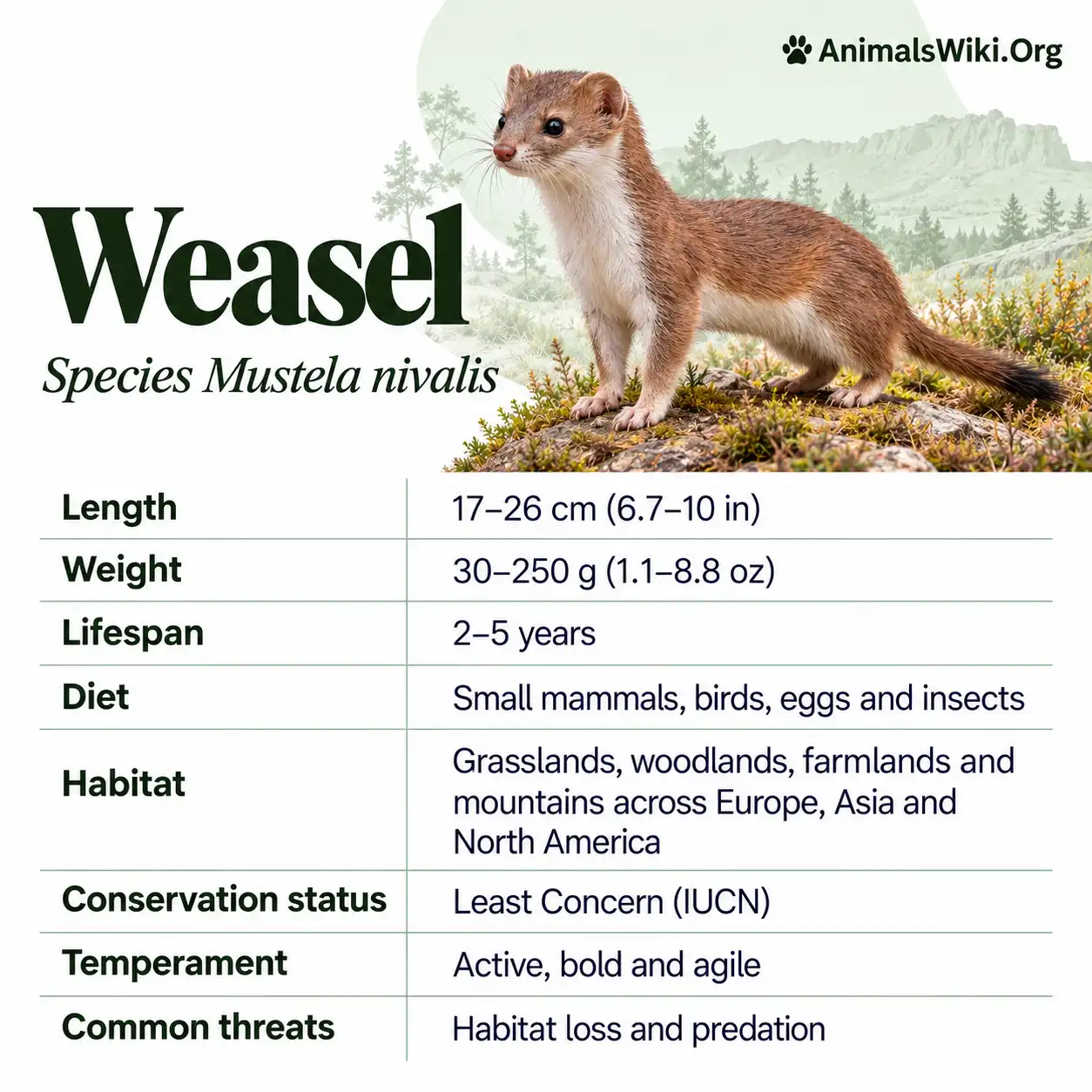
Weasel, The Tiny Predator with Extraordinary Hunting Skills
A weasel is a small, slender mammal with short legs, a flexible body and hunting abilities that seem remarkable for its size. It can disappear into thick grass, follow rodents through narrow passages and investigate spaces that larger predators cannot enter.
The name covers several species. In Britain, “weasel” usually means the least weasel, Mustela nivalis. In North America, people may also use it for long-tailed weasels and animals commonly called short-tailed weasels or ermines.
These distinctions matter. Not every weasel has the same tail markings, winter coat, breeding schedule or distribution.
Weasels belong to Mustelidae, the family that includes stoats, polecats, ferrets, mink, otters and badgers. Within that diverse family, the smallest weasels have become particularly specialized for pursuing small prey.
Their lives involve a demanding balance between finding food and avoiding danger. A narrow body helps them enter rodent tunnels, but a small body also loses heat quickly. Hunting success, shelter and seasonal conditions therefore have immediate importance.
This guide explores the main types of weasels, their habitats, diets, reproduction and conservation. It focuses especially on the least weasel while identifying facts that belong to other species.
Weasel Facts
| Feature | Details |
|---|---|
| Animal group | Mammal |
| Family | Mustelidae |
| Familiar species | Least weasel, Mustela nivalis |
| Another widespread species | Long-tailed weasel, Neogale frenata |
| Typical body shape | Long, slender body with short legs |
| Least weasel tail | Short and without the conspicuous black tip of a stoat |
| Main foods | Small mammals, especially rodents |
| Activity | Can occur during the day and night |
| Shelter | Rodent burrows, cavities and other concealed places |
| Young | Called kits |
| Least weasel pregnancy | Approximately 34–37 days |
| Delayed implantation | Absent in least weasels; present in some other weasels |
| Winter coat | Varies by species, population and location |
| Global least weasel status | Least Concern |
| Notable distinction | The least weasel is the smallest living member of Carnivora |
1. What Is a Weasel?
A weasel is a small carnivorous mammal whose body is especially suited to exploring narrow spaces.
The familiar least weasel has a slim torso, short limbs, a pointed muzzle and a short tail. Its proportions allow it to follow prey into places that would be inaccessible to a larger hunter.
However, “weasel” is not the name of one species alone. Several mammals carry the name, and everyday usage differs between countries.
This can create confusion when a general description mixes information from different animals.
A statement about a long-tailed weasel’s reproduction may not apply to a least weasel. A description of winter coloration in Minnesota may not describe an animal living in Britain.
The best starting point is therefore the scientific name.
Once the species is clear, its appearance, feeding behavior and relationship with the surrounding environment become easier to understand.
2. Which Animals Belong to the Weasel Family?
Weasels belong to Mustelidae, a family containing animals with remarkably different lifestyles.
Otters are adapted to feeding in water. Badgers are powerful diggers. Martens are capable climbers. Small weasels specialize in investigating cover and confined spaces.
The phrase “weasel family” does not mean every member resembles a least weasel.
It identifies evolutionary relationships rather than one shared body size or habitat.
Even among animals commonly called weasels, modern classification uses more than one genus.
For example, the long-tailed weasel is currently classified as Neogale frenata. Older references usually call it Mustela frenata.
Both names appear in useful literature, so recognizing the change prevents unnecessary confusion.
A different scientific name in an older book does not always indicate a different animal.
It may reflect an updated understanding of relationships within a diverse mammal family.
3. Main Types of Weasels
The following examples show why weasels should not be treated as one uniform animal.
| Species | Scientific name | General distribution |
|---|---|---|
| Least weasel | Mustela nivalis | Parts of Eurasia, North America and North Africa |
| Long-tailed weasel | Neogale frenata | The Americas |
| Siberian weasel | Mustela sibirica | Parts of Asia |
| Yellow-bellied weasel | Mustela kathiah | Parts of southern and eastern Asia |
| Altai mountain weasel | Mustela altaica | Mountainous regions of Asia |
| African striped weasel | Poecilogale albinucha | Parts of sub-Saharan Africa |
This is a selection rather than a complete species checklist.
The Siberian weasel occurs across a broad Asian range that includes Pakistan. The African striped weasel belongs to a different genus and has a conspicuous appearance unlike the familiar brown-and-white least weasel.
The Altai mountain weasel also has a different conservation assessment from several widespread relatives.
Accurate species labels are therefore essential when choosing images, comparing measurements or discussing conservation.
4. What Does a Least Weasel Look Like?
A least weasel generally has brown upperparts and pale underparts, with a long, narrow body and short legs.
Its head is small, its ears are rounded, and its tail is short compared with that of a stoat.
In many familiar brown-coated populations, the boundary between the brown back and pale underside is irregular.
However, appearance varies geographically, so a British identification description should not be treated as a template for the entire species.
The tail is especially useful. Least weasels lack the conspicuous black tail tip associated with stoats and long-tailed weasels.
A clear view of the whole animal provides stronger evidence than a brief glimpse of the head.
Grass, motion blur and poor lighting can hide important markings.
For identification, combine the tail, proportions, body size and location rather than relying on the animal’s brown color alone.
5. How Small Is a Weasel?
The least weasel is the smallest living member of the mammalian order Carnivora.
Some populations contain adults weighing only a few dozen grams.
Measurements differ considerably across the species’ range, and males are generally larger than females.
A University of Minnesota summary gives regional least weasel weights around 40–56 grams, illustrating how small these animals can be.
British reference measurements are often larger, particularly for males.
This variation makes one universal weight range difficult to apply without context.
It also explains why photographs can be misleading. A close-up portrait enlarges the animal visually, while the absence of familiar objects conceals scale.
The phrase “tiny predator” is accurate, but the most useful description identifies the species and measurement.
Long-tailed and Siberian weasels are substantially different animals from the smallest least weasels, even though they share the common name.
6. Weasel vs. Stoat: How Can You Tell Them Apart?
For the least weasel and European stoat, the tail provides one of the most useful distinctions.
A stoat has a longer tail with a conspicuous black tip. A least weasel has a shorter tail without that contrasting tip.
Stoats are generally larger, although apparent size can be difficult to judge during a brief encounter.
The pattern separating upper and lower body colors can also help, but it should be considered alongside other features.
| Feature | Least weasel | European stoat |
|---|---|---|
| General size | Smaller | Larger |
| Tail | Shorter | Longer |
| Black tail tip | Absent as a conspicuous feature | Present |
| Typical British winter coat | Remains brown above | May turn white in some regions |
| Common identification challenge | Brief views conceal the tail | Brief views make size difficult to judge |
The rule concerns these particular species. It should not become the claim that every animal called a weasel lacks a black tail tip.
7. Weasel vs. Ferret, Polecat and Mink
Weasels, ferrets, polecats and mink belong to the same family, but they are not interchangeable names.
A domestic ferret is a domesticated animal closely associated with polecat ancestry. It is generally much larger and heavier than a least weasel.
A European polecat has a robust body and contrasting facial mask.
An American mink is also larger than a least weasel and is strongly associated with waterside habitats.
These comparisons help when identifying an unfamiliar elongated mammal.
However, habitat alone cannot settle the question. A weasel can occur near water, and another mustelid may cross a field.
Look for several features together: approximate size, face pattern, tail length, body color and behavior.
A tiny animal disappearing into a vole runway presents a different identification problem from a larger dark mammal swimming across a stream.
The complete encounter matters more than one familiar label.
8. Where Do Weasels Live?
Different weasels occupy different geographic ranges.
The least weasel has an extensive distribution across parts of the Northern Hemisphere, while the long-tailed weasel occurs through much of the Americas.
Other species are concentrated in particular Asian or African regions.
Broad range maps should not be interpreted as continuous occupation.
A country may contain suitable and unsuitable habitats, and records can be patchy because these mammals are difficult to observe.
Introductions complicate the picture further.
Least weasels occur in New Zealand because people introduced them; they are not native there.
This distinction matters when considering ecological effects.
A native predator can be part of a long-established food web while an introduced population encounters prey with a different evolutionary history.
The same species can consequently be a conservation concern in one place and a threat requiring management in another.
9. What Is a Weasel’s Habitat?
Least weasels use a variety of habitats, including grasslands, farmland, woodland edges, scrub and some colder open environments.
The most useful features often involve prey and cover.
Dense ground vegetation can shelter rodents and provide concealed routes for the weasel.
A place that appears untidy to a person may contain a network of runways, cavities and feeding opportunities.
Conversely, a visually attractive woodland with sparse ground cover may provide fewer useful hunting spaces.
This helps explain why habitat quality cannot be judged by scenery alone.
The animal needs access to food and places where it can investigate that food effectively.
Shelter also matters, especially during breeding or cold weather.
A patch supporting rodents but offering few secure resting places may function differently from one containing both resources.
Weasel habitat is therefore best understood through the practical opportunities it provides.
10. Where Do Weasels Sleep?
Weasels use concealed resting places such as cavities, spaces among roots, log piles and burrows created by other animals.
A least weasel may occupy the former nest of prey.
Its home range can contain several resting sites rather than one permanent den used throughout life.
This arrangement allows an animal to rest near different parts of its feeding area.
The shelter may also contain nesting material or stored food.
A breeding female requires a protected place for dependent kits.
For people managing gardens, buildings or woodpiles, the important point is that a small opening can lead to a larger hidden space.
An adult seen entering does not reveal whether young remain inside.
Avoid dismantling an occupied shelter or sealing an entrance without establishing the situation.
The visible animal can represent only one part of a family’s use of that location.
11. Why Are Weasels So Long and Slender?
A narrow body allows a weasel to enter rodent tunnels and follow prey through dense cover.
This provides access to food beyond the reach of larger predators.
Short legs keep the animal close to the ground and suit movement through confined spaces.
However, the body shape involves a trade-off.
A small, elongated mammal has substantial surface area relative to its volume, making heat conservation challenging.
The same structure that helps obtain food can increase the importance of obtaining it regularly.
This is why weasel biology cannot be separated into unrelated facts about shape and appetite.
The two are connected.
Shelter, activity and feeding contribute to maintaining the animal’s energy balance.
Its form is highly effective for a particular hunting lifestyle, but that effectiveness comes with demands that a more rounded mammal of similar mass may experience differently.
12. What Do Weasels Eat?
The weasel diet depends on species, but small mammals are central to the feeding of many familiar weasels.
Least weasels are especially associated with rodents such as mice, voles and lemmings.
Other prey can include birds, eggs and young rabbits, depending on availability and the population involved.
The animal’s small size does not limit it to insects.
Instead, its narrow body allows access to small vertebrate prey in protected spaces.
Diet should nevertheless be described without exaggeration.
A list of possible foods does not mean every item contributes equally.
Local prey abundance can strongly influence what is eaten and whether reproduction succeeds.
For a least weasel, the difference between a rodent-rich season and a poor one can be substantial.
Food is therefore not merely one topic in its natural history. It helps connect habitat use, movements, breeding and survival.
13. How Do Weasels Hunt?
Weasels search through cover, investigate scent and enter passages where prey may be concealed.
Their hunting advantage comes partly from being small enough to follow rodents into their own environment.
A larger predator may wait outside a burrow. A weasel can sometimes continue the pursuit inside.
This changes the meaning of refuge for the prey.
The process involves more than speed. Locating a runway, choosing an entrance and navigating confined spaces are important.
Smell can contribute information when visibility is limited.
Research has investigated weasel responses to rodent odors, reflecting the importance of chemical cues in these interactions.
For observers, a weasel pausing with its nose near the ground may be collecting information rather than hesitating randomly.
Its quick movements become easier to understand when viewed as part of a search through a complex network of potential food locations.
14. Can a Weasel Catch Prey Larger Than Itself?
Yes. Weasels can take prey that outweighs them, although the frequency and type of such prey vary.
Young rabbits are included in natural-history accounts for some species.
However, the most dramatic example should not become the model for every meal.
Least weasels are strongly associated with small rodents, and routine feeding may involve prey much closer to their own size.
Successful hunting also depends on circumstances.
A predator may encounter a young, confined or vulnerable animal rather than overpowering a healthy adult in open ground.
This distinction avoids turning capability into a universal claim.
The impressive feature is not unlimited strength.
It is the combination of access, movement, sensory information and predatory behavior that allows a small mammal to exploit opportunities.
Weasels are effective hunters within those conditions, without needing exaggerated descriptions of invincibility.
15. Why Do Weasels Need So Much Food?
Small weasels have high energy requirements relative to their size.
Maintaining body temperature and supporting activity both require energy.
Popular references often summarize this by saying a weasel may consume around a third of its body weight daily.
That is a broad illustration, not a fixed requirement for every species or individual.
Temperature, activity, breeding condition and food quality affect actual needs.
Research on male least weasels showed that winter energy demands were strongly associated with keeping warm, while warmer-season demands could reflect high activity.
The animals adjusted activity time in relation to conditions.
This makes their behavior more flexible than the image of a predator running constantly.
A weasel must balance the energy gained from hunting with the energy spent moving and remaining warm.
Resting in a protected place is therefore part of survival, not simply time spent between interesting events.
16. Do Weasels Store Food?
Yes. Food caching is documented in weasels.
An animal may take prey when an opportunity is available and store some of it for later consumption.
This separates the moment of capture from the moment of eating.
It can be especially useful when prey availability changes or when a female must provide for young.
Caching also helps explain why several prey items may be found near a shelter.
The presence of a store does not mean the animal was feeding on everything simultaneously.
It is also misleading to describe such behavior as killing purely for entertainment.
A predator encountering concentrated vulnerable prey can continue responding to those opportunities.
Stored food is part of that broader feeding strategy.
Understanding the behavior provides a more useful explanation than human moral labels, particularly when discussing encounters around captive birds or other concentrated food sources.
17. Are Weasels Active During the Day or Night?
Weasels can be active during both daylight and darkness.
Their schedules differ between species, locations and conditions.
Least weasels should not automatically be described as strictly nocturnal simply because many other small carnivores are active at night.
Regular feeding needs can contribute to repeated periods of searching and resting.
Access to covered runways and tunnels also allows activity without remaining exposed in open ground.
For an observer, a daytime sighting is therefore normal biological possibility rather than evidence of illness.
The animal’s condition and behavior matter more than the hour alone.
A short appearance may be followed by a long period out of view.
This makes casual sightings a poor guide to the complete daily routine.
Repeated observations or suitable cameras reveal a more useful picture than assuming an animal seen once at noon is normally active only then.
18. Do Weasels Hibernate?
Least weasels do not hibernate.
They remain active through winter, including in environments where snow covers the ground.
Activity does not mean they ignore the need to conserve energy.
They use shelter and alternate movement with resting periods.
Winter also changes the places where food can be found.
For a small predator able to enter narrow passages, opportunities continue beneath surfaces that appear inactive to a person walking above them.
The important distinction is between seasonal inactivity and less visible activity.
A snow-covered field may contain a network of mammal movements below the surface.
The weasel’s winter environment therefore includes more than the exposed landscape people see.
Understanding that hidden space helps explain how a tiny animal continues hunting in conditions that seem to offer little food or cover.
19. How Can Weasels Hunt Beneath Snow?
The space beneath snow can contain tunnels and runways used by small mammals.
Weasels can enter this hidden environment and pursue prey there.
This area is often called the subnivean space.
Snow can separate the activity below from the conditions above, although its effects depend on depth and structure.
For a weasel, movement beneath the surface provides both hunting opportunities and concealment.
Tracks may disappear into a small opening and reappear elsewhere.
That does not mean the animal stopped moving between those points.
It may have traveled through spaces invisible from above.
This is an example of how body size determines access.
A narrow predator can use an environment that is effectively unavailable to a fox or a large bird.
Winter hunting is therefore a continuation of the same basic advantage that allows weasels to enter rodent burrows during other seasons.
20. Do All Weasels Turn White in Winter?
No. Winter coloration depends on the species and population.
Some least weasels develop a white winter coat, while others remain brown.
British least weasels generally retain brown upperparts throughout the year.
Northern populations elsewhere may change substantially.
Long-tailed weasels also show geographic variation, with white winter coats in some colder regions and brown coats in others.
This is why both “weasels turn white” and “weasels never turn white” are incomplete statements.
The correct answer needs a location and species.
Seasonal molt also produces transitional appearances.
An animal photographed while replacing its coat may look patchy rather than matching a textbook summer or winter illustration.
Those transitions are normal.
For identification, the tail and body proportions can remain useful even when the coat is changing and color alone becomes less dependable.
21. What Determines White and Brown Winter Coats?
Seasonal coloration has a genetic basis as well as a relationship with local environmental conditions.
Research on least weasels has linked alternative winter colors to the pigmentation gene MC1R.
A 2026 study investigated how a particular genetic change affects the biological signaling associated with winter-brown coloration.
The research also examined how this variation persisted over evolutionary time.
The important point is that a winter-brown weasel is not simply a winter-white individual deciding to delay its coat change.
Inherited differences contribute to the pattern.
Local snow conditions can influence which coloration is advantageous, while populations contain evolutionary histories that shape the variation available.
This provides a useful example of adaptation in a familiar mammal.
A change visible in the coat connects molecular biology, seasonal environments and the long-term persistence of different forms within a species.
22. How Can Reduced Snow Affect Weasels?
A white coat can provide camouflage against snow but become conspicuous on dark ground.
This creates the possibility of camouflage mismatch when coat color and background no longer correspond.
Research in northeastern Poland examined winter-white and winter-brown least weasels and used models to test predator responses.
Contrasting models were detected more frequently than those matching the background.
The study also linked the relative occurrence of winter-white animals with snow-cover duration.
These findings do not establish one identical outcome for every population.
They do show why changing winter conditions can matter to a small mammal vulnerable to predators.
The effect is more specific than the statement that warmer weather is simply better for a tiny animal.
Reduced cold can occur alongside reduced camouflage, and several consequences may operate together.
23. Are Weasels Solitary?
Adult least weasels generally spend much of their time alone.
Mothers with kits are an important exception.
Home ranges and territorial behavior depend on prey distribution, sex and local density.
Males may extend their movements during the breeding season.
Solitary activity does not mean that individuals never encounter one another or use places visited by others.
The distinction matters when interpreting photographs.
Two animals in one image could represent a family interaction, a breeding encounter or another temporary association.
One animal seen alone does not reveal its complete social history.
For these small predators, interactions are spread through space and time rather than always occurring in a visible group.
Their organization is therefore harder to appreciate than that of animals gathering around one communal home.
Observation over time provides the context missing from a single encounter.
24. How Do Weasels Communicate?
Weasels use chemical signals and can also produce sounds.
Scent marking allows information to remain after the animal has moved away.
This is useful for mammals that spend substantial time alone and use concealed routes.
Sounds can occur during defensive or social interactions, although calls are usually less familiar to people than the animal’s appearance.
Communication should not be interpreted too confidently from one brief observation.
A sound does not reveal a precise message without context.
Similarly, a weasel rubbing or investigating a location may be responding to information that a human cannot detect.
For naturalists, careful description is valuable.
Record what happened, whether another animal was present and what followed.
Those details provide stronger evidence than imagining an elaborate conversation or assigning a fixed meaning to every movement.
The animal’s sensory environment contains information that remains largely hidden from us.
25. How Do Least Weasels Reproduce?
Least weasels have relatively short pregnancies, generally around 34–37 days.
Unlike long-tailed weasels, they do not use delayed implantation.
Breeding is closely connected with food availability.
In favorable conditions, females may produce more than one litter during a season.
Typical litters contain several kits, but litter size varies.
The mother supplies the principal care, including nursing and provisioning.
This reproductive flexibility helps populations respond when prey becomes abundant.
It does not mean unlimited population growth.
The same animals remain dependent on sufficient food, and poor prey conditions can reduce breeding success or survival.
For an accurate account, reproduction should therefore be linked with ecology rather than presented as a fixed calendar alone.
The availability of small mammals influences what is possible during a particular season.
26. How Does Long-Tailed Weasel Reproduction Differ?
Long-tailed weasels use delayed implantation.
After mating, early development pauses before implantation and continued growth.
Consequently, the interval between mating and birth can be much longer than the active period of fetal development.
This allows mating and birth to occur in different seasons.
Least weasels do not follow that pattern.
The difference is especially important because both animals appear in general articles simply labeled “weasel.”
A description that combines a month-long least weasel pregnancy with the long-tailed weasel’s seasonal delay produces a misleading account.
The scientific name resolves the problem.
Reproductive biology is one of the clearest reasons to separate species throughout a wildlife article.
Close relatives can share an elongated body and predatory lifestyle while differing substantially in how reproduction is scheduled.
27. What Are Baby Weasels Like?
Baby weasels are called kits.
Least weasel kits are born small and dependent, with closed eyes and limited ability to regulate their own lives outside the nest.
The mother nurses them and later supplies animal food.
Movement, sensory abilities and feeding skills develop gradually.
A youngster capable of leaving the nest is not automatically fully independent.
The transition involves more than body growth.
It includes finding food, handling prey and using cover effectively.
The family association ends as young disperse, but the timing varies with conditions.
For someone finding a small weasel, the safest assumption is not that it needs immediate handling.
Observe from a distance and seek appropriate wildlife advice if there is clear injury or another problem.
A mother may be nearby even when she is not visible.
28. How Long Do Weasels Live?
Many wild least weasels have short lives.
British reference accounts give a general lifespan around two years, while noting that relatively few survive beyond that age.
These figures should not be applied automatically to every weasel species or population.
Early survival, food supply, weather and predation influence the outcome.
A maximum recorded age is also different from an average.
An unusually long-lived captive animal does not establish how long most wild individuals survive.
The least weasel’s biology combines rapid development and reproductive responsiveness with substantial mortality.
That pattern differs from long-lived mammals whose populations depend on many years of adult survival.
For readers, the important point is that a weasel’s life can be brief and demanding.
Its effectiveness as a hunter does not remove the pressures associated with being extremely small.
29. What Animals Eat Weasels?
Weasels can be taken by birds of prey and larger mammalian predators.
Their small size allows access to prey but also leaves them vulnerable.
Cover therefore serves two purposes: it helps them hunt and helps them avoid becoming prey.
White winter camouflage can contribute protection where snow is present, while brown coloration can blend with other backgrounds.
Predator lists vary by location, and a documented predator should not automatically be treated as the main source of mortality everywhere.
A weasel can also be killed during an encounter without being consumed.
For a general profile, the key relationship is that these animals occupy both sides of predation.
They are capable hunters and potential prey.
Understanding both roles provides a fuller picture than portraying them as fearless little predators facing no meaningful risks.
30. How Do Weasels Affect Rodent Populations?
Weasels are important rodent predators, but their population effects depend on the ecological setting.
Long-term research in northern Europe has investigated their role alongside stoats and birds of prey in vole population cycles.
A 2025 synthesis drew on decades of observations and field experiments.
It emphasized the collective influence of different predators rather than assigning every change in vole abundance to weasels alone.
This distinction matters.
A rodent population responds to food, weather, reproduction, disease and several predators.
A weasel population can also respond to prey abundance with a delay.
The result is a changing system, not a simple rule that more weasels always produce an immediate, fixed reduction in rodents.
For readers, the practical conclusion is that weasels are meaningful participants in rodent ecology without being a guaranteed solution to every pest problem.
31. Are Weasel Populations Declining?
Some evidence raises concern about declines, particularly in parts of North America.
A 2021 study combined harvest records, museum information, community observations and camera surveys.
The datasets had different limitations, but collectively they supported concern about reduced occurrence or abundance in some areas.
The authors called for improved monitoring.
This is more informative than treating every decline in trapping records as a direct population count.
Trapper numbers, effort and practices can also change.
At the same time, uncertainty is not a reason to assume populations are secure.
Small, elusive animals can decline without attracting the attention received by larger mammals.
The study illustrates why familiar species still need investigation.
A broad historical range or an old reputation for abundance does not guarantee that the same conditions continue everywhere today.
32. Are All Weasels Endangered?
No. Conservation status differs by species and region.
The least weasel is globally classified as Least Concern.
The Altai mountain weasel is classified as Near Threatened.
Regional assessments can also identify concerns that are not reflected in a broad global category.
This is why “weasels are common” and “weasels are endangered” are both inadequate without further detail.
The scientific name establishes which animal is being discussed.
The geographic scope establishes whether the statement concerns the whole species or one regional population.
Monitoring quality matters too.
A species can be difficult to count while still requiring attention.
Conservation should therefore combine classification with evidence about habitat, occurrence and threats.
A global category provides a useful summary, but it does not replace the work needed to understand what is happening locally.
33. Why Are Weasels a Problem in New Zealand?
Weasels are introduced predators in New Zealand.
They were brought there during historical attempts to control rabbits.
Their arrival created new predation pressures on native wildlife, including birds, lizards and invertebrates.
The New Zealand Department of Conservation identifies them as a threat, although they are generally less common there than stoats.
This does not contradict their ecological importance in native habitats.
Conservation evaluates relationships within a particular system.
An introduced predator can encounter prey that did not evolve with it and can add pressure to populations already affected by habitat loss or other introduced animals.
The lesson is not that the species is inherently good or bad.
It is that moving predators between ecosystems can produce consequences very different from the original intention.
Protecting native weasels and managing introduced ones can both be legitimate conservation goals.
34. How Do Scientists Monitor Weasels?
Weasels are difficult to monitor because they are small, fast and often concealed.
An ordinary camera aimed at a broad trail may miss an animal moving close to the ground.
Specialized enclosed camera systems can guide movement through a visible space without capturing the animal.
One example is the Mostela, combining a camera with a tracking tunnel inside a box.
Research comparing methods has found benefits for detecting least weasels, while also identifying limits associated with low numbers of observations.
No device guarantees that every animal present will be recorded.
Placement, habitat and study duration remain important.
The broader point is that detection methods must match the species.
A camera survey designed for deer may provide limited evidence about tiny mustelids.
Better monitoring helps distinguish true absence from an animal simply passing unnoticed.
35. Can Weasels Live Near Farms and Gardens?
Yes. Weasels can use human-modified landscapes where food and cover remain available.
A farm containing rodents, hedges and sheltered structures can provide opportunities.
Their presence does not automatically mean poultry is being attacked.
However, concentrated vulnerable animals may attract predators if access is easy.
Secure housing and regular inspection of gaps offer a more durable response than assuming every nearby weasel must be removed.
Avoid feeding wild weasels or attempting to handle them.
Where a shelter may contain young, establish the situation before closing an entrance.
The same practical reasoning applies to any small predator: address the resource or access point creating the conflict.
A weasel crossing a garden may simply be moving between feeding places.
Observing what actually happens is more useful than reacting to its reputation.
36. How Can You Identify Weasel Tracks Responsibly?
Weasels have five toes, but a footprint may not preserve all five clearly.
Their prints are small and can resemble those of related mustelids.
A clear sequence is more informative than one partial mark.
Photographing a track with a scale can help later assessment without disturbing the animal.
Also note the substrate, direction and surrounding signs.
An identification based on tracks alone should remain cautious when important details are missing.
Do not handle droppings or probe a suspected den.
Repeated observations, images and several kinds of evidence provide a stronger basis.
For community wildlife records, an honest description of uncertainty is useful.
“Small mustelid, possibly a weasel” with a good photograph can contribute more than a confident label unsupported by visible features.
Responsible observation protects the animal while preserving information that others can assess.
Frequently Asked Questions About Weasels
What kind of animal is a weasel?
A weasel is a small mammal in Mustelidae. The common name covers several species. The least weasel, Mustela nivalis, is the familiar species usually called simply “weasel” in Britain.
Is a weasel a rodent?
No. Weasels belong to the order Carnivora. They frequently eat rodents, but their small size and use of burrows do not make them members of the rodent group.
What is the smallest weasel?
The least weasel is the smallest living member of Carnivora. Body size varies geographically, and males are generally larger than females. Some adults weigh only a few dozen grams.
Are weasels related to otters?
Yes. Both belong to Mustelidae. The family also includes badgers, martens, polecats and other mammals whose lifestyles differ substantially from those of small weasels.
What is the scientific name of a weasel?
The least weasel is Mustela nivalis. Other species have different names, including Neogale frenata for the long-tailed weasel. One scientific name does not cover every weasel.
What do weasels eat?
Many weasels eat small mammals. Least weasels are especially associated with rodents. Birds, eggs and other prey may also be taken, depending on the species and available resources.
Do weasels eat mice?
Yes. Mice and other small rodents are important foods for many weasels. Their narrow bodies allow them to follow prey into runways and confined spaces.
Can weasels catch rabbits?
Some can take young rabbits. This does not mean rabbits dominate every weasel’s diet. Least weasels are particularly associated with smaller rodents.
Do weasels store food?
Yes. They can cache prey for later consumption. This helps explain why several prey items may occur near a shelter or nest.
Are weasels active at night?
They can be, but activity also occurs during daylight. Least weasels should not be described as exclusively nocturnal. Their schedules vary with conditions and feeding needs.
Do weasels hibernate?
Least weasels do not hibernate. They remain active through winter and can hunt beneath snow. Shelter and resting periods still help them manage demanding conditions.
Do all weasels turn white?
No. Winter coloration varies by species and population. Some least weasels turn white, while others retain brown upperparts. British least weasels generally remain brown.
Does a weasel have a black tail tip?
A least weasel lacks the conspicuous black tip of a stoat. Long-tailed weasels do have a black-tipped tail, so the answer depends on which species is involved.
What is the difference between a weasel and a stoat?
For least weasels and European stoats, tail length and the black tail tip are especially useful. Stoats are generally larger and have a longer, black-tipped tail.
Is a ferret a weasel?
A ferret belongs to the weasel family but is a domesticated animal associated with polecat ancestry. It is not the same species as the least weasel.
Where do weasels sleep?
They use concealed places such as burrows, cavities, spaces among roots and log piles. A home range can contain several resting sites rather than one permanent shelter.
What are baby weasels called?
They are called kits. Newborns depend on maternal care and gradually develop their senses, movement and feeding abilities before becoming independent.
How long is a least weasel pregnant?
Pregnancy usually lasts approximately 34–37 days. Least weasels do not use the prolonged delayed implantation found in long-tailed weasels.
How many litters do least weasels have?
One or more litters may occur depending on conditions, especially food supply. Reproduction can increase in favorable prey years rather than following one identical schedule everywhere.
How long do weasels live?
Many wild least weasels have short lives, with British references commonly giving around two years. Other species and populations differ, and maximum ages are not the same as averages.
What predators eat weasels?
Birds of prey and larger mammalian predators can take them. Weasels remain vulnerable despite their hunting abilities, making cover and camouflage important.
Are weasels endangered?
The least weasel is globally Least Concern, but other species and regional populations have different assessments. Some evidence also raises concern about declines in parts of North America.
Why are weasels harmful in New Zealand?
They are introduced predators there and can threaten native wildlife. Their effects differ from those in ecosystems where they are native.
Should you feed a wild weasel?
Avoid feeding it. Preserve natural habitat and observe from a distance. If an animal appears injured or trapped, contact an appropriate wildlife professional rather than attempting to tame or handle it.
What should you do if you see a weasel?
Give it space and keep pets away. Note the tail, approximate size and location if possible. A photograph taken without pursuit can help identification.



