
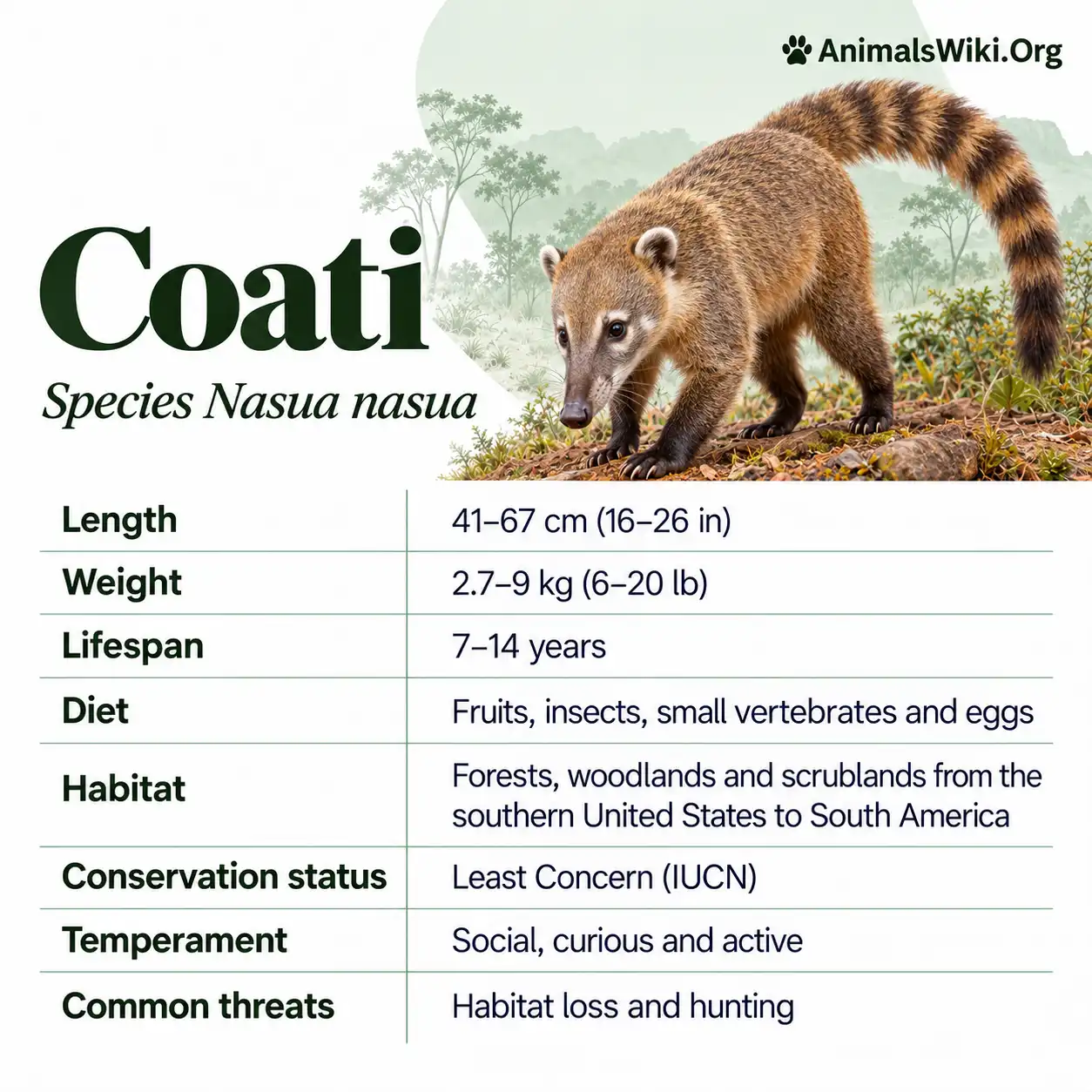
Coati, Types, Habitat, Diet, Behavior and Conservation
A coati is a curious-looking mammal with a flexible snout, strong digging claws, and a long tail often carried upright while walking. Related to raccoons, coatis are skilled climbers and active foragers that search for fruit, insects, and other foods across parts of the Americas.
Watching a coati reveals an animal constantly investigating its surroundings. Its nose moves through leaf litter, its paws uncover hidden prey, and its body changes direction as it follows promising smells. When several travel together, their raised tails and frequent calls make the group especially noticeable.
Yet there is more to a coati than an unusual appearance. Females and young often form social groups called bands, while adult males commonly spend more time alone. Relationships within these groups involve grooming, competition, communication, and protection of youngsters.
Coatis also contribute to ecosystems by consuming small animals and carrying seeds away from fruiting plants. Their ability to use different foods helps some populations survive in modified landscapes, although adaptability does not remove their dependence on suitable habitat.
This guide explores coati identification, classification, species, habitat, diet, behavior, reproduction, young, lifespan, and conservation. It also explains the differences between coatis and raccoons, what “coatimundi” means, and why feeding wild coatis can create problems.
Coati Facts
| Feature | Details |
|---|---|
| Common name | Coati |
| Alternative name | Coatimundi |
| Animal group | Mammal |
| Order | Carnivora |
| Family | Procyonidae |
| Familiar species | White-nosed coati and South American coati |
| White-nosed coati scientific name | Nasua narica |
| South American coati scientific name | Nasua nasua |
| Mountain coati classification | Varies between taxonomic authorities |
| Native region | Parts of North, Central, and South America |
| Main foods | Fruit, insects, other invertebrates, and occasional small vertebrates |
| General size of the familiar larger species | Often comparable in weight to a large domestic cat |
| Typical adult weight reference | Approximately 3–6 kilograms for many individuals |
| Distinctive features | Mobile snout, long tail, strong claws |
| Social group | Band |
| Typical social pattern | Females and young often group together; many adult males live alone |
| Pregnancy | Roughly 10–11 weeks in commonly described Nasua populations |
| Young | Pups or kits |
| Main ecological roles | Consumer, prey animal, and seed disperser |
| Conservation status | Depends on species and assessment |
1. What Is a Coati?
A coati is a member of Procyonidae, the animal family that includes raccoons, ringtails, kinkajous, and olingos.
Its appearance is distinctive: a relatively slender body, short legs, elongated nose, and conspicuous tail. Although people sometimes compare it with a small anteater or a monkey, it belongs to neither group.
Coatis are omnivores. They consume both plant and animal foods, adjusting their feeding to local opportunities. Their classification in the order Carnivora reflects evolutionary relationships rather than a requirement to eat mainly meat.
The name “coati” applies to more than one species. This matters because body size, distribution, social behavior, and conservation concerns are not identical across the group.
Most familiar descriptions concern white-nosed and South American coatis. Mountain coatis have a more restricted highland distribution and a smaller scientific literature.
A useful introduction therefore recognizes both their shared features and their differences. There is no single coati lifestyle that can be applied without qualification to every population.
2. How Many Types of Coatis Are There?
The answer depends on the taxonomic reference being used.
Traditional accounts commonly describe four species:
- White-nosed coati, Nasua narica
- South American coati, Nasua nasua
- Western mountain coati, Nasuella olivacea
- Eastern mountain coati, Nasuella meridensis
However, the Mammal Diversity Database currently places mountain coatis within Nasua and treats the eastern form as part of Nasua olivacea. Under that arrangement, three living species are recognized.
This difference reflects changing interpretations of evolutionary evidence, rather than the discovery that some animals never existed.
Readers may therefore encounter both Nasua olivacea and Nasuella olivacea in reliable material.
The practical approach is to identify which classification is being followed. Older conservation assessments may retain names and boundaries that differ from newer taxonomic databases.
Throughout this article, mountain-coati names are explained where necessary, while most detailed behavioral discussion concerns the two better-studied, widespread species.
3. The White-Nosed Coati
The white-nosed coati, Nasua narica, occurs from parts of the southwestern United States through Mexico and Central America into northwestern South America.
Its pale muzzle and contrasting facial markings help distinguish it from the South American coati, although identification should consider location and the whole animal.
This species occupies a variety of wooded environments. It is particularly familiar to visitors in parts of Central America, where bands may forage near trails and tourist facilities.
Females and young commonly travel together, while adult males usually live separately outside breeding interactions.
A solitary coati is therefore not necessarily lost or separated from its group. It may be following a normal adult-male pattern.
At the northern edge of its distribution, the species also demonstrates that coatis are not exclusively tropical rainforest animals.
Nevertheless, a broad geographic range does not mean every location within it provides suitable habitat. Food, cover, water, and disturbance influence where animals can persist.
4. The South American Coati
The South American coati, Nasua nasua, is also called the brown-nosed or ring-tailed coati.
It occurs across a substantial part of South America, including areas of Brazil, Bolivia, Paraguay, Argentina, and several other countries.
Its coat can vary from reddish or yellowish brown to much darker shades. Common names are useful, but they should not be interpreted as requiring every individual to display an identical nose color or sharply defined tail rings.
This species is important in research on social relationships, fruit consumption, and seed dispersal.
Studies have also revealed exceptions to the simplified idea that every adult male coati lives alone. Some South American coati groups include a resident adult male.
That finding makes the species especially useful for exploring how social systems vary with population and circumstances.
Its broad distribution also includes different environments, so observations from one Brazilian park or an Argentine forest should not automatically be treated as universal.
5. Mountain Coatis
Mountain coatis inhabit parts of the Andes and differ from their larger, more familiar relatives in size and ecological setting.
They are associated with highland environments, including montane forests and páramo landscapes.
Their biology is less thoroughly documented, so some older descriptions rely partly on comparisons with other coatis. That makes careful field research particularly valuable.
A camera-trap study in northern Peru examined South American and mountain coatis along an elevation gradient. The two showed different associations with elevation, illustrating that closely related animals can use a landscape differently.
The study also recorded far fewer mountain-coati detections, limiting some conclusions about activity.
This is a useful reminder that shared appearance does not establish identical habitat requirements.
For conservation, mountain coatis deserve attention in their own right. Protecting widespread lowland coatis does not automatically protect animals occupying different elevations, forest structures, and geographic ranges.
6. Coati vs. Raccoon
Coatis and raccoons belong to the same family, but they are different animals.
The coati’s elongated snout is one of the easiest distinctions. Its body also tends to appear more stretched and its tail is often held upright during ground movement.
| Feature | Coati | Raccoon |
|---|---|---|
| Family | Procyonidae | Procyonidae |
| Snout | Long and highly mobile | Shorter |
| General build | Often relatively slender | Usually stockier |
| Tail position when walking | Frequently upright | Commonly carried lower |
| Typical activity | Many coatis are mainly active by day | Many raccoons are mainly active at night |
| Familiar social pattern | Female-and-young bands | Different and more variable social arrangements |
| Feeding style | Extensive nose-led searching and digging | Strong use of sensitive forepaws alongside other senses |
These are broad comparisons rather than rules covering every individual.
Knowing the difference improves wildlife identification, particularly in places where both animals occur. A ringed tail alone is insufficient because several members of the family share that feature.
7. What Does a Coati Look Like?
A coati has an elongated body, a pointed muzzle, small rounded ears, and a tail that can approach the length of its head and body combined.
Coat coloration varies among species, populations, and individuals. Brown, reddish, grayish, and nearly black tones occur.
The face often contains contrasting pale and dark markings. Tail rings may be prominent or relatively faint.
Strong claws are visible on the paws, and the overall posture changes during feeding. A searching animal frequently lowers its head and brings its snout close to the substrate.
Its appearance makes more sense when viewed as a set of working features. The nose investigates, the paws uncover food, and the tail contributes to balance.
Descriptions based on a single photograph can miss this flexibility. A coati standing alert looks quite different from one digging beneath leaves or stretched along a branch.
Movement is therefore part of what makes the animal recognizable.
8. How Big Is a Coati?
The better-known larger coatis commonly weigh several kilograms, with approximately 3–6 kilograms providing a useful broad reference for many individuals.
Adult males are generally larger than females, although age and individual variation affect comparisons.
A large portion of total length consists of tail. This makes it important to distinguish head-and-body measurements from nose-to-tail measurements.
Mountain coatis are smaller than the familiar white-nosed and South American forms.
For readers comparing animals, “about the weight of a large domestic cat” can be helpful, provided it is understood as an approximate comparison rather than a standard measurement.
Body mass also changes with condition, season, and food access. Animals receiving substantial human food may not represent typical wild body condition.
A useful size description therefore provides a range and identifies the species. Treating every coati as the same size conceals both biological variation and the differences between highland and larger-bodied forms.
9. Why Does a Coati Have Such a Long Nose?
The coati’s flexible snout is central to its feeding behavior.
It can investigate leaf litter, soil, cracks, and narrow spaces where food is difficult to see.
Smell helps direct attention toward promising locations, while close physical exploration allows the animal to examine the surface.
Research using experimental fruit plots found that South American coatis relied strongly on olfaction to discover food.
Interestingly, movement speed affected detection. Slower-moving groups detected the experimental food from greater distances under the conditions studied.
This demonstrates a practical trade-off: moving quickly covers ground, while slower searching can improve discovery.
The nose is therefore not simply an unusual ornament. It participates in decisions about where to stop, dig, turn, or continue traveling.
Watching a coati’s snout often reveals the first indication that it has found something interesting, before its paws begin uncovering the item.
10. What Is a Coati’s Tail Used For?
A coati’s long tail contributes mainly to balance.
During climbing, it helps the animal manage body position as it moves across branches or descends uneven surfaces.
On the ground, the tail is often carried upright. In vegetation, this posture may also help group members remain visually noticeable, although that proposed function should not be presented as the only reason for the position.
A coati’s tail should not be equated with the fully grasping tail of a kinkajou.
A detailed white-nosed coati reference describes it as non-prehensile, while noting that it can provide some contact or grip during steep descents.
The paws and claws remain the main structures securing the animal to the tree.
This distinction prevents an appealing but inaccurate picture of coatis hanging freely by their tails.
The tail is conspicuous, but its usefulness comes from supporting movement rather than replacing the limbs.
11. How Coatis Dig and Climb
Coatis use their forepaws and curved claws to uncover food beneath leaves, in soil, and around decaying wood.
The sequence often begins with sniffing. Once a promising location is found, the animal scratches or pulls material aside and investigates again.
This repeated exchange between detection and digging makes feeding an active process.
The same general body must also function above ground. Coatis climb trees to reach resources, escape danger, and use resting sites.
Their mobility allows them to exploit both forest-floor and elevated opportunities.
Rather than viewing digging and climbing as unrelated talents, it is useful to see them as complementary parts of a flexible foraging lifestyle.
A fallen log may contain prey, while a living tree may provide fruit or a secure place to rest.
That combination explains why habitat structure matters. Food is distributed across surfaces, layers, and spaces, and coatis are equipped to investigate many of them.
12. Where Do Coatis Live?
Coatis are native to the Americas.
Taken together, their ranges extend from parts of the southwestern United States through Central America and across substantial portions of South America.
However, no single species occupies that entire combined distribution.
The white-nosed coati reaches north into the United States and south into northwestern Colombia. The South American coati occupies a different, extensive range farther south. Mountain coatis are associated with Andean regions.
This distinction matters because broad statements such as “white-nosed coatis live from Arizona to Argentina” confuse the range of one species with that of the group.
A useful distribution description identifies both the animal and the region.
Maps also require interpretation. A country listed within a species’ range does not mean coatis occur in every province, habitat, or elevation.
Local conditions determine where populations can survive, reproduce, and remain connected to neighboring groups.
13. What Kind of Habitat Does a Coati Need?
Coatis use several habitat types, including tropical forests, seasonally dry woodland, wooded mountain areas, and some modified landscapes.
Their adaptability is important, but it should not be confused with independence from vegetation.
Trees provide resting, nesting, climbing, and escape opportunities. Ground cover and leaf litter support feeding, while fruiting plants contribute food at different times.
Different species also encounter different conditions. A mountain coati in an Andean forest does not occupy the same environment as a white-nosed coati in a dry woodland.
Habitat quality is therefore more than the amount of green visible on a map.
A useful landscape must provide resources within reachable distances and allow animals to move without excessive risk.
Even where coatis visit gardens, buildings, or picnic areas, nearby natural vegetation may remain essential. Human-associated food can attract animals into places that do not meet all their long-term needs.
14. What Do Coatis Eat?
Coatis eat both plant and animal material.
Fruit and invertebrates are particularly important in many studied populations. Depending on circumstances, they also consume small vertebrates, eggs, carrion, and other available foods.
Their diet is opportunistic, but the word should not suggest that every potential food is equally important.
Research on South American coatis found that vertebrate consumption was occasional, while plant material and arthropods occurred much more frequently in samples.
A coati capable of catching a lizard is not necessarily spending most of its day hunting vertebrates.
Food also varies with local availability. A fruit-rich site can support different feeding patterns from an area where animals spend more time searching for invertebrates.
The best description therefore identifies the main categories without creating a rigid menu.
Their flexible diet helps explain why coatis occur across different environments, while their feeding choices connect them with plants, small animals, and wider food webs.
15. How Coati Diet Changes With the Seasons
Seasonal changes influence the balance between fruit and animal foods.
Fruiting plants do not produce the same crop throughout the year, and invertebrate availability can change with rainfall and temperature.
A study in Iguazú, Argentina, found that South American coati feeding tracked the availability of major resources.
Certain fruiting plants played a substantial role in where groups traveled and how they spent feeding time.
This makes the diet a moving target rather than a fixed list.
Seasonality can also affect competition. A concentrated fruit crop attracts several animals to one location, while dispersed invertebrates encourage searching across a wider area.
The animal’s daily route may therefore reflect both what food exists and how it is arranged.
For habitat conservation, preserving a variety of food-producing plants can help maintain resources across seasons. One productive tree species may be important, but a forest’s value also comes from the changing opportunities created by its broader community.
16. How Coatis Help Disperse Seeds
When coatis eat fruit, they sometimes swallow seeds that later pass through the digestive tract.
If those seeds remain intact and are deposited away from the parent plant, the animal has contributed to seed dispersal.
Research in a Brazilian forest fragment documented coatis consuming fruit from numerous plant species and dispersing seeds from many of them.
The study also examined germination, showing why simply finding seeds in feces is only one part of evaluating ecological effectiveness.
Where a seed is deposited matters. Soil, moisture, light, and later disturbance influence whether it becomes a seedling.
Coatis therefore participate in a process whose final result depends on both animal movement and plant requirements.
They should not be described as planting a new forest every time they eat.
Nevertheless, their ability to transport seeds can contribute to regeneration and connections among vegetation patches, particularly where other fruit-eating animals have become less common.
17. Are Coatis Active During the Day?
Many coatis are primarily diurnal, meaning that much of their activity occurs during daylight.
Foraging bands are often encountered moving across the forest floor, searching beneath vegetation, and climbing between feeding locations.
However, activity is not identical in every species, sex, or setting.
Adult males may show different schedules from female-and-young groups, and disturbance can influence when animals use particular places.
A study of urban South American coatis found daytime activity continuing despite the modified environment.
This is useful because it shows that urban life does not automatically produce a complete shift toward nocturnal behavior.
Still, one population’s schedule should not become a rule for all coatis.
A balanced description recognizes the strong daytime pattern while leaving room for variation.
For wildlife observers, early and late daylight hours can provide opportunities, but sightings depend on habitat, local behavior, and whether animals are using areas accessible to people.
18. Where Do Coatis Sleep?
Coatis commonly use trees for nighttime resting.
Elevated sites provide a different setting from the ground where much of their feeding occurs. The ability to move upward also offers options when animals encounter danger.
Resting arrangements should be distinguished from maternity nests.
A female preparing to give birth may construct or use a more substantial nesting site suitable for dependent young. That setting has different requirements from a temporary adult resting location.
This distinction helps explain why removing trees can affect coatis even if ground-level food remains.
A habitat must support the full daily and reproductive cycle, not only daytime feeding.
Likewise, a photograph of animals resting together does not explain every aspect of their social organization.
Resting, traveling, feeding, and breeding can produce different patterns of association.
Understanding where coatis sleep adds another layer to their ecology: they are often conspicuous ground foragers whose lives remain closely linked to trees.
19. Why Do Female Coatis Live in Bands?
Female coatis and their young commonly form groups called bands.
Group living can provide opportunities for communication, social support, and shared awareness of danger.
However, it also creates competition. Several animals may want the same fruit or search a limited feeding patch at once.
A band is therefore not simply a collection of animals enjoying company. It is a social arrangement involving both benefits and costs.
Research shows that relationships within groups are differentiated. Individuals do not interact identically with every companion.
Mothers and offspring may maintain especially strong associations, while adult females form other important social connections.
Group size also varies, and a number observed at one site should not be treated as the normal size everywhere.
The most informative way to describe a band is to consider membership, relationships, movement, and changing circumstances.
This reveals a structured social world behind what initially looks like a busy procession of noses and upright tails.
20. Are Adult Male Coatis Always Solitary?
Adult males commonly live alone, especially in descriptions of white-nosed coatis.
However, “all adult males are solitary” is too absolute.
Research on South American coatis has documented groups containing resident adult males. In one study, those males obtained substantial reproductive success, despite some offspring being fathered by males from outside the group.
This shows that association with females can have important consequences for male breeding opportunities.
It also demonstrates why species and population differences matter.
A general wildlife guide can describe the common solitary-male pattern while explaining that exceptions are biologically meaningful.
A lone male is not a separate species, and a group-associated male is not necessarily behaving abnormally.
Social systems respond to the balance of competition, mating opportunities, resources, and established relationships.
Coatis provide a useful example of why short labels such as “solitary” or “social” cannot fully describe every individual in a species.
21. Grooming and Relationships Within the Band
Grooming is one of the behaviors through which coatis maintain social relationships.
An animal carefully works through another’s fur, creating close contact that can reveal patterns of association.
Research on South American coati social networks found that mother–offspring bonds and female relationships helped shape grooming patterns.
Importantly, kinship did not explain every interaction. Related animals were not automatically less aggressive toward one another in all contexts.
The study also recorded adult females supporting juveniles that were not their own offspring.
These findings show why a band should not be imagined as a perfectly harmonious family.
Coatis can form strong bonds while also competing, threatening, and occasionally fighting.
Different behaviors reveal different sides of the social system. Animals that feed near each other are not necessarily the same pairs that groom most often.
Studying several kinds of interaction creates a more realistic picture of how the group functions.
22. How Coatis Communicate
Coatis communicate through sound, body movements, scent-related behavior, and direct interaction.
Calls are especially useful when a group spreads through vegetation, where individuals cannot always maintain an unobstructed view of one another.
Research on South American coatis described a varied acoustic repertoire associated with contact, feeding, threats, play, and distress.
This diversity fits an animal whose social life includes many different circumstances.
A soft contact call does not perform the same job as a sharp alarm response or a sound produced during conflict.
However, call names such as “chirp” and “grunt” are human descriptions of acoustic patterns. They should not be treated as exact translations into sentences.
The meaning of a signal depends on context, the caller, and the response of listeners.
Observing communication therefore involves more than recording an interesting noise. Researchers investigate when it occurs and what other animals do afterward.
23. What Do Coati Calls Tell Us?
Recent research continues to reveal complexity in coati vocal behavior.
A 2026 study of wild white-nosed coatis in Panama and Arizona identified 19 acoustically distinct vocalization types using recordings and acoustic analyses.
The researchers also found variation among individuals and evidence suggesting that calls may contain individually distinctive information.
These findings do not mean that scientists have decoded a complete coati language.
They provide a foundation for asking more detailed questions: which calls help coordinate movement, whether listeners recognize particular callers, and how calling changes across social situations.
Contact calls are particularly relevant because bands move while searching for scattered food.
Sound can help maintain connections when vegetation blocks sight.
The study also illustrates how scientific knowledge develops. Broad observations that coatis chirp or bark can be refined through recordings, measurements, and tests of competing explanations.
24. How Coatis Watch for Predators
Coatis must divide attention between finding food and detecting danger.
An animal with its nose in leaf litter cannot continuously scan the surroundings. Group living can reduce some of that difficulty, although individuals still need to remain alert.
Research on South American coatis found that position within the band influenced vigilance.
Animals near the edges, particularly the front edge, were more watchful than individuals with more nearby companions.
The presence of very young animals also affected vigilance patterns.
This shows that danger is not distributed evenly across a moving group.
A coati in the center may experience a different immediate situation from one reaching an unfamiliar area first.
Such findings make group behavior easier to understand. Looking up, pausing, and changing position are not interruptions to an otherwise simple feeding routine; they are part of balancing food acquisition with survival.
25. What Animals Eat Coatis?
Coatis are prey for several predators, with the relevant species differing by region.
Large cats, some smaller cats, large snakes, and birds of prey may take coatis, particularly vulnerable youngsters.
A predator list should not imply that every listed animal regularly hunts every coati species.
Local overlap, body size, habitat, and opportunity influence actual encounters.
Coatis respond to risk through vigilance, alarm calls, escape, and defensive behavior. Their claws and teeth can be used when necessary.
Climbing adds another option, although trees are not completely free of predators.
Group living also changes the balance of risk by increasing opportunities to detect danger.
At the same time, coatis occupy a middle position in food webs: they consume other organisms while providing food for larger animals.
Understanding that position explains why they matter beyond their own numbers. Changes in coati abundance can interact with food resources, predators, and the wider ecological community.
26. How Do Coatis Reproduce?
Coati breeding is often seasonal, but exact timing varies with species, region, and hemisphere.
Descriptions based on one location should not assign a single breeding month to coatis across the Americas.
In commonly described Nasua populations, pregnancy lasts roughly 10–11 weeks.
Before giving birth, a female separates from the usual group arrangement and prepares a nesting location.
Litters commonly contain several young, with approximately two to seven often reported in broad references.
The reproductive cycle links behavior with resource availability. Raising young places additional demands on the female, while the timing of birth influences the conditions youngsters encounter as they grow.
Mating systems can also be more complex than one male fathering every litter within a band.
Genetic studies show why observed mating and actual parentage are not always identical.
A complete account therefore includes seasonal timing, nesting, maternal investment, and the later survival of offspring.
27. What Are Baby Coatis Like?
Newborn coatis are small and poorly developed compared with adults.
Their eyes are closed, and they depend on their mother for milk, warmth, grooming, and protection.
The term altricial describes this dependent condition.
Early growth involves several separate changes: the eyes open, movement improves, teeth develop, and the young become increasingly capable of exploring.
Field observations from western Mexico documented substantial growth during the first weeks, illustrating how quickly this stage can progress.
However, a youngster becoming mobile is not immediately independent.
It still needs to develop feeding skills, navigate branches and ground surfaces, and respond appropriately to other animals.
The nest provides a setting for these early stages before the mother and litter resume broader group activity.
Baby coatis are therefore more than miniature adults. Their needs and abilities change over time, influencing both maternal behavior and the social environment they eventually join.
28. How Mothers Raise Their Young
The mother provides the main direct care during the nesting period.
She must attend to the young while continuing to obtain enough food for herself.
After several weeks, developing youngsters begin accompanying her and become part of the wider band.
The timing varies among descriptions and populations, so an exact day should not be treated as a universal milestone.
Group members may contribute protection and social support, but that does not make all females interchangeable caregivers.
The mother–offspring relationship remains important as young animals learn to move and forage.
Nursing and independent feeding can overlap. A youngster may begin finding food while still receiving milk.
This gradual transition is common in mammals and helps avoid a misleading image of independence beginning at one abrupt moment.
Successful reproduction therefore extends beyond birth. Young must survive the nest period, integrate into the group, and develop the abilities needed for later life.
29. How Long Do Coatis Live?
Coati lifespan depends on species, setting, and the kind of measurement being reported.
Wild survival is harder to document than the age of an animal whose birth and death are recorded under professional care.
Coatis in managed settings can live into their teens, but an exceptional age should not be mistaken for the typical lifespan of a wild animal.
Food availability, disease, injury, predation, and human-caused mortality all affect survival.
For a population, age structure matters alongside longevity.
A group with surviving young and breeding adults has different prospects from one in which few youngsters reach maturity.
Likewise, the loss of an experienced adult female can affect more than one individual if dependent young are involved.
The most useful lifespan discussion therefore avoids a single supposedly guaranteed number.
It considers the different risks encountered through life and whether enough animals survive each stage to maintain a functioning population.
30. Are Coatis Endangered?
There is no single conservation category covering every coati.
The white-nosed coati and South American coati are listed as Least Concern in the referenced global assessments.
Older IUCN mountain-coati assessments use a different taxonomy: the western mountain coati is Near Threatened, while the eastern mountain coati is Endangered.
| Coati assessment name | Category in the referenced assessment |
|---|---|
| White-nosed coati, Nasua narica | Least Concern |
| South American coati, Nasua nasua | Least Concern |
| Western mountain coati, Nasuella olivacea | Near Threatened |
| Eastern mountain coati, Nasuella meridensis | Endangered |
These assessment units should not be combined casually with newer classifications that merge the mountain forms.
Least Concern also does not mean every local population is secure. Hunting, habitat loss, and other pressures can cause regional problems within a widespread species.
Accurate conservation writing identifies both the animal being assessed and the date and scope of the assessment.
31. Habitat Loss, Roads, and Fragmentation
Habitat loss removes resources, while fragmentation changes how the remaining resources are connected.
For coatis, a wooded patch may provide food but still be separated from neighboring areas by roads, buildings, or unsuitable land.
Their ability to use some disturbed environments does not eliminate these difficulties.
Research on urban South American coatis found strong selection for forested areas, even where animals explored nearby houses.
The study also reported smaller home ranges than those described in some natural settings.
A small home range should not automatically be interpreted as evidence of ideal conditions. Concentrated food and movement barriers can both contribute.
Conservation therefore needs to consider habitat quality, connectivity, and risk together.
Keeping trees while allowing all travel routes to become hazardous can leave a population constrained.
A functioning landscape provides opportunities to feed, rest, reproduce, and move beyond a single isolated patch.
32. Why Feeding Wild Coatis Is a Problem
Coatis may approach people when they associate human activity with food.
That behavior can appear charming, but direct feeding and access to rubbish can alter normal foraging and increase risky encounters.
A study in two Brazilian parks found human-associated waste among coati food remains, including non-food materials.
The concern is not simply that the animals enjoy an easy meal. They may ingest packaging, spend time around traffic or buildings, and become involved in conflict with visitors.
Repeated feeding also changes the meaning of an encounter. An approaching animal may be seeking food rather than displaying friendliness.
The practical response is to keep food secured and dispose of waste in appropriate wildlife-resistant systems.
Visitors should follow local rules and avoid encouraging animals to search bags or picnic tables.
Protecting a wild coati includes allowing it to remain a wild forager rather than making it dependent on a visitor’s attention.
33. Can Coatis Live Near People?
Some coati populations persist in parks, forest fragments, and other landscapes influenced by people.
Their flexible diet and exploratory behavior can help them use available resources.
However, persistence near people does not prove that all consequences are beneficial.
Research in an urban Brazilian setting found high densities alongside relatively low apparent survival, showing why abundant sightings need careful interpretation.
An area can attract many animals while also exposing them to hazards.
This distinction is important for residents and wildlife managers. Frequent appearances around a building may reflect food access rather than a healthy balance of natural resources.
Practical coexistence focuses on prevention: secure waste, avoid feeding, reduce unnecessary contact, and preserve suitable vegetation.
Removing attractants is generally more constructive than repeatedly drawing animals close and then treating their presence as a nuisance.
Coatis can be adaptable neighbors, but that relationship works best when their natural requirements remain central.
34. Are Coatis Suitable Pets?
Coatis are wild mammals with strong exploratory behavior, climbing abilities, claws, and teeth.
An animal that appears manageable when young can become much harder to accommodate as it matures.
Its needs involve space, environmental complexity, appropriate social arrangements, veterinary expertise, and opportunities to perform natural behaviors.
Affection toward an individual animal does not by itself provide those conditions.
Keeping coatis also raises practical issues that differ by location, so legal claims should not be generalized across countries.
For most readers, the useful approach is to appreciate coatis through responsible wildlife observation and professionally managed settings.
A social-media clip showing a tame individual does not describe the requirements or behavior of the group as a whole.
Likewise, releasing a former pet is not a conservation solution.
Responsible interest begins with understanding the animal’s biology and supporting circumstances in which its welfare and ecological role can be maintained.
35. How Scientists Study Coatis
Coatis are studied through direct observation, camera traps, movement tracking, acoustic recordings, dietary analysis, and genetics.
Each method reveals something different.
Following a band can show who grooms whom and how animals respond to food. Fecal analysis reveals evidence of diet. Genetic work can investigate parentage and relationships.
Movement data help explain how animals use forests, roads, and developed areas.
Researchers also conduct carefully designed experiments. A study comparing drinking locations showed that visibility and group size influenced vigilance.
This demonstrated that seemingly simple behavior at a water source can reflect a balance between thirst and perceived danger.
Combining methods creates a stronger picture than relying on one kind of observation.
It also helps separate presence from population health. Seeing many coatis establishes that animals use a location; understanding their survival, reproduction, and ecological effects requires additional evidence.
36. Why Coatis Matter
Coatis connect several parts of an ecosystem.
They consume fruit, uncover invertebrates, occasionally take small vertebrates, and provide food for predators.
Their movements can carry seeds between locations, linking feeding behavior with plant reproduction.
Their social systems also make them valuable subjects for studying communication, cooperation, competition, and the development of relationships.
Protecting coatis does not require imagining them as universally rare or harmless. A realistic appreciation recognizes both their ecological contributions and the complications created by human food and habitat change.
For visitors, the most useful actions are straightforward: observe from a respectful distance, avoid feeding, secure belongings, and follow local guidance.
For conservation, priorities depend on the species and landscape. Widespread coatis and restricted mountain populations should not be treated as interchangeable.
The coati’s appeal begins with its lively nose and upright tail, but understanding the animal means recognizing the forest resources, social relationships, and movement opportunities that support its life.
Frequently Asked Questions About Coatis
1. What kind of animal is a coati?
A coati is a mammal in Procyonidae, the raccoon family. It has a long, flexible snout, strong claws, and a conspicuous tail. Several species are included under the common name.
2. Is a coati the same as a coatimundi?
“Coatimundi” is widely used as an alternative name. Historically, it was associated with solitary males, which were once mistaken for a separate kind of animal. A lone male remains a coati.
3. How do you pronounce coati?
A common English pronunciation is koh-AH-tee. Regional pronunciation varies. The plural is “coatis,” pronounced with an added final “z” sound.
4. Is a coati a raccoon?
It is a relative of raccoons, not a type of raccoon. Both belong to Procyonidae, but coatis have a more elongated, mobile snout and different typical movement and social patterns.
5. Is a coati a monkey?
No. Coatis are carnivoran mammals, while monkeys are primates. Climbing ability and a long tail do not establish a close evolutionary relationship.
6. Where do coatis live?
Coatis are native to parts of North, Central, and South America. Their combined range is extensive, but individual species occupy different regions and habitats.
7. Are coatis found in the United States?
Yes. White-nosed coatis occur naturally in parts of the southwestern United States, particularly Arizona and New Mexico. They are not widespread throughout the country.
8. What do coatis eat?
Fruit and invertebrates are important foods. Coatis also consume other available items, including occasional small vertebrates, eggs, and carrion. The balance changes with species, location, and season.
9. Are coatis carnivores or omnivores?
They are omnivorous in diet and belong to the order Carnivora. These descriptions concern different things: what they eat and their evolutionary classification.
10. Why do coatis hold their tails upright?
The upright tail is characteristic during ground movement. It may help group members remain visible in vegetation. The tail also contributes to balance, particularly when climbing.
11. Can coatis hang by their tails?
Their tails should not be described as fully grasping like a kinkajou’s. Coatis rely mainly on their paws and claws for secure contact with trees.
12. Do coatis climb trees?
Yes. They climb to reach resources, rest, escape danger, and use nesting sites. Their ground-foraging habits do not make trees unimportant to their daily lives.
13. Are coatis active at night?
Many coatis are mainly active by day. Some individuals, particularly adult males in certain populations, can show different schedules. Activity should be described with species and local conditions in mind.
14. What is a group of coatis called?
A group is commonly called a band. Bands often include adult females and young animals, although membership and size vary among populations.
15. Why do male coatis live alone?
Solitary living is common among adult males, but it is not universal. Some South American coati groups include resident males, showing that social arrangements can differ.
16. Do coatis make sounds?
Yes. They produce contact calls, alarms, and sounds associated with conflict or other interactions. Their repertoires are more varied than a single chirp or bark.
17. What are baby coatis called?
Young coatis are commonly called pups or kits. They are born dependent and spend their early weeks in a protected nesting location.
18. How many babies do coatis have?
Several young are typical, with approximately two to seven often reported for the familiar larger species. Litter size varies and should not be treated as identical in every population.
19. How long is coati pregnancy?
Pregnancy is roughly 10–11 weeks in commonly described Nasua populations. Exact timing varies, and breeding months differ between regions and hemispheres.
20. Are coatis dangerous?
Coatis can bite or scratch, especially if cornered, handled, or encouraged to compete for food. Respectful distance and avoiding feeding reduce unnecessary encounters.
21. Are coatis endangered?
The answer depends on the species. White-nosed and South American coatis are assessed as Least Concern, while older mountain-coati assessments include Near Threatened and Endangered categories.
22. How many coatis are left?
There is no single reliable worldwide count covering all coatis. Population knowledge varies by species and location. Conservation assessments use evidence beyond a precise global headcount.
23. Do coatis help forests?
They can contribute to seed dispersal by eating fruit and depositing intact seeds elsewhere. The eventual benefit depends on the plant species, deposition site, and conditions for germination.
24. Should tourists feed coatis?
No. Feeding can alter behavior, encourage risky approaches, and expose animals to inappropriate food or packaging. Secure food and appropriate waste disposal help protect both animals and visitors.
25. What is the best way to observe a coati?
Watch quietly from a distance, allow it an escape route, and avoid attracting it with food. Observing natural searching, climbing, and social behavior provides a more meaningful encounter than encouraging close contact.



