
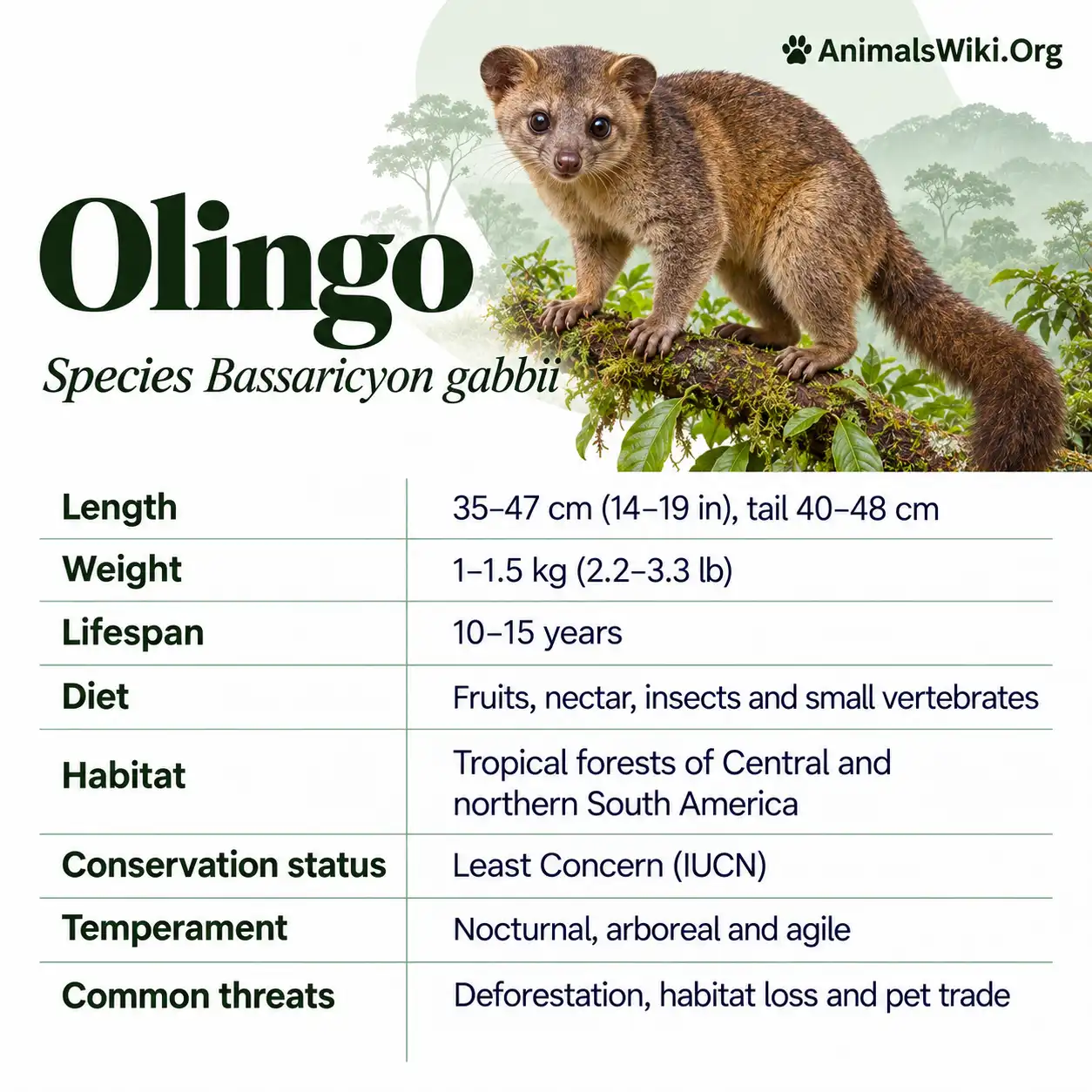
Olingo, Types, Habitat, Diet, Behavior and Conservation
An olingo is a small, tree-dwelling mammal native to parts of Central and South America. With large eyes, rounded ears, soft brownish fur, and a long tail, it moves through forest branches at night in search of food.
Olingos belong to the raccoon family, Procyonidae, which also includes coatis, kinkajous, and ringtails. However, their appearance and lifestyle differ considerably from the familiar image of a raccoon investigating the ground.
Much of an olingo’s life unfolds above human eye level. It travels among branches, visits fruiting trees, and uses a forest environment that changes with height, season, and the availability of food. This combination of nighttime activity and canopy living helps explain why many people have never heard of it.
Olingos are also frequently confused with kinkajous. Although both are nocturnal forest mammals, one important difference is the tail: an olingo’s tail does not grasp branches like a kinkajou’s.
Scientific understanding of these animals has changed substantially. A major revision clarified species boundaries in 2013 and formally described the olinguito, a smaller cloud-forest relative.
This guide explores olingo classification, appearance, habitat, diet, behavior, reproduction, ecological importance, and conservation, while separating established knowledge from details that remain poorly studied.
Olingo Facts
| Feature | Details |
|---|---|
| Common name | Olingo |
| Animal group | Mammal |
| Order | Carnivora |
| Family | Procyonidae |
| Genus | Bassaricyon |
| Currently recognized species in the genus | Four, including the olinguito |
| Northern olingo | Bassaricyon gabbii |
| Eastern lowland olingo | Bassaricyon alleni |
| Western lowland olingo | Bassaricyon medius |
| Olinguito | Bassaricyon neblina |
| Native region | Parts of Central and South America |
| Main habitat | Forest, with habitat differences among species |
| Main food | Predominantly fruit, with other foods also consumed |
| Activity | Primarily nocturnal |
| Locomotion | Strongly arboreal |
| Tail | Long and non-prehensile |
| Typical social pattern | Often solitary |
| Usual number of young | One |
| Global population total | Not reliably established |
| Conservation category | Varies by species |
1. What Is an Olingo?
An olingo is a small procyonid: a member of the mammal family that includes raccoons and several other American forest animals.
It is not a monkey, a lemur, or a miniature bear. Those comparisons describe superficial similarities rather than its evolutionary position.
The animal’s combination of a slender body, long tail, large eyes, and climbing behavior suits a life spent largely in trees. Its feeding habits are strongly associated with fruit, although fruit is not necessarily the only food consumed.
Olingos belong to the order Carnivora. That classification can be confusing because the word resembles “carnivore,” meaning an animal that eats other animals. An evolutionary order and a dietary description are different things.
A mammal can belong to Carnivora while relying heavily on plant foods. Olingos demonstrate that flexibility.
They are particularly interesting because their lives remain less thoroughly documented than those of many larger forest mammals. Even basic questions about population density, social relationships, and seasonal behavior need additional field research.
2. How Many Olingo Species Are There?
Four living species are currently recognized in the genus Bassaricyon.
Three are generally called olingos, while the fourth is widely known as the olinguito.
| Common name | Scientific name | Broad geographic association |
|---|---|---|
| Northern olingo | Bassaricyon gabbii | Central America |
| Eastern lowland olingo | Bassaricyon alleni | Northern South America, principally east of the Andes |
| Western lowland olingo | Bassaricyon medius | Panama and northwestern South America |
| Olinguito | Bassaricyon neblina | Northern Andean cloud forests |
Older publications may list different numbers or apply familiar names to different geographic groups.
This is especially important when reading older accounts of Bassaricyon gabbii. Some observations published under that name concern populations assigned to other species after the 2013 revision.
A species name therefore needs to be considered alongside the publication date and study location.
The animals did not change when their classification was revised. Scientists improved the framework used to describe their differences and relationships.
3. The Northern Olingo
The northern olingo, Bassaricyon gabbii, is the Central American member of the genus.
Current distribution references include Costa Rica, Nicaragua, Panama, and Honduras, although suitable habitat and confirmed occurrence are not continuous throughout those countries.
This is the species many readers encounter in discussions of olingos in Central American forests.
It is primarily nocturnal and arboreal, making nighttime canopy observation more useful than a casual daytime walk.
Its appearance can overlap with that of other small forest mammals, especially when only the face or a portion of the tail is visible.
Location helps narrow identification, but it should not replace a clear view of diagnostic features.
The northern olingo has also appeared in research on interactions with unusual canopy plants. Those observations show how studying a little-known mammal can reveal relationships that would remain invisible in surveys focused only on the forest floor.
Its current global category is Least Concern, although that does not establish the security of every local population.
4. The Eastern Lowland Olingo
The eastern lowland olingo, Bassaricyon alleni, occurs across parts of northern South America, including Amazonian regions.
The Mammal Diversity Database lists its distribution in countries including Bolivia, Brazil, Colombia, Ecuador, Guyana, Peru, and Venezuela.
These country records should not be read as evidence that the species occupies every forest within their borders.
Amazonian landscapes contain different vegetation, river systems, elevations, and levels of disturbance. Research coverage is also uneven.
This species is especially relevant to recent canopy-camera research. Studies have recorded its nighttime movements and provided direct evidence of insect feeding.
Such observations are valuable because an animal often seen at fruiting trees can otherwise become known almost entirely through fruit-related sightings.
The eastern lowland olingo illustrates how technology can broaden natural-history knowledge. Cameras placed where animals actually travel can reveal behavior missed by observers standing far below.
Its broad distribution makes it important, but its ecological details remain incompletely understood.
5. The Western Lowland Olingo
The western lowland olingo, Bassaricyon medius, occurs in Panama and parts of northwestern South America.
Its distribution is associated principally with regions west of the main Andean divide, distinguishing it geographically from the eastern lowland olingo.
The word “lowland” is useful but should not be interpreted as a rigid rule excluding every elevated record.
Species names often summarize a general pattern rather than defining an absolute environmental boundary.
This olingo has been recorded in forest environments that broaden earlier expectations about its distribution.
A published record from the Colombian Caribbean documented its occurrence near tropical dry forest, extending knowledge beyond the better-known Pacific and Andean records in Colombia.
The finding did not prove that all dry forests are suitable. It demonstrated that verified local observations can improve an incomplete range map.
For readers, the practical lesson is to distinguish a species’ known distribution from assumptions about where it ought to occur.
6. How Is an Olinguito Different?
The olinguito, Bassaricyon neblina, belongs to the same genus as other olingos but is a distinct species.
It is associated with cloud forests in the northern Andes of Colombia and Ecuador.
Compared with its relatives, it has a particularly dense, woolly coat and often a reddish or orange-brown appearance.
A commonly cited body weight is around 900 grams, although individual measurements vary.
The name does not describe a baby olingo. An adult olinguito remains an olinguito.
Its habitat is also important to the comparison. Cool, moist cloud forests differ from the warmer forest environments associated with many other olingos.
This means the animals should not be treated as interchangeable when discussing conservation or environmental requirements.
The olinguito’s recognition helped make the wider genus more familiar, but its publicity can also create confusion. Photographs labeled simply “olingo” may show this particular species rather than one of the larger, less woolly relatives.
7. Olingo vs. Kinkajou
Olingos and kinkajous are frequently confused because both are nocturnal, tree-dwelling members of the raccoon family.
However, they belong to different genera and differ in several useful features.
| Feature | Olingo | Kinkajou |
|---|---|---|
| Genus | Bassaricyon | Potos |
| Tail | Non-prehensile | Prehensile |
| General build | Usually relatively light and slender | Often heavier and more robust |
| Tail function | Primarily balance | Balance and grasping |
| Typical appearance | Brownish or grayish coat; long bushy tail | Often golden-brown, with a muscular grasping tail |
| Food | Predominantly fruit, with additional foods | Strongly fruit-based, with other foods |
| Activity | Mainly nocturnal | Mainly nocturnal |
The tail is especially valuable when visible. A kinkajou can use its muscular tail to secure itself to a branch; an olingo cannot use its tail in the same way.
Size and facial appearance can help, but poor lighting makes them less dependable.
Correct identification improves not only a wildlife sighting but also the accuracy of distribution and behavioral records.
8. What Does an Olingo Look Like?
An olingo has a relatively narrow body, rounded ears, large eyes, and a long, furred tail.
Coat color varies among species and individuals. Brown, gray-brown, and warmer yellowish tones occur, often with paler underparts.
The tail may show faint bands, but strong raccoon-like rings should not be expected in every individual.
An olingo seen at night may look quite different from a specimen photographed in daylight. Artificial illumination, shadows, and camera settings alter the apparent color.
This matters because many wildlife identifications begin with brief nighttime photographs.
The animal’s silhouette can be more useful than an exact shade: look at the body proportions, ear shape, muzzle, and relationship between body and tail.
A face alone may be insufficient, particularly when comparing an olingo with a kinkajou.
The best identification combines several visible features with location, rather than treating one attractive characteristic as decisive.
9. How Big Is an Olingo?
Olingos are small mammals, generally weighing around a kilogram or somewhat more, depending on species and individual variation.
A broad genus-level range of approximately 0.7–2 kilograms appears in the major taxonomic review, including the smaller olinguito.
The tail contributes substantially to total length.
This creates a common source of confusion: an animal described as around 80 centimeters long may include a tail approaching the length of its head and body.
Body length, tail length, and total length should therefore be kept separate.
The animal’s thick fur can also exaggerate its apparent bulk in photographs.
Comparisons with household animals are approximate at best. An olingo may appear catlike, but its proportions, movement, and ecological requirements are different.
For educational writing, a modest size range is more useful than an unsupported claim about the largest possible individual.
It communicates the scale of the animal while leaving room for differences among species.
10. Why Is the Tail Important?
An olingo’s tail helps it maintain balance while moving through trees.
A branch is not a flat path. It may narrow, bend, slope, or move under the animal’s weight.
Changes in tail position contribute to adjustments in body balance as the animal walks, climbs, or reaches for food.
However, the tail is not a fifth grasping limb.
This distinction becomes particularly important when describing photographs. A tail draped around vegetation does not necessarily mean the animal is hanging from it.
The paws remain central to maintaining contact with the surface.
Understanding the tail’s role also helps explain why a long tail can evolve in different animals without performing exactly the same function.
An olingo, a kinkajou, and a monkey may all have noticeable tails, but their anatomy and movement strategies are not identical.
The visible resemblance is a starting point for comparison, not the final explanation.
11. Life in the Forest Canopy
An olingo experiences a forest as a network of elevated routes.
Branches lead toward food, shelter, and neighboring trees. Their usefulness depends on diameter, stability, spacing, and connections.
A place that looks close from the ground may be separated by an awkward canopy gap.
Conversely, two trees with distant trunks may connect overhead through branches and vines.
This makes the three-dimensional structure of the forest important.
Research using cameras at different heights has recorded eastern lowland olingos as part of a broader community of nocturnal canopy mammals.
Such work shows why forest animals should not all be studied as though they use the same vertical layer.
For the olingo, protecting a forest includes maintaining the structures through which it moves.
Tree count alone does not describe that network. The arrangement and continuity of vegetation influence whether a landscape remains practically usable above ground.
12. Where Do Olingos Live?
Olingos are native to the Neotropics: tropical regions of the Americas.
Their combined distribution includes Central America and northern portions of South America.
No single species occupies the entire combined range.
The northern olingo belongs to Central America, while the lowland South American species differ broadly in their relationship to the Andes. The olinguito occupies a more specialized northern Andean cloud-forest setting.
These distinctions matter when interpreting a map or photograph.
An image caption that says only “South American olingo” may conceal uncertainty about which species is shown.
Distribution knowledge is also still developing. New verified records can fill gaps or extend a documented range.
That does not necessarily mean animals have recently moved into the area. Sometimes the species was present but overlooked.
A useful range description therefore separates where animals are known to occur from where suitable conditions merely suggest they might occur.
13. What Makes Good Olingo Habitat?
Suitable habitat must provide more than trees.
An olingo needs food across time, usable travel routes, and appropriate resting or shelter opportunities.
A forest containing one heavily fruiting tree may attract an animal temporarily without supplying everything required over a longer period.
Variation in vegetation can help create a changing supply of resources.
Large trees and connected crowns may offer different opportunities from a young stand with widely separated branches.
Habitat quality also differs among species. Conditions suitable for an Andean olinguito should not automatically be applied to a lowland olingo.
The conservation implication is that forest area and forest function must be considered together.
Two patches of equal size may differ substantially in resource availability and connectivity.
For a canopy mammal, the practical question is not merely whether vegetation remains. It is whether the remaining vegetation supports feeding, movement, shelter, and reproduction through the animal’s life.
14. What Do Olingos Eat?
Fruit is central to olingo feeding ecology.
Olingos visit fruiting trees and obtain nourishment from a variety of plant resources. Flowers and nectar also contribute in some studied populations.
Animal foods occur as well, but their importance should not be exaggerated from isolated observations.
The term frugivore describes an animal whose diet is strongly associated with fruit. It does not necessarily mean that every mouthful throughout its life is fruit.
For an olingo, feeding opportunities change as plants flower and fruit.
This creates a lifestyle connected to forest rhythms. A productive tree can become valuable for a period and then provide little food once its crop is exhausted.
An individual must therefore locate resources beyond one permanent feeding station.
Its dietary flexibility matters, but it does not make all vegetation equivalent. A landscape needs to offer accessible foods of appropriate types and timing.
15. Do Olingos Eat Insects?
Yes. Direct observations confirm insect consumption in eastern lowland olingos.
A 2023 study recorded animals catching and eating arthropods around elevated traps during research in Amazonian Peru.
This finding helped resolve a gap in natural-history evidence.
Olingos were already suspected or reported to consume animal foods, but direct records make the case stronger than repeated assumptions.
However, the observations do not show that insects dominate the normal diet.
The study setting involved animals attracted to research equipment and baited locations. It established that the behavior occurs, while leaving questions about its usual frequency.
The researchers recommended additional dietary methods to investigate the relative importance of food categories.
For readers, the useful conclusion is straightforward: olingos are predominantly fruit-associated feeders with documented insect consumption.
Calling them strict fruit-only animals is too narrow, while presenting them as dedicated insect hunters would also misrepresent the evidence.
16. Nectar and Flower Feeding
Flowers can provide a concentrated resource for nocturnal mammals.
Nectar contains sugars, and a flowering tree may attract several kinds of visitors during the same night.
Olingos have been observed using flowering trees alongside kinkajous and other animals.
Research on balsa trees in Panama examined nectar production, visitation, and the movements of potential pollinators.
The study found that food availability changed across the night, with nectar production and animal activity concentrated earlier in the nighttime period.
This creates a time-sensitive feeding opportunity.
An animal arriving at a flower encounters conditions shaped by both the plant and previous visitors.
Flower feeding therefore adds another dimension to olingo ecology: resources vary not only between seasons but within a single night.
It also illustrates the importance of maintaining a diversity of forest plants. A flowering species may provide a useful resource when other foods are less available.
17. Competition With Kinkajous
Olingos and kinkajous can visit the same food sources.
Where their needs overlap, interactions may include avoidance or displacement.
A field study in central Panama recorded olingo feeding and movement while examining possible competition with kinkajous.
The study suggested that competition could influence local abundance and distribution, although such effects are difficult to separate from habitat quality and other factors.
An important historical detail is that the Panamanian olingos were published under a broader use of Bassaricyon gabbii. Later classification places the relevant population within the western lowland olingo.
Competition does not mean the two animals cannot coexist.
It means access to particular resources may be influenced by the presence of another consumer.
A fruiting or flowering tree can support several species while still producing unequal outcomes during individual encounters.
Understanding those interactions helps move beyond the idea that a forest food source is simply available to every animal equally.
18. Are Olingos Nocturnal?
Olingos are primarily active at night.
Their nocturnal lifestyle helps explain why they are unfamiliar even in places where they occur.
Daytime visitors may pass beneath suitable canopy without seeing an animal, while nighttime cameras record regular movement.
Large eyes are consistent with life under low-light conditions, but darkness does not make movement effortless. Branches, obstacles, and gaps still require careful navigation.
Research on canopy bridges in Peru included eastern lowland olingos among frequently recorded nocturnal mammals.
Those records support the broad nighttime pattern while also showing that activity must be measured across many observations.
A single animal appearing unusually early or late does not overturn the general pattern.
For observers, the most useful expectation is nighttime activity combined with elevated movement.
A search aimed only at the ground during daylight is poorly matched to the animal’s normal way of life.
19. Are Olingos Solitary?
Olingos are generally described as solitary, with mother–young associations forming an important exception.
However, solitary does not mean that individuals never meet or feed near one another.
A productive tree can attract several animals because food is concentrated in one place.
Such a gathering does not necessarily indicate a permanent social group.
This distinction is useful across wildlife biology. Sharing a resource temporarily differs from traveling, resting, and maintaining stable relationships as a group.
Olingos can also communicate without remaining together.
The details of their social systems remain incompletely documented, so a strong claim about rigid territories, permanent pairs, or one universal mating system would be premature.
The most defensible description recognizes a predominantly solitary lifestyle alongside occasional interaction.
For readers, this means that one photograph of several animals together should be interpreted as an observed gathering, rather than proof that olingos routinely live in family bands.
20. How Do Olingos Communicate?
Olingos use vocal and scent-related behavior, although their communication is less thoroughly studied than that of many familiar mammals.
Accounts of captive eastern lowland olingos describe scent marking and responses involving odor when threatened.
Field observations also include vocal exchanges between individuals.
These records establish that a mainly solitary lifestyle does not eliminate communication.
An animal can leave chemical information after moving away or call to another individual hidden by vegetation.
However, the precise meaning of signals requires dedicated research.
It would be speculative to assign a detailed message to every sound or mark.
A useful account therefore separates observed behavior from proposed function.
Communication may be important in social contact, reproduction, and responses to danger, but the strength of evidence differs among those topics.
This is an area where recordings, carefully documented observations, and comparisons across known individuals could substantially improve understanding.
21. How Far Do Olingos Travel?
Olingos move between resources rather than remaining permanently in one tree.
Tracking work has documented substantial nighttime movement, although available samples are too limited to define one standard daily distance.
A home range also differs from a territory. A home range describes an area used by an animal; territoriality requires evidence of defense.
These terms should not be exchanged automatically.
For an arboreal mammal, distance measured on a map can also conceal the complexity of the route.
The animal may travel along angled branches, climb, descend, and detour around gaps.
Its actual movement therefore depends on the structure of the canopy as well as the spacing of food.
A useful way to understand olingo travel is as a changing connection between resources.
Seasonal fruiting, flowering, shelter availability, and the presence of other animals can all influence which parts of the forest become valuable at a particular time.
22. How Do Olingos Reproduce?
Published reproductive information is limited and often comes from managed animals or older accounts using broader species names.
A commonly reported pregnancy duration is approximately 72–74 days, followed by the birth of one youngster.
These figures should be treated as reported olingo life-history information, rather than a precise rule established independently for every species.
The scarcity of field observations makes breeding schedules particularly difficult to describe.
An animal active high in trees at night is challenging to follow through mating, pregnancy, birth, and early development.
Researchers may observe one stage without knowing what happened before or afterward.
This makes long-term studies valuable.
Reproduction is also more than the birth event. Population maintenance depends on offspring surviving, becoming independent, and eventually reproducing themselves.
Understanding those transitions would provide a stronger basis for conservation than simply repeating a gestation number.
23. What Are Baby Olingos Like?
Young olingos are born dependent on maternal care.
Published accounts describe newborns with closed eyes and a small body size, requiring milk, warmth, and protection.
The term altricial describes this early condition.
Development involves several milestones rather than one sudden change from helplessness to independence.
Eyes open, movement becomes more coordinated, and the youngster begins exploring and sampling solid foods.
Historical accounts provide approximate ages for some of these events, but the evidence should not be generalized beyond its original context without care.
A baby beginning to eat fruit is not necessarily ready to survive alone.
It must also develop the ability to move safely, locate resources, and respond to its surroundings.
For a canopy mammal, movement skill is especially important.
The mother’s role therefore extends beyond supplying food: the association supports a period during which the young animal becomes capable of functioning in a complex environment.
24. Why Birth and Survival Are Different Questions
A single-young reproductive pattern makes the survival of each offspring important.
However, it is not enough to know how many young are born.
Scientists also need to understand how many survive early development, how long they remain dependent, and what happens after independence.
These questions are especially challenging for elusive canopy mammals because juveniles can disappear from observation without their fate becoming known.
A missing animal may have moved, remained undetected, or died.
That uncertainty affects estimates of population growth.
It also explains why a photograph of a mother carrying a youngster is valuable but incomplete evidence.
The image confirms an event; it does not establish the success of an entire breeding season.
For conservation, repeated monitoring across life stages offers a more meaningful picture.
The objective is a population that replaces losses through surviving offspring, supported by habitat capable of sustaining both adults and developing young.
25. How Long Do Olingos Live?
Olingo lifespan is not well established in the wild.
Older summaries report long-lived captive individuals, but those records should not be turned into a normal lifespan for all olingos.
Historical identification adds another complication. An animal once recorded under one species name may belong to a different species under current classification.
This makes very precise claims about maximum age difficult to repeat confidently without examining the original record.
A careful description is that olingos can live for many years, while reliable species-specific averages remain limited.
Wild survival depends on food, habitat, injury, disease, predation, and other pressures.
Managed conditions change several of those factors, so direct comparison requires context.
For conservation, survival through different life stages is often more useful than the oldest recorded age.
A population’s future depends on enough young and adults surviving to reproduce, rather than on one exceptional individual living a particularly long time.
26. Olingos and Seed Dispersal
Fruit-eating mammals can influence where plants reproduce.
When an olingo carries fruit or passes viable seeds after feeding, it may move plant material away from the original source.
The ecological result depends on what happens next.
A seed must reach a location where it can survive, germinate, and establish. Not every transported seed becomes a new plant.
Olingo seed dispersal should therefore be described as a process with several stages.
Food handling, movement distance, deposition, and later conditions all matter.
This helps explain why studying diet alone does not fully establish an animal’s ecological contribution.
Researchers also investigate whether seeds remain intact and where they are deposited.
For forests, different dispersers can provide different services because they handle fruit and move through vegetation differently.
Olingos form part of that wider network, connecting plant resources with the movements of nocturnal mammals.
Their contribution is especially interesting where transport occurs within the canopy itself.
27. The Olingo and an Unusual Tree-Dwelling Cycad
One of the most distinctive documented olingo interactions involves Zamia pseudoparasitica, a cycad that grows on trees in Panama.
Researchers placed cameras in the canopy and recorded northern olingos repeatedly visiting its cones.
Once cones opened, the animals removed and carried away seeds.
The observations suggested that olingos might contribute to dispersal of this unusual plant.
However, the researchers appropriately treated that conclusion as tentative.
Carrying a seed away does not prove where it was eventually deposited or whether it germinated.
The study matters because it revealed behavior that ground-based observation could easily miss.
It also provides a striking example of why a small, little-known mammal may have an ecological role beyond its public profile.
An animal most people cannot name could participate in the life cycle of an equally unusual plant living above the forest floor.
28. Can Olingos Help Pollinate Plants?
Flower visitors can transport pollen when it adheres to their bodies and is carried to another flower.
Olingos visiting nectar sources may participate in this process.
However, visitation and effective pollination are not identical.
An animal can drink nectar without transferring enough appropriate pollen to contribute substantially to reproduction.
Scientists therefore investigate contact with flower structures, pollen loads, movement among plants, and reproductive outcomes.
Research on nocturnal mammals at balsa flowers supports the importance of considering non-flying mammals alongside bats and birds.
For olingos, the broader ecological question is how feeding behavior connects flowering trees.
The answer may vary among plant species and local communities.
It is more accurate to describe a potential or documented contribution in a particular system than to call every olingo a major pollinator of all tropical forests.
The relationship remains a useful reminder that mammals can influence plants in ways beyond simply eating their fruit.
29. How Was the Olinguito Recognized?
The olinguito was formally described in 2013 after researchers combined museum work, anatomical comparisons, genetics, and field observations.
It was not an animal that suddenly appeared that year.
Specimens had existed in collections, and at least one living individual had previously been kept under an incorrect identification.
Differences in skulls, teeth, coats, and geographic records helped researchers recognize that a distinct species had been overlooked.
Fieldwork then confirmed animals living in the relevant cloud-forest habitat.
This history demonstrates the value of museums as research resources.
A preserved specimen can answer questions that were not anticipated when it was collected.
It also shows why discovery is sometimes a process of correcting identity rather than finding an animal no person has ever seen.
Local people may already know an animal long before its scientific classification is resolved.
The formal description provides a shared framework for studying and protecting it.
30. Why Old Olingo Information Can Be Confusing
Older sources may use different species boundaries from modern references.
This affects more than names.
A report from Panama, a captive animal from Amazonian Peru, and a cloud-forest specimen may once have been discussed under overlapping labels even though they represent different species today.
Combining all their measurements or behaviors can produce an animal description that fits none of them accurately.
The solution is not to discard historical work.
Instead, observations should be interpreted using the location, specimen identity, and later taxonomic research.
This makes natural-history writing more reliable.
For example, a reproductive detail recorded in captive eastern lowland olingos should not automatically become a confirmed field fact for northern olingos.
The same principle applies to lifespan and distribution.
The 2013 revision was important because it supplied a clearer structure for organizing these older observations, making future research easier to compare.
31. Are Olingos Endangered?
The conservation category depends on the species.
Current referenced listings place the northern, eastern lowland, and western lowland olingos in Least Concern. The olinguito is Near Threatened.
| Species | Referenced global category |
|---|---|
| Northern olingo | Least Concern |
| Eastern lowland olingo | Least Concern |
| Western lowland olingo | Least Concern |
| Olinguito | Near Threatened |
Least Concern does not mean that every population is stable or that habitat loss is irrelevant.
A species may have a broad range while declining in particular areas.
The lowland-oIingo assessments also identify important research needs, including better information on distribution, population size, and threats.
Assessment dates matter. A listing checked in 2026 may still rely on an assessment conducted years earlier.
A careful article therefore distinguishes the current listed category from the date of the underlying evaluation.
For these animals, uncertainty reinforces the importance of monitoring rather than proving that no conservation work is needed.
32. Forest Loss and Canopy Fragmentation
Removing forest affects olingos by reducing resources and disrupting movement.
For a tree-dwelling mammal, fragmentation can occur overhead even when some vegetation remains on the ground.
A road, pipeline clearing, pasture, or developed strip may interrupt a familiar canopy route.
The animal then faces a different set of options: detour, descend, cross an exposed area, or stop using resources beyond the gap.
Research on natural canopy bridges in Peru recorded eastern lowland olingos among the mammals using retained overhead connections.
These findings demonstrate that canopy continuity can have practical value.
They do not establish that one bridge design will work everywhere.
Vegetation structure, maintenance, disturbance, and the width of the opening influence usefulness.
The broader lesson is that conservation should consider how animals actually travel.
Protecting forest mammals requires attention to usable connections, rather than treating isolated patches as though they function independently of the surrounding landscape.
33. What Canopy Bridges Can and Cannot Do
Canopy bridges can preserve or recreate an elevated route across a break in vegetation.
Both natural and partly artificial connections have been used by arboreal mammals, including eastern lowland olingos.
A study of bridge use documented an olingo using a semi-artificial connection shortly after installation.
That is encouraging evidence of practical use.
However, a crossing record does not by itself establish long-term population recovery.
Managers also need to consider durability, safety, repeated use, and whether the connection links meaningful habitat.
A bridge that deteriorates or ends in unsuitable vegetation has limited value.
This makes monitoring important after construction.
Canopy bridges are best understood as one tool within a larger conservation approach.
They can reduce a particular movement barrier, while habitat protection, resource availability, and control of continuing disturbance address other parts of the problem.
The objective is a functioning landscape, not simply a structure visible in a project photograph.
34. How Scientists Study Olingos
Studying olingos requires methods suited to animals that are small, nocturnal, and often high above the ground.
Canopy cameras can record movement and feeding without an observer standing beside the animal.
Field observations, tracking, genetic work, and museum comparisons provide other forms of evidence.
Each method answers different questions.
A camera can confirm that an animal crossed a branch. Tracking can reveal a broader movement pattern. A specimen can help resolve identification.
Research comparing canopy-camera records has shown the importance of placing equipment in the vertical spaces animals use.
Ground-only surveys can overlook an active community overhead.
Combining methods is especially valuable because an absence of sightings does not automatically mean an absence of animals.
Olingos also demonstrate that research need not begin with a dramatic expedition. Careful examination of existing photographs, specimens, and field notes can produce meaningful improvements in knowledge.
35. Responsible Observation and Conservation
The best way to appreciate an olingo is to observe it without changing its behavior unnecessarily.
Night walks should follow local guidance, use appropriate lighting, and avoid repeated attempts to chase or reposition animals for photographs.
Food should not be used to lure an unfamiliar wild mammal into close contact.
An animal approaching a feeder or building also should not be assumed to be tame.
For conservation, protecting forest structure and improving reliable records are valuable priorities.
Olingos remain easy to confuse with other mammals, so clear photographs showing several features are more useful than confident labels on an indistinct face.
Interest in these animals can also support wider appreciation of nighttime biodiversity.
A forest does not become inactive when daylight ends.
Olingos are part of a community whose feeding, movement, and plant interactions continue in darkness, often beyond ordinary observation.
Learning about them reveals a richer forest than the one visible from a daytime trail.
Frequently Asked Questions About Olingos
1. What kind of animal is an olingo?
An olingo is a small mammal in the raccoon family, Procyonidae. It belongs to the genus Bassaricyon and is strongly associated with nighttime activity in trees.
2. Is an olingo a monkey?
No. Olingos belong to Carnivora, while monkeys are primates. A long tail and climbing ability are similarities in appearance and lifestyle, rather than evidence that the animals belong to the same group.
3. Is an olingo a raccoon?
It is a member of the raccoon family, but it is not a raccoon species. Olingos have their own genus and differ in body proportions, feeding patterns, and use of the forest canopy.
4. How many olingo species are recognized?
Four species are currently recognized in Bassaricyon, including the olinguito. Popular accounts sometimes refer to three olingos and discuss the olinguito separately, so the wording can appear inconsistent.
5. What is the scientific name of an olingo?
There is no single species name covering every olingo. The genus is Bassaricyon. Species include B. gabbii, B. alleni, B. medius, and B. neblina.
6. Where do olingos live?
They occur in parts of Central and South America. Individual species have different distributions, so the range of the entire genus should not be assigned to every species.
7. What do olingos eat?
They eat predominantly fruit, with flowers, nectar, insects, and other foods recorded. The importance of each category varies, and detailed wild-diet information remains limited for some species.
8. Do olingos eat insects?
Yes. Direct observations have documented eastern lowland olingos catching and eating arthropods. Those records confirm insect consumption without establishing that insects dominate the usual diet.
9. Why do olingos belong to Carnivora if they eat fruit?
Carnivora is an evolutionary classification. It includes animals with different diets. Being a member of the order does not require an animal to obtain most of its food from meat.
10. Are olingos nocturnal?
Yes. They are primarily active at night. Their combination of nocturnal behavior and canopy living makes them easy to overlook during ordinary daytime wildlife observation.
11. Are olingos solitary?
They are generally described as solitary, although individuals can interact or gather at productive food sources. A temporary feeding aggregation is different from a permanent social group.
12. Can olingos hang by their tails?
Their tails are non-prehensile and do not grasp branches like kinkajou tails. Olingos use their paws for secure contact, while the tail assists with balance.
13. What is the easiest difference between an olingo and a kinkajou?
The tail is particularly useful: kinkajous have grasping tails, while olingos do not. Body size, facial features, and proportions can also help when the animal is clearly visible.
14. Is an olinguito a baby olingo?
No. The olinguito is a distinct species, Bassaricyon neblina. Its common name does not describe an age class. Both adult and juvenile olinguitos belong to that species.
15. Where do olinguitos live?
Olinguitos inhabit northern Andean cloud forests in Colombia and Ecuador. Their habitat differs from the warmer forest settings associated with many other members of the genus.
16. When was the olinguito described?
It was formally described in 2013. The species existed and had been encountered earlier, but scientists had not correctly recognized and named it as distinct.
17. How large is an olingo?
These are small mammals, generally around a kilogram or somewhat more, depending on species. Their long tails contribute substantially to total length, so body and total measurements should be distinguished.
18. How many young do olingos have?
One youngster is typical in published accounts. However, reproductive evidence is limited, and a detail recorded for one species or managed animal should not automatically be treated as a universal field rule.
19. How long is olingo pregnancy?
Approximately 72–74 days is commonly reported in life-history accounts. The evidence is not equally detailed for every species, so it is best presented as an approximate reported duration.
20. How long do olingos live?
Reliable wild averages are not well established. Older captive records suggest that individuals can be long-lived, but maximum ages need careful interpretation because historical species identifications sometimes changed.
21. Are olingos endangered?
The northern and two lowland olingos are listed as Least Concern in the referenced assessments. The olinguito is Near Threatened. These categories do not mean every local population is secure.
22. How many olingos remain in the wild?
There is no reliable worldwide total covering all species. Survey difficulties, incomplete distribution knowledge, and uneven research make precise global numbers inappropriate.
23. Do olingos help plants?
They can move seeds and visit flowers, creating potential roles in seed dispersal and pollination. The ecological outcome depends on the plant, food handling, movement, and where material is deposited.
24. Can olingos be kept as pets?
They are wild, nocturnal canopy mammals with specialized needs. Their attractive appearance does not make them suitable household companions. Responsible appreciation supports appropriate habitat and professional wildlife care.
25. What is the best way to see an olingo?
A responsible guided night walk in suitable habitat offers a better opportunity than a daytime ground search. Observe quietly, follow local rules, and avoid feeding or pursuing the animal.



