
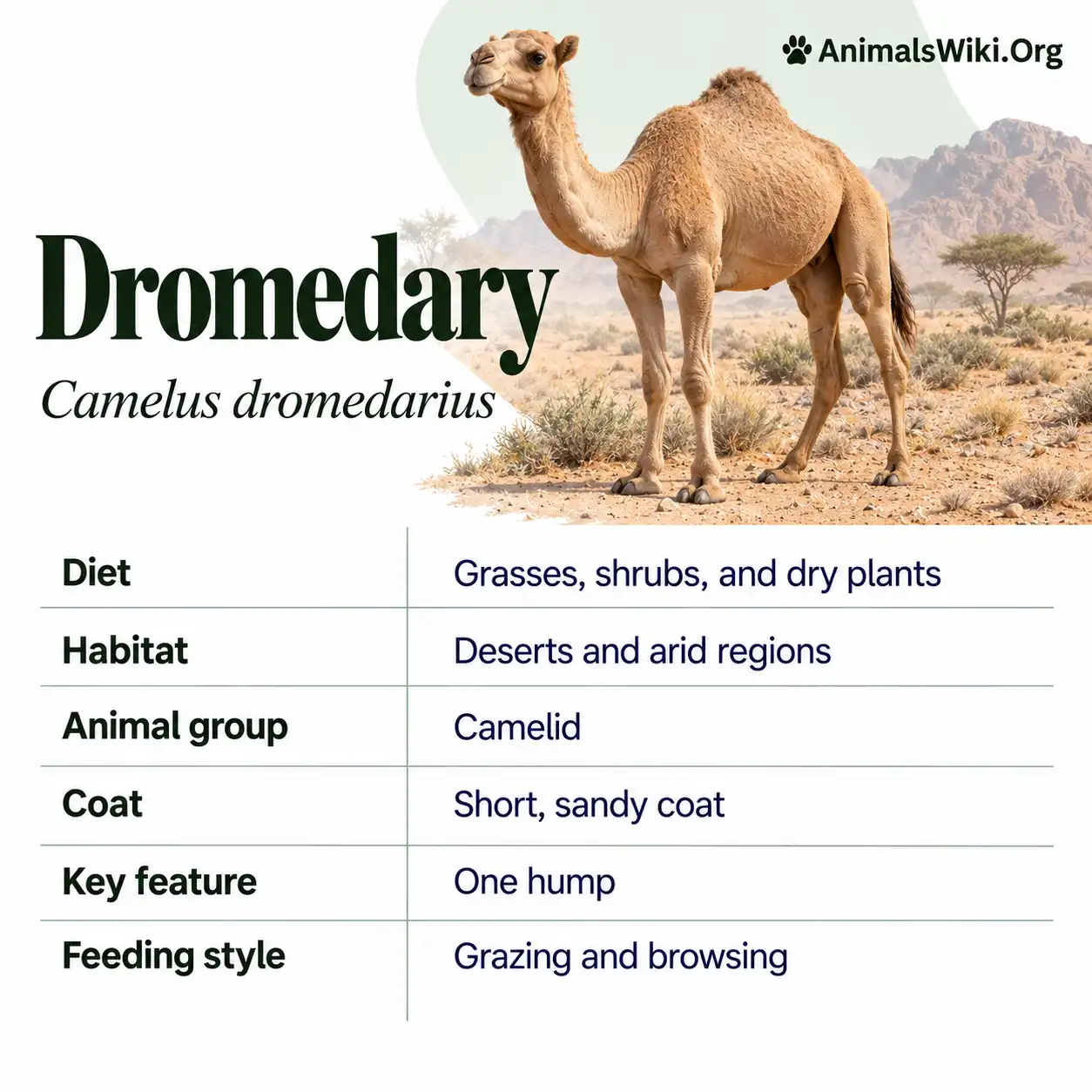
Dromedary Camel, The One-Humped Survivor of Desert Landscapes
The dromedary camel is one of the most recognizable animals associated with deserts. Its single hump, long neck, broad feet, and distinctive profile have become symbols of travel across hot, dry landscapes. Yet the animal’s importance reaches far beyond its appearance.
For thousands of years, dromedaries have helped people transport goods, obtain food, and maintain livelihoods in regions where water and vegetation can be widely scattered. Their usefulness comes from a combination of physical adaptations, flexible feeding behavior, and generations of human knowledge about camel management.
Despite their familiarity, many common camel facts are misunderstood. A dromedary does not store drinking water inside its hump. It does not survive indefinitely without water, and its desert adaptations do not make it immune to heat stress, hunger, or exhaustion.
There is also an important distinction between a domestic camel roaming freely and a genuinely wild camel species.
This guide explains the dromedary camel’s biology, behavior, history, and continuing relationship with people, while separating well-supported facts from popular myths.
Dromedary Camel Facts
| Feature | Details |
|---|---|
| Common name | Dromedary camel |
| Other names | Arabian camel; one-humped camel |
| Scientific name | Camelus dromedarius |
| Animal class | Mammalia |
| Family | Camelidae |
| Genus | Camelus |
| Number of humps | One |
| Hump contents | Mainly fat supported by connective tissue |
| Diet | Herbivorous; browses and grazes |
| Typical environments | Arid and semi-arid landscapes |
| Main domestic distribution | Africa, the Middle East, and parts of South Asia |
| Feral population | Established across parts of Australia |
| Reproduction | Usually one calf after approximately 12–14 months of pregnancy |
| Social behavior | Social, with grouping influenced by management and breeding |
| Lifespan | Can reach approximately 40 years, with individual variation |
| Relationship with people | Domestic livestock used for food, transport, recreation, and other purposes |
What Is a Dromedary Camel?
A dromedary camel is the one-humped member of the genus Camelus. Its scientific name is Camelus dromedarius, and it is commonly called the Arabian camel.
“Arabian” reflects an important part of its history, but the name should not suggest that modern dromedaries occur only on the Arabian Peninsula. Domestic populations are widespread across Africa, the Middle East, and parts of South Asia.
Dromedaries have been shaped by domestication and selective breeding. Different populations vary in size, coat color, body shape, milk production, movement, and working use.
Today’s dromedaries are domestic animals or descendants of domestic animals. The original wild populations from which they were domesticated no longer survive as known, distinct wild populations.
This makes the dromedary different from the wild camel of Central Asia, which belongs to another species. Free-living dromedaries in Australia are described as feral because their ancestry comes from introduced domestic camels.
Scientific Classification and Camel Relatives
The dromedary belongs to the family Camelidae, which includes both Old World camels and South American camelids.
Its closer living relatives include the domestic Bactrian camel and the wild camel. More distant members of the same family include llamas, alpacas, guanacos, and vicuñas.
| Classification level | Dromedary camel |
|---|---|
| Kingdom | Animalia |
| Phylum | Chordata |
| Class | Mammalia |
| Family | Camelidae |
| Genus | Camelus |
| Species | Camelus dromedarius |
Camelids share several anatomical features, including padded feet and a specialized digestive system. However, family membership does not mean that all camelids have identical environmental needs.
An alpaca adapted to highland conditions should not be treated as a smaller version of a desert dromedary. Likewise, knowledge about a Bactrian camel should be applied carefully when discussing a one-humped camel.
Recognizing these relationships helps explain similarities without overlooking important differences.
Dromedary vs Bactrian Camel
The easiest visible difference is the number of humps: a dromedary has one, while a Bactrian camel has two.
However, the distinction involves more than hump count. Dromedaries generally have longer-looking legs and a lighter outline, while domestic Bactrian camels typically have a stockier appearance and a heavier seasonal coat.
There are three living Old World camel species to distinguish:
| Animal | Scientific name | Humps | General identity |
|---|---|---|---|
| Dromedary camel | Camelus dromedarius | One | Domestic camel associated especially with hot, dry regions |
| Domestic Bactrian camel | Camelus bactrianus | Two | Domestic camel associated with continental Asian environments |
| Wild camel | Camelus ferus | Two | Separate wild species surviving in parts of China and Mongolia |
The wild camel is not simply a domestic Bactrian camel that escaped. It is a distinct species.
Keeping these names separate is especially important when discussing conservation, because the threats facing wild camels differ from the management issues surrounding domestic dromedaries. ZSL
What Does a Dromedary Camel Look Like?
A dromedary has a long, curved neck, a relatively narrow chest, long legs, and one prominent hump positioned above its back.
Its head has a characteristic profile, with a divided upper lip and mobile nostrils. The ears are comparatively small, and the eyes are bordered by conspicuous eyelashes.
Coat color varies. Sandy brown and light brown animals are familiar, but dromedaries can also be much darker or much lighter. Color alone does not indicate an animal’s temperament or usefulness.
Hair distribution is uneven, with some areas carrying longer hair than others. The coat also changes with age, season, ancestry, and management.
Although the animal looks angular compared with many other livestock species, that outline should not automatically be interpreted as poor condition. Assessing a camel requires knowledge of its normal anatomy.
At the same time, a large hump does not provide a complete health assessment. Movement, muscle, appetite, behavior, and the rest of the body also matter.
How Big Is a Dromedary Camel?
Dromedaries are large animals, but their size varies with sex, ancestry, nutrition, and age.
A broad reference range places many adults around 400–600 kilograms, with shoulder heights approximately 1.8–2 meters. These figures describe a useful general range rather than absolute limits.
Males are commonly larger than females. Some populations and individuals fall outside simplified size ranges.
It is also important to distinguish shoulder height from the height of the hump or head. Different descriptions may appear to disagree because they measure different parts of the animal.
For handling and transport, appearance alone is not a reliable substitute for an appropriate assessment of body size and weight.
A large camel may still be unfit, immature, or unsuitable for a particular workload. Physical dimensions establish only part of what the animal can comfortably do.
Health, training, equipment, and environmental conditions complete the picture.
What Is Inside a Dromedary Camel’s Hump?
The hump contains mainly fat, supported by connective tissue. It is an energy reserve, not a tank filled with drinking water.
When food intake does not meet the animal’s energy needs, stored fat can be used. As those reserves decline, the hump may become smaller and change shape.
This explains why hump condition can provide information about energy stores. However, it should not be interpreted in isolation from the rest of the animal.
Fat metabolism produces some water as part of normal biochemical processes, but that does not make the hump a substitute for drinking.
Concentrating a substantial fat reserve in one region also differs from distributing the same amount as a thick layer beneath the skin across the entire body.
The most useful way to understand the hump is as one component of the camel’s energy-management system. Its desert survival depends on many other adaptations working alongside it.
How Long Can a Dromedary Go Without Water?
There is no single number that applies to every dromedary in every situation.
The interval between drinks depends on temperature, activity, diet, body condition, reproductive status, and the amount of moisture available in plants. A resting camel eating moist vegetation faces different demands from a working animal traveling through extreme heat.
Dromedaries can tolerate dehydration better than many domestic mammals, but tolerance is not the same as freedom from harm.
Their physiology helps them conserve water and recover when water becomes available. Nevertheless, dehydration still places demands on the body.
Popular claims about surviving a certain number of days are therefore incomplete unless the conditions are explained.
For managed animals, the practical lesson is to provide reliable drinking opportunities appropriate to their needs. Their exceptional abilities should help people understand their biology, rather than justify deliberately withholding water.
A camel’s resilience has limits, even when those limits differ from those of cattle or horses.
How Dromedaries Manage Body Temperature
A dromedary can adjust the daily pattern of its body temperature in ways that reduce the need for evaporative cooling under demanding conditions.
Allowing body temperature to rise during part of the day can temporarily store heat that would otherwise require water loss through cooling. Heat can then be released when environmental conditions become more favorable.
This response is influenced by hydration and surrounding conditions. It does not mean every healthy camel constantly experiences the widest temperature range reported in experiments.
Dromedaries also sweat. The claim that camels never sweat is incorrect.
Their temperature regulation involves interactions among internal rhythms, skin temperature, coat, circulation, and the environment. It cannot be explained by one feature alone.
Research under experimental desert conditions has examined how daily heat and dehydration influence these temperature patterns.
Understanding this flexibility helps explain water conservation without suggesting that a camel cannot overheat or needs no relief from extreme conditions.
Kidneys, Breathing, and Water Conservation
The dromedary’s ability to conserve water depends partly on how its organs manage fluid losses.
Its kidneys can produce concentrated urine, reducing the amount of water needed to remove waste. Water recovery within the digestive system also contributes to relatively dry dung.
The nose plays a role as well. Its internal passages help recover moisture from outgoing air, limiting respiratory water loss.
These are separate processes that contribute to the same overall result: slower depletion of body water.
They do not create water from nothing, and they cannot compensate indefinitely for a complete lack of drinking water or moisture in food.
Research on camel kidneys has investigated structural and molecular features associated with adaptation to arid environments.
The broader lesson is that desert adaptation is a coordinated system. The hump receives the most attention, but internal organs perform much of the less visible work that allows the animal to cope.
What Is Unusual About Camel Blood?
Camelid red blood cells are typically elliptical rather than the familiar round outline seen in many other mammals.
Their shape and membrane characteristics have attracted scientific attention because camels experience substantial changes in water balance.
Research has examined how these cells respond to different osmotic conditions, meaning differences in the concentration of dissolved substances around them.
However, the explanation should not be reduced to the claim that oval cells alone make a camel immune to dehydration. Blood function depends on multiple properties and the wider regulation of the body.
This characteristic is also not unique to dromedaries among all mammals. Other camelids have similarly distinctive red blood cells.
The finding is a useful example of how adaptation exists at more than one scale. A camel’s broad feet are visible from a distance, while some of its important physiological traits can only be studied through laboratory work.
Eyelashes, Nostrils, and Protection from Sand
Dromedaries have several features that help them cope with blowing dust and sand.
Long eyelashes reduce the amount of material reaching the eyes. Hair around other exposed areas contributes additional protection, while the nostrils can narrow or close against airborne particles.
Their long legs also raise much of the body above the hottest ground surface.
These features are useful, but they do not make a camel completely unaffected by sandstorms. Severe weather can still interfere with breathing, visibility, movement, and comfort.
Protection from airborne sand should also be distinguished from water conservation inside the nose. The same general body region can perform several functions.
When describing adaptations, it is tempting to present every feature as perfect protection. Biology works through advantages and trade-offs instead.
A dromedary is better equipped than many animals for dusty, dry conditions, but appropriate shelter and management remain valuable when conditions become difficult.
Why Do Dromedaries Have Broad Feet?
Each foot has two toes supported by a broad, padded surface. When the camel places weight on the foot, that surface helps distribute the load over the ground.
This is useful on loose sand, where a narrow contact area would tend to sink more deeply.
The feet are not simply enlarged versions of a horse’s hooves. Their structure is part of the distinctive anatomy of camelids.
However, an advantage on sand does not guarantee equal performance everywhere. Sharp surfaces, unsuitable flooring, persistent wet conditions, or slippery ground can create problems.
A camel’s feet should therefore be considered when choosing housing surfaces, travel routes, and working conditions.
Pads and nails still require observation. An animal that begins placing its feet differently, shortens its steps, or becomes reluctant to move may need examination.
The phrase “built for the desert” is most useful when it explains suitability for certain conditions, rather than suggesting unlimited adaptability.
Where Do Dromedary Camels Live?
Domestic dromedaries occur across a broad belt of Africa and Asia.
They are particularly associated with North Africa, the Horn of Africa, the Arabian Peninsula, and adjoining dry regions. They are also important in parts of Pakistan and India.
Human movement and trade helped shape this distribution. The present map is therefore a history of relationships between people and livestock as well as a reflection of climate.
Dromedaries may be kept in mobile pastoral systems, village herds, commercial farms, tourist operations, or zoological collections.
Australia contains extensive feral populations descended from imported domestic animals. These are introduced populations rather than evidence that dromedaries originally evolved there.
Distribution should also be separated from abundance. A country can contain camels without every region supporting large herds.
Local water, vegetation, land use, markets, and management traditions determine where animals are maintained within the broader geographic range.
Dromedary Camel Habitat
Dromedaries are associated with arid and semi-arid environments, but those categories include more than rolling sand dunes.
They can use dry plains, scrublands, open grasslands, and landscapes containing scattered trees and shrubs. Many important camel environments have firm ground and patchy vegetation.
The essential resources are food, water, space, and conditions the animals can tolerate.
Seasonal changes affect how those resources are distributed. Rain may produce temporary vegetation, while dry periods can require animals and herders to travel farther.
A camel landscape is therefore not necessarily a place where animals remain in one small area throughout the year.
The familiar image of a lone camel standing on bare sand captures only a small part of the species’ life.
Understanding actual habitat use requires looking at movement, feeding opportunities, access to water, and the decisions of people who manage the herds.
What Does a Dromedary Camel Eat?
Dromedaries are herbivores that both browse and graze.
Browsing involves feeding on leaves, shoots, and other parts of shrubs and trees. Grazing involves taking grasses and other lower-growing vegetation.
Their mobile lips help them select food, and they can use some coarse or thorny plants that are difficult for other livestock to handle.
This flexibility is valuable where vegetation is scattered or changes seasonally.
However, it does not mean every plant is safe or nutritionally adequate. An animal introduced to unfamiliar vegetation can encounter hazards, and a poor ration remains a poor ration even for a hardy browser.
Managed diets should reflect age, body condition, activity, pregnancy, milk production, and available forage.
The ability to obtain food from dry landscapes is best understood as feeding flexibility supported by specialized anatomy and digestion. It should not be interpreted as an ability to live healthily on rubbish or arbitrary plant material.
How Does a Camel Digest Its Food?
Dromedaries use microbial fermentation to obtain nutrients from fibrous plants.
Their stomach is generally described as having three compartments, commonly labeled C1, C2, and C3. These differ anatomically from the four-part stomach arrangement of cattle and other true ruminants.
Camels also regurgitate partially processed food and chew it again. This repeated chewing helps break down plant material.
Because they chew cud, camels are sometimes casually grouped with ruminants. More precise descriptions recognize their distinct camelid digestive anatomy.
The microorganisms involved in digestion are important partners. Feeding management should support that system rather than treating the stomach as a container that can process anything without consequences.
Abrupt dietary changes and unsuitable feeds can still create health problems.
The digestive system explains part of the dromedary’s ability to use challenging forage, but nutritional quality and access to enough food remain essential.
Social Behavior and Herd Life
Dromedaries are social animals, although the composition of their groups varies.
Management systems strongly influence which animals remain together. Breeding status, sex, age, available resources, and human decisions all affect group structure.
Some groups contain females and young animals, while males may be managed separately or associate differently outside breeding periods.
Social relationships matter because access to food, water, rest, and companions is experienced by individuals rather than by an abstract herd.
A group may appear well provided for while one animal is repeatedly displaced from resources.
Observing interactions helps identify such problems. Consistent withdrawal, difficulty feeding, or conflict around water can reveal management issues.
Domestication also means that human handling forms part of the camel’s social environment.
A good system considers both camel-to-camel relationships and the animal’s responses to people, rather than assuming that keeping several animals together automatically meets every behavioral need.
How Dromedaries Communicate
Dromedaries communicate through sounds, posture, movement, scent, and physical interaction.
Their vocal range includes grumbling, groaning, bellowing, and softer sounds. The meaning depends on context, the individual, and what is happening around it.
A noisy camel is not automatically aggressive. Vocalization may occur during handling, social interaction, or changes in position.
Head and neck posture, attention, muscle tension, and willingness to approach provide additional information.
Breeding males use particularly conspicuous displays. Scent marking and changes in behavior can communicate reproductive condition and influence interactions with rivals.
Handlers should avoid relying on one signal in isolation. Learning the animal’s usual responses makes changes easier to recognize.
Communication is also affected by human consistency. Predictable movements and familiar cues can reduce confusion, while sudden pressure or unfamiliar handling may alter the animal’s response.
Understanding context is more useful than assigning a fixed human emotion to every camel sound.
Why Do Camels Spit?
Camels can project a mixture that includes saliva and regurgitated digestive contents.
This behavior may occur when an animal is disturbed, threatened, or involved in an unpleasant interaction. It is not simply the casual spraying of clean saliva.
The smell and unexpected movement can discourage whatever is nearby.
However, the popular image of a camel that spits at every person is misleading. Individuals differ, and the context matters.
People should not provoke the behavior for photographs or entertainment. Repeatedly upsetting an animal to demonstrate a familiar stereotype compromises welfare and can create unsafe interactions.
A camel can also defend itself in more serious ways, including biting and kicking.
Respectful distance, experienced handling, and attention to body language matter more than treating spitting as a harmless joke.
The animal’s behavior should be interpreted as information about the interaction, not as proof that all camels have the same temperament.
Walking, Pacing, and Working Ability
Dromedaries are effective traveling animals, and their movement contributes to their traditional description as “ships of the desert.”
They can use a pacing gait in which the foreleg and hind leg on the same side move together. This produces a characteristic rolling sensation for a rider.
Traveling ability depends on conditioning, health, terrain, weather, and the load being carried.
A camel accustomed to steady movement is not automatically prepared for racing or heavy transport. Training and physical preparation need to match the activity.
Likewise, there is no universal safe load that applies to every camel.
The weight and balance of cargo, saddle fit, route, duration, rest, and the animal’s condition all matter.
Historical accounts of long journeys demonstrate what camels have contributed to human transport, but they should not become excuses to expect maximum performance from every individual under all conditions.
Breeding Behavior and the Dulla
Male dromedaries can show dramatic behavioral changes during the breeding period, often called the rut.
They may become more active, vocal, competitive, and difficult to manage safely. Experienced handling is particularly important during this time.
One distinctive feature is the dulla, a structure associated with the soft palate. A male can inflate and protrude it from the mouth, creating a conspicuous display.
The balloon-like structure is sometimes incorrectly identified as the camel’s stomach or tongue. It is neither.
Reproductive behavior should be understood as part of the animal’s biology rather than a novelty to provoke.
Breeding decisions also involve welfare and management. The health of both parents, appropriate handling facilities, veterinary support, and the future of the calf all require planning.
A camel’s ability to reproduce does not establish that breeding it is appropriate under every set of circumstances.
Pregnancy, Birth, and Young Camels
A female dromedary usually gives birth to one calf after a pregnancy lasting approximately 12–14 months.
The long pregnancy represents a substantial investment in each offspring. Twins are unusual and should not be assumed to be the normal reproductive pattern.
A newborn calf is relatively well developed and can stand and begin walking soon after birth. It still depends heavily on its mother and appropriate early care.
Milk provides essential nutrition, while the young animal gradually begins exploring solid food.
The hump is not simply a miniature version of a well-conditioned adult’s fat reserve. Its development changes as the calf grows and its diet changes.
Early development involves social learning as well as physical growth.
Calves need appropriate opportunities to interact, move, and learn ordinary handling without being subjected to demands beyond their maturity.
Good reproductive management considers the well-being of the mother and calf together.
Dromedary Camel Lifespan
Dromedaries can live for several decades, and reference accounts commonly describe lifespans approaching 40 years.
That figure is not a promise for every individual. Health, nutrition, injury, workload, disease, and management all influence survival.
Working life and total lifespan are also different. An animal may need reduced activity or retirement well before reaching the end of its life.
Older camels can require changes in feeding, closer observation, and adjustments to the environment.
Dental function, body condition, mobility, and the ability to obtain food and water become especially important.
A long life should be evaluated through comfort and function rather than age alone.
An elderly camel still needs social opportunities and appropriate professional care. Its reduced usefulness for transport or production does not reduce its basic needs.
Planning for later life is therefore part of responsible management from the beginning, rather than an issue to address only when work becomes difficult.
When Were Dromedaries Domesticated?
Dromedary domestication is associated with the Arabian Peninsula several thousand years ago, but reconstructing the process requires combining archaeological and genetic evidence.
A single date can give a false impression of a brief event. Domestication generally involves changes in human control, breeding, use, and animal populations over time.
Genetic research has identified wild dromedaries from southeastern Arabia among the contributors to the domestic gene pool.
The history also appears to include continued incorporation of wild animals after initial domestication.
Later trade and movement helped mix domestic populations across large distances.
This means modern dromedary diversity reflects both early domestication and subsequent human activity.
The disappearance of original wild populations makes ancient remains particularly valuable. They provide information that cannot be recovered simply by examining living domestic animals.
Research continues to refine the relationships among early use, breeding, trade, and the expansion of camel-based transport.
Camels and Long-Distance Trade
Dromedaries helped connect communities separated by difficult terrain and widely spaced water sources.
Caravans carried goods, supported travelers, and linked settlements to larger trade networks. Their success depended on much more than the endurance of the animals.
Routes required knowledge of wells, seasonal conditions, resting places, available forage, and local relationships.
Skilled handlers understood how to organize loads, recognize problems, and maintain the animals through a journey.
The camel therefore formed part of an integrated transport system involving people, infrastructure, knowledge, and trade.
Describing it as a natural freight vehicle overlooks that expertise.
It also overlooks the animal’s limits. Poor loading, excessive demands, inadequate feeding, and lack of recovery could undermine both welfare and the journey itself.
The dromedary’s historical importance is best understood as a partnership between biological capabilities and accumulated human experience, rather than a story of an animal that needed almost nothing.
Dromedaries and Pastoral Livelihoods
For many pastoral communities, dromedaries remain important sources of food, income, transport, and cultural identity.
Their ability to use dispersed vegetation can be valuable in landscapes where rainfall is unpredictable.
Mobile herding systems may allow people to follow changing resources rather than depend on one fixed feeding area.
However, mobility requires access. Fences, settlement expansion, changing land use, and restrictions around water points can affect how such systems operate.
Supporting camel pastoralism therefore involves more than improving individual animals. It can also involve veterinary services, market access, land management, and recognition of herders’ practical knowledge.
Different communities organize their herds in different ways, so there is no single universal camel-keeping tradition.
The United Nations’ International Year of Camelids in 2024 highlighted the wider contributions of these animals to livelihoods, nutrition, and culture.
That recognition included dromedaries alongside other members of the camelid family.
Camel Milk and Food Production
Dromedary milk is an important food in several regions, particularly where camel keeping forms part of pastoral life.
Production varies with genetics, nutrition, water availability, stage of lactation, calf management, and the farming system.
A single headline figure for daily milk yield can therefore be misleading.
Milk production also involves the calf. Responsible management considers how human use of milk interacts with the young animal’s nutritional needs.
Commercial dairy systems require suitable facilities, consistent feeding, hygiene, professional support, and reliable resources. Greater production does not remove those responsibilities.
Camel milk should also be discussed as food rather than advertised as a guaranteed treatment for disease.
Appropriate processing matters. WHO guidance identifies pasteurization or other suitable heat treatment as important for the safe consumption of camel milk, alongside careful handling.
The nutritional and cultural value of a food does not justify unsupported medical claims about it.
Dromedary Camels in Pakistan
Pakistan has longstanding camel-keeping traditions across several dry and semi-dry regions.
Local populations reflect different environments, breeding histories, and uses. Names such as Marecha and Barela are associated with camel production in parts of Punjab and the Cholistan region.
These animals contribute to transport, milk production, and rural livelihoods.
Their importance should not be reduced to picturesque desert scenes. Camel keeping involves daily decisions about feed, water, breeding, movement, health, and access to services.
Research in southern Punjab has examined welfare through animal, resource, and management indicators across pastoral herds.
Such work shows why assessment needs to consider the actual setting. Conditions differ between mobile herds, settled livestock systems, and commercial operations.
Recognizing traditional experience and applying systematic welfare assessment can complement each other.
The objective is to support both the animals and the people who depend on them, while identifying practical changes where needs are not being met.
How Dromedaries Reached Australia
Camels were imported into Australia during the nineteenth and early twentieth centuries to support transport and development in inland regions.
Their usefulness depended on skilled cameleers who knew how to handle, load, feed, and travel with them.
Many of these workers were collectively called “Afghans,” although they came from several places, including regions now within Pakistan, as well as Afghanistan and other parts of South Asia.
Camel teams carried supplies and supported projects across areas where other transport options were limited.
As roads, railways, and motor vehicles expanded, the economic role of many camel teams declined.
Some animals were released or escaped, contributing to the establishment of free-living populations.
This history is therefore both an animal story and a human migration story.
Recognizing the cameleers’ knowledge provides a fuller account than describing imported camels as though they operated independently of the people who managed them.
Feral Camels and Environmental Impacts in Australia
Australia’s feral camels descend from introduced domestic populations. They are not the surviving original wild ancestors of the dromedary.
Their ability to travel widely and use dry-country vegetation has allowed them to occupy extensive areas.
However, an animal that is valuable within a managed livestock system can create difficulties when introduced populations expand in a different ecosystem.
Australian authorities identify impacts including damage to vegetation, infrastructure, water points, and culturally important places.
Competition for resources can become particularly significant during drought.
Management must consider environmental effects, local communities, practical feasibility, and animal welfare.
It is also important to avoid presenting one old population estimate as a permanent fact. Numbers change, and estimates depend on survey methods and the areas included.
The key distinction is ecological: feral status describes a population’s history and management relationship, while impact depends on what the animals do in the landscape.
Modern Uses: Transport, Racing, Tourism, and Farming
Dromedaries continue to serve several roles, although their importance differs between regions.
Some remain working transport animals. Others are kept for milk, breeding, recreation, racing, or tourism.
These activities create different demands. A dairy camel, a tourist riding animal, and a racing camel may require different training and management while sharing fundamental needs.
Equipment fit, appropriate conditioning, rest, nutrition, and professional care remain relevant across all uses.
Tourism should be assessed through the animals’ actual condition and treatment. A short visitor experience does not reveal the full daily workload or management system.
Likewise, sporting performance should not be treated as proof that every aspect of welfare is satisfactory.
A useful assessment asks whether the animal can eat, drink, rest, move comfortably, interact appropriately, and receive care.
Modernization can improve facilities and knowledge, but good outcomes depend on how those resources are used.
Care and Welfare of Dromedary Camels
Good camel care addresses nutrition, water, health, surroundings, behavior, and human interaction.
A suitable environment provides comfortable resting areas, appropriate space, secure boundaries, and protection when weather or local conditions become difficult.
Animals need compatible social arrangements and handling that takes their size and responses into account.
Body condition, feet, skin, movement, appetite, and signs of discomfort should be monitored.
Veterinary planning should reflect local disease risks and the individual animal. Preventive programs cannot safely be copied from another livestock species without considering differences.
Working camels also need attention to saddles, loads, routes, and recovery.
Research-based welfare protocols increasingly assess multiple areas together, including feeding, housing, health, and behavior.
That approach is valuable because a camel can survive while still experiencing poor welfare.
The standard should be more than endurance. It should be a life in which essential needs are met consistently.
Conservation, Genetic Diversity, and Climate Change
Dromedaries are widespread domestic animals, so their situation differs from that of the threatened wild camel species.
Nevertheless, preserving local genetic diversity can matter. Selection for a narrow set of production traits may overlook characteristics useful in particular environments.
Maintaining locally adapted populations involves breeding decisions, records, and continued support for the systems in which those animals are kept.
Climate change adds another layer of complexity.
Dromedaries can be valuable in dry environments, but increasing heat, prolonged drought, vegetation loss, and pressure on water resources can still harm them and their keepers.
Calling them climate-proof animals would be inaccurate.
Their resilience may contribute to adaptation strategies, but it cannot replace sustainable land use, accessible services, or sound welfare standards.
The future of camel keeping depends on supporting both biological diversity and the people who maintain practical knowledge about these animals.
Resilience works best when it is supported, rather than repeatedly pushed to its limits.
Common Dromedary Camel Myths
| Myth | More accurate explanation |
|---|---|
| The hump stores drinking water | It stores mainly fat |
| Dromedaries never sweat | They do sweat as part of temperature regulation |
| Every camel has two humps | Dromedaries have one |
| Australian dromedaries are original wild camels | They descend from introduced domestic animals |
| Camels can live indefinitely without water | Their tolerance has limits and depends on conditions |
| A camel can eat anything | Unsafe plants, unsuitable feed, and foreign material can cause harm |
| All camels are aggressive | Behavior varies with the individual, context, and handling |
| A large hump proves perfect health | Health assessment requires more than one body feature |
| Desert adaptation removes the need for care | Food, water, rest, social needs, and healthcare remain essential |
| Camel milk cures diseases | Such claims require reliable medical evidence |
Understanding these corrections improves more than factual accuracy. Myths can influence how animals are fed, handled, worked, and represented in tourism or educational content.
Frequently Asked Questions About Dromedary Camels
What is a dromedary camel?
A dromedary is the one-humped camel species, Camelus dromedarius. It is a domestic animal widely associated with arid and semi-arid regions of Africa and Asia, with feral descendants established in Australia.
Is an Arabian camel the same as a dromedary?
Yes. Arabian camel and dromedary camel are common names for the same species. The name does not mean modern populations occur only in Arabia; domestic dromedaries have a much wider distribution.
How many humps does a dromedary have?
A dromedary has one hump. Domestic Bactrian camels and the separate wild camel species have two. Hump count is the simplest visible distinction, although other anatomical and environmental differences also exist.
What does a camel store in its hump?
The hump stores mainly fat. The animal can use that reserve for energy when food intake is insufficient. It is not a hollow reservoir containing drinking water.
Can the hump become smaller?
Yes. Its size and shape can change as stored fat is used or replenished. However, hump appearance should be considered alongside overall body condition, health, feeding, and behavior.
Why can dromedaries tolerate dry conditions?
Several adaptations work together, including water conservation by the kidneys, recovery of moisture during breathing, flexible temperature regulation, and tolerance of changes in hydration. No single feature explains the entire ability.
Do camels need water every day?
Needs vary with food moisture, activity, temperature, and other conditions. Managed camels should receive reliable drinking opportunities suited to their requirements rather than being deliberately deprived because of their endurance reputation.
Do dromedary camels sweat?
Yes. Sweating is part of their cooling system. Their ability to regulate heat and water loss does not mean they never sweat or cannot suffer from excessive heat.
Are dromedary camels herbivores?
Yes. Their normal diet consists primarily of plant material, including grasses, leaves, shoots, and parts of shrubs or trees. They can browse and graze, depending on what is available.
Can a camel eat thorny plants?
Dromedaries can use some thorny and coarse vegetation because of their specialized lips and mouth structures. This does not make every thorny plant safe or mean that mouth injuries are impossible.
How many stomachs does a dromedary have?
Its stomach is generally described as having three compartments, labeled C1, C2, and C3. Saying “three stomachs” is a common simplification, but compartments is the more accurate anatomical description.
Why do camels chew cud?
Repeated chewing helps process fibrous plant material. Microorganisms also contribute to digestion. Camels share this feeding behavior with true ruminants, although their digestive anatomy differs from the four-compartment arrangement found in cattle.
Do dromedaries spit at people?
They can project saliva mixed with regurgitated digestive material when disturbed or threatened. It is not an inevitable response to every person, and animals should not be provoked to demonstrate the behavior.
Are dromedaries dangerous?
They are large animals capable of biting, kicking, and causing serious injury. Risk depends on the individual, circumstances, reproductive condition, and handling. Familiarity or domestication does not eliminate the need for experienced management.
What is the balloon-like structure in a male camel’s mouth?
It is the dulla, a structure associated with the soft palate. Males can inflate and protrude it during displays. It is often mistakenly described as the tongue or stomach.
How long is a dromedary pregnant?
Pregnancy usually lasts approximately 12–14 months. Individual timing varies. Breeding requires preparation for the mother’s needs, calving, early calf care, and the offspring’s long-term future.
What is a baby camel called?
A baby camel is called a calf. A female is commonly called a cow, and a male a bull. These livestock terms are shared with several other large mammal groups.
How long do dromedaries live?
They can live for several decades, with lifespans approaching 40 years described in reference accounts. Individual outcomes depend on health, care, disease, injury, workload, and other circumstances.
Are there wild dromedary camels?
The original wild dromedary populations no longer survive as known, distinct populations. Free-living dromedaries, such as those in Australia, descend from domestic animals and are described as feral.
Are Australian camels native to Australia?
No. They descend from imported camels used for transport and related work. Their later establishment as feral populations reflects introduction and release or escape, rather than an original Australian distribution.
Is the wild camel the same species as a dromedary?
No. The wild camel is Camelus ferus, a separate two-humped species. Its conservation situation should not be confused with that of widespread domestic one-humped camels.
Can dromedaries live in cold weather?
They can experience cool conditions, but tolerance depends on the animal and circumstances. Their needs should not be assumed identical to those of Bactrian camels adapted to more strongly continental environments.
Are dromedaries still used for transport?
Yes, although their role varies between places. Vehicles have replaced camel transport in many settings, while camels remain useful in others and continue to be kept for several additional purposes.
Is camel milk safe to drink?
Appropriate processing and handling are important. Pasteurized or otherwise suitably heat-treated milk is the safer choice. Raw milk should not be promoted as risk-free because it comes from a camel.
What is the most important dromedary camel fact?
Its desert survival depends on several adaptations working together. The hump stores energy, while other body systems conserve water and manage heat. Those abilities do not remove the need for responsible care.
Dromedary Camel (Camelus dromedarius)
The dromedary camel is a remarkable domestic animal whose significance combines biology, history, and human knowledge.
Its single hump stores fat, while its kidneys, respiratory passages, blood, body-temperature regulation, feet, and feeding behavior contribute to life in dry landscapes. These features make the camel resilient, but they do not make it independent of food, water, rest, or care.
Dromedaries have supported trade, pastoral livelihoods, transport, and food production across large regions. Their history also includes the skilled people who bred, managed, and traveled with them.
Understanding this animal means looking beyond familiar desert imagery. A dromedary is a social, adaptable, and demanding living creature whose abilities are best appreciated through accurate information and responsible treatment.



