
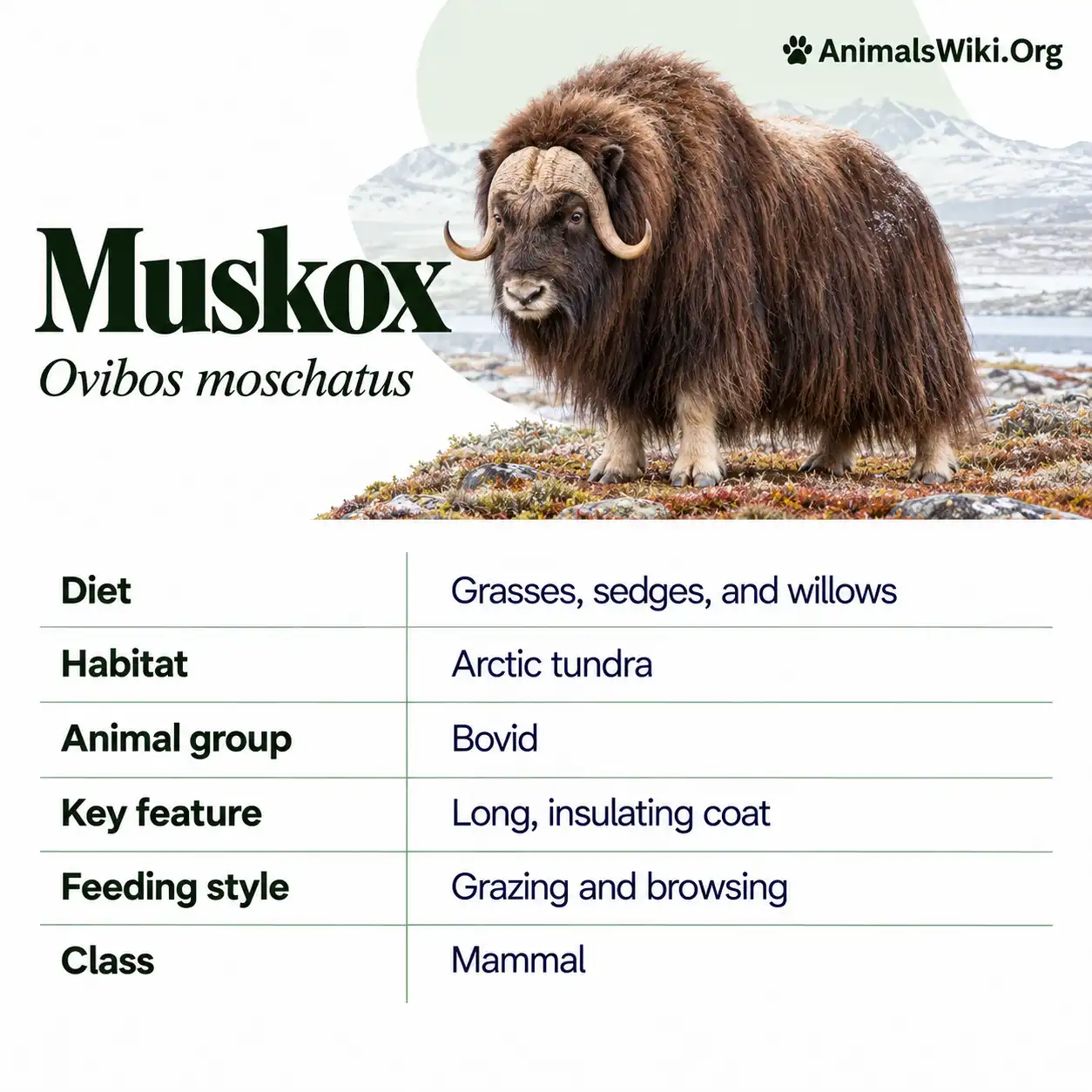
Muskox, The Shaggy Arctic Survivor With an Extraordinary Winter Coat
The muskox is one of the Arctic’s most recognizable land mammals. Its long, hanging coat, curved horns, and compact body create an unmistakable silhouette against snow, tundra, and low northern vegetation. Watching a herd stand together in a wind-scoured landscape offers a striking example of animals surviving conditions that would overwhelm many other large herbivores.
Yet the muskox is more than a symbol of endurance. Its survival depends on a carefully balanced annual cycle: gaining reserves during the short growing season, finding accessible plants in winter, conserving energy, reproducing successfully, and responding to predators as a group.
Known scientifically as Ovibos moschatus, the muskox belongs to the same broad family as cattle, sheep, goats, and antelopes. Despite its name and ox-like appearance, it is more closely associated with the sheep-and-goat branch of that family than with true cattle.
Its history combines persistence, loss, and restoration. Muskoxen survived the great environmental changes of the late Ice Age, disappeared from some regions, and were later reintroduced or introduced into several northern landscapes. Their present conservation story is equally varied: the species is globally classified as Least Concern, while some populations have experienced substantial declines.
Understanding muskoxen therefore requires looking beyond their impressive coat. Winter icing, disease, nutritional condition, local management, and the knowledge of northern communities all contribute to the picture.
This guide explores muskox identification, classification, habitat, distribution, food, adaptations, social behavior, reproduction, predators, ecological importance, and conservation. It also explains why a cold-adapted animal can remain vulnerable in a rapidly changing Arctic.
Muskox Facts
| Feature | Details |
|---|---|
| Common name | Muskox |
| Alternative spelling | Musk ox |
| Usual plural | Muskoxen |
| Scientific name | Ovibos moschatus |
| Family | Bovidae |
| Broad evolutionary group | Sheep-and-goat relatives |
| Native strongholds | Arctic Canada and Greenland |
| Restored or introduced populations | Parts of Alaska, Russia, Scandinavia, and other northern locations |
| Typical habitat | Arctic tundra and some open subarctic or mountain landscapes |
| General adult weight | Approximately 180–400 kilograms in commonly cited reference ranges |
| Sexual size difference | Bulls are generally larger than cows |
| Horns | Present in both sexes |
| Distinctive coat | Long guard hairs over fine insulating underwool |
| Underwool name | Qiviut |
| Diet | Grasses, sedges, forbs, and browse |
| Digestion | Ruminant |
| Gestation | Approximately eight to nine months |
| Young per birth | Usually one calf |
| Main natural predators | Wolves and bears, varying geographically |
| Global conservation category | Least Concern |
| Latest global assessment located | Assessed in 2020; published in 2022 |
| Historical global estimate | Approximately 170,000 in a synthesis published in 2020 |
| Current worldwide total | Not established here by a new comprehensive census |
1. What Is a Muskox?
The muskox is a large, hoofed, plant-eating mammal adapted to northern environments. It is the only living species in the genus Ovibos.
Its appearance can be deceptive. Long hair almost conceals its legs, making the body look lower and heavier than it would without the coat. Beneath that hanging hair is an animal capable of purposeful movement across uneven ground.
The common name combines two impressions: an ox-like body and the strong odor associated with males during the breeding season. Neither impression provides a complete account of its biology.
Muskoxen are ruminants, meaning that microbial fermentation and repeated chewing help them obtain nutrients from vegetation. They also live within social systems that influence feeding, mating, and defense.
Perhaps the most important point is that they are not simply animals that “like cold.” They survive through a combination of insulation, body form, behavior, nutrition, and seasonal timing.
A thick coat helps retain heat, but the animal still needs food. A defensive formation helps confront predators, but it does not eliminate mortality. Every adaptation operates within practical limits.
2. Scientific Classification and Naming
The Muskox’s Place in the Animal Kingdom
| Taxonomic rank | Classification |
|---|---|
| Kingdom | Animalia |
| Phylum | Chordata |
| Class | Mammalia |
| Order | Artiodactyla |
| Suborder | Ruminantia |
| Family | Bovidae |
| Genus | Ovibos |
| Species | Ovibos moschatus |
| Scientific authority | Zimmermann, 1780 |
The Mammal Diversity Database recognizes Ovibos moschatus as the living muskox species. References differ in how they arrange some intermediate ranks, but the genus and species identification is consistent.
Is It Really an Ox?
The muskox is more closely associated with sheep and goats than with cattle or bison.
The genus name Ovibos reflects a sheep–ox combination in its linguistic roots, which suits its mixed visual impression without implying that it is a hybrid.
Common names frequently describe appearance rather than precise ancestry. Scientific classification helps resolve that mismatch.
Muskox, Musk Ox, or Muskoxen?
“Muskox” and “musk ox” are both widely used. “Muskoxen” is the conventional plural adopted in this article.
Indigenous names differ among languages and regions. A single spelling or translation should not be treated as universal across all northern communities.
Scientific and local names serve different purposes: one connects formal biological records, while others carry cultural knowledge, language, and relationships with the animal.
3. Identification and Physical Appearance
A Compact, Barrel-Shaped Body
Muskoxen have a substantial torso, short-looking legs, a short tail, and a large head.
Bulls are generally larger than cows. Common reference ranges place adult females around 180–275 kilograms and males around 300–400 kilograms, although other sources report somewhat different figures.
These are broad guides rather than fixed boundaries. Seasonal reserves can also alter an animal’s weight.
The Hanging Coat
Long outer hairs create the familiar shaggy outline. They can extend far down the sides and largely obscure the lower body.
Color is usually dark brown to nearly black, with lighter areas possible on the back, legs, and face. The lighter back region is often called a saddle.
A shedding muskox may appear untidy, with loose underwool hanging through the outer coat. That appearance alone does not establish poor health.
Horns in Both Sexes
Both males and females have horns that curve downward and outward before turning upward.
Mature bulls develop a prominent horn boss across the forehead. Females have a less massive arrangement at the bases.
Horn development changes with age, making young animals look different from fully mature adults.
The combination of body form, hanging hair, horn shape, and short tail is more reliable for identification than any single feature. University and zoological references describe these characteristics together.
4. Muskox Compared With Bison, Yak, and Takin
Several large, shaggy mammals can look superficially similar, especially in cropped photographs.
| Feature | Muskox | Bison | Yak | Takin |
|---|---|---|---|---|
| Genus | Ovibos | Bison | Bos | Budorcas |
| Broad relationship | Sheep-and-goat relatives | Cattle relatives | Cattle relatives | Sheep-and-goat relatives |
| Typical setting | Arctic tundra | Grassland, woodland, and related habitats | Asian highlands | Asian mountain forests and uplands |
| Body impression | Compact, with a long hair skirt | Strong shoulder hump | Long-haired bovine outline | Heavy forequarters and broad muzzle |
| Tail | Short | Longer, with terminal hair | Long and heavily haired | Short |
| Familiar identifying feature | Sweeping horns and hanging coat | Hump and massive front end | Hairy tail and bovine head | Large nose and substantial shoulders |
These comparisons are general, and each group includes variation.
A photograph’s setting should support identification rather than determine it. Animals can be photographed in zoos, managed herds, or introduced populations far from their ancestral range.
The strongest identification begins with anatomy: tail, head, horn arrangement, body proportions, and coat distribution.
5. Ice Age History
A Survivor of Major Environmental Change
Muskoxen belong to a lineage associated with northern landscapes long before modern conservation programs.
Their history overlaps the broader Ice Age world of large herbivores and predators, many of which later disappeared.
However, the phrase “Ice Age survivor” should not be expanded into “unchanged since the Ice Age.” Living populations continue to evolve, respond to environmental pressures, and experience changes in distribution.
A Formerly Wider Range
Fossil and historical evidence shows that the muskox lineage once occupied a much broader northern distribution.
Changes in climate, habitat, and human pressures contributed to a complicated history of contraction and persistence. Their relative importance differed through time and place.
A single explanation for every disappearance would oversimplify that history.
Why the Past Matters
Historical information can help distinguish native occurrence from recent introduction. It can also reveal that present distribution is only one stage in a changing story.
Nevertheless, an ancient fossil does not automatically establish that a modern release is ecologically appropriate. Today’s vegetation, land use, disease conditions, and conservation objectives also matter.
6. Geographic Distribution
Native Strongholds
Arctic Canada and Greenland contain the principal surviving native strongholds.
Canada supports populations on Arctic islands and the mainland. Greenland has native populations as well as populations established through transfers within the country.
Alaska historically supported muskoxen, lost them, and later received animals through restoration efforts.
Introduced Northern Populations
Human-assisted movements established populations in parts of Russia and Scandinavia.
These populations have different histories and management contexts. A herd in Norway should not be described as having persisted there continuously since the last Ice Age.
A Small Swedish Example
Research published in 2025 described Sweden’s small wild population, descended from animals that crossed from the introduced Norwegian population in 1971. A summer 2024 survey estimated eight individuals.
That figure belongs to a particular population and survey date. It is not a count of all Scandinavian muskoxen.
Maps Need Historical Context
A useful range map distinguishes native, restored, introduced, and unsuccessful introduction areas.
Combining them into one color can conceal important differences in conservation history and ecological interpretation.
7. Reintroduction and Population Restoration
The Alaskan Restoration Story
Muskoxen disappeared from Alaska before being restored through twentieth-century conservation efforts.
In 1930, 34 animals captured in Greenland were transported to Alaska. Subsequent establishment on Nunivak Island provided a foundation for later transfers.
The Alaska Department of Fish and Game identifies those animals as the ancestors of modern Alaskan muskox populations.
What Restoration Can Achieve
Reintroduction can return a species to part of its former range and restore opportunities for ecological and cultural relationships.
However, successful establishment does not guarantee that every later population will increase indefinitely.
Food supply, weather, predation, disease, and management continue to influence outcomes after release.
Why Founder History Matters
A small founder group can shape genetic diversity and population relationships for generations.
This does not mean failure is inevitable, but it explains why genetic monitoring can complement counts and health studies.
Measuring Success Properly
The number released is only a starting point.
A meaningful evaluation asks whether animals survive, reproduce, establish suitable space use, and persist without creating unacceptable ecological or social problems.
The Alaskan story illustrates the value of long-term commitment rather than a one-time movement of animals.
8. Habitat and Seasonal Landscape Use
Arctic Tundra
Tundra includes low vegetation shaped by cold conditions, short growing seasons, and the local effects of moisture and soils.
It is not one uniform habitat. Wet sedge areas, dry ridges, river valleys, and shrub patches offer different resources.
Muskoxen experience these differences at the scale of individual feeding sites.
Summer and Winter Priorities
During the growing season, fresh plants offer opportunities to gain nutrients and build reserves.
In winter, accessibility becomes especially important. Food beneath deep or hard snow may require too much effort to obtain.
The best winter feeding place is therefore not necessarily the place with the most vegetation.
Wind-Scoured Ground
Exposed areas can have shallow snow because wind removes it.
Such places may look harsher to a human observer while providing easier access to food.
This creates a useful ecological trade-off: greater exposure can coincide with lower feeding costs.
Local Movement
Muskoxen can move appreciable distances, but they generally do not follow the same long-distance migration pattern familiar from many caribou herds.
Local and seasonal movements should be described in relation to particular populations rather than through one universal distance.
9. Diet and Food Selection
What Do Muskoxen Eat?
Muskoxen consume grasses, sedges, forbs, and woody browse.
Willow leaves and twigs can contribute, along with other tundra plants. The exact mixture depends on location and season.
They are herbivores rather than predators, even though their horns and powerful build can make them formidable.
Seasonal Variation
Fresh summer growth differs substantially from winter forage.
Plants change in moisture, digestibility, and nutrient content as they grow and mature. Availability also changes when snow covers the ground.
The National Park Service describes summer feeding on plants such as willow leaves, grasses, sedges, horsetails, and flowers.
Selective Feeding Within a Broad Diet
Eating several plant groups does not mean every plant is equally valuable.
Animals can choose particular patches and plant parts. A leafy shoot may offer a different return from a coarse stem.
The important conservation measure is usable forage, not simply total vegetation.
Food and Competition
Muskoxen can share landscapes with other herbivores, but overlap does not automatically prove serious competition.
Competition becomes meaningful when a shared resource limits performance. Establishing that requires evidence about diets, availability, and outcomes.
10. Digestion and Energy Reserves
A Ruminant Strategy
Muskoxen use microbial fermentation to process vegetation.
Regurgitating and rechewing food helps break it down, while microorganisms contribute to extracting nutrients from fibrous material.
This system makes low-growing tundra plants usable, but it does not make poor food nutritionally equivalent to fresh growth.
Preparing for Winter
The short growing season is an opportunity to improve body condition.
Stored reserves can help support survival and reproduction when food is less abundant or less accessible.
A successful summer therefore has consequences beyond the immediate feeding period.
Pregnancy and Maternal Reserves
Females carry pregnancies through winter, and calves may be born before local snowmelt and widespread fresh growth.
This means reproduction depends partly on resources acquired earlier.
A study using chemical signals in guard hair linked late-gestation nutritional stress with subsequent calf recruitment, highlighting the importance of conditions before birth.
Energy Conservation
Movement, digging, warming the body, and responding to disturbance all have costs.
Conserving energy is therefore a functional part of winter survival, rather than evidence that the animals are inherently inactive or incapable of movement.
11. Qiviut and the Two-Layered Coat
What Is Qiviut?
Qiviut is the fine underwool beneath the muskox’s long outer guard hairs.
It traps insulating air close to the body. The outer layer helps protect the undercoat and contributes to the animal’s characteristic appearance.
The two layers work together rather than serving as interchangeable types of hair.
Seasonal Shedding
Muskoxen shed qiviut as conditions become warmer.
Loose underwool can emerge in ragged clumps, remain attached temporarily, or catch on vegetation as animals rub and move.
The University of Alaska Fairbanks describes a relatively concentrated shedding period and explains how already-loosened qiviut can be combed from managed animals.
A Valuable Fiber
Qiviut is valued for softness, fineness, and insulation.
It can be collected from naturally shed material, managed animals, or hides obtained through harvest.
However, statements that one fiber is a precise number of times “warmer” than another depend on how the comparison is measured. Fiber diameter, yarn construction, fabric thickness, and testing conditions all matter.
Shedding Is Not Automatically Illness
A muskox with loose hair may simply be molting.
Assessing health requires more context, including behavior, body condition, movement, and other visible signs.
12. Other Arctic Adaptations
Compact Body Form
A compact body helps reduce exposed surface area relative to body volume.
Short appendages also limit some routes of heat loss compared with a more elongated body plan.
These general principles help explain the muskox’s shape without implying that anatomy alone determines survival.
Insulation and Behavior Together
A good coat remains most useful when paired with appropriate behavior.
During difficult weather, animals can reduce activity and adopt positions that limit exposure.
The National Park Service describes muskoxen resting with their backs toward strong winds and using shallow-snow areas for winter feeding.
Finding Food Beneath Snow
Smell and experience help animals locate feeding opportunities that are not immediately visible.
They use their hooves to uncover vegetation. Snow hardness and depth influence how difficult that task becomes.
Cold Adaptation Has Limits
The ability to withstand severe cold does not guarantee adequate nutrition.
An animal can remain insulated while failing to obtain enough food. That distinction explains why weather effects on forage accessibility can be as important as air temperature itself.
13. Winter Feeding and the Problem of Ice
Snow and Ice Are Different Obstacles
Loose snow can sometimes be moved aside. A hard ice layer may be much more difficult to penetrate.
A winter thaw or rain event followed by freezing can seal vegetation beneath a crust or ice.
Consequently, a warmer episode can create worse feeding conditions than a period of consistently cold weather.
Why Icing Matters
Blocked food increases the effort required to feed and can force animals to search elsewhere.
The consequences depend on how much of the landscape is affected, how long the barrier lasts, and the animals’ body reserves.
Young, old, or nutritionally stressed individuals may face particular difficulties.
Connected Effects
Poor winter feeding can influence survival, pregnancy, milk production, and the condition of calves.
This creates a chain of consequences that may remain visible after the weather event has ended.
Avoiding Simplistic Explanations
Not every mortality event follows icing, and not every icing event causes a population decline.
Researchers need local weather records, animal observations, and health information to determine what happened.
Climate-related mechanisms are most useful when supported by evidence rather than applied automatically to every change.
14. Social Organization and Communication
Herd Life
Muskoxen form groups whose composition and size vary.
Mixed groups can contain females, young, and males, while bachelor groups or solitary bulls also occur.
Season, resources, reproductive activity, and local density influence these arrangements.
Relationships Within Groups
Herd members do not behave as identical units.
Dominance, age, sex, and maternal relationships affect interactions. A calf’s dependence on its mother differs from the relationship between two adult bulls.
Recognizing these differences makes behavior easier to interpret.
Signals and Sounds
Muskoxen communicate through posture, movement, scent, and vocalization.
Head position, orientation, and approach can carry information during social encounters. Calves also communicate with their mothers.
Describing Behavior Carefully
An observer should record the action before assigning meaning.
“An adult turned toward the approaching person” is a stronger observation than “the animal became angry” when no further behavior was documented.
This approach avoids turning useful wildlife records into assumptions about human-like emotions.
15. Defensive Lines and Circles
How the Formation Works
Muskoxen are famous for facing outward toward danger while sheltering vulnerable animals behind them.
The arrangement is flexible. A line may face a threat from one direction, while a more enclosing formation can develop when danger surrounds the group.
The National Park Service explicitly distinguishes a defensive line from the broader circle-defense pattern.
Why It Can Be Effective
Adults present horns and substantial bodies toward an approaching predator.
Calves gain protection by remaining near or within the adult group rather than standing exposed.
However, the formation depends on the animals remaining coordinated.
It Is Not an Impenetrable Wall
Predators can test the group, exploit movement, or target an isolated individual.
Defensive behavior reduces risk; it does not eliminate predation.
Human Disturbance
A person or dog approaching closely can trigger the same defensive response.
A dramatic photograph of a group facing the camera may therefore document disturbance rather than relaxed natural behavior.
Responsible observation avoids deliberately provoking the formation.
16. Breeding Season and Male Competition
The Rut
Muskox breeding occurs in late summer and autumn, with timing varying among locations and references.
Bulls compete for access to receptive females.
Displays and threats can resolve some encounters before physical contact, while other contests involve forceful collisions.
Head-On Clashes
Mature males can run toward one another and strike horn boss against horn boss.
Their skulls, horns, necks, and body structures help them withstand these encounters, but protection is not absolute.
The Alaska Department of Fish and Game describes repeated displays and clashes as part of male breeding competition.
Are They Immune to Brain Injury?
No such absolute claim is justified.
A small 2022 anatomical and neuropathological study reported findings consistent with brain trauma in muskoxen and emphasized that protective anatomy may reduce rather than eliminate injury.
The study was preliminary and should not be turned into a measured injury rate for wild populations.
The Cost of Competition
Breeding effort can consume energy and reduce time available for feeding.
An animal entering winter after substantial reproductive effort may face a different challenge from one that retained more reserves.
17. Pregnancy, Birth, and Calf Development
Gestation and Birth
Pregnancy lasts approximately eight to nine months.
Usually one calf is born, while twins are uncommon. Births generally occur in spring, but exact timing varies geographically.
A Nunavut government fact sheet links reproductive frequency with conditions and describes the usual single-calf pattern.
Early Mobility
Calves can stand and nurse soon after birth.
Rapid mobility is valuable because remaining near the mother and herd contributes to protection.
Nevertheless, newborns remain dependent on milk, maternal attention, and favorable conditions.
Feeding and Growth
Young muskoxen begin sampling plants while still nursing.
The transition to a fully independent herbivorous diet is gradual rather than immediate.
Growth depends on both milk and access to suitable forage as the calf develops.
Not Every Cow Calves Every Year
Reproductive investment depends partly on condition.
A female may skip breeding or devote resources to an existing calf rather than produce another immediately.
For population monitoring, this means that an absence of calves has several possible explanations and needs to be interpreted alongside health, age structure, and environmental conditions.
18. Lifespan and Survival
How Long Do Muskoxen Live?
Females can survive into their late teens and sometimes beyond twenty years, while males often have shorter lives.
These are broad patterns rather than guarantees for individuals.
Age at death varies with population, sex, nutrition, predation, injury, and environmental conditions.
Average and Maximum Are Different
An exceptional old animal demonstrates potential longevity.
It does not establish the average age reached by newborns.
A population with many early deaths can have a low average lifespan even if some adults live for many years.
Survival Through Difficult Seasons
Condition before winter influences what an animal can withstand.
Stored resources can buffer a period of poor feeding, but reserves are finite.
Why Demography Matters
A population can decline because adults die more frequently, because too few calves survive, or through a combination of both.
Monitoring age and sex composition helps identify these differences.
A total count alone may reveal that something changed without explaining why.
19. Predators and Ecological Relationships
Wolves and Bears
Wolves and grizzly bears are important muskox predators in parts of the range. Other relationships vary by location.
The IUCN account also notes rare polar bear predation, but that should not be interpreted as a dominant relationship everywhere.
Different Risks for Different Animals
A calf, isolated adult, injured animal, and coordinated herd present different challenges to a predator.
Body size and horns do not make every individual equally difficult to attack.
Predation and Scavenging
An animal found feeding on a carcass did not necessarily kill it.
Researchers distinguish predation from scavenging using evidence about the carcass, injuries, tracks, timing, and other observations.
The Conservation Context
Native predators are part of Arctic ecosystems.
A population decline should not automatically be blamed on them when disease, nutrition, weather, and human pressures may also contribute.
Understanding interactions is more useful than identifying one convenient culprit.
20. Ecological Importance
Influencing Vegetation
Muskox feeding removes plant material and can affect growth patterns.
The outcome depends on grazing intensity, plant community, moisture, and season.
Heavy use and moderate use need not have identical effects.
Nutrients and Decomposition
Dung and urine return nutrients to the ground, while carcasses support scavengers and decomposers.
These pathways connect the animal with soils, plants, insects, birds, and mammals.
Arctic Carbon Questions
Large herbivores can influence vegetation and nutrient cycling in ways relevant to carbon exchange.
However, it would be an exaggeration to claim that muskoxen alone can solve Arctic climate change.
The direction and scale of effects require ecosystem-specific evidence.
A Distinctive Component of Biodiversity
Muskoxen are valuable as a unique living lineage and part of northern ecosystems.
Their importance is not limited to meat, fiber, tourism, or their role as prey.
Conservation should recognize those relationships while respecting the animal’s broader biological significance.
21. Relationships With Northern Communities
Food, Materials, and Knowledge
Muskoxen contribute to livelihoods and cultural practices in several northern regions.
Meat, hides, and qiviut can have practical and economic value, while observations accumulated through travel and harvesting contribute ecological knowledge.
These relationships vary among communities and should not be generalized into one uniform tradition.
Qiviut Production
Managed herds provide opportunities to collect underwool and support fiber-based enterprises.
Alaska accounts describe qiviut processing and its importance to people in communities such as Mekoryuk.
Harvest and Conservation
Harvest decisions need to reflect local abundance, population trends, health, and management objectives.
A harvest level suitable for an increasing population may be inappropriate after a major decline.
Knowledge Partnerships
Residents and harvesters can notice unusual deaths, changing distribution, or poor condition before occasional research teams do.
Combining that knowledge with laboratory work and systematic surveys can reveal problems that neither approach would fully resolve alone.
The relationship should be collaborative, with findings communicated back to the people contributing information.
22. Population Estimates and Local Trends
The Global Estimate
A circumpolar synthesis published in 2020 estimated approximately 170,000 muskoxen while acknowledging substantial uncertainties and differences among populations.
That is a dated synthesis, not a new worldwide count for 2026.
Banks Island
Parks Canada reports a Banks Island peak estimate of 68,585 in 2001 and an estimate of 10,979 in 2019.
These figures illustrate a major local decline and must retain their dates.
| Population information | Date | Scope | Interpretation |
|---|---|---|---|
| Approximately 170,000 | Synthesis published in 2020 | Circumpolar | Historical global approximation |
| 68,585 | 2001 | Banks Island | Historical peak estimate reported by Parks Canada |
| 10,979 | 2019 | Banks Island | Later regional estimate |
| Eight individuals | Survey in summer 2024 | Swedish wild population | Small, specific introduced-descendant population |
| Exact worldwide total in 2026 | Not established here | Global | Should not be supplied as a verified census |
Why Counts Differ
Studies vary in survey method, season, area, and whether calves are included.
Detection also changes with terrain and visibility.
Global Status Versus Local Experience
A species can remain widespread overall while communities experience severe losses locally.
Both scales matter. The global category should not erase regional problems, and one declining population should not automatically define every other population.
23. Conservation Status and Main Threats
Least Concern
The latest global IUCN assessment located for this article assessed muskoxen in December 2020 and was published in 2022. The species is classified as Least Concern.
This means it does not currently meet the assessment thresholds for a globally threatened category.
It does not mean every population is secure or that monitoring is unnecessary.
Disease
A study published in December 2025 investigated deaths on Ellesmere and Axel Heiberg islands during 2021–2024.
It linked the mortality event with an Arctic lineage of the bacterium Erysipelothrix rhusiopathiae, demonstrating the importance of health surveillance in remote populations.
That finding should not be generalized into the claim that all muskox declines have the same cause.
Parasites and Changing Conditions
Temperature and environmental changes can affect parasites, hosts, and transmission opportunities.
The consequences vary among regions and organisms.
Icing and Food Access
Rain-on-snow and refreezing can restrict forage even where vegetation remains present.
This is an accessibility problem rather than simply a shortage of plants.
Disturbance and Cumulative Pressure
Repeated displacement, development, harvest, and environmental stress can interact.
The practical question is which pressures matter most for a particular population and whether management can reduce them.
24. Research and Conservation Priorities
Repeatable Population Monitoring
Surveys should use methods that allow meaningful comparisons through time.
Clear records of area, effort, season, and uncertainty help prevent changes in method from being mistaken for biological trends.
Health Surveillance
Reporting and investigating unusual mortality can reveal emerging problems.
Laboratory diagnosis is especially valuable when several causes could produce similar visible signs.
Nutritional Research
Plant availability and animal condition need to be studied together.
A 2025 study examined relationships between qiviut element profiles and population trajectories, exploring how hair samples might contribute to understanding health and nutrition.
Such tools complement field observations rather than replace population surveys.
Community Participation
People regularly using the landscape can contribute continuity that visiting teams lack.
Monitoring programs should recognize that expertise and share results in accessible forms.
Adaptive Management
Actions should be evaluated through outcomes.
If a measure aims to improve calf recruitment or reduce disturbance, monitoring should test whether those changes occur.
Conservation is strongest when it can adjust to evidence rather than preserve an ineffective practice.
25. Responsible Observation and Photography
Keep Distance
Muskoxen are powerful wild animals, even when standing quietly.
Observers should avoid approaching closely, blocking movement, or placing themselves between adults and calves.
Local viewing guidance should determine practical distances and behavior.
Control Dogs
Dogs can be perceived as threats and may trigger defensive responses.
Where dogs are permitted, responsible control is essential. Protected areas may impose additional restrictions.
Do Not Provoke the Circle
A defensive formation is not a performance to request.
If animals bunch together and face an observer, that is a reason to increase distance.
Photograph Molting Honestly
Loose qiviut is normal seasonal biology.
Images should not be labeled as illness or neglect without evidence.
Make Records Useful
A date, general location, group composition, and observed behavior provide context.
Unusual deaths or apparently sick animals should be reported through appropriate local wildlife channels rather than approached or handled.
26. Frequently Asked Questions
1. What is a muskox?
A muskox is a large Arctic herbivore known scientifically as Ovibos moschatus. It has a compact body, curved horns, and a long outer coat over fine insulating underwool. It is the only living species in its genus and belongs to the bovid family.
2. Is a muskox a type of cattle?
It belongs to the same broad family as cattle, but its evolutionary relationships place it closer to sheep and goats than to true cattle or bison. The name reflects appearance rather than a precise classification. It is not a hybrid of an ox and a sheep.
3. Where do muskoxen live?
Their native strongholds are Arctic Canada and Greenland. Alaska supports restored populations, and introduced populations occur in parts of Russia and Scandinavia. These different histories matter: a modern herd is not necessarily a continuously surviving native population simply because it lives in a northern landscape.
4. Do muskoxen live in Antarctica?
No. Muskoxen are northern mammals associated with Arctic and some subarctic environments. Antarctica is in the Southern Hemisphere and has a different ecological history. Similar cold temperatures do not mean that the two polar regions naturally contain the same animals.
5. How large is a muskox?
Common reference ranges place adults around 180–400 kilograms, with males generally larger than females. Population, age, season, and body condition affect weight. The hanging coat also exaggerates apparent bulk, so a photograph alone is not a reliable way to estimate body mass.
6. Do female muskoxen have horns?
Yes. Both sexes carry horns. Mature bulls develop a particularly substantial boss across the forehead, while females have less massive horn bases. Young animals look different from fully developed adults, so age and viewing angle can complicate identification.
7. What is qiviut?
Qiviut is the muskox’s fine underwool, located beneath its long guard hairs. It traps insulating air and is shed seasonally. People value it as a soft fiber, but collecting it from managed animals involves appropriate handling rather than treating wild muskoxen as approachable sources of wool.
8. Are muskoxen shaved like sheep?
Qiviut naturally loosens during the seasonal molt and can be combed from appropriately managed animals. It can also be collected from shed material or hides. Wild animals should not be approached or handled to obtain fiber, and harvesting methods differ among enterprises.
9. What do muskoxen eat?
They eat tundra vegetation, including grasses, sedges, broad-leaved herbs, and woody browse. Diet changes with season and locality. Their feeding strategy is flexible, but plants still differ in nutritional value and accessibility, particularly when snow or ice covers the ground.
10. How do muskoxen find food in winter?
They use suitable feeding areas, including places with relatively shallow snow, and uncover plants with their hooves. Hardness matters as well as depth. A layer of ice can make food much more difficult to reach than loose snow of similar thickness.
11. Why can warmer winter weather be harmful?
Rain or thawing followed by refreezing can lock forage beneath ice. The animals may remain well insulated while struggling to obtain enough food. This explains why cold tolerance and resistance to climate-related change are different things.
12. Do muskoxen migrate like caribou?
They generally do not follow the same extensive migration pattern associated with many caribou populations. Muskoxen make local and seasonal movements, and individuals can travel substantial distances. Exact movement patterns should be described for the population concerned rather than through one universal rule.
13. Why do muskoxen form circles?
They can arrange adults toward a threat while sheltering calves behind or within the group. The formation is flexible and may be a line rather than a complete circle. It reduces predation risk but does not make the herd impossible to attack.
14. What predators eat muskoxen?
Wolves and grizzly bears are important predators in parts of the range, with other relationships varying locally. Calves, isolated animals, and weakened individuals can face different risks from coordinated adult groups. A predator list does not reveal how often each predator kills muskoxen.
15. Are muskoxen aggressive?
They can defend themselves forcefully, especially when threatened or when calves are present. Calm behavior does not make close approach safe. Observers should give them room and avoid provoking a defensive response, particularly with dogs or by blocking their route.
16. Why do male muskoxen collide head-on?
Bulls compete for access to females during the breeding season. Displays may escalate into collisions involving their horn bosses. Protective anatomy helps them withstand impacts, but it does not justify claiming that they cannot be injured or that such contests have no physical cost.
17. Can muskoxen get brain injuries?
Research published in 2022 reported preliminary evidence consistent with brain trauma in a small sample of headbutting bovids, including muskoxen. The findings challenge absolute claims of immunity. They do not establish a population-wide injury rate or prove that every collision causes lasting damage.
18. How long is muskox pregnancy?
Gestation is approximately eight to nine months. A single calf is usual, while twins are uncommon. Exact timing varies among locations, and reproductive success depends on maternal condition as well as the biological duration of pregnancy.
19. When are muskox calves born?
Births generally occur in spring, with regional variation. Calving can precede local snowmelt and widespread fresh plant growth. This makes the mother’s stored reserves important for supporting late pregnancy and early milk production.
20. Do female muskoxen have a calf every year?
Not necessarily. Reproduction depends partly on body condition and available resources. Some females may skip a breeding opportunity or invest longer in an existing calf. Interpreting calf numbers therefore requires information about environmental conditions, age structure, and survival.
21. How long do muskoxen live?
Females can reach their late teens and sometimes exceed twenty years, while males often have shorter lives. These are broad patterns, not guaranteed ages. Average lifespan, maximum age, and annual survival describe different aspects of population biology.
22. Are muskoxen endangered?
Globally, the species is classified as Least Concern in the assessment completed in 2020 and published in 2022. However, some populations have declined substantially. The global category should not be interpreted as proof that every local population is stable or free from serious threats.
23. How many muskoxen remain?
A synthesis published in 2020 estimated approximately 170,000 worldwide, with acknowledged uncertainty. That number is historical context rather than a verified global count for 2026. Regional surveys conducted in different years cannot simply be combined into a current total without careful analysis.
24. Are muskoxen unchanged Ice Age animals?
No living species should be described as evolutionarily frozen. Muskoxen have a long history and survived environmental changes associated with the Ice Age, but their populations, distribution, and genetics have continued to change. “Ice Age survivor” is a useful historical phrase, not a claim of biological immobility.
25. Why is disease an important concern?
Recent investigations have linked some major mortality events with bacterial infection, while parasites and nutritional stresses also affect particular populations. The importance of each factor differs geographically. Diagnosing causes requires health investigations rather than assuming that every decline results from the same disease.
26. What helps muskox conservation most?
Useful priorities include consistent surveys, health monitoring, community collaboration, responsible harvest management, and protection from avoidable disturbance. Actions should respond to local evidence. A stable global classification does not remove the need to investigate declining populations or emerging mortality events.
Muskox (Ovibos moschatus)
The muskox survives the Arctic through a combination of insulation, energy management, social behavior, and seasonal opportunity. Its qiviut coat is remarkable, but it works within a larger biological system that includes food access, maternal reserves, group relationships, and predator responses.
Its history demonstrates both resilience and vulnerability. Restoration has returned muskoxen to some northern landscapes, while disease, icing, and other pressures have affected established populations. These contrasting experiences can occur within a species that remains globally classified as Least Concern.
Accurate information helps make sense of that complexity. Population estimates need dates, local declines need geographic context, and impressive adaptations should not be turned into claims of invulnerability.
The most effective conservation combines reliable field surveys, health research, northern knowledge, and management that adjusts to evidence. That approach recognizes the muskox as both a distinctive Arctic animal and part of a wider living landscape.
Protecting its future means maintaining the conditions that allow the entire annual cycle to work—from summer feeding and winter survival to successful calving and the growth of the next generation.



