Zebra Facts
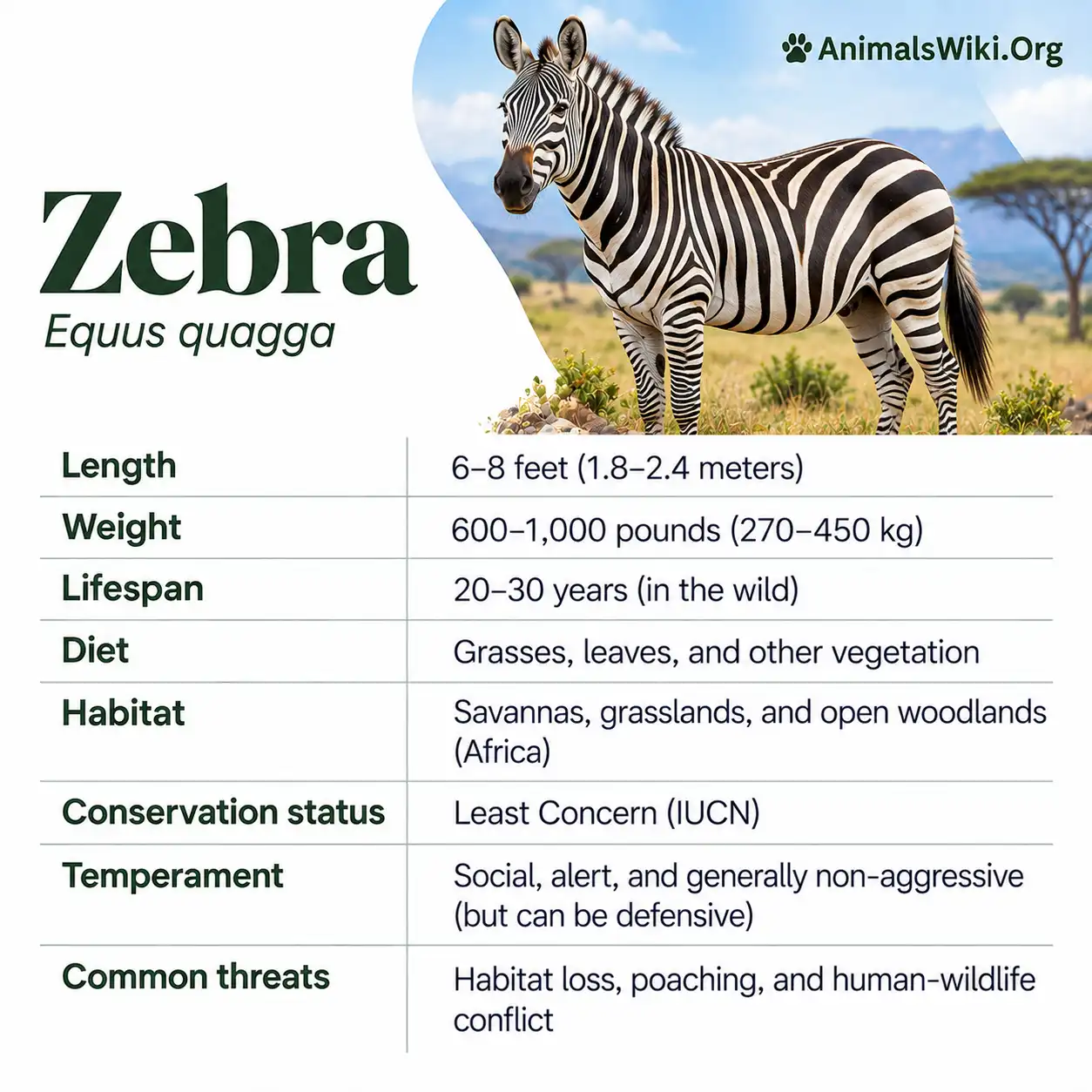
| Feature | Details |
|---|---|
| Common Name | Zebra |
| Scientific Name | Equus quagga (Plains Zebra), Equus grevyi (Grevy’s Zebra), Equus zebra (Mountain Zebra) |
| Family | Equidae |
| Order | Perissodactyla |
| First Described | 1758 (Mountain Zebra, by Carl Linnaeus) |
| Native Habitat | Savanna, grassland, woodland, semi-arid scrubland, mountainous terrain |
| Geographic Range | Eastern and southern Africa |
| Average Size | 2.0–2.9 m body length; 1.1–1.6 m at the shoulder |
| Average Weight | 175–450 kg depending on species |
| Lifespan | 20–25 years (wild); up to 30+ years (captivity) |
| Diet | Herbivore — primarily grasses, supplemented by leaves and bark |
| Conservation Status | Ranges from Near Threatened (Plains Zebra) to Endangered (Grevy’s Zebra and Mountain Zebra) |
| Defining Feature | Unique black-and-white striping pattern, individually distinct like a fingerprint; highly social herding behavior; among the closest living relatives of the domestic horse |
| Number of Species | 3 recognized species |
1. Zebra Species Overview & Classification
As the dry-season sun climbs over the Serengeti-Mara ecosystem, a river of black-and-white bodies stretches across the horizon in every direction — hundreds of thousands of individual animals moving in a single, continuous, rippling mass, their striped coats blending together into a shimmering, almost hypnotic visual field that makes it genuinely difficult, at any real distance, to distinguish where one animal ends and the next begins. This is one of the largest and most visually spectacular land migrations remaining anywhere on Earth, and at its very center — moving alongside, among, and in close ecological partnership with the far more numerous wildebeest that share this annual journey — is the zebra, an animal whose bold, unmistakable striped coat has made it one of the most immediately recognizable wild mammals in the entire world, instantly identifiable to people who have never set foot on the African continent and who may never have knowingly encountered any other African wildlife species by name.
The zebra is a group of three closely related wild equid species native to eastern and southern Africa — the widespread and comparatively abundant Plains Zebra (Equus quagga), the considerably rarer and more range-restricted Grevy’s Zebra (Equus grevyi), and the Mountain Zebra (Equus zebra), itself divided into two recognized subspecies occupying separate mountainous regions of southern Africa. All three species belong to the genus Equus, placing zebras in close taxonomic company with domestic horses, donkeys, and the various wild ass species covered elsewhere within the broader Equidae family — a genuinely significant evolutionary relationship reflected in the zebra’s overall body plan, digestive physiology, and general behavioral ecology, even as the animal’s singular, world-famous striping pattern sets it visually apart from every other member of this shared evolutionary lineage.
Zebras occupy a position of considerable ecological and cultural significance disproportionate to what might be assumed from their comparatively modest individual size relative to some of the larger African megafauna covered elsewhere throughout this broader guide series: they represent one of the most numerically significant large herbivores across substantial portions of the East African savanna ecosystem, play a genuinely important and scientifically well-documented ecological role in the Serengeti-Mara migration system specifically, and remain, alongside lions, elephants, and giraffes, among the handful of African wildlife species that have become so thoroughly and universally recognized within global popular culture that the animal’s very name has entered common usage as a general descriptive term for any black-and-white striped pattern, regardless of context. At the same time, the zebra group’s conservation picture reveals a genuinely striking divergence between species — from the comparatively secure, if still declining, Plains Zebra to the genuinely critically imperiled Grevy’s Zebra, one of the rarest large mammals in all of Africa — a conservation reality considerably less widely appreciated than the animal’s near-universal popular recognition might suggest.
Species Classification Table
| Classification Level | Details |
|---|---|
| Kingdom | Animalia |
| Phylum | Chordata |
| Class | Mammalia |
| Order | Perissodactyla |
| Family | Equidae |
| Genus | Equus |
| Described By | Carl Linnaeus, 1758 (Mountain Zebra) |
| Closest Relatives | Domestic horse, donkey, African and Asian wild asses (all genus Equus) |
The Three Zebra Species
| Species | Scientific Name | Range | Population (approx.) | Notes |
|---|---|---|---|---|
| Plains Zebra | Equus quagga | Eastern and southern Africa (widest range) | ~500,000+ | Most numerous and widely distributed species; central to the Great Migration |
| Grevy’s Zebra | Equus grevyi | Kenya, Ethiopia (small remaining range) | ~2,500–3,000 | Largest zebra species; narrowest stripes; Endangered |
| Mountain Zebra | Equus zebra | Namibia, South Africa (mountainous regions) | ~35,000 (Cape) / ~1,000–2,000 (Hartmann’s, more threatened) | Two subspecies; distinctive dewlap; adapted to rugged terrain |
Note: The extinct Quagga (Equus quagga quagga), once considered a distinct species and now understood via genetic research to be a subspecies of the Plains Zebra, is discussed extensively in the Conservation and Discovery sections given its historically significant extinction and ongoing “de-extinction” breeding project.
The Name “Zebra”
The English word “zebra” entered the language via Portuguese and Spanish, tracing back to a term used by Portuguese explorers along the African coast, itself likely derived from a Vulgar Latin root related to “equiferus” (“wild horse”) — reflecting the earliest European encounters with the animal as a genuinely striking, exotic variant of the more familiar wild and domestic horses already known to European naturalists and explorers of the period.
🦓 Did You Know? No two zebras share exactly the same stripe pattern — much like a human fingerprint, each individual zebra’s specific arrangement, width, and spacing of stripes is entirely unique, a fact researchers use to identify and track individual wild zebras over years or even decades through photographic pattern-matching, without requiring physical tagging or other invasive marking methods.
2. Zebra Physical Description & Unique Features
The zebra’s body reflects the broader anatomical body plan characteristic of the Equidae family, combined with one of the most visually striking and scientifically debated coloration patterns found in any mammal on Earth.
Size and Build
Zebra size varies meaningfully across the three recognized species:
Grevy’s Zebra (the largest species):
- Shoulder height: 1.4–1.6 m (4.6–5.2 feet)
- Weight: 350–450 kg (770–990 lbs)
- Body length: Up to 2.9 m (9.5 feet)
Plains Zebra (intermediate size, the most numerous species):
- Shoulder height: 1.1–1.4 m
- Weight: 175–385 kg, varying considerably across the species’ several recognized subspecies
Mountain Zebra (generally the smallest species):
- Shoulder height: 1.1–1.3 m
- Weight: 204–372 kg
Sexual dimorphism: Generally modest across all three species, with males (stallions) typically somewhat larger and heavier than females (mares), though the difference is considerably less pronounced than in numerous other large mammal species covered throughout this broader guide series.
The Stripes — One of Biology’s Most Genuinely Debated Adaptations
The zebra’s defining physical feature — its bold, high-contrast black-and-white striped coat — represents one of the most visually striking and, notably, one of the most genuinely and actively scientifically debated coloration adaptations documented anywhere in the animal kingdom:
- Individual uniqueness: As introduced extensively in the Species Overview section, no two zebras display exactly the same stripe pattern, with individual variation in stripe width, spacing, and precise arrangement sufficient to allow reliable individual identification — a genuine practical research tool discussed further throughout this guide
- Species-specific pattern variation: Each of the three zebra species displays a somewhat distinct characteristic stripe pattern: Grevy’s Zebra displays notably narrow, densely packed stripes extending down to a white belly, the Plains Zebra typically displays somewhat broader stripes, often including fainter “shadow stripes” in certain subspecies, and the Mountain Zebra displays a distinctive pattern including a characteristic gridiron pattern on the rump and a notable absence of stripes on the belly
- The multiple-hypothesis scientific debate: The precise evolutionary function and adaptive advantage of zebra striping has been the subject of genuine, sustained, and still not fully resolved scientific research and debate, with several competing (and not necessarily mutually exclusive) hypotheses receiving significant research attention:
- Biting fly deterrence: A substantial and increasingly well-supported body of research suggests zebra stripes may function specifically to deter biting flies, including tsetse flies and various horseflies, with experimental research demonstrating that striped surfaces genuinely attract significantly fewer biting flies than solid-colored surfaces of comparable size and shape — a hypothesis with particular scientific traction given the genuine disease transmission risk (including trypanosomiasis) that biting flies represent to African savanna herbivores
- Thermoregulation: Some research has proposed that the differential heat absorption between black and white stripes may create small-scale air currents across the zebra’s body surface, contributing to more effective heat dissipation in the hot African savanna climate, though this hypothesis remains somewhat less consistently supported by subsequent research than the biting-fly deterrence hypothesis
- Predator confusion (the “motion dazzle” hypothesis): A historically popular hypothesis suggests that the visual disruption created by numerous striped individuals moving together within a herd may confuse predators’ ability to visually track and target any single individual — though more recent research has raised some genuine question regarding the strength of experimental support for this specific hypothesis relative to the biting-fly deterrence explanation
- Social recognition: Stripe patterns may additionally serve a genuine social function, potentially assisting individual and species recognition within and between zebra social groups, discussed further in the Social Behavior section
The genuine scientific consensus emerging from this considerable body of comparative research increasingly favors the biting-fly deterrence hypothesis as the primary evolutionary driver, though most researchers in the field acknowledge that several of these functions may operate simultaneously and non-exclusively, representing a genuinely multifaceted adaptive explanation rather than a single, simple answer.
Coat and Skin
Are zebras black with white stripes, or white with black stripes? This popularly debated question has a genuine scientific answer: zebra embryonic skin develops with a black base pigmentation, with the white stripes forming subsequently through localized pigment-inhibition during development — meaning that, in a genuine developmental-biology sense, zebras are more accurately described as black animals with white stripes, rather than the reverse, a finding directly supported by observation of the animal’s actual skin pigmentation beneath the coat, which is uniformly dark regardless of the overlying stripe pattern.
Body Structure and Locomotion
Zebras possess the general body plan characteristic of the broader Equidae family, including a single-toed hoof structure (an evolutionary adaptation for efficient, sustained running shared across all modern horse, donkey, and zebra species), a relatively long neck and head, and an overall body build well suited to sustained, efficient running — a genuinely important adaptation discussed extensively in the Predators section, given the considerable predation pressure zebras face across their African savanna range.
Mane and Tail
Zebras possess a distinctive, typically stiff, upright mane running along the neck, generally displaying the same black-and-white striping pattern as the rest of the body, along with a horse-like tail ending in a tuft of longer hair, broadly consistent with the general tail structure characteristic of the wider Equidae family.
3. Zebra Habitat & Geographic Range
Zebras occupy a considerable range of open and semi-open habitat types across eastern and southern Africa, with meaningful habitat specialization documented across the three recognized species reflecting their somewhat distinct ecological niches and geographic distributions.
Preferred Habitat Features
Open savanna and grassland — the core habitat type for the Plains Zebra specifically, the most numerous and widely distributed of the three species, offering the extensive grazing resources central to the species’ predominantly grass-based diet, described extensively in the Diet section
Semi-arid scrubland and desert-edge habitat — Grevy’s Zebra shows particular habitat association with drier, more arid scrubland and semi-desert conditions across its considerably more restricted modern range, reflecting a degree of habitat and physiological adaptation to more marginal water availability compared to its Plains Zebra relative
Mountainous and hilly terrain — as reflected directly in its common name, the Mountain Zebra shows strong habitat association with rugged, mountainous, and hilly terrain across its southern African range, occupying a genuinely distinct ecological niche from the more open-grassland-associated Plains Zebra
Water access — all three zebra species require regular access to water, with the specific frequency and distance tolerance varying by species — Grevy’s Zebra, notably, shows somewhat greater tolerance for extended distance between water sources compared to the Plains Zebra, a genuine adaptation to its considerably more arid native range
Habitat Types Occupied
| Habitat | Primary Zebra Use | Species | Key Features |
|---|---|---|---|
| Open savanna grassland | Primary habitat | Plains Zebra | Abundant grazing; central to Great Migration |
| Semi-arid scrubland/desert edge | Primary habitat | Grevy’s Zebra | Greater water-independence tolerance |
| Mountainous/hilly terrain | Primary habitat | Mountain Zebra | Rugged, steep terrain adaptation |
| Woodland edge and mixed bushveld | Secondary habitat | Plains Zebra, Mountain Zebra | Transitional habitat use |
Geographic Range
Current range by species:
| Region | Key Countries | Primary Species | Population Status |
|---|---|---|---|
| East Africa | Kenya, Tanzania | Plains Zebra (dominant); Grevy’s Zebra (Kenya specifically) | Plains Zebra locally abundant; Grevy’s Zebra severely restricted |
| Southern/Central Africa | Zambia, Botswana, Zimbabwe, Mozambique, Angola | Plains Zebra | Generally stable to locally declining |
| Southern Africa (mountainous regions) | South Africa, Namibia | Mountain Zebra (two subspecies) | Cape Mountain Zebra recovering; Hartmann’s Mountain Zebra more vulnerable |
| Horn of Africa | Ethiopia | Grevy’s Zebra (small remaining population) | Critically limited remaining range |
The Great Migration — Zebras as Migration Pioneers
The Serengeti-Mara Great Migration, one of the most famous and visually spectacular wildlife phenomena on Earth, involves the coordinated seasonal movement of over a million wildebeest alongside several hundred thousand Plains Zebras across the Serengeti-Mara ecosystem spanning Tanzania and Kenya — and, notably, zebras are widely documented by researchers as effectively serving as “pioneer” grazers within this migration system, discussed extensively in the Ecosystem Role section, typically arriving at fresh grazing areas ahead of the considerably more numerous wildebeest and consuming the taller, coarser grass growth that wildebeest are less well equipped to efficiently process, thereby preparing the ground, in a genuine ecological sense, for the wildebeest that follow.
4. Zebras Diet & Feeding Behavior
The zebra is a genuine herbivorous grazer, with a diet centered predominantly on grasses, reflecting the broader dietary pattern characteristic of the Equidae family and the species’ considerable digestive adaptation for processing substantial quantities of fibrous plant material.
What Zebras Eat
Grasses — the overwhelming dietary foundation across all three zebra species and the great majority of seasons, with zebras capable of consuming a considerably broader range of grass species and growth stages, including taller, coarser, more mature grass, than many other African grazing herbivores are able to efficiently process
Leaves and shrub browse — consumed as a supplementary dietary component, particularly during drier seasons or in more marginal habitat where grass availability is limited, reflecting genuine dietary flexibility necessary to survive the considerable seasonal variability characteristic of much of the zebra’s African range
Bark — consumed opportunistically, particularly during periods of significant grass scarcity, reflecting the broader dietary flexibility documented across the zebra group more generally
Digestive Adaptation — The Hindgut Fermenter Advantage
Unlike ruminant herbivores such as wildebeest, cattle, and the numerous other Bovidae family members covered throughout this broader guide series, zebras and other equids are hindgut fermenters, digesting plant material through microbial fermentation occurring in an enlarged cecum and colon located after the stomach, rather than through the multi-chambered ruminant stomach system characteristic of Bovidae species:
- Faster digestive throughput, lower extraction efficiency: This hindgut fermentation strategy processes plant material considerably more rapidly than ruminant digestion, but extracts somewhat less total nutritional value per unit of food consumed — meaning zebras must consume a greater overall volume of forage relative to body size compared to a similarly sized ruminant, but can process that forage more quickly and can tolerate lower-quality, more fibrous plant material (including taller, more mature grass stems that ruminants process less efficiently) than many ruminant grazers
- Ecological significance for the Great Migration: This digestive distinction carries direct and genuinely significant ecological consequences for the broader Serengeti-Mara migration system, described extensively in the Habitat and Ecosystem Role sections, since zebras’ capacity to efficiently process taller, coarser, more mature grass allows them to effectively “open up” and reduce grazing areas ahead of the more numerous wildebeest, whose ruminant digestive system is considerably better suited to the shorter, more nutrient-dense grass regrowth that follows zebra grazing
Feeding Behavior Patterns
Extended daily grazing: Zebras typically spend a very considerable proportion of their daily activity budget — often estimated at 60–80% of daylight hours — actively grazing, reflecting both the considerable volume of forage required to meet the species’ nutritional needs given its comparatively lower digestive extraction efficiency and the generally lower nutritional density of the grass-dominated diet itself
Water dependency: As referenced extensively in the Habitat section, zebras require regular access to water, with the Plains Zebra specifically showing meaningful water dependency requiring relatively frequent access, a factor directly influencing the species’ broader seasonal movement and migration patterns across the Serengeti-Mara and other range ecosystems
Group foraging: Zebras typically forage in the coordinated social groups described extensively in the Social Behavior section, benefiting from collective predator vigilance while feeding across generally open, exposed grazing terrain.
5. Zebra Reproduction & Life Cycle
Zebra reproductive biology follows a broadly typical pattern for large African savanna herbivores, with year-round breeding capability in favorable conditions and a genuinely significant maternal investment period reflecting the considerable vulnerability young zebras face during their early developmental stage.
Sexual Maturity
- Females: Typically reach sexual maturity at approximately 2–3 years of age
- Males: Generally reach sexual maturity at a broadly similar age, though, consistent with the pattern documented across numerous other polygynous large mammal species covered throughout this broader guide series, actual competitive breeding success is typically further delayed until males achieve sufficient size, condition, and social standing to successfully compete with rival males, discussed extensively in the Social Behavior section
Breeding Season
Unlike numerous other African savanna herbivores that breed within a tightly concentrated, strictly seasonal window, zebras — particularly the Plains Zebra — show comparatively greater breeding season flexibility, with mating capable of occurring across a considerably broader portion of the year in favorable conditions, though births still show some meaningful seasonal concentration, typically timed to coincide with periods of more favorable grass availability supporting nursing mothers and developing foals.
Mating Behavior
As detailed extensively in the Social Behavior section, zebra mating occurs predominantly within the stable, harem-based family group structure characteristic of the species, with the dominant stallion within a given family group generally holding primary breeding access to the group’s mares.
Gestation and Birth
- Gestation period: Approximately 360–390 days (roughly 12–13 months), notably long relative to the species’ overall body size, broadly consistent with the extended gestation periods characteristic of the wider Equidae family
- Litter size: Single foal; twins are extremely rare
- Birth condition: Foals are born in a strongly precocial state, capable of standing and beginning to walk within a remarkably short period — typically within roughly an hour of birth — and capable of running alongside the mother and broader herd within just a few hours, a genuinely critical survival adaptation given the substantial predation pressure zebras face across their African savanna range, described extensively in the Predators section
Foal Development
| Stage | Timing | Development |
|---|---|---|
| Birth | Day 0 | Precocial; standing within ~1 hour; running within hours |
| Early bonding/imprinting period | Days 1–3 | Critical mother-foal bonding period (described below) |
| Early nursing period | Weeks 1–12 | Highly dependent on mother; begins sampling grass |
| Weaning | ~7–11 months | Gradual transition to independent grazing |
| Juvenile growth | 1–2 years | Continued growth; developing stripe pattern definition |
| Sexual maturity | 2–3 years | Reproductive capability begins |
| Dispersal (particularly males) | ~1–3 years | Young males typically leave natal group, joining bachelor groups |
The Critical Mother-Foal Imprinting Period
A genuinely significant and scientifically well-documented element of zebra reproductive and early developmental biology involves an intense early imprinting period immediately following birth, during which the mother actively works to ensure the newborn foal learns to recognize her specific individual stripe pattern, scent, and vocalization — a genuinely critical bonding process given the potential, particularly within a large, densely aggregated herd or migration group, for a foal to become confused about which specific adult female is its own mother amid the visually similar striped coats of numerous surrounding adults; mares are documented actively working to keep other zebras, including other foals and adult females, away from a newborn foal during this critical early bonding window specifically to reinforce and secure this essential individual recognition bond.
Lifespan
- Wild: Typically 20–25 years, though substantially affected by considerable predation pressure, particularly during the vulnerable early foal developmental period described extensively in the Predators section
- Captivity: Documented living 30 years or more under protected conditions, reflecting the considerable gap between typical wild mortality pressure and the species’ underlying physiological longevity potential.
6. Social Behavior & Communication
Zebra social structure varies meaningfully between species, with the Plains Zebra and Mountain Zebra displaying a genuinely stable, cohesive harem-based family group social system, while Grevy’s Zebra displays a considerably more fluid, less permanently bonded social structure.
The Harem Social System (Plains and Mountain Zebra)
Plains Zebra and Mountain Zebra society is organized around genuinely stable, long-term family groups (sometimes called harems), typically consisting of a single dominant stallion, several mares, and their dependent offspring:
- Group stability and persistence: Unlike many other African herd-forming species, these zebra family groups display remarkable long-term stability, with the same specific individuals — mares in particular — frequently remaining together within a consistent family group structure for years, even as the group moves through, joins, and separates from the much larger aggregate herds characteristic of migration periods, described further below
- Stallion role: The dominant stallion within a family group is primarily responsible for defending the group against both predators (discussed extensively in the Predators section) and rival males seeking to challenge for breeding access or attempt to abduct individual mares — a genuine and, in various documented cases, physically serious competitive dynamic between rival stallions
- Bachelor groups: Young males that have dispersed from their natal family group, along with older males that have lost control of or never successfully established their own family group, frequently associate in separate, looser bachelor groups, a social pattern broadly consistent with that documented across numerous other polygynous large mammal species covered throughout this broader guide series
Grevy’s Zebra — A More Fluid Social System
Grevy’s Zebra, by contrast, displays a genuinely distinct and considerably more fluid social structure compared to its Plains and Mountain Zebra relatives: rather than maintaining stable, long-term family group bonds, Grevy’s Zebra social groupings are typically more temporary and resource-based, with individuals — particularly females — associating more loosely and reforming group composition considerably more frequently, a social pattern believed to reflect the species’ adaptation to its considerably more arid, resource-sparse native habitat, where the stable, tightly bonded family group structure characteristic of Plains and Mountain Zebra may be less ecologically viable given the more scattered, unpredictable distribution of adequate grazing and water resources across Grevy’s Zebra’s characteristic semi-arid range.
Territorial stallions (Grevy’s Zebra specifically): Uniquely among the three zebra species, mature Grevy’s Zebra stallions are documented establishing and actively defending fixed territories, particularly around critical water sources, rather than maintaining the mobile, harem-following social structure characteristic of Plains and Mountain Zebra stallions — a genuinely significant social structure distinction reflecting the different underlying resource distribution and ecological pressures characteristic of the species’ considerably more arid native range.
Aggregation During Migration
During the significant seasonal migration periods characteristic of the Plains Zebra population specifically, described extensively in the Habitat section, numerous individual family groups aggregate into much larger, temporary mass herds, sometimes numbering in the hundreds of thousands of individuals when moving alongside the considerably more numerous wildebeest — while individual family group cohesion is generally maintained even within these massive aggregate herds, the overall visual and functional effect is one of a vast, continuously shifting mega-herd.
Communication
Vocalizations: Zebras produce a range of vocalizations, including a distinctive braying call (particularly characteristic of the Plains Zebra, sometimes rendered onomatopoeically and contributing to certain regional common name traditions), along with snorts, whinnies, and various other contact and alarm calls broadly consistent with the general vocal repertoire documented across the wider Equidae family
Visual signals: As referenced extensively in the Physical Description section, individual stripe pattern recognition likely plays a genuine role in zebra social communication and individual recognition, particularly relevant to the critical mother-foal bonding process described extensively in the Reproduction section, alongside body posture, ear position, and various other visual signals broadly consistent with the general communication repertoire documented across the wider Equidae family
Mutual grooming: Zebras engage in genuine mutual grooming behavior, particularly between bonded individuals within stable family groups, serving both practical hygiene function and meaningful social bonding reinforcement.
7. Predators & Defense Mechanisms
Zebras face substantial and genuinely significant predation pressure across their African savanna and grassland range, representing one of the primary prey species supporting several of Africa’s most significant large predator populations.
Natural Predators
Lions — the single most significant predator of adult zebras across much of the species’ range, with zebra representing a genuinely significant dietary component for numerous African lion populations, particularly relevant within the Serengeti-Mara ecosystem given the substantial zebra population present during the Great Migration
Spotted hyenas — significant predators, particularly of foals and weakened or vulnerable adults, and documented occasionally taking healthy adult zebras through coordinated group hunting pressure
African wild dogs — significant predators, particularly effective given wild dogs’ considerable pack-coordinated hunting strategy, capable of successfully pursuing and capturing zebras despite the considerable individual and collective defensive capability described extensively below
Leopards — significant predators of zebra foals and, occasionally, smaller adult individuals, particularly within denser bushveld or woodland-edge habitat where leopard ambush hunting strategy proves most effective
Cheetahs — occasional predators, particularly of zebra foals, though adult zebras generally exceed the practical prey-size range most cheetahs typically target given the species’ comparatively slighter build relative to lions and hyenas
Crocodiles — significant predators specifically during river crossings undertaken as part of the Great Migration, described extensively in the Habitat section, with the concentrated, vulnerable river-crossing moment representing one of the most dramatic and well-documented predation events associated with the broader migration phenomenon
Defense Strategies
Powerful kicking capability: The zebra’s genuinely significant kicking capability represents one of the species’ most important active defensive tools, with a well-placed kick capable of causing serious injury to an attacking predator — a defensive capability broadly comparable in general principle to that documented across numerous other Equidae family members, including domestic horses, and one that requires genuine predator caution and tactical care even from apex predators such as lions
Biting: Zebras are additionally capable of delivering a genuinely forceful bite, providing a further active defensive tool particularly relevant during close-range predator confrontation
Speed and endurance: Zebras are capable of sustained running speeds reaching approximately 65 km/h (40 mph), providing a significant active escape mechanism, and the species’ considerable stamina allows sustained flight over meaningful distances when pursued
Stripe-based visual disruption (motion dazzle): As referenced extensively in the Physical Description section, while the specific predator-confusion function of zebra striping remains somewhat scientifically debated relative to the increasingly well-supported biting-fly deterrence hypothesis, the potential for striped coat patterns to create visual disruption and difficulty in individual target-tracking, particularly within a densely aggregated, rapidly moving herd, represents a genuinely plausible supplementary defensive consideration
Collective herd vigilance and coordinated defense: As detailed extensively in the Social Behavior section, zebra family group and broader herd social structure provides meaningful collective predator vigilance, and stallions in particular are documented actively confronting and attempting to deter predators threatening their family group, including, in various well-documented cases, cooperative group defensive behavior involving multiple adult zebras working together to protect vulnerable foals from an approaching predator threat
Alarm calling: Zebras produce distinct alarm vocalizations upon detecting a predator threat, alerting other group members and, notably, frequently alerting other African savanna species sharing the same habitat, given the genuine mixed-species vigilance benefit documented across numerous savanna herbivore communities, including the wildebeest that so frequently accompany zebras during the Great Migration.
8. Relationship with Humans
Indigenous African Cultural Significance
Zebras hold varied cultural and symbolic significance across numerous African societies within their considerable range, frequently appearing within traditional storytelling, art, and symbolic tradition across various East and Southern African cultures, reflecting the animal’s long-standing, deeply familiar ecological presence across the African savanna landscapes these communities have historically inhabited.
The Historical Failure of Zebra Domestication
Despite the zebra’s close taxonomic relationship to the domestic horse and donkey, and despite genuine, well-documented historical attempts — including notably significant efforts during the 19th and early 20th centuries, particularly within European colonial contexts specifically seeking to develop a horse alternative genuinely resistant to African trypanosomiasis (the tsetse-fly-transmitted disease that has historically devastated horse populations across substantial portions of Africa) — zebras have never been successfully domesticated at any scale remotely comparable to that achieved with horses or donkeys:
- Documented behavioral obstacles: Zebras display a genuinely and consistently documented temperament considerably less amenable to sustained human handling and training compared to horses, including a documented tendency toward unpredictable aggression, a considerably stronger and more persistent flight response, and, notably, a physical build and neck flexibility that makes zebras genuinely more difficult to effectively restrain, lasso, or otherwise physically control compared to horses — behavioral and physical characteristics widely believed by researchers to reflect the zebra’s evolutionary history under sustained, intense African predator pressure, described extensively in the Predators section, which has selected strongly for heightened wariness and defensive reactivity relative to the considerably reduced historical predation pressure characteristic of the horse’s primary Eurasian steppe evolutionary environment
- Notable historical individual examples: Despite this broader pattern of domestication failure, various historically documented individual examples of zebras trained for limited riding or carriage-pulling purposes do exist, including some genuinely notable historical instances within various colonial-era African contexts, though these individual examples never developed into anything approaching the sustained, large-scale, genuinely successful domestication achieved with horses, donkeys, and numerous other species covered throughout this broader guide series
Modern Wildlife Tourism
Zebras represent one of the most consistently significant and widely photographed components of African safari tourism, appearing alongside the more traditionally emphasized “Big Five” species as a genuinely essential and expected element of the broader East and Southern African wildlife safari experience, with the annual Great Migration specifically, described extensively in the Habitat section, representing one of the single most significant wildlife tourism draws on the entire African continent.
Zebra-Cattle and Zebra-Horse Hybridization
Various documented crosses between zebras and domestic horses (producing hybrids called “zorses”) and between zebras and domestic donkeys (producing hybrids called “zonkeys” or “zedonks”) have occurred both through deliberate breeding programs and occasional accidental crossing, generally producing hybrid offspring displaying a partial stripe pattern combined with the general body characteristics of the domestic parent species — these hybrids, consistent with the broader biological pattern documented across numerous interspecies equid crosses, are typically sterile, and their production has generally reflected novelty or specialized breeding interest rather than any genuine practical agricultural application.
Historical Hunting Pressure
Historical hunting pressure, both for hide (zebra skin has held meaningful commercial and decorative value historically) and, particularly relevant to Grevy’s Zebra specifically, for meat and broader subsistence use, contributed meaningfully to historical population decline across portions of the zebra group’s range, discussed further in the Conservation section, though this pressure has been substantially reduced through modern legal protection across the great majority of the species’ current range.
9. Zebra Conservation Status & Threats
IUCN Status
| Species | IUCN Status |
|---|---|
| Plains Zebra | Near Threatened |
| Grevy’s Zebra | Endangered |
| Mountain Zebra (Cape subspecies) | Vulnerable (recovering) |
| Mountain Zebra (Hartmann’s subspecies) | Vulnerable |
The considerable divergence in conservation status across the three zebra species reflects genuinely distinct regional population histories, habitat pressures, and conservation trajectories — a pattern of within-group conservation status divergence documented across numerous other closely related species groups covered throughout this broader guide series.
Grevy’s Zebra — One of Africa’s Most Critically Imperiled Large Mammals
Grevy’s Zebra represents a genuinely severe and closely monitored modern African wildlife conservation crisis, considerably less widely publicly recognized than the species’ comparative rarity would suggest:
- Dramatic historical decline: The Grevy’s Zebra population has declined by an estimated more than 50% since the 1970s and 1980s, from historical population estimates numbering in the tens of thousands to a current remaining global population estimated at only approximately 2,500–3,000 individuals, confined almost entirely to a small, restricted portion of northern Kenya, with a small, additional remnant population in adjacent Ethiopia
- Severe range contraction: The species’ historical range once extended across a considerably broader portion of the Horn of Africa and northern Kenya than its current, much more restricted modern distribution, representing a genuinely significant range contraction directly paralleling the population decline described above
Current Threats
1. Habitat Loss and Competition with Domestic Livestock
As with the urial covered elsewhere throughout this broader guide series, direct forage and water competition with domestic livestock — particularly relevant to Grevy’s Zebra given its considerably more arid, resource-constrained native range — represents a significant, sustained threat, with expanding livestock grazing pressure across Kenya and Ethiopia’s arid and semi-arid rangeland directly competing with wild zebra populations for increasingly limited water and forage resources.
2. Habitat Fragmentation
Agricultural expansion, human settlement growth, and infrastructure development across substantial portions of the zebra group’s broader East and Southern African range have fragmented previously continuous habitat, disrupting traditional movement patterns and, particularly relevant to the Plains Zebra’s significant migratory behavior, threatening the continued viability of the extensive, unobstructed habitat corridors the Great Migration depends upon.
3. Poaching and Illegal Hunting
While reduced relative to historical levels across much of the zebra group’s protected range, ongoing poaching pressure — targeting meat, hide, and, in certain contexts, the animal’s distinctive striped skin for decorative or ceremonial use — remains a documented, ongoing conservation concern in various portions of the group’s range, particularly acute for the already critically reduced Grevy’s Zebra population.
4. Drought and Climate Change
Given zebras’ considerable water dependency, described extensively in the Habitat section, increasingly frequent and severe drought conditions associated with broader climate change represent a significant and, in various regional contexts, acutely severe modern threat, with documented significant mortality events occurring during severe drought periods, particularly affecting the already critically reduced Grevy’s Zebra population and its considerably more arid, marginal native range.
5. Disease
Various diseases, including anthrax and equine influenza, represent periodic, locally significant mortality threats to zebra populations across various portions of their range, with disease outbreak risk potentially compounded by the population concentration effects associated with reduced available habitat and increasingly concentrated water source access during drought periods.
Conservation Successes
Despite the considerable threats described above, meaningful conservation success has been documented for portions of the zebra group, most notably the Cape Mountain Zebra, which recovered from a historical population low of fewer than 100 individuals in the mid-20th century to a current population of several thousand individuals through sustained, dedicated South African conservation management — representing a genuinely significant conservation recovery success story broadly comparable to several other notable species recovery narratives covered elsewhere throughout this broader guide series.
10. Famous Zebras Around the World
The Quagga — A Cautionary Tale of Extinction and Modern “De-Extinction” Effort
The Quagga (Equus quagga quagga), now understood through genetic research to represent a distinct subspecies of the Plains Zebra rather than a fully separate species, deserves recognition as one of the most historically significant individual zebra populations in the broader conservation history covered throughout this guide series: distinguished by a striking coat pattern featuring stripes confined predominantly to the head, neck, and front portion of the body, fading to a more solid brown coloration toward the rear, the Quagga was hunted to complete extinction in the wild by the 1870s, with the last known captive individual dying in Amsterdam’s Artis Zoo in 1883 — and the species has subsequently become the subject of a genuinely significant modern “Quagga Project” selective breeding program, initiated in South Africa in 1987, which has worked to selectively breed Plains Zebras displaying quagga-like coat characteristics in an effort to functionally recreate, if not genetically restore in a strict sense, an animal closely resembling the extinct subspecies.
Marty and the Zebras of “Madagascar”
While a fictional animated character rather than a real individual animal, Marty, the zebra protagonist of the DreamWorks Madagascar franchise, deserves recognition as, likely, the single most globally recognized individual zebra character in contemporary popular culture, discussed further in the Pop Culture section, introducing hundreds of millions of moviegoers worldwide to a zebra-based character personality.
The Grevy’s Zebra Trust Research Population
While not individually named celebrity animals, the closely monitored, individually tracked Grevy’s Zebra population within and around Kenya’s Samburu-Laikipia ecosystem — a population central to the ongoing work of dedicated conservation organizations including the Grevy’s Zebra Trust — represents one of the more significant and closely studied individual wild zebra populations currently at the center of active international conservation research and advocacy attention, given the species’ genuinely severe and closely monitored conservation status.
11. Role in Ecosystem & Food Chain
Zebras as “Pioneer” Grazers Within the Great Migration System
As introduced extensively in the Habitat and Diet sections, zebras play a genuinely significant and scientifically well-documented ecological role within the broader Serengeti-Mara Great Migration ecosystem specifically, functioning effectively as “pioneer” grazers that arrive at fresh grazing areas ahead of the considerably more numerous wildebeest and, through their hindgut-fermenter digestive capacity to efficiently process taller, coarser, more mature grass growth, effectively “open up” grazing areas by removing this coarser vegetation layer, thereby promoting the shorter, more nutrient-dense grass regrowth that the more nutritionally selective wildebeest are better adapted to efficiently utilize — a genuinely elegant example of facilitative grazing succession between two ecologically complementary herbivore species sharing the same broader migratory ecosystem, representing one of the more scientifically well-documented examples of this specific ecological dynamic anywhere in comparative grassland ecology.
Zebras as a Foundational Prey Species
As detailed extensively in the Predators section, zebras represent a genuinely significant prey resource supporting numerous major African predator populations, including lions, spotted hyenas, African wild dogs, and leopards, making healthy zebra populations directly and significantly relevant to the broader conservation and ecological health of Africa’s most iconic large predator community.
Vegetation Management and Grassland Ecosystem Structure
Beyond their specific facilitative role within the Great Migration system, zebras more broadly contribute to grassland vegetation management and structure across the considerable extent of their African savanna and grassland habitat range, with sustained zebra grazing pressure influencing plant community composition and structure in a manner broadly comparable, in general ecological principle, to the vegetation management roles documented across numerous other large grazing herbivores covered throughout this broader guide series.
Sentinel and Mixed-Species Vigilance Benefit
As referenced in the Predators section, zebra alarm behavior and general vigilance frequently provides meaningful benefit to numerous other African savanna species sharing the same habitat, with various other herbivore species documented taking behavioral cues from nearby zebra alertness and flight responses — a mixed-species vigilance dynamic broadly comparable to that documented for giraffes and several other savanna sentinel species covered elsewhere throughout this broader guide series.
12. Zebra Discovery & Evolution Timeline
~4–4.5 million years ago — The genus Equus, encompassing all modern horses, donkeys, and zebras, becomes established as a distinct evolutionary lineage in North America, subsequently spreading across Eurasia, Africa, and South America via land bridge connections before the genus’s eventual extinction across the Americas following the broader Pleistocene megafaunal extinction event.
~1–2 million years ago — The specific evolutionary lineages leading to the three modern zebra species become established as distinct branches within the broader African Equus lineage, developing the characteristic striping pattern and species-specific ecological adaptations described extensively throughout this guide.
Ancient era (Indigenous African civilizations) — Numerous African societies across the zebra’s considerable native range establish long-standing cultural, symbolic, and practical relationships with the species, reflecting the animal’s deep, longstanding ecological familiarity across the African savanna landscape well predating European scientific contact.
1758 — Carl Linnaeus formally describes the Mountain Zebra in the 10th edition of Systema Naturae, establishing the foundational modern scientific classification for the broader zebra group.
19th century — European colonial exploration and settlement across eastern and southern Africa brings sustained direct European contact with all three zebra species, alongside the beginning of significant commercial hunting pressure and, notably, the specific historical attempts at zebra domestication described extensively in the Human Relationships section, driven substantially by interest in developing a trypanosomiasis-resistant alternative to the horse.
1870s — The Quagga, described extensively in the Famous Zebras section, is hunted to complete extinction in the wild, representing one of the more historically significant and closely documented large-mammal extinction events of the 19th century.
1883 — The last known captive Quagga dies at Amsterdam’s Artis Zoo, marking the species’ complete global extinction.
Early-mid 20th century — Significant historical hunting pressure and habitat conversion contribute to substantial population decline across portions of the zebra group’s range, including the beginning of the Cape Mountain Zebra’s dramatic decline toward its historical population low.
1950s–1960s — The Cape Mountain Zebra population reaches its historical low point, with fewer than 100 individuals remaining, prompting the beginning of dedicated South African conservation intervention efforts.
1970s–1980s — Grevy’s Zebra populations begin the severe, sustained decline described extensively in the Conservation section, driven substantially by habitat competition with expanding domestic livestock across Kenya and Ethiopia.
1987 — The Quagga Project is formally established in South Africa, initiating the selective breeding program described extensively in the Famous Zebras section, aimed at recreating quagga-like coat characteristics within the Plains Zebra population.
1996 — Grevy’s Zebra is formally classified as Endangered by the IUCN, reflecting mounting scientific documentation of the species’ severe population decline.
2000s–2010s — Continued conservation research and habitat protection efforts across the zebra group’s range, including significant, dedicated Grevy’s Zebra conservation programming in Kenya, alongside continued, well-documented Cape Mountain Zebra population recovery success.
2022–2026 — Ongoing conservation monitoring and habitat protection efforts across all three zebra species, continued Great Migration ecosystem monitoring amid broader East African land-use change pressure, and continued active conservation programming specifically targeting the critically endangered Grevy’s Zebra population.
13. Zebra Comparison with Similar Species
| Feature | Zebra (Equus spp.) | Domestic Horse (Equus caballus) | African Wild Ass (Equus africanus) | Wildebeest (Connochaetes spp.) |
|---|---|---|---|---|
| Family | Equidae | Equidae | Equidae | Bovidae |
| Digestion type | Hindgut fermenter | Hindgut fermenter | Hindgut fermenter | Ruminant (foregut fermenter) |
| Native range | Eastern/southern Africa | Domesticated (wild ancestor extinct) | Horn of Africa (Critically Endangered) | Eastern/southern Africa |
| Domestication status | Never successfully domesticated | Fully domesticated | Wild ancestor of domestic donkey | Wild (not domesticated) |
| Coat pattern | Black-and-white stripes (species-specific) | Solid/variable coloration | Faint leg striping only | Grey-brown; no striping |
| Social structure | Harem groups (most species) | Harem groups (feral populations) | Small groups/solitary | Large herds |
| Weight | 175–450 kg | 380–1,000 kg | 230–280 kg | 118–275 kg |
| Conservation | Varies (Near Threatened–Endangered) | Domesticated (secure) | Critically Endangered | Least Concern (most species) |
| Closest relative in this guide | Domestic horse (shared genus Equus) | Zebra | Zebra (shared genus) | Zebra (migration ecological partner) |
14. Best Places to See Zebras in the Wild
East Africa
- 🇹🇿/🇰🇪 Serengeti-Mara ecosystem, Tanzania/Kenya — the single most significant location worldwide for observing Plains Zebra, particularly spectacular during the annual Great Migration, when hundreds of thousands of zebras move alongside the region’s famous wildebeest population
- 🇰🇪 Samburu-Laikipia ecosystem, Kenya — among the best remaining locations to observe the critically endangered Grevy’s Zebra, alongside dedicated conservation programming led by organizations including the Grevy’s Zebra Trust
- 🇹🇿 Ngorongoro Crater, Tanzania — reliable Plains Zebra viewing within this uniquely enclosed, exceptionally wildlife-dense volcanic caldera ecosystem
Southern Africa
- 🇿🇦 Kruger National Park, South Africa — abundant Plains Zebra population; one of the most accessible major zebra-viewing destinations in Africa
- 🇿🇦 Mountain Zebra National Park, South Africa — as directly reflected in its name, a dedicated protected area specifically established to support Cape Mountain Zebra conservation and recovery, described extensively in the Conservation section
- 🇳🇦 Etosha National Park, Namibia — significant Hartmann’s Mountain Zebra population, particularly reliable around the park’s waterholes during the dry season
- 🇧🇼 Okavango Delta and Makgadikgadi Pans, Botswana — supports significant Plains Zebra populations, including a notable, less internationally famous but ecologically significant zebra migration within the Makgadikgadi ecosystem specifically
15. Fun Facts About Zebras
- 🦓 No two zebras have exactly the same stripe pattern — as individually unique as a human fingerprint
- 🦓 Scientifically, zebras are more accurately described as black animals with white stripes, not the reverse — their underlying skin is uniformly dark
- 🦓 Research increasingly supports the idea that zebra stripes primarily evolved to deter biting flies, which are measurably less attracted to striped surfaces than solid-colored ones
- 🦓 Despite genuine, sustained historical attempts, zebras have never been successfully domesticated at any scale comparable to horses or donkeys, largely due to their heightened wariness and stronger flight response
- 🦓 The extinct Quagga, hunted to extinction by the 1870s, is now understood to have simply been a distinctively patterned subspecies of the Plains Zebra
- 🦓 A dedicated South African breeding program, the Quagga Project, has worked since 1987 to recreate quagga-like coat characteristics through selective zebra breeding
- 🦓 Zebras act as “pioneer grazers” ahead of wildebeest during the Great Migration, clearing away tough, mature grass so shorter, more nutritious regrowth benefits the wildebeest that follow
- 🦓 A well-placed zebra kick is powerful enough to seriously injure or even kill an attacking predator, including lions
- 🦓 The Grevy’s Zebra, the largest and rarest zebra species, has declined by more than 50% since the 1970s, with only around 2,500–3,000 individuals remaining
- 🦓 Newborn zebra foals can stand within about an hour of birth and run alongside the herd within just a few hours
- 🦓 In British English, a striped pedestrian crosswalk is officially called a “zebra crossing”
- 🦓 Unlike Plains and Mountain Zebras, mature Grevy’s Zebra stallions defend fixed territories around water sources rather than following a herd
15. Frequently Asked Questions About Zebra
Q1: Are zebras black with white stripes, or white with black stripes?
Scientifically, zebras are more accurately described as black animals with white stripes, not the reverse. Zebra embryonic skin develops with black base pigmentation, and the white stripes subsequently form through localized pigment inhibition during development — a finding directly supported by the fact that a zebra’s actual skin, beneath the coat, is uniformly dark regardless of the overlying stripe pattern.
Q2: Why do zebras have stripes?
This remains one of the more genuinely and actively debated questions in evolutionary biology, though a substantial and increasingly well-supported body of research points to biting fly deterrence as the primary evolutionary driver — experimental research has demonstrated that striped surfaces genuinely attract significantly fewer biting flies, including disease-transmitting tsetse flies and horseflies, than solid-colored surfaces of comparable size and shape. Other proposed explanations include thermoregulation (differential heat absorption creating cooling air currents), predator confusion through visual “motion dazzle” within moving herds, and social/individual recognition. Most researchers believe several of these functions likely operate simultaneously rather than there being one single, simple explanation.
Q3: Why weren’t zebras ever domesticated like horses?
Despite genuine, sustained historical attempts — particularly during European colonial exploration of Africa, when there was significant interest in developing a horse alternative resistant to tsetse-fly-transmitted diseases — zebras have never been successfully domesticated at any scale comparable to horses or donkeys. Zebras display a consistently documented temperament considerably less amenable to sustained human handling, including a stronger, more persistent flight response and greater unpredictability, along with a physical build that makes them genuinely harder to restrain and control. Researchers widely believe this reflects the zebra’s evolutionary history under intense, sustained African predator pressure, which selected strongly for heightened wariness — quite different from the considerably reduced historical predation pressure that shaped the horse’s evolution on the Eurasian steppe.
Q4: What is the Great Migration, and what role do zebras play in it?
The Great Migration is the massive, seasonal movement of over a million wildebeest, along with several hundred thousand Plains Zebras, across the Serengeti-Mara ecosystem spanning Tanzania and Kenya — one of the largest and most visually spectacular wildlife migrations remaining on Earth. Zebras play a genuinely significant ecological role as “pioneer grazers,” typically arriving at fresh grazing areas ahead of the more numerous wildebeest and, thanks to their hindgut-fermenter digestive system’s capacity to efficiently process taller, coarser, mature grass, effectively clearing this vegetation layer to promote the shorter, more nutrient-dense grass regrowth that wildebeest are better adapted to utilize — a well-documented example of facilitative grazing succession between two ecologically complementary species.
Q5: Is the zebra endangered?
It depends significantly on which of the three species you mean. The Plains Zebra, the most numerous and widely distributed species, is classified as Near Threatened, reflecting a documented population decline but still relatively large overall numbers. The Grevy’s Zebra, by contrast, is classified as Endangered and represents a genuinely severe conservation crisis, with the population having declined by more than 50% since the 1970s to only around 2,500–3,000 remaining individuals, confined almost entirely to a small portion of northern Kenya and adjacent Ethiopia. The Mountain Zebra is classified as Vulnerable, though its Cape subspecies specifically has recovered significantly from a historical population low of fewer than 100 individuals through dedicated South African conservation efforts.
Q6: What was the Quagga, and is it really extinct?
The Quagga was a distinctively patterned population of zebra, featuring stripes confined mostly to the head, neck, and front of the body, fading to solid brown toward the rear. It was hunted to complete extinction in the wild by the 1870s, with the last known individual dying in an Amsterdam zoo in 1883. Genetic research has since revealed that the Quagga was not a fully separate species but rather a distinct subspecies of the Plains Zebra. Since 1987, a South African conservation program called the Quagga Project has worked to selectively breed Plains Zebras displaying quagga-like coat characteristics, aiming to functionally recreate an animal closely resembling the extinct subspecies, though this represents selective breeding for physical resemblance rather than genuine genetic resurrection of the original lineage.
Q7: How fast can zebras run, and how do they defend themselves from predators?
Zebras can reach sustained running speeds of approximately 65 km/h (40 mph), providing a significant active escape mechanism against pursuing predators including lions, hyenas, and African wild dogs. Beyond speed, zebras possess a genuinely powerful kick capable of causing serious injury to an attacking predator, along with a forceful bite, both requiring real tactical caution even from apex predators like lions. Zebra family groups also provide meaningful collective defense, with dominant stallions documented actively confronting predators threatening their group, and multiple adults sometimes cooperating to protect vulnerable foals from an approaching threat.
Q8: How is Grevy’s Zebra different from the more common Plains Zebra?
Grevy’s Zebra is the largest of the three zebra species, distinguished by notably narrow, densely packed stripes extending down to a white belly, large rounded ears, and a considerably more arid native range confined to a small portion of northern Kenya and Ethiopia. Socially, Grevy’s Zebra is genuinely distinct from Plains Zebra as well: rather than forming the stable, long-term harem family groups characteristic of Plains Zebra, Grevy’s Zebra displays a more fluid social structure with looser, more temporary groupings, and mature males establish and defend fixed territories around water sources rather than following a mobile family group — a social adaptation believed to reflect the species’ evolution within its considerably more arid, resource-scattered native habitat.