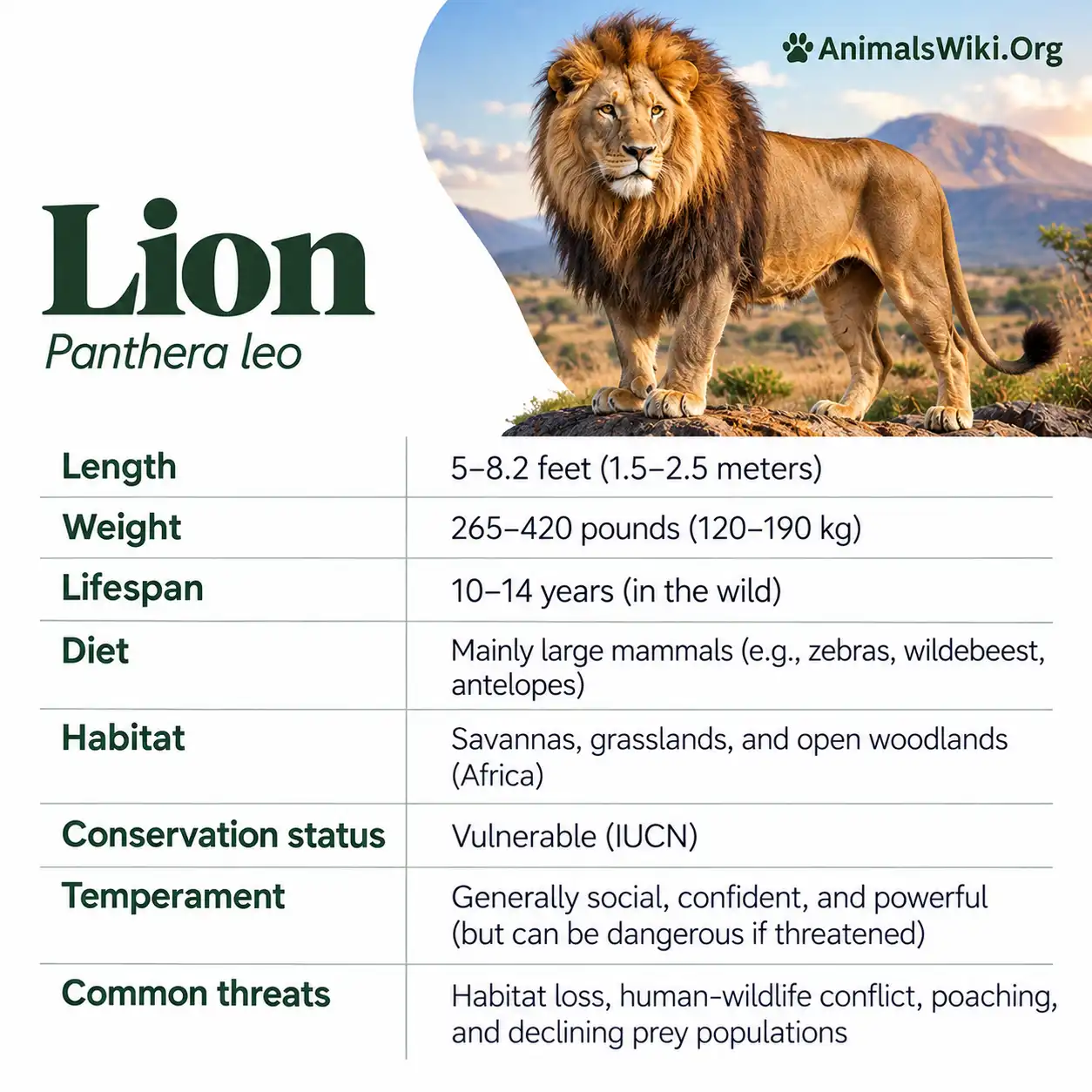
The lion is one of the world’s most recognizable wild animals. Known for its powerful body, thunderous roar, social lifestyle, and the impressive mane of adult males, the lion has fascinated people for thousands of years. It appears in mythology, art, literature, national symbols, and wildlife documentaries across cultures.
Scientifically known as Panthera leo, the lion is a large member of the cat family, Felidae. Lions are primarily found in sub-Saharan Africa, while a small population of Asiatic lions survives in and around the Gir landscape of western India.
Unlike most wild cats, lions are highly social. They commonly live in groups called prides, consisting mainly of related females, their cubs, and one or more adult males. This social structure influences almost every part of their lives, from hunting and raising young to defending territory.
Despite their reputation for strength, lions face serious conservation challenges. Habitat loss, declining prey populations, conflict with people, and fragmented populations have contributed to their decline in many parts of their historical range.
This guide explores the lion’s habitat, diet, size, weight, lifespan, hunting behavior, social structure, reproduction, adaptations, predators, conservation, and other fascinating facts.
Lion Facts
| Feature | Information |
|---|---|
| Common Name | Lion |
| Scientific Name | Panthera leo |
| Kingdom | Animalia |
| Phylum | Chordata |
| Class | Mammalia |
| Order | Carnivora |
| Family | Felidae |
| Genus | Panthera |
| Animal Type | Mammal |
| Diet | Carnivore |
| Group Name | Pride |
| Main Habitat | Savannas, grasslands, shrublands, and open woodlands |
| Distribution | Primarily sub-Saharan Africa; small population in India |
| Male Weight | Commonly around 150–250 kg (330–550 lb), varying by population |
| Female Weight | Commonly around 110–180 kg (240–400 lb), varying by population |
| Lifespan | Often around 10–15 years in the wild; potentially longer in managed care |
| Speed | Can reach roughly 80 km/h (50 mph) during short bursts |
| Reproduction | Live birth |
| Young | Cub |
| Famous Feature | Male’s mane and powerful roar |
| Conservation Status | Vulnerable on the IUCN Red List |
What Is a Lion?
A lion is a large carnivorous mammal belonging to the cat family.
It is one of the five living species traditionally included in the genus Panthera, alongside the tiger, jaguar, leopard, and snow leopard.
Lions possess muscular bodies, strong legs, large paws, sharp retractable claws, and powerful jaws. These characteristics make them capable predators of medium-sized and large mammals.
What makes lions particularly unusual among cats is their social behavior.
Most wild cat species spend much of their adult lives alone. Lions, by contrast, commonly form organized social groups.
Their combination of physical strength, cooperative behavior, and territoriality has helped lions become major predators within the ecosystems they inhabit.
Scientific Classification of the Lion
| Classification | Name |
|---|---|
| Kingdom | Animalia |
| Phylum | Chordata |
| Class | Mammalia |
| Order | Carnivora |
| Family | Felidae |
| Subfamily | Pantherinae |
| Genus | Panthera |
| Species | Panthera leo |
Lions are closely related to other members of the genus Panthera, particularly large cats such as tigers, leopards, jaguars, and snow leopards.
What Does a Lion Look Like?
Lions have strong, muscular bodies designed for capturing large prey.
Their coats generally range from pale yellow and sandy beige to deeper tawny shades. This coloration helps lions blend into dry grasslands and savanna environments.
They have broad heads, relatively short muzzles, powerful shoulders, and long tails ending in distinctive dark tufts.
Males and females are noticeably different in appearance.
Male Lion
Adult male lions are generally larger than females and typically develop a mane around the head, neck, shoulders, and sometimes the chest.
Mane color can vary considerably. Some are relatively light, while others become dark brown or nearly black in certain areas.
Female Lion
Female lions, called lionesses, do not normally develop the large mane associated with adult males.
Their lack of a heavy mane and generally lighter body size can be advantageous while stalking and pursuing prey.
Lionesses perform much of the cooperative hunting within a pride.
Why Do Male Lions Have Manes?
The lion’s mane is one of the most distinctive features of any wild cat.
A mane develops as a male matures and is influenced by factors including age, hormones, genetics, and environmental conditions.
It functions partly as a visual signal.
A large, mature mane can make a male appear physically imposing during interactions with rivals and potential mates.
The mane may also provide some protection around the neck during fights, although its role is more complicated than simply functioning as armor.
Mane characteristics differ among individuals and populations.
How Big Is a Lion?
Lions are the second-largest living cat species, after the tiger.
Adult males are significantly larger than females.
Male African lions commonly weigh around 150–250 kg (330–550 lb), although size varies by region, age, genetics, and physical condition.
Lionesses commonly weigh approximately 110–180 kg (240–400 lb).
Large adult males can measure well over 2 meters in overall length when the tail is included.
Rather than having one universal size, lions show considerable variation across their geographic range.
Male Lion vs. Female Lion
| Feature | Male Lion | Female Lion |
|---|---|---|
| Common Name | Lion | Lioness |
| Size | Larger | Smaller |
| Mane | Usually present | Usually absent |
| Main Pride Role | Territorial defense and pride protection | Hunting and cub care |
| Body Build | Heavier and more robust | Lighter and agile |
| Social Behavior | May form coalitions with other males | Often lives with related females |
These roles are not absolute. Male lions can hunt, and females actively participate in defending the pride and territory.
Where Do Lions Live?
Today, wild lions are concentrated mainly in sub-Saharan Africa.
Important populations occur in countries including Tanzania, Kenya, Botswana, South Africa, Zambia, Zimbabwe, Namibia, and several other African nations.
A separate population of Asiatic lions survives in western India, centered around Gujarat’s Gir landscape.
Historically, lions occupied a vastly larger range.
They once occurred across much of Africa as well as portions of southeastern Europe, the Middle East, and Asia.
Their modern distribution represents only a fraction of that historical range.
Lion Habitat
Lions are adaptable animals capable of occupying several habitat types.
They can live in:
- Savannas
- Open grasslands
- Shrublands
- Dry woodlands
- Semi-arid regions
- Scrub habitats
Although popular images often place lions exclusively on open African savannas, they can survive in considerably more varied environments.
Suitable habitat must provide sufficient prey, water access or moisture sources, resting cover, and enough space for territories.
African Lion
Most of the world’s wild lions live in Africa.
African lions occupy scattered populations across sub-Saharan Africa, with some of the most famous populations living in protected landscapes such as the Serengeti ecosystem.
Their habitats range from grasslands and open woodland to dry scrub.
Different populations can vary in body size, prey preferences, social organization, and appearance depending on local environmental conditions.
Asiatic Lion
The Asiatic lion represents the surviving lion population of India.
Once distributed much more widely across southwestern Asia, wild Asiatic lions are now centered primarily in and around the Gir landscape of Gujarat.
Asiatic lions share many characteristics with African lions but can show physical differences.
Males often have less extensive manes than many African males, and a visible fold of skin along the abdomen is frequently associated with Asiatic lions.
Their survival represents one of the most important large-cat conservation stories in Asia.
What Do Lions Eat?
Lions are obligate carnivores, meaning they depend on animal tissue for their nutritional needs.
Their diet varies depending on location and available prey.
Common prey can include:
- Wildebeest
- Zebra
- Buffalo
- Antelope
- Warthog
- Gazelle
- Various deer and antelope species
- Young giraffes
- Other medium-sized and large mammals
Lions are opportunistic predators.
They can also capture smaller animals when available and may scavenge carcasses killed by other predators.
Likewise, other carnivores may attempt to steal food from lions.
How Do Lions Hunt?
Lions usually rely on stealth and short bursts of speed rather than prolonged pursuit.
A hunting lion attempts to move close to its target while remaining concealed.
Tall grass, darkness, bushes, and uneven terrain can help hide its approach.
Once within striking distance, the lion accelerates rapidly.
It may leap onto the prey, use its forelimbs and claws to destabilize the animal, and then use a powerful bite to subdue it.
Because sprinting requires enormous amounts of energy, an unsuccessful chase is usually abandoned relatively quickly.
Do Lions Hunt in Groups?
Lions are capable of hunting alone, but pride members can also cooperate.
Cooperative hunting is particularly useful when pursuing large, fast, or potentially dangerous prey.
Several lionesses may approach a herd from different directions.
Some individuals can help drive prey toward others positioned for an ambush.
However, lion hunts are not always perfectly coordinated. Hunting strategies vary depending on prey, habitat, pride composition, and circumstances.
Male lions are also capable hunters and may hunt independently or participate in group feeding and hunting.
How Fast Can a Lion Run?
A lion can reach approximately 80 km/h (50 mph) in a short sprint under favorable conditions.
However, lions cannot maintain their maximum speed for long distances.
Their muscular bodies are designed for explosive acceleration rather than endurance running.
This explains why stalking is so important.
Getting close to prey before beginning a chase saves energy and increases the chance of success.
What Is a Pride of Lions?
A group of lions is commonly called a pride.
A typical pride can contain several related adult females, their cubs, juveniles, and one or more adult males.
Pride size varies enormously.
Some groups are relatively small, while others can contain many individuals when prey and habitat conditions are favorable.
Females frequently remain associated with their birth pride, creating groups containing mothers, daughters, sisters, aunts, and other relatives.
Young males are more likely to leave their birth pride as they mature.
Male Lion Coalitions
Male lions frequently form small groups known as coalitions.
Coalition partners may be brothers, relatives, or occasionally unrelated males.
Working together can make it easier to compete with rival males and gain access to a pride.
Once males control a pride, they defend their position against challengers.
Male tenure can be temporary because other coalitions may eventually attempt to take over.
Competition between males is consequently an important part of lion social life.
Lion Territory
Lions are territorial.
A pride’s territory provides important resources such as prey, water, shade, and breeding opportunities.
Territory size varies greatly according to habitat quality and prey density.
Where prey is abundant, lions may survive within relatively smaller areas.
In regions where prey is scattered, they may need much larger ranges.
Lions communicate territorial ownership through scent marking, roaring, and patrols.
Why Do Lions Roar?
The lion’s roar is one of the most powerful sounds produced by a terrestrial predator.
Roaring has several social functions.
It can:
- Advertise territorial presence
- Warn rival lions
- Help separated pride members locate one another
- Communicate between individuals
- Reinforce social contact
Under suitable conditions, a lion’s roar can carry across several kilometers.
Lions commonly roar during the evening and nighttime, when cooler air and quieter surroundings can help sound travel.
When Are Lions Most Active?
Lions spend a surprisingly large portion of the day resting.
They can sleep or rest for 16–20 hours in a day, although activity varies.
Resting helps conserve energy between hunting, territorial patrols, mating, and social interactions.
Lions tend to become more active from late afternoon through the night and around dawn.
Cooler temperatures make movement and hunting less energetically demanding than during the hottest part of the day.
Lion Reproduction
Lions do not have one universal breeding season across their entire range.
Females can reproduce when conditions are suitable.
After mating, pregnancy lasts approximately 110 days, or a little over three months.
A lioness usually gives birth in a sheltered location away from the main pride.
The newborn cubs are small, vulnerable, and completely dependent on their mother.
After several weeks, she gradually introduces them to other pride members.
Lion Cubs
Baby lions are called cubs.
A litter commonly contains around two to four cubs, although larger or smaller litters are possible.
Newborn cubs have spotted coats.
These spots become less obvious as they grow, although faint markings may remain visible on some adults.
Cubs depend on milk early in life and gradually begin eating meat.
They learn important skills through play, observation, exploration, and interaction with adults and other young lions.
How Lions Raise Their Cubs
Lion prides have an unusual social system that can provide opportunities for cooperative cub care.
Related females may give birth around similar periods.
Lionesses can sometimes nurse cubs belonging to other females within the pride.
Cubs consequently grow up surrounded by other young lions and several adult females.
However, life remains dangerous.
Cubs face threats from starvation, disease, accidents, predators, and unfamiliar male lions during pride takeovers.
Lion Lifespan
Wild lions commonly live approximately 10–15 years, although lifespan varies.
Females often have the potential to survive longer than males in the wild.
Adult males experience intense competition over territories and prides. Fighting with rival males can result in serious injuries that shorten their lives.
Lions living under professional human care can sometimes survive into their late teens or beyond because they receive regular food and veterinary attention and do not face the same territorial pressures.
Lion Adaptations
Lions possess numerous adaptations that help them survive as large predators.
Powerful Muscles
Strong shoulders, legs, and neck muscles help lions tackle large animals.
Sharp Claws
Retractable claws provide traction and help grip struggling prey.
Strong Jaws
Large canine teeth and powerful jaw muscles are important for capturing and subduing prey.
Camouflaged Coat
Tawny fur blends well with dry grass and vegetation.
Excellent Night Vision
Lions see effectively under low-light conditions, supporting nighttime hunting.
Sensitive Hearing
Strong hearing helps lions detect animals and communicate over long distances.
Social Cooperation
Living in prides can assist with territorial defense, cub protection, and some hunts.
Are Lions Apex Predators?
Lions are among the major predators in the ecosystems they inhabit.
Healthy adult lions have few natural predators capable of regularly hunting them.
However, they compete intensely with other carnivores.
Important competitors can include:
- Spotted hyenas
- Leopards
- African wild dogs
- Cheetahs
- Other lions
Interactions between these predators can involve competition over carcasses, prey, territories, and access to resources.
Lions and Hyenas
The relationship between lions and spotted hyenas is more complex than is sometimes portrayed.
Both species are capable hunters and both can scavenge.
They compete for many of the same prey animals.
Lions may steal kills from hyenas, while groups of hyenas can sometimes displace lions from carcasses, depending on the numbers and individuals involved.
Their competition demonstrates how multiple large predators can occupy the same ecosystem while continually competing for resources.
Lions and Leopards
Lions and leopards can inhabit the same landscapes, but their lifestyles differ significantly.
Lions are larger and social, whereas leopards are generally solitary.
Leopards frequently avoid direct encounters with lions.
One of their most useful adaptations is the ability to climb trees and sometimes carry prey into branches, where it may be safer from some competitors.
Lion vs. Tiger
Lions and tigers are the two largest living cat species and are frequently compared.
| Feature | Lion | Tiger |
|---|---|---|
| Scientific Name | Panthera leo | Panthera tigris |
| Social Behavior | Usually social | Primarily solitary |
| Group | Pride | Usually lives alone |
| Male Mane | Present | Absent |
| Coat Pattern | Mostly plain tawny | Distinctive stripes |
| Natural Range Today | Africa and India | Asia |
| Largest Cat? | Second-largest species | Largest living cat species |
Both are powerful predators adapted to different ecological conditions and social systems.
Lion vs. Leopard
| Feature | Lion | Leopard |
|---|---|---|
| Scientific Name | Panthera leo | Panthera pardus |
| Size | Much larger | Smaller |
| Social Life | Often social | Primarily solitary |
| Coat | Tawny | Rosette-patterned |
| Tree Climbing | Can climb | Exceptional climber |
| Male Mane | Usually present | Absent |
Lions generally dominate leopards during direct encounters, which is one reason leopards often rely on stealth and trees to avoid them.
White Lions
A white lion is not a separate lion species.
Its pale coloration is generally caused by a rare inherited condition known as leucism.
Unlike albinism, leucism does not necessarily eliminate pigmentation from the eyes and all other tissues.
White lions can range from very pale cream to almost white.
They are especially associated with certain lion populations in southern Africa.
Black Lions
Claims and manipulated images of completely black lions sometimes circulate online.
Unlike melanistic leopards and jaguars—commonly called black panthers—there is no well-established natural population of truly melanistic black lions.
Male lions can, however, develop extremely dark manes.
A dark-maned male viewed under certain lighting conditions can therefore appear much darker than a typical lion.
Are Lions Dangerous?
Yes. Lions are large, powerful wild predators and can be dangerous to humans.
Most lions do not naturally spend their time hunting people, but attacks can occur, particularly where people, livestock, and lions share landscapes.
Factors affecting conflict can include reduced natural prey, livestock availability, human expansion into wildlife habitat, and individual lion behavior.
Wild lions should never be approached, fed, or treated as tame animals.
Lion Conservation Status
The lion is classified as Vulnerable on the IUCN Red List.
Wild lion populations have disappeared from large portions of their historical range.
Major surviving populations are increasingly concentrated in protected areas and other landscapes where conservation measures remain effective.
The status of individual populations varies considerably, meaning some populations are more secure than others.
Why Are Lions Declining?
Several pressures affect wild lions.
Habitat Loss
Expanding agriculture, settlements, roads, and other infrastructure can reduce available lion habitat.
Habitat Fragmentation
Remaining lion populations may become separated from one another, making movement and genetic exchange more difficult.
Human-Wildlife Conflict
Lions sometimes kill livestock.
People who depend on livestock for their livelihoods may retaliate by killing lions.
Declining Natural Prey
Overhunting and habitat degradation can reduce populations of the wild herbivores lions depend upon.
Illegal Killing
Lions can also be affected by poaching and illegal wildlife trade.
Effective conservation therefore requires protecting not just lions but the wider ecosystems and human communities sharing their landscapes.
Why Are Lions Important to the Ecosystem?
Lions help shape ecosystems through predation and competition.
By hunting herbivores, they participate in regulating relationships among predator and prey populations.
Their kills also provide food for scavengers.
Animals such as vultures, jackals, hyenas, insects, and microorganisms can consume remains left behind after lions feed.
Lions therefore influence ecosystems in ways extending beyond the prey they directly capture.
Cultural Importance of Lions
Few animals have influenced human culture as strongly as the lion.
Lions have appeared in ancient sculptures, religious traditions, royal emblems, coats of arms, flags, literature, paintings, films, and modern sports logos.
They have commonly symbolized qualities such as strength, authority, courage, royalty, and protection.
Their cultural importance extends far beyond countries where wild lions currently survive.
30 Interesting Lion Facts
- The scientific name of the lion is Panthera leo.
- Lions belong to the cat family Felidae.
- Lions are the second-largest living cat species.
- Tigers are generally considered the largest living cats.
- A group of lions is called a pride.
- Female lions are called lionesses.
- Baby lions are called cubs.
- Adult males usually develop manes.
- Lions are primarily carnivorous.
- Lionesses perform much of the cooperative hunting in prides.
- Male lions are also capable hunters.
- Lions can reach around 80 km/h during short bursts.
- They cannot maintain their maximum speed for long.
- Lions often hunt during cooler periods and at night.
- They can spend much of the day resting.
- A lion’s roar can travel several kilometers under favorable conditions.
- Lions use roaring to communicate and advertise territory.
- Most wild lions live in Africa.
- A small population of Asiatic lions survives in India.
- Lions historically occupied a much larger geographic range.
- Females commonly remain with related females in their pride.
- Young males usually leave their birth pride as they mature.
- Male lions can form coalitions.
- Lion cubs are born with spotted coats.
- Several lionesses may help care for cubs within a pride.
- White lions are not a separate species.
- Lions compete with hyenas for prey and carcasses.
- Adult lions have few regular natural predators.
- Habitat loss and human-wildlife conflict threaten many populations.
- Lions are classified as Vulnerable on the IUCN Red List.
Did You Know?
Lions are the most social of the world’s wild cats.
While most other cat species are predominantly solitary, lions regularly form long-lasting groups containing related females, cubs, and associated males.
This unusual social system helps explain many famous lion behaviors, including cooperative hunting, communal cub care, territorial defense, roaring, and male coalitions.
Frequently Asked Questions About Lions
What is a lion?
A lion is a large carnivorous mammal belonging to the cat family Felidae. Its scientific name is Panthera leo.
Where do lions live?
Most wild lions live in sub-Saharan Africa. A smaller population of Asiatic lions survives in western India.
What is a group of lions called?
A group of lions is called a pride.
What is a female lion called?
An adult female lion is called a lioness.
What is a baby lion called?
A baby lion is called a cub.
What do lions eat?
Lions eat meat and commonly prey on animals such as wildebeest, zebra, buffalo, antelope, warthogs, and other mammals.
How big is a lion?
Adult males commonly weigh around 150–250 kg, while females are generally smaller. Body size varies significantly among individuals and populations.
How fast can a lion run?
A lion can reach roughly 80 km/h (50 mph) for a short distance.
How long do lions live?
Wild lions often live around 10–15 years, although individual lifespans vary. Lions under managed care can sometimes live considerably longer.
Why do lions have manes?
Male manes are associated with maturity and sexual signaling and can make males appear more imposing during social encounters.
Do female lions have manes?
Most lionesses do not have the large mane characteristic of adult males, although rare exceptions have been documented.
Why do lions roar?
Lions roar to communicate, advertise territory, maintain contact with pride members, and warn rivals.
Do lions hunt in groups?
They can. Lionesses frequently cooperate during hunts, especially when pursuing large prey, although lions also hunt individually.
Do male lions hunt?
Yes. Male lions are capable hunters and may hunt alone or in other situations, despite the common association of pride hunting with females.
Can lions climb trees?
Yes. Lions are capable of climbing trees, although they are generally less specialized for climbing than leopards.
Can lions swim?
Yes. Lions can swim when necessary, although swimming is not as central to their lifestyle as it is for some other large cats.
Are lions bigger than tigers?
Tigers are generally considered the largest living cat species, while lions are the second largest.
Are white lions albino?
Usually no. Famous white lions generally owe their coloration to leucism rather than albinism.
Are there lions in India?
Yes. India supports the remaining wild population of Asiatic lions, concentrated in Gujarat.
Are lions endangered?
The lion is currently classified as Vulnerable on the IUCN Red List. Conservation conditions vary substantially among different populations.
What are the main threats to lions?
Major pressures include habitat loss, habitat fragmentation, declining prey, human-wildlife conflict, and illegal killing.
Why are lions important?
Lions are major predators that influence prey populations, competition among carnivores, scavenger communities, and broader ecosystem relationships.
Conclusion
The lion (Panthera leo) is much more than a symbol of strength. It is a highly specialized predator with one of the most complex social systems found among wild cats.
From the lionesses cooperating during hunts to males forming coalitions and defending territories, social relationships influence nearly every aspect of lion life. Their powerful muscles, retractable claws, strong jaws, sharp senses, camouflage, and ability to accelerate rapidly make them formidable hunters.
Yet physical strength does not protect lions from every threat.
Habitat loss, fragmentation, reduced prey populations, and conflict with humans have eliminated lions from much of their former geographic range. Their future increasingly depends on protecting large connected landscapes, maintaining healthy prey populations, reducing conflict with local communities, and conserving the ecosystems on which both wildlife and people depend.
Whether heard roaring across an African savanna or observed resting with a pride beneath the shade, the lion remains one of nature’s most recognizable predators—and one of the most important large carnivores to conserve.