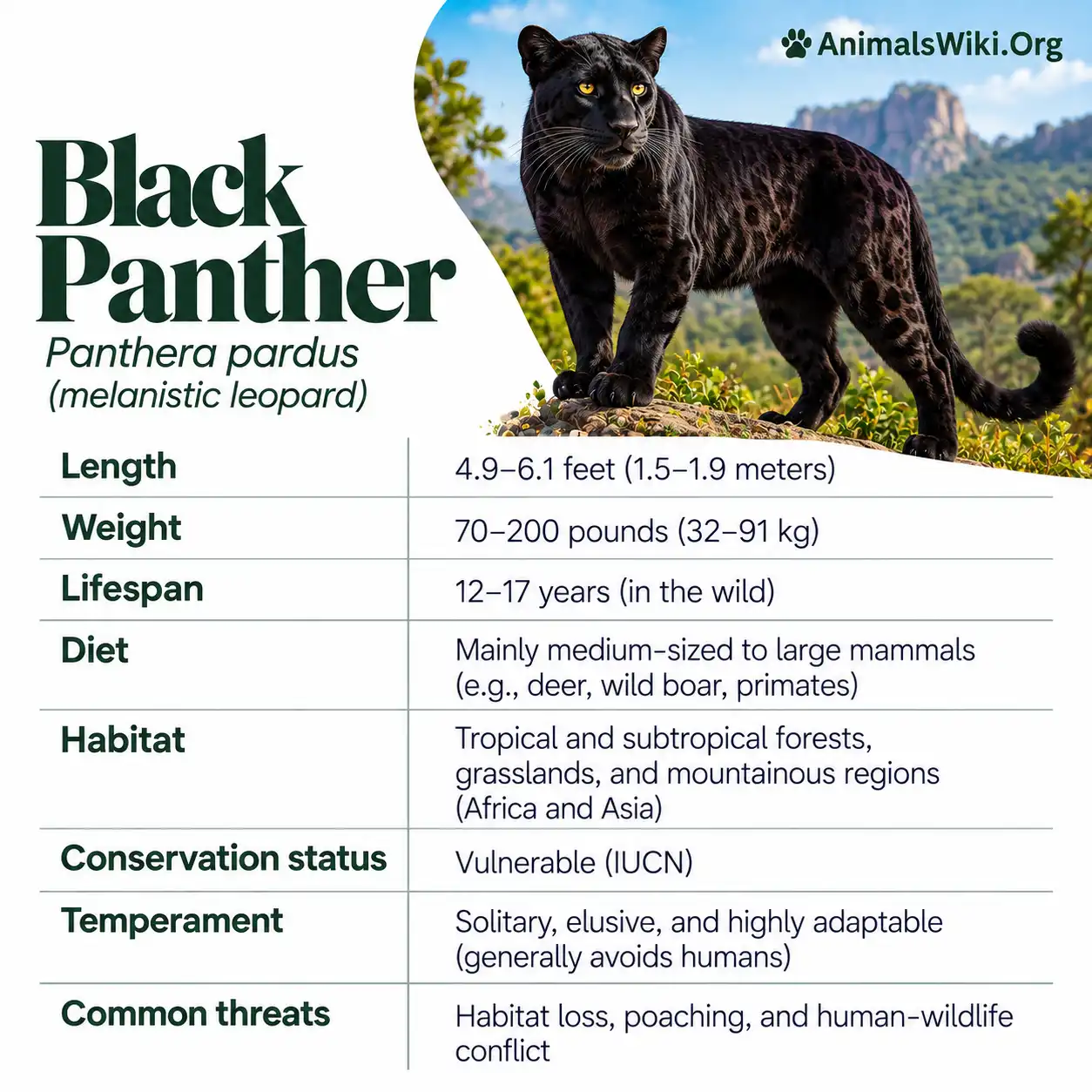
The black panther is one of the most mysterious, beautiful, and frequently misunderstood animals in the wild. With its almost completely black coat, muscular body, piercing eyes, powerful jaws, and secretive behavior, a black panther can appear dramatically different from other spotted big cats.
However, one of the most important black panther facts is that the black panther is not a separate species.
The name usually refers to a melanistic leopard (Panthera pardus) or melanistic jaguar (Panthera onca). Melanism is a genetic condition that produces unusually high levels of dark pigmentation in the coat.
In Africa and Asia, a wild black panther is generally a melanistic leopard. In Central and South America, the term generally refers to a melanistic jaguar.
Although these cats can look completely black from a distance, their characteristic spots or rosettes usually remain present. Under bright sunlight or appropriate lighting, the hidden pattern can often be seen beneath the dark coat.
Black panthers therefore share the biology, diet, habitat, behavior, size, and basic adaptations of whichever species they actually belong to.
A black leopard may climb trees and carry prey onto branches, while a black jaguar may patrol tropical forests and wetlands and hunt around rivers. Understanding the difference is essential when discussing black panther habitat, diet, size, lifespan, behavior, reproduction, and conservation.
This comprehensive guide explores black panther facts, melanism, species, habitat, distribution, diet, size, weight, lifespan, speed, hunting, climbing, swimming, reproduction, cubs, adaptations, predators, conservation, and differences between black panthers and other wild cats.
Black Panther Facts
| Feature | Information |
|---|---|
| Common Name | Black Panther |
| Separate Species? | No |
| Usually Refers To | Melanistic leopard or melanistic jaguar |
| Leopard Scientific Name | Panthera pardus |
| Jaguar Scientific Name | Panthera onca |
| Family | Felidae |
| Main Genus | Panthera |
| Animal Type | Mammal |
| Diet | Carnivore |
| Coat Color | Very dark brown to black |
| Cause of Color | Melanism |
| Markings | Rosettes usually remain visible |
| Main Regions | Africa, Asia, Central America and South America |
| Habitat | Forests, wetlands, grasslands and other habitats depending on species |
| Lifestyle | Primarily solitary |
| Hunting Style | Stealth and ambush |
| Climbing | Excellent, especially black leopards |
| Swimming | Capable; black jaguars are particularly strong swimmers |
| Reproduction | Live birth |
| Young | Cub |
| Main Threats | Habitat loss, fragmentation, prey decline, illegal killing and wildlife trade |
| Conservation | Depends on whether the animal is a leopard or jaguar |
What Is a Black Panther?
A black panther is not one distinct animal species.
The term is most commonly used for a black-colored member of the genus Panthera, especially a:
- Melanistic leopard
- Melanistic jaguar
The word “panther” has historically been used loosely for several large cats, which can create confusion.
When people picture a black panther, they usually imagine a large cat with a glossy black coat.
Scientifically, identifying the underlying species is more informative.
A black leopard remains a leopard.
A black jaguar remains a jaguar.
Their unusually dark appearance does not transform them into a third species.
Why Are Black Panthers Black?
Black panthers get their dark coloration through melanism.
Melanin is a pigment responsible for dark coloration in skin, hair, fur, feathers, and other tissues in animals.
Genetic variations can cause unusually high dark pigmentation.
The resulting animal may appear almost entirely black.
However, the underlying coat pattern usually remains.
This is why a black panther’s rosettes can become visible when sunlight strikes its fur at the correct angle.
Do Black Panthers Have Spots?
Yes.
One of the most fascinating black panther facts is that the spots have not actually disappeared.
A melanistic leopard still possesses its characteristic leopard rosettes.
A melanistic jaguar still possesses jaguar rosettes.
Dark pigmentation makes the contrast between the background coat and markings much less obvious.
In strong sunlight, photographs often reveal a beautiful pattern of dark rosettes hidden within the apparently black fur.
Are Black Panthers a Separate Species?
No.
There is no scientifically recognized species whose formal common name corresponds to a separate “black panther” species.
Instead, the term describes dark individuals of existing cat species.
The two animals most commonly called black panthers are:
Black Leopard
A melanistic Panthera pardus.
Black Jaguar
A melanistic Panthera onca.
Their anatomy and ecology correspond to their actual species.
Black Leopard
The black leopard is a melanistic form of the common leopard.
Black leopards occur naturally in parts of Africa and Asia.
Melanism appears particularly common in some populations inhabiting dense tropical forests.
A black leopard possesses all the major leopard characteristics:
- Excellent climbing ability
- Powerful muscles
- Long tail
- Retractable claws
- Ambush hunting behavior
- Broad diet
- Solitary lifestyle
Its dark coloration is the major visible difference.
Black Jaguar
A black jaguar is a melanistic Panthera onca.
Black jaguars occur in the Americas.
Like normally colored jaguars, they have:
- Broad heads
- Powerful jaws
- Muscular bodies
- Strong legs
- Excellent swimming ability
- Ambush hunting behavior
Their rosettes remain visible under suitable lighting.
Because jaguars and leopards have different body structures, an experienced observer can sometimes distinguish a black jaguar from a black leopard even when coat patterns are difficult to see.
Black Panther Scientific Name
There is no single scientific name for every black panther.
The correct scientific name depends on the species.
| Black Panther Type | Scientific Name |
|---|---|
| Black Leopard | Panthera pardus |
| Black Jaguar | Panthera onca |
This distinction is particularly important for educational and scientific content.
Simply listing “Panthera” as the scientific name of a black panther is incomplete because Panthera is a genus containing multiple species.
Where Do Black Panthers Live?
Black panthers can occur wherever melanistic leopard or jaguar populations exist.
This means their combined distribution includes parts of:
- Africa
- South Asia
- Southeast Asia
- Central America
- South America
However, the type of black panther differs geographically.
Africa and Asia
Black panthers in these regions are generally black leopards.
The Americas
Black panthers in Central and South America are generally black jaguars.
Geography is therefore one of the easiest clues for identifying the underlying species.
Black Panther Habitat
There is no single black panther habitat because black panthers belong to different species.
Possible habitats include:
- Tropical rainforests
- Subtropical forests
- Dense woodland
- Wetlands
- Grasslands
- Savannas
- Shrublands
- River systems
- Mountain forests
Melanistic cats are particularly famous from humid forest environments.
Dense forests contain deep shadows and relatively low light, where a dark coat may potentially provide camouflage advantages under certain conditions.
Black Panthers in Tropical Rainforests
Rainforests are strongly associated with black panthers in popular imagery, and there is some biological basis for this association.
Melanistic leopards are relatively frequent in certain forested parts of Asia.
Black jaguars also occur in tropical regions of the Americas.
A rainforest contains:
- Dense vegetation
- Heavy shade
- Broken sunlight
- Trees
- Thick understory
- Numerous prey species
These environments can provide excellent conditions for secretive ambush predators.
How Big Is a Black Panther?
There is no universal black panther size.
Size depends on whether the animal is a leopard or jaguar.
Black Leopard Size
Black leopards have the same general size range as other leopards.
Adult body size varies considerably by sex and geographic population.
Black Jaguar Size
Black jaguars have the same general size range as normally colored jaguars.
Jaguars are generally stockier and heavier than leopards.
Large male jaguars can exceed 100 kilograms (220 pounds) and exceptionally large individuals can be heavier.
Therefore, a black jaguar can be substantially heavier than a black leopard.
Black Panther Weight
The weight of a black panther depends entirely on the underlying species, sex, region, and individual.
A melanistic leopard does not become heavier simply because its coat is black.
Likewise, melanism does not make a jaguar larger.
When comparing black panther weights, species identification should always come first.
Male vs. Female Black Panther
Males are generally larger than females in both leopards and jaguars.
| Feature | Male | Female |
|---|---|---|
| Average Size | Larger | Smaller |
| Build | More muscular | Generally lighter |
| Lifestyle | Primarily solitary | Solitary except with cubs |
| Home Range | Usually larger | Usually smaller |
| Cub Care | Usually little direct involvement | Raises cubs |
| Hunting | Independent | Independent and hunts for cubs |
The black coat does not fundamentally alter these sex-based differences.
What Do Black Panthers Eat?
Black panthers are carnivores.
Their exact diet depends on whether they are leopards or jaguars and where they live.
Black Leopard Diet
Potential prey includes:
- Deer
- Antelope
- Wild pigs
- Monkeys
- Baboons
- Rodents
- Hares
- Birds
- Reptiles
Black Jaguar Diet
Potential prey includes:
- Capybaras
- Peccaries
- Deer
- Caimans
- Turtles
- Armadillos
- Pacas
- Fish
- Other mammals and reptiles
Both species are opportunistic predators capable of consuming diverse prey.
How Do Black Panthers Hunt?
Black panthers are primarily ambush predators.
They depend on stealth rather than long-distance pursuit.
A black panther may use:
- Dense vegetation
- Darkness
- Trees
- Rocks
- Terrain
- Forest shadows
to conceal its approach.
Once sufficiently close, the cat launches a sudden attack.
Strong forelimbs and sharp retractable claws help control prey.
The exact killing method differs according to prey and whether the predator is a leopard or jaguar.
Do Black Panthers Hunt at Night?
Black leopards and black jaguars can both be active at night.
However, describing all black panthers as exclusively nocturnal would be inaccurate.
Activity patterns depend on:
- Prey behavior
- Temperature
- Human disturbance
- Habitat
- Competition
- Individual behavior
Many large cats adjust their schedules according to local conditions.
How Fast Can a Black Panther Run?
There is no unique “black panther speed.”
Melanism changes coat coloration rather than creating a different athletic species.
A black leopard has approximately the same running abilities as another leopard.
A black jaguar has approximately the same running abilities as another jaguar.
Both are capable of rapid short bursts but are primarily adapted for ambush hunting, not prolonged high-speed pursuit.
Neither approaches the extreme sprinting specialization of the cheetah.
Are Black Panthers Strong?
Yes.
Both leopards and jaguars are extremely powerful relative to their body sizes.
Black leopards possess strong shoulders and excellent climbing ability.
They can drag prey and sometimes carry carcasses into trees.
Black jaguars have heavier bodies and exceptionally powerful jaws.
A jaguar can tackle robust prey including reptiles and other animals that require tremendous close-range strength.
The exact type of strength therefore differs somewhat between the two species.
Can Black Panthers Climb Trees?
Yes.
Both leopards and jaguars can climb trees.
However, leopards are particularly famous for their climbing ability.
A black leopard may:
- Rest on branches
- Escape competitors
- Observe its surroundings
- Store prey in trees
Jaguars can also climb but are more heavily built and generally more strongly associated with ground and water-based activity.
Can Black Panthers Swim?
Yes.
Both leopard and jaguar black panthers can swim.
Jaguars are especially comfortable around water.
A black jaguar may cross rivers, move through wetlands, and hunt animals associated with aquatic environments.
Black leopards are also capable swimmers, although swimming is usually less central to their ecology.
Are Black Panthers Solitary?
Yes.
Both adult leopards and jaguars are primarily solitary animals.
They generally hunt and travel alone.
Individuals maintain home ranges and communicate through:
- Scent marking
- Scratches
- Vocalizations
- Body language
Females temporarily live with their cubs.
Adults also meet during mating.
How Do Black Panthers Communicate?
Black panthers communicate in the same basic ways as other members of their species.
Communication can include:
Scent Marking
Chemical signals communicate territory and reproductive information.
Scratching
Claw marks can leave visible territorial signals.
Vocalizations
Leopards and jaguars can produce growls and powerful calls.
Body Language
Ear position, posture, facial expression, and tail movement can communicate mood and intention.
Their black coloration does not fundamentally change these communication systems.
Can Black Panthers Roar?
Leopards and jaguars belong to the genus Panthera and can produce powerful roaring-type vocalizations.
However, their calls differ from the famous roar of a lion.
A black panther therefore does not have a special “black panther roar.”
Its vocalizations depend on whether the animal is a leopard or jaguar.
Black Panther Reproduction
Melanistic leopards and jaguars reproduce in the same basic manner as normally colored members of their respective species.
Females give birth after a pregnancy lasting approximately three to three and a half months, depending on species and individual variation.
A mother selects a protected den where the cubs can remain concealed.
She provides:
- Milk
- Warmth
- Protection
- Food
- Hunting instruction
Males generally do not participate substantially in raising cubs.
Black Panther Cubs
Baby black panthers are cubs.
Their appearance depends on genetics.
A melanistic parent does not necessarily produce only melanistic offspring.
Because the inheritance of melanism differs between leopards and jaguars, litter coloration can vary.
Cubs depend completely on their mother when young.
As they grow, play behavior helps develop:
- Stalking
- Pouncing
- Climbing
- Coordination
- Strength
- Balance
Eventually, the mother introduces them to hunting.
How Long Do Black Panthers Live?
There is no separate black panther lifespan.
Their longevity follows that of their species.
Wild leopards often live approximately 10–15 years, although individuals vary.
Wild jaguars commonly live approximately 12–15 years, with variation between individuals.
Under professional managed care, both species can sometimes live beyond 20 years.
Melanism itself does not create a completely different lifespan.
Black Panther Adaptations
Black panthers possess the same core adaptations as their species, with dark coloration added through melanism.
Dark Coat
The black coat may provide camouflage under some low-light forest conditions.
Hidden Rosettes
The original spotted pattern remains beneath the dark pigmentation.
Powerful Muscles
Strong bodies support ambush hunting.
Retractable Claws
Sharp claws help capture prey and climb.
Strong Night Vision
Low-light vision supports activity after sunset.
Sensitive Hearing
Acute hearing helps locate prey.
Stealth
Quiet movement allows close approaches before attacks.
Species-Specific Specializations
Black leopards are exceptional climbers.
Black jaguars combine tremendous muscular strength with powerful jaws and excellent swimming ability.
Black Panther vs. Leopard
This comparison has an unusual answer:
A black panther can actually be a leopard.
A black leopard is simply a melanistic Panthera pardus.
| Feature | Black Leopard | Typical Leopard |
|---|---|---|
| Species | Panthera pardus | Panthera pardus |
| Main Difference | Melanistic coat | Typical golden coat |
| Rosettes | Present but difficult to see | Clearly visible |
| Diet | Same basic diet | Same |
| Behavior | Same species behavior | Same |
| Climbing | Excellent | Excellent |
The primary difference is pigmentation.
Black Panther vs. Jaguar
Again, a black panther can actually be a jaguar.
A melanistic jaguar is commonly called a black panther.
Black jaguars retain the same muscular body, powerful bite, and swimming abilities as normally colored jaguars.
The black coat is a color variation, not evidence of a separate species.
Black Leopard vs. Black Jaguar
| Feature | Black Leopard | Black Jaguar |
|---|---|---|
| Scientific Name | Panthera pardus | Panthera onca |
| Range | Africa & Asia | Americas |
| Build | Leaner | Stockier |
| Head | Relatively smaller | Broad and powerful |
| Tail | Relatively longer | Relatively shorter |
| Climbing | Exceptional | Good |
| Swimming | Capable | Excellent |
| Bite | Powerful | Exceptionally powerful |
| Coat | Melanistic with hidden rosettes | Melanistic with hidden rosettes |
Geographic location is often the easiest identification clue.
Black Panther vs. Cougar
A cougar is not generally a black panther.
Cougars belong to the species Puma concolor.
Adult cougars usually have plain tawny coats.
The term “panther” is sometimes used regionally for cougars, particularly in names such as Florida panther, but that is a separate naming issue.
Scientifically confirmed melanism has not been established in cougars in the same way it has in leopards and jaguars.
Therefore, the classic jet-black wild cat commonly called a black panther should not automatically be identified as a cougar.
Black Panther vs. Cheetah
Black panthers and cheetahs differ dramatically.
| Feature | Black Panther | Cheetah |
|---|---|---|
| Species | Usually leopard or jaguar | Acinonyx jubatus |
| Coat | Melanistic | Golden with solid spots |
| Build | Muscular | Slender |
| Hunting | Ambush | High-speed pursuit |
| Speed | Fast short bursts | Fastest land animal |
| Claws | Retractable | Less fully retractable |
| Main Strength | Stealth and power | Speed |
| Range | Depends on leopard/jaguar | Primarily Africa |
Cheetahs are specialized for running, while black leopards and jaguars rely more heavily on stealth and strength.
Black Panther vs. Lion
A black panther is considerably smaller than a lion if the panther is a leopard or jaguar.
Lions also have a dramatically different social system.
Lions frequently live in prides, whereas leopards and jaguars are primarily solitary.
Male lions develop manes.
Black panthers retain the normal physical structure of either a leopard or jaguar.
Black Panther vs. Tiger
Tigers are generally much larger than either leopards or jaguars.
A tiger has a striped coat rather than rosettes.
Both tigers and the cats commonly called black panthers belong to Panthera, but they are different species.
All-black tigers are not equivalent to melanistic leopards or jaguars.
Extremely dark or pseudo-melanistic tiger patterns are a separate phenomenon.
Black Panther vs. Snow Leopard
Snow leopards are Panthera uncia and are specially adapted to high mountain environments in Central and South Asia.
They have:
- Thick pale fur
- Broad furry paws
- Extremely long tails
- Mountain adaptations
A black leopard occurring in Asia may share part of the same broad continent but generally occupies very different habitats.
Snow leopards are not normally what people mean by “black panther.”
Black Panther vs. Clouded Leopard
Clouded leopards belong to the genus Neofelis.
They are smaller forest cats with:
- Cloud-shaped markings
- Extremely long canine teeth
- Flexible ankles
- Exceptional climbing adaptations
The classic Asian black panther is usually a melanistic common leopard rather than a clouded leopard.
Are Black Panthers Apex Predators?
The answer depends on species and ecosystem.
A black jaguar can function as an apex predator in many environments.
A black leopard is also a major predator but may share landscapes with larger competitors such as lions or tigers.
Coat color does not change ecological rank.
A melanistic leopard occupies essentially the same ecological niche as another leopard living under similar conditions.
Do Black Panthers Have Predators?
Adult black panthers are powerful predators, but they are not invulnerable.
A black leopard may face threats from:
- Lions
- Tigers
- Large hyenas
- Other leopards
- Humans
A black jaguar has relatively few natural predators as a healthy adult, although conflicts with other jaguars can occur.
Cubs of both species are more vulnerable.
Are Black Panthers Dangerous to Humans?
Black panthers are powerful wild predators.
A leopard or jaguar is physically capable of causing severe or fatal injuries.
However, wild individuals generally avoid unnecessary contact with people.
The black coat does not make an animal inherently more aggressive.
Claims that black panthers are naturally more vicious than normally colored leopards or jaguars are not supported simply by coat coloration.
Any wild large cat should be treated with appropriate caution and distance.
Are Black Panthers Rare?
Melanism is much less common than normal coloration across the total populations of leopards and jaguars.
However, its frequency differs substantially by region.
In certain forest populations, melanistic leopards can occur at noticeably higher frequencies.
Black jaguars also occur naturally, although normally colored jaguars remain more familiar overall.
Therefore, describing all black panthers as equally rare everywhere oversimplifies their distribution.
Why Are Black Panthers More Common in Some Forests?
Researchers have investigated whether dark coloration may provide advantages in particular environments.
Dense tropical forests have:
- Heavy shade
- Low-light conditions
- Thick vegetation
- Broken sunlight
A dark coat could potentially influence camouflage under these conditions.
However, melanism is a genetic trait, and its geographic distribution reflects a combination of inheritance, population history, natural selection, and other ecological factors.
Black Panther Conservation Status
Because black panthers are not a separate species, they do not have their own independent global conservation category.
Their conservation status follows the underlying species.
The leopard (Panthera pardus) is classified as Vulnerable.
The jaguar (Panthera onca) is classified as Near Threatened.
Individual regional populations can face substantially greater risks than these global categories suggest.
Threats to Black Panthers
Major threats include:
Habitat Loss
Forests and other habitats are cleared for agriculture, infrastructure, mining, settlements, and development.
Habitat Fragmentation
Remaining populations become separated by roads and human-modified landscapes.
Prey Decline
Hunting and habitat degradation reduce natural prey.
Human-Wildlife Conflict
Predation on livestock can lead to retaliatory killing.
Illegal Hunting
Leopards and jaguars may be killed illegally.
Wildlife Trafficking
Body parts can enter illegal wildlife markets.
Road Mortality
Road development creates collision risks and fragments habitats.
Why Are Black Panthers Important?
Black panthers perform the same ecological roles as other members of their species.
As predators, leopards and jaguars influence prey communities and food webs.
Protecting them requires conserving substantial natural habitats.
Those landscapes also support countless other species.
Protecting a black jaguar’s rainforest habitat, for example, can simultaneously protect:
- Monkeys
- Tapirs
- Birds
- Reptiles
- Amphibians
- Fish
- Insects
- Thousands of plant species
Large-cat conservation can therefore contribute to ecosystem-wide protection.
Cultural Importance of Black Panthers
Few wild animals have acquired as much mystery in popular culture as the black panther.
Its dark coat and secretive behavior have made it a symbol of:
- Strength
- Mystery
- Stealth
- Independence
- Power
- Night
- Wilderness
Black panthers appear in folklore, literature, art, films, sports identities, brands, and popular culture.
The real animal is arguably even more fascinating because the familiar name actually represents an unusual genetic form of other remarkable big cats.
40 Interesting Black Panther Facts
- A black panther is not a separate species.
- Most black panthers are melanistic leopards or jaguars.
- Black leopards are Panthera pardus.
- Black jaguars are Panthera onca.
- Their black coloration is caused by melanism.
- Black panthers still have spots or rosettes.
- Their patterns can become visible in sunlight.
- Black leopards occur in Africa and Asia.
- Black jaguars occur in the Americas.
- Geography can help identify the species.
- Jaguars are generally stockier than leopards.
- Leopards usually have relatively longer tails.
- Black leopards are excellent climbers.
- Black jaguars are excellent swimmers.
- Both are carnivores.
- Both primarily use ambush hunting.
- Black panthers are not specialized for long-distance running.
- Their dark coats do not make them a separate species.
- Melanism is genetic.
- Black coloration does not automatically make the animal more aggressive.
- Adult leopards are primarily solitary.
- Adult jaguars are also primarily solitary.
- Black panther babies are called cubs.
- Females raise their cubs.
- Cubs learn hunting skills from their mothers.
- A black panther can climb trees.
- Black panthers can swim.
- Jaguars are particularly comfortable around water.
- Black leopards may carry prey into trees.
- Jaguars possess exceptionally powerful jaws.
- Black panthers can be active at night.
- They can also be active during daylight.
- A cougar is generally not the animal meant by “black panther.”
- A Florida panther is actually a cougar population.
- A black panther is not a black lion.
- It is not a separate “panther” species.
- Habitat destruction threatens both leopards and jaguars.
- Illegal killing is another important threat.
- Melanistic individuals can occur naturally in wild populations.
- Black panthers are among the most visually distinctive color forms of the world’s large cats.
Did You Know?
A black panther’s famous black coat hides a pattern in plain sight.
Look closely at a melanistic leopard or jaguar in strong natural light and you may see the familiar rosettes appearing through the dark fur.
The animal did not lose its spots.
Instead, increased dark pigmentation dramatically reduced the contrast between the markings and surrounding coat.
This means that beneath the striking black appearance is still the recognizable pattern of a leopard or jaguar.
It is one of the best examples of how a relatively dramatic change in appearance can occur without creating an entirely new species.
Frequently Asked Questions About Black Panthers
What is a black panther?
A black panther is usually a melanistic leopard or melanistic jaguar rather than a separate species.
Is a black panther a real animal?
Yes. Melanistic leopards and jaguars are real naturally occurring animals. However, “black panther” is a descriptive common term rather than a separate species name.
What is the scientific name of a black panther?
There is no single scientific name. A black leopard is Panthera pardus, while a black jaguar is Panthera onca.
Why are black panthers black?
Their dark coloration results from melanism, a genetic condition involving increased dark pigmentation.
Do black panthers have spots?
Yes. Their rosettes remain present but are difficult to see against the dark coat.
Where do black panthers live?
Black leopards occur in Africa and Asia, while black jaguars occur in Central and South America.
Do black panthers live in rainforests?
Yes. Both melanistic leopards and jaguars can inhabit tropical forests.
Do black panthers live in Africa?
Yes. A wild black panther in Africa would generally be a melanistic leopard.
Do black panthers live in Asia?
Yes. Melanistic leopards occur in parts of Asia.
Do black panthers live in South America?
Yes. Black jaguars occur in South America.
What do black panthers eat?
They are carnivores. Diet depends on whether the animal is a leopard or jaguar and which prey species occur locally.
How big is a black panther?
Size depends on species. Black jaguars are generally stockier and can be heavier than black leopards.
How much does a black panther weigh?
There is no single weight range because the term includes at least two different species with substantial regional and sex-based size variation.
How fast can a black panther run?
Black leopards and jaguars can sprint rapidly over short distances, but neither is specialized for extreme speed like a cheetah.
Can black panthers climb trees?
Yes. Both species can climb, with leopards being particularly accomplished tree climbers.
Can black panthers swim?
Yes. Jaguars in particular are powerful swimmers and frequently use aquatic habitats.
Can black panthers roar?
Leopards and jaguars belong to Panthera and produce powerful roaring-type vocalizations.
Are black panthers nocturnal?
They can be active at night, but activity patterns vary according to species, habitat, prey, and human disturbance.
Are black panthers solitary?
Yes. Adult leopards and jaguars are primarily solitary.
What is a baby black panther called?
A baby leopard or jaguar is called a cub.
Are black panthers born black?
Melanistic coloration is genetically determined and can be visible in young animals, although coat appearance develops as cubs mature.
How long do black panthers live?
Lifespan depends on species. Wild leopards and jaguars often live roughly into their early to mid-teens, with substantial individual variation.
Is a black panther a leopard?
It can be. In Africa and Asia, black panthers are generally melanistic leopards.
Is a black panther a jaguar?
It can also be a jaguar. In the Americas, black panthers are generally melanistic jaguars.
Is a black panther a cougar?
Generally no. Although “panther” is sometimes used regionally for cougars, the classic black panther is usually a melanistic leopard or jaguar.
Is a black panther stronger than a leopard?
A black leopard is a leopard, so melanism itself does not make it stronger.
Is a black panther stronger than a jaguar?
If the black panther is a black jaguar, it is a jaguar. If it is a black leopard, jaguars are generally heavier and more robust, but individual comparisons vary.
Is a black panther faster than a cheetah?
No. Cheetahs are specialized for much greater sprinting speed.
Are black panthers aggressive?
They are powerful predators, but black coloration itself does not make them more aggressive than normally colored members of the same species.
Are black panthers dangerous to humans?
They are capable of causing severe injury, but wild leopards and jaguars generally avoid unnecessary encounters with people.
Are black panthers rare?
Melanistic individuals are less common overall than normally colored leopards and jaguars, although their frequency varies considerably between populations.
Are black panthers endangered?
There is no separate black-panther conservation category. Conservation status follows the underlying leopard or jaguar species and the condition of its regional population.
Why are black panthers important?
They perform the same ecological roles as other leopards and jaguars, helping shape predator-prey relationships within their ecosystems.
Conclusion
The black panther is one of the most striking examples of natural color variation among the world’s large cats.
Its glossy dark coat creates the appearance of an entirely different animal, but beneath that coloration is usually a familiar predator: either a leopard (Panthera pardus) or jaguar (Panthera onca).
Melanism darkens the coat without erasing the animal’s characteristic rosettes. Under suitable light, those hidden patterns emerge, revealing the leopard or jaguar beneath the black coloration.
A black leopard retains the extraordinary climbing ability, stealth, muscular strength, and adaptability of its species. A black jaguar retains the robust body, powerful jaws, swimming ability, and formidable ambush-hunting skills characteristic of jaguars.
Understanding this distinction makes the real black panther more fascinating rather than less.
It demonstrates how genetics can dramatically alter an animal’s appearance while leaving its fundamental species identity unchanged.
Unfortunately, dark coloration provides no protection from the major pressures facing wild cats.
Habitat destruction, fragmentation, declining prey populations, illegal hunting, wildlife trafficking, road development, and conflict with people continue to affect leopard and jaguar populations.
Protecting black panthers therefore means protecting the species and landscapes to which they belong.
From a black leopard silently moving through an Asian rainforest to a melanistic jaguar patrolling the forests and waterways of the Americas, these remarkable cats remain powerful symbols of secrecy, strength, adaptation, and the extraordinary diversity of the natural world.