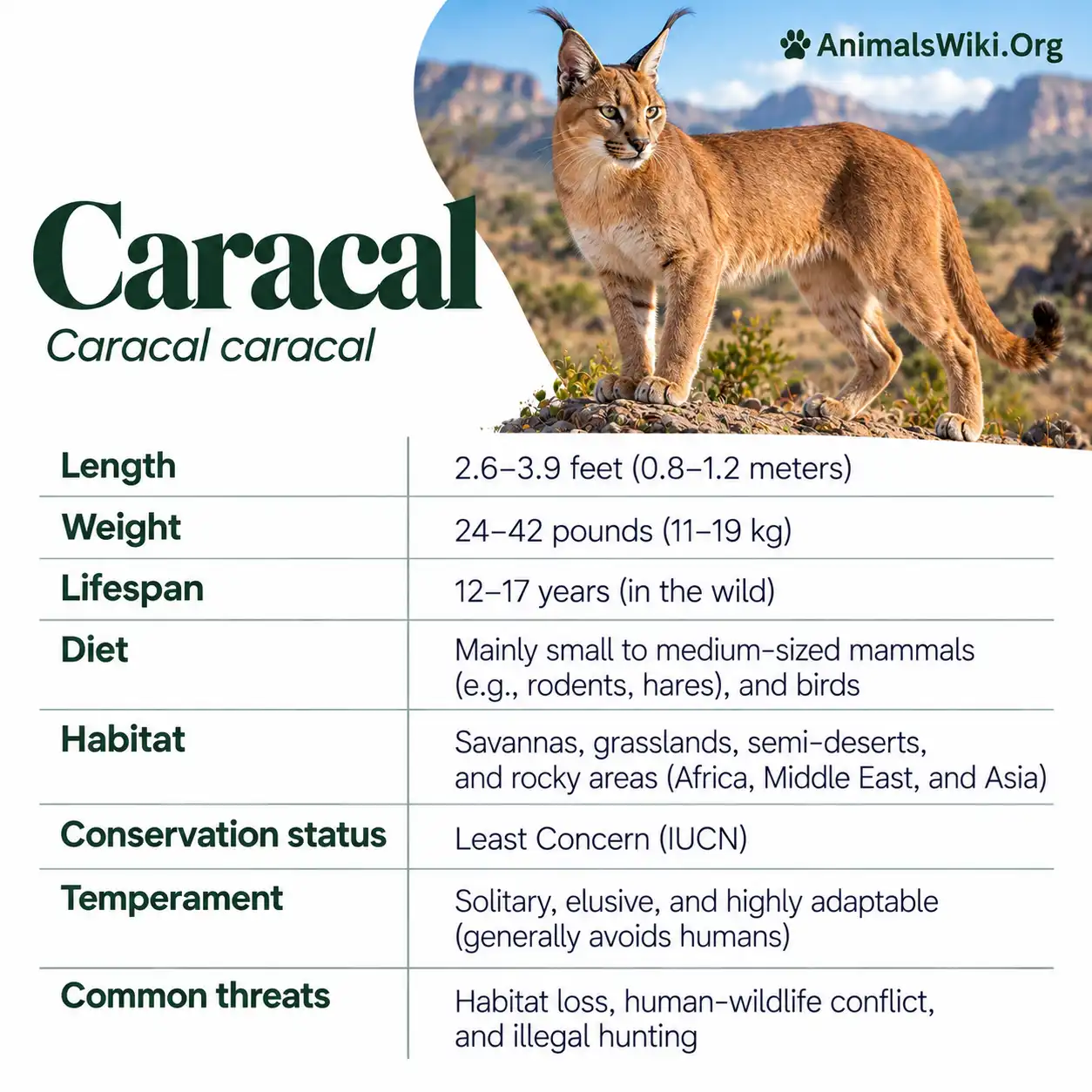
The caracal is one of the world’s most athletic and distinctive wild cats. Famous for its long black ear tufts, reddish-golden coat, powerful legs, remarkable jumping ability, and skill at catching birds in midair, the caracal is a highly adaptable predator found across parts of Africa, the Middle East, Central Asia, and South Asia.
Scientifically known as Caracal caracal, this medium-sized wild cat belongs to the family Felidae. Although the caracal is sometimes called the desert lynx, it is not a true lynx. Its closest evolutionary relationships are instead associated with other African cats, including the serval and African golden cat.
Caracals have a sleek but muscular appearance. Their long legs help them accelerate rapidly and leap vertically to capture birds, while their large ears provide excellent hearing. The characteristic black tufts extending from the tips of their ears make the caracal immediately recognizable.
Unlike lions, caracals do not live in prides. They are primarily solitary predators and often hunt during cooler periods of the day or night. Their diet can include rodents, hares, birds, small antelopes, reptiles, and other animals.
The caracal’s adaptability allows it to survive in environments ranging from dry savannas and semi-deserts to shrublands, woodlands, and mountainous terrain.
This comprehensive guide explores caracal facts, habitat, diet, size, weight, lifespan, speed, jumping ability, ear tufts, hunting behavior, reproduction, kittens, adaptations, predators, distribution, conservation, and differences between caracals and other wild cats.
Caracal Facts
| Feature | Information |
|---|---|
| Common Name | Caracal |
| Scientific Name | Caracal caracal |
| Other Name | Desert lynx |
| Kingdom | Animalia |
| Phylum | Chordata |
| Class | Mammalia |
| Order | Carnivora |
| Family | Felidae |
| Subfamily | Felinae |
| Genus | Caracal |
| Species | Caracal caracal |
| Animal Type | Mammal |
| Diet | Carnivore |
| Native Range | Africa and parts of Asia |
| Main Habitat | Savannas, shrublands, semi-deserts, woodlands and rocky areas |
| Lifestyle | Primarily solitary |
| Body Length | Roughly 60–105 cm (24–41 in) |
| Tail Length | Roughly 20–35 cm (8–14 in) |
| Weight | Approximately 6–20 kg (13–44 lb), depending on sex and region |
| Famous Feature | Long black ear tufts |
| Special Ability | Exceptional vertical jumping |
| Hunting Style | Stalking, ambush and explosive attack |
| Reproduction | Live birth |
| Young | Kitten |
| Lifespan | Often around 10–12 years in the wild |
| Conservation Status | Least Concern globally |
| Major Threats | Habitat change, persecution, prey decline and conflict with livestock owners |
What Is a Caracal?
A caracal is a medium-sized wild cat native to Africa and portions of Asia.
Its scientific name is Caracal caracal.
The caracal has a distinctive combination of:
- Long black ear tufts
- Pointed ears
- Reddish-tawny fur
- Long muscular legs
- Short tail
- Athletic body
- Strong hindquarters
- Large paws
It is a fast, agile predator capable of tackling prey both on the ground and in the air.
Caracals are particularly famous for making spectacular vertical leaps to strike flying birds.
Why Is It Called a Caracal?
The name caracal is derived from a Turkish expression associated with the animal’s black ears.
This is appropriate because its black-backed ears and long dark tufts are its most recognizable characteristics.
The ear tufts can extend several centimeters beyond the tips of the ears.
They create the distinctive silhouette that makes a caracal relatively easy to identify.
Scientific Classification of the Caracal
| Classification | Name |
|---|---|
| Kingdom | Animalia |
| Phylum | Chordata |
| Class | Mammalia |
| Order | Carnivora |
| Family | Felidae |
| Subfamily | Felinae |
| Genus | Caracal |
| Species | Caracal caracal |
Caracals belong to Felinae, the subfamily containing many smaller and medium-sized cats.
They are not members of Panthera, the genus containing lions, tigers, jaguars, leopards, and snow leopards.
Is a Caracal a Lynx?
No.
The caracal is sometimes called a desert lynx, but it is not a true lynx.
True lynx belong to the genus Lynx.
The caracal belongs to the genus Caracal.
The confusion is understandable because both animals can have:
- Ear tufts
- Relatively short tails
- Long legs
- Predatory lifestyles
Genetically and taxonomically, however, they are distinct groups.
What Does a Caracal Look Like?
The caracal has a sleek, athletic body.
Its coat is generally:
- Reddish-brown
- Tawny
- Sandy
- Golden-brown
The underside is paler.
Unlike leopards, servals, and cheetahs, adult caracals usually lack prominent body spots.
The face contains distinctive dark markings around the eyes and muzzle.
The backs of the ears are dark, while long black tufts extend upward from their tips.
These features create an elegant but unmistakably wild appearance.
Why Do Caracals Have Black Ear Tufts?
Scientists have proposed several possible functions for the caracal’s famous ear tufts.
They may contribute to:
- Visual communication
- Breaking up the outline of the ears
- Signaling between individuals
However, the exact evolutionary function of the long tufts is not completely established.
The ears themselves are extremely important for hunting because caracals have excellent hearing.
Numerous muscles allow the ears to rotate and detect sounds from different directions.
How Big Is a Caracal?
Adult caracals commonly measure approximately 60–105 centimeters (24–41 inches) in head-and-body length.
Their tails add roughly 20–35 centimeters (8–14 inches).
Body size varies according to sex and geographic region.
Adult males are generally larger and heavier than females.
Caracals are much smaller than lions, tigers, leopards, or cougars but substantially larger than an average domestic cat.
How Much Does a Caracal Weigh?
Adult caracals commonly weigh approximately 6–20 kilograms (13–44 pounds).
Large males can reach the upper end of this range, while females are usually smaller.
Weight differs between populations.
Despite their relatively modest size, caracals are extremely muscular and capable of capturing surprisingly substantial prey.
Male Caracal vs. Female Caracal
| Feature | Male Caracal | Female Caracal |
|---|---|---|
| Size | Larger | Smaller |
| Weight | Heavier | Lighter |
| Build | More robust | More slender |
| Lifestyle | Primarily solitary | Solitary except with kittens |
| Home Range | Often larger | Generally smaller |
| Cub Care | Little direct involvement | Raises kittens |
Both males and females are capable hunters.
Where Do Caracals Live?
Caracals have a broad geographic distribution.
They occur across much of Africa and extend into portions of:
- The Middle East
- Arabian Peninsula
- Turkey
- Iran
- Central Asia
- Pakistan
- India
Their distribution is not continuous everywhere.
Some Asian populations are smaller and more fragmented than many African populations.
Caracal Habitat
Caracals occupy a surprisingly broad variety of environments.
Habitats include:
- Dry savannas
- Semi-deserts
- Shrublands
- Scrublands
- Dry woodland
- Grasslands
- Rocky hills
- Mountain slopes
- Forest edges
Despite their reputation as desert cats, caracals generally prefer environments containing enough vegetation or rocky cover to conceal them while hunting.
They are better described as dry-country specialists than animals restricted to true deserts.
Do Caracals Live in the Desert?
Caracals can survive in arid and semi-arid environments, but they are not exclusively desert animals.
They also inhabit:
- Savannas
- Woodlands
- Shrublands
- Grasslands
- Mountainous areas
Their ability to tolerate relatively dry conditions contributes to their wide distribution.
They obtain substantial moisture from prey, which can reduce their dependence on frequent access to drinking water.
Caracals in Africa
Africa contains a large proportion of the world’s caracal range.
The species occurs in numerous regions, from dry landscapes to savannas and shrublands.
African caracals may share ecosystems with:
- Lions
- Leopards
- Cheetahs
- Servals
- African wild dogs
- Hyenas
- Jackals
Their smaller size encourages them to avoid direct confrontation with larger predators.
Caracals in Asia
Caracal populations also occur across parts of western, central, and southern Asia.
Asian populations are generally less continuous than those across much of Africa.
They can inhabit dry plains, rocky landscapes, shrublands, and other suitable environments.
Habitat alteration, prey decline, and human pressure can create conservation problems for some regional populations.
Are There Caracals in Pakistan?
Yes.
Caracals occur in parts of Pakistan, although they are uncommon and difficult to observe.
Suitable habitat includes arid and semi-arid landscapes.
Their secretive behavior, low population density, and primarily nocturnal activity can make detection challenging.
Regional monitoring and habitat protection are important for understanding and conserving remaining populations.
What Do Caracals Eat?
Caracals are obligate carnivores.
Their diet varies according to geographic region and prey availability.
Potential prey includes:
- Rodents
- Hares
- Rabbits
- Birds
- Small antelopes
- Young gazelles
- Hyraxes
- Small monkeys
- Reptiles
- Other small and medium-sized animals
Caracals are opportunistic predators.
Their ability to hunt many different prey species helps them survive in environments where food availability changes seasonally.
Do Caracals Eat Birds?
Yes.
Bird hunting is one of the behaviors for which caracals are most famous.
A caracal can stalk a group of birds and then launch itself vertically into the air.
Using its paws, it can strike birds attempting to escape.
This remarkable hunting technique combines:
- Explosive leg power
- Fast reflexes
- Excellent vision
- Precise coordination
Historical accounts even describe trained caracals being used to hunt birds.
How Do Caracals Hunt?
Caracals depend primarily on stealth and explosive acceleration.
A typical hunt may involve:
- Detecting prey using sight or hearing.
- Quietly approaching while remaining concealed.
- Closing the distance.
- Launching a rapid attack.
- Capturing prey with the paws and claws.
- Delivering a killing bite.
Caracals can chase prey briefly but generally avoid prolonged pursuit.
Their hunting strategy is therefore similar to many other ambush-oriented wild cats.
How High Can a Caracal Jump?
Caracals are extraordinary jumpers.
They are widely reported to make vertical leaps of approximately 3 meters (10 feet) when attacking birds.
Individual performance depends on circumstances, terrain, age, fitness, and motivation.
Their powerful hind legs generate the explosive force necessary for these spectacular jumps.
This ability has made the caracal one of the world’s most famous jumping cats.
Why Can Caracals Jump So High?
Several anatomical characteristics contribute to their jumping ability.
Long Hind Legs
Long rear limbs provide leverage.
Powerful Muscles
Strong hindquarter muscles generate explosive force.
Lightweight Body
Their relatively lean build allows rapid acceleration.
Flexible Spine
The spine helps extend the body during movement.
Excellent Coordination
Precise paw-eye coordination helps them strike airborne prey.
These adaptations make jumping an important part of caracal hunting.
How Fast Can a Caracal Run?
Caracals can run at approximately 50 mph (80 km/h) during short bursts, although precise maximum-speed measurements vary.
They are fast enough to chase small prey briefly.
However, speed is only one part of their hunting strategy.
Stealth, hearing, reflexes, and jumping ability are equally important.
Unlike a cheetah, the caracal is not built for sustained high-speed pursuit.
Are Caracals Nocturnal?
Caracals are frequently most active during:
- Night
- Dawn
- Dusk
In cooler weather or areas with limited human disturbance, they may also become active during daylight.
Activity patterns depend on temperature, prey, season, and human presence.
Being active at night can help caracals avoid heat in arid environments.
Are Caracals Solitary?
Yes.
Adult caracals are primarily solitary animals.
They generally travel and hunt independently.
Males and females come together for breeding.
Females also live with their kittens while raising them.
Individuals communicate indirectly using scent marks and other signals.
Caracal Territory
Caracal home-range size varies enormously depending on:
- Habitat
- Prey density
- Sex
- Water availability
- Population density
- Human disturbance
Males generally travel across larger areas than females.
In prey-poor dry landscapes, individuals may need particularly large home ranges to obtain enough food.
How Do Caracals Communicate?
Caracals use scent, body language, and vocalizations.
Sounds can include:
- Growls
- Hisses
- Meows
- Purrs
- Spits
They also leave scent marks to communicate information about territory and reproductive status.
Their mobile ears and expressive facial movements may contribute to visual communication.
Can Caracals Purr?
Yes.
Caracals can purr.
They also produce meows, hisses, growls, and other vocalizations.
Unlike lions and tigers, they cannot produce the classic deep roar associated with Panthera cats.
Can Caracals Roar?
No.
Caracals do not roar like lions, tigers, jaguars, and leopards.
They belong to the subfamily Felinae, not Pantherinae.
Their vocal repertoire is more comparable in certain respects with smaller cats, although their calls can still sound powerful and intimidating.
Caracal Reproduction
Caracals can reproduce at different times of year depending on their location.
After mating, pregnancy lasts approximately two and a half months.
The female selects a sheltered den site.
Possible locations include:
- Rock crevices
- Dense vegetation
- Abandoned burrows
- Hollow trees
- Caves
She gives birth and raises the kittens without routine assistance from the male.
Caracal Kittens
Baby caracals are called kittens.
Litters commonly contain around one to four kittens, although numbers vary.
Newborn kittens are dependent on their mother.
As they grow, they begin exploring their surroundings and practicing movements through play.
Young caracals must eventually learn:
- Stalking
- Pouncing
- Jumping
- Capturing prey
- Avoiding danger
- Navigating their territory
Their distinctive ear tufts become increasingly obvious as they develop.
How Long Do Caracal Kittens Stay With Their Mother?
Young caracals typically remain with their mother for several months while developing hunting and survival skills.
They become increasingly independent as they approach maturity.
Eventually, juveniles disperse to establish their own home ranges.
The exact timing varies among individuals and populations.
Caracal Lifespan
Wild caracals commonly live approximately 10–12 years, although lifespan varies.
Factors affecting survival include:
- Food availability
- Disease
- Injuries
- Larger predators
- Human persecution
- Roads
- Habitat quality
Under professional managed care, caracals can sometimes live into their mid-to-late teens.
Caracal Adaptations
The caracal possesses numerous adaptations for life as a fast, stealthy predator.
Long Ear Tufts
The famous black tufts may contribute to visual communication.
Excellent Hearing
Large mobile ears help locate small prey.
Powerful Hind Legs
Strong legs enable extraordinary jumping.
Tawny Coat
The reddish-brown coat provides camouflage in dry grass and rocky landscapes.
Retractable Claws
Sharp claws help seize prey.
Strong Eyesight
Good vision helps detect prey and coordinate attacks.
Fast Reflexes
Quick reactions are particularly useful when hunting birds.
Water Efficiency
Caracals can obtain substantial moisture from prey.
Dietary Flexibility
A broad diet allows them to exploit locally available food.
Together, these adaptations make the caracal a highly effective predator in dry and open environments.
Caracal vs. Serval
Caracals and servals are relatively closely related African cats, but their appearances are very different.
| Feature | Caracal | Serval |
|---|---|---|
| Scientific Name | Caracal caracal | Leptailurus serval |
| Coat | Mostly plain reddish-tawny | Yellow with black spots |
| Ears | Long black tufts | Very large rounded ears |
| Build | Muscular | Tall and slender |
| Legs | Long and powerful | Exceptionally long |
| Habitat | Dry savannas and shrublands | Grasslands and wetlands |
| Famous Skill | Jumping for birds | Locating small prey by sound |
Both are outstanding jumpers and possess exceptional hearing.
Caracal vs. Lynx
| Feature | Caracal | Lynx |
|---|---|---|
| Genus | Caracal | Lynx |
| Range | Africa & Asia | Northern Hemisphere |
| Coat | Usually plain tawny | Often spotted or mottled |
| Ear Tufts | Very long | Prominent |
| Tail | Short | Very short |
| Habitat | Often dry/open | Often forest/cold environments |
| Relationship | Not a true lynx | True lynx |
The nickname “desert lynx” therefore describes appearance rather than taxonomy.
Caracal vs. Bobcat
Bobcats are true members of the genus Lynx and are native to North America.
Caracals occur naturally in Africa and parts of Asia.
Bobcats usually have:
- Spotted or mottled coats
- Bobbed tails
- Facial ruffs
- Shorter ear tufts
Caracals have:
- Reddish plain coats
- Longer black ear tufts
- More streamlined bodies
They are entirely different species.
Caracal vs. Cougar
Cougars are substantially larger than caracals.
| Feature | Caracal | Cougar |
|---|---|---|
| Scientific Name | Caracal caracal | Puma concolor |
| Main Range | Africa & Asia | Americas |
| Size | Medium | Large |
| Tail | Relatively short | Very long |
| Ear Tufts | Prominent | Absent |
| Coat | Reddish-tawny | Tawny |
| Famous Ability | Vertical jumping | Powerful long-distance jumping |
| Main Prey | Small to medium animals | Often larger mammals such as deer |
Both are athletic ambush predators.
Caracal vs. Cheetah
Caracals and cheetahs can share African landscapes, but their hunting strategies differ.
Cheetahs are specialized for extreme running speed.
Caracals depend more on:
- Stealth
- Explosive acceleration
- Jumping
- Ambush
Cheetahs have spotted coats and facial tear marks.
Caracals have mostly plain coats and prominent ear tufts.
Caracal vs. Leopard
Leopards are considerably larger and heavier than caracals.
Leopards have rosette-covered coats and exceptional tree-climbing ability.
Caracals have mostly plain reddish coats and long ear tufts.
Both use stealth and ambush, but leopards can capture substantially larger prey.
Where the two species coexist, a caracal generally avoids direct confrontation with a leopard.
Caracal vs. African Golden Cat
Caracals and African golden cats share an evolutionary relationship, but their ecology differs.
African golden cats are strongly associated with forests of equatorial Africa.
Caracals are more commonly associated with drier and more open habitats.
Their coat patterns and body proportions also differ.
Caracal vs. Domestic Cat
A caracal may superficially resemble an unusually large domestic cat, but it is a wild species.
Adult caracals are:
- Larger
- Stronger
- More athletic
- Better armed
- Behaviorally adapted to hunting
They retain natural predatory and territorial behaviors and should not be treated as ordinary house cats.
Do Caracals Have Predators?
Adult caracals are capable predators, but larger carnivores can threaten them.
Potential threats include:
- Lions
- Leopards
- Hyenas
- African wild dogs
- Other large predators
Kittens are more vulnerable.
Caracals often rely on stealth and avoidance to reduce encounters with larger carnivores.
Are Caracals Apex Predators?
Generally, caracals are better described as mesopredators rather than apex predators.
They occupy an important predatory role but often share ecosystems with larger carnivores.
Their ecological position allows them to prey on small and medium-sized animals while simultaneously needing to avoid larger predators.
Are Caracals Dangerous to Humans?
Caracals are powerful wild animals with sharp claws and teeth.
They can cause serious injuries if threatened, cornered, or improperly handled.
However, wild caracals generally avoid humans.
They are not normally considered significant predators of people.
Any wild caracal should be observed from a safe distance.
Can Caracals Be Pets?
Caracals are wild cats rather than domesticated animals.
Even individuals raised around people retain powerful hunting instincts, territorial behavior, specialized dietary requirements, and the physical ability to cause serious injury.
Ownership laws vary considerably between countries and regions.
Their welfare needs are also dramatically different from those of domestic cats.
For these reasons, a caracal should not be treated as an ordinary household pet.
Caracal Conservation Status
Globally, the caracal is classified as Least Concern on the IUCN Red List.
However, this global category can hide substantial regional differences.
The species remains relatively widespread in parts of Africa, while some Asian populations are much less common and more fragmented.
Local conservation status should therefore be considered separately from the global assessment.
Threats to Caracals
Human-Wildlife Conflict
Caracals sometimes prey on sheep, goats, poultry, or other livestock.
This can result in retaliatory killing.
Habitat Change
Agriculture and development can alter natural habitat.
Prey Decline
Reduction of natural prey can affect caracal populations.
Roads
Vehicle collisions can kill individuals and fragment habitat.
Hunting and Persecution
Caracals are intentionally killed in some regions.
Population Fragmentation
Small isolated populations can face greater long-term risks.
Why Are Caracals Important?
Caracals help regulate populations of prey animals.
Their diet frequently includes rodents and other small mammals.
As predators, they form part of complex food webs connecting:
- Plants
- Herbivores
- Small mammals
- Birds
- Reptiles
- Larger carnivores
Protecting healthy predator communities contributes to functioning ecosystems.
40 Interesting Caracal Facts
- The scientific name of the caracal is Caracal caracal.
- Caracals belong to the family Felidae.
- They are native to Africa and parts of Asia.
- Caracals are sometimes called desert lynxes.
- They are not true lynx.
- Their most recognizable features are long black ear tufts.
- Their coats are usually reddish or tawny.
- Adult caracals generally lack obvious body spots.
- Their ears are extremely mobile.
- Caracals have excellent hearing.
- They are carnivores.
- They eat rodents.
- They hunt hares and rabbits.
- They also hunt birds.
- Caracals are famous for catching birds in midair.
- They can leap roughly 3 meters vertically.
- Powerful hind legs make these jumps possible.
- Caracals can run rapidly over short distances.
- They depend heavily on stealth.
- They are ambush predators.
- Caracals are primarily solitary.
- They often become active at night.
- They may also hunt around dawn and dusk.
- Caracals can survive in relatively dry environments.
- They obtain moisture from prey.
- Caracals can purr.
- They cannot roar like lions.
- Baby caracals are called kittens.
- Females raise their kittens.
- Caracals use protected den sites.
- Males are generally larger than females.
- Caracals are smaller than leopards.
- They are smaller than cougars.
- Caracals are related to servals.
- They are also related to African golden cats.
- They occur in Pakistan.
- Larger predators can kill caracals.
- Human-livestock conflict can threaten them.
- Some Asian populations are uncommon.
- The caracal is globally classified as Least Concern.
Did You Know?
A caracal can turn bird hunting into an aerial performance.
When several birds suddenly take flight, a caracal can launch itself vertically using its extremely powerful hind legs.
While airborne, it can twist its body and strike with its front paws.
This spectacular ability combines excellent hearing, precise vision, fast reflexes, muscular legs, and exceptional coordination.
The famous black ear tufts may attract the most attention, but the caracal’s extraordinary athleticism is what makes it one of the most impressive medium-sized wild cats.
Frequently Asked Questions About Caracals
What is a caracal?
A caracal is a medium-sized wild cat native to Africa and parts of Asia. Its scientific name is Caracal caracal.
What does caracal mean?
The name originates from a Turkish expression associated with the animal’s distinctive black ears.
Where do caracals live?
Caracals occur across much of Africa and portions of the Middle East, Central Asia, and South Asia.
Do caracals live in Pakistan?
Yes. Caracals occur in parts of Pakistan, although they are uncommon and difficult to observe.
Do caracals live in deserts?
They can inhabit arid and semi-arid environments but are not restricted to true deserts.
What is a caracal’s habitat?
Caracals inhabit savannas, shrublands, dry woodland, grasslands, rocky areas, and semi-deserts.
What do caracals eat?
They eat rodents, hares, birds, reptiles, and various small to medium-sized mammals.
Do caracals eat birds?
Yes. They are famous for jumping into the air and striking flying birds.
How high can a caracal jump?
Caracals are widely reported to make vertical leaps of around 3 meters or 10 feet.
Why can caracals jump so high?
Their long, muscular hind legs generate exceptional explosive power.
How fast can a caracal run?
Caracals can sprint rapidly over short distances, with figures around 50 mph often cited, although exact maximum speeds vary.
How big is a caracal?
Adults commonly measure roughly 60–105 cm in head-and-body length.
How much does a caracal weigh?
Adults commonly weigh approximately 6–20 kg, depending on sex and geographic population.
Why do caracals have ear tufts?
Their exact purpose is not completely established, although the tufts may contribute to visual communication.
How long are caracal ear tufts?
They can extend several centimeters above the ears.
Is a caracal a lynx?
No. Caracals belong to the genus Caracal, while true lynx belong to Lynx.
Why is a caracal called a desert lynx?
The nickname comes largely from superficial similarities such as ear tufts and a relatively short tail rather than close taxonomic identity.
Is a caracal related to a serval?
Yes. Caracals and servals belong to closely related African cat lineages.
Are caracals nocturnal?
They are often active at night, dawn, and dusk, although activity varies.
Are caracals solitary?
Yes. Adult caracals are primarily solitary.
Can caracals climb trees?
Yes. Caracals can climb, although climbing is not as central to their ecology as it is for some forest cats.
Can caracals swim?
They are physically capable of swimming, though swimming is not one of their best-known behaviors.
Can caracals purr?
Yes. Caracals can purr.
Can caracals roar?
No. They cannot produce the classic roar of Panthera cats.
What is a baby caracal called?
A baby caracal is called a kitten.
How many kittens do caracals have?
Litters commonly contain around one to four kittens, although litter size varies.
How long do caracals live?
Wild caracals often live around 10–12 years, while individuals under managed care may live longer.
Are caracals bigger than servals?
The species overlap in weight, but their body proportions differ considerably. Servals are taller and more slender, while caracals are more robust.
Are caracals bigger than bobcats?
Their size ranges overlap to some degree, although body proportions and appearance differ.
Are caracals stronger than domestic cats?
Yes. Caracals are substantially larger, stronger, and more athletic than ordinary domestic cats.
Are caracals dangerous?
Caracals are powerful wild animals capable of causing serious injury, although wild individuals generally avoid humans.
Can caracals be pets?
Caracals are undomesticated wild cats with specialized behavioral, space, dietary, and welfare requirements. They are not equivalent to domestic cats.
What animals hunt caracals?
Lions, leopards, hyenas, wild dogs, and other larger predators may threaten caracals where their ranges overlap.
Are caracals endangered?
Globally, caracals are classified as Least Concern, although some regional populations are uncommon or face significant pressures.
Why are caracals important?
As predators, caracals help shape populations of rodents, birds, and other prey within their ecosystems.
Conclusion
The caracal (Caracal caracal) is one of the most athletic and visually distinctive wild cats of Africa and Asia.
Its long black ear tufts may be its most recognizable feature, but the caracal’s abilities extend far beyond its unusual appearance.
Powerful hind legs allow it to make spectacular vertical jumps. Excellent hearing helps detect prey hidden among vegetation. Sharp retractable claws and lightning-fast reflexes allow it to capture animals on the ground and even strike birds from the air.
Its reddish-tawny coat provides effective camouflage across dry grasslands, savannas, rocky landscapes, and shrublands.
The caracal is also remarkably adaptable.
It can survive in hot, dry environments, obtain much of its moisture from prey, hunt numerous animal species, and alter its activity according to temperature and human disturbance.
Despite sometimes being called a desert lynx, the caracal is not a true lynx. It represents its own distinctive wild-cat lineage and is more closely associated evolutionarily with cats such as the serval and African golden cat.
Globally, the species remains relatively widespread, but this does not mean every population is secure. Habitat alteration, persecution, declining prey, roads, and livestock conflict can place serious pressure on regional populations, particularly in parts of Asia.
Protecting the caracal means maintaining healthy natural landscapes, preserving prey populations, reducing unnecessary persecution, and improving coexistence between wild predators and people.
From its extraordinary aerial attacks on birds to the unmistakable black tufts rising from its ears, the caracal is a remarkable example of how agility, stealth, hearing, and explosive power can combine to create one of nature’s most accomplished medium-sized predators.