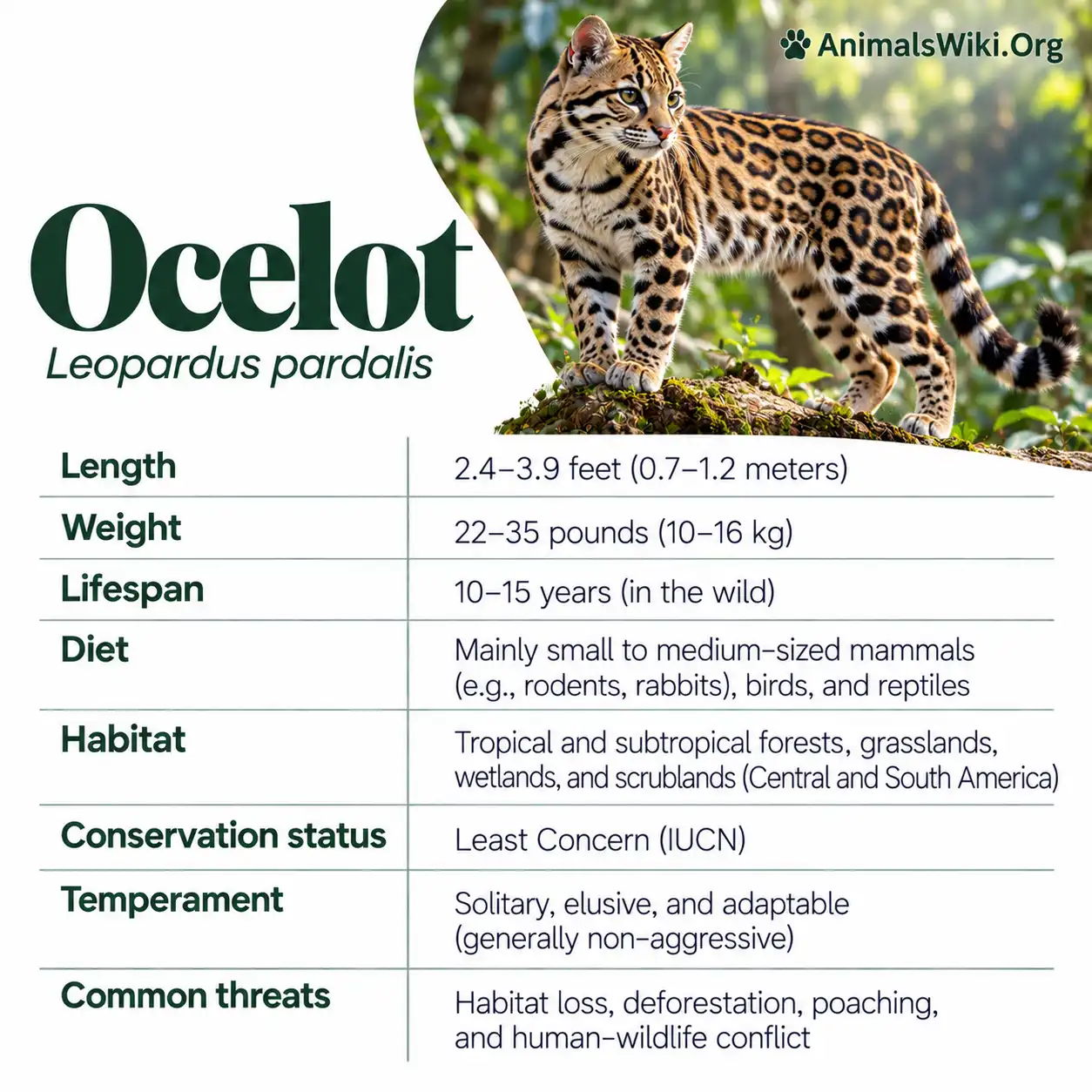
The ocelot is one of the most beautifully patterned wild cats of the Americas. Famous for its golden-yellow coat covered with dark spots, elongated rosettes, stripes, and bands, this secretive predator is perfectly suited to moving almost unnoticed through dense forests and tropical vegetation.
Scientifically known as Leopardus pardalis, the ocelot is a medium-sized wild cat found from parts of the southern United States through Mexico and Central America into much of South America. Its range includes tropical rainforests, dry forests, wetlands, savannas, shrublands, and other landscapes containing sufficient vegetation and prey.
Although an ocelot’s patterned coat can resemble that of a leopard or jaguar, it is considerably smaller than either species. Ocelots belong to the genus Leopardus, a group of spotted cats native to the Americas.
Ocelots are primarily solitary carnivores. They rely on camouflage, excellent night vision, sensitive hearing, stealth, and patience to hunt rodents, small mammals, birds, reptiles, and other prey.
Their secretive behavior means people rarely observe them for long in the wild, even in places where ocelots are relatively established. Camera traps have therefore become valuable tools for studying their populations and movements.
This comprehensive guide explores ocelot facts, habitat, diet, size, weight, lifespan, speed, behavior, hunting, climbing, swimming, reproduction, kittens, adaptations, predators, rainforest ecology, conservation, and differences between ocelots and other wild cats.
Ocelot Facts
| Feature | Information |
|---|---|
| Common Name | Ocelot |
| Scientific Name | Leopardus pardalis |
| Kingdom | Animalia |
| Phylum | Chordata |
| Class | Mammalia |
| Order | Carnivora |
| Family | Felidae |
| Subfamily | Felinae |
| Genus | Leopardus |
| Species | Leopardus pardalis |
| Animal Type | Mammal |
| Diet | Carnivore |
| Native Range | North, Central and South America |
| Main Habitat | Forests, wetlands, savannas and dense shrublands |
| Lifestyle | Primarily solitary |
| Body Length | Roughly 70–100 cm (28–39 in) |
| Tail Length | Roughly 25–45 cm (10–18 in) |
| Weight | Commonly around 7–16 kg (15–35 lb) |
| Coat | Golden, yellowish or grayish with dark spots and markings |
| Main Activity | Often nocturnal or crepuscular |
| Hunting Style | Stealth and ambush |
| Reproduction | Live birth |
| Young | Kitten |
| Lifespan | Often around 7–10+ years in the wild; longer under managed care |
| Conservation Status | Least Concern globally |
| Major Threats | Habitat loss, fragmentation, roads, persecution and historical wildlife trade |
What Is an Ocelot?
An ocelot is a medium-sized spotted wild cat native to the Americas.
Its scientific name is Leopardus pardalis.
Ocelots are considerably larger than typical domestic cats but much smaller than jaguars, cougars, or common leopards.
They possess:
- Beautiful spotted coats
- Elongated rosettes
- Facial stripes
- Rounded ears
- Large eyes
- Muscular legs
- Retractable claws
- Relatively long tails
- Strong night vision
Their patterned coats provide excellent camouflage among vegetation, shadows, branches, and forest-floor debris.
Scientific Classification of the Ocelot
| Classification | Name |
|---|---|
| Kingdom | Animalia |
| Phylum | Chordata |
| Class | Mammalia |
| Order | Carnivora |
| Family | Felidae |
| Subfamily | Felinae |
| Genus | Leopardus |
| Species | Leopardus pardalis |
Despite its leopard-like appearance, the ocelot is not a leopard.
Leopards belong to the genus Panthera.
Ocelots belong to Leopardus, a New World cat lineage containing several smaller spotted species.
What Does an Ocelot Look Like?
Ocelots possess one of the most complex coat patterns among wild cats.
Their background color can range from:
- Cream
- Yellow
- Golden
- Reddish-yellow
- Grayish
Across this background are dark markings that can include:
- Solid spots
- Open rosettes
- Long irregular blotches
- Horizontal bands
- Facial stripes
- Tail bands
The underside is generally paler.
Distinct dark lines run across the face and around the eyes.
The backs of the ears are dark with noticeable pale or white spots.
Why Do Ocelots Have Spots?
An ocelot’s coat provides highly effective camouflage.
Forest environments contain a complicated mixture of:
- Sunlight
- Shadow
- Leaves
- Branches
- Grass
- Tree trunks
- Forest-floor debris
The irregular pattern breaks up the cat’s outline.
This makes an ocelot difficult for prey to detect.
Camouflage also helps the cat remain concealed from larger predators and human observers.
Are Every Ocelot’s Spots Different?
Individual ocelots have unique coat patterns.
Researchers can use these markings to identify particular animals in camera-trap photographs.
This allows scientists to estimate:
- Population size
- Survival
- Movement
- Home-range use
- Habitat preferences
The technique is particularly valuable because ocelots are secretive and often active at night.
How Big Is an Ocelot?
Ocelots are medium-sized wild cats.
Adults commonly measure approximately 70–100 centimeters (28–39 inches) in head-and-body length.
The tail can add approximately 25–45 centimeters (10–18 inches).
Adults commonly weigh around 7–16 kilograms (15–35 pounds), although size varies geographically and between sexes.
Males are generally larger than females.
Ocelot vs. Domestic Cat Size
An adult ocelot is usually considerably larger and more muscular than an ordinary domestic cat.
Ocelots have:
- Longer bodies
- Stronger limbs
- Larger paws
- More muscular shoulders
- Larger canine teeth
- Wild predatory behavior
Even when an ocelot does not look dramatically larger in a photograph, its physical strength is substantially greater than that of most household cats.
Male Ocelot vs. Female Ocelot
| Feature | Male Ocelot | Female Ocelot |
|---|---|---|
| Size | Generally larger | Generally smaller |
| Weight | Usually heavier | Usually lighter |
| Home Range | Often larger | Usually smaller |
| Lifestyle | Solitary | Solitary except with kittens |
| Hunting | Independent | Independent and hunts for kittens |
| Parental Care | Limited | Primary caregiver |
Both sexes have the species’ characteristic spotted coat.
Where Do Ocelots Live?
Ocelots have a broad distribution across the Americas.
Their range extends from parts of the southern United States through Mexico and Central America and into South America.
Countries containing ocelot populations include:
- United States
- Mexico
- Belize
- Guatemala
- Costa Rica
- Panama
- Colombia
- Venezuela
- Ecuador
- Peru
- Brazil
- Bolivia
- Paraguay
- Argentina
- Other countries within their range
Ocelot abundance differs dramatically across this enormous distribution.
Ocelots in the United States
The ocelot reaches the northern edge of its present range in the United States.
Remaining breeding populations are particularly associated with southern Texas.
Historically, ocelots occurred more widely across parts of the southwestern United States.
Habitat loss and fragmentation dramatically reduced their distribution.
Conservation of dense vegetation and habitat corridors is therefore especially important for remaining U.S. ocelots.
Ocelot Habitat
Ocelots can occupy several habitat types, provided enough cover is available.
Habitats include:
- Tropical rainforest
- Subtropical forest
- Dry forest
- Mangroves
- Wetlands
- Savannas
- Dense shrubland
- Thorn scrub
- Grassland with sufficient cover
Dense vegetation is particularly valuable because ocelots depend heavily on concealment.
Ocelots in the Amazon Rainforest
The Amazon rainforest contains extensive ocelot habitat.
Dense tropical vegetation provides:
- Cover
- Numerous prey species
- Water
- Trees
- Complex hunting environments
Ocelots living in the Amazon share their habitat with numerous predators, including jaguars, pumas, margays, jaguarundis, and other carnivores.
This creates a complex predator community in which species differ in body size, prey selection, activity, and habitat use.
What Do Ocelots Eat?
Ocelots are carnivores.
Their diet is dominated largely by small and medium-sized animals.
Potential prey includes:
- Rodents
- Mice
- Rats
- Opossums
- Rabbits
- Armadillos
- Small monkeys
- Birds
- Lizards
- Snakes
- Frogs
- Fish
- Crabs
Diet varies considerably according to location.
Small mammals are especially important in many populations.
How Do Ocelots Hunt?
Ocelots rely on stealth and patience.
They move quietly through vegetation while using sight, hearing, and smell to locate prey.
An ocelot may:
- Search slowly through cover.
- Listen for movement.
- Approach quietly.
- Pause and wait.
- Launch a rapid attack.
- Capture prey using claws and teeth.
Rather than chasing prey over long distances, ocelots usually benefit from getting close before attacking.
Do Ocelots Hunt at Night?
Ocelots are frequently described as nocturnal, and much of their activity occurs after sunset.
However, they can also become active during daylight.
Activity depends on:
- Prey behavior
- Temperature
- Habitat
- Human disturbance
- Larger predators
- Season
Nighttime activity may help them hunt prey while avoiding excessive daytime heat in warmer environments.
How Fast Can an Ocelot Run?
Ocelots can run quickly over short distances, but reliable maximum-speed measurements are limited.
They are not specialized high-speed runners like cheetahs.
Their hunting success depends more strongly on:
- Camouflage
- Stealth
- Reflexes
- Short acceleration
- Maneuverability
- Sensitive hearing
Dense forest vegetation would make sustained high-speed running impractical.
Can Ocelots Climb Trees?
Yes.
Ocelots are capable tree climbers.
They may climb to:
- Rest
- Escape threats
- Explore
- Search for prey
However, they spend substantial amounts of time on the ground.
The ocelot is therefore less specialized for an arboreal lifestyle than the closely related margay.
Can Ocelots Swim?
Yes.
Ocelots are capable swimmers.
Some populations live near wetlands, rivers, mangroves, and other aquatic environments.
They may cross water when traveling and can take aquatic or semi-aquatic prey when opportunities arise.
Are Ocelots Solitary?
Yes.
Adult ocelots are primarily solitary.
Males and females generally maintain separate home ranges, although ranges can overlap.
Individuals usually hunt independently.
Males and females come together for breeding, while mothers remain with kittens until the young animals become independent.
Ocelot Territory
Ocelots maintain home ranges that vary according to:
- Sex
- Prey availability
- Habitat
- Population density
- Season
- Geographic region
Male territories are generally larger than female territories.
Ocelots communicate territorial information through scent marking and other signals.
Maintaining connected habitat is particularly important because young animals need to disperse and establish territories.
How Do Ocelots Communicate?
Ocelots communicate through:
- Scent marking
- Urine
- Feces
- Scratching
- Body posture
- Vocalizations
They can produce:
- Meows
- Growls
- Hisses
- Yowls
- Other calls
Chemical signals are particularly important for solitary animals because they allow individuals to exchange information without meeting directly.
Can Ocelots Roar?
No.
Ocelots cannot produce the deep roar associated with lions, tigers, jaguars, and leopards.
They belong to the subfamily Felinae rather than Pantherinae.
Their vocalizations are more similar in general structure to those of smaller cats.
Can Ocelots Purr?
Ocelots can produce purr-like vocalizations.
They also use meows, growls, hisses, and other sounds.
Vocal communication becomes particularly noticeable during reproductive periods and interactions between mothers and kittens.
Ocelot Reproduction
Ocelots can reproduce throughout much of the year in suitable environments.
After mating, pregnancy lasts approximately 79–85 days.
The female selects a protected den site.
Possible locations include:
- Dense vegetation
- Hollow trees
- Rock crevices
- Fallen logs
- Thick brush
Unlike many similarly sized mammals, ocelots reproduce relatively slowly.
Ocelot Kittens
Baby ocelots are called kittens.
A female commonly gives birth to one kitten, although twins can occur.
The relatively small litter size contributes to the species’ comparatively slow reproductive rate.
Newborn kittens are dependent on their mother.
She provides:
- Milk
- Warmth
- Protection
- Shelter
- Food
- Hunting instruction
As kittens grow, they gradually begin exploring beyond the den.
How Do Ocelot Kittens Learn to Hunt?
Play is an important part of development.
Young ocelots practice:
- Stalking
- Pouncing
- Biting
- Climbing
- Balance
- Coordination
Eventually, they accompany their mother and observe her hunting.
The process allows young cats to develop the skills needed for independent survival.
How Long Do Ocelot Kittens Stay With Their Mother?
Young ocelots can remain associated with their mother for many months and may not become fully independent until around one to two years of age, depending on the individual.
Their relatively long developmental period, combined with small litter sizes, means ocelot populations can recover slowly from major losses.
Ocelot Lifespan
Wild ocelots may commonly live around 7–10 years or more, although reliable lifespan estimates vary by population.
Some individuals survive substantially longer.
Under professional managed care, ocelots can live for 15–20 years or more.
Survival in the wild depends on:
- Food
- Disease
- Larger predators
- Habitat quality
- Human activity
- Roads
- Injuries
Ocelot Adaptations
Ocelots possess numerous adaptations for life as secretive forest predators.
Patterned Coat
Spots and rosettes provide exceptional camouflage.
Large Eyes
Large eyes support vision under low-light conditions.
Sensitive Hearing
Acute hearing helps locate small prey.
Retractable Claws
Sharp claws help capture prey and climb.
Strong Legs
Muscular limbs support jumping and rapid attacks.
Flexible Body
Agility allows movement through dense vegetation.
Whiskers
Sensitive whiskers help detect nearby objects and movement.
Stealth
Quiet movement is essential for ambush hunting.
Dietary Flexibility
Ocelots can consume numerous prey species.
Together, these adaptations make them highly effective predators in complex habitats.
Ocelot Predators
Ocelots share their range with several larger carnivores.
Potential threats include:
- Jaguars
- Cougars
- Large snakes
- Other large predators
Young kittens are especially vulnerable.
Adult ocelots use camouflage, dense cover, climbing, and avoidance to reduce danger.
Humans can also be an important source of mortality through roads, habitat destruction, persecution, and other activities.
Are Ocelots Apex Predators?
Generally, no.
Ocelots are better described as mesopredators.
They are skilled predators of small and medium-sized animals but often share ecosystems with substantially larger predators such as jaguars and cougars.
Their position in the food web is therefore below the largest carnivores.
Nevertheless, ocelots can have significant effects on populations of rodents and other small prey.
Ocelot vs. Jaguar
| Feature | Ocelot | Jaguar |
|---|---|---|
| Scientific Name | Leopardus pardalis | Panthera onca |
| Size | Medium | Large |
| Weight | Commonly 7–16 kg | Often many times heavier |
| Coat | Spots, stripes and elongated rosettes | Large rosettes |
| Build | Slender | Very muscular |
| Main Prey | Small to medium animals | Medium to large animals |
| Roar | No | Yes |
| Ecological Role | Mesopredator | Often apex predator |
A jaguar is dramatically larger and more powerful than an ocelot.
Ocelot vs. Leopard
Ocelots and leopards are not closely equivalent despite their similar spotted appearances.
Leopards are native to Africa and Asia.
Ocelots are native to the Americas.
Leopards belong to Panthera pardus.
Ocelots belong to Leopardus pardalis.
A leopard is considerably larger and capable of taking much larger prey.
Ocelot vs. Margay
Ocelots and margays are closely related spotted cats.
| Feature | Ocelot | Margay |
|---|---|---|
| Scientific Name | Leopardus pardalis | Leopardus wiedii |
| Size | Larger | Smaller |
| Lifestyle | More terrestrial | More arboreal |
| Legs | Strong | Highly adapted for climbing |
| Ankles | Typical climbing ability | Highly flexible |
| Tail | Moderate | Very long relative to body |
| Habitat | Diverse dense habitats | Strongly associated with forests |
The margay is more specialized for life in trees.
Ocelot vs. Oncilla
The oncilla, also known as the northern tiger cat in some classifications, is much smaller than an ocelot.
Both have spotted coats and belong to the genus Leopardus.
However, the ocelot has a heavier, more muscular body and can take larger prey.
Careful identification can be difficult from photographs without a reliable scale.
Ocelot vs. Bobcat
Bobcats occur primarily in North America and have:
- Short bobbed tails
- Ear tufts
- Facial ruffs
- Spotted or mottled coats
Ocelots have:
- Longer tails
- More elaborate coat patterns
- Strong facial stripes
- More tropical distribution
Their geographic ranges overlap in limited areas, particularly in southern Texas and northern Mexico.
Ocelot vs. Caracal
| Feature | Ocelot | Caracal |
|---|---|---|
| Range | Americas | Africa & Asia |
| Coat | Highly patterned | Mostly plain tawny |
| Ear Tufts | Minimal | Very long and black |
| Habitat | Often forests and dense vegetation | Often dry/open landscapes |
| Famous Skill | Stealth and camouflage | High jumping |
| Genus | Leopardus | Caracal |
Both are medium-sized predators, but they evolved on different continents under different ecological conditions.
Ocelot vs. Serval
Servals are African cats with very long legs, large ears, and spotted coats.
Ocelots are shorter and more muscular.
Servals specialize heavily in detecting small animals in grasslands and wetlands.
Ocelots frequently hunt within dense vegetation and forests.
Their superficially similar spots are examples of different cats evolving effective camouflage.
Ocelot vs. Domestic Cat
An ocelot is a wild predator, not a large breed of domestic cat.
Compared with a typical house cat, an ocelot has:
- Greater body mass
- Much stronger muscles
- Larger teeth
- Larger claws
- Stronger hunting instincts
- Territorial wild behavior
Even an ocelot raised around people remains fundamentally different from a domesticated cat.
Can Ocelots Be Pets?
Ocelots are wild animals rather than domesticated pets.
They have specialized needs involving:
- Large territories
- Hunting behavior
- Environmental complexity
- Diet
- Scent marking
- Privacy
- Exercise
They can also inflict serious bites and scratches.
Ownership regulations vary by jurisdiction.
Historically, ocelots were sometimes kept as exotic pets, but their behavioral and welfare needs make them fundamentally unsuitable for ordinary domestic life.
Are Ocelots Dangerous to Humans?
Ocelots are strong wild predators capable of causing injury.
However, wild ocelots generally avoid people.
They do not normally view humans as prey.
Their secretive behavior means many people living within ocelot range may never see one in the wild.
Ocelot Conservation Status
The ocelot is currently classified globally as Least Concern.
However, conservation conditions differ dramatically across its range.
The species remains widespread in much of Central and South America.
At the northern edge of its distribution, particularly in the United States, populations are far smaller and more vulnerable.
This demonstrates why global conservation categories should not be interpreted as proof that every regional population is secure.
Why Are Ocelots Threatened in Some Areas?
Habitat Loss
Forests and shrublands can be cleared for agriculture, cities, industry, and infrastructure.
Habitat Fragmentation
Roads and development divide populations.
Vehicle Collisions
Road mortality is particularly important for small isolated populations.
Historical Fur Trade
Ocelots were once heavily hunted for their beautiful skins.
Illegal Wildlife Trade
Illegal capture and trafficking can still occur.
Population Isolation
Small populations may become genetically isolated.
Loss of Dense Cover
Ocelots depend strongly on vegetation for concealment.
Ocelots and the Fur Trade
The ocelot’s beautiful coat once made it a major target of the international fur trade.
Large numbers were killed for their skins during the twentieth century.
International protections and trade restrictions dramatically reduced legal commercial trade in ocelot skins.
The history of ocelot exploitation demonstrates how demand for wildlife products can rapidly affect wild populations.
Ocelot Conservation in Texas
Ocelot conservation in southern Texas focuses heavily on habitat.
Dense thorn scrub provides essential cover.
Conservation strategies can include:
- Protecting remaining habitat
- Restoring native vegetation
- Connecting habitat fragments
- Building wildlife road crossings
- Reducing vehicle collisions
- Monitoring individuals with cameras and tracking technology
Maintaining connectivity is especially important for small populations.
Why Are Ocelots Important?
Ocelots help regulate populations of small animals.
Their prey can include large numbers of:
- Rodents
- Small mammals
- Reptiles
- Birds
They therefore form an important part of tropical and subtropical food webs.
Ocelots are also useful indicators of habitat quality because healthy populations require sufficient vegetation, prey, and connected landscapes.
40 Interesting Ocelot Facts
- The ocelot’s scientific name is Leopardus pardalis.
- Ocelots are native to the Americas.
- They belong to the family Felidae.
- Ocelots belong to the genus Leopardus.
- They are not true leopards.
- Their coats contain spots and elongated rosettes.
- Every individual has a distinctive pattern.
- Researchers can identify individuals from camera-trap images.
- Ocelots are larger than most domestic cats.
- They are much smaller than jaguars.
- Males are generally larger than females.
- Ocelots are carnivores.
- Rodents are important prey.
- They also eat birds.
- Ocelots can eat reptiles.
- Some consume fish and other aquatic prey.
- Ocelots primarily hunt through stealth.
- They are often active at night.
- They can also be active during daylight.
- Ocelots can climb trees.
- They can swim.
- Adults are primarily solitary.
- Ocelots use scent marking.
- They cannot roar like jaguars.
- Baby ocelots are called kittens.
- Females commonly have small litters.
- A single kitten is common.
- Females raise their young without regular help from males.
- Ocelots inhabit tropical rainforests.
- They also live in dry forests.
- Some populations inhabit wetlands.
- Ocelots occur in southern Texas.
- Their range extends deep into South America.
- Jaguars can prey on or compete with ocelots.
- Cougars also share parts of their range.
- Ocelots were historically hunted heavily for fur.
- Habitat fragmentation threatens some populations.
- Road collisions are particularly dangerous to isolated populations.
- Ocelots are generally considered mesopredators.
- The species is globally classified as Least Concern.
Did You Know?
An ocelot’s beautiful coat works almost like a natural fingerprint.
The arrangement of spots, stripes, and elongated rosettes differs between individuals.
Researchers can therefore place motion-activated cameras in forests and compare photographs to recognize particular ocelots.
If the same animal appears at several camera locations, scientists can begin reconstructing its movements and home range.
When enough cameras are used, these unique coat patterns can also help estimate population density.
The markings that help an ocelot disappear into the forest therefore simultaneously give scientists a powerful way to identify it.
Frequently Asked Questions About Ocelots
What is an ocelot?
An ocelot is a medium-sized spotted wild cat native to the Americas. Its scientific name is Leopardus pardalis.
Where do ocelots live?
Ocelots occur from parts of the southern United States through Mexico and Central America into South America.
Do ocelots live in the United States?
Yes. A small population survives primarily in southern Texas.
Do ocelots live in the Amazon rainforest?
Yes. The Amazon provides extensive habitat for ocelots.
What is an ocelot’s habitat?
Ocelots inhabit tropical forests, dry forests, wetlands, mangroves, shrublands, savannas, and other areas with sufficient cover.
What do ocelots eat?
Ocelots eat rodents, rabbits, opossums, birds, reptiles, and various other small animals.
Are ocelots carnivores?
Yes. Ocelots are carnivorous predators.
How big is an ocelot?
Adults commonly measure approximately 70–100 cm in head-and-body length, excluding the tail.
How much does an ocelot weigh?
Adults commonly weigh approximately 7–16 kg, although body size varies.
Are male ocelots bigger than females?
Yes. Adult males are generally larger and heavier.
Why do ocelots have spots?
Their patterned coats provide camouflage among vegetation, light, and shadow.
Does every ocelot have different spots?
Yes. Individual coat patterns are distinctive enough to help researchers identify animals in photographs.
Are ocelots nocturnal?
They are frequently active at night, although they can also be active during daylight.
How fast can an ocelot run?
Ocelots can move quickly over short distances, but reliable maximum-speed measurements are limited and they are not specialized endurance runners.
Can ocelots climb trees?
Yes. Ocelots are capable climbers.
Can ocelots swim?
Yes. They can swim and cross waterways.
Do ocelots live in trees?
No. They can climb trees but spend substantial time on the ground.
Are ocelots solitary?
Yes. Adults are primarily solitary.
Can ocelots roar?
No. Ocelots cannot produce the classic roar of Panthera cats.
Can ocelots purr?
They can produce purr-like sounds along with other small-cat vocalizations.
What is a baby ocelot called?
A baby ocelot is called a kitten.
How many kittens do ocelots have?
Ocelots have relatively small litters, and a single kitten is common, although more can be born.
How long do ocelots live?
Wild lifespan varies, while individuals under managed care can survive considerably longer and sometimes reach their late teens or beyond.
Is an ocelot a leopard?
No. Ocelots are Leopardus pardalis, while leopards are Panthera pardus.
Is an ocelot a jaguar?
No. Jaguars are Panthera onca and are much larger.
Is an ocelot a big cat?
Ocelots are medium-sized wild cats belonging to Felinae rather than the Pantherinae group containing the classic roaring big cats.
Is an ocelot bigger than a domestic cat?
Yes. Ocelots are generally larger, heavier, and substantially more powerful than typical domestic cats.
Is an ocelot bigger than a bobcat?
Their size ranges can overlap, although they differ significantly in appearance, tail length, and distribution.
What is the difference between an ocelot and a margay?
Ocelots are larger and more terrestrial. Margays are smaller and more specialized for climbing and living in trees.
What is the difference between an ocelot and a jaguar?
Jaguars are dramatically larger, heavier, and more powerful. Ocelots primarily hunt much smaller prey.
Are ocelots dangerous?
They can cause serious injuries if threatened or handled, but wild ocelots generally avoid humans.
Can ocelots be pets?
Ocelots are undomesticated wild cats with specialized behavioral, environmental, dietary, and welfare requirements. They are not equivalent to domestic cats.
What predators eat ocelots?
Larger predators such as jaguars and cougars can potentially kill ocelots, while kittens face additional threats.
Are ocelots endangered?
Globally, the species is classified as Least Concern, but some regional populations—particularly those at the northern edge of the range—are much more vulnerable.
Why are ocelots important?
Ocelots help regulate populations of rodents and other small animals and form an important part of forest food webs.
Conclusion
The ocelot (Leopardus pardalis) is one of the most beautifully patterned and secretive wild cats of the Americas.
Its spectacular coat of spots, stripes, and elongated rosettes is far more than decoration. The complicated pattern breaks up the animal’s outline among leaves, branches, shadows, and patches of sunlight, allowing an ocelot to move remarkably close to prey without being detected.
Large eyes and sensitive hearing improve its ability to hunt under low-light conditions. Strong legs and retractable claws allow it to pounce, climb, and control prey, while its flexible diet helps it survive across many different environments.
This adaptability has allowed ocelots to inhabit landscapes ranging from tropical Amazon rainforest and mangroves to dry forests, thorn scrub, wetlands, and savannas.
Yet adaptability has limits.
Ocelots require enough cover, prey, and connected habitat to maintain viable populations. Roads, deforestation, urban expansion, agricultural development, and habitat fragmentation can become serious problems—particularly where only small isolated populations remain.
Their history also demonstrates the consequences of wildlife exploitation. Ocelots were once killed extensively for their beautifully patterned fur, placing enormous pressure on wild populations before stronger international protections were introduced.
Today, protecting ocelots requires conserving natural vegetation, maintaining wildlife corridors, reducing road mortality, preventing illegal wildlife trade, and ensuring that populations can move between suitable habitats.
Hidden among the forests and dense vegetation of the Americas, the ocelot remains a remarkable example of feline camouflage, stealth, adaptability, and predatory precision.