
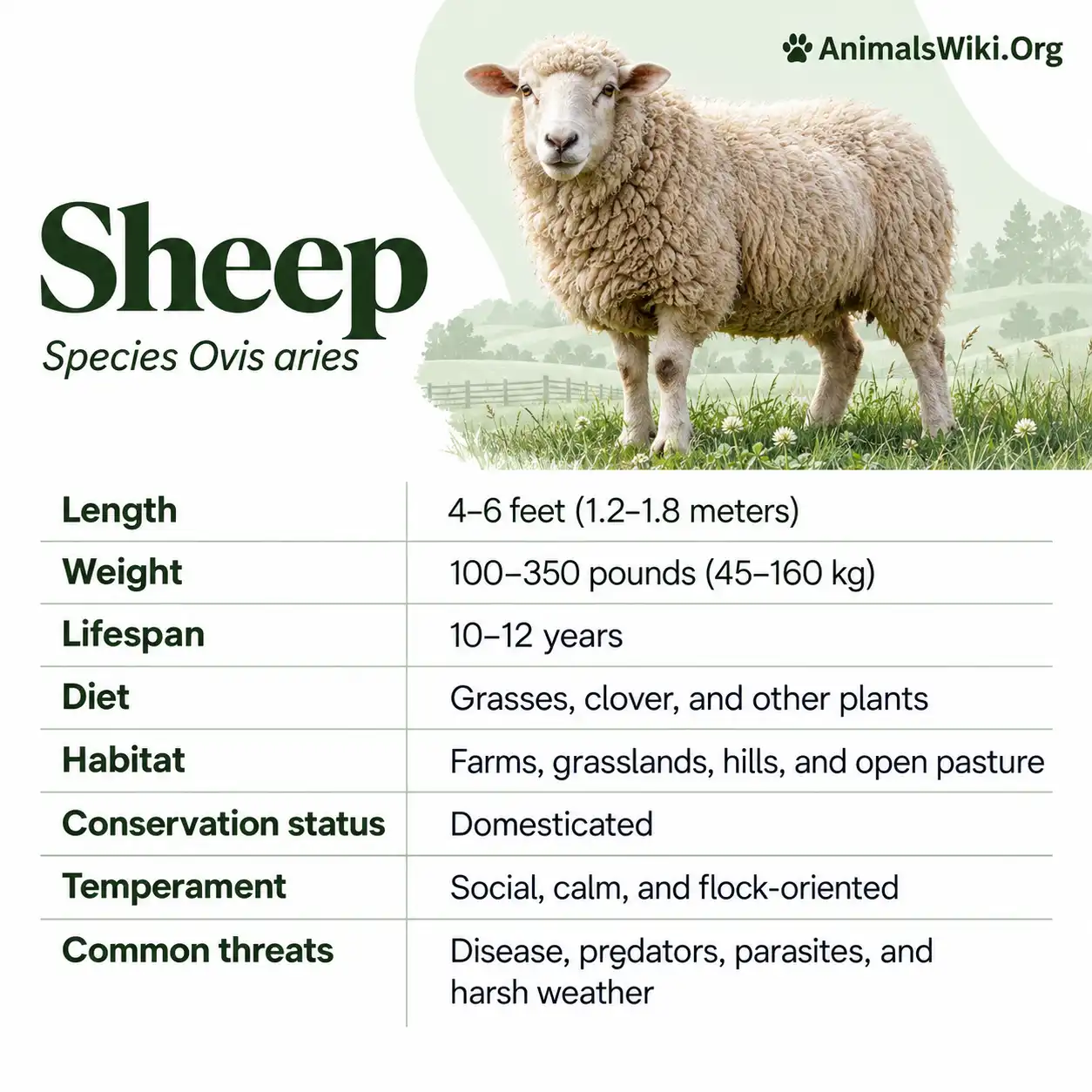
Sheep, The Woolly Grazing Mammals of Farms & Wild Grasslands
The sheep is one of the world’s most familiar domesticated mammals, recognized by its woolly coat, grazing behavior, strong flocking instinct, horizontal pupils, and long history alongside humans.
Domestic sheep are generally classified as Ovis aries.
They belong to the family Bovidae, making them relatives of:
- Goats
- Cattle
- Antelopes
- Gazelles
- Bison
Humans domesticated sheep thousands of years ago, making them among the earliest livestock animals to become an important part of human civilization.
Today, sheep are raised throughout much of the world for products including:
- Wool
- Meat
- Milk
- Leather
Different breeds have been selectively developed for different purposes.
Some produce exceptionally fine wool.
Others are primarily meat breeds.
Some are important dairy animals.
There are also breeds adapted to:
- Mountains
- Deserts
- Cold climates
- Wet grasslands
- Dry rangelands
Although domestic sheep are often imagined simply as peaceful farm animals, their biology contains many fascinating adaptations.
Sheep are ruminants.
Instead of digesting grass in a simple stomach like humans, they possess a complex four-compartment stomach system.
Microorganisms living inside the digestive tract break down tough plant fibers, allowing sheep to obtain nutrients from grasses and other vegetation.
Sheep also have unusual eyes.
Their pupils are generally elongated horizontally rather than circular like human pupils.
Because sheep are prey animals, a broad field of vision is extremely valuable.
It helps them monitor their surroundings while grazing and detect potential predators approaching from different directions.
Their strong tendency to form flocks provides another layer of protection.
An isolated sheep can be more vulnerable.
Within a flock, many animals can watch for danger, and grouping makes it harder for a predator to isolate one target.
Sheep are also more intelligent and socially complex than stereotypes often suggest.
They can learn routines, distinguish individuals, remember information, navigate familiar environments, and maintain social relationships within their flock.
The word sheep can refer to one animal or several animals.
Unlike many English animal names, its plural is not “sheeps.”
A male sheep is called a ram.
A female is called a ewe.
A young sheep is called a lamb.
Sheep should also not be confused with goats.
Although closely related, sheep and goats belong to different genera and differ in:
- Behavior
- Feeding preferences
- Anatomy
- Coat
- Tail carriage
- Horn structure
Domestic sheep also have wild relatives.
Wild sheep inhabit rugged environments across parts of:
- Europe
- Asia
- North America
Many wild species possess impressive horns and exceptional climbing abilities.
From its remarkable digestive system and panoramic vision to its thick wool and powerful flocking instinct, the sheep is far more biologically interesting than its familiar farmyard appearance might suggest.
This comprehensive guide explores sheep facts, breeds, anatomy, wool, horns, eyes, teeth, hooves, size, weight, habitat, distribution, diet, digestion, rumination, behavior, intelligence, communication, flocking, reproduction, pregnancy, lambs, lifespan, predators, adaptations, sheep vs. goat differences, wild sheep, domestication, farming, ecological importance, and much more.
Sheep Facts
| Feature | Information |
|---|---|
| Common Name | Sheep |
| Scientific Name | Ovis aries |
| Animal Type | Mammal |
| Family | Bovidae |
| Genus | Ovis |
| Diet | Herbivorous |
| Digestive Type | Ruminant |
| Stomach Compartments | 4 |
| Body Covering | Hair/wool depending on breed |
| Feet | Cloven hooves |
| Male | Ram |
| Female | Ewe |
| Young | Lamb |
| Group | Flock |
| Reproduction | Live birth |
| Gestation | About 5 months |
| Typical Birth | Often 1–2 lambs, varying by breed |
| Main Foods | Grasses and other vegetation |
| Main Defense | Flocking, vigilance and escape |
| Domestic Uses | Wool, meat and milk |
| Close Relatives | Goats, cattle, antelopes and other bovids |
What Is a Sheep?
A sheep is a hoofed, herbivorous mammal belonging to the family Bovidae.
Domestic sheep belong to the species:
Ovis aries
They have been selectively bred into numerous breeds with different characteristics.
Domestic sheep vary greatly in:
- Size
- Coat
- Wool quality
- Color
- Horns
- Milk production
- Meat production
- Climate tolerance
Is a Sheep a Mammal?
Yes.
Sheep possess the defining characteristics of mammals.
They:
- Have hair
- Are warm-blooded
- Give birth to live young
- Produce milk
- Breathe with lungs
Female sheep nurse their lambs using milk produced by mammary glands.
Scientific Classification of Sheep
A simplified classification of domestic sheep is:
| Classification | Name |
|---|---|
| Kingdom | Animalia |
| Phylum | Chordata |
| Class | Mammalia |
| Order | Artiodactyla |
| Family | Bovidae |
| Subfamily | Caprinae |
| Genus | Ovis |
| Species | Ovis aries |
Sheep belong to the same subfamily as goats and several other goat-like bovids.
Domestic Sheep
Domestic sheep have lived alongside humans for thousands of years.
Selective breeding produced animals specialized for different purposes.
Some breeds are valued primarily for:
- Fine wool
Others are bred mainly for:
- Meat
- Milk
- Mixed production
Domestic sheep also vary dramatically in appearance.
Wild Sheep
Domestic sheep belong to a larger group containing several wild Ovis species.
Wild sheep include animals such as:
- Bighorn sheep
- Dall sheep
- Argali
- Urial
- Mouflon
These animals are adapted to rugged landscapes and often possess impressive horns.
Sheep Breeds
Humans have developed many sheep breeds.
Well-known examples include:
- Merino
- Suffolk
- Dorset
- Hampshire
- Dorper
- Texel
- Rambouillet
- Awassi
- East Friesian
- Jacob
- Karakul
Each breed has its own combination of characteristics.
Merino Sheep
Merino sheep are especially famous for their:
fine wool
Merino wool is valued for being relatively:
- Soft
- Fine
- Warm
- Flexible
It is widely used in high-quality clothing and textiles.
Suffolk Sheep
Suffolk sheep are recognizable by their:
- Black faces
- Black legs
- White woolly bodies
They are particularly well known as meat-producing sheep.
Dorper Sheep
The Dorper was developed for meat production and adaptation to relatively dry environments.
It is a hair-sheep type that can shed much of its coat rather than requiring the same shearing regime as heavy-wool breeds.
Awassi Sheep
Awassi sheep are important in parts of the Middle East and surrounding regions.
They are valued for:
- Milk
- Meat
- Adaptation to dry climates
They are generally classified among fat-tailed sheep.
What Does a Sheep Look Like?
Domestic sheep vary considerably, but common features include:
- Compact body
- Four legs
- Cloven hooves
- Long muzzle
- Side-facing eyes
- Horizontal pupils
- Short tail or naturally longer tail depending on management and breed
- Wool or hair coat
- Horns in some breeds
Colors include:
- White
- Black
- Brown
- Gray
- Mixed patterns
Sheep Wool
Wool is one of the most famous characteristics of sheep.
However, not every sheep produces the same type of coat.
Some breeds produce heavy wool.
Others possess:
- Hair
- Mixed hair and wool
- Naturally shedding coats
Why Do Sheep Have Wool?
Wool provides insulation.
It helps protect sheep against:
- Cold
- Wind
- Temperature changes
Selective breeding greatly increased wool production in many domestic breeds.
Do Sheep Need to Be Sheared?
Many modern wool breeds need regular shearing because they do not naturally shed enough fleece.
Without appropriate shearing, excessive wool can contribute to problems involving:
- Heat
- Mobility
- Hygiene
- Skin health
However, hair sheep naturally shed much of their coats and generally do not require conventional wool shearing.
Does Shearing Hurt Sheep?
Proper shearing removes the fleece without cutting the skin and should not hurt the animal.
It is somewhat comparable to cutting hair.
Poor technique, however, can cause injuries.
Skilled handling is therefore important.
Does Sheep Wool Grow Back?
Yes.
After shearing, wool-producing sheep grow new fleece.
The growth rate depends on:
- Breed
- Nutrition
- Health
- Age
- Environment
What Is Lanolin?
Lanolin is a waxy substance associated with sheep wool.
It is produced by glands in the skin and helps protect the fleece and skin.
Purified lanolin is used in various:
- Cosmetics
- Skin products
- Industrial applications
Sheep Skin
Underneath the fleece is skin containing:
- Hair follicles
- Sweat glands
- Sebaceous glands
The density and characteristics of wool follicles strongly influence fleece quality.
Sheep Eyes
Sheep have eyes positioned toward the sides of the head.
This arrangement provides a broad field of view.
For a grazing prey animal, this is extremely useful.
A sheep can continue feeding while monitoring much of its surroundings for danger.
Why Do Sheep Have Horizontal Pupils?
Sheep typically have horizontally elongated pupils.
These pupils contribute to broad panoramic vision.
This helps them detect predators across open landscapes.
Similar pupil shapes occur in several other grazing prey animals.
Can Sheep See Behind Them?
Sheep possess a very broad field of vision because their eyes are positioned laterally.
They can monitor much of the surrounding environment without turning their heads.
However, claims that they have completely perfect 360-degree vision are oversimplified.
There are still limitations and blind areas.
Can Sheep See Color?
Yes.
Sheep are not limited to black-and-white vision.
Their color perception differs from human vision, but they can distinguish colors.
Sheep Hearing
Sheep have good hearing.
Their ears can move to help detect and locate sounds.
Hearing is important for:
- Predator detection
- Communication
- Lamb recognition
- Flock awareness
Sheep Sense of Smell
Sheep also possess a strong sense of smell.
Smell contributes to:
- Food selection
- Social recognition
- Reproduction
- Mother-lamb bonding
A ewe can use scent to help recognize her own lamb.
Sheep Teeth
Adult sheep possess a distinctive arrangement of teeth.
They do not have upper front incisors like humans.
Instead, the lower incisors bite against a tough structure called the:
dental pad
This arrangement helps sheep crop vegetation.
Do Sheep Have Upper Teeth?
Sheep have upper back teeth, but they lack upper incisors at the front of the mouth.
The lower incisors work against the dental pad.
How Do Sheep Eat Grass?
A sheep uses its:
- Lips
- Tongue
- Lower incisors
- Dental pad
to grasp and cut vegetation.
The food is initially swallowed with relatively limited chewing.
Later, it is regurgitated as cud and chewed more thoroughly.
Sheep Digestive System
Sheep are ruminants.
Their stomach system contains four compartments:
- Rumen
- Reticulum
- Omasum
- Abomasum
Each performs a different role in digestion.
What Is the Rumen?
The rumen is a large fermentation chamber.
It contains enormous populations of microorganisms.
These microbes help break down plant material that the sheep could not efficiently digest alone.
Sheep and Gut Microbes
Microorganisms in the rumen include:
- Bacteria
- Protozoa
- Fungi
- Other microbes
They help break down cellulose and other plant components.
Fermentation produces compounds that the sheep can absorb and use for energy.
What Is Cud?
Cud is partially digested food that is brought back from the digestive system into the mouth.
The sheep chews it again.
This process is called:
rumination
Why Do Sheep Chew Cud?
Rechewing food breaks plant material into smaller pieces.
This helps microbes digest fibrous vegetation more effectively.
It allows sheep to obtain nutrition from foods humans cannot digest efficiently.
Do Sheep Have Four Stomachs?
People often say sheep have “four stomachs.”
More accurately, sheep have one stomach divided into four specialized compartments.
What Do Sheep Eat?
Sheep are herbivores.
Their diet can include:
- Grass
- Clover
- Forbs
- Hay
- Leaves
- Legumes
- Agricultural feed
The exact diet depends on:
- Habitat
- Season
- Farming system
- Nutritional requirements
Do Sheep Eat Grass?
Yes.
Grass is one of the most important foods for many sheep.
Their digestive system is highly adapted to extracting nutrients from fibrous vegetation.
Do Sheep Eat Hay?
Yes.
Hay is commonly provided when fresh pasture is unavailable or insufficient.
Do Sheep Eat Grain?
Domestic sheep may receive grain or formulated feeds in some production systems.
However, sudden or excessive intake of concentrated feed can disturb rumen function.
Proper feeding management is important.
Are Sheep Herbivores?
Yes.
Their anatomy and digestive physiology are specialized primarily for plant-based diets.
Sheep vs. Goat Feeding
Sheep are generally characterized more strongly as grazers, while goats frequently browse more extensively.
Sheep often prefer:
- Grasses
- Low vegetation
Goats are more likely to select:
- Leaves
- Shrubs
- Twigs
- Woody vegetation
However, both species can adjust their diets according to food availability.
Where Do Sheep Live?
Domestic sheep occur on every inhabited continent.
They are raised in environments including:
- Grasslands
- Farms
- Mountains
- Dry rangelands
- Semi-deserts
- Temperate pastures
Wild sheep are often strongly associated with rugged mountainous terrain.
Sheep Habitat
Domestic sheep require access to:
- Suitable forage
- Water
- Shelter
- Safe resting areas
Their ability to tolerate different climates varies greatly by breed.
Do Sheep Live in Mountains?
Yes.
Many wild sheep are exceptional mountain animals.
Domestic sheep are also raised in upland and mountainous regions around the world.
How Do Wild Sheep Climb Mountains?
Wild sheep possess:
- Strong legs
- Excellent balance
- Specialized hooves
- Powerful muscles
Their feet provide traction on:
- Rock
- Steep slopes
- Uneven terrain
Mountain habitats can also help them escape predators.
Sheep Hooves
Sheep possess:
cloven hooves
Each foot has two main toes.
The hoof structure supports movement over various surfaces.
Do Sheep Need Hoof Trimming?
Domestic sheep may require hoof trimming depending on:
- Breed
- Terrain
- Moisture
- Hoof growth
- Management
Hooves can wear naturally on rough ground, while soft conditions may allow excessive growth.
How Big Are Sheep?
Size varies greatly among breeds.
Some sheep are relatively small.
Others are large and heavily built.
Adult body weight can range from several dozen kilograms to well over 100 kilograms in large breeds and males.
How Much Does a Sheep Weigh?
There is no single standard sheep weight.
Weight depends on:
- Breed
- Sex
- Age
- Nutrition
- Health
Rams are generally heavier than ewes of the same breed.
Male Sheep
An adult male sheep is called a:
ram
Rams are often:
- Larger
- More muscular
- Heavier
than females.
In horned breeds, males may develop particularly impressive horns.
Female Sheep
An adult female sheep is called a:
ewe
Ewes produce milk to feed their lambs.
Baby Sheep
A young sheep is called a:
lamb
The process of giving birth is called:
lambing
Ram vs. Ewe
| Feature | Ram | Ewe |
|---|---|---|
| Sex | Male | Female |
| Typical Size | Larger | Smaller |
| Main Reproductive Role | Produces sperm | Pregnancy and nursing |
| Horns | Often larger where present | Smaller or absent in some breeds |
Breed differences can be substantial.
Sheep Horns
Some sheep have horns.
Others are naturally hornless, a condition known as:
polled
Horn development depends strongly on:
- Breed
- Sex
- Genetics
Why Do Rams Have Curved Horns?
In many wild sheep and domestic breeds, ram horns grow in curved or spiral forms.
They can function in:
- Competition
- Display
- Defense
Large wild rams may clash horns during breeding competition.
Do Female Sheep Have Horns?
Some do.
In certain breeds and wild species, females possess horns.
In others, females are hornless or have much smaller horns than males.
Sheep Behavior
Sheep are strongly social animals.
They generally prefer to remain with other sheep.
This flocking behavior influences:
- Movement
- Feeding
- Resting
- Predator avoidance
What Is a Group of Sheep Called?
A group of sheep is commonly called a:
flock
“Herd” may also be used in some contexts.
Why Do Sheep Stay in Flocks?
Flocking provides several potential advantages.
More animals mean:
- More eyes watching for predators
- Reduced chance that one individual is targeted
- Coordinated movement
- Social security
The behavior is deeply rooted in their evolution as prey animals.
Do Sheep Get Lonely?
Sheep are highly social.
Isolation can cause stress, especially when a sheep cannot see or interact with companions.
Keeping sheep with appropriate social contact is important for welfare.
Are Sheep Intelligent?
Yes.
Sheep are capable of:
- Learning
- Memory
- Social recognition
- Navigation
- Problem solving
The stereotype that sheep are unintelligent does not accurately represent their behavioral abilities.
Can Sheep Recognize Faces?
Research indicates that sheep can distinguish and remember visual information about familiar individuals.
They can recognize:
- Other sheep
- Familiar human faces under experimental conditions
Their social recognition abilities are more sophisticated than many people assume.
Can Sheep Remember People?
Sheep can learn to recognize familiar handlers and associate people with:
- Food
- Handling
- Positive experiences
- Negative experiences
Sheep Communication
Sheep communicate through:
- Vocalizations
- Smell
- Body posture
- Facial signals
- Physical contact
One of the most recognizable sheep sounds is the:
bleat
Why Do Sheep Bleat?
Sheep may bleat because of:
- Communication
- Separation
- Hunger
- Stress
- Excitement
- Mother-lamb contact
The meaning depends on context.
How Do Lambs Find Their Mothers?
Mother and lamb use a combination of:
- Smell
- Vocal recognition
- Visual cues
to identify each other.
Soon after birth, bonding becomes extremely important.
Sheep Reproduction
Sheep reproduce sexually.
Many breeds show seasonal breeding patterns influenced by changing day length.
Mating usually occurs when the ewe enters:
estrus
or heat.
Sheep Pregnancy
A ewe’s pregnancy lasts approximately:
five months
A commonly cited average is around:
147 days
although individual pregnancies vary.
How Many Lambs Do Sheep Have?
A ewe may give birth to:
- One lamb
- Twins
- Triplets
- Occasionally more
The typical number depends strongly on breed, age, nutrition, and genetics.
Sheep Lambing
Lambing is the process of giving birth.
After birth, the ewe usually:
- Licks the lamb
- Learns its scent
- Encourages nursing
- Remains close to it
Early maternal bonding is critical.
Why Is Colostrum Important for Lambs?
The first milk produced by the ewe is called:
colostrum
It contains concentrated nutrients and important antibodies.
Newborn lambs need adequate colostrum soon after birth because it helps provide early immune protection.
Can Lambs Walk After Birth?
Yes.
Healthy lambs normally attempt to:
- Stand
- Walk
- Find the udder
- Nurse
relatively soon after birth.
This is important for survival in open environments.
What Do Lambs Eat?
Initially, lambs depend heavily on:
milk
As they grow, they begin experimenting with:
- Grass
- Hay
- Other vegetation
Their rumen gradually develops into a fully functional fermentation system.
How Long Do Sheep Live?
Sheep lifespan depends on:
- Breed
- Health
- Environment
- Predators
- Disease
- Farming system
Domestic sheep can potentially live roughly:
10–15 years or more
under favorable conditions.
Working agricultural lifespans are often shorter.
Sheep Predators
Potential sheep predators vary geographically.
They can include:
- Wolves
- Coyotes
- Large cats
- Bears
- Feral or domestic dogs
- Foxes, particularly for lambs
- Large eagles in limited circumstances involving young animals
Predator risk depends heavily on region.
How Do Sheep Defend Themselves?
Domestic sheep primarily rely on:
- Vigilance
- Flocking
- Running
- Staying near companions
Horned sheep may also use their horns defensively.
Wild sheep can escape onto steep terrain.
Sheep Adaptations
Sheep possess several important adaptations.
Horizontal Pupils
Provide broad visual coverage.
Side-Facing Eyes
Help monitor potential predators.
Flocking Behavior
Improves group vigilance.
Ruminant Digestion
Extracts nutrients from fibrous plants.
Wool or Hair Coat
Provides insulation.
Cloven Hooves
Support movement over varied terrain.
Strong Sense of Smell
Supports social recognition and feeding.
Social Communication
Helps maintain flock cohesion.
Sheep vs. Goat
Sheep and goats are close relatives but distinct animals.
| Feature | Sheep | Goat |
|---|---|---|
| Genus | Ovis | Capra |
| Feeding Tendency | More grazing | More browsing |
| Tail | Usually hangs downward | Often held upward |
| Coat | Often woolly | Usually hairy |
| Horns | Often curled/spiraled | Often more upright/backward |
| Social Behavior | Strong flocking | Often more independently exploratory |
Breed differences mean these are general tendencies rather than absolute rules.
Is a Sheep the Same as a Goat?
No.
Domestic sheep are generally:
Ovis aries
Domestic goats are:
Capra hircus
They belong to different genera.
Sheep vs. Lamb
A sheep is the animal generally.
A lamb is a:
young sheep
Therefore, every lamb is a sheep, but not every sheep is a lamb.
Sheep vs. Ram
A ram is an:
adult male sheep
“Sheep” refers to the species regardless of sex.
Sheep vs. Ewe
A ewe is an:
adult female sheep
Sheep vs. Mutton
These terms describe different things.
Sheep refers to the animal.
Lamb can refer to a young sheep and, in culinary usage, meat from a young sheep.
Mutton generally refers to meat from a mature sheep.
Definitions can vary somewhat by country and food regulations.
Sheep vs. Bighorn Sheep
Bighorn sheep are wild North American sheep.
They are famous for:
- Massive curved horns
- Mountain habitat
- Powerful climbing ability
Domestic sheep and bighorn sheep belong to the same genus but are different species.
Sheep vs. Mouflon
Mouflon are wild sheep associated with parts of western Asia and historically introduced populations in Europe.
They are closely connected to the evolutionary and domestication history of domestic sheep.
Sheep Domestication
Sheep were among the earliest livestock species domesticated by humans.
Domestication began thousands of years ago in Southwest Asia.
Early humans initially valued sheep particularly for:
- Meat
- Skins
- Milk
Selective breeding later produced increasingly woolly animals.
Why Did Humans Domesticate Sheep?
Sheep offered several advantages.
They could provide:
- Meat
- Milk
- Skins
- Fiber
- Manure
They could also convert vegetation unsuitable for direct human consumption into useful products.
Sheep Wool and Human Civilization
Wool became an important material for:
- Clothing
- Blankets
- Carpets
- Trade
Different societies selectively bred sheep for increasingly specialized fleece.
This produced the enormous diversity of wool types seen today.
Sheep Milk
Sheep milk is used to produce various dairy products.
It is especially important in certain traditional cheeses.
Compared with cow milk, sheep milk generally contains relatively high levels of:
- Fat
- Protein
- Total solids
although exact composition varies.
Sheep in Agriculture
Sheep contribute to agricultural systems through:
- Meat
- Wool
- Milk
- Grazing
- Manure
They can use landscapes unsuitable for intensive crop production.
However, poor grazing management can damage vegetation and soil.
Sheep and Grasslands
Well-managed grazing can be integrated into grassland systems.
Excessive stocking, however, can contribute to:
- Overgrazing
- Soil erosion
- Loss of vegetation
- Habitat degradation
Ecological effects depend heavily on stocking intensity, climate, vegetation, and management.
Wild Sheep Ecology
Wild sheep influence ecosystems through:
- Grazing
- Nutrient cycling
- Movement across landscapes
They also provide prey for large carnivores.
Their presence can therefore influence both vegetation and predator communities.
Sheep Conservation
Domestic sheep are extremely widespread and are not globally threatened as a species.
Wild sheep present a different picture.
Individual wild Ovis species and populations may face threats including:
- Habitat loss
- Competition with livestock
- Hunting
- Poaching
- Disease transmission
- Habitat fragmentation
- Climate change
Conservation status therefore needs to be considered species by species.
40 Interesting Sheep Facts
- Sheep are mammals.
- Domestic sheep are scientifically known as Ovis aries.
- Sheep belong to the family Bovidae.
- Goats are close relatives of sheep.
- A male sheep is called a ram.
- A female sheep is called a ewe.
- A young sheep is called a lamb.
- A group of sheep is called a flock.
- Sheep are herbivores.
- Sheep are ruminants.
- Their stomach has four specialized compartments.
- The rumen contains enormous populations of microorganisms.
- Sheep chew cud.
- They primarily graze on vegetation.
- Sheep lack upper front incisors.
- Their lower incisors bite against a dental pad.
- Sheep have cloven hooves.
- Their eyes are positioned toward the sides of the head.
- Sheep generally have horizontally elongated pupils.
- Their eyes provide broad visual coverage.
- Sheep can see colors.
- They have a strong sense of smell.
- Sheep possess good hearing.
- They are strongly social animals.
- Sheep prefer living with companions.
- They can recognize familiar individuals.
- Sheep are capable of learning and remembering information.
- Their familiar vocalization is called a bleat.
- Sheep communicate through sound, smell and body signals.
- Ewes recognize their lambs partly through scent and vocalizations.
- Sheep pregnancy lasts roughly five months.
- Twins are common in many breeds.
- Newborn lambs can stand relatively soon after birth.
- Colostrum is extremely important to newborn lambs.
- Some sheep have horns.
- Other sheep are naturally polled.
- Not every sheep produces heavy wool.
- Hair sheep can naturally shed much of their coats.
- Sheep were among the earliest animals domesticated for livestock.
- Domestic sheep have lived alongside humans for thousands of years.
Did You Know?
A sheep can continue watching much of its surroundings even while its head is lowered to eat grass.
The secret lies partly in its unusual eyes.
Humans have forward-facing eyes and roughly circular pupils.
That arrangement provides excellent depth perception directly in front of us.
A sheep faces a different evolutionary problem.
It is a grazing prey animal.
While feeding, its head may remain close to the ground for long periods.
Predators could potentially approach from:
- Behind
- Beside
- Across open grassland
Stopping every few seconds and turning the entire head in every direction would make feeding inefficient.
Instead, sheep possess eyes positioned toward the sides of the skull.
Their pupils are horizontally elongated.
Together, these characteristics create an exceptionally broad visual field.
Even more remarkably, grazing animals can adjust eye orientation as the head moves downward, helping keep the visual field aligned with the surrounding landscape.
For a sheep, vision is therefore not simply about seeing what is directly ahead.
It is a biological surveillance system.
The same animal can:
eat grass and monitor much of the surrounding landscape at the same time.
Combine that panoramic vision with dozens of other sheep watching from within the flock, and the survival advantage becomes even greater.
Frequently Asked Questions About Sheep
What is a sheep?
A sheep is a herbivorous hoofed mammal belonging to the genus Ovis.
What is the scientific name of domestic sheep?
Ovis aries.
Is a sheep a mammal?
Yes.
Are sheep herbivores?
Yes.
What do sheep eat?
They mainly eat grasses, forbs, hay and other plant material.
Do sheep eat grass?
Yes.
Do sheep eat hay?
Yes.
Do sheep eat grain?
Domestic sheep can receive grain or formulated feeds, but concentrated foods must be managed carefully.
Do sheep eat meat?
Sheep are physiologically adapted primarily to a herbivorous diet.
Are sheep ruminants?
Yes.
Do sheep have four stomachs?
They have one stomach system divided into four specialized compartments.
What are the four sheep stomach compartments?
Rumen, reticulum, omasum and abomasum.
What is a sheep’s rumen?
It is a large fermentation chamber containing microorganisms that digest plant material.
Why do sheep chew cud?
Rumination allows them to rechew partially digested plant material and improve digestion.
What is cud?
Cud is partially digested food regurgitated and chewed again.
Do sheep have teeth?
Yes.
Do sheep have upper front teeth?
No. They lack upper incisors and instead possess a dental pad.
How do sheep cut grass?
Their lower incisors press vegetation against the upper dental pad.
What is a male sheep called?
A ram.
What is a female sheep called?
A ewe.
What is a baby sheep called?
A lamb.
What is a group of sheep called?
A flock.
Is the plural of sheep “sheeps”?
No. Both the singular and plural are sheep.
What is lambing?
Lambing is the process of a ewe giving birth.
How long is a sheep pregnant?
Approximately five months, with around 147 days commonly cited as an average.
How many lambs can a sheep have?
One or two are common, but triplets and larger litters occur in some breeds.
Can sheep have twins?
Yes.
Can sheep have triplets?
Yes.
Can lambs walk after birth?
Healthy lambs usually begin trying to stand and walk relatively soon after birth.
What do baby sheep eat?
Newborn lambs drink milk before gradually transitioning toward vegetation.
What is colostrum?
It is the nutrient- and antibody-rich first milk produced after birth.
Why do lambs need colostrum?
It provides energy and important early immune protection.
How long do sheep live?
Under favorable conditions, domestic sheep can potentially live roughly 10–15 years or longer.
How big do sheep get?
Size varies greatly among breeds.
How much does a sheep weigh?
Adults can range from several dozen kilograms to well over 100 kilograms depending on breed, sex and condition.
Are rams bigger than ewes?
Generally, yes.
Do sheep have horns?
Some do.
Do all rams have horns?
No. Horn development depends on breed and genetics.
Do female sheep have horns?
Females of some breeds and wild species have horns, while others do not.
What does polled mean in sheep?
Polled means naturally hornless.
Why do rams have large horns?
Horns can be used for competition, display and defense.
Do rams fight?
Yes. Males may clash heads and horns during competition.
Does headbutting hurt rams?
Rams possess anatomical adaptations that help them withstand impacts, but fighting can still cause injuries.
Do sheep have wool?
Many domestic sheep do, but some breeds have predominantly hair coats.
Why do sheep grow wool?
Wool provides insulation, and humans have selectively bred many sheep for increased fleece production.
Do sheep need shearing?
Many wool breeds do.
Does shearing hurt sheep?
Proper shearing removes fleece without harming the skin.
Does sheep wool grow back?
Yes.
What is lanolin?
Lanolin is a waxy substance associated with sheep fleece and skin.
Are there sheep that don’t need shearing?
Yes. Hair sheep naturally shed much of their coats.
Why do sheep have horizontal pupils?
Horizontal pupils contribute to broad panoramic vision useful for detecting predators.
Can sheep see behind themselves?
Their side-facing eyes provide an extremely broad field of vision, although it is not completely unrestricted.
Can sheep see color?
Yes.
Can sheep see in the dark?
They can function under relatively low-light conditions, but they do not possess unlimited night vision.
Do sheep have good hearing?
Yes.
Do sheep have a good sense of smell?
Yes.
Can sheep recognize faces?
Research indicates that sheep can distinguish and remember familiar faces.
Can sheep recognize humans?
They can learn to recognize familiar handlers and visual cues.
Are sheep intelligent?
Yes. Sheep demonstrate learning, memory and social-recognition abilities.
Are sheep stupid?
No. The stereotype does not accurately reflect their cognitive abilities.
Why do sheep follow each other?
Strong flocking behavior promotes social cohesion and predator avoidance.
Do sheep get lonely?
They are highly social and can become stressed when isolated.
Why do sheep bleat?
Bleating is used for communication and may indicate separation, hunger, stress or social contact.
Can a mother sheep recognize her lamb?
Yes. Ewes use smell, sound and other cues to identify their offspring.
Where do sheep live?
Domestic sheep occur worldwide in farms, grasslands, rangelands and mountainous regions.
Do sheep live in mountains?
Yes. Many wild sheep are highly specialized mountain animals.
Can sheep climb?
Wild sheep in particular are excellent climbers on steep rocky terrain.
Do sheep have hooves?
Yes. They have cloven hooves.
Why are sheep hooves split?
The two-toed structure is characteristic of even-toed ungulates and assists movement over varied terrain.
Do sheep need their hooves trimmed?
Domestic sheep sometimes require hoof trimming depending on terrain and management.
Can sheep run?
Yes.
Can sheep swim?
Sheep can swim when necessary, although swimming is not a central part of their normal lifestyle.
Are sheep dangerous?
Domestic sheep are generally not aggressive toward humans, but large rams can cause injuries by charging or headbutting.
Can sheep bite?
Their front dental anatomy makes serious biting less likely than in many animals, although they can use their mouths defensively.
What animals eat sheep?
Predators can include wolves, coyotes, large cats, bears and dogs, depending on region.
How do sheep protect themselves?
They rely heavily on flocking, vigilance and escape.
Are sheep and goats the same?
No.
What is the difference between sheep and goats?
Sheep belong to Ovis, while goats belong to Capra. They also differ in behavior, feeding tendencies, tails, coats and anatomy.
Is a lamb a sheep?
Yes. A lamb is a young sheep.
Is a ram a sheep?
Yes. A ram is an adult male sheep.
Is a ewe a sheep?
Yes. A ewe is an adult female sheep.
What is the difference between lamb and sheep?
Lamb refers specifically to a young sheep, while sheep refers to the animal generally.
What is mutton?
Mutton generally refers to meat from a mature sheep.
Are sheep related to cattle?
Yes. Both belong to the family Bovidae.
Are sheep related to antelopes?
Yes. Sheep and antelopes are members of Bovidae, although they belong to different branches within the family.
Are sheep related to deer?
They are both even-toed ungulates, but deer belong to Cervidae rather than Bovidae.
Are sheep domesticated?
Domestic sheep have been selectively bred by humans for thousands of years.
Where were sheep domesticated?
Their domestication history is centered in Southwest Asia.
Why were sheep domesticated?
They provided useful resources including meat, skins, milk and eventually specialized wool.
What are sheep used for today?
Sheep are raised for wool, meat, milk and other agricultural purposes.
Is sheep milk drinkable?
Yes.
What is sheep milk used for?
It is consumed directly in some cultures and widely used in traditional dairy products and cheeses.
Are sheep important to ecosystems?
Wild sheep influence vegetation and nutrient cycling and provide prey for carnivores. Domestic sheep can also influence landscapes through grazing.
Can sheep damage grasslands?
Excessive or poorly managed grazing can contribute to vegetation loss and soil degradation.
Are sheep endangered?
Domestic sheep are not globally endangered, but conservation status varies among wild sheep species and populations.
What threatens wild sheep?
Threats can include hunting, habitat loss, livestock competition, disease, fragmentation and climate-related environmental change.
Conclusion
The sheep may be one of humanity’s most familiar livestock animals, but familiarity can hide how remarkable its biology really is.
A sheep is designed around the challenges of being a social grazing prey animal.
Its horizontally elongated pupils and side-facing eyes provide a broad view of the surrounding landscape.
Its ears detect approaching sounds.
Its strong sense of smell helps identify:
- Food
- Companions
- Offspring
- Reproductive signals
When danger appears, its instinct is usually not to fight.
It relies on the flock.
Dozens of animals watching together create a collective warning system far more effective than one sheep standing alone.
Its digestive system is equally impressive.
Grass contains enormous amounts of fibrous material that humans cannot efficiently digest.
Sheep solve that problem through cooperation with microorganisms.
Inside the rumen, microbial communities break down plant material.
Food is later regurgitated and chewed again as cud.
The result is an animal capable of turning tough vegetation into:
- Energy
- Growth
- Milk
- Wool
The relationship between sheep and humans transformed that natural grazing biology into one of the world’s most important livestock systems.
Thousands of years of selective breeding produced sheep specialized for different purposes.
Merinos became famous for extraordinarily fine wool.
Other breeds were developed for:
- Meat
- Milk
- Harsh climates
- Dry landscapes
- Cold environments
Some grow heavy fleeces that require regular shearing.
Others naturally shed their hair.
Some are hornless.
Others possess impressive horns.
Some weigh only several dozen kilograms, while large rams can exceed 100 kilograms.
Behind all that domestic diversity lies a wild evolutionary heritage.
Wild sheep still inhabit rugged landscapes where strong legs, balance, cloven hooves and vigilance can mean the difference between escaping a predator and becoming its prey.
Animals such as:
- Bighorn sheep
- Argali
- Urial
- Mouflon
- Dall sheep
demonstrate how adaptable the Ovis lineage has become across mountains, drylands and open landscapes.
Sheep are therefore much more than wool-covered farm animals.
They are sophisticated ruminants, social communicators, panoramic observers, mountain survivors and one of the animals that has most profoundly influenced the development of human agriculture.
From the microbes fermenting grass inside the rumen to the horizontal pupils scanning a pasture for danger, nearly every part of the sheep reflects millions of years of adaptation to life as a social grazing mammal.



