Duck, The Remarkable Waterbirds of Wetlands, Rivers & Lakes
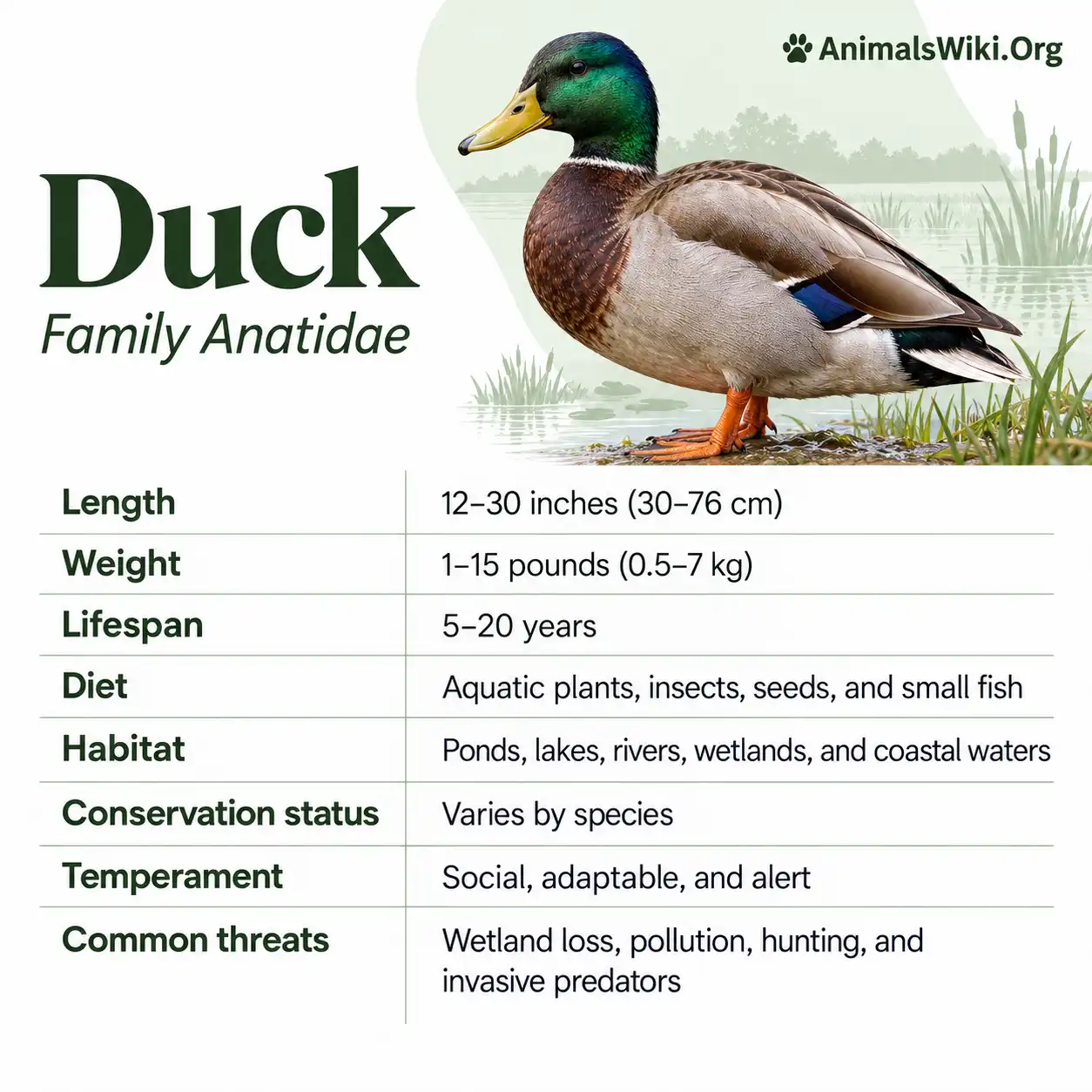
The duck is one of the world’s most familiar waterbirds, recognized by its broad bill, webbed feet, waterproof feathers, compact body, and remarkable ability to move between water, land, and air.
Ducks can be found across much of the world in habitats ranging from quiet freshwater ponds and enormous lakes to rivers, marshes, flooded grasslands, estuaries, coastal lagoons, and even the open ocean.
Although people often think of a duck as a single type of bird, the word duck actually refers to a diverse collection of waterfowl, especially within the family Anatidae.
This family also contains:
- Geese
- Swans
There are many species commonly called ducks, and they differ enormously in:
- Size
- Color
- Bill shape
- Feeding behavior
- Habitat
- Diving ability
- Migration
- Courtship
- Plumage
Some ducks spend much of their feeding time tipping forward at the water’s surface.
These are commonly called dabbling ducks.
Others disappear completely underwater while pursuing food.
These are known as diving ducks.
Sea ducks can forage in cold coastal waters, while specialized species may pursue:
- Fish
- Mollusks
- Aquatic insects
- Crustaceans
Many other ducks consume large quantities of:
- Seeds
- Aquatic plants
- Grasses
- Algae
- Small aquatic animals
One of the duck’s most recognizable adaptations is its webbed feet.
The toes are connected by skin, creating a broad surface that can push against the water during swimming.
But ducks do much more than swim.
Many species are powerful fliers capable of traveling enormous distances during seasonal migration.
Some migrate between breeding and wintering grounds separated by hundreds or even thousands of kilometers.
Duck feathers are another remarkable adaptation.
A duck spends considerable time preening—carefully arranging and maintaining its plumage.
A gland near the base of the tail, known as the uropygial or preen gland, produces oily secretions that contribute to feather maintenance.
More importantly, the microscopic structure and careful arrangement of the feathers help create a highly water-resistant barrier.
Air trapped among the feathers also contributes to:
- Insulation
- Buoyancy
- Thermal protection
This is why a duck can spend long periods in cold water while keeping much of its underlying plumage and skin protected.
Ducks also possess fascinating reproductive behavior.
During breeding season, males of many species display striking colors.
A male duck is commonly called a:
drake
An adult female is usually called a:
hen
A young duck is called a:
duckling
Ducklings of many species are precocial, meaning they hatch relatively well developed.
Soon after emerging from the egg, they may be able to:
- Walk
- Swim
- Follow their mother
- Search for food
Yet they still depend on maternal guidance and protection.
Ducks are also ecologically important.
They can:
- Consume aquatic vegetation
- Control some invertebrate populations
- Disperse seeds
- Transport nutrients
- Serve as prey
- Influence wetland food webs
Their presence also connects distant ecosystems because migratory ducks transport energy and biological material across landscapes.
From the webbing between their toes to the microscopic architecture of their feathers, ducks possess an extraordinary collection of adaptations for life around water.
This comprehensive guide explores duck facts, species, anatomy, feathers, waterproofing, bills, webbed feet, swimming, diving, flying, migration, habitat, diet, feeding, behavior, communication, mating, eggs, ducklings, lifespan, predators, adaptations, mallards, dabbling ducks, diving ducks, sea ducks, duck vs. goose differences, ecological importance, conservation, and much more.
Duck Quick Facts
| Feature | Information |
|---|---|
| Common Name | Duck |
| Animal Type | Bird |
| Family | Primarily Anatidae |
| Body Covering | Feathers |
| Diet | Omnivorous in many species; varies widely |
| Feet | Usually webbed |
| Main Habitats | Wetlands, lakes, ponds, rivers, coasts and marshes |
| Distribution | Worldwide except Antarctica as regular native breeding waterfowl |
| Male | Drake |
| Female | Hen |
| Young | Duckling |
| Reproduction | Egg-laying |
| Movement | Walking, swimming, flying and diving depending on species |
| Major Adaptations | Webbed feet, water-resistant plumage, specialized bills |
| Social Behavior | Often social; varies by species and season |
| Migration | Common in many species |
| Close Relatives | Geese and swans |
What Is a Duck?
A duck is a type of waterbird belonging primarily to the family:
Anatidae
However, “duck” is a common rather than strictly taxonomic category.
Not every member of Anatidae is called a duck.
The family also includes:
- Swans
- Geese
Ducks comprise many evolutionary lineages within this larger waterfowl family.
Is a Duck a Bird?
Yes.
Ducks possess all the defining characteristics of birds.
They have:
- Feathers
- Wings
- Beaks
- Lightweight skeletons
- Warm-blooded metabolism
They reproduce by laying eggs.
Scientific Classification of Ducks
Because “duck” describes many species rather than one species, there is no single scientific name covering every duck.
A simplified classification is:
| Classification | Name |
|---|---|
| Kingdom | Animalia |
| Phylum | Chordata |
| Class | Aves |
| Order | Anseriformes |
| Family | Anatidae |
Different ducks belong to numerous genera and species within Anatidae.
How Many Duck Species Are There?
There is no completely straightforward number because classification changes and the common term “duck” does not correspond perfectly to one taxonomic group.
There are well over 100 species commonly regarded as ducks worldwide.
Taxonomic revisions can change:
- Species boundaries
- Genus placement
- Relationships between groups
For SEO and general educational purposes, it is more accurate to describe ducks as a diverse group containing more than 100 species rather than present one permanently fixed total.
Types of Ducks
Ducks can be grouped according to ecology and feeding behavior.
Common categories include:
- Dabbling ducks
- Diving ducks
- Sea ducks
- Stiff-tailed ducks
- Whistling ducks
- Mergansers
- Eiders
- Scoters
These categories differ in:
- Feeding
- Diving
- Body shape
- Leg placement
- Habitat
Dabbling Ducks
Dabbling ducks commonly feed near the water’s surface.
Rather than diving deeply, they may:
- Dip their heads underwater
- Tip their bodies forward
- Stretch their necks downward
The familiar tail-up feeding posture is called:
upending
Examples include many mallards, teals, pintails, and shovelers.
Diving Ducks
Diving ducks submerge completely to obtain food.
They may feed on:
- Aquatic plants
- Mollusks
- Invertebrates
- Other submerged food
Their legs tend to be positioned farther toward the rear of the body than those of many dabbling ducks.
This improves underwater propulsion but can make walking on land more awkward.
Sea Ducks
Sea ducks spend substantial amounts of time in marine or coastal environments.
This group includes birds such as:
- Eiders
- Scoters
- Long-tailed ducks
- Some mergansers
Many are excellent divers.
Mallard
The mallard (Anas platyrhynchos) is one of the world’s most recognizable ducks.
Adult males are famous for their:
- Glossy green heads
- Yellowish bills
- Chestnut-brown chests
- Gray bodies
Females are generally mottled brown, providing excellent camouflage while nesting.
Mallards are also extremely important in the ancestry of many domestic duck breeds.
Mandarin Duck
The male mandarin duck (Aix galericulata) is famous for extraordinarily colorful plumage.
Its elaborate appearance includes:
- Orange
- White
- Purple
- Green
- Brown
Females are much more subdued in coloration.
Wood Duck
The wood duck (Aix sponsa) is a colorful North American species.
Unlike the stereotypical ground-nesting duck, wood ducks commonly nest in:
tree cavities
Their ducklings famously leave elevated nest cavities by jumping toward the ground or water after hatching.
Muscovy Duck
The Muscovy duck (Cairina moschata) is native to the Americas.
It is recognizable by the fleshy red facial structures particularly prominent in adult males.
Domestic Muscovy ducks have been raised by humans for centuries.
What Does a Duck Look Like?
Duck appearance varies widely.
Typical features include:
- Broad or specialized bill
- Relatively compact body
- Short neck compared with many geese and swans
- Webbed feet
- Dense feathers
- Wings
- Short tail
Some ducks are brightly colored.
Others rely heavily on:
- Brown
- Gray
- Black
- White
camouflage.
Duck Anatomy
A duck’s body contains several specialized structures for aquatic life.
Important features include:
- Bill
- Nostrils
- Eyes
- Neck
- Wings
- Dense plumage
- Webbed feet
- Tail
- Preen gland
Internal anatomy is also specialized for:
- Flight
- Digestion
- Respiration
- Thermoregulation
Duck Bill
Duck bills vary according to diet.
Different species use them for:
- Filtering
- Grazing
- Grabbing
- Probing
- Catching fish
- Handling aquatic animals
The bill is therefore not simply a flat scoop.
It is a specialized feeding tool.
Do Ducks Have Teeth?
No.
Ducks do not have true teeth.
However, many possess comb-like structures along the edges of their bills called:
lamellae
These can look like tiny teeth.
What Are Duck Lamellae?
Lamellae are structures along the bill margins.
They can help ducks:
- Strain food
- Manipulate vegetation
- Grip slippery objects
Their form varies according to feeding specialization.
Duck Tongue
Ducks possess muscular tongues that work together with the bill.
The tongue helps:
- Manipulate food
- Move water
- Assist filtration
Its structure varies among species with different diets.
Duck Eyes
Ducks have well-developed vision.
Their eyes are positioned more laterally than human eyes, giving them a relatively broad visual field.
Vision is important for:
- Predator detection
- Feeding
- Navigation
- Flight
- Social interactions
Can Ducks See Color?
Yes.
Bird vision is generally highly developed, and ducks can perceive color.
Bird visual systems can differ substantially from human vision.
Can Ducks See Underwater?
Diving ducks must locate and capture food underwater.
Their eyes and visual systems can function in both air and aquatic environments, although refraction changes when light passes through water.
Different species rely on vision to different degrees while submerged.
Duck Ears
Ducks have ears, but they do not have external ear flaps like mammals.
The ear openings are located on the sides of the head and are covered by feathers.
Can Ducks Hear?
Yes.
Hearing is important for:
- Communication
- Mate recognition
- Parent-young contact
- Environmental awareness
Duck Feathers
Feathers provide ducks with:
- Insulation
- Protection
- Flight surfaces
- Camouflage
- Display coloration
- Water resistance
A duck’s plumage consists of multiple feather types performing different functions.
Why Don’t Ducks Get Wet?
Ducks do get wet externally, but their plumage is extremely effective at preventing water from easily reaching the skin.
Water resistance comes from a combination of:
- Feather structure
- Interlocking feather arrangements
- Preening
- Oily secretions
Air trapped within the plumage also contributes to insulation.
Are Duck Feathers Waterproof?
They are highly water resistant.
Calling them completely waterproof is a simplification because prolonged soaking, contamination, poor feather condition, or health problems can reduce water resistance.
What Is a Duck’s Preen Gland?
Near the base of the tail is the:
uropygial gland
or preen gland.
It produces an oily secretion that ducks distribute while preening.
Why Do Ducks Preen?
Preening helps ducks:
- Clean feathers
- Align feather structures
- Maintain plumage
- Distribute gland secretions
- Remove debris and some parasites
Well-maintained plumage is essential for both insulation and flight.
Duck Down
Beneath the outer feathers is soft insulating material known as:
down
Down traps air close to the body.
This provides excellent thermal insulation.
How Do Ducks Stay Warm in Cold Water?
Several adaptations work together:
- Dense feathers
- Down insulation
- Trapped air
- Body fat
- Specialized circulation in the legs
These help minimize heat loss.
Why Don’t Duck Feet Freeze?
Ducks can stand and swim in very cold conditions because their legs contain an efficient countercurrent heat-exchange system.
Warm arterial blood traveling toward the feet passes near colder blood returning toward the body.
Heat transfers between them.
This reduces heat loss through the feet while preserving warmth in the body’s core.
Duck Feet
Most ducks possess webbed feet.
Three forward-facing toes are connected by flexible skin.
When swimming, the foot spreads to push against water.
During the recovery stroke, the webbing can fold more efficiently.
Why Do Ducks Have Webbed Feet?
Webbing increases the surface area of the foot.
This makes each stroke more effective at pushing water backward and moving the duck forward.
Do Ducks Have Claws?
Yes.
Duck toes end in claws.
These can help with:
- Walking
- Scratching
- Gripping
- Climbing in some species
Can Ducks Walk?
Yes.
Ducks can walk on land, although walking ability varies among species.
Dabbling ducks tend to move relatively comfortably on land.
Many diving ducks have legs positioned farther toward the rear and may appear more awkward.
Why Do Ducks Waddle?
Their wide-set legs, body shape, and leg position produce the characteristic side-to-side walking motion called a:
waddle
Can Ducks Swim?
Yes.
Swimming is one of the defining abilities of most ducks.
They propel themselves mainly with their webbed feet.
Can Ducks Dive?
Many can.
Diving ability varies considerably.
Dabbling ducks usually feed near the surface.
Diving ducks and sea ducks may disappear completely underwater for food.
How Long Can Ducks Stay Underwater?
It depends on species.
Small surface-feeding ducks may submerge only briefly.
Specialized diving ducks can remain underwater considerably longer while searching for food.
There is no single duration that applies to all ducks.
Can Ducks Fly?
Most wild ducks can fly extremely well.
Their flight allows them to:
- Escape predators
- Move between wetlands
- Search for food
- Migrate
- Reach breeding grounds
Some domesticated breeds are too heavy for sustained flight.
How Fast Can Ducks Fly?
Flight speed varies with:
- Species
- Wind
- Migration conditions
- Body size
- Flight purpose
Many ducks are fast, powerful fliers capable of sustained travel.
Strong tailwinds can dramatically increase ground speed.
Why Do Ducks Fly in Groups?
Group flight can provide:
- Social coordination
- Navigation benefits
- Predator awareness
Some waterfowl also use formations that can improve aerodynamic efficiency.
Do Ducks Fly in a V Formation?
Some ducks can use V-shaped or line formations, particularly during migration.
V formations are especially famous among geese, but they are not exclusive to them.
Duck Migration
Many ducks migrate seasonally.
They may travel between:
breeding grounds ↔ wintering grounds
Migration can involve enormous distances.
Important cues include:
- Day length
- Weather
- Food availability
- Hormonal changes
How Do Ducks Know Where to Migrate?
Migratory navigation can involve multiple sources of information, including:
- Sun position
- Stars
- Earth’s magnetic field
- Landscape features
- Learned routes
- Inherited directional tendencies
The relative importance of these mechanisms varies.
Where Do Ducks Live?
Ducks occupy aquatic habitats throughout much of the world.
Common habitats include:
- Lakes
- Ponds
- Rivers
- Streams
- Marshes
- Swamps
- Estuaries
- Lagoons
- Coastal waters
- Mangroves
- Flooded fields
- Reservoirs
Do Ducks Live in Freshwater?
Many do.
Freshwater habitats support enormous numbers of ducks.
Do Ducks Live in Saltwater?
Yes.
Sea ducks and several other species spend substantial time in:
- Coastal seas
- Bays
- Estuaries
- Saltwater environments
Do Ducks Live in Trees?
Some species use trees extensively.
Wood ducks and several other cavity-nesting ducks may nest in:
- Hollow trees
- Natural cavities
- Nest boxes
What Do Ducks Eat?
Ducks have diverse diets.
Foods may include:
- Seeds
- Aquatic plants
- Grasses
- Algae
- Insects
- Insect larvae
- Worms
- Snails
- Crustaceans
- Mollusks
- Small fish
- Amphibians
Diet depends heavily on species.
Are Ducks Omnivores?
Many ducks are omnivorous.
However, the balance between plant and animal foods varies.
Some species are much more:
- Herbivorous
- Insectivorous
- Mollusk-feeding
- Fish-eating
than others.
Do Ducks Eat Fish?
Some do.
Mergansers are particularly specialized for catching fish.
Other ducks may consume small fish opportunistically.
Do Ducks Eat Insects?
Yes.
Aquatic insects and their larvae can be important foods, especially during breeding seasons when protein demand increases.
Do Ducks Eat Frogs?
Some ducks may consume:
- Tadpoles
- Tiny frogs
- Other small amphibians
when available.
It is not a universal dietary feature.
Do Ducks Eat Grass?
Yes.
Several ducks graze on grasses and other terrestrial or aquatic vegetation.
Do Ducks Eat Bread?
Ducks can eat bread, but bread is not an appropriate staple food.
Large quantities provide poor nutritional balance and can contribute to:
- Unhealthy feeding patterns
- Water pollution
- Crowding
- Dependence on human feeding
Wild ducks generally do best when allowed to consume their natural foods.
How Do Ducks Find Food?
Different ducks use different methods.
They may:
- Dab at the surface
- Filter water
- Graze
- Upend
- Probe mud
- Dive
- Pursue fish
Bill shape often reflects feeding strategy.
Why Do Ducks Put Their Heads Underwater?
Dabbling ducks commonly submerge their heads and necks to reach:
- Plants
- Seeds
- Invertebrates
They may tip vertically with their tails pointing upward.
Why Do Ducks Stick Their Tails in the Air?
This occurs during:
upending
The duck’s head and neck reach downward while its buoyant rear remains above the surface.
Duck Behavior
Duck behavior varies greatly by species and season.
They may be:
- Highly social
- Territorial
- Migratory
- Solitary during nesting
- Gregarious during winter
Large flocks can form where food is abundant.
What Is a Group of Ducks Called?
Common terms include:
- Flock
- Raft, especially when floating together
- Team in some traditional usage
“Flock” is the most broadly understandable term.
Duck Communication
Ducks communicate using:
- Calls
- Whistles
- Grunts
- Body posture
- Head movements
- Wing displays
- Plumage
Not every duck makes the familiar “quack.”
Why Do Ducks Quack?
Quacking can serve purposes including:
- Contact
- Alarm
- Courtship
- Social communication
- Mother-duckling communication
Different species produce dramatically different sounds.
Do All Ducks Quack?
No.
Some whistle.
Others:
- Grunt
- Squeak
- Growl
- Make rasping sounds
The classic loud quack is particularly associated with female mallard-type ducks.
Do Male Ducks Quack?
Male mallards and related ducks generally produce quieter, raspier calls than females.
Vocalizations differ among species.
Are Ducks Social?
Many ducks are highly social outside the nesting period.
They may gather in large groups during:
- Feeding
- Migration
- Molting
- Winter
Social behavior changes throughout the annual cycle.
Do Ducks Sleep?
Yes.
Ducks need regular sleep.
They may sleep:
- On land
- On water
- In sheltered vegetation
- In groups
Can Ducks Sleep With One Eye Open?
Birds, including ducks, can use a phenomenon called:
unihemispheric slow-wave sleep
Under certain circumstances, one brain hemisphere can sleep more deeply while the other remains relatively alert.
The eye connected predominantly with the more alert hemisphere may remain open.
This can help monitor predators.
Duck Mating
Duck courtship can involve elaborate:
- Calls
- Head movements
- Swimming displays
- Wing movements
- Plumage displays
In many species, males develop particularly colorful breeding plumage.
Why Are Male Ducks Colorful?
Bright plumage can function in:
- Courtship
- Species recognition
- Sexual selection
Females of many species have more subdued coloration, which can improve camouflage while nesting.
Male Duck
An adult male duck is commonly called a:
drake
Female Duck
An adult female duck is commonly called a:
hen
Baby Duck
A young duck is called a:
duckling
Duck Nest
Nest location varies by species.
Ducks may nest:
- On the ground
- In tall vegetation
- Near water
- In tree cavities
- On islands
- In marshes
- In nest boxes
Females often line nests with:
- Grass
- Leaves
- Down feathers
Duck Eggs
Duck eggs usually have hard calcium-rich shells.
Color varies among species and breeds.
Eggs may be:
- White
- Cream
- Greenish
- Bluish
How Many Eggs Do Ducks Lay?
Clutch size varies by species.
Many ducks lay several eggs per nesting attempt, with some species producing relatively large clutches.
There is no single number appropriate for all ducks.
How Long Do Duck Eggs Take to Hatch?
Incubation varies by species.
For many familiar ducks, it lasts roughly:
three to four weeks
Muscovy ducks generally incubate longer than typical mallard-derived domestic ducks.
Who Incubates Duck Eggs?
In many duck species, the female performs most or all incubation.
Male involvement varies among species.
Ducklings
Ducklings of many species are precocial.
After hatching, they can often:
- Walk
- Swim
- Follow their mother
- Feed themselves to a considerable degree
They still depend on maternal protection and guidance.
Can Ducklings Swim Immediately?
Many ducklings can enter water shortly after hatching.
However, young ducklings do not initially possess the same fully developed feather condition and insulation as adults.
Staying warm and avoiding prolonged chilling remain important.
Why Do Ducklings Follow Their Mother?
Following keeps them close to:
- Protection
- Feeding areas
- Warmth
- Guidance
Early learning and imprinting-like processes contribute to this behavior.
What Is Imprinting?
Imprinting is a rapid form of early learning found in many young birds.
Ducklings learn important social information shortly after hatching.
This helps them recognize and follow an appropriate caregiver.
Do Ducklings Think Humans Are Their Mothers?
Under unusual captive circumstances, ducklings can imprint strongly on humans or other moving objects if those become the major social stimulus during a sensitive early period.
This is not their normal natural developmental situation.
How Fast Do Ducklings Grow?
Growth rate depends on:
- Species
- Breed
- Nutrition
- Temperature
- Health
Domestic meat breeds can grow particularly rapidly.
Duck Molting
Ducks periodically replace old feathers through:
molting
Feather replacement is essential because worn feathers become less effective for:
- Flight
- Insulation
- Waterproofing
Do Ducks Lose Their Ability to Fly During Molting?
Many waterfowl undergo a period when the major flight feathers are replaced nearly simultaneously.
During this time, they can become temporarily:
flightless
They often seek safe, food-rich habitats during this vulnerable period.
Eclipse Plumage
Male ducks of some species develop duller plumage after the breeding season.
This temporary appearance is called:
eclipse plumage
It can make colorful drakes resemble females more closely.
How Long Do Ducks Live?
Duck lifespan varies enormously.
Factors include:
- Species
- Predation
- Disease
- Weather
- Habitat
- Hunting
- Food
- Human care
Wild ducks face high mortality, particularly when young.
Individuals that survive the dangerous early years can sometimes live for many years.
Domestic ducks under good care may also live for a decade or longer, depending on breed and health.
Duck Predators
Duck predators vary according to location and life stage.
Potential predators include:
- Foxes
- Coyotes
- Raccoons
- Mink
- Otters
- Large fish
- Snapping turtles
- Crocodilians
- Snakes
- Birds of prey
- Gulls
- Corvids
Eggs and ducklings are particularly vulnerable.
What Eats Duck Eggs?
Duck nests may be raided by:
- Foxes
- Raccoons
- Snakes
- Rodents
- Corvids
- Gulls
- Other opportunistic predators
Nest concealment is therefore extremely important.
What Eats Ducklings?
Ducklings may be attacked by:
- Large fish
- Turtles
- Birds
- Mammals
- Snakes
The mother remains vigilant and may use alarm calls or distraction behavior.
How Do Ducks Defend Themselves?
Ducks use several strategies:
- Flight
- Swimming
- Diving
- Camouflage
- Vigilance
- Flocking
- Alarm calls
- Defensive biting or wing strikes
Females nesting on the ground often rely heavily on camouflage.
Why Are Female Ducks Brown?
In many species, females possess subdued brown or mottled plumage.
This provides camouflage while:
- Incubating eggs
- Protecting nests
- Caring for young
Bright coloration could make a nesting female easier for predators to detect.
Duck Adaptations
Ducks possess numerous adaptations for aquatic life.
Webbed Feet
Efficiently push against water.
Dense Plumage
Provides protection and insulation.
Preening
Maintains feather structure and water resistance.
Down Feathers
Trap insulating air.
Specialized Bills
Handle different food types.
Broad Vision
Helps detect predators.
Strong Wings
Enable migration in many species.
Countercurrent Heat Exchange
Reduces heat loss through the legs and feet.
Buoyant Body
Helps ducks float efficiently.
Precocial Ducklings
Allow young to move away from the nest soon after hatching.
Why Do Ducks Float?
Ducks float because of several factors.
Their bodies contain:
- Air sacs
- Low-density tissues
- Air trapped within feathers
Combined with water displacement, these features provide substantial buoyancy.
Why Do Ducks Sit So High on Water?
Trapped air within the plumage increases buoyancy.
Body composition and feather structure help keep much of the duck above the waterline.
Duck vs. Goose
Ducks and geese are close relatives.
| Feature | Duck | Goose |
|---|---|---|
| Typical Size | Usually smaller | Usually larger |
| Neck | Generally shorter | Generally longer |
| Feeding | Highly varied | Often strongly grazing |
| Body Shape | Compact | Larger and longer-necked |
| Family | Anatidae | Anatidae |
There are exceptions, so these are general differences.
Duck vs. Swan
Swans are generally:
- Much larger
- Longer-necked
- Heavier
than typical ducks.
Both belong to Anatidae.
Duck vs. Chicken
Ducks and chickens are both birds but belong to different evolutionary groups.
| Feature | Duck | Chicken |
|---|---|---|
| Order | Anseriformes | Galliformes |
| Feet | Usually webbed | Non-webbed scratching feet |
| Main Lifestyle | Often aquatic | Primarily terrestrial |
| Plumage | Highly water resistant | Not specialized for swimming |
| Swimming | Excellent in most | Limited |
Duck vs. Goose Footprints
Both typically show webbing between the forward toes.
Goose footprints are generally larger because geese themselves are usually larger.
Wild Duck vs. Domestic Duck
Domestic ducks descend primarily from:
mallards
with the important exception of domestic Muscovy ducks, which descend from the Muscovy duck lineage.
Domestication has produced breeds differing dramatically in:
- Size
- Color
- Egg production
- Meat production
- Flight ability
- Behavior
Domestic Duck Breeds
Well-known domestic breeds include:
- Pekin
- Indian Runner
- Khaki Campbell
- Rouen
- Cayuga
- Welsh Harlequin
Muscovy ducks represent a separate domesticated lineage from mallard-derived breeds.
Pekin Duck
Pekin ducks are among the best-known domestic breeds.
They typically have:
- White feathers
- Orange bills
- Orange legs
They have been widely bred for meat production.
Indian Runner Duck
Indian Runner ducks are famous for their unusually upright posture.
They appear almost vertical compared with typical ducks.
They are also known for relatively high egg production.
Duck Domestication
Most domestic duck breeds ultimately descend from the mallard.
Humans selected ducks for traits including:
- Body size
- Egg production
- Temperament
- Plumage
- Reduced flight
- Meat production
Muscovy domestication occurred separately in the Americas.
Ducks and Humans
Humans interact with ducks in many ways.
Ducks are important for:
- Food
- Eggs
- Agriculture
- Cultural traditions
- Recreation
- Ecotourism
- Scientific research
Wild ducks are also among the most visible animals in urban wetlands.
Duck Eggs as Food
Domestic duck eggs are eaten in many cultures.
Compared with typical chicken eggs, they are often:
- Larger
- Richer in flavor
- Higher in certain nutrients per egg
Exact nutritional values depend on egg size and diet.
Ducks in Wetland Ecosystems
Ducks participate in wetland ecosystems by consuming:
- Plants
- Seeds
- Invertebrates
- Small animals
They also become prey for numerous predators.
Ducks and Seed Dispersal
Ducks can transport plant seeds between wetlands.
Seeds may:
- Stick externally
- Survive passage through the digestive system
Migratory ducks can therefore connect plant communities across surprisingly large distances.
Ducks and Nutrient Cycling
By feeding in one location and depositing waste in another, ducks move nutrients through aquatic and terrestrial ecosystems.
Large concentrations of waterfowl can substantially influence local nutrient levels.
Are Ducks Good for Ponds?
Wild ducks are natural components of many pond ecosystems.
However, unnaturally high duck densities caused by artificial feeding can create problems such as:
- Excess nutrients
- Algal growth
- Water contamination
- Vegetation damage
Balanced ecosystems are preferable to artificially concentrated flocks.
Should You Feed Wild Ducks?
Wild ducks generally do not require routine human feeding.
Artificial feeding can:
- Concentrate birds unnaturally
- Spread disease
- Pollute water
- Alter behavior
- Attract predators
Allowing them to forage naturally is usually better.
Why Is Bread Bad for Ducks?
Small amounts are unlikely to act like a poison, but bread is nutritionally poor compared with natural duck foods.
Repeated feeding can encourage unhealthy diets and overcrowding.
The larger ecological problem is often the accumulation of uneaten food and excessive concentrations of birds.
Duck Conservation
Conservation status differs dramatically among duck species.
Some ducks remain:
- Widespread
- Abundant
- Adaptable
Others are threatened by:
- Wetland destruction
- Pollution
- Hunting
- Invasive species
- Climate change
- Disturbance
- Fishing gear
- Habitat fragmentation
Wetland conservation is especially important for waterfowl.
Why Are Wetlands Important for Ducks?
Wetlands provide:
- Food
- Nesting habitat
- Shelter
- Migration stopovers
- Molting areas
- Wintering habitat
A duck may depend on several different wetlands during one annual cycle.
40 Interesting Duck Facts
- Ducks are birds.
- Most ducks belong to the family Anatidae.
- Geese and swans are close relatives of ducks.
- There are more than 100 species commonly called ducks.
- Ducks occur across much of the world.
- Most ducks have webbed feet.
- Webbing improves swimming efficiency.
- Duck feathers are highly water resistant.
- Ducks spend considerable time preening.
- They possess a preen gland near the tail.
- Down feathers provide excellent insulation.
- Ducks can remain comfortable in surprisingly cold water.
- Countercurrent circulation reduces heat loss through their feet.
- Ducks do not have true teeth.
- Many have comb-like lamellae along their bills.
- Bill shape varies with diet.
- Many ducks are omnivores.
- Some ducks specialize in fish.
- Others consume large quantities of vegetation.
- Dabbling ducks often feed at the water’s surface.
- Dabbling ducks may tip tail-up while feeding.
- Diving ducks submerge completely.
- Sea ducks can forage in marine environments.
- Most wild ducks can fly.
- Many species migrate long distances.
- A male duck is called a drake.
- A female duck may be called a hen.
- A baby duck is called a duckling.
- Ducklings of many species are precocial.
- Ducklings can often walk and swim shortly after hatching.
- Many female ducks have excellent camouflage.
- Male ducks can develop spectacular breeding plumage.
- Not every duck quacks.
- Some ducks whistle or grunt.
- Ducks can sleep while floating.
- Some can use unihemispheric sleep.
- Many ducks temporarily lose flight ability while molting.
- Most domestic ducks descend from mallards.
- Domestic Muscovy ducks represent a separate domesticated lineage.
- Ducks play important roles in wetland food webs and seed dispersal.
Did You Know?
A duck can stand on ice with bare-looking feet while keeping its body warm because its circulation works like a biological heat exchanger.
At first, this seems impossible.
A duck’s body is covered with thick insulating feathers.
Its feet are not.
Yet those feet may remain in:
- Freezing water
- Snow
- Ice
for long periods.
If large amounts of warm blood constantly traveled from the body into the feet and returned cold, enormous quantities of heat would be lost.
Ducks solve this problem through countercurrent heat exchange.
Blood traveling from the warm body toward the feet passes close to blood returning from the colder feet.
Heat moves from the warmer outgoing blood into the cooler returning blood.
The result is remarkably efficient.
The blood reaching the feet is cooler than the body’s core.
That means less heat escapes into the environment.
Meanwhile, blood returning toward the body is warmed before reaching vital organs.
The feet can therefore remain much cooler than the duck’s core without the entire animal becoming dangerously cold.
This is only one part of the duck’s cold-weather system.
Above the legs, dense plumage traps insulating air.
Soft down reduces heat loss.
Body fat provides additional insulation.
Feather maintenance prevents water from easily penetrating toward the skin.
Together, these adaptations allow an animal weighing only a few kilograms—or considerably less in smaller species—to sit calmly on freezing water that would rapidly chill an unprotected human.
A duck’s apparently simple webbed foot is therefore connected to one of the most elegant heat-conservation systems in the bird world.
Frequently Asked Questions About Ducks
What is a duck?
A duck is a waterbird belonging primarily to the family Anatidae.
Is a duck a bird?
Yes.
Is a duck a mammal?
No. Ducks are birds.
What family do ducks belong to?
Anatidae.
Are ducks related to geese?
Yes.
Are ducks related to swans?
Yes.
How many duck species are there?
More than 100 species are commonly regarded as ducks worldwide.
Where do ducks live?
Ducks inhabit lakes, ponds, rivers, wetlands, marshes, estuaries and coastal waters around the world.
Do ducks live in freshwater?
Yes.
Can ducks live in saltwater?
Yes. Several species regularly inhabit marine and coastal environments.
Do ducks live in trees?
Some species nest in tree cavities.
What is the most common duck?
The mallard is one of the world’s most widespread and familiar duck species.
What is a mallard?
The mallard (Anas platyrhynchos) is a widespread dabbling duck and the primary ancestor of most domestic duck breeds.
What do ducks eat?
Ducks may eat aquatic plants, seeds, grasses, insects, mollusks, crustaceans, worms and small fish.
Are ducks herbivores?
Some consume large quantities of plants, but many are omnivorous.
Are ducks omnivores?
Many species are.
Do ducks eat fish?
Some ducks eat fish regularly, while others consume them only occasionally.
Do ducks eat insects?
Yes.
Do ducks eat worms?
Yes, when available.
Do ducks eat snails?
Many species can eat snails and other mollusks.
Do ducks eat frogs?
Some may consume tiny frogs or tadpoles opportunistically.
Do ducks eat grass?
Yes.
Can ducks eat bread?
They can physically eat it, but bread is not a suitable staple food for wild ducks.
Why shouldn’t ducks eat lots of bread?
It is nutritionally poor and artificial feeding can contribute to crowding and water-quality problems.
Do ducks have teeth?
No.
Why do duck bills look like they have teeth?
Many have lamellae along their bill edges.
What are lamellae?
They are comb-like structures used for handling or filtering food.
Do ducks have tongues?
Yes.
Do ducks have ears?
Yes, but the ear openings are hidden beneath feathers.
Can ducks hear?
Yes.
Can ducks see color?
Yes.
Can ducks see underwater?
Diving species use their vision underwater while searching for food.
Why do ducks have webbed feet?
Webbing increases surface area and improves swimming efficiency.
Do ducks have claws?
Yes.
Can ducks walk?
Yes.
Why do ducks waddle?
Their body shape and leg position produce a characteristic side-to-side gait.
Can ducks swim?
Yes.
Can all ducks dive?
Most can submerge to some degree, but specialized diving ability varies greatly.
What is a diving duck?
A diving duck regularly submerges completely to obtain food.
What is a dabbling duck?
A dabbling duck typically feeds near the surface rather than pursuing food through deep underwater dives.
Why do ducks put their tails in the air?
Dabbling ducks upend to reach food beneath the surface.
Can ducks fly?
Most wild ducks can.
Can domestic ducks fly?
Some can, while heavy domestic breeds may have limited or almost no sustained flight ability.
How fast can ducks fly?
Speed varies considerably among species and conditions, but many ducks are fast, powerful fliers.
Do ducks migrate?
Many species do.
Why do ducks migrate?
Migration allows them to exploit seasonally favorable breeding, feeding and wintering habitats.
How do ducks navigate?
They can use environmental cues including celestial information, Earth’s magnetic field, landmarks and learned or inherited routes.
Do ducks fly in V formations?
Some do, particularly during longer flights.
Are duck feathers waterproof?
They are highly water resistant rather than literally impervious under every condition.
Why don’t ducks become soaked?
Feather structure, preening and oily secretions help keep water from penetrating deeply into the plumage.
What is a duck’s preen gland?
It is the uropygial gland near the base of the tail.
Why do ducks preen?
Preening cleans, aligns and maintains their feathers.
What is duck down?
Down is soft insulating plumage located beneath the outer feathers.
How do ducks stay warm?
Dense plumage, trapped air, down, body fat and specialized circulation reduce heat loss.
Why don’t duck feet freeze?
Countercurrent heat exchange limits heat loss while allowing the feet to remain cooler than the body’s core.
Why can ducks float?
Body structure, air sacs and air trapped in their feathers contribute to buoyancy.
What is a male duck called?
A drake.
What is a female duck called?
A hen.
What is a baby duck called?
A duckling.
What is a group of ducks called?
Flock is the most common general term; a group floating together may also be called a raft.
Do ducks quack?
Some do.
Do all ducks quack?
No.
Why do ducks quack?
Calls are used for social communication, contact, alarm and reproductive behavior.
Are male ducks colorful?
Males of many species develop colorful breeding plumage, but not all species follow the same pattern.
Why are female ducks often brown?
Camouflaged plumage can help conceal females while nesting.
Where do ducks build nests?
Depending on species, nests may be on the ground, in vegetation, on islands or inside tree cavities.
Do ducks lay eggs?
Yes.
How many eggs do ducks lay?
Clutch size varies substantially by species.
How long do duck eggs take to hatch?
For many familiar species, incubation lasts approximately three to four weeks.
Who sits on duck eggs?
The female performs most or all incubation in many species.
Can ducklings walk after hatching?
Yes. Many are precocial.
Can baby ducks swim?
Many ducklings can swim soon after hatching.
Why do ducklings follow their mother?
Following provides protection, guidance and access to suitable feeding habitat.
What is duckling imprinting?
It is a form of rapid early learning that helps young birds identify and follow an appropriate caregiver.
Do ducks molt?
Yes.
Why do ducks molt?
Molting replaces worn feathers.
Can ducks become flightless during molting?
Yes. Many species temporarily lose flight ability while replacing major flight feathers.
What is eclipse plumage?
It is the duller temporary plumage shown by males of some duck species after breeding.
How long do ducks live?
Lifespan varies greatly by species and environment. Some individuals can survive for many years, while mortality among eggs and young ducklings is high.
What animals eat ducks?
Predators include foxes, coyotes, birds of prey, mink, snakes and other carnivores depending on location.
What eats ducklings?
Large fish, turtles, birds, snakes and mammals may prey on ducklings.
What eats duck eggs?
Nest predators can include mammals, snakes, gulls and corvids.
How do ducks protect themselves?
They use flight, swimming, diving, camouflage, flocking and vigilance.
Are ducks aggressive?
They can become territorial or defensive, especially during breeding and nesting.
Can ducks bite?
Yes. Ducks can pinch with their bills, although most pose little danger to people.
Are ducks dangerous?
Generally no, though defensive birds can bite or strike.
Can ducks sleep on water?
Yes.
Can ducks sleep with one eye open?
Under some circumstances, ducks can use unihemispheric sleep while maintaining partial vigilance.
Are ducks intelligent?
Ducks can learn, remember environmental information, recognize social cues and perform complex migratory and behavioral tasks.
Are ducks social?
Many species are highly social outside the nesting season.
What is the difference between a duck and a goose?
Geese are generally larger and longer-necked, while ducks are typically smaller and more compact.
What is the difference between a duck and a swan?
Swans are usually much larger and have considerably longer necks.
Are ducks and chickens related?
They are both birds but belong to different orders and have different evolutionary adaptations.
Are domestic ducks the same as mallards?
Most domestic breeds descend largely from mallards, but selective breeding has produced substantial differences.
Are Muscovy ducks mallards?
No. Muscovy ducks represent a separate species and domestication lineage.
What are ducks used for?
Domestic ducks are raised for eggs, meat and other agricultural purposes.
Are duck eggs edible?
Yes.
Why are ducks important to wetlands?
They influence food webs, nutrient cycling, seed dispersal and aquatic plant and invertebrate communities.
Do ducks spread seeds?
Yes. Ducks can transport seeds internally and externally between habitats.
Are ducks good for ponds?
Natural duck populations are normal parts of many pond ecosystems, although excessive artificially concentrated populations can create ecological problems.
Should people feed wild ducks?
Allowing wild ducks to forage naturally is generally preferable to routine artificial feeding.
Are ducks endangered?
Some species are widespread, while others face serious conservation problems. Status varies by species.
What threatens wild ducks?
Major pressures can include wetland loss, pollution, invasive species, disturbance, unsustainable hunting, climate change and habitat degradation.
Why should wetlands be protected for ducks?
Wetlands provide essential feeding, nesting, migration, molting and wintering habitat.
Conclusion
The duck is far more than a familiar bird floating across a pond.
It is an extraordinarily successful waterbird equipped to operate in three very different environments:
water, land, and air.
Its webbed feet function like flexible paddles.
Its feathers form a highly water-resistant barrier.
Soft down traps insulating air close to the body.
Specialized circulation minimizes heat loss through feet exposed to freezing water.
Its bill can function as a grazing tool, filter, probe, gripping structure, or fish-catching instrument depending on the species.
This versatility has allowed ducks to occupy habitats ranging from:
- Tiny woodland ponds
- Vast freshwater lakes
- Marshes
- Rivers
- Estuaries
- Arctic wetlands
- Coastal seas
Different duck species have evolved dramatically different ways of exploiting these environments.
A dabbling duck may remain on the surface with its tail pointed skyward while searching for submerged vegetation.
A diving duck disappears beneath the water.
A merganser pursues fish.
A sea duck dives for marine prey.
A grazing duck walks across land cropping vegetation.
And when seasonal conditions deteriorate, many species simply take to the air and migrate hundreds or thousands of kilometers to another region.
Their life cycle is equally remarkable.
Inside a carefully concealed nest, a female incubates her eggs until fully formed ducklings emerge.
Unlike helpless nestlings of many songbirds, ducklings can often walk and swim shortly after hatching.
They follow their mother into the surrounding habitat and begin feeding while she watches for danger.
The risks are enormous.
Eggs can be taken by nest predators.
Ducklings can become prey for:
- Fish
- Turtles
- Birds
- Snakes
- Mammals
Adults face predators on both land and in the air.
Yet ducks compensate with:
- Camouflage
- Vigilance
- Flight
- Swimming
- Diving
- Social behavior
- High mobility
They are also important ecological participants.
Ducks consume plants and animals.
They disperse seeds.
They move nutrients.
They provide prey.
Migratory species connect wetlands separated by enormous distances.
Their movements demonstrate why protecting a single pond is not always enough.
A migratory duck may require one habitat for breeding, another for molting, several stopover wetlands during migration, and an entirely different ecosystem for winter.
From the mallard of an urban pond to a sea duck diving beneath cold coastal waters, every species represents a variation on the same extraordinarily successful waterfowl design.
The next time a duck appears to be doing nothing more than calmly floating across a lake, much more is happening than meets the eye.
Beneath the surface, webbed feet are paddling.
Within the feathers, trapped air is preserving warmth and buoyancy.
Inside the legs, blood vessels are conserving heat.
The eyes are watching for danger.
And when necessary, that seemingly relaxed waterbird can transform almost instantly from a floating animal into a powerful flier.
That combination of swimming, flying, feeding flexibility, migration, insulation, and reproductive adaptability explains why ducks have become some of the most successful and recognizable waterbirds on Earth.