Secretary Bird, The Long-Legged Snake-Hunting Raptor of Africa
The Secretary Bird is one of the most unusual birds of prey on Earth.
Tall.
Long-legged.
Powerful.
Mostly terrestrial.
And capable of killing prey with rapid, forceful:
kicks and stamps.
Its scientific name is:
Sagittarius serpentarius.
The Secretary Bird is native to:
sub-Saharan Africa.
Unlike most familiar raptors, it spends much of its day walking across:
- Savannas
- Grasslands
- Open plains
- Shrublands
searching for prey on:
the ground.
At first glance, the Secretary Bird hardly looks like a typical bird of prey.
Its body resembles an:
eagle or hawk.
But underneath it are extremely long:
legs.
Its head carries a dramatic crest of elongated black:
feathers.
Its face contains patches of bare:
orange-to-reddish skin.
Its plumage is largely:
gray.
Its flight feathers, thighs and parts of the crest are:
black.
And when the bird spreads its wings, its appearance becomes even more:
impressive.
The Secretary Bird is perhaps most famous as a:
snake hunter.
Its scientific species name, serpentarius, itself reflects the association with:
serpents.
But snakes are only part of its diet.
Secretary Birds also hunt:
- Insects
- Grasshoppers
- Beetles
- Lizards
- Small mammals
- Frogs
- Birds
- Eggs
- Other small vertebrates
The bird often searches for these animals simply by:
walking.
A pair can cover many kilometers across open habitat during a day of:
foraging.
When prey is discovered, the Secretary Bird can strike downward with remarkable:
speed.
Its legs are not merely stilts.
They are:
weapons.
A rapid kick or stamp can stun, injure or kill prey while keeping the Secretary Bird’s vulnerable head relatively far from:
danger.
This is particularly useful when confronting:
snakes.
Instead of immediately lowering its head toward a potentially dangerous reptile, the bird can attack using its:
feet.
Its wings may also be spread during confrontations, helping with:
balance and maneuvering.
Yet popular descriptions sometimes turn the Secretary Bird into an almost mythical:
snake assassin.
That is an exaggeration.
It does kill snakes.
It can tackle dangerous species under some circumstances.
But Secretary Birds are opportunistic predators rather than animals that spend every day deliberately searching for:
venomous snakes.
They often consume abundant and easier prey such as:
insects and small vertebrates.
Their reproductive life is equally fascinating.
Secretary Birds form breeding pairs and construct enormous:
stick nests.
And despite spending so much time on the ground, they usually place those nests high in:
trees.
A favorite nesting structure in many areas is the crown of a:
thorny acacia-like tree.
The pair may return to the same nest and enlarge it over:
time.
After the chicks hatch, both parents contribute to their:
care.
Young Secretary Birds eventually develop the long legs and terrestrial hunting style characteristic of:
adults.
But this remarkable African predator faces growing:
pressure.
Loss and degradation of open habitat, disturbance, infrastructure, fire changes and other human impacts have contributed to declines across parts of its:
range.
This comprehensive guide explores Secretary Bird facts, scientific name, classification, appearance, crest feathers, long legs, height, weight, wingspan, habitat, African distribution, diet, snake hunting, kicking power, walking, running, flight, behavior, reproduction, nests, eggs, chicks, lifespan, adaptations, predators, Secretary Bird vs Eagle, Secretary Bird vs Crane, Secretary Bird vs Ostrich, danger to humans, conservation and why this extraordinary terrestrial raptor is one of Africa’s most distinctive birds.
Secretary Bird Facts
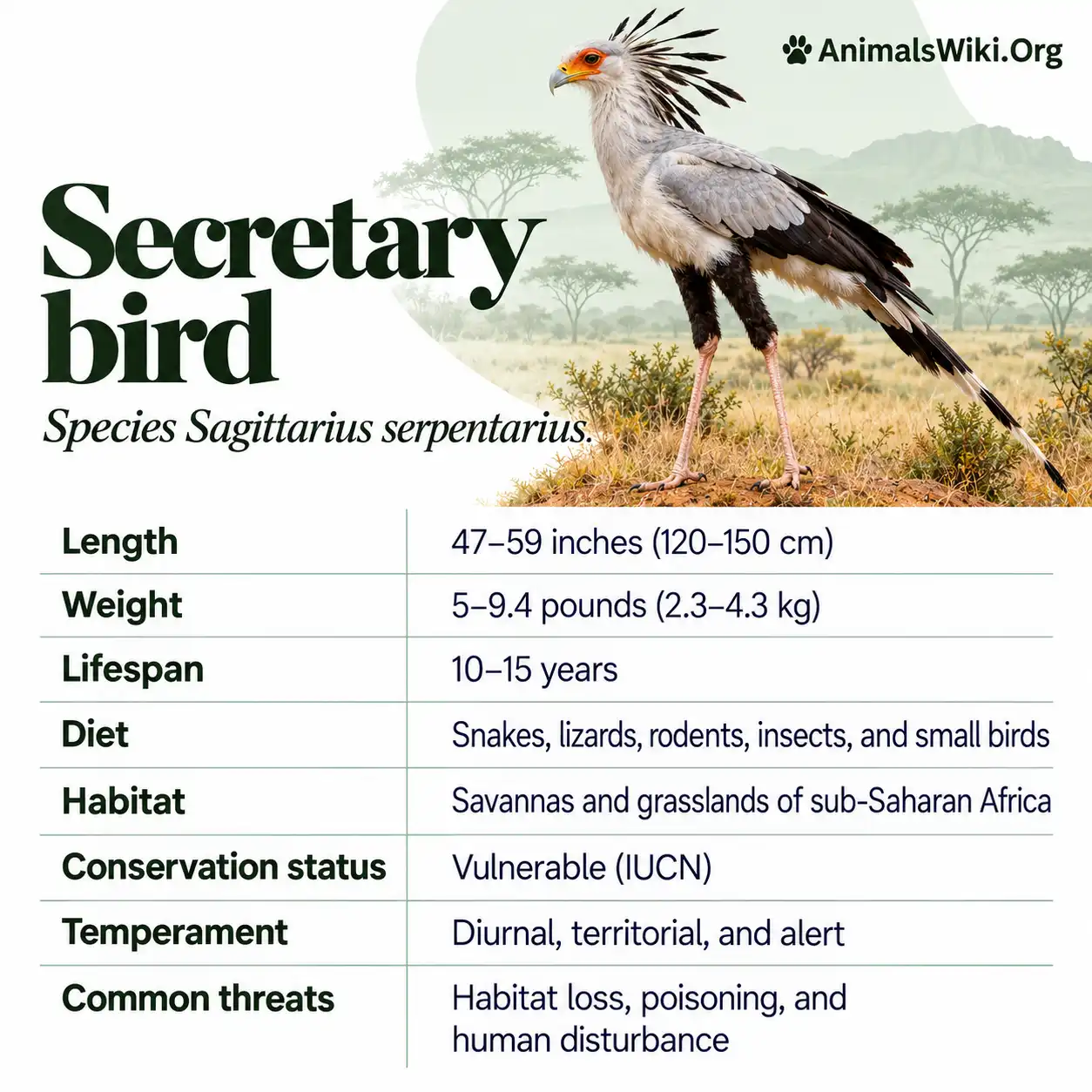
| Feature | Information |
|---|---|
| Common Name | Secretary Bird |
| Scientific Name | Sagittarius serpentarius |
| Animal Type | Bird |
| Bird Type | Bird of prey / raptor |
| Order | Accipitriformes |
| Family | Sagittariidae |
| Genus | Sagittarius |
| Living Species in Family | 1 |
| Native Region | Sub-Saharan Africa |
| Habitat | Savanna, grassland & open scrub |
| Height | Around 1.2–1.3 m |
| Weight | Roughly 3–4.5 kg |
| Wingspan | Roughly 1.9–2.1 m |
| Diet | Carnivorous |
| Activity | Diurnal |
| Hunting Style | Mostly terrestrial |
| Famous Prey | Snakes |
| Main Weapon | Powerful feet & legs |
| Nest | Large stick platform in tree |
| Eggs | Usually 1–3 |
| Major Threat | Habitat degradation and human pressures |
What Is a Secretary Bird?
The Secretary Bird is a large terrestrial bird of prey native to:
Africa.
Its scientific name is:
Sagittarius serpentarius.
Although its long legs may resemble those of cranes or storks, it is a true:
raptor.
Is the Secretary Bird a Bird of Prey?
Yes.
Secretary Birds belong to the order:
Accipitriformes.
This broader raptor group includes birds such as:
- Eagles
- Hawks
- Kites
- Vultures
The Secretary Bird, however, belongs to its own distinctive family:
Sagittariidae.
Is the Secretary Bird an Eagle?
No.
It is related within the broader radiation of accipitriform:
raptors,
but it is not an eagle.
Scientific Classification of the Secretary Bird
| Classification | Name |
|---|---|
| Kingdom | Animalia |
| Phylum | Chordata |
| Class | Aves |
| Order | Accipitriformes |
| Family | Sagittariidae |
| Genus | Sagittarius |
| Species | Sagittarius serpentarius |
How Many Secretary Bird Species Are There?
There is only:
one living species.
It is the sole living representative of the family:
Sagittariidae.
Why Is It Called a Secretary Bird?
The exact origin of the English name remains:
debated.
A popular explanation suggests that the long black crest feathers reminded Europeans of old-fashioned clerks or secretaries carrying quill pens behind their:
ears.
Another proposed explanation connects the name with linguistic transformations of terms associated with:
hunting birds.
Because the historical origin is uncertain, the “quill pen secretary” story should not be presented as unquestionable:
fact.
What Does Sagittarius Serpentarius Mean?
The scientific name strongly reflects the bird’s:
appearance and behavior.
Sagittarius can be associated with an:
archer.
Serpentarius refers to:
snakes or serpents.
The species has long been famous for hunting:
snakes.
What Does a Secretary Bird Look Like?
The Secretary Bird has an extraordinary combination of features:
- Eagle-like head
- Hooked raptor bill
- Long black crest feathers
- Bare orange or reddish facial skin
- Gray body
- Black flight feathers
- Long tail feathers
- Extremely long legs
- Powerful feet
Few other birds look remotely:
similar.
Why Does the Secretary Bird Have Long Legs?
Its long legs are adaptations for a primarily:
terrestrial hunting lifestyle.
They allow the bird to:
- See over vegetation
- Walk efficiently
- Cover large areas
- Strike prey
- Keep its head away from dangerous animals
How Tall Is a Secretary Bird?
Adults commonly stand around:
1.2–1.3 meters tall.
Much of that impressive height comes from the:
legs.
How Much Does a Secretary Bird Weigh?
Adults commonly weigh approximately:
3–4.5 kg.
Exact size varies between individuals.
What Is a Secretary Bird’s Wingspan?
Its wingspan is roughly:
1.9–2.1 meters.
The broad wings make the bird an impressive:
flier.
Are Male Secretary Birds Bigger Than Females?
Males and females look broadly:
similar.
Males may average slightly larger in some measurements, but the sexes are not dramatically different in appearance.
What Color Is a Secretary Bird?
The main body is:
gray.
Contrasting areas include:
- Black wing feathers
- Black thighs
- Black crest feathers
- Pale lower legs
- Orange-to-reddish facial skin
This creates a striking and elegant:
appearance.
Why Does the Secretary Bird Have Black Feathers Behind Its Head?
The elongated feathers form its famous:
crest.
The bird can raise or alter the position of these feathers during:
behavioral displays.
Does the Secretary Bird Have Eyelashes?
Secretary Birds appear to have extremely prominent:
eyelashes.
These are specialized feather structures around the eyes rather than mammalian hair.
They contribute to the bird’s distinctive facial:
appearance.
Where Do Secretary Birds Live?
Secretary Birds occur across parts of:
sub-Saharan Africa.
Their distribution extends through suitable open habitats from portions of West and East Africa into:
southern Africa.
Do Secretary Birds Live in the Sahara?
They are not birds of the central hyper-arid:
Sahara Desert.
They favor more productive open habitats south of the Sahara.
Secretary Bird Habitat
Typical habitat includes:
- Savanna
- Open grassland
- Lightly wooded grassland
- Open scrub
- Semi-arid plains
They generally avoid extremely dense:
forest.
Why Do Secretary Birds Prefer Open Grasslands?
Open habitat allows them to:
- Walk efficiently
- Spot prey
- Chase animals
- Use their long legs effectively
- Take off and land
Dense forest would interfere with their specialized terrestrial:
hunting strategy.
Are Secretary Birds Terrestrial?
Yes.
They are among the most strongly ground-oriented of all:
raptors.
They spend much of the day walking while searching for:
prey.
Where Do Secretary Birds Sleep?
They typically roost in:
trees.
This gives them protection from many ground-level threats during:
the night.
What Do Secretary Birds Eat?
Secretary Birds are:
carnivores.
Their diet can include:
- Grasshoppers
- Beetles
- Other insects
- Lizards
- Snakes
- Frogs
- Small mammals
- Birds
- Eggs
Diet varies according to habitat and prey:
availability.
Do Secretary Birds Eat Snakes?
Yes.
Snake hunting is one of their most famous:
behaviors.
Do Secretary Birds Only Eat Snakes?
No.
This is a major misconception.
Snakes are only one component of a much broader:
diet.
Insects and other small prey can be extremely important.
Do Secretary Birds Eat Venomous Snakes?
They can attack venomous:
snakes.
However, this does not mean every Secretary Bird regularly fights cobras, mambas or other highly dangerous snakes.
They are opportunistic hunters.
Do Secretary Birds Kill Cobras?
They are physically capable of attacking some:
venomous snakes, including cobra-like prey under suitable circumstances.
But viral descriptions of Secretary Birds routinely fighting large cobras exaggerate their everyday:
ecology.
Do Secretary Birds Kill Mambas?
Potential encounters with dangerous snakes are possible within overlapping ranges.
However, it would be misleading to describe large mambas as normal or preferred:
prey.
Are Secretary Birds Immune to Snake Venom?
There is no good basis for assuming Secretary Birds are universally immune to:
snake venom.
Their strategy is primarily to avoid being bitten.
Long legs, fast foot strikes and careful positioning reduce direct exposure to:
fangs.
How Do Secretary Birds Kill Snakes?
They attack primarily with their:
feet.
The bird can deliver rapid downward strikes that:
- Stun
- Injure
- Immobilize
- Kill
the snake.
Do Secretary Birds Kick Snakes?
Yes.
“Kicking” and forceful downward stamping are central to their famous snake-hunting:
technique.
How Powerful Is a Secretary Bird’s Kick?
Scientific biomechanical research has shown that Secretary Birds can deliver exceptionally:
fast and forceful foot strikes.
The impact can involve several times the bird’s own:
body weight.
This is enough to rapidly incapacitate many small prey animals.
How Fast Can a Secretary Bird Kick?
Experimental observations indicate that a foot strike can be completed in only:
a few hundredths of a second.
The exact speed and force vary by strike and individual.
The key advantage is the combination of:
speed, accuracy and force.
Why Doesn’t the Snake Bite the Secretary Bird?
Sometimes a snake potentially:
could.
The bird is not magically protected.
Instead, the Secretary Bird reduces risk by:
- Maintaining distance
- Using long legs
- Striking rapidly
- Moving around the prey
- Avoiding the snake’s head
Successful hunting depends heavily on:
precision.
Do Secretary Birds Use Their Wings When Fighting Snakes?
They may spread or move their wings during an encounter.
This can help with:
- Balance
- Maneuverability
- Positioning
The wings are not normally used as the primary:
weapon.
Do Secretary Birds Stomp Their Prey?
Yes.
Forceful stamping is an important way of subduing:
prey.
Do Secretary Birds Eat Their Prey Whole?
Small prey may be swallowed:
whole.
Larger animals may require additional handling.
Do Secretary Birds Have Sharp Talons?
They possess raptor-like feet, but their foot anatomy differs from that of strongly grasping aerial predators such as:
eagles.
Their feet are especially effective for:
striking and stamping.
Do Secretary Birds Hunt From the Air?
Most hunting occurs:
on the ground.
They are capable fliers, but their characteristic feeding strategy involves walking through open habitat.
How Far Do Secretary Birds Walk?
Secretary Birds can travel:
many kilometers in a day
while foraging.
They may spend hours continuously moving through:
grassland.
Can Secretary Birds Run?
Yes.
Their long legs allow them to move quickly across:
the ground.
Running can be useful when:
- Pursuing prey
- Escaping danger
- Preparing for takeoff
How Fast Can a Secretary Bird Run?
Precise maximum running-speed measurements are not well standardized.
It is safer to describe them as:
fast and efficient terrestrial walkers and runners
rather than assigning an unsupported exact speed.
Can Secretary Birds Fly?
Yes.
Despite spending most of their hunting time on the ground, Secretary Birds are strong:
fliers.
How Does a Secretary Bird Take Off?
Because of its long legs and large body, it may:
run
before becoming airborne.
Once aloft, it can fly effectively and:
soar.
Can Secretary Birds Soar?
Yes.
Their broad wings allow them to use:
rising air currents.
Do Secretary Birds Migrate?
They are generally not classic long-distance migrants.
Movements can occur in response to:
- Rainfall
- Food availability
- Habitat conditions
Are Secretary Birds Diurnal?
Yes.
They are primarily active during:
daylight.
They usually roost in trees at:
night.
Secretary Bird Behavior
Secretary Birds are often encountered:
alone or in pairs.
Pairs may forage within the same general area while remaining some distance apart.
Do Secretary Birds Live in Flocks?
Not typically.
Large permanent flocks are not characteristic of:
the species.
Do Secretary Birds Mate for Life?
Breeding pairs can form long-term:
bonds.
But “mate for life” should not be treated as an absolute rule for every individual.
Are Secretary Birds Territorial?
Breeding pairs can occupy and defend large:
home ranges or territories.
Their extensive foraging requirements mean they need substantial open:
landscapes.
How Do Secretary Birds Communicate?
They communicate through:
- Calls
- Body posture
- Crest position
- Courtship behavior
- Flight displays
What Sound Does a Secretary Bird Make?
Secretary Birds are not among the loudest:
raptors.
They can produce:
- Croaking sounds
- Whistles
- Clucking or growling-like sounds
especially around nests and during social interactions.
Secretary Bird Courtship
Courtship can involve dramatic:
aerial displays.
Pairs may:
- Soar
- Chase one another
- Dive
- Circle
- Perform undulating flights
These displays help reinforce:
pair bonds.
Where Do Secretary Birds Build Nests?
Despite hunting on the ground, Secretary Birds build nests in:
trees.
Flat-topped thorn trees and similar structures can provide suitable nesting:
sites.
What Does a Secretary Bird Nest Look Like?
The nest is a large platform constructed mainly from:
sticks.
It may be lined with softer vegetation.
How Big Is a Secretary Bird Nest?
Nests can become very:
large.
Repeated use and additional material can create a broad structure well over:
a meter across.
Do Secretary Birds Reuse Their Nests?
Yes.
Pairs may return to and repair existing:
nests.
How Many Eggs Do Secretary Birds Lay?
A typical clutch contains:
one to three eggs.
What Color Are Secretary Bird Eggs?
Eggs are generally:
pale, often with bluish or greenish tones.
How Long Do Secretary Bird Eggs Take to Hatch?
Incubation lasts roughly:
six to seven weeks.
Who Incubates Secretary Bird Eggs?
Both parents can participate, although the female generally performs much of the:
incubation.
What Is a Baby Secretary Bird Called?
A baby Secretary Bird is called a:
chick.
What Do Secretary Bird Chicks Eat?
Parents bring food to the nest.
Chicks receive prey appropriate to their:
development.
Do Both Parents Feed the Chicks?
Yes.
Both parents contribute to raising:
the young.
When Do Secretary Bird Chicks Leave the Nest?
Young birds require several months to grow, develop flight feathers and become increasingly:
independent.
Fledging generally occurs at roughly:
three months of age, with variation.
Do Young Secretary Birds Hunt Snakes Immediately?
No.
Hunting skills develop through:
experience and maturation.
Young birds must learn effective prey handling and terrestrial foraging.
How Long Do Secretary Birds Live?
Precise wild lifespan varies and is difficult to measure.
Secretary Birds can live for:
well over a decade, and managed individuals may survive substantially longer.
Secretary Bird Adaptations
Extremely Long Legs
Provide height, mobility and distance from dangerous prey.
Powerful Feet
Function as the primary hunting weapons.
Rapid Foot Strikes
Can incapacitate prey almost instantly.
Hooked Bill
Helps handle and consume animal prey.
Crest Feathers
Used in communication and visual display.
Excellent Eyesight
Helps detect movement across open grasslands.
Broad Wings
Allow strong flight and soaring.
Terrestrial Hunting
Exploits prey inaccessible to many aerial raptors.
Long Tail
Helps balance the bird in flight and during terrestrial movement.
Tree Roosting
Reduces exposure to nocturnal ground predators.
What Animals Eat Secretary Birds?
Healthy adults face relatively few regular:
predators.
Eggs and chicks are more vulnerable.
Potential threats can include:
- Large raptors
- Crows and ravens
- Snakes
- Monitor lizards
- Mammalian predators
Predator communities vary geographically.
Do Lions Eat Secretary Birds?
Large African carnivores could potentially kill a Secretary Bird if an opportunity arose.
However, lions are not specialized or major predators of:
Secretary Birds.
Do Hyenas Eat Secretary Birds?
An adult on the ground could potentially be vulnerable to a large carnivore.
Secretary Birds reduce such risks through:
- Vigilance
- Running
- Flight
- Tree roosting
Can Eagles Kill Secretary Birds?
Large raptors may represent a greater danger to:
young birds or eggs.
Healthy adults are substantial birds capable of defending themselves and escaping by flight.
How Do Secretary Birds Defend Themselves?
They can:
- Run
- Fly
- Kick
- Strike with their feet
- Use the bill if necessary
Their long legs provide powerful:
defensive weapons.
Secretary Bird vs. Eagle
| Feature | Secretary Bird | Eagle |
|---|---|---|
| Bird Type | Raptor | Raptor |
| Main Hunting Area | Ground | Often air/perch |
| Legs | Extremely long | Shorter, powerful |
| Main Attack | Kicking/stamping | Grasping with talons |
| Flight | Strong | Strong |
| Famous Prey | Snakes & small animals | Highly variable |
| Habitat | Mainly African open country | Worldwide except Antarctica |
Secretary Bird vs. Crane
Secretary Birds and cranes can look superficially similar because both have:
long legs.
But they are not close equivalents.
Secretary Birds are:
raptors.
Cranes belong to:
Gruiformes.
Secretary Birds also possess hooked predatory:
bills.
Secretary Bird vs. Stork
Both can be tall, long-legged birds.
But storks belong to:
Ciconiidae.
Secretary Birds belong to:
Sagittariidae
and are specialized terrestrial:
raptors.
Secretary Bird vs. Ostrich
| Feature | Secretary Bird | Ostrich |
|---|---|---|
| Height | ~1.2–1.3 m | Up to ~2.7 m |
| Flight | Can fly | Flightless |
| Diet | Carnivorous | Omnivorous, plant-heavy |
| Main Hunting | Walks & kicks prey | Not a specialized predator |
| Wings | Functional for flight | Non-flight wings |
| Family | Sagittariidae | Struthionidae |
Secretary Bird vs. Roadrunner
Both hunt extensively:
on foot.
Both can eat:
reptiles.
But the Secretary Bird is a much larger African:
raptor,
while Roadrunners are members of the:
cuckoo family.
Secretary Bird vs. Snake Eagle
Snake Eagles often search for snakes from:
the air or perches.
Secretary Birds usually encounter prey while:
walking across the ground.
Both demonstrate different evolutionary solutions to hunting:
reptiles.
Are Secretary Birds Dangerous to Humans?
Secretary Birds do not normally pose a serious threat to:
humans.
People are not their prey.
Do Secretary Birds Attack Humans?
Unprovoked attacks are not characteristic:
behavior.
A cornered, nesting or handled bird could nevertheless defend itself.
Can a Secretary Bird Kick a Human?
Physically:
yes.
Its legs can deliver powerful strikes.
This is one reason wild birds should not be approached or:
handled.
Can Secretary Birds Be Pets?
No.
Secretary Birds are large wild raptors with:
- Extensive space requirements
- Specialized diets
- Strong hunting instincts
- Powerful legs
- Legal protections
They are unsuitable as ordinary:
pets.
Are Secretary Birds Endangered?
Secretary Birds have undergone serious population declines across parts of their:
range.
Their conservation situation is a major concern.
Because formal assessments can change over time, current conservation status and numerical population estimates should always be checked against the latest authoritative assessment when publishing updated figures.
Why Are Secretary Birds Declining?
Major threats include:
- Habitat loss
- Habitat degradation
- Agricultural expansion
- Overgrazing
- Infrastructure development
- Human disturbance
- Fire regime changes
- Collisions
- Electrocution on power infrastructure
- Persecution in some areas
Does Farming Affect Secretary Birds?
Agriculture can transform natural:
grassland and savanna.
Some modified landscapes may still be used, but intensive habitat conversion can reduce:
- Prey
- Nest sites
- Suitable foraging space
Do Power Lines Threaten Secretary Birds?
Large birds can be vulnerable to:
- Collisions
- Electrocution
depending on infrastructure design.
Safer power-line construction can reduce these:
risks.
Does Overgrazing Affect Secretary Birds?
Heavy grazing can alter:
- Vegetation structure
- Insect populations
- Small vertebrate communities
- Fire patterns
and therefore reduce habitat quality.
Why Do Secretary Birds Need Large Habitats?
Their hunting strategy involves covering extensive:
ground.
A landscape must contain enough prey, open foraging habitat and suitable nesting:
trees.
How Can Secretary Birds Be Protected?
Important conservation measures include:
- Protecting savannas
- Maintaining grasslands
- Preserving nesting trees
- Reducing disturbance
- Making power infrastructure safer
- Preventing persecution
- Monitoring populations
- Managing fire appropriately
- Supporting conservation areas
Why Are Secretary Birds Important to Ecosystems?
They are predators of:
- Insects
- Reptiles
- Small mammals
- Other small animals
This places them within important:
terrestrial food webs.
Do Secretary Birds Control Snake Populations?
They do consume snakes and therefore contribute to natural predator-prey:
relationships.
However, describing them as dedicated “snake-control machines” oversimplifies their much broader ecological:
role.
Do Secretary Birds Control Insects?
Yes.
Large insects can form a substantial part of the diet, meaning Secretary Birds also influence:
invertebrate populations.
50 Interesting Secretary Bird Facts
- The Secretary Bird is a raptor.
- Its scientific name is Sagittarius serpentarius.
- It is native to Africa.
- It occurs primarily south of the Sahara.
- It belongs to the family Sagittariidae.
- It is the only living species in its family.
- Secretary Birds are famous for extremely long legs.
- They can stand around 1.2–1.3 meters tall.
- Their wingspan can reach roughly two meters.
- Their bodies are primarily gray.
- They have black flight feathers.
- They have long black crest feathers.
- Bare facial skin can appear orange to reddish.
- Secretary Birds are carnivores.
- They hunt mainly on the ground.
- They spend hours walking.
- They can travel many kilometers while feeding.
- Secretary Birds eat insects.
- They eat lizards.
- They eat small mammals.
- They eat frogs.
- They eat snakes.
- Some snake prey can be venomous.
- They are not known to be universally immune to snake venom.
- They reduce snake-bite risk by attacking with their feet.
- Their foot strikes are exceptionally fast.
- Their kicks can deliver forces several times their body weight.
- They can stomp prey repeatedly.
- They do not eat only snakes.
- Insects can be important prey.
- Secretary Birds can run.
- They can fly.
- They can soar.
- They often roost in trees.
- They are mainly active during the day.
- Adults often occur alone or in pairs.
- Breeding pairs perform aerial displays.
- They build large stick nests.
- Their nests are constructed in trees.
- Nests may be reused.
- Females typically lay one to three eggs.
- Both parents help care for young.
- Chicks remain dependent for months.
- Secretary Birds are not cranes.
- They are not storks.
- They are genuine birds of prey.
- They are not specialized exclusively for cobra hunting.
- Habitat degradation threatens populations.
- Their long legs are both locomotor tools and weapons.
- The Secretary Bird is one of the world’s most specialized terrestrial raptors.
Did You Know?
A Secretary Bird can use its leg almost like a high-speed hammer.
Morning begins across an African:
savanna.
The grass is dry.
A tall gray bird steps through:
it.
One foot.
Then another.
Its body sits more than a meter above:
the ground.
Black crest feathers rise behind its:
head.
From a distance, the bird appears elegant.
Almost delicate.
But underneath that body are two extraordinary:
weapons.
The Secretary Bird walks forward.
Something moves in:
the grass.
The bird stops.
Its eyes lock onto the:
movement.
A snake emerges.
The Secretary Bird does not immediately lower its face toward:
the reptile.
That would put its eyes and head close to:
the snake’s strike.
Instead, the bird stays:
upright.
The snake moves.
The Secretary Bird shifts:
position.
Then—
STOMP.
One foot flashes:
downward.
The strike happens so rapidly that human eyes can struggle to follow every detail.
The snake reacts.
Another:
strike.
The bird’s long legs provide something extremely valuable:
distance.
Its head can remain relatively far from the dangerous end of:
the prey.
If the snake moves, the bird can:
- Step away
- Change angle
- Strike again
Eventually the prey is:
subdued.
Only then does the Secretary Bird bring its hooked bill close enough to:
feed.
This hunting technique reveals why the bird’s unusual body makes:
sense.
Most raptors attack using powerful talons attached to relatively shorter:
legs.
Many seize prey from:
the air.
The Secretary Bird took a different evolutionary path.
It became a predator that:
walks.
Its hunting territory is the:
ground.
Its search strategy is:
distance.
Its main weapon is:
impact.
And the famous snake encounter is only one version of the technique.
The same legs can strike:
- Lizards
- Rodents
- Insects
- Frogs
- Other prey
The Secretary Bird therefore isn’t simply a:
snake killer.
It is something much more unusual.
A raptor redesigned for hunting:
on foot.
Frequently Asked Questions About Secretary Birds
What is a Secretary Bird?
The Secretary Bird is a large, long-legged African bird of prey.
What is the scientific name of the Secretary Bird?
Sagittarius serpentarius.
Is the Secretary Bird a raptor?
Yes.
Is the Secretary Bird an eagle?
No, although both belong to the broader accipitriform raptor group.
Is the Secretary Bird a stork?
No.
Is the Secretary Bird a crane?
No.
What family does the Secretary Bird belong to?
Sagittariidae.
How many Secretary Bird species are there?
There is one living species.
Where do Secretary Birds live?
Across suitable open habitats in sub-Saharan Africa.
Do Secretary Birds live in Africa?
Yes. They are native to Africa.
Do Secretary Birds live in the Sahara?
They generally inhabit suitable open country south of the central Sahara rather than the extreme desert interior.
What habitat do Secretary Birds prefer?
Savannas, grasslands and open scrub.
Do Secretary Birds live in forests?
They generally avoid dense forest.
Why do Secretary Birds need open habitat?
Open terrain allows them to walk, detect prey and hunt efficiently.
How tall is a Secretary Bird?
Approximately 1.2–1.3 meters.
How much does a Secretary Bird weigh?
Usually around 3–4.5 kg.
What is a Secretary Bird’s wingspan?
Roughly 1.9–2.1 meters.
Why are Secretary Bird legs so long?
They are adapted for walking, seeing over vegetation and striking prey while maintaining distance.
Why does the Secretary Bird have a crest?
The crest is involved in visual communication and contributes to the species’ distinctive appearance.
Why is it called the Secretary Bird?
The name’s exact origin is debated. One popular explanation compares its crest feathers to quill pens once carried by secretaries.
What does Sagittarius serpentarius mean?
The name refers broadly to an archer and an association with serpents.
Are Secretary Birds carnivores?
Yes.
What do Secretary Birds eat?
Insects, snakes, lizards, frogs, small mammals, birds and other small animals.
Do Secretary Birds eat snakes?
Yes.
Do Secretary Birds only eat snakes?
No. Their diet is much broader.
Do Secretary Birds eat cobras?
They can attack venomous snakes, potentially including some cobras, but cobras are not their exclusive or routine prey.
Do Secretary Birds eat mambas?
They may potentially encounter them, but large mambas should not be presented as normal everyday prey.
Are Secretary Birds immune to snake venom?
There is no reason to assume universal venom immunity.
How do Secretary Birds avoid snake bites?
They maintain distance and use rapid, precise foot strikes.
How do Secretary Birds kill snakes?
Primarily by kicking and stamping them.
How powerful is a Secretary Bird’s kick?
Biomechanical studies indicate their foot strikes can deliver impacts several times their body weight.
How fast is a Secretary Bird’s kick?
A strike can occur within only a few hundredths of a second.
Do Secretary Birds use their beaks to kill snakes?
The bill can help handle prey, but the feet are the principal striking weapons.
Do Secretary Birds have talons?
They have powerful raptor feet, although their anatomy is particularly adapted to striking rather than the extreme grasping seen in many eagles.
Do Secretary Birds stomp prey?
Yes.
Do Secretary Birds eat insects?
Yes. Insects can be an important part of their diet.
Do Secretary Birds eat grasshoppers?
Yes.
Do Secretary Birds eat rodents?
Small mammals can be prey.
Do Secretary Birds eat lizards?
Yes.
Do Secretary Birds eat frogs?
Yes.
Do Secretary Birds hunt on the ground?
Yes. This is their characteristic hunting style.
How far can a Secretary Bird walk?
They can cover many kilometers while foraging during a day.
Can Secretary Birds run?
Yes.
Can Secretary Birds fly?
Yes.
Can Secretary Birds soar?
Yes.
Why do Secretary Birds run before flying?
Running can help a large long-legged bird generate momentum for takeoff.
Are Secretary Birds flightless?
No. They are fully capable of flight.
Are Secretary Birds nocturnal?
No. They are mainly diurnal.
Where do Secretary Birds sleep?
Usually in trees.
Do Secretary Birds live alone?
They are commonly encountered alone or in pairs.
Do Secretary Birds live in flocks?
Large permanent flocks are unusual.
Do Secretary Birds mate for life?
Pairs may maintain long-term bonds, although this should not be treated as an absolute rule.
How do Secretary Birds court?
Pairs can perform spectacular aerial displays involving soaring, chasing and diving.
Where do Secretary Birds nest?
In trees.
Why do ground-hunting Secretary Birds nest in trees?
Elevated nests provide protection and secure sites for eggs and chicks.
What are Secretary Bird nests made from?
Primarily sticks, often lined with softer vegetation.
How many eggs do Secretary Birds lay?
Usually one to three.
How long do Secretary Bird eggs incubate?
Roughly six to seven weeks.
Do both parents care for chicks?
Yes.
What is a baby Secretary Bird called?
A chick.
How long until Secretary Bird chicks fly?
They generally fledge at around three months, although development varies.
Do young Secretary Birds know how to kill snakes?
Their hunting abilities improve through development and experience.
How long do Secretary Birds live?
They can live well over a decade, with longer lifespans possible under managed conditions.
What predators eat Secretary Birds?
Eggs and chicks are more vulnerable than adults and may be threatened by large birds, reptiles and mammals.
Can lions eat Secretary Birds?
It is possible opportunistically, but lions are not specialized Secretary Bird predators.
How do Secretary Birds defend themselves?
They can run, fly and deliver powerful kicks.
Can a Secretary Bird kill a human?
Secretary Birds do not hunt humans and are not considered dangerous human predators.
Can a Secretary Bird hurt a human?
A defensive bird could cause injury with its powerful feet.
Are Secretary Birds friendly?
They are wild raptors and should not be interpreted as domesticated or naturally friendly animals.
Can Secretary Birds be pets?
No. Their ecological needs, behavior and legal protection make them unsuitable pets.
Are Secretary Birds endangered?
Their populations have declined substantially and the species is of serious conservation concern.
Why are Secretary Birds declining?
Habitat degradation, agriculture, infrastructure, disturbance, fire changes and other human pressures contribute.
Do power lines kill Secretary Birds?
Collisions and electrocution can threaten large birds in some landscapes.
Does habitat loss threaten Secretary Birds?
Yes.
Why are Secretary Birds important?
They are native predators that influence insect, reptile and small-vertebrate populations.
Do Secretary Birds control snakes?
They eat snakes, but their ecological role is much broader than snake control alone.
Do Secretary Birds control insects?
Yes. They consume many insects.
What is the difference between a Secretary Bird and an Eagle?
Secretary Birds hunt mainly while walking and strike prey with long legs, whereas many eagles hunt from the air or perches and seize prey with powerful grasping talons.
What is the difference between a Secretary Bird and a Crane?
Secretary Birds are raptors; cranes are not.
What is the difference between a Secretary Bird and an Ostrich?
Secretary Birds are smaller carnivorous raptors capable of flight, while Ostriches are enormous flightless omnivores.
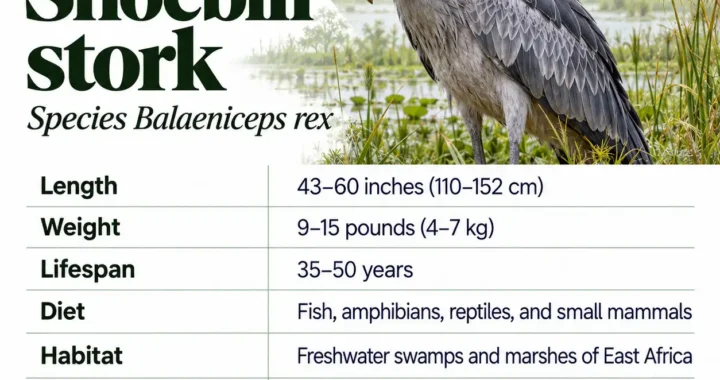
What is the difference between a Secretary Bird and a Shoebill?
The Secretary Bird is a terrestrial African raptor that hunts across savannas with powerful kicks. The Shoebill is a large wetland bird that ambushes fish and other aquatic prey with an enormous bill.
What is the most interesting Secretary Bird fact?
Instead of relying mainly on aerial attacks like many raptors, the Secretary Bird can walk across African grasslands for hours and use its extraordinarily long legs to deliver lightning-fast, powerful strikes to snakes and other prey.
Conclusion
The Secretary Bird looks as though evolution combined two completely different kinds of:
bird.
Above—
the hooked bill.
Sharp eyes.
Broad wings.
Predatory instincts of a:
raptor.
Below—
legs so long that the bird can stand more than a meter above:
the ground.
Those legs transformed the way this predator:
hunts.
Instead of spending its entire day watching the landscape from a high perch, the Secretary Bird comes:
down.
It walks.
Across savanna.
Through grassland.
Across open plains.
Kilometer after:
kilometer.
An insect moves.
The bird:
strikes.
A lizard runs.
The bird:
chases.
Then a snake appears.
The Secretary Bird does not need to put its head immediately within range of:
fangs.
Its weapon is already touching:
the ground.
A foot rises.
Then comes:
impact.
Fast.
Accurate.
Powerful.
The snake is not the only possible victim.
Those same legs can dispatch many different forms of:
prey.
And that is one of the most important facts about the Secretary Bird.
It is famous for:
snakes.
But it is not merely a snake:
killer.
It is a specialized terrestrial:
raptor.
Its long legs allow it to explore an ecological hunting strategy few other birds of prey have taken to such an:
extreme.
Then evening arrives.
The ground hunter changes roles.
It spreads wings approaching:
two meters across.
Runs.
Takes off.
And rises toward:
a tree.
There it can roost above many dangers of the African:
night.
During breeding season, the same trees hold enormous:
stick nests.
Chicks grow there under the protection of parents whose daily lives are spent patrolling the:
ground below.
But open African landscapes are changing.
Grasslands become farms.
Nesting trees disappear.
Infrastructure crosses:
habitat.
Fire patterns change.
And a bird evolved to walk enormous distances requires something increasingly difficult to preserve:
space.
Protect that space, and one of Africa’s most extraordinary predators can continue doing what it has evolved to do.
Walk.
Watch.
Strike.
Fly.
A bird of prey that hunts with the elegance of a raptor—
and the legs of almost no other:
raptor on Earth.