Shoebill Stork, The Giant Prehistoric-Looking Bird of Africa’s Wetlands
The Shoebill, often called the Shoebill stork, is one of the most extraordinary birds on Earth.
Tall.
Silent.
Almost motionless.
And equipped with an enormous:
shoe-shaped bill.
Its scientific name is:
Balaeniceps rex.
The name Balaeniceps essentially refers to its remarkable:
whale-like head.
And rex means:
king.
It is an appropriate name for a bird that can stand more than a meter tall while staring across an African swamp with an almost:
prehistoric appearance.
At first glance, the Shoebill looks like an unusual:
stork.
That explains its famous nickname:
Shoebill stork.
But the Shoebill is not classified as a true stork.
True storks belong to the family:
Ciconiidae.
The Shoebill belongs to its own family:
Balaenicipitidae.
Modern evolutionary evidence places it within the broader order Pelecaniformes, making its relationships closer to birds such as:
- Pelicans
- Herons
- Hamerkops
than its common “stork” name might suggest.
The Shoebill is native to tropical:
East-Central Africa.
It inhabits enormous freshwater wetlands, especially places containing:
- Papyrus
- Reeds
- Floating vegetation
- Shallow water
- Swamps
- Marshes
Here it hunts in a remarkable way.
A Shoebill may stand completely:
still.
Minutes can pass.
Its eyes remain fixed on:
the water.
Then suddenly—
the entire bird launches its enormous head:
forward.
The bill crashes into the vegetation and water.
When the Shoebill lifts its head again, it may be holding:
- Lungfish
- Catfish
- Tilapia
- Frogs
- Water snakes
- Other aquatic prey
The Shoebill’s hunting strategy depends heavily on:
patience.
Its movements can be so slow and deliberate that the bird appears almost:
statue-like.
But when prey comes within range, the strike can be:
explosive.
Its giant bill is not simply oversized decoration.
It is a powerful:
hunting tool.
The hooked tip helps grip and manipulate prey.
The broad bill can capture animals hidden among dense aquatic:
vegetation.
Shoebills are particularly famous for hunting:
African lungfish.
Lungfish can survive in oxygen-poor wetlands where many other fish struggle.
Shoebills are remarkably well suited to exploiting these swamp:
ecosystems.
Their huge feet spread their weight across soft vegetation.
Their long legs allow them to move through:
shallow water.
Their enormous wings allow them to fly above the wetlands despite their heavy:
appearance.
And unlike the loud calls of many birds, adult Shoebills are often relatively:
quiet.
One of their most famous sounds is not a conventional call at all.
It is:
bill-clattering.
The bird rapidly strikes its upper and lower bill together, producing a loud mechanical sound resembling:
machine-gun fire.
Yet behind the Shoebill’s intimidating appearance is a bird facing serious conservation:
pressure.
Wetland destruction.
Human disturbance.
Fire.
Livestock.
Illegal capture.
And changes to freshwater ecosystems can all threaten its:
survival.
This comprehensive guide explores Shoebill stork facts, scientific name, classification, appearance, enormous bill, height, weight, wingspan, habitat, African distribution, diet, lungfish hunting, speed, flight, behavior, bill-clattering, reproduction, eggs, chicks, sibling competition, lifespan, adaptations, predators, Shoebill vs Stork, Shoebill vs Pelican, danger to humans, conservation and why this prehistoric-looking African wetland bird has fascinated people around the world.
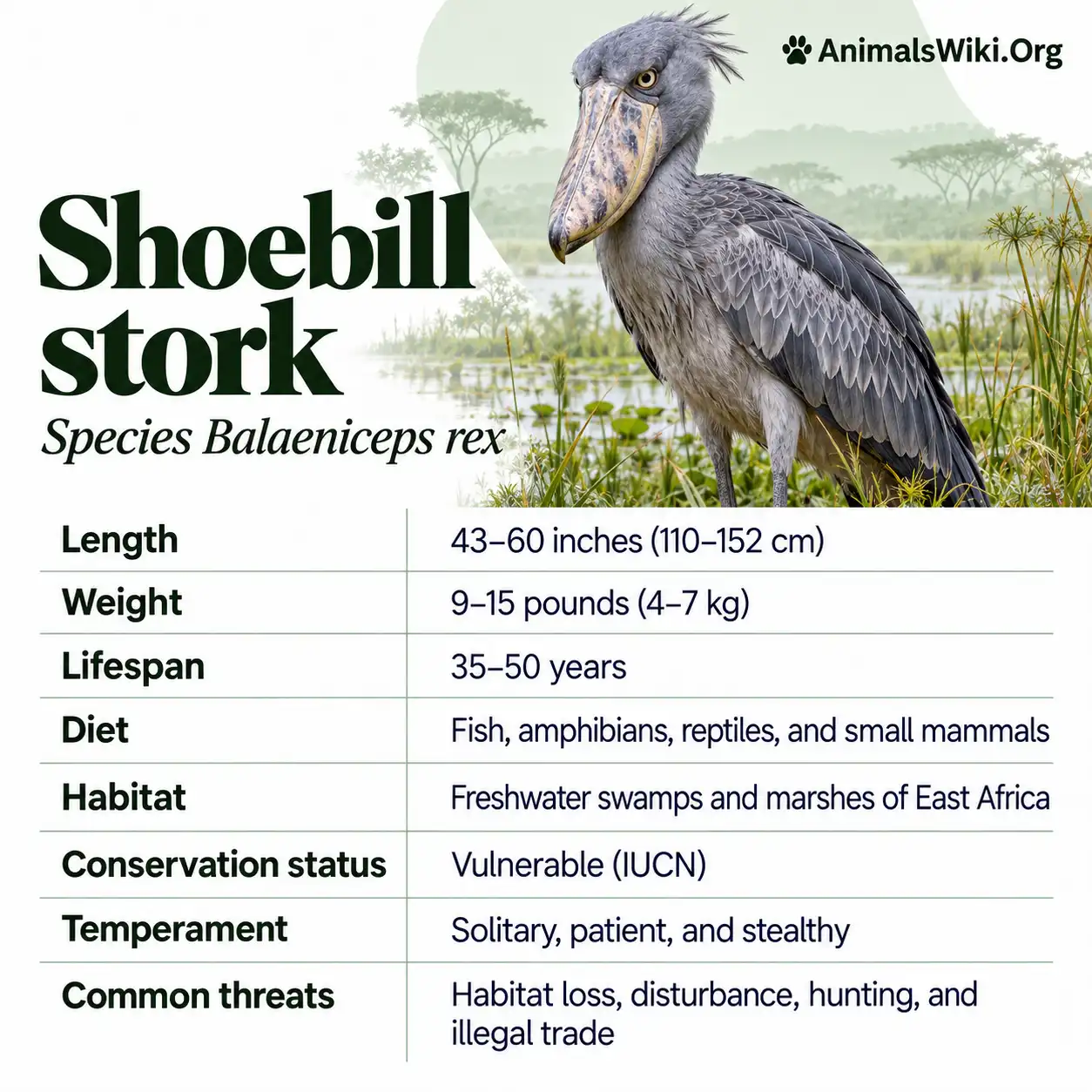
Shoebill Facts
| Feature | Information |
|---|---|
| Common Name | Shoebill |
| Popular Name | Shoebill Stork |
| Scientific Name | Balaeniceps rex |
| Class | Aves |
| Order | Pelecaniformes |
| Family | Balaenicipitidae |
| Genus | Balaeniceps |
| Species | B. rex |
| Native Region | Tropical East-Central Africa |
| Habitat | Freshwater swamps & marshes |
| Height | Roughly 1.1–1.4 m |
| Weight | Roughly 4–7 kg |
| Wingspan | Roughly 2.3–2.6 m |
| Diet | Carnivorous |
| Famous Prey | Lungfish |
| Hunting Style | Ambush / stand-and-wait |
| Activity | Mainly daytime |
| Social Behavior | Often solitary |
| Eggs | Usually 1–3 |
| Famous Sound | Bill-clattering |
| Major Threats | Wetland degradation, disturbance & capture |
What Is a Shoebill?
The Shoebill is a large African wetland bird scientifically known as:
Balaeniceps rex.
It is the only living species in the genus:
Balaeniceps.
It is also the sole living representative of the family:
Balaenicipitidae.
Is a Shoebill a Stork?
No.
Although commonly called the:
Shoebill stork,
it is not a true stork.
True storks belong to:
Ciconiidae.
Shoebills belong to:
Balaenicipitidae.
The nickname survives because the Shoebill’s:
- Long legs
- Large body
- Wetland lifestyle
- Overall silhouette
can resemble a stork.
What Is the Scientific Name of the Shoebill?
The scientific name is:
Balaeniceps rex.
What Does Balaeniceps Rex Mean?
Balaeniceps combines roots referring to:
whale + head.
Rex means:
king.
The name reflects the bird’s massive head and imposing:
appearance.
Scientific Classification of the Shoebill
| Classification | Name |
|---|---|
| Kingdom | Animalia |
| Phylum | Chordata |
| Class | Aves |
| Order | Pelecaniformes |
| Family | Balaenicipitidae |
| Genus | Balaeniceps |
| Species | Balaeniceps rex |
How Many Shoebill Species Are There?
There is only:
one living Shoebill species.
That species is:
Balaeniceps rex.
What Does a Shoebill Look Like?
The Shoebill has an unmistakable appearance.
Its most distinctive features include:
- Massive shoe-shaped bill
- Large head
- Gray plumage
- Long dark legs
- Huge feet
- Broad wings
- Small crest
- Pale penetrating eyes
Its body shape looks like a combination of several different:
waterbirds.
Why Is It Called a Shoebill?
Its enormous bill resembles an old-fashioned:
wooden shoe or clog.
This distinctive structure gave the bird its English name:
Shoebill.
How Big Is a Shoebill’s Beak?
The bill can reach approximately:
20–25 cm long
and is exceptionally broad and deep.
Exact measurements vary between individuals.
Why Is the Shoebill’s Beak So Big?
The bill is specialized for capturing relatively large aquatic:
prey.
Its broad structure helps the bird seize animals among:
- Mud
- Water
- Vegetation
The hooked tip helps:
grip and manipulate prey.
Does a Shoebill Have a Hook on Its Beak?
Yes.
The upper bill ends in a strong:
hooked tip.
This assists in controlling prey.
How Tall Is a Shoebill?
Adult Shoebills commonly stand around:
110–140 cm tall.
That means a large individual can reach roughly:
4 feet or more.
Can a Shoebill Be 5 Feet Tall?
Claims that Shoebills routinely reach five feet tall are often:
exaggerated.
Large individuals are certainly impressive, but commonly cited measurements are closer to:
1.1–1.4 meters.
How Much Does a Shoebill Weigh?
Adults generally weigh roughly:
4–7 kg.
Males tend to be somewhat larger than:
females.
What Is the Shoebill’s Wingspan?
A large Shoebill can have a wingspan of approximately:
2.3–2.6 meters.
This gives the bird an impressive appearance when:
airborne.
Are Male Shoebills Bigger Than Females?
Yes.
Males are generally somewhat:
larger and heavier.
Their bills may also be larger.
What Color Is a Shoebill?
Adults are primarily:
gray.
Their plumage can include:
- Blue-gray
- Slate-gray
- Darker flight feathers
Young birds tend to appear:
browner.
Why Does the Shoebill Look Prehistoric?
Its:
- Massive skull
- Giant hooked bill
- Tall body
- Intense stare
- Slow movements
- Broad wings
create an appearance people associate with:
prehistoric animals.
But the Shoebill is a modern bird, not a living:
dinosaur species.
Are Shoebills Dinosaurs?
In the evolutionary sense, all modern birds are living:
avian dinosaurs.
But Shoebills are not surviving non-avian dinosaurs from prehistoric swamps.
Their unusual appearance is a result of modern bird:
evolution.
Where Do Shoebills Live?
Shoebills occur in freshwater wetlands across parts of:
tropical East-Central Africa.
Countries within their range include areas of:
- South Sudan
- Uganda
- Democratic Republic of the Congo
- Rwanda
- Tanzania
- Zambia
They may occur locally elsewhere within the broader wetland region.
What Habitat Do Shoebills Prefer?
Shoebills favor large:
freshwater wetlands.
Important habitats include:
- Papyrus swamps
- Reedbeds
- Marshes
- Seasonally flooded wetlands
- Floating vegetation
- Shallow channels
Why Do Shoebills Like Swamps?
Swamps provide:
- Fish
- Amphibians
- Nesting vegetation
- Hunting cover
- Shallow feeding areas
These conditions suit the Shoebill’s specialized:
hunting technique.
Do Shoebills Live in the Nile?
Shoebills occur in parts of the greater Nile wetland:
system.
The vast wetlands of South Sudan are particularly important.
Do Shoebills Live in Uganda?
Yes.
Uganda is one of the best-known countries for wild:
Shoebills.
Do Shoebills Live in South Sudan?
Yes.
South Sudan contains extensive wetlands suitable for:
Shoebills.
Do Shoebills Live in Zambia?
Yes.
Important Shoebill habitat occurs in parts of:
Zambia.
Do Shoebills Live in Trees?
No.
Shoebills are primarily:
wetland birds.
They may perch occasionally, but their daily ecology revolves around marshes and shallow water.
Do Shoebills Have Big Feet?
Yes.
Their feet are remarkably:
large.
Long, widely spread toes help distribute their weight across:
- Mud
- Floating vegetation
- Soft swamp surfaces
Do Shoebills Have Webbed Feet?
No.
Their toes are long and spread widely but are not strongly webbed like those of:
ducks or pelicans.
What Do Shoebills Eat?
Shoebills are:
carnivores.
Their diet can include:
- Lungfish
- Catfish
- Tilapia
- Other fish
- Frogs
- Water snakes
- Small reptiles
- Other aquatic animals
What Is a Shoebill’s Favorite Food?
Shoebills are particularly famous for eating:
lungfish.
However, describing any one prey species as a universal “favorite” is too simplistic.
They take available prey suited to their:
hunting technique.
Do Shoebills Eat Lungfish?
Yes.
African lungfish are among their most characteristic:
prey.
Why Are Shoebills Good at Catching Lungfish?
Lungfish inhabit swampy, oxygen-poor environments where Shoebills:
hunt effectively.
Shoebills patiently watch areas where fish approach:
the surface.
Then they strike.
Do Shoebills Eat Catfish?
Yes.
Catfish are important prey in some:
areas.
Do Shoebills Eat Frogs?
Yes.
Frogs and other amphibians may be:
eaten.
Do Shoebills Eat Snakes?
Yes.
They can capture:
water snakes.
Do Shoebills Eat Crocodiles?
This claim requires careful explanation.
Shoebills have been reported taking very small:
young crocodilians
or similarly sized reptiles.
But they do not routinely hunt large:
crocodiles.
Online images and videos often exaggerate this claim.
Do Shoebills Eat Other Birds?
Small birds or chicks may occasionally be taken, but fish and other aquatic animals form the core of their:
diet.
Do Shoebills Eat Mammals?
Small mammals may occasionally be captured if available, but Shoebills are primarily specialized hunters of:
aquatic prey.
How Does a Shoebill Hunt?
The Shoebill often uses a:
stand-and-wait hunting strategy.
It may remain motionless while watching:
the water.
When prey appears, it suddenly thrusts its:
head and bill forward.
Why Do Shoebills Stand So Still?
Remaining motionless prevents the bird from:
alerting prey.
It also allows the Shoebill to focus on subtle movements in:
the water.
How Fast Does a Shoebill Strike?
The strike happens extremely quickly compared with the bird’s otherwise:
slow movements.
Reliable standardized measurements of exact strike speed are limited.
What Happens During a Shoebill Strike?
The bird lunges forward with its bill:
open.
It may scoop up:
- Prey
- Water
- Vegetation
- Mud
The Shoebill then manipulates the catch and discards unwanted material before:
swallowing its prey.
Does a Shoebill Decapitate Its Prey?
The enormous hooked bill can crush, cut and manipulate:
prey.
Large prey may be repeatedly handled before being swallowed.
The dramatic word “decapitate” should not be treated as the bird’s universal hunting method.
Do Shoebills Chew Their Food?
No.
Birds do not chew with teeth like:
mammals.
Once prey has been positioned appropriately, the Shoebill generally:
swallows it.
Are Shoebills Good Hunters?
Yes.
Their entire anatomy is specialized for patient wetland:
ambush hunting.
Are Shoebills Nocturnal?
Shoebills are primarily:
diurnal.
Much of their feeding activity occurs during daylight, although activity patterns can vary.
Shoebill Behavior
Shoebills are often:
solitary.
Even breeding pairs may forage at some distance from:
each other.
Do Shoebills Live in Flocks?
Usually not.
They are generally encountered:
- Alone
- In pairs
- Occasionally in loose concentrations where feeding conditions are favorable
Are Shoebills Territorial?
They can defend nesting and feeding:
areas.
Breeding birds especially maintain space around their nests.
Why Are Shoebills So Still?
Stillness is a major component of their:
hunting strategy.
Their patience helps them ambush prey without creating obvious movement.
Are Shoebills Intelligent?
They show sophisticated behaviors associated with:
- Hunting
- Nesting
- Parental care
- Environmental awareness
However, there is no scientifically useful basis for assigning them a simple human-like intelligence:
score.
Do Shoebills Blink?
Yes.
Like other birds, Shoebills:
blink.
They also possess a protective third eyelid called a:
nictitating membrane.
Why Do Shoebills Stare?
Their forward-focused attention while hunting gives them an unusually intense:
appearance.
They are concentrating on potential prey rather than intentionally trying to appear:
frightening.
Are Shoebills Silent?
Adult Shoebills are often relatively:
quiet.
But they are not completely silent.
Their best-known sound is:
bill-clattering.
What Does a Shoebill Sound Like?
Bill-clattering creates a rapid:
machine-gun-like sound.
Young birds may also produce vocal sounds when communicating with:
parents.
Why Do Shoebills Clatter Their Bills?
Bill-clattering is used during:
- Courtship
- Nesting
- Greeting
- Communication
It resembles similar behavior found in:
storks, despite the Shoebill not being a true stork.
Can Shoebills Fly?
Yes.
Despite their heavy appearance, Shoebills are fully capable:
fliers.
How Does a Shoebill Fly?
The bird uses its enormous broad wings and powerful:
wingbeats.
Like pelicans and herons, it retracts its long neck during:
flight.
Why Does a Shoebill Pull Its Neck Back While Flying?
Retracting the neck helps balance the heavy:
head and bill.
This differs from true storks, which generally fly with their necks:
extended.
How High Can a Shoebill Fly?
Shoebills are capable of sustained flight and may use rising air currents.
However, precise universal maximum flight-altitude figures are not well established.
Do Shoebills Migrate?
They are not classic long-distance migrants.
Movements are more often influenced by:
- Water levels
- Food availability
- Seasonal wetland conditions
Can Shoebills Swim?
Adults are primarily wading and flying birds rather than specialized:
swimmers.
They hunt while standing in shallow water or on vegetation.
Shoebill Reproduction
Shoebills form breeding pairs and build enormous nests in:
wetlands.
Where Do Shoebills Build Nests?
Nests are generally constructed on:
- Floating vegetation
- Swamp islands
- Dense aquatic plants
They need enough support to hold an adult and:
growing chicks.
What Is a Shoebill Nest Made Of?
Materials can include:
- Reeds
- Grasses
- Papyrus
- Other aquatic vegetation
The nest can become a large flattened:
platform.
How Many Eggs Do Shoebills Lay?
A clutch commonly contains:
one to three eggs.
Two eggs are frequently reported.
What Color Are Shoebill Eggs?
Eggs are generally:
pale or whitish.
How Long Do Shoebill Eggs Take to Hatch?
Incubation lasts approximately:
one month.
Both parents participate in caring for the:
nest.
Do Male Shoebills Incubate Eggs?
Yes.
Both male and female Shoebills can participate in:
incubation.
Do Shoebills Cool Their Eggs With Water?
Yes.
This is one of their fascinating nesting behaviors.
Adults may carry water in their bills and pour it over:
eggs or chicks.
They may also bring wet vegetation to the nest.
This helps manage heat in exposed:
wetland environments.
What Is a Baby Shoebill Called?
A baby Shoebill is called a:
chick.
What Do Shoebill Chicks Look Like?
Newly hatched chicks are:
- Small
- Down-covered
- Dependent on parents
They gradually develop the enormous bill and gray plumage characteristic of:
adults.
Do Shoebill Parents Feed Their Chicks?
Yes.
Parents provide food to:
developing chicks.
Why Does Only One Shoebill Chick Often Survive?
Although more than one egg may hatch, Shoebills commonly raise only:
one chick successfully.
Competition between siblings can be intense.
Older or stronger chicks may dominate younger:
siblings.
Differences in food access and parental investment can increase this inequality.
Do Shoebill Chicks Fight Each Other?
Sibling aggression can occur.
The stronger chick may:
attack or suppress
the weaker chick.
Do Shoebill Parents Choose the Strongest Chick?
The situation is more complex than deliberate human-like “choosing.”
Parents often invest most successfully in the chick with the highest probability of:
survival.
Sibling competition contributes to this pattern.
How Long Before a Shoebill Chick Can Fly?
Young Shoebills require several months before becoming capable of strong:
flight.
Development continues even after fledging.
How Long Do Shoebills Live?
Precise wild lifespan data are limited.
Shoebills can live for:
several decades, particularly under managed conditions.
Figures around 30 years or more are commonly associated with long-lived individuals.
Shoebill Adaptations
Giant Bill
Captures large aquatic prey.
Hooked Bill Tip
Helps grip and manipulate animals.
Long Legs
Allow movement through shallow wetlands.
Huge Feet
Distribute body weight over soft vegetation.
Long Toes
Provide stability on floating plants and mud.
Gray Plumage
Provides relatively subdued coloration in wetland surroundings.
Motionless Hunting
Prevents prey from detecting the bird.
Rapid Strike
Allows sudden capture after long periods of waiting.
Broad Wings
Support flight despite a large body.
Retracted Neck in Flight
Helps balance the enormous head.
Bill-Clattering
Provides a powerful communication signal.
Water-Carrying Behavior
Helps regulate nest temperature.
What Animals Eat Shoebills?
Adult Shoebills are large enough that they face relatively few:
natural predators.
Eggs and chicks are more vulnerable.
Potential threats may include:
- Large monitor lizards
- Snakes
- Predatory mammals
- Large birds
- Crocodilians
The exact predator community varies by location.
Do Crocodiles Eat Shoebills?
Large crocodiles are capable of attacking many animals around African:
wetlands.
Shoebills generally avoid situations that expose them to such predators.
Eggs and young birds can be especially vulnerable to various wetland predators.
Do Shoebills Fight Crocodiles?
Viral claims often exaggerate Shoebill interactions with:
crocodiles.
A Shoebill is not a specialized crocodile-fighting bird.
It primarily hunts:
fish and other manageable aquatic prey.
Are Shoebills Apex Predators?
They can be important wetland predators, but describing them universally as apex predators is:
misleading.
Large crocodiles and other predators occupy higher trophic positions in many of the same ecosystems.
Are Shoebills Dangerous to Humans?
Shoebills are not considered major threats to:
humans.
They generally avoid unnecessary confrontation.
Do Shoebills Attack Humans?
Serious unprovoked attacks on humans are not characteristic Shoebill:
behavior.
However, they are powerful wild birds with enormous bills and should never be:
provoked or handled casually.
Can a Shoebill Bite You?
Its bill can potentially cause serious:
injury.
Professional wildlife handling requires appropriate expertise.
Why Do Shoebills Bow to Humans?
Captive Shoebills sometimes display bowing or greeting behaviors toward familiar:
keepers.
Viral videos have made this behavior famous.
It should not be interpreted as proof that wild Shoebills naturally want to:
befriend humans.
Are Shoebills Friendly?
Individual captive birds may become accustomed to:
people.
Wild Shoebills should still be regarded as:
wild animals.
Can You Pet a Shoebill?
No one should attempt to approach or touch a wild Shoebill.
Interactions with managed birds should occur only under appropriate professional:
supervision.
Can Shoebills Be Pets?
No.
They are large specialized wild birds requiring:
- Wetland habitat
- Specialized food
- Large spaces
- Professional care
They are also subject to wildlife protection and trade:
regulations.
Shoebill vs. Stork
| Feature | Shoebill | True Stork |
|---|---|---|
| Family | Balaenicipitidae | Ciconiidae |
| Bill | Huge, broad & shoe-shaped | Usually long & narrower |
| Neck in Flight | Retracted | Usually extended |
| Main Habitat | African wetlands | Diverse wetlands/open habitats |
| Main Prey | Mainly aquatic animals | Highly variable |
| Famous Sound | Bill-clattering | Many also bill-clatter |
| True Stork? | No | Yes |
Shoebill vs. Pelican
Shoebills and pelicans share evolutionary relationships within:
Pelecaniformes.
But they have very different feeding structures.
Pelicans possess a large:
throat pouch.
Shoebills possess a massive:
shoe-shaped crushing and gripping bill.
Shoebill vs. Heron
Both retract the neck during flight.
Both hunt aquatic prey.
But Shoebills are:
- Heavier
- More massive-headed
- Equipped with much broader bills
Herons generally have long, spear-like:
bills.
Shoebill vs. Hamerkop
Hamerkops are much:
smaller.
Both are African wetland birds within the broader pelecaniform radiation, but the Shoebill is considerably larger and more specialized for catching substantial:
aquatic prey.
Shoebill vs. Pelican vs. Stork
The Shoebill illustrates why appearance alone can be misleading in:
taxonomy.
It looks somewhat like a stork.
Its bill may suggest a pelican.
Its neck posture in flight resembles a heron.
Modern classification places it among:
Pelecaniformes.
Are Shoebills Endangered?
The Shoebill is a conservation concern.
Its global population is relatively:
small and fragmented.
Formal conservation categories and population estimates can change as surveys improve, so the latest authoritative assessment should be checked when publishing current numerical figures.
Why Are Shoebills Threatened?
Major pressures include:
- Wetland destruction
- Wetland degradation
- Human disturbance
- Agricultural expansion
- Livestock
- Fire
- Hunting
- Egg collection
- Capture for wildlife trade
Does Habitat Loss Affect Shoebills?
Yes.
Shoebills depend heavily on large functioning:
wetland ecosystems.
Draining or altering swamps can eliminate both nesting areas and:
feeding habitat.
Are Shoebills Captured for the Pet Trade?
Illegal capture for wildlife collections has been a conservation:
concern.
Removing even a relatively small number of birds can matter when populations are already:
limited.
Does Human Disturbance Affect Shoebill Nests?
Yes.
Breeding Shoebills can be sensitive to:
disturbance.
Repeated human activity near nests can reduce breeding success.
How Can Shoebills Be Protected?
Conservation measures include:
- Protecting wetlands
- Preventing illegal capture
- Reducing nest disturbance
- Managing fires
- Working with local communities
- Protecting breeding sites
- Monitoring populations
- Supporting sustainable ecotourism
Can Ecotourism Help Shoebills?
Responsible birdwatching can create economic value for keeping:
wetlands intact.
However, tourism must be carefully managed to prevent disturbance around:
nests and feeding areas.
Why Are Shoebills Important?
Shoebills are specialized wetland:
predators.
Their survival is closely connected to healthy freshwater ecosystems.
Protecting Shoebills therefore also helps draw attention to the conservation of:
- Swamps
- Fish populations
- Papyrus wetlands
- Other waterbirds
- Amphibians
- Reptiles
50 Interesting Shoebill Facts
- The Shoebill is a bird.
- Its scientific name is Balaeniceps rex.
- It is often called the Shoebill stork.
- It is not a true stork.
- Shoebills belong to Balaenicipitidae.
- There is only one living Shoebill species.
- They are native to Africa.
- Shoebills specialize in freshwater wetlands.
- Papyrus swamps provide important habitat.
- Adults can stand over one meter tall.
- Their wingspan can exceed two meters.
- Their bill is shaped somewhat like a shoe.
- The bill can be around 20–25 cm long.
- It has a hooked tip.
- Shoebills are primarily carnivorous.
- Lungfish are famous Shoebill prey.
- They also eat catfish.
- They can eat frogs.
- They can catch water snakes.
- Reports exist of very small crocodilian prey, but they do not hunt large crocodiles.
- Shoebills are ambush hunters.
- They can remain motionless for long periods.
- Their hunting strike is sudden.
- Their feet are enormous.
- Long toes help them stand on soft vegetation.
- Their feet are not strongly webbed.
- Shoebills can fly.
- They have enormous wings.
- They retract their necks during flight.
- True storks generally fly with their necks extended.
- Shoebills are often solitary.
- They are primarily active during the day.
- Adults are relatively quiet.
- They produce loud bill-clattering.
- Bill-clattering can sound like a machine gun.
- Shoebills build large wetland nests.
- Nests are constructed from vegetation.
- Females commonly lay one to three eggs.
- Both parents participate in breeding care.
- Adults may carry water to cool eggs or chicks.
- More than one chick may hatch.
- Often only one chick ultimately survives.
- Sibling competition can be intense.
- Young Shoebills are browner than adults.
- Adults develop predominantly gray plumage.
- Shoebills can live for decades.
- They are not considered major threats to humans.
- Wetland destruction threatens them.
- Illegal capture is another conservation concern.
- Their giant bill, intense stare and motionless hunting style make Shoebills among the most distinctive birds on Earth.
Did You Know?
A Shoebill can spend minutes looking almost completely frozen—and then transform into an explosive predator in a fraction of the time.
Morning light spreads across an African:
swamp.
Papyrus rises from the water.
Insects move through the humid air.
Somewhere beneath the floating vegetation, a lungfish moves toward:
the surface.
Above it stands a:
Shoebill.
The bird does:
nothing.
Its enormous feet rest across the vegetation.
Its neck is tucked.
Its huge bill points:
downward.
One minute passes.
Then another.
To a human observer, the bird may appear almost:
asleep.
It isn’t.
The Shoebill is:
watching.
A small disturbance appears beneath the water.
The head moves.
Then becomes still:
again.
The fish rises.
Suddenly the Shoebill’s entire body drives:
forward.
Its wings open slightly for balance.
The neck extends.
The enormous bill crashes into:
the water.
Mud flies.
Plants bend.
For a moment the bird’s head almost disappears into:
the swamp.
Then it rises.
Inside the bill is:
prey.
The Shoebill must now separate food from:
- Water
- Mud
- Vegetation
Its hooked bill helps control the struggling:
animal.
Finally the prey is positioned.
And swallowed.
Then something remarkable happens.
The Shoebill returns to:
stillness.
The explosive predator becomes a statue:
again.
This contrast defines much of Shoebill hunting.
It is not a bird built to chase fish endlessly through:
water.
It lets prey come within:
range.
Its patience is part of the:
weapon.
Its enormous bill is another.
Its feet are another.
Its ability to stand on unstable swamp vegetation is:
another.
Every part of the bird fits its environment.
Even one of its strangest behaviors occurs at:
the nest.
Under intense tropical sunlight, eggs and chicks can become:
hot.
The adult walks toward:
water.
It fills its enormous bill.
Returns to the nest.
And releases water across:
the eggs or young.
The same structure that catches lungfish becomes a container for:
water.
A weapon becomes:
parental equipment.
That combination—patience, explosive hunting and surprisingly careful parental behavior—is why the Shoebill is far more interesting than the frightening expression seen in:
photographs.
Frequently Asked Questions About Shoebills
What is a Shoebill?
The Shoebill is a large African wetland bird scientifically known as Balaeniceps rex.
Is a Shoebill a stork?
No. Despite the common name “Shoebill stork,” it is not a true stork.
Why is it called a Shoebill stork?
Its tall body, long legs and wetland lifestyle resemble those of storks, while its enormous bill resembles a shoe.
What is the scientific name of the Shoebill?
Balaeniceps rex.
What does Balaeniceps rex mean?
The name refers roughly to a “whale-headed king,” reflecting its massive head and bill.
What family does the Shoebill belong to?
Balaenicipitidae.
How many Shoebill species exist?
Only one living species is recognized.
Where do Shoebills live?
In freshwater wetlands of tropical East-Central Africa.
What countries have Shoebills?
They occur in countries including South Sudan, Uganda, Democratic Republic of the Congo, Rwanda, Tanzania and Zambia.
Do Shoebills live in Uganda?
Yes.
Do Shoebills live in South Sudan?
Yes.
Do Shoebills live in Zambia?
Yes.
Do Shoebills live in swamps?
Yes. Swamps and marshes are their primary habitats.
Do Shoebills live in papyrus wetlands?
Yes.
How tall is a Shoebill?
Usually around 1.1–1.4 meters.
Are Shoebills 5 feet tall?
They are sometimes described that way online, but commonly reported adult heights are generally below five feet.
How much does a Shoebill weigh?
Roughly 4–7 kg for adults, with variation.
What is a Shoebill’s wingspan?
Approximately 2.3–2.6 meters in large adults.
Which is bigger, male or female Shoebill?
Males are generally larger.
Why is a Shoebill’s beak so large?
It is specialized for capturing and controlling relatively large aquatic prey.
How long is a Shoebill’s beak?
Approximately 20–25 cm in many adults.
Why does the Shoebill have a hook on its beak?
The hook helps grip and manipulate prey.
Why does a Shoebill look prehistoric?
Its massive bill, large head, broad wings, tall body and intense stare create a prehistoric-looking appearance.
Is a Shoebill a dinosaur?
Like all birds it descends from avian dinosaur ancestry, but it is not a surviving non-avian dinosaur.
What do Shoebills eat?
Mainly fish and other aquatic animals.
Do Shoebills eat lungfish?
Yes.
Do Shoebills eat catfish?
Yes.
Do Shoebills eat frogs?
Yes.
Do Shoebills eat snakes?
They can eat water snakes.
Do Shoebills eat crocodiles?
They may occasionally take very small crocodilians, but they do not normally hunt large crocodiles.
Do Shoebills eat humans?
No.
How does a Shoebill hunt?
It stands still, waits for prey and then performs a sudden powerful strike.
Why do Shoebills stand still?
Stillness helps prevent prey from detecting them.
Are Shoebills fast?
Their normal movements can be slow, but their hunting strike is rapid.
Can Shoebills fly?
Yes.
Do Shoebills have big wings?
Yes. Their wingspan can exceed two meters.
Why do Shoebills fly with their necks pulled back?
Retracting the neck helps balance the large head and bill.
Do Shoebills migrate?
They generally make local or seasonal movements rather than classic long-distance migrations.
Are Shoebills nocturnal?
No. They are mainly active during the day.
Are Shoebills solitary?
Usually.
Do Shoebills live in flocks?
Not normally.
Are Shoebills territorial?
They can defend breeding and feeding areas.
Do Shoebills make sounds?
Yes, although adults are relatively quiet.
What is Shoebill bill-clattering?
It is the rapid striking together of the upper and lower bill.
Why do Shoebills sound like machine guns?
Rapid bill-clattering produces a loud mechanical sound resembling machine-gun fire.
Why do Shoebills stare?
They concentrate intensely while searching for prey, producing their famous fixed expression.
Do Shoebills blink?
Yes.
Do Shoebills have a third eyelid?
Yes, a nictitating membrane protects the eye.
Where do Shoebills nest?
On vegetation platforms in swamps and wetlands.
How many eggs does a Shoebill lay?
Usually one to three.
Do both Shoebill parents incubate?
Yes.
How long do Shoebill eggs incubate?
Approximately one month.
What is a baby Shoebill called?
A chick.
Do Shoebill parents feed their chicks?
Yes.
Why do Shoebills pour water on their eggs?
Water helps cool eggs and chicks in hot wetland environments.
Do Shoebill chicks fight?
Sibling aggression can occur.
Why does only one Shoebill chick often survive?
Sibling competition and unequal access to parental resources often favor the stronger chick.
Do Shoebill parents kill the weaker chick?
It is more accurate to describe the process as sibling competition combined with differential parental investment rather than deliberate parental execution.
How long do Shoebills live?
They can survive for several decades, with managed individuals sometimes reaching around 30 years or more.
Are Shoebills dangerous?
They are powerful wild birds but are not considered significant predators of humans.
Do Shoebills attack humans?
Unprovoked serious attacks are not characteristic behavior.
Can a Shoebill hurt a person?
Yes. Its powerful bill could cause injury if the animal were mishandled or provoked.
Why do Shoebills bow?
Captive birds may use bowing or similar displays during familiar social interactions.
Are Shoebills friendly to humans?
Some managed individuals become accustomed to keepers, but wild Shoebills should not be considered domesticated or naturally friendly.
Can you pet a Shoebill?
Wild Shoebills should never be approached for petting.
Can Shoebills be pets?
No. They are specialized protected wild birds.
Are Shoebills endangered?
They are a species of conservation concern with a relatively small and fragmented global population.
Why are Shoebills threatened?
Wetland degradation, disturbance, fire, illegal capture and other human pressures threaten populations.
Are Shoebills rare?
Yes. They have a restricted distribution and relatively low population density.
Are Shoebills hunted?
Human persecution and capture have occurred in parts of their range.
Are Shoebills captured for zoos?
International movement of Shoebills is tightly connected to wildlife regulations, and illegal capture is a conservation concern.
Why are wetlands important to Shoebills?
Wetlands provide their food, hunting grounds and nesting habitat.
What happens if Shoebill wetlands disappear?
The birds lose both prey-rich feeding habitat and breeding areas.
Are Shoebills related to Pelicans?
They belong to the same broader order, Pelecaniformes.
Are Shoebills related to Herons?
They are part of the same broader pelecaniform radiation.
Are Shoebills related to Storks?
They are not true storks, despite superficial similarities and their popular nickname.
What is the difference between a Shoebill and a Stork?
Shoebills belong to Balaenicipitidae and have enormous broad bills, while true storks belong to Ciconiidae and generally possess narrower bills.
What is the difference between a Shoebill and a Pelican?
Pelicans possess expandable throat pouches for catching fish, while Shoebills use a massive rigid hooked bill for ambush hunting.
What is the difference between a Shoebill and a Heron?
Shoebills are much more heavily built and have massive broad bills instead of the long spear-like bills typical of herons.
Is the Shoebill an apex predator?
It is an important wetland predator, but calling it a universal apex predator exaggerates its position in ecosystems containing large crocodiles and other predators.
What is special about a Shoebill?
Its enormous shoe-shaped bill, patient hunting, giant feet, machine-gun-like bill-clattering and prehistoric appearance make it one of the world’s most distinctive birds.
What is the most interesting Shoebill fact?
A Shoebill can stand almost completely motionless while waiting for a lungfish, explode into a rapid hunting strike with its enormous hooked bill, and later use that same bill to carry water back to cool its eggs or chicks.
Conclusion
The Shoebill appears almost too strange to be:
real.
A bird taller than many young children.
Feet built for:
swamps.
Wings stretching more than:
two meters.
And at the center of everything—
an enormous:
shoe-shaped bill.
For much of the day, the Shoebill may appear to do almost:
nothing.
It stands.
Watches.
Waits.
A fish moves beneath the:
water.
The Shoebill remains:
still.
Then the transformation happens.
The neck launches.
The wings balance the body.
The bill crashes:
down.
And one of Africa’s strangest-looking birds becomes a remarkably effective:
predator.
But its enormous bill serves more than one purpose.
At the nest, the same bird may collect:
water.
It returns to its eggs or chicks.
Then uses that water to help protect them from the heat.
The predator becomes:
a parent.
Its reputation also demonstrates how easily appearances create:
myths.
The Shoebill looks like a:
stork.
But it is not a true stork.
It looks prehistoric.
But it is not a surviving non-avian:
dinosaur.
Its bill looks capable of attacking almost anything.
But its normal prey consists primarily of:
fish and other aquatic animals.
It looks terrifying to humans.
Yet humans represent a far greater threat to:
Shoebills
than Shoebills represent to us.
Drain a swamp.
Disturb a nest.
Capture a bird.
Alter a wetland.
And a species adapted over immense stretches of evolutionary time can suddenly find its habitat:
disappearing.
Protect the wetlands, however, and something extraordinary remains.
Among the papyrus and reeds stands a gray:
giant.
Motionless.
Watching.
Waiting.
Its enormous bill pointed toward:
the water.
A living symbol of Africa’s great wetlands—and one of the most unforgettable birds on:
Earth.