Philippine Facts, The Giant Forest Raptor of the Philippines
The Philippine Eagle is one of the largest, rarest and most spectacular birds of prey on Earth.
Tall.
Powerful.
Deep-chested.
Crowned with long brown feathers.
And found naturally in only one country:
the Philippines.
Its scientific name is:
Pithecophaga jefferyi.
For many years, the species was widely known as the:
Monkey-Eating Eagle.
That name created a misleading impression.
Philippine Eagles can hunt monkeys, but they do not survive primarily on:
monkeys.
Their diet is much broader and can include:
- Philippine flying lemurs, or colugos
- Monkeys
- Civets
- Squirrels
- Rats
- Bats
- Birds
- Monitor lizards
- Snakes
- Other forest animals
The name Philippine Eagle therefore better represents this extraordinary national:
symbol.
It is also officially recognized as the:
national bird of the Philippines.
The Philippine Eagle is built for life inside:
tropical forest.
Its wings are broad.
Its tail is long.
Its feet are powerful.
Its bill is deeply:
hooked.
Behind the head grows an extraordinary crown of elongated:
feathers.
When raised, these feathers create a dramatic:
crest.
Combined with the bird’s blue-gray bill and intense eyes, the crest gives the Philippine Eagle an almost:
lion-like appearance.
But the bird’s most remarkable feature may be its:
size.
Philippine Eagles can reach around:
86–102 cm in body length.
Females are generally larger than:
males.
Large females can weigh roughly:
6 kg or more, while males are usually lighter.
Their wingspan can approach or exceed:
two meters.
Yet simply calling the Philippine Eagle “the world’s largest eagle” requires:
qualification.
Different eagle species rank differently depending on whether “largest” means:
- Weight
- Body length
- Wingspan
The Philippine Eagle is unquestionably among the world’s:
largest living eagles.
But species such as the Harpy Eagle and Steller’s Sea Eagle can rival or exceed it in some measurements.
The Philippine Eagle’s true specialization becomes apparent when it:
flies.
An enormous eagle living in dense forest cannot rely on extremely long wings designed for endless soaring over:
open landscapes.
Instead, it must maneuver between:
- Trees
- Branches
- Vines
- Steep forest slopes
Broad wings and a long tail help it navigate this complex:
environment.
The Philippine Eagle is an apex forest:
predator.
A bird may sit quietly on a branch and watch the:
canopy.
Movement appears.
The eagle launches.
It accelerates through:
trees.
The feet extend.
The talons open.
And an animal that thought the forest canopy offered protection may suddenly encounter one of Asia’s most powerful:
raptors.
Yet the Philippine Eagle itself is extremely:
vulnerable.
Its greatest enemy is not another:
predator.
It is the disappearance of:
forest.
Philippine Eagles require enormous territories containing:
- Mature forest
- Large nesting trees
- Abundant prey
- Relatively low human disturbance
When forests are cut into smaller fragments, an eagle pair can lose the ecological resources necessary to:
survive and reproduce.
The problem is intensified by extraordinarily slow:
reproduction.
A pair generally raises only:
one chick.
That chick depends on its parents for an extended:
period.
A successful pair may therefore produce only one young bird approximately every:
two years.
That makes every adult Philippine Eagle extraordinarily important to the future of the:
species.
This comprehensive guide explores Philippine Eagle facts, scientific name, classification, appearance, crest, size, height, weight, wingspan, talons, Philippine distribution, islands, rainforest habitat, diet, colugos, monkeys, hunting, flight, speed, behavior, reproduction, nests, eggs, chicks, lifespan, adaptations, predators, Philippine Eagle vs Harpy Eagle, Philippine Eagle vs Bald Eagle, Philippine Eagle vs Golden Eagle, danger to humans, conservation and why this magnificent forest raptor has become one of the world’s most important symbols of wildlife conservation.
Philippine Eagle Facts
| Feature | Information |
|---|---|
| Common Name | Philippine Eagle |
| Former Popular Name | Monkey-Eating Eagle |
| Scientific Name | Pithecophaga jefferyi |
| Animal Type | Bird |
| Bird Type | Eagle / raptor |
| Order | Accipitriformes |
| Family | Accipitridae |
| Genus | Pithecophaga |
| Native Country | Philippines |
| Distribution | Luzon, Samar, Leyte & Mindanao |
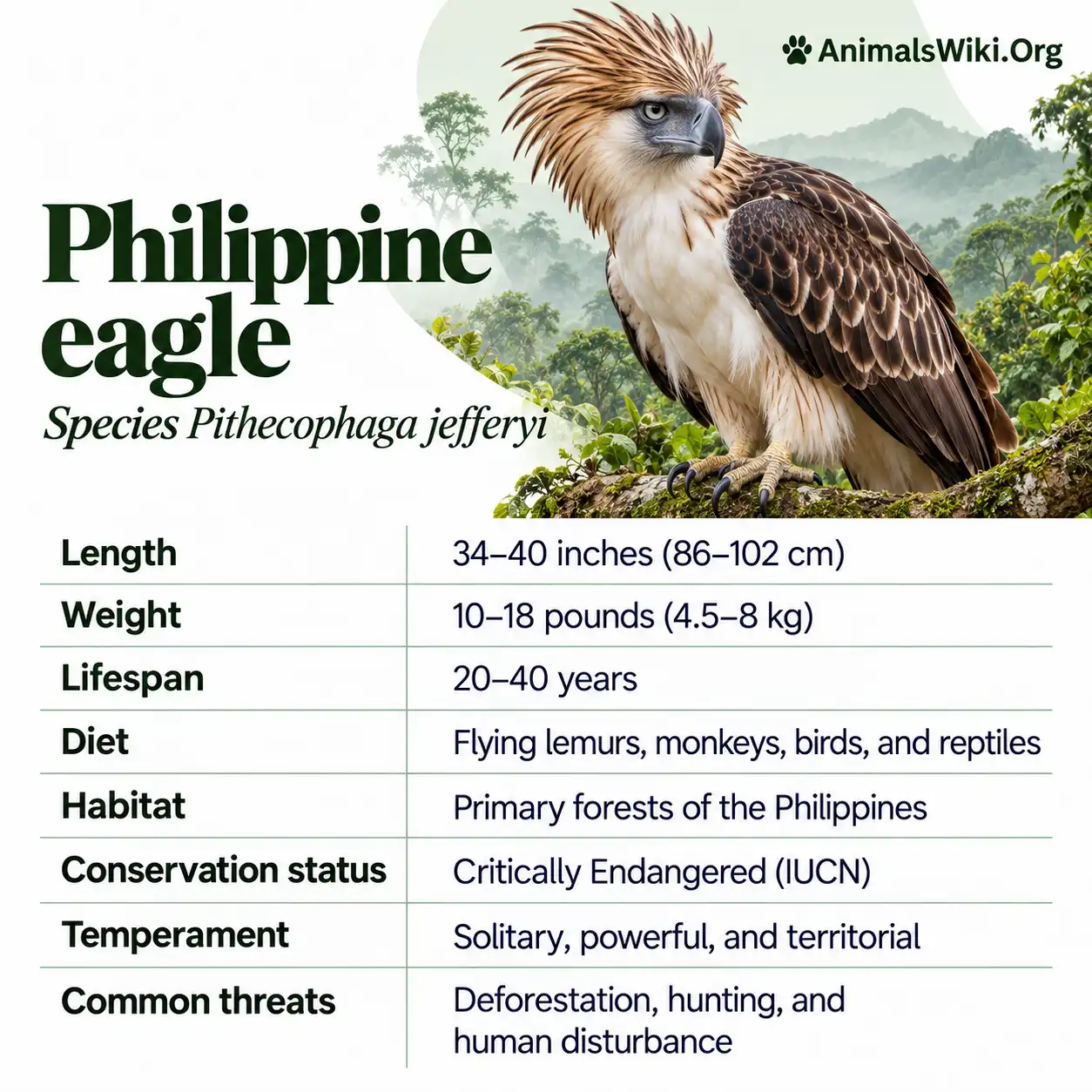
| Habitat | Tropical forest |
| Body Length | Roughly 86–102 cm |
| Weight | Roughly 4.5–8 kg depending on sex/individual |
| Wingspan | Roughly 1.8–2.2 m |
| Diet | Carnivorous |
| Activity | Diurnal |
| Eggs | Usually 1 |
| Young | Usually 1 chick |
| National Importance | National bird of the Philippines |
| Major Threats | Deforestation, fragmentation & persecution |
| Conservation Concern | Extremely high |
What Is a Philippine Eagle?
The Philippine Eagle is an enormous forest-dwelling bird of prey found naturally only in:
the Philippines.
Its scientific name is:
Pithecophaga jefferyi.
It belongs to the eagle and hawk family:
Accipitridae.
Is the Philippine Eagle a True Eagle?
Yes.
The Philippine Eagle is a genuine:
raptor and eagle.
It is among the largest forest eagles alive today.
Scientific Classification of the Philippine Eagle
| Classification | Name |
|---|---|
| Kingdom | Animalia |
| Phylum | Chordata |
| Class | Aves |
| Order | Accipitriformes |
| Family | Accipitridae |
| Genus | Pithecophaga |
| Species | Pithecophaga jefferyi |
How Many Philippine Eagle Species Are There?
There is only one living species in the genus:
Pithecophaga.
That species is:
Pithecophaga jefferyi.
Is the Philippine Eagle Endemic to the Philippines?
Yes.
The Philippine Eagle occurs naturally:
nowhere else on Earth.
This makes it an:
endemic species.
Why Was It Called the Monkey-Eating Eagle?
Early observations created the impression that monkeys were especially important:
prey.
This resulted in the name:
Monkey-Eating Eagle.
Later research revealed a much broader:
diet.
The bird can eat many forest animals and does not depend exclusively—or even necessarily primarily—on:
monkeys.
Why Was Its Name Changed to Philippine Eagle?
The name Philippine Eagle better reflects the bird’s national significance and avoids the misleading implication that it survives mainly by eating:
monkeys.
What Does Pithecophaga Mean?
The genus name comes from Greek roots referring approximately to:
ape/monkey eater.
This reflects the historical assumption about its:
diet.
What Does a Philippine Eagle Look Like?
The Philippine Eagle has a striking appearance.
Important features include:
- Long brown crest feathers
- Pale face and underparts
- Dark brown upperparts
- Large blue-gray bill
- Powerful yellow feet
- Dark curved talons
- Broad wings
- Long tail
- Massive body
Why Does the Philippine Eagle Have a Crest?
The long feathers behind the head can be:
raised.
The crest is involved in visual expression and makes the bird appear considerably larger and more:
dramatic.
Why Does the Philippine Eagle Look Like a Lion?
Its long shaggy crest spreads around the head in a way that can resemble a:
mane.
This gives the bird its famous regal:
appearance.
How Big Is a Philippine Eagle?
Adult Philippine Eagles commonly measure approximately:
86–102 cm long.
This makes them among the longest living:
eagles.
How Tall Is a Philippine Eagle?
A large upright Philippine Eagle can approach approximately:
one meter in apparent standing height.
Body length is generally the more reliable scientific measurement.
How Much Does a Philippine Eagle Weigh?
Weight differs significantly between:
sexes.
Females are larger.
Broadly, adults can weigh around:
4.5–8 kg, with most males toward the lower end and large females toward the upper end.
Are Female Philippine Eagles Bigger Than Males?
Yes.
Like many raptors, Philippine Eagles exhibit:
reverse sexual size dimorphism.
Females are noticeably:
larger.
What Is a Philippine Eagle’s Wingspan?
The wingspan is approximately:
1.8–2.2 meters.
Exact measurements vary among individuals.
Why Doesn’t Such a Huge Eagle Have a Bigger Wingspan?
The Philippine Eagle lives in:
forest.
Extremely long wings would make navigating between branches more:
difficult.
Broad wings and a long tail provide better:
maneuverability.
Is the Philippine Eagle the Largest Eagle in the World?
It is one of the world’s largest:
eagles.
However, there is no single answer without defining:
“largest.”
The Philippine Eagle ranks extremely high in:
body length.
Other species may equal or surpass it in:
- Average weight
- Maximum weight
- Wingspan
What Eagle Is Bigger Than a Philippine Eagle?
Depending on the measurement, competitors include:
- Harpy Eagle
- Steller’s Sea Eagle
- White-tailed Eagle
- Wedge-tailed Eagle
The Philippine Eagle remains one of the largest forest raptors ever to survive into modern:
times.
How Big Are Philippine Eagle Talons?
Philippine Eagles possess enormous curved:
talons.
They are not usually regarded as quite as massive as those of the Harpy Eagle, but they remain formidable tools capable of subduing relatively large:
prey.
How Strong Is a Philippine Eagle?
It is an exceptionally powerful:
raptor.
Its strength comes from:
- Large body
- Strong legs
- Powerful feet
- Curved talons
- Strong flight muscles
- Hooked bill
Claims assigning precise “grip PSI” numbers should be treated cautiously unless supported by standardized measurements.
Where Do Philippine Eagles Live?
They occur on several Philippine islands, particularly:
- Luzon
- Samar
- Leyte
- Mindanao
Mindanao supports an especially important portion of the surviving:
population.
Do Philippine Eagles Live Only in the Philippines?
Yes.
Wild Philippine Eagles are naturally restricted to:
the Philippines.
Do Philippine Eagles Live in Mindanao?
Yes.
Mindanao is one of the species’ most important:
strongholds.
Do Philippine Eagles Live in Luzon?
Yes.
The species survives in suitable forest on:
Luzon.
Do Philippine Eagles Live in Samar?
Yes.
Philippine Eagles occur in remaining suitable habitat on:
Samar.
Do Philippine Eagles Live in Leyte?
Yes.
The species has been documented on:
Leyte.
Do Philippine Eagles Live in Palawan?
The Philippine Eagle is not regarded as naturally occurring on:
Palawan.
Its established native range centers on Luzon, Samar, Leyte and:
Mindanao.
Philippine Eagle Habitat
Philippine Eagles inhabit:
tropical forests.
They can use:
- Lowland rainforest
- Montane forest
- Steep forested terrain
- Mature secondary forest in some situations
Large connected forests are especially:
important.
Why Do Philippine Eagles Need Forest?
The forest provides:
- Nesting trees
- Prey
- Hunting habitat
- Cover
- Large territories
Without forest, the Philippine Eagle cannot maintain its natural:
lifestyle.
Do Philippine Eagles Live in Mountains?
Yes.
They can inhabit mountainous and rugged:
forest.
As lowland forests have disappeared, many remaining populations have become strongly associated with more remote upland areas.
What Do Philippine Eagles Eat?
Philippine Eagles are:
carnivores.
Their diet varies between islands and habitats.
Prey can include:
- Philippine flying lemurs / colugos
- Monkeys
- Civets
- Squirrels
- Rats
- Bats
- Birds
- Monitor lizards
- Snakes
Do Philippine Eagles Eat Monkeys?
Yes.
But monkeys are only part of their:
diet.
This is why the old name “Monkey-Eating Eagle” is misleading.
Do Philippine Eagles Eat Flying Lemurs?
Yes.
The Philippine flying lemur, more accurately called a:
colugo,
is an important prey species in some areas.
Is a Flying Lemur Actually a Lemur?
No.
Despite its common name, the Philippine flying lemur is not a true:
lemur.
It is a:
colugo.
It also does not truly fly.
Instead, it:
glides.
Do Philippine Eagles Eat Civets?
Yes.
Civets can become prey.
Do Philippine Eagles Eat Bats?
Yes.
Bats can be part of the diet.
Do Philippine Eagles Eat Rats?
Yes.
Rodents can be taken.
Do Philippine Eagles Eat Monitor Lizards?
Yes.
Large reptiles, including monitor lizards, may be:
hunted.
Do Philippine Eagles Eat Snakes?
Yes.
Snakes can form part of the:
diet.
Do Philippine Eagles Eat Birds?
Yes.
Various birds can become:
prey.
Do Philippine Eagles Eat Domestic Animals?
Opportunistic attacks on domestic animals can occur in some circumstances.
However, domestic animals are not the ecological foundation of their:
diet.
Do Philippine Eagles Eat Humans?
No.
Humans are not normal prey.
How Does a Philippine Eagle Hunt?
Philippine Eagles often hunt from:
perches.
The bird watches the surrounding forest for:
movement.
Once prey is detected, it launches through:
the canopy.
The feet extend.
The talons grasp:
the prey.
Do Philippine Eagles Hunt Monkeys in Trees?
Yes.
They are capable of pursuing arboreal prey through:
forest.
Their broad wings and long tails help them maneuver around obstacles.
Do Philippine Eagles Hunt in Pairs?
Pair hunting behavior has been observed, with two birds potentially cooperating or positioning themselves in ways that help flush or intercept:
prey.
However, they are also capable of hunting:
alone.
Can Philippine Eagles Fly Through Dense Forest?
Yes.
Their anatomy is strongly suited to:
forest flight.
The combination of:
- Broad wings
- Long tail
- Powerful muscles
provides impressive maneuverability.
How Fast Can a Philippine Eagle Fly?
Reliable standardized maximum speed measurements are limited.
The species can fly powerfully and accelerate during:
hunting.
Highly specific viral speed claims should be treated cautiously.
Can Philippine Eagles Soar?
Yes.
They can soar above:
forest.
However, much of their hunting involves navigating within or near the:
canopy.
Can a Philippine Eagle Carry a Monkey?
It can carry appropriately sized:
prey.
Whether a prey animal can be transported depends on:
- Weight
- Eagle size
- Distance
- Flight conditions
- Terrain
Large prey may be eaten where captured or transported in:
stages.
Can a Philippine Eagle Lift a Human?
No.
The species does not have anything approaching the ability to carry an adult:
human.
Philippine Eagle Behavior
Philippine Eagles are generally:
territorial.
A breeding pair occupies a very large:
home range.
Are Philippine Eagles Solitary?
Outside the pair bond and family unit, they are not highly:
social birds.
Adults are generally encountered alone or as:
pairs.
Do Philippine Eagles Mate for Life?
Pairs can form long-term:
monogamous bonds.
A pair may remain associated with the same territory for many:
years.
Are Philippine Eagles Territorial?
Yes.
Breeding pairs require large territories containing enough:
prey and nesting habitat.
Do Philippine Eagles Make Sounds?
Yes.
They produce various:
calls and whistles.
Young birds can be particularly vocal when begging for:
food.
Are Philippine Eagles Nocturnal?
No.
They are primarily:
diurnal.
Philippine Eagle Reproduction
Philippine Eagles have an exceptionally slow reproductive:
cycle.
This is one of the major reasons the species is vulnerable to population:
decline.
Where Do Philippine Eagles Build Their Nests?
Nests are constructed high in:
large trees.
The nest usually sits in a major:
fork or branch structure.
What Trees Do Philippine Eagles Nest In?
Large native rainforest trees are:
preferred.
Dipterocarp trees and other massive forest trees can provide suitable:
nest sites.
How Big Is a Philippine Eagle Nest?
The nest is a huge platform made from:
sticks and branches.
It can reach well over:
a meter across.
Do Philippine Eagles Reuse Their Nests?
Yes.
Pairs may use the same nesting territory and nest structure across multiple breeding:
cycles.
How Many Eggs Does a Philippine Eagle Lay?
The female generally lays:
one egg.
How Long Does a Philippine Eagle Egg Take to Hatch?
Incubation lasts approximately:
two months, around 58–60 days.
Who Incubates the Philippine Eagle Egg?
Both parents participate.
However, the female performs most:
incubation.
The male supplies much of the:
food.
What Is a Baby Philippine Eagle Called?
A baby Philippine Eagle can be called a:
chick or eaglet.
What Does a Philippine Eagle Chick Look Like?
Young chicks initially have soft:
white down.
As they develop, feathers gradually replace the down.
Juvenile plumage differs from the darker coloration of:
mature adults.
Do Both Philippine Eagle Parents Care for Their Chick?
Yes.
Parental care is:
extensive.
The female spends considerable time near the chick during early development.
The male provides much of the food.
Later, both parents continue supporting the:
juvenile.
When Does a Philippine Eagle Chick Fly?
Young Philippine Eagles generally fledge at around:
four to five months of age.
But fledging does not mean immediate:
independence.
How Long Does a Young Philippine Eagle Stay With Its Parents?
A juvenile may remain dependent for:
many months after fledging.
Parents continue supplying food while it develops hunting:
skills.
How Often Do Philippine Eagles Breed?
A pair generally raises only one chick approximately every:
two years.
This exceptionally slow rate has enormous conservation:
consequences.
At What Age Do Philippine Eagles Breed?
Young Philippine Eagles take several years to reach full:
maturity.
They generally do not begin breeding until they are around:
five years old or older.
How Long Do Philippine Eagles Live?
Philippine Eagles are long-lived:
birds.
They can survive for several:
decades.
Individuals in managed care have demonstrated that lifespans exceeding:
30 years
are possible.
Philippine Eagle Adaptations
Broad Wings
Allow powerful flight while maintaining forest maneuverability.
Long Tail
Functions as a steering system between trees.
Powerful Feet
Allow the eagle to capture medium-sized forest animals.
Curved Talons
Grip and penetrate prey.
Hooked Bill
Tears flesh efficiently.
Excellent Eyesight
Detects prey movement through forest.
Large Body
Allows the eagle to overpower substantial prey.
Crest Feathers
Provide visual signaling and the species’ characteristic appearance.
Strong Pair Bond
Supports the prolonged care required by a single chick.
Large Territory
Provides enough prey for such a large predator.
How Good Is Philippine Eagle Eyesight?
Like other eagles, Philippine Eagles have excellent:
vision.
Their eyesight allows them to detect potential prey through complex forest:
habitat.
Can Philippine Eagles Hear Well?
Yes.
Hearing can complement vision when animals move within dense:
vegetation.
Does the Philippine Eagle Have Natural Predators?
Healthy adult Philippine Eagles have very few regular natural:
predators.
They occupy a high position within Philippine forest:
food webs.
Eggs and young chicks are potentially more vulnerable.
Is the Philippine Eagle an Apex Predator?
Yes.
The Philippine Eagle functions as an:
apex forest predator.
Few native animals regularly prey upon healthy adults.
What Is the Philippine Eagle’s Biggest Enemy?
At the population level:
human activity.
Particularly:
- Deforestation
- Forest fragmentation
- Shooting
- Trapping
- Other forms of disturbance
Philippine Eagle vs. Harpy Eagle
| Feature | Philippine Eagle | Harpy Eagle |
|---|---|---|
| Scientific Name | Pithecophaga jefferyi | Harpia harpyja |
| Region | Philippines | Central & South America |
| Habitat | Tropical forest | Tropical rainforest |
| Length | Up to ~1 m | Up to ~1 m |
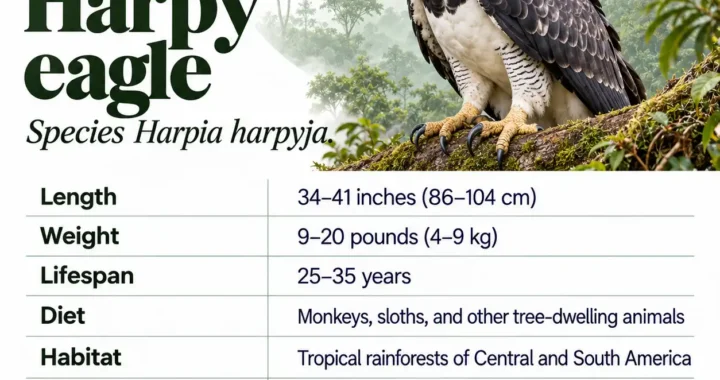
| Female Weight | Up to ~7–8 kg range | Often ~6–9 kg |
| Wingspan | ~1.8–2.2 m | ~1.8–2.2 m |
| Talons | Very large | Exceptionally massive |
| Famous Prey | Colugos, monkeys | Sloths, monkeys |
| Major Threat | Forest loss | Forest loss |
Philippine Eagle vs. Bald Eagle
The Bald Eagle is primarily associated with:
North American aquatic environments.
It feeds heavily on:
fish.
The Philippine Eagle is a:
tropical forest predator
specialized for hunting mammals, birds and reptiles within forest.
Philippine Eagle vs. Golden Eagle
Golden Eagles generally hunt across:
open landscapes.
Philippine Eagles hunt within:
tropical forests.
The Golden Eagle has wing proportions suited to soaring and pursuit in open terrain.
The Philippine Eagle has proportions better suited to maneuvering around:
trees.
Philippine Eagle vs. Steller’s Sea Eagle
Steller’s Sea Eagles can be among the world’s heaviest:
eagles.
They are strongly associated with:
coasts and fish.
Philippine Eagles are specialized:
forest predators.
Philippine Eagle vs. Crowned Eagle
The African Crowned Eagle and Philippine Eagle both prey heavily on:
forest vertebrates.
Both can hunt:
monkeys.
But they evolved independently in very different geographic:
regions.
Philippine Eagle vs. Monkey-Eating Eagle
There is no biological difference.
They are two names for the same:
species.
“Philippine Eagle” is the preferred modern common name.
Is the Philippine Eagle Stronger Than the Harpy Eagle?
There is no standardized scientific contest determining which species is:
stronger.
The Harpy Eagle generally possesses especially massive:
feet and talons.
The Philippine Eagle is extraordinarily large and powerful in its own:
right.
Both are among the world’s premier forest:
raptors.
Is the Philippine Eagle Bigger Than the Harpy Eagle?
The Philippine Eagle can be exceptionally long-bodied.
Harpy Eagle females are generally:
heavier and more massively built.
Which is “bigger” therefore depends on the measurement being:
compared.
Is the Philippine Eagle Bigger Than a Bald Eagle?
Philippine Eagles are generally:
longer-bodied and more massive-looking.
However, large Bald Eagles can have substantial wingspans.
Again, different measurements produce different:
comparisons.
Are Philippine Eagles Dangerous to Humans?
Philippine Eagles are powerful enough to cause serious:
injury.
But humans are not their natural:
prey.
Do Philippine Eagles Attack Humans?
Predatory attacks on humans are not normal:
behavior.
A threatened or cornered eagle could defend itself.
Can a Philippine Eagle Kill a Human?
The bird has dangerous talons and should be respected, but there is no evidence that Philippine Eagles routinely hunt or kill:
humans.
Can a Philippine Eagle Carry a Child?
No credible evidence suggests Philippine Eagles carry away:
human children.
Their lifting ability is often greatly exaggerated online.
Can Philippine Eagles Be Pets?
No.
They are:
- Wild predators
- Extremely rare
- Legally protected
- Ecologically specialized
They require professional conservation management rather than private:
ownership.
Why Is the Philippine Eagle Important?
The species has enormous:
ecological, cultural and conservation significance.
As an apex predator, it helps maintain natural relationships within:
forest ecosystems.
As a national symbol, it represents the unique biodiversity of:
the Philippines.
Is the Philippine Eagle the National Bird of the Philippines?
Yes.
The Philippine Eagle is officially recognized as the:
national bird of the Philippines.
Why Is the Philippine Eagle a National Symbol?
Its:
- Strength
- Rarity
- Endemic status
- Majestic appearance
have made it a powerful symbol of Philippine natural:
heritage.
Is the Philippine Eagle Endangered?
The Philippine Eagle is among the world’s most threatened large:
raptors.
It has an extremely small and fragmented population.
Because conservation assessments and population estimates can change, the latest authoritative sources should be consulted whenever publishing a precise current population figure or formal conservation category.
Why Is the Philippine Eagle So Rare?
Several factors combine:
simultaneously.
The species:
- Requires enormous territories
- Needs large forests
- Reproduces slowly
- Produces only one chick at a time
- Suffers from habitat destruction
- Is vulnerable to shooting
These factors make population recovery:
slow.
How Many Philippine Eagles Are Left?
The wild population is believed to be very:
small.
However, estimates vary because these eagles inhabit remote forests and are difficult to survey.
For SEO content that includes an exact current number, the figure should be checked against the latest conservation surveys rather than relying on an older estimate.
Why Is Deforestation Dangerous to Philippine Eagles?
Deforestation removes:
habitat.
But the problem extends beyond losing individual:
trees.
Forest destruction also removes:
- Prey
- Nest sites
- Hunting areas
- Breeding territories
- Connections between populations
Does Logging Threaten Philippine Eagles?
Yes.
Logging can remove mature forest and enormous:
nesting trees.
Even selective forest disturbance can alter habitat quality.
Does Agriculture Threaten Philippine Eagles?
Yes.
Conversion of forest into:
- Farms
- Plantations
- Pasture
- Settlements
reduces available habitat.
Are Philippine Eagles Shot by Humans?
Unfortunately:
yes.
Shooting and other forms of human-caused mortality have killed Philippine Eagles.
For a species that reproduces so slowly, losing even one breeding adult can be:
serious.
Why Is Killing One Philippine Eagle So Serious?
Imagine a breeding pair produces roughly one young bird every:
two years.
If an adult is killed, the surviving partner may lose:
- Its mate
- A breeding attempt
- Future offspring
Replacement can take:
years.
Can Captive Breeding Help Philippine Eagles?
Yes.
Managed conservation breeding can provide an additional tool for protecting the:
species.
However, captive breeding cannot replace the need to preserve:
wild forest.
An eagle cannot be successfully restored to nature without suitable:
habitat.
How Can Philippine Eagles Be Protected?
Conservation requires:
- Protecting forests
- Preserving nesting trees
- Preventing shooting
- Monitoring nests
- Protecting territories
- Restoring damaged habitat
- Supporting local communities
- Conservation breeding
- Environmental education
- Scientific research
Why Is Community Conservation Important?
People live near many remaining Philippine Eagle:
territories.
Long-term conservation therefore works best when local communities benefit from and participate in:
forest protection.
Why Are Philippine Eagles Important to Forests?
They are high-level:
predators.
Their presence indicates that a forest can support:
- Large trees
- Diverse prey
- Complex food webs
- Extensive habitat
Protecting a Philippine Eagle territory therefore protects many other:
species.
50 Interesting Philippine Eagle Facts
- The Philippine Eagle is a bird of prey.
- Its scientific name is Pithecophaga jefferyi.
- It is found naturally only in the Philippines.
- It is an endemic species.
- It is the national bird of the Philippines.
- It was formerly called the Monkey-Eating Eagle.
- It does not eat only monkeys.
- It belongs to Accipitridae.
- It is the only living species in Pithecophaga.
- Philippine Eagles are among the world’s largest eagles.
- Adults can reach around one meter in body length.
- Females are larger than males.
- Large females can weigh around 6 kg or more.
- Their wingspan can approach or exceed two meters.
- Philippine Eagles have long brown crest feathers.
- Their crest can resemble a mane.
- They possess powerful hooked bills.
- Their feet are yellow.
- Their talons are large and curved.
- They are adapted to tropical forest.
- Broad wings help them maneuver around trees.
- Long tails help them steer.
- They live on Mindanao.
- They live on Luzon.
- They occur on Samar.
- They occur on Leyte.
- They are not naturally distributed on Palawan.
- Philippine Eagles eat colugos.
- They eat monkeys.
- They eat civets.
- They eat squirrels.
- They eat rats.
- They can eat bats.
- They eat large birds.
- They can eat monitor lizards.
- They can eat snakes.
- They are apex predators.
- They do not normally prey on humans.
- Adults form breeding pairs.
- They build enormous tree nests.
- Females usually lay one egg.
- Incubation lasts about two months.
- Both parents care for the chick.
- The chick fledges after several months.
- Juveniles remain dependent after fledging.
- A pair generally raises only one chick roughly every two years.
- Their slow reproduction makes population recovery difficult.
- Deforestation is one of their greatest threats.
- Shooting also threatens the species.
- Protecting Philippine Eagles helps protect entire Philippine forest ecosystems.
Did You Know?
A Philippine Eagle pair may spend around two years raising just one young eagle before beginning another successful breeding cycle.
That single fact explains much of the species’ conservation:
story.
High in a Philippine:
forest,
an enormous tree rises above the surrounding:
canopy.
Inside its branches sits a huge:
nest.
One adult Philippine Eagle stands beside:
it.
Long brown crest feathers frame the:
head.
The eagle looks:
powerful.
And it is.
But inside the nest is something remarkably:
fragile.
One:
egg.
For roughly two months, the parents invest in protecting and incubating:
it.
Eventually—
the shell:
breaks.
A chick emerges.
Small.
White.
Dependent.
Nothing like the enormous forest predator it may one day:
become.
The mother remains close.
The male:
hunts.
Somewhere in the forest, he detects:
movement.
Perhaps a colugo clings to a:
tree.
Perhaps a squirrel crosses a:
branch.
Perhaps another suitable animal moves through the:
canopy.
The eagle launches.
Broad wings accelerate through:
forest.
The tail turns.
The feet extend.
Prey is:
captured.
Food returns to:
the nest.
Day after day.
Week after:
week.
The chick grows.
White down becomes:
feathers.
Its wings become:
stronger.
Eventually, after several months, the young eagle stands at the edge of:
the nest.
Below it is an enormous:
forest.
Then—
it:
flies.
But the story is not finished.
The juvenile is still not an experienced:
hunter.
Its parents continue helping it.
It must learn to:
- Navigate forest
- Detect prey
- Control enormous wings
- Use powerful feet
- Survive independently
That takes:
time.
And because parental investment lasts so long, the adults cannot simply produce another chick immediately.
This creates one of the Philippine Eagle’s greatest:
weaknesses.
Not weakness in:
strength.
Weakness in:
numbers.
A population that replaces itself slowly cannot easily absorb:
losses.
If one adult eagle is shot, it may take years for the population to replace the reproductive potential that disappeared in a single:
moment.
If one nesting tree is cut, a breeding pair may lose a site used across multiple:
years.
If an entire forest disappears, the problem becomes far greater.
The eagle loses:
everything.
Its prey.
Its nest.
Its hunting territory.
Its future:
chicks.
That is why the Philippine Eagle can simultaneously be one of Asia’s most powerful predators—
and one of its most vulnerable:
birds.
Frequently Asked Questions About Philippine Eagles
What is a Philippine Eagle?
The Philippine Eagle is a giant forest raptor endemic to the Philippines.
What is the scientific name of the Philippine Eagle?
Pithecophaga jefferyi.
Is the Philippine Eagle a true eagle?
Yes.
Is the Philippine Eagle a bird of prey?
Yes.
What family does the Philippine Eagle belong to?
Accipitridae.
How many Philippine Eagle species exist?
There is one living species in the genus Pithecophaga.
Where do Philippine Eagles live?
They live in forests of the Philippines.
Are Philippine Eagles found anywhere outside the Philippines?
Not as naturally occurring wild populations.
Are Philippine Eagles endemic?
Yes.
What islands have Philippine Eagles?
Luzon, Samar, Leyte and Mindanao.
Do Philippine Eagles live in Mindanao?
Yes.
Do Philippine Eagles live in Luzon?
Yes.
Do Philippine Eagles live in Samar?
Yes.
Do Philippine Eagles live in Leyte?
Yes.
Do Philippine Eagles live in Palawan?
They are not considered naturally distributed on Palawan.
Do Philippine Eagles live in rainforest?
Yes.
Do Philippine Eagles live in mountains?
They can inhabit mountainous forests.
How big is a Philippine Eagle?
Adults can reach roughly 86–102 cm in body length.
How tall is a Philippine Eagle?
A large bird standing upright can appear close to a meter tall.
How much does a Philippine Eagle weigh?
Adults broadly range around 4.5–8 kg, with females substantially larger.
Are female Philippine Eagles bigger?
Yes.
What is a Philippine Eagle’s wingspan?
Approximately 1.8–2.2 meters.
Is the Philippine Eagle the world’s largest eagle?
It is among the largest, but the answer depends on whether weight, length or wingspan is being compared.
What is the biggest eagle in the world?
Different species rank first under different measurements. The Philippine Eagle is especially notable for body length.
Is the Philippine Eagle bigger than the Harpy Eagle?
Philippine Eagles can be extremely long, while female Harpy Eagles are generally more massively built and heavier.
Is the Philippine Eagle bigger than the Bald Eagle?
It is generally more massive-bodied and longer, though individual wingspan comparisons vary.
Why does the Philippine Eagle have a crest?
The long feathers form a prominent display structure and give the eagle its distinctive appearance.
Why does the Philippine Eagle look like a lion?
Its shaggy brown crest resembles a mane.
How strong is a Philippine Eagle?
It is an extremely powerful forest raptor capable of capturing medium-sized mammals, birds and reptiles.
How strong is its grip?
Its grip is powerful, but exact viral PSI figures should not be treated as established without standardized scientific measurements.
How big are Philippine Eagle talons?
They are very large and strongly curved, although Harpy Eagle talons are generally considered even more massive.
What do Philippine Eagles eat?
Colugos, monkeys, civets, squirrels, rats, bats, birds, reptiles and other forest prey.
Do Philippine Eagles eat monkeys?
Yes.
Do Philippine Eagles only eat monkeys?
No.
Why was the Philippine Eagle called the Monkey-Eating Eagle?
Early observations led researchers to overemphasize monkeys in its diet.
Do Philippine Eagles eat flying lemurs?
Yes, Philippine colugos can be important prey.
Is a Philippine flying lemur a real lemur?
No. It is a colugo.
Do Philippine Eagles eat civets?
Yes.
Do Philippine Eagles eat squirrels?
Yes.
Do Philippine Eagles eat rats?
Yes.
Do Philippine Eagles eat bats?
They can.
Do Philippine Eagles eat monitor lizards?
Yes.
Do Philippine Eagles eat snakes?
Yes.
Do Philippine Eagles eat other birds?
Yes.
Do Philippine Eagles eat humans?
No.
How do Philippine Eagles hunt?
They often hunt from perches and launch rapid attacks through forest.
Do Philippine Eagles hunt in trees?
Yes.
Do Philippine Eagles hunt together?
Pair hunting behavior has been observed, although they also hunt individually.
Can Philippine Eagles fly?
Yes.
Can Philippine Eagles soar?
Yes.
Can Philippine Eagles fly through dense forest?
Yes. Their broad wings and long tails provide strong maneuverability.
How fast can a Philippine Eagle fly?
A reliable universal maximum speed is not well established.
Can a Philippine Eagle carry a monkey?
It can transport suitably sized prey.
Can a Philippine Eagle lift a human?
No.
Can a Philippine Eagle carry a child?
There is no credible evidence that Philippine Eagles carry away human children.
Are Philippine Eagles nocturnal?
No. They are primarily active during daylight.
Do Philippine Eagles live alone?
Adults usually occur alone or in breeding pairs.
Do Philippine Eagles mate for life?
Pairs can maintain long-term monogamous bonds.
Are Philippine Eagles territorial?
Yes.
How large is a Philippine Eagle territory?
Territories can cover many square kilometers and vary according to habitat quality and prey availability.
Where do Philippine Eagles nest?
High in large forest trees.
What are Philippine Eagle nests made of?
Large sticks and branches.
How many eggs do Philippine Eagles lay?
Usually one.
How long does the egg take to hatch?
Approximately two months.
Who incubates the egg?
Both parents participate, but the female performs most incubation.
What does the male Philippine Eagle do?
During early breeding he performs much of the hunting and provides food.
What is a baby Philippine Eagle called?
A chick or eaglet.
When does a Philippine Eagle chick fly?
Usually after roughly four to five months.
Does the chick leave its parents immediately?
No. Juveniles remain dependent for many months.
How often do Philippine Eagles reproduce?
A pair generally raises about one chick every two years.
Why do Philippine Eagles reproduce so slowly?
Their single chick requires prolonged parental care.
When do Philippine Eagles become adults?
They take several years to reach reproductive maturity.
How long do Philippine Eagles live?
They can live for several decades.
What animals eat Philippine Eagles?
Healthy adults have few regular natural predators.
Are Philippine Eagles apex predators?
Yes.
What is the biggest threat to Philippine Eagles?
Human-driven habitat destruction is among the greatest threats.
Are Philippine Eagles dangerous to humans?
They are powerful enough to injure a person but do not normally prey on humans.
Do Philippine Eagles attack people?
Predatory attacks are not characteristic behavior.
Can a Philippine Eagle kill a human?
Humans are not natural prey, although the eagle’s talons could cause serious defensive injuries.
Can Philippine Eagles be pets?
No.
Is the Philippine Eagle rare?
Yes. It is one of the world’s rarest large eagles.
Is the Philippine Eagle endangered?
It faces an extremely serious risk of extinction and remains a major conservation priority.
Why are Philippine Eagles endangered?
Forest loss, fragmentation, shooting and their extremely slow reproduction all contribute.
How many Philippine Eagles are left?
Only a small wild population survives, but exact estimates should be checked against the latest authoritative surveys because population assessments change.
Does deforestation kill Philippine Eagles?
Deforestation destroys nesting, hunting and breeding habitat and is a major driver of decline.
Are Philippine Eagles still being shot?
Human-caused shooting remains a conservation concern.
Can captive breeding save the Philippine Eagle?
Conservation breeding can help, but it must be combined with protection of wild habitat.
Why is protecting one nesting pair important?
A pair reproduces extremely slowly, so every successful breeding adult has high conservation value.
Is the Philippine Eagle the national bird of the Philippines?
Yes.
Why is the Philippine Eagle important to the Philippines?
It is an endemic national symbol representing the country’s unique wildlife and forests.
What is the difference between a Philippine Eagle and a Harpy Eagle?
Both are giant forest raptors. The Philippine Eagle lives only in the Philippines, while the Harpy Eagle inhabits Central and South America and generally has even more massive feet and talons.
What is the difference between a Philippine Eagle and a Bald Eagle?
The Philippine Eagle specializes in tropical forest prey, while the Bald Eagle is strongly associated with fish and aquatic habitats.
What is the difference between a Philippine Eagle and a Golden Eagle?
The Philippine Eagle is a tropical forest specialist, while the Golden Eagle is primarily adapted to open and mountainous landscapes.
What is the most interesting Philippine Eagle fact?
One of the world’s largest eagles may spend around two years helping raise a single offspring, meaning every successful chick represents an enormous investment by its parents.
Conclusion
The Philippine Eagle represents a contradiction.
It is enormous—
yet:
rare.
It is powerful—
yet:
vulnerable.
It dominates the forest food web—
yet depends completely on the survival of:
that forest.
High in the canopy, an adult waits.
Its brown crest rises around:
its head.
Its eyes scan the:
trees.
A colugo moves.
A monkey crosses a:
branch.
A reptile disappears beneath:
foliage.
The eagle launches.
Broad wings push through:
air.
The tail turns.
The feet extend.
Talons reach toward:
prey.
This is what millions of years of evolution created:
a giant predator designed for the forests of the:
Philippines.
But evolution did not prepare it for forests disappearing within a few:
generations.
A Philippine Eagle pair cannot simply move into:
a city.
It cannot replace an enormous nesting tree with:
concrete.
It cannot maintain a territory without:
prey.
And it cannot rapidly replace adults lost to:
shooting.
Its reproductive strategy is simply too:
slow.
One egg.
One chick.
Months of parental care.
A long juvenile dependence.
Then roughly two years before another offspring may be successfully:
raised.
That makes the future of the Philippine Eagle inseparable from the future of Philippine:
forests.
Protect the eagle and you must protect:
the trees.
Protect the trees and you protect:
- Mammals
- Birds
- Reptiles
- Plants
- Insects
- Entire forest communities
The Philippine Eagle is therefore more than one rare:
bird.
It is a symbol of an entire:
ecosystem.
A predator with the wings of a giant.
The crown of a king.
The talons of a hunter.
And a future that depends upon whether enough forest remains beneath those wings for the next generation to:
fly.