
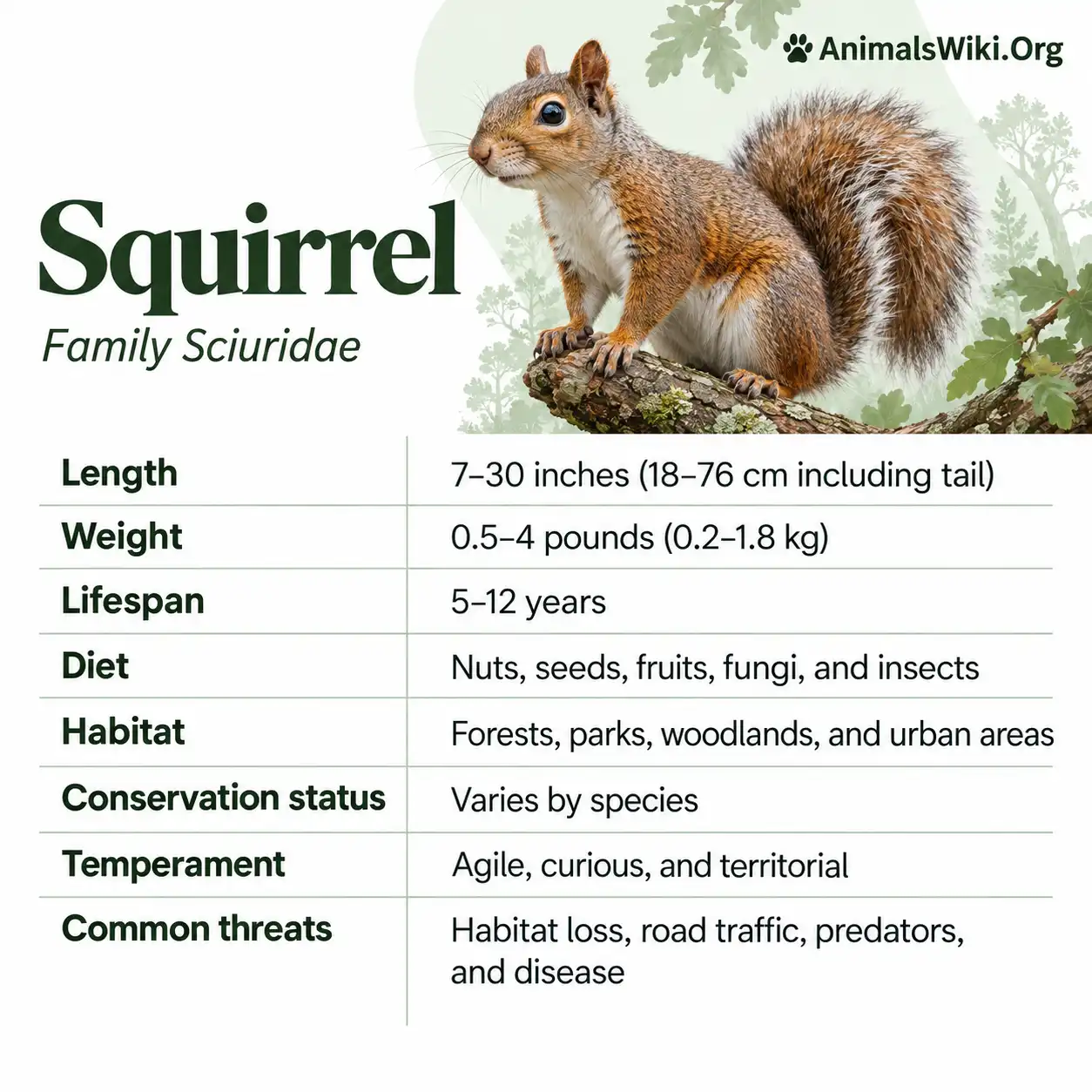
Squirrel, The Agile Tree-Climbing Rodents of Forests & Woodlands
The squirrel is one of the world’s most recognizable rodents, famous for its bushy tail, sharp claws, quick movements, powerful hind legs, and remarkable ability to climb, jump, dig, and store food.
But the word squirrel does not describe just one animal.
Squirrels belong to the rodent family Sciuridae, a diverse group that includes:
- Tree squirrels
- Ground squirrels
- Flying squirrels
- Chipmunks
- Marmots
- Prairie dogs
Together, these animals occupy an extraordinary range of habitats, from tropical forests and city parks to deserts, grasslands, mountains, and cold northern woodlands.
The classic squirrel most people picture is a tree squirrel.
Tree squirrels are exceptionally well adapted for moving through branches.
Their sharp curved claws grip bark.
Powerful hind legs launch the body between trees.
Flexible ankles help some tree squirrels descend trunks headfirst.
And the famous bushy tail performs several jobs.
It can contribute to:
- Balance
- Communication
- Temperature regulation
- Protection from weather
- Stability during jumps
Squirrels are also famous for storing food.
Many species collect nuts and seeds during periods of abundance and save them for later.
Some use scatter hoarding, hiding individual food items in many separate locations.
This creates a fascinating ecological consequence.
Not every buried seed is recovered.
Forgotten nuts and seeds can germinate.
Through this behavior, squirrels can contribute to the dispersal and regeneration of plants and trees.
Not all squirrels live in trees.
Ground squirrels spend much of their lives on or beneath the ground.
They may create complex burrow systems that provide:
- Shelter
- Nesting chambers
- Escape routes
- Protection from extreme temperatures
Flying squirrels take squirrel movement in an entirely different direction.
Despite their name, they do not fly like bats or birds.
Instead, they glide.
A membrane of skin called a patagium stretches between the limbs.
When a flying squirrel leaps from a tree, this membrane expands and creates an aerodynamic surface.
By adjusting its limbs and tail, the squirrel can steer toward another tree.
Squirrels are rodents, meaning their front incisors grow continuously.
Gnawing helps keep these teeth worn to a functional length.
Their diet can include:
- Nuts
- Seeds
- Fruits
- Fungi
- Buds
- Flowers
- Bark
- Insects
- Eggs
- Other foods depending on species
Although often described simply as herbivores, many squirrels are better considered opportunistic feeders, with diet varying considerably among species.
Squirrels also possess sophisticated communication systems.
They can use:
- Alarm calls
- Chirps
- Barks
- Tail movements
- Body posture
- Scent signals
A flicking tail may warn other squirrels, communicate agitation, or signal awareness of a threat.
Their intelligence is particularly visible when they search for hidden food.
Squirrels can use:
- Spatial memory
- Landmarks
- Smell
- Search patterns
to relocate stored food.
They may also organize caches according to food type or quality.
Some squirrels even alter caching behavior when potential competitors are nearby.
From an acorn hidden beneath autumn leaves to a flying squirrel gliding silently through a nighttime forest, the squirrel family contains far more biological diversity than its familiar backyard representatives suggest.
This comprehensive guide explores squirrel facts, species, types, anatomy, teeth, bushy tails, climbing, jumping, gliding, habitat, distribution, diet, nuts, food storage, caching, memory, intelligence, communication, nests, reproduction, baby squirrels, lifespan, predators, defenses, hibernation, flying squirrels, ground squirrels, tree squirrels, squirrel vs. chipmunk differences, squirrel adaptations, ecological importance, conservation, and much more.
Squirrel Facts
| Feature | Information |
|---|---|
| Common Name | Squirrel |
| Animal Type | Mammal |
| Order | Rodentia |
| Family | Sciuridae |
| Diet | Mostly plant-based but often opportunistic |
| Teeth | Continuously growing incisors |
| Main Groups | Tree, ground and flying squirrels |
| Habitats | Forests, grasslands, deserts, mountains and urban areas |
| Distribution | Naturally widespread across most continents |
| Main Foods | Nuts, seeds, fruits, fungi and vegetation |
| Movement | Running, climbing, jumping, digging or gliding depending on species |
| Famous Feature | Bushy tail |
| Flying Squirrels | Glide rather than truly fly |
| Food Storage | Common in many species |
| Young | Often called kits or pups |
| Group | Various terms; squirrels are often solitary or loosely social depending on species |
| Main Predators | Birds of prey, carnivorous mammals, snakes and others |
What Is a Squirrel?
A squirrel is a rodent belonging to the family:
Sciuridae
The squirrel family contains a wide variety of animals.
These include familiar tree squirrels as well as:
- Flying squirrels
- Ground squirrels
- Chipmunks
- Marmots
- Prairie dogs
Therefore, “squirrel” can refer to a much broader biological group than the bushy-tailed animal commonly seen climbing trees.
Is a Squirrel a Mammal?
Yes.
Squirrels are mammals.
They:
- Have hair or fur
- Are warm-blooded
- Breathe using lungs
- Give birth to live young
- Produce milk for their offspring
Is a Squirrel a Rodent?
Yes.
Squirrels belong to the mammalian order:
Rodentia
Rodents are characterized by specialized incisors that grow continuously.
Scientific Classification of Squirrels
A simplified classification is:
| Classification | Name |
|---|---|
| Kingdom | Animalia |
| Phylum | Chordata |
| Class | Mammalia |
| Order | Rodentia |
| Family | Sciuridae |
Individual squirrel species belong to many different genera.
How Many Squirrel Species Are There?
The squirrel family contains more than 200 species, with many modern references recognizing roughly 280 or more species within Sciuridae depending on taxonomy.
Because classifications are periodically revised, an exact permanent number is difficult to provide.
These species include:
- Tree squirrels
- Ground squirrels
- Flying squirrels
- Chipmunks
- Marmots
- Prairie dogs
Types of Squirrels
Squirrels are commonly divided informally into three major ecological groups:
- Tree squirrels
- Ground squirrels
- Flying squirrels
Each group has evolved different ways of using its environment.
Tree Squirrels
Tree squirrels spend much of their time in:
- Trees
- Forest canopies
- Woodland
- Parks
They are excellent climbers and jumpers.
Common examples include:
- Eastern gray squirrel
- Eurasian red squirrel
- Fox squirrel
Ground Squirrels
Ground squirrels spend much more time on the ground.
Many construct underground burrows.
Ground-dwelling members of Sciuridae include animals such as:
- Ground squirrels
- Prairie dogs
- Marmots
- Chipmunks
Their lifestyles differ considerably from those of typical tree squirrels.
Flying Squirrels
Flying squirrels are specialized for gliding between trees.
They possess a membrane called a:
patagium
that stretches between their limbs.
When extended, it acts somewhat like an aerodynamic wing.
Can Flying Squirrels Really Fly?
No.
Flying squirrels cannot generate powered flight like:
- Birds
- Bats
- Insects
Instead, they glide downward through the air.
They launch from a high position and use gravity plus their gliding membrane to travel toward another tree.
Eastern Gray Squirrel
The eastern gray squirrel (Sciurus carolinensis) is one of the most familiar tree squirrels.
It is native to eastern North America but has been introduced into other regions.
Its coat is usually gray, although individuals can show:
- Brown
- Reddish
- Black
- White variations
Red Squirrel
The term “red squirrel” can refer to different species depending on region.
The Eurasian red squirrel (Sciurus vulgaris) inhabits parts of Europe and Asia.
It is famous for:
- Reddish fur
- Bushy tail
- Ear tufts in many populations and seasons
Fox Squirrel
The fox squirrel (Sciurus niger) is a large North American tree squirrel.
Color varies widely among populations.
Individuals may contain combinations of:
- Gray
- Brown
- Orange
- Black
What Does a Squirrel Look Like?
Typical squirrels possess:
- Fur-covered body
- Four limbs
- Sharp claws
- Large eyes
- Rounded ears
- Whiskers
- Long incisors
- Long tail
Tree squirrels are particularly recognizable because of their large bushy tails.
Squirrel Anatomy
Important external structures include:
- Head
- Eyes
- Ears
- Whiskers
- Incisors
- Forelegs
- Hind legs
- Claws
- Tail
Each contributes to survival.
Squirrel Teeth
Like other rodents, squirrels possess specialized front incisors.
These teeth:
grow continuously throughout life.
Regular gnawing and normal feeding wear them down.
Why Do Squirrel Teeth Keep Growing?
Continuous growth compensates for constant wear.
Squirrels use their incisors to gnaw through:
- Nut shells
- Seeds
- Plant material
- Bark
- Other hard substances
Without proper wear, the teeth could become dangerously overgrown.
What Color Are Squirrel Teeth?
Healthy rodent incisors often appear:
- Yellowish
- Orange
rather than bright white.
This coloration is associated with iron-containing enamel that contributes to tooth strength.
Do Squirrels Have Sharp Teeth?
Yes.
Their incisors are extremely effective cutting and gnawing tools.
A squirrel can open hard shells by applying repeated bites.
Can Squirrels Bite?
Yes.
A frightened or cornered squirrel can deliver a painful bite.
Wild squirrels should not be handled unnecessarily.
Squirrel Eyes
Squirrels rely heavily on vision.
Their relatively large eyes help them detect:
- Predators
- Branches
- Food
- Other squirrels
- Movement
Vision is particularly important for animals jumping between trees.
Can Squirrels See Color?
Squirrels can distinguish some colors, although their color vision differs from that of humans.
Movement detection and contrast are especially important for survival.
Squirrel Whiskers
Squirrels possess sensitive whiskers called:
vibrissae
These help provide tactile information about nearby objects.
Whiskers are particularly useful when navigating:
- Tight spaces
- Tree cavities
- Nests
- Darkness
Squirrel Ears
Squirrels possess good hearing.
Hearing helps them detect:
- Predators
- Alarm calls
- Other squirrels
- Environmental sounds
Some species have distinctive ear tufts.
Squirrel Claws
Sharp curved claws allow tree squirrels to grip:
- Bark
- Branches
- Rough surfaces
These claws are essential for rapid climbing.
How Do Squirrels Climb Trees?
Tree squirrels combine:
- Sharp claws
- Strong limbs
- Flexible joints
- Excellent balance
- Lightweight bodies
Their claws dig into bark while powerful legs move the body upward.
Can Squirrels Climb Down Trees Headfirst?
Many tree squirrels can descend trunks headfirst.
Their hind ankles are unusually flexible and can rotate substantially.
This allows the hind feet to grip the bark while pointing in a useful direction during descent.
It is a remarkable climbing adaptation.
Squirrel Hind Legs
Squirrels have powerful hind limbs.
These provide force for:
- Jumping
- Running
- Climbing
- Landing
Tree squirrels can leap impressive distances relative to their body size.
How Far Can a Squirrel Jump?
Jumping ability varies by species, body size, terrain, and whether the jump is horizontal or downward.
Tree squirrels can cross surprisingly large gaps between branches.
Rather than relying on one universal distance, it is more accurate to say their bodies are highly specialized for powerful short-distance leaps.
Squirrel Tail
The large bushy tail is one of the squirrel’s most recognizable features.
It serves multiple purposes.
Why Do Squirrels Have Bushy Tails?
A squirrel’s tail can help with:
- Balance
- Steering during jumps
- Communication
- Thermal regulation
- Protection from sun
- Protection from cold
It is therefore far more than decoration.
Do Squirrels Use Their Tails for Balance?
Yes.
When a squirrel moves across narrow branches, the tail acts partly as a counterbalance.
During jumps, tail movements can help stabilize body position.
Do Squirrels Use Their Tails as Parachutes?
A squirrel’s tail can increase drag and contribute to stability during a fall.
However, describing it as a complete parachute is an oversimplification.
It helps control the body rather than making the squirrel capable of floating safely from any height.
Why Do Squirrels Flick Their Tails?
Tail flicking can communicate:
- Alarm
- Agitation
- Awareness
- Threat
It may warn other squirrels or signal to a predator that it has been detected.
Do Squirrels Use Their Tails as Blankets?
Yes, in a functional sense.
A squirrel can curl its tail around its body to help conserve heat or provide protection from weather.
What Do Squirrels Eat?
Squirrel diets vary by species and habitat.
Common foods include:
- Nuts
- Seeds
- Fruits
- Berries
- Fungi
- Buds
- Flowers
- Leaves
- Bark
- Insects
Some may also opportunistically consume:
- Eggs
- Small animals
- Carrion
Are Squirrels Herbivores?
Many squirrel diets are dominated by plant foods.
However, some squirrels opportunistically eat animal material.
Therefore, describing all squirrels as strict herbivores would be inaccurate.
Do Squirrels Eat Nuts?
Yes.
Nuts are extremely important foods for many tree squirrels.
Examples include:
- Acorns
- Walnuts
- Hazelnuts
- Hickory nuts
Nuts provide concentrated:
- Energy
- Fat
- Protein
Do Squirrels Eat Acorns?
Yes.
Acorns are important seasonal foods for many squirrel species living around oak trees.
Do Squirrels Eat Fruit?
Yes.
They may consume:
- Berries
- Apples
- Other fruits
depending on local availability.
Do Squirrels Eat Mushrooms?
Yes.
Fungi can be important components of some squirrel diets.
Squirrels can also contribute to fungal spore dispersal.
Do Squirrels Eat Insects?
Yes.
Some squirrels consume insects and other invertebrates opportunistically.
Do Squirrels Eat Bird Eggs?
They can.
Squirrels occasionally raid bird nests for:
- Eggs
- Nestlings
However, the importance of this behavior varies greatly.
Do Squirrels Eat Meat?
Some squirrels consume animal foods opportunistically.
Their normal diet is often strongly dominated by plant material, especially seeds and nuts.
Why Do Squirrels Bury Nuts?
Food storage helps squirrels survive periods when food is less abundant.
Instead of eating everything immediately, a squirrel can save high-energy food for:
- Winter
- Early spring
- Other periods of scarcity
What Is Scatter Hoarding?
Scatter hoarding is the practice of storing individual food items in many separate locations.
A squirrel might hide hundreds or thousands of items across its home range.
This reduces the risk of losing its entire food supply at once.
Do Squirrels Remember Where They Bury Nuts?
Yes.
Spatial memory plays an important role in cache recovery.
Squirrels can use:
- Memory
- Landmarks
- Smell
- Search behavior
to relocate hidden food.
Do Squirrels Find Every Buried Nut?
No.
Some caches are:
- Forgotten
- Stolen
- Abandoned
- Never recovered
This can benefit plants because forgotten seeds may germinate.
Do Squirrels Plant Trees?
Not intentionally.
But their caching behavior can effectively result in tree planting.
A buried seed that is not recovered may germinate under favorable conditions.
Squirrels can therefore contribute to:
seed dispersal and forest regeneration.
Do Squirrels Steal Each Other’s Food?
Yes.
Cache theft occurs.
Other squirrels may observe caching and later retrieve the stored food.
This creates evolutionary pressure for more sophisticated hiding strategies.
Are Squirrels Intelligent?
Yes.
Squirrels demonstrate:
- Spatial memory
- Learning
- Problem solving
- Flexible behavior
- Cache management
Their intelligence is particularly evident in complex environments.
Can Squirrels Solve Problems?
Yes.
Squirrels can learn how to overcome obstacles and manipulate objects to obtain food.
Their persistence makes them famous for defeating supposedly “squirrel-proof” bird feeders.
Can Squirrels Remember Humans?
Squirrels living around people can learn associations between particular human behaviors and:
- Food
- Threat
- Safety
This does not necessarily mean they understand humans in the same social way people recognize each other.
But they are capable of learning and memory.
Squirrel Communication
Squirrels communicate through:
- Vocalizations
- Tail movements
- Posture
- Scent
Calls can include:
- Chirps
- Barks
- Squeaks
- Trills
- Alarm sounds
Why Do Squirrels Bark?
Bark-like calls can function as alarm signals.
They may alert nearby squirrels to predators.
Why Do Squirrels Make Clicking or Chattering Sounds?
These sounds may occur during:
- Alarm
- Aggression
- Social interactions
- Territorial encounters
Meaning varies by species and situation.
Where Do Squirrels Live?
Squirrels occupy an enormous variety of habitats.
These include:
- Tropical forests
- Temperate forests
- Boreal forests
- Woodlands
- Grasslands
- Mountains
- Deserts
- Parks
- Gardens
- Cities
Where Are Squirrels Found?
Native squirrel species occur across much of:
- North America
- South America
- Europe
- Asia
- Africa
Squirrels have also been introduced into regions beyond their natural ranges.
Are There Squirrels in Australia?
Australia does not have the same native diversity of squirrels found across many other continents.
Introduced squirrel populations have occurred in some areas.
Do Squirrels Live in Trees?
Tree squirrels do.
They use trees for:
- Food
- Shelter
- Escape
- Nesting
- Travel
Ground squirrels, however, spend much more time on or below the ground.
Squirrel Nests
Tree squirrels often build nests known as:
dreys
A drey is usually constructed from:
- Twigs
- Leaves
- Bark
- Grass
- Other plant material
What Is a Squirrel Drey?
A drey is a nest typically positioned among tree branches.
Its outer structure may look like a large ball of leaves.
Inside, softer materials create an insulated resting area.
Do Squirrels Live in Tree Holes?
Yes.
Natural tree cavities can provide excellent shelter.
Squirrels may use them for:
- Sleeping
- Raising young
- Escaping weather
- Avoiding predators
Do Squirrels Live Underground?
Ground squirrels do.
Their burrows can contain:
- Sleeping chambers
- Nesting chambers
- Escape tunnels
- Food-storage areas
depending on species.
Do Squirrels Hibernate?
Some do.
Many ground squirrels can enter true hibernation.
Most familiar tree squirrels do not undergo the same deep, prolonged hibernation.
Instead, they remain active throughout much of winter, although activity may decrease during severe weather.
Do Gray Squirrels Hibernate?
No.
Eastern gray squirrels remain active during winter.
They rely partly on stored food and sheltered nests.
Do Red Squirrels Hibernate?
Typical tree squirrels such as Eurasian and North American red squirrels remain active through winter rather than undergoing prolonged true hibernation.
Ground Squirrel Hibernation
Some ground squirrels are remarkable hibernators.
During hibernation:
- Body temperature falls
- Heart rate decreases
- Breathing slows
- Metabolism drops dramatically
This allows them to survive periods of cold and food scarcity.
Flying Squirrel Gliding
Flying squirrels leap from elevated surfaces and extend their limbs.
This stretches the patagium into a broad gliding surface.
They can adjust:
- Limb position
- Membrane shape
- Tail angle
to control direction.
How Far Can Flying Squirrels Glide?
Gliding distance depends on:
- Species
- Starting height
- Forest structure
- Wind
- Landing point
Many can travel impressive distances between trees.
Some large flying squirrels can make particularly long glides.
Are Flying Squirrels Nocturnal?
Many flying squirrel species are primarily nocturnal.
Large eyes help them function under low-light conditions.
Their nighttime activity also reduces direct competition with some daytime tree squirrels.
Squirrel Reproduction
Squirrel reproductive patterns vary widely.
Mating seasons depend on:
- Species
- Latitude
- Climate
- Food availability
Females typically give birth in protected nests or burrows.
Squirrel Pregnancy
Gestation varies among species.
In many tree squirrels, pregnancy lasts roughly:
one to one-and-a-half months
but there is substantial variation across the squirrel family.
Baby Squirrels
Young squirrels may be called:
- Kits
- Kittens
- Pups
depending on source and region.
At birth, tree squirrel young are generally:
- Small
- Hairless
- Blind
- Highly dependent
Are Baby Squirrels Born With Fur?
Many tree squirrel babies are born largely hairless.
Fur develops as they grow.
Are Baby Squirrels Born Blind?
Yes, in many tree squirrel species.
Their eyes open later during development.
What Do Baby Squirrels Eat?
Young squirrels initially drink:
their mother’s milk
As they mature, they gradually begin consuming solid food.
Do Male Squirrels Raise Babies?
In many familiar tree squirrel species, females provide most or all direct parental care.
Social and parental systems vary across the broader squirrel family.
How Many Babies Do Squirrels Have?
Litter size varies by species.
Tree squirrels commonly produce several young in a litter.
Factors include:
- Species
- Female age
- Food availability
- Health
- Season
How Long Do Squirrels Live?
Squirrel lifespan varies dramatically.
Many young wild squirrels die during their first year.
Individuals that survive early life can live for several years.
Some tree squirrels can survive well beyond five years in the wild, and maximum recorded lifespans can be substantially longer.
Captive squirrels may live longer because they face fewer predators and more consistent food.
Why Do So Many Young Squirrels Die?
Young squirrels face risks from:
- Predators
- Disease
- Starvation
- Weather
- Falls
- Vehicles
- Habitat disturbance
Surviving the first year is a major challenge.
Squirrel Predators
Predators vary by region and species.
They include:
- Hawks
- Eagles
- Owls
- Foxes
- Coyotes
- Wildcats
- Domestic cats
- Snakes
- Mustelids
Ground squirrels may face additional predators near burrow systems.
Do Hawks Eat Squirrels?
Yes.
Hawks are important predators of tree and ground squirrels.
Do Owls Eat Squirrels?
Yes.
Owls may capture squirrels, particularly species active around dawn, dusk, or night.
Flying squirrels can be especially vulnerable to nocturnal owls.
Do Snakes Eat Squirrels?
Yes.
Snakes can prey on:
- Young squirrels
- Adults of smaller species
They may also enter nests or burrows.
Do Cats Eat Squirrels?
Domestic and feral cats can kill squirrels, especially young or small individuals.
How Do Squirrels Defend Themselves?
Squirrels use:
- Speed
- Climbing
- Jumping
- Hiding
- Alarm calls
- Tail signals
- Burrows
- Tree cavities
They generally rely on escape rather than direct combat.
Why Do Squirrels Run in Zigzags?
Erratic movement can make it harder for a predator to predict the squirrel’s direction.
However, sudden direction changes can be dangerous around vehicles because drivers may not know which way the animal will move.
Can Squirrels Survive Falls?
Tree squirrels are relatively well adapted to falling.
Their:
- Small body mass
- Large surface area relative to weight
- Flexible bodies
- Bushy tails
can reduce the forces involved.
However, squirrels are not invulnerable.
Falls can still cause injury or death.
Squirrel Adaptations
Squirrels possess an impressive collection of survival adaptations.
Continuously Growing Incisors
Allow repeated gnawing of hard foods.
Sharp Claws
Provide excellent grip on bark.
Powerful Hind Legs
Enable jumping and rapid climbing.
Flexible Ankles
Help tree squirrels descend trunks.
Bushy Tail
Supports balance, communication, and thermal protection.
Large Eyes
Help detect predators and navigate complex environments.
Food Caching
Provides stored energy during periods of scarcity.
Spatial Memory
Helps recover hidden food.
Alarm Calls
Warn other squirrels about danger.
Burrowing
Protects ground squirrels from weather and predators.
Gliding Membranes
Allow flying squirrels to travel between trees without descending to the ground.
Squirrel vs. Chipmunk
Chipmunks are actually members of the squirrel family.
However, they differ from the typical tree squirrel.
| Feature | Typical Tree Squirrel | Chipmunk |
|---|---|---|
| Family | Sciuridae | Sciuridae |
| Body | Generally larger | Generally smaller |
| Stripes | Usually absent | Usually prominent |
| Lifestyle | Strongly arboreal | More ground-oriented |
| Burrows | Less central in many species | Common |
| Cheek Pouches | Not prominent | Well developed |
Is a Chipmunk a Squirrel?
Yes.
Chipmunks belong to the squirrel family Sciuridae.
They represent a specialized branch of ground-dwelling squirrels.
Squirrel vs. Rat
Squirrels and rats are both rodents, but they belong to different families.
| Feature | Squirrel | Rat |
|---|---|---|
| Family | Sciuridae | Muridae |
| Tail | Often bushy in tree squirrels | Usually relatively naked/scaly |
| Lifestyle | Often arboreal or burrowing | Often ground-dwelling/generalist |
| Body Form | Adapted to climbing/jumping in many species | Generalized rodent form |
Squirrel vs. Mouse
Both are rodents but belong to different families.
Squirrels are generally larger and often possess:
- Bushier tails
- Stronger climbing adaptations
- Different skull and body proportions
Squirrel vs. Rabbit
A rabbit is not a rodent.
Rabbits belong to the order:
Lagomorpha
Squirrels belong to:
Rodentia
Both possess prominent incisors, but their evolutionary histories and dental anatomy differ.
Squirrel vs. Prairie Dog
Prairie dogs are actually members of the squirrel family.
They are highly social ground squirrels adapted to life in large burrow colonies.
Squirrel vs. Marmot
Marmots are also members of Sciuridae.
They are large ground squirrels adapted to terrestrial and often mountainous environments.
Black Squirrels
A black squirrel is often not a separate species.
In several populations, black coloration results from:
melanism
This produces unusually dark fur.
For example, black eastern gray squirrels are color variants of the same species.
White Squirrels
White squirrels may result from:
- Albinism
- Leucism
- Other genetic color variations
Not every white squirrel is an albino.
True albinism usually involves reduced melanin affecting the eyes as well as fur.
Why Are Some Squirrels Black?
Genetic variations can increase dark pigmentation.
In some populations, black squirrels are relatively common.
Local climate, population history, and genetics can influence how frequent the trait becomes.
Squirrels in Cities
Several squirrel species adapt extremely well to urban environments.
Cities can provide:
- Large trees
- Parks
- Gardens
- Food
- Nesting structures
- Reduced numbers of some predators
This has made squirrels familiar urban wildlife.
Why Are Squirrels So Comfortable Around Humans?
Urban squirrels can learn that people are often not immediate threats.
They may also associate humans with food.
However, they remain wild animals and should not be treated like pets.
Should You Feed Wild Squirrels?
Routine feeding can create problems.
It may:
- Alter natural behavior
- Increase crowding
- Encourage dependence
- Increase disease transmission
- Create conflicts
Maintaining natural habitat and native food-producing plants is generally more beneficial.
Do Squirrels Damage Homes?
They can.
Squirrels sometimes enter:
- Attics
- Roof spaces
- Wall cavities
They may gnaw:
- Wood
- Insulation
- Wiring
Preventing access is preferable to allowing animals to establish nests inside buildings.
Why Do Squirrels Chew Things?
Their incisors grow continuously.
Gnawing is therefore an essential part of maintaining functional teeth.
They may chew:
- Wood
- Bark
- Nuts
- Hard plant material
- Human-made objects
Are Squirrels Dangerous?
Squirrels generally avoid attacking humans.
However, a trapped, injured, or handled squirrel may:
- Bite
- Scratch
Wild squirrels should therefore be observed without unnecessary handling.
Are Squirrels Good for the Environment?
Squirrels can perform several important ecological roles.
They contribute to:
- Seed dispersal
- Forest regeneration
- Fungal spore dispersal
- Food webs
- Soil disturbance
Their ecological impact varies by species and habitat.
Squirrels and Forest Regeneration
Scatter-hoarding squirrels can transport seeds away from parent trees.
Some buried seeds are never recovered.
Those seeds may germinate.
This can help plants colonize new locations.
Squirrels and Fungi
Squirrels may consume underground and aboveground fungi.
Fungal spores can then be dispersed through the environment.
These fungi can form important relationships with tree roots.
Squirrels as Prey
Squirrels are important prey for many predators.
They transfer energy from:
- Seeds
- Plants
- Fungi
to animals such as:
- Hawks
- Owls
- Foxes
- Wild cats
- Snakes
Squirrel Conservation
Conservation status varies greatly among squirrel species.
Some are:
- Common
- Widespread
- Highly adaptable
Others have restricted distributions and face serious threats.
Potential pressures include:
- Deforestation
- Habitat fragmentation
- Hunting
- Invasive species
- Road mortality
- Climate change
- Competition
- Disease
Conservation must therefore be considered species by species.
Invasive Squirrels
Squirrels introduced outside their natural ranges can sometimes become invasive.
Introduced populations may:
- Compete with native squirrels
- Damage vegetation
- Spread disease
- Alter ecosystems
The ecological consequences depend on the species and region.
40 Interesting Squirrel Facts
- Squirrels are mammals.
- They are rodents.
- They belong to the family Sciuridae.
- There are more than 200 squirrel species.
- The family also contains chipmunks.
- Prairie dogs are members of the squirrel family.
- Marmots are also squirrels in the broad taxonomic sense.
- Squirrels possess continuously growing incisors.
- Their incisors are often orange or yellowish.
- Tree squirrels have sharp curved claws.
- Their hind legs are powerful jumping tools.
- Many tree squirrels can descend trunks headfirst.
- Flexible ankles contribute to this ability.
- A squirrel’s bushy tail assists balance.
- The tail also contributes to communication.
- Squirrels can use their tails for thermal protection.
- Many squirrels eat nuts.
- They also eat seeds.
- Some consume fungi.
- Some opportunistically eat animal foods.
- Many squirrels cache food.
- Scatter hoarders create numerous separate food stores.
- Spatial memory helps them recover caches.
- Other squirrels can steal caches.
- Forgotten seeds can grow into plants.
- Squirrels therefore contribute to seed dispersal.
- Tree squirrels often build nests called dreys.
- They may also use tree cavities.
- Ground squirrels construct underground burrows.
- Some ground squirrels truly hibernate.
- Most familiar tree squirrels do not undergo deep winter hibernation.
- Flying squirrels cannot truly fly.
- They glide using a membrane called the patagium.
- Many flying squirrels are nocturnal.
- Baby tree squirrels are often born blind and hairless.
- Females provide most parental care in many tree squirrel species.
- Hawks are major squirrel predators.
- Owls can prey on squirrels.
- Black squirrels may simply be melanistic forms of another squirrel species.
- Squirrels can play important roles in forest regeneration.
Did You Know?
A squirrel that forgets where it buried a nut may accidentally help create the next generation of forest.
Food caching is one of the most fascinating examples of how an animal’s survival behavior can influence an entire ecosystem.
Imagine an oak woodland during autumn.
Acorns become abundant.
A squirrel could remain beneath one tree and eat them immediately.
Instead, many squirrels collect food and transport it away.
An acorn may be carried:
- Across the ground
- Up a slope
- Through vegetation
- Away from the parent tree
The squirrel then digs a small hole.
The acorn is placed inside.
Soil and leaf litter cover it.
The squirrel moves on.
It may repeat this process again and again.
Instead of one enormous food store, a scatter-hoarding squirrel creates numerous hidden caches.
This is a clever survival strategy.
If another animal discovers one cache, the squirrel loses only a small part of its stored food.
But now the squirrel faces a new challenge:
How does it find all those hidden nuts again?
Memory plays an important role.
The squirrel can remember spatial information and use landmarks.
Smell can also help locate buried food.
Yet no memory system is perfect.
Some nuts remain underground.
Others are intentionally abandoned.
For the tree, this apparent failure can become an opportunity.
The seed has already been:
- Transported away from the parent
- Placed against the soil
- Partially protected by leaf litter
If environmental conditions are suitable, it may germinate.
A new tree begins growing from food that a squirrel intended to eat.
The relationship is not intentional gardening.
The squirrel is trying to survive.
The tree is trying to reproduce.
But their ecological interests intersect.
Through thousands of individual caching decisions, squirrel populations can influence where seeds move and where future plants establish.
That means the squirrel racing through the branches above a forest is not simply living in that ecosystem.
Through its memory—and occasionally through its forgetting—it can help shape the forest itself.
Frequently Asked Questions About Squirrels
What is a squirrel?
A squirrel is a rodent belonging to the family Sciuridae.
Is a squirrel a mammal?
Yes.
Is a squirrel a rodent?
Yes.
What family do squirrels belong to?
Sciuridae.
How many squirrel species are there?
The squirrel family contains more than 200 species, with modern classifications commonly recognizing roughly 280 or more.
What types of squirrels are there?
Major ecological groups include tree squirrels, ground squirrels and flying squirrels.
Where do squirrels live?
They inhabit forests, woodlands, grasslands, mountains, deserts, parks, gardens and cities.
Are squirrels found worldwide?
They naturally occur across much of the Americas, Europe, Asia and Africa, with introductions elsewhere.
Do squirrels live in trees?
Tree squirrels do.
Do squirrels live underground?
Ground squirrels often do.
What is a squirrel nest called?
A tree squirrel nest is commonly called a drey.
What is a squirrel drey made from?
Typically twigs, leaves, bark, grass and softer plant material.
Do squirrels live in tree holes?
Yes.
What do squirrels eat?
They commonly eat nuts, seeds, fruits, fungi, buds and other plant material.
Do squirrels eat nuts?
Yes.
Do squirrels eat acorns?
Yes.
Do squirrels eat walnuts?
Yes.
Do squirrels eat fruit?
Yes.
Do squirrels eat mushrooms?
Yes.
Do squirrels eat insects?
Some do.
Do squirrels eat meat?
They can opportunistically consume animal material.
Do squirrels eat bird eggs?
They sometimes do.
Are squirrels herbivores?
Their diets are usually dominated by plant material, but many are opportunistic rather than strict herbivores.
Why do squirrels bury nuts?
They store food for periods when resources are less abundant.
What is squirrel caching?
Caching is the storage of food for later use.
What is scatter hoarding?
It means storing food in numerous separate locations.
Do squirrels remember where they bury food?
Yes. Spatial memory contributes significantly to cache recovery.
Can squirrels smell buried nuts?
Smell can help them locate food, alongside memory and other cues.
Do squirrels find every nut they bury?
No.
Do squirrels plant trees?
Not deliberately, but unrecovered cached seeds can germinate.
Are squirrels good for forests?
Many contribute to seed and fungal-spore dispersal.
Are squirrels intelligent?
Yes. They demonstrate memory, learning and problem-solving abilities.
Can squirrels solve puzzles?
They can learn to overcome complex obstacles, particularly when motivated by food.
Do squirrels recognize humans?
Urban squirrels can learn associations involving familiar people, food and threats.
Do squirrels communicate?
Yes.
How do squirrels communicate?
Through calls, tail movements, posture and scent.
Why do squirrels flick their tails?
Tail flicking can signal alarm, agitation or awareness of a predator.
Why do squirrels bark?
Bark-like vocalizations can function as alarm signals.
Why do squirrels chatter?
Chattering may occur during alarm, aggression or social interactions.
Why do squirrels have bushy tails?
Their tails assist with balance, communication, thermal protection and body control.
Do squirrels use their tails for balance?
Yes.
Do squirrels use their tails as blankets?
They can wrap their tails around themselves for protection and warmth.
Can a squirrel’s tail help during a fall?
Yes. It can contribute to stability and increase aerodynamic drag.
Can squirrels climb trees?
Yes. Tree squirrels are exceptional climbers.
Why are squirrels so good at climbing?
Sharp claws, powerful limbs, balance and flexible joints provide excellent climbing ability.
Can squirrels climb down trees headfirst?
Many tree squirrels can.
How can squirrels climb downward?
Flexible hind ankles allow the feet to rotate into positions that maintain grip on the bark.
Can squirrels jump?
Yes.
How far can squirrels jump?
It varies by species and situation, but tree squirrels can cross substantial gaps relative to their body size.
Can squirrels swim?
Yes. Squirrels can swim when necessary.
Can squirrels fly?
Normal squirrels cannot fly.
Can flying squirrels fly?
They glide rather than perform powered flight.
What is a flying squirrel’s wing called?
The gliding membrane is called a patagium.
Are flying squirrels nocturnal?
Many species are.
Do squirrels have good eyesight?
Yes, particularly for detecting movement and navigating complex environments.
Can squirrels see color?
They can distinguish some colors, although their visual system differs from ours.
Do squirrels have whiskers?
Yes.
What are squirrel whiskers used for?
They provide tactile information about nearby objects.
Do squirrels have good hearing?
Yes.
Do squirrels have teeth?
Yes.
Why do squirrel teeth keep growing?
Continuous growth compensates for wear caused by gnawing.
Why are squirrel teeth orange?
Their incisors contain iron-rich enamel that can produce yellow-orange coloration and increase hardness.
Do squirrels need to chew?
Normal gnawing and feeding help keep continuously growing incisors properly worn.
Can squirrels bite humans?
Yes, particularly if frightened or handled.
Are squirrel bites dangerous?
Any wild-animal bite can cause injury and infection risk and should be treated appropriately.
Are squirrels dangerous?
They normally avoid confrontation with humans.
What is a baby squirrel called?
Young squirrels may be called kits or pups.
Are baby squirrels born blind?
Many tree squirrel young are.
Are baby squirrels born with fur?
They are often born largely hairless.
What do baby squirrels eat?
They initially drink their mother’s milk.
How many babies do squirrels have?
Litter size varies by species, but several young per litter are common among many tree squirrels.
How long are squirrels pregnant?
Gestation varies, with many tree squirrels carrying young for roughly one to one-and-a-half months.
Do male squirrels care for babies?
Females provide most direct parental care in many familiar tree squirrel species.
How long do squirrels live?
Wild lifespan varies greatly. Many die young, but successful adults of some species can live for several years or considerably longer.
Do squirrels hibernate?
Some ground squirrels do.
Do tree squirrels hibernate?
Most familiar tree squirrels remain active through winter.
Do gray squirrels hibernate?
No.
Do red squirrels hibernate?
Typical red tree squirrels remain active during winter.
What do squirrels do in winter?
Tree squirrels rely on shelter, stored food and reduced activity during severe weather.
What happens to ground squirrels during hibernation?
Body temperature, metabolism, heart rate and breathing can decrease dramatically.
What animals eat squirrels?
Predators include hawks, owls, foxes, coyotes, wild cats, snakes and other carnivores.
Do hawks eat squirrels?
Yes.
Do owls eat squirrels?
Yes.
Do snakes eat squirrels?
Yes.
Do foxes eat squirrels?
Yes.
Do cats kill squirrels?
Domestic and feral cats can kill squirrels.
How do squirrels escape predators?
They run, climb, jump, hide, enter burrows or cavities, and use alarm signals.
Why do squirrels run in zigzags?
Erratic movement can make their direction harder for a predator to predict.
Can squirrels survive high falls?
Their small size and body design can reduce fall forces, but they can still be injured or killed.
What is a black squirrel?
Often it is a melanistic color variant of another squirrel species rather than a separate species.
What is a white squirrel?
White coloration may result from albinism, leucism or other genetic variations.
Is a chipmunk a squirrel?
Yes. Chipmunks belong to Sciuridae.
Is a prairie dog a squirrel?
Yes. Prairie dogs are specialized ground squirrels.
Is a marmot a squirrel?
Yes. Marmots belong to the squirrel family.
What is the difference between a squirrel and chipmunk?
Chipmunks are usually smaller, often striped, more ground-oriented and possess prominent cheek pouches.
What is the difference between a squirrel and rat?
Both are rodents, but squirrels belong to Sciuridae while rats belong to Muridae.
Is a rabbit a squirrel?
No.
Is a rabbit a rodent?
No. Rabbits are lagomorphs.
Are squirrels pests?
They can become problematic when they enter buildings, damage crops or affect introduced ecosystems, but they also perform valuable ecological roles.
Why do squirrels enter attics?
Buildings can provide warm, protected nesting sites.
Why do squirrels chew wires?
Gnawing behavior helps maintain their continuously growing incisors, and exposed materials can become targets.
Should people feed wild squirrels?
Routine feeding can alter behavior and increase crowding, so maintaining natural habitat is generally preferable.
Are squirrels endangered?
Some squirrel species are common, while others face serious conservation threats.
What threatens squirrels?
Threats can include habitat destruction, fragmentation, invasive species, hunting, roads, disease and climate change.
Why are squirrels important?
They contribute to seed dispersal, fungal dispersal, forest regeneration and food webs.
Conclusion
The squirrel is far more than a small animal collecting nuts beneath a tree.
It represents one of the most diverse and adaptable branches of the rodent family tree.
Some squirrels spend their lives racing through forest canopies.
Others disappear into underground burrows.
Some survive winters through deep hibernation.
And flying squirrels leap into empty space, spread a membrane between their limbs, and glide silently from tree to tree.
The familiar tree squirrel is itself a remarkable athlete.
Its claws grip bark.
Powerful hind legs launch it across gaps.
Flexible ankles help it descend trunks headfirst.
Large eyes monitor branches and predators.
Its bushy tail continually adjusts to help maintain balance and body position.
Even its teeth are specialized for a life of constant gnawing.
The incisors never stop growing.
Instead, everyday feeding continually wears them down.
Yet one of the squirrel’s most important adaptations is not immediately visible.
It is memory.
A squirrel living in a seasonal environment cannot depend entirely on whatever food happens to be available today.
During periods of abundance, it can collect nuts and seeds and hide them for later.
Some species create numerous separate caches.
Weeks or months later, spatial memory, landmarks, smell, and systematic searching help recover them.
But not every seed returns to the squirrel’s mouth.
Some remain buried.
Those forgotten caches reveal the squirrel’s wider ecological importance.
A seed transported away from its parent tree and buried beneath soil has been placed in a potentially favorable position for germination.
One squirrel’s forgotten meal can therefore become:
a future tree.
Squirrels also interact with fungi, predators, plants, and countless other organisms.
They disperse fungal spores.
They influence seed survival.
They provide food for:
- Hawks
- Owls
- Foxes
- Snakes
- Wild cats
Ground squirrels alter soil through burrowing.
Flying squirrels connect distant trees without descending into the dangerous world below the canopy.
Their success comes from adaptability.
The squirrel family has produced:
- Climbers
- Diggers
- Hibernators
- Gliders
- Seed specialists
- Urban survivors
Some species thrive beside humans.
Others survive only in restricted forests and face serious conservation challenges.
So the next time a squirrel races along a branch, pauses with an acorn between its paws, flicks its tail, and disappears behind a tree trunk, it is worth remembering what that small animal represents.
Behind the familiar bushy tail is a sophisticated combination of strength, balance, memory, communication, specialized teeth, food-storage behavior, and ecological influence.
Squirrels do not simply live among trees.
In many ecosystems, through the food they move, bury, eat—and occasionally forget—they can help shape the forests around them.



