
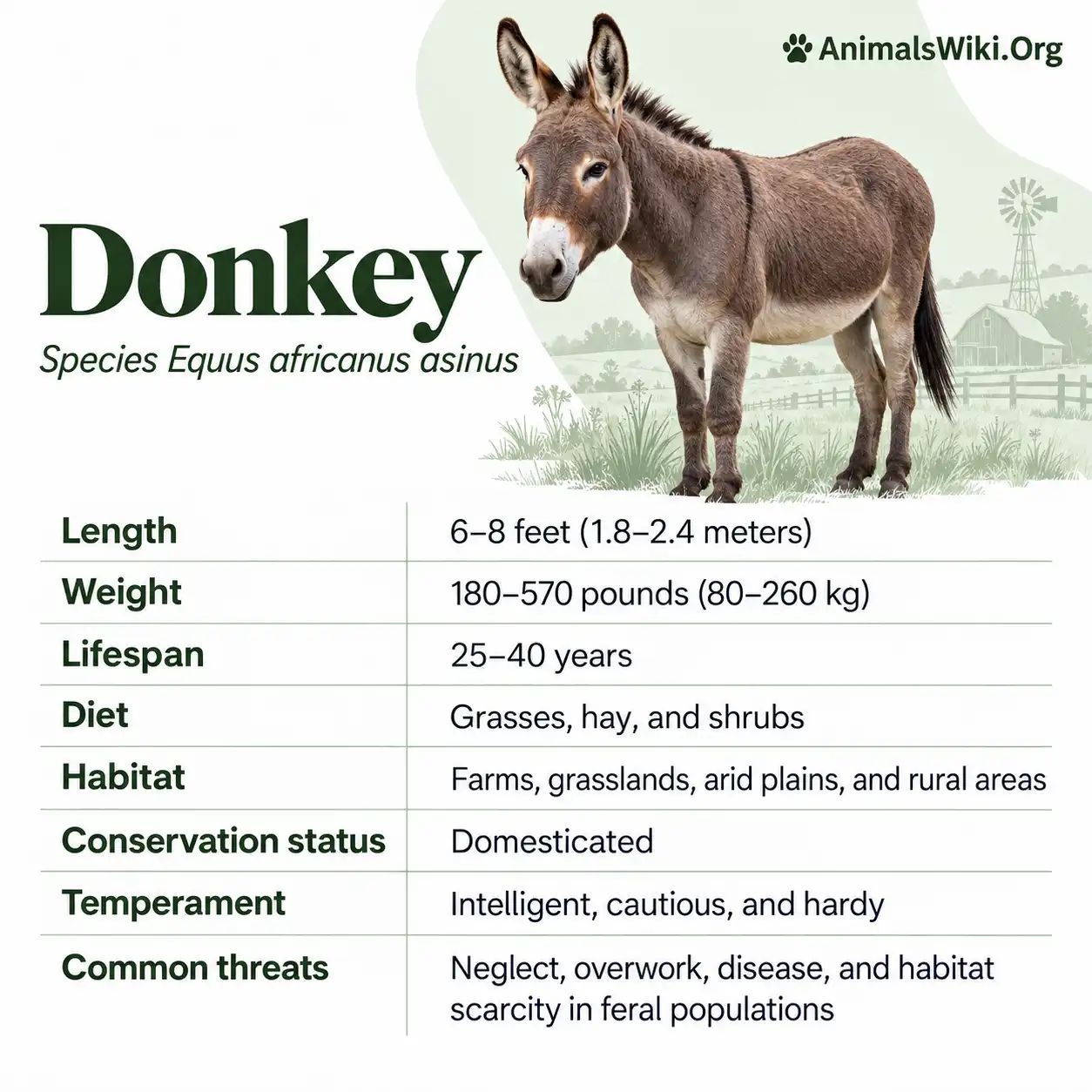
Donkey, The Hardy and Intelligent Working Equines of the World’s Drylands
The donkey is a hardy, intelligent, and remarkably adaptable member of the horse family, recognized by its long ears, strong hooves, distinctive braying call, and extraordinary ability to survive and work in dry, rugged environments.
Domestic donkeys are generally classified as Equus africanus asinus and are descended from the African wild ass.
They belong to the family Equidae, making them close relatives of:
- Horses
- Zebras
- Wild asses
Humans have lived and worked alongside donkeys for thousands of years.
Before trucks, tractors, and modern roads transformed transportation, donkeys helped people move:
- Food
- Water
- Firewood
- Agricultural products
- Building materials
- Trade goods
across difficult landscapes.
Even today, donkeys remain important working animals in many parts of the world.
Their success is closely connected to their ancestry.
The ancestors of domestic donkeys evolved in arid and semi-arid regions of Africa, where animals had to cope with:
- Limited water
- Sparse vegetation
- Intense heat
- Rocky terrain
- Widely scattered resources
As a result, donkeys developed an impressive combination of endurance, efficient digestion, strong feet, cautious decision-making, and tolerance of challenging environmental conditions.
That caution has sometimes been misunderstood.
Donkeys are often stereotyped as stubborn.
In reality, a donkey may stop when it considers a situation unsafe.
Unlike a frightened horse that may react quickly by fleeing, a donkey can be more inclined to assess a potential danger before proceeding.
This difference in behavior can make a donkey appear stubborn when it is actually demonstrating:
- Caution
- Self-preservation
- Learning
- Independent decision-making
Donkeys are also highly social animals.
They can form strong bonds with:
- Other donkeys
- Horses
- Other animals
- Human caregivers
They communicate through body posture, scent, touch, and vocalizations.
The most famous donkey sound is the powerful:
bray
A donkey’s bray can travel over considerable distances, making long-range communication useful in open environments where individuals may be separated.
Donkeys also possess extremely prominent ears.
Their long ears are excellent sound collectors, but they may have another advantage.
Large ears provide considerable surface area, potentially assisting heat exchange in warm climates.
Donkeys differ from horses in other important ways as well.
Their nutritional requirements, hoof characteristics, coat properties, behavior, and responses to environmental conditions can differ substantially.
Treating a donkey simply as a “small horse” can therefore lead to inappropriate care.
Donkeys are their own highly specialized equines.
They have also contributed to one of the world’s most famous hybrid animals:
the mule
A mule is usually produced by breeding a:
male donkey × female horse
The reverse cross—a male horse with a female donkey—is called a:
hinny
Most mules and hinnies are infertile because horses and donkeys have different chromosome numbers.
From ancient trade routes to modern farms, the donkey has played an enormous role in human civilization.
This comprehensive guide explores donkey facts, scientific classification, African wild ass ancestry, anatomy, long ears, hooves, teeth, size, weight, colors, habitat, diet, digestion, behavior, intelligence, memory, communication, braying, social life, sleep, speed, strength, reproduction, pregnancy, baby donkeys, lifespan, predators, defenses, adaptations, donkey vs horse differences, donkey vs mule differences, hinnies, wild donkeys, feral donkeys, domestication, working donkeys, conservation, and much more.
Donkey Facts
| Feature | Information |
|---|---|
| Common Name | Donkey |
| Scientific Classification | Equus africanus asinus |
| Animal Type | Mammal |
| Family | Equidae |
| Genus | Equus |
| Ancestor | African wild ass |
| Diet | Herbivorous |
| Main Foods | Grasses and other fibrous vegetation |
| Male | Jack |
| Female | Jenny or jennet |
| Young | Foal |
| Famous Sound | Bray |
| Feet | Single hoof on each foot |
| Reproduction | Live birth |
| Gestation | Roughly 12 months, often somewhat longer than horses |
| Social Behavior | Social; capable of strong bonds |
| Main Adaptations | Efficient use of sparse forage, strong hooves, large ears, endurance and cautious behavior |
| Close Relatives | Horses, zebras and wild asses |
| Hybrid With Horse | Mule or hinny depending on parentage |
What Is a Donkey?
A donkey is a domesticated equine descended primarily from African wild asses.
It belongs to the genus:
Equus
The same genus includes:
- Horses
- Zebras
- Other wild asses
Donkeys have been selectively bred and managed by humans for thousands of years.
Is a Donkey a Mammal?
Yes.
Donkeys possess all the major characteristics of mammals.
They:
- Have hair
- Are warm-blooded
- Breathe using lungs
- Give birth to live young
- Produce milk for their offspring
Is a Donkey a Horse?
No.
Donkeys and horses are close relatives but are distinct equines.
A domestic horse is generally classified as:
Equus ferus caballus
A domestic donkey is generally:
Equus africanus asinus
They can interbreed, but their offspring are usually infertile.
Scientific Classification of the Donkey
| Classification | Name |
|---|---|
| Kingdom | Animalia |
| Phylum | Chordata |
| Class | Mammalia |
| Order | Perissodactyla |
| Family | Equidae |
| Genus | Equus |
| Species | Equus africanus |
| Domestic Form | Equus africanus asinus |
Taxonomic treatment can vary somewhat among scientific authorities.
Donkeys and the African Wild Ass
Domestic donkeys trace their ancestry to African wild asses.
The African wild ass evolved in harsh environments where:
- Water could be scarce
- Vegetation could be poor
- Temperatures could be high
- Individuals might travel across rocky ground
Many characteristic donkey adaptations reflect this evolutionary history.
What Does a Donkey Look Like?
A typical donkey has:
- Long ears
- Relatively large head
- Short upright mane
- Strong neck
- Compact body
- Slender but strong legs
- Narrow hooves
- Tail with a tuft of long hair near the end
Their appearance varies considerably among breeds.
Donkey Colors
Donkeys occur in colors including:
- Gray
- Brown
- Black
- Reddish brown
- White
- Spotted patterns
Gray is particularly familiar.
Many donkeys also possess lighter coloration around:
- Muzzle
- Eyes
- Belly
Why Do Some Donkeys Have a Cross on Their Backs?
Many donkeys possess dark markings consisting of:
- A dorsal stripe along the back
- A shoulder stripe crossing it
Together these can create a cross-like pattern.
These markings are natural pigmentation features associated with their equine ancestry.
Donkey Ears
Long ears are one of the donkey’s most recognizable characteristics.
They are much more prominent than the ears of a typical horse.
Why Do Donkeys Have Long Ears?
Long ears may provide several advantages.
They are highly effective at detecting sound.
In open, arid environments, this could help donkeys communicate and detect activity over relatively long distances.
The large surface area may also assist with heat dissipation.
Do Donkeys Have Good Hearing?
Yes.
Their large, mobile ears help collect and locate sounds.
Ear position also communicates mood and attention.
Donkey Eyes
Donkeys possess large eyes positioned toward the sides of the head.
This provides a broad field of vision.
For a prey animal, broad visual coverage helps detect potential threats.
Can Donkeys See Color?
Yes, although equine color vision differs from human color vision.
Donkeys do not experience the visual world exactly as humans do.
Donkey Teeth
Donkeys are grazing herbivores with teeth specialized for processing fibrous vegetation.
Their front incisors cut vegetation.
Their cheek teeth grind plant material.
Do Donkey Teeth Keep Growing?
Equine teeth do not grow indefinitely in exactly the same way as rodent incisors.
Instead, donkeys possess long-crowned teeth that gradually erupt as their grinding surfaces wear.
Dental health is therefore important throughout life.
How Many Teeth Does a Donkey Have?
The number varies with:
- Age
- Sex
- Individual anatomy
Adult equines generally possess several dozen teeth.
Males may have canine teeth more commonly than females.
Some individuals also develop small wolf teeth.
Donkey Hooves
Each donkey foot ends in a single hoof.
Donkey hooves evolved for movement over relatively dry, firm terrain.
They differ in shape and structure from typical horse hooves.
Are Donkey Hooves Different From Horse Hooves?
Yes.
Donkey hooves are often:
- More upright
- Narrower
- Differently shaped
than those of horses.
Donkey hoof care should therefore account for donkey-specific anatomy rather than simply applying horse standards without adjustment.
Do Donkeys Need Hoof Trimming?
Domestic donkeys usually require regular hoof assessment and trimming.
Natural wear may not be sufficient, especially when they live on:
- Soft pasture
- Bedding
- Limited exercise areas
Overgrown hooves can cause serious health and mobility problems.
Donkey Mane
Donkeys generally possess a shorter, more upright mane than horses.
Their tails are also distinctive.
Unlike a horse’s long-haired tail from near the base, a donkey’s tail is more cow-like in appearance, with shorter hair along much of its length and a longer tuft near the end.
How Big Is a Donkey?
Donkeys vary enormously in size.
There are:
- Miniature donkeys
- Standard donkeys
- Large donkey breeds
Height is commonly measured at the withers—the highest point around the shoulder region.
How Much Does a Donkey Weigh?
Weight depends strongly on:
- Breed
- Height
- Sex
- Age
- Body condition
Small donkeys may weigh well under 200 kilograms, while large breeds can weigh several hundred kilograms.
There is no single representative weight for every donkey.
Miniature Donkeys
Miniature donkeys are selectively bred for small size.
They are often kept as:
- Companion animals
- Show animals
- Small-farm animals
Their smaller size does not remove their need for appropriate equine care.
Large Donkey Breeds
Some donkey breeds were developed for:
- Heavy work
- Draft purposes
- Mule production
Large breeds can be substantially taller and heavier than typical donkeys.
Male Donkey
An adult male donkey is called a:
jack
or jack donkey.
Female Donkey
An adult female donkey is commonly called a:
jenny
or:
jennet
Baby Donkey
A young donkey is called a:
foal
A young male is a:
colt
A young female is a:
filly
What Do Donkeys Eat?
Donkeys are herbivores.
Their natural feeding strategy is adapted to relatively:
- Fibrous
- Low-energy
- Sparse
vegetation.
Foods can include:
- Grasses
- Straw
- Hay
- Leaves
- Shrubby vegetation
- Other fibrous plants
Domestic diets must be carefully managed.
Are Donkeys Herbivores?
Yes.
Their digestive anatomy is adapted for plant material.
Do Donkeys Eat Grass?
Yes.
However, lush pasture can contain considerably more energy than the sparse vegetation associated with donkey evolutionary history.
Unrestricted access to rich grazing can contribute to obesity and related health problems in susceptible animals.
Do Donkeys Eat Hay?
Yes.
Appropriate hay may be used as part of a managed diet.
The type and amount should match the animal’s:
- Size
- Body condition
- Activity
- Health
- Environment
Do Donkeys Eat Straw?
Straw can form an important source of low-energy fiber in some appropriately managed donkey diets.
However, diet planning should consider individual health, dental condition, climate, and forage quality.
Do Donkeys Eat Carrots?
Donkeys can eat small amounts of suitable vegetables such as carrots as treats.
Treats should not replace a balanced, fiber-rich diet.
Can Donkeys Eat Too Much?
Yes.
Domestic donkeys can become overweight relatively easily when given calorie-rich food without enough exercise.
Obesity can increase the risk of serious health problems.
Donkey Digestive System
Donkeys are:
hindgut fermenters
They do not possess the four-compartment stomach of cattle or sheep.
Instead, microbial fermentation occurs mainly in the:
- Cecum
- Large intestine
Are Donkeys Ruminants?
No.
Donkeys are not ruminants.
They do not chew cud.
Their digestive system is more similar to that of horses.
How Do Donkeys Digest Grass?
Food passes through the stomach and small intestine before reaching the enlarged hindgut.
Microorganisms in the hindgut help ferment fibrous plant material.
This allows donkeys to obtain energy from vegetation.
Do Donkeys Chew Cud?
No.
Donkeys do not ruminate like:
- Sheep
- Goats
- Cattle
Donkeys and Water
Donkeys require access to safe drinking water.
Their ancestors evolved in dry environments, but this does not mean domestic donkeys should routinely be deprived of water.
Adequate hydration remains essential.
Where Do Donkeys Live?
Domestic donkeys occur around the world.
They are especially associated with regions where their:
- Endurance
- Sure-footedness
- Ability to use fibrous forage
make them useful.
They can be found on:
- Farms
- Smallholdings
- Drylands
- Mountain routes
- Rural communities
- Sanctuaries
Natural Habitat of Donkey Ancestors
African wild asses are associated with:
- Arid landscapes
- Semi-deserts
- Rocky terrain
- Sparse grasslands
These habitats shaped many donkey characteristics.
Can Donkeys Live in Deserts?
Donkeys are well adapted to dry conditions.
However, domestic donkeys still need:
- Water
- Appropriate food
- Shade
- Shelter
- Veterinary care
“Desert-adapted” does not mean invulnerable to heat or dehydration.
Can Donkeys Live in Cold Climates?
They can live in cooler regions when provided appropriate management.
Donkeys are generally less naturally protected from prolonged wet and cold weather than many horse breeds.
Access to dry shelter is especially important.
Are Donkey Coats Waterproof?
Donkey coats generally provide less effective protection from persistent rain than the coats of many horses.
This is one reason shelter is important in wet climates.
Donkey Behavior
Donkeys are intelligent animals with behavioral patterns shaped by their evolutionary history.
They can be:
- Curious
- Cautious
- Social
- Playful
- Calm
- Defensive when threatened
Individual personalities vary.
Are Donkeys Stubborn?
The stereotype is misleading.
A donkey may refuse to move when it perceives:
- Danger
- Pain
- Confusion
- Unstable footing
- Excessive load
This caution can appear to humans as stubbornness.
Understanding the reason behind refusal is more useful than assuming disobedience.
Are Donkeys Intelligent?
Yes.
Donkeys can:
- Learn routines
- Remember locations
- Recognize individuals
- Solve practical problems
- Learn from experience
Their intelligence is often underestimated.
Do Donkeys Have Good Memories?
Donkeys are capable of long-term learning and recognition.
They can remember:
- Routes
- Places
- Other animals
- Human interactions
for substantial periods.
Are Donkeys Social?
Yes.
Donkeys can form strong social relationships.
Many benefit from suitable companionship.
Do Donkeys Get Lonely?
Social isolation can negatively affect donkey welfare.
A compatible companion is often important.
Donkeys can bond strongly with other donkeys.
Can Donkeys Bond With Humans?
Yes.
With consistent, appropriate handling, donkeys can develop strong relationships with familiar caregivers.
Trust is particularly important because donkeys may resist situations they perceive as unsafe.
Donkey Communication
Donkeys communicate using:
- Vocalizations
- Ear position
- Tail movement
- Body posture
- Touch
- Smell
Their famous vocalization is the bray.
Why Do Donkeys Bray?
Braying can communicate:
- Location
- Social contact
- Excitement
- Distress
- Reproductive interest
- Anticipation
The exact meaning depends on context.
How Loud Is a Donkey Bray?
A bray is extremely distinctive and can carry over substantial distances under favorable conditions.
Long-distance vocal communication may be particularly useful in open environments.
Why Do Donkeys Say “Hee-Haw”?
“Hee-haw” is the human imitation of the characteristic two-part bray.
The sound is produced through a distinctive pattern of airflow and vocalization.
Donkey Body Language
Ear position is particularly informative.
A donkey’s ears can indicate:
- Attention
- Relaxation
- Concern
- Irritation
However, body language should always be interpreted using the entire animal rather than one signal alone.
Do Donkeys Kick?
Yes.
Like horses, donkeys can kick powerfully when:
- Frightened
- Threatened
- Irritated
- Defending themselves
Safe handling is important.
Do Donkeys Bite?
Yes.
Donkeys can bite, especially during:
- Conflict
- Play
- Fear
- Poor handling
Large equines can cause significant injuries.
Are Donkeys Dangerous?
Well-socialized donkeys are generally manageable around experienced handlers.
However, they are strong animals capable of:
- Biting
- Kicking
- Crushing
- Knocking people over
Respectful handling remains essential.
Donkey Speed
Donkeys can:
- Walk
- Trot
- Canter
- Gallop
but they are generally valued more for endurance and sure-footedness than extreme speed.
Are Donkeys Fast?
They can move quickly when necessary, but most domestic donkeys are not specialized for the same sustained high-speed performance associated with racing horses.
Are Donkeys Strong?
Yes.
Relative to their size, donkeys can be remarkably strong and capable working animals.
However, this does not mean they should carry excessive loads.
How Much Weight Can a Donkey Carry?
Safe carrying capacity depends on:
- Size
- Age
- Fitness
- Body condition
- Terrain
- Load balance
- Health
- Duration of work
There is no single safe weight applicable to every donkey.
Overloading can cause pain, wounds, lameness, and long-term injury.
Why Are Donkeys Good Working Animals?
Useful traits include:
- Endurance
- Sure-footedness
- Caution
- Efficient use of forage
- Strength
- Ability to navigate difficult terrain
These characteristics made them historically important transport animals.
Can Donkeys Climb Mountains?
Donkeys can move effectively over rough and steep terrain.
Their careful foot placement and compact hooves contribute to sure-footed movement.
Can Donkeys Swim?
Yes.
Donkeys are physically capable of swimming when necessary.
However, individual willingness to enter water varies.
Donkey Sleep
Donkeys sleep both standing and lying down.
Like other equines, they can rest lightly while standing.
Deeper sleep requires periods of lying down.
Do Donkeys Sleep Standing Up?
They can doze while standing.
However, they also need opportunities to lie down for deeper sleep.
Donkey Reproduction
Donkeys reproduce sexually.
A female becomes receptive during estrus.
After successful mating and fertilization, pregnancy develops inside the uterus.
How Long Is a Donkey Pregnant?
Donkey gestation is long.
It is commonly around:
12 months
and can often extend somewhat beyond one year.
Individual variation is normal.
How Many Babies Do Donkeys Have?
A jenny usually gives birth to:
one foal
Twins are possible but uncommon and can present significant risks.
Newborn Donkey Foal
A healthy foal normally begins attempting to:
- Lift its head
- Stand
- Walk
- Nurse
relatively soon after birth.
Early intake of colostrum is extremely important.
What Is Colostrum?
Colostrum is the first milk produced after birth.
It contains:
- Concentrated nutrients
- Antibodies
that help protect the newborn.
What Do Baby Donkeys Eat?
Initially, foals depend on:
their mother’s milk
As they grow, they gradually begin sampling:
- Grass
- Hay
- Other suitable forage
Do Donkey Mothers Care for Their Foals?
Yes.
Jennies typically develop strong maternal relationships with their young.
They provide:
- Milk
- Protection
- Social guidance
Donkey Lifespan
Domestic donkeys can be relatively long-lived.
With good care, many can live:
25–30 years
and some individuals can live into their 30s or beyond.
Lifespan depends on:
- Nutrition
- Dental care
- Hoof care
- Disease
- Workload
- Environment
- Veterinary care
What Is the Oldest a Donkey Can Live?
Exceptional individuals may survive well beyond the average range.
However, extremely high ages should not be treated as typical.
Donkey Predators
Wild and feral donkeys may face predators depending on region.
Potential predators include:
- Wolves
- Large cats
- Hyenas
- Other large carnivores
Foals are generally more vulnerable than healthy adults.
How Do Donkeys Defend Themselves?
Donkeys can defend themselves using:
- Powerful kicks
- Bites
- Strikes
- Running
- Group vigilance
They may stand their ground more readily than horses in some situations.
Can Donkeys Fight Predators?
Donkeys can aggressively confront certain threats.
They may:
- Chase
- Bite
- Kick
However, claims that every donkey will automatically attack predators are inaccurate.
Individual behavior varies greatly.
Donkeys as Livestock Guardians
Some donkeys are kept with livestock because they may show aggression toward unfamiliar canine-like animals.
However, guardian suitability varies by individual.
Not every donkey makes a safe or effective livestock guardian.
Donkey Adaptations
Donkeys possess numerous adaptations connected to their dryland ancestry.
Long Ears
Improve sound detection and may contribute to heat dissipation.
Strong Hooves
Support movement across hard, rocky terrain.
Efficient Digestion
Allows effective use of fibrous, relatively low-quality forage.
Cautious Behavior
Encourages assessment of potentially dangerous situations.
Strong Memory
Supports navigation and learning.
Endurance
Helps with long-distance movement.
Social Communication
Allows individuals to maintain contact across open environments.
Heat Tolerance
Reflects adaptation to relatively warm, dry environments.
Donkey vs. Horse
Donkeys and horses share a family but have important differences.
| Feature | Donkey | Horse |
|---|---|---|
| Family | Equidae | Equidae |
| Genus | Equus | Equus |
| Ears | Longer | Generally shorter |
| Mane | Usually short and upright | Often longer and flowing |
| Tail | Tufted near end | Long hair from near base |
| Hooves | Narrower/more upright | Generally broader |
| Behavior | Often more cautious | Often stronger flight response |
| Ancestry | African wild ass | Wild horse lineage |
| Chromosomes | 62 | 64 |
How Many Chromosomes Does a Donkey Have?
Domestic donkeys have:
62 chromosomes
Horses have:
64 chromosomes
This difference helps explain the reproductive limitations of their hybrid offspring.
Donkey vs. Mule
A donkey and mule are not the same animal.
A mule is generally produced by breeding:
male donkey × female horse
| Feature | Donkey | Mule |
|---|---|---|
| Parents | Donkey × donkey | Male donkey × female horse |
| Chromosomes | 62 | Usually 63 |
| Fertility | Normally fertile | Usually infertile |
| Species Type | Domesticated equine | Hybrid |
| Appearance | Typical donkey traits | Combination of horse and donkey traits |
Why Are Mules Usually Infertile?
Mules usually have:
63 chromosomes
This odd number creates difficulties during meiosis, the process that produces reproductive cells.
Chromosomes cannot pair normally, so viable eggs or sperm are rarely produced.
Can a Mule Ever Reproduce?
Rare cases of fertile female mules have been documented.
However, mule fertility is exceptionally unusual.
Male mules are considered effectively sterile.
Donkey vs. Hinny
A hinny is usually produced by:
male horse × female donkey
A mule is:
male donkey × female horse
Both are horse-donkey hybrids, but parental direction differs.
Donkey vs. Zebra
Both belong to the genus Equus.
Zebras are recognizable by their striped coats and are wild African equines.
Donkeys generally possess:
- Longer ears
- More subdued coloration
- A long history of domestication
Donkey vs. Pony
A pony is a small type of domestic horse.
A donkey is a different equine lineage.
Therefore:
small horse ≠ donkey
Donkey vs. Burro
“Burro” is the Spanish word for donkey.
In parts of the Americas, the word is commonly used for donkeys, particularly smaller or feral animals.
Biologically, a burro is a donkey.
Donkey vs. Ass
“Ass” is the traditional zoological term for members of several wild and domestic donkey-related equines.
A domestic donkey is a domesticated ass.
“Donkey” became the more common everyday English term.
Wild Donkeys
Strictly speaking, wild asses and feral donkeys should be distinguished.
A wild ass belongs to a naturally wild lineage.
A feral donkey descends from domesticated animals that returned to free-living conditions.
Feral Donkeys
Feral donkey populations exist in several regions.
They can survive successfully in:
- Deserts
- Scrublands
- Grasslands
- Rugged landscapes
In some ecosystems they are considered invasive because they can alter:
- Vegetation
- Water sources
- Soil
- Native wildlife habitat
African Wild Ass
The African wild ass is the wild ancestor of domestic donkeys.
It is adapted to extremely harsh dryland conditions.
Wild populations have experienced severe conservation pressures.
Donkey Domestication
Donkeys were domesticated thousands of years ago in Africa.
Their domestication transformed transportation and trade.
They could move goods through environments where wheeled vehicles were impractical.
Why Were Donkeys Domesticated?
Their valuable characteristics included:
- Strength
- Endurance
- Sure-footedness
- Modest nutritional requirements
- Ability to travel through dry landscapes
They became particularly important as pack animals.
Donkeys in Ancient Civilizations
Donkeys contributed to:
- Trade
- Agriculture
- Transport
- Mining
- Military logistics
- Movement of food and water
Their historical importance is sometimes underestimated because modern machines now perform many of these roles.
Working Donkeys
Millions of people have historically depended on working equines, including donkeys, for transportation and agriculture.
Working donkeys may:
- Carry loads
- Pull carts
- Transport water
- Carry crops
- Assist with farming
Their welfare depends on responsible management.
Donkey Welfare
Important welfare needs include:
- Appropriate nutrition
- Clean water
- Shelter
- Hoof care
- Dental care
- Veterinary treatment
- Social companionship
- Suitable workload
- Properly fitted equipment
Working ability should never be used as justification for overloading or neglect.
Donkey Saddles and Harnesses
Poorly fitted equipment can cause:
- Pressure sores
- Skin wounds
- Muscle pain
- Spinal discomfort
Harnesses and packs must be fitted appropriately to the individual animal.
Donkey Intelligence and Training
Effective donkey training generally relies on:
- Patience
- Consistency
- Clear signals
- Positive reinforcement
- Building trust
Force can increase fear and resistance.
A donkey that refuses an action may be communicating discomfort or uncertainty.
Donkey Conservation
Domestic donkeys are widespread.
However, the situation is very different for their wild relatives.
Wild ass populations may face threats including:
- Habitat degradation
- Competition with livestock
- Hunting
- Water scarcity
- Human disturbance
- Hybridization with domestic animals
Conservation status should therefore be considered separately for each wild species or subspecies.
Ecological Effects of Feral Donkeys
Feral donkeys can have complicated ecological effects.
In introduced environments, large populations may:
- Graze native vegetation
- Trample soil
- Alter waterholes
- Compete with native herbivores
Their ecological role therefore differs greatly between regions.
40 Interesting Donkey Facts
- Donkeys are mammals.
- They belong to the horse family Equidae.
- Domestic donkeys descend from African wild asses.
- Their genus is Equus.
- Horses and zebras are close relatives.
- Donkeys have 62 chromosomes.
- Horses have 64.
- Mules usually have 63.
- A male donkey is called a jack.
- A female donkey is called a jenny or jennet.
- A baby donkey is called a foal.
- Donkeys are herbivores.
- They are hindgut fermenters.
- Donkeys are not ruminants.
- They do not chew cud.
- Donkeys possess unusually long ears.
- Their ears provide excellent hearing.
- Large ears may also assist heat exchange.
- Donkeys have a short upright mane.
- Their tails usually have a long tuft near the end.
- Donkey hooves differ from horse hooves.
- Domestic donkeys need regular hoof care.
- Donkeys are highly social.
- They can form strong bonds.
- Donkeys are intelligent animals.
- They can remember learned information and familiar individuals.
- Their famous vocalization is called a bray.
- Braying can carry over considerable distances.
- Donkeys can kick powerfully.
- They can also bite.
- Donkeys are often more cautious than the stereotype of “stubbornness” suggests.
- Their digestive systems are adapted to fibrous forage.
- Rich diets can make domestic donkeys overweight.
- Donkey pregnancy lasts roughly a year.
- A jenny usually produces one foal.
- Donkeys can live for several decades with good care.
- A mule usually has a donkey father and horse mother.
- A hinny usually has a horse father and donkey mother.
- Most mules and hinnies are infertile.
- Donkeys have supported human transportation, agriculture, and trade for thousands of years.
Did You Know?
The donkey’s reputation for stubbornness may actually come from one of its greatest survival adaptations: caution.
Imagine two equines standing beside an unfamiliar obstacle.
A horse and a donkey both notice something potentially dangerous.
A horse’s evolutionary history strongly favors rapid escape from threats.
When frightened, its first response may be:
move away immediately.
A donkey’s ancestors evolved under somewhat different environmental pressures.
In rugged, dry terrain, blindly running away could itself be dangerous.
A panicked animal might encounter:
- Loose rocks
- A steep drop
- Unstable ground
- A dead end
- Another hazard
Stopping to evaluate the situation could therefore provide an advantage.
That behavioral difference helps explain why a donkey may plant its feet and refuse to continue when it:
- Does not understand what is being requested
- Detects unsafe footing
- Feels pain
- Is overloaded
- Fears an unfamiliar object
From the human perspective, the animal appears stubborn.
From the donkey’s perspective, it may be making a risk assessment.
This is also why forcing a frightened donkey can make the problem worse.
Good handling involves determining why the animal is reluctant.
Once the donkey understands the situation and trusts its handler, it can be remarkably cooperative.
So one of the most famous insults associated with the donkey may actually misunderstand the animal completely.
What humans have historically called stubbornness can sometimes be better described as:
caution, memory, and self-preservation.
Frequently Asked Questions About Donkeys
What is a donkey?
A donkey is a domesticated equine descended primarily from African wild asses.
What is the scientific name of a donkey?
Domestic donkeys are commonly classified as Equus africanus asinus.
Is a donkey a mammal?
Yes.
Is a donkey a horse?
No. Donkeys and horses are different but closely related equines.
What family does a donkey belong to?
Equidae.
What genus does a donkey belong to?
Equus.
Are donkeys related to horses?
Yes.
Are donkeys related to zebras?
Yes.
What did domestic donkeys evolve from?
They descend primarily from African wild asses.
What is a male donkey called?
A jack.
What is a female donkey called?
A jenny or jennet.
What is a baby donkey called?
A foal.
What is a young male donkey called?
A colt.
What is a young female donkey called?
A filly.
What is a group of donkeys called?
Terms such as herd are commonly used. Traditional collective nouns also exist, but herd is the clearest everyday term.
What do donkeys eat?
They eat fibrous vegetation such as grasses, straw, hay, and other suitable plant material.
Are donkeys herbivores?
Yes.
Do donkeys eat grass?
Yes.
Do donkeys eat hay?
Yes.
Can donkeys eat straw?
Appropriate straw can be an important fiber source in some managed diets.
Can donkeys eat carrots?
Small amounts can be offered as treats.
Do donkeys eat meat?
Their digestive system is specialized for a herbivorous diet.
Are donkeys ruminants?
No.
Do donkeys have four stomachs?
No.
Do donkeys chew cud?
No.
How do donkeys digest grass?
They are hindgut fermenters, with microbial fermentation occurring primarily in the cecum and large intestine.
Do donkeys need water?
Yes. They require reliable access to safe drinking water.
Can donkeys survive without water?
Their dryland ancestry gives them useful adaptations, but domestic donkeys still require adequate hydration.
Why do donkeys have long ears?
Their ears improve sound detection and may also contribute to heat dissipation.
Do donkeys have good hearing?
Yes.
Can donkeys move their ears?
Yes. Their ears are highly mobile.
Why do donkeys have a cross on their backs?
Many possess a dorsal stripe crossed by a shoulder stripe, creating a natural cross-like marking.
Do all donkeys have a cross marking?
No. Markings vary with genetics and coat color.
Do donkeys have hooves?
Yes.
Are donkey hooves different from horse hooves?
Yes. Donkey hooves are typically narrower and more upright.
Do donkeys need hoof trimming?
Domestic donkeys commonly require regular hoof care.
Do donkeys have teeth?
Yes.
Do donkey teeth grow continuously?
Their long-crowned teeth continue erupting as the chewing surfaces wear, but this differs from the continuously growing incisors of rodents.
Do donkeys need dental care?
Yes. Regular dental assessment can be important, particularly as they age.
How big is a donkey?
Size varies enormously from miniature to large breeds.
How much does a donkey weigh?
Depending on breed and size, adult donkeys may range from well under 200 kilograms to several hundred kilograms.
Are miniature donkeys a separate species?
No. They are domestic donkeys selectively bred for small size.
How long do donkeys live?
Many domestic donkeys can live around 25–30 years with good care, and some survive longer.
Can donkeys live for 40 years?
Some individuals can reach their 30s or beyond, although such ages should not be assumed for every donkey.
Are donkeys intelligent?
Yes.
Do donkeys have good memories?
Yes. They can retain learned information and recognize familiar animals, people, and places.
Are donkeys stubborn?
Their cautious behavior is often mistaken for stubbornness.
Why does a donkey refuse to move?
Possible reasons include fear, pain, uncertainty, unsafe footing, poor training, or excessive load.
Are donkeys social?
Yes.
Do donkeys get lonely?
Social isolation can negatively affect their welfare.
Do donkeys need another donkey?
Suitable companionship is important, and another compatible donkey is often an excellent companion.
Can donkeys bond with humans?
Yes.
What sound does a donkey make?
A bray.
Why do donkeys bray?
They may bray for communication, social contact, excitement, distress, or reproductive reasons.
Why is a donkey sound called “hee-haw”?
“Hee-haw” imitates the characteristic two-part braying sound.
Can donkeys kick?
Yes.
Can donkeys bite?
Yes.
Are donkeys dangerous?
They are generally manageable with appropriate handling, but their kicks and bites can cause serious injury.
Are donkeys stronger than horses?
Strength varies by individual and size. Donkeys are notably strong and enduring relative to their body size, but broad strength comparisons are misleading.
How much weight can a donkey carry?
Safe load depends on the individual donkey’s size, health, fitness, terrain, and equipment. There is no universal safe weight.
Can donkeys pull carts?
Yes, when appropriately trained, conditioned, equipped, and not overloaded.
Can donkeys carry people?
Some sufficiently large, healthy donkeys can carry appropriately sized riders, but load, saddle fit, age, and fitness must be considered.
Can donkeys run?
Yes.
Can donkeys gallop?
Yes.
Are donkeys fast?
They can move quickly but are better known for endurance and sure-footedness than racing speed.
Can donkeys climb mountains?
They can navigate steep and rocky terrain effectively.
Can donkeys swim?
Yes.
Do donkeys sleep standing up?
They can doze while standing.
Do donkeys lie down to sleep?
Yes. Lying down is important for deeper sleep.
How long is a donkey pregnant?
Usually around 12 months, with some pregnancies lasting somewhat longer.
How many babies does a donkey have?
Usually one foal.
Can donkeys have twins?
Yes, but twin pregnancies are uncommon and risky.
Can baby donkeys walk after birth?
Healthy foals usually attempt to stand and walk relatively soon.
What do baby donkeys drink?
Their mother’s milk.
What is colostrum?
Colostrum is the antibody-rich first milk produced after birth.
Do mother donkeys care for their babies?
Yes.
What predators eat donkeys?
Depending on region, wild or feral donkeys may face large carnivores such as wolves, large cats, or hyenas.
How do donkeys defend themselves?
They can kick, bite, strike, run, and confront threats.
Can a donkey kill a predator?
A donkey’s kicks can seriously injure an attacker, but not every donkey will successfully defend against every predator.
Are donkeys good livestock guardians?
Some individuals can deter canine predators, but guardian behavior is not reliable in every donkey.
Where do donkeys live?
Domestic donkeys live worldwide, particularly in agricultural and rural environments.
Can donkeys live in deserts?
They are strongly adapted to dry conditions, provided their welfare needs are met.
Can donkeys live in cold weather?
Yes, with appropriate shelter and management.
Do donkeys like rain?
Many donkeys seek shelter during prolonged rain because their coats are generally less effective at resisting persistent wet conditions than those of many horses.
Do donkeys need shelter?
Yes, especially from prolonged rain, cold, extreme heat, and wind.
What is a mule?
A mule is usually the offspring of a male donkey and female horse.
What is a hinny?
A hinny is usually the offspring of a male horse and female donkey.
What is the difference between a donkey and a mule?
A donkey is an equine lineage, while a mule is a horse-donkey hybrid.
Can donkeys reproduce?
Yes.
Can mules reproduce?
Most mules are infertile.
Why are mules sterile?
Their 63 chromosomes create difficulties during reproductive-cell formation.
How many chromosomes does a donkey have?
How many chromosomes does a horse have?
How many chromosomes does a mule have?
Usually 63.
Can a donkey mate with a zebra?
Horse-family species can sometimes produce hybrid offspring, including donkey-zebra hybrids, although such crosses are unusual and the offspring commonly have fertility problems.
What is a zonkey?
“Zonkey” is an informal term for a zebra-donkey hybrid.
Is a burro a donkey?
Yes. Burro is the Spanish term for donkey and is widely used in parts of the Americas.
Is an ass a donkey?
A domestic donkey is a domesticated ass. “Ass” is an older zoological term.
What is the difference between a wild donkey and a feral donkey?
A feral donkey descends from domestic animals, while a genuinely wild ass belongs to a naturally wild population or lineage.
When were donkeys domesticated?
Donkeys were domesticated thousands of years ago in Africa.
Why did humans domesticate donkeys?
They were valuable for carrying loads, transportation, agriculture, and trade.
Are donkeys still used for work?
Yes. Working donkeys remain economically important in many communities.
Do donkeys make good pets?
They can be rewarding companion animals for people capable of providing appropriate space, nutrition, companionship, hoof care, dental care, and veterinary treatment.
Can a donkey live alone?
Donkeys are social animals, and long-term isolation is generally undesirable.
Are donkeys easy to train?
They can learn very effectively when training is patient, consistent, and based on trust.
Why shouldn’t you force a donkey?
Force can increase fear and resistance and may ignore underlying pain or safety concerns.
Are donkeys endangered?
Domestic donkeys are widespread, but some wild ass populations face severe conservation threats.
Are feral donkeys invasive?
In some introduced ecosystems, large feral populations can significantly alter vegetation, soils, and water sources.
Why are donkeys important?
Donkeys have supported human transport, farming, trade, and livelihoods for thousands of years and remain important in many communities today.
Conclusion
The donkey is one of the most underestimated domesticated animals in human history.
Its familiar long ears and unmistakable bray can make it seem like a simple farm animal.
In reality, nearly every major feature of the donkey reflects a long evolutionary history of surviving difficult environments.
Its ancestors lived in African drylands where resources could be:
- Sparse
- Unpredictable
- Widely separated
Survival in such landscapes favored an animal capable of making efficient use of fibrous vegetation.
It favored strong feet capable of crossing rocky ground.
It favored excellent hearing.
It favored endurance.
And importantly, it favored caution.
That last characteristic may explain one of the greatest misunderstandings about donkeys.
The donkey’s legendary “stubbornness” is not necessarily a sign of low intelligence or laziness.
A donkey that stops may be evaluating danger.
It may remember a previous negative experience.
It may detect unstable ground.
It may be uncomfortable.
It may simply not understand what is being requested.
This combination of memory and self-preservation helped make donkeys reliable working partners when humans began domesticating them thousands of years ago.
Their contribution to civilization became enormous.
Before engines and paved highways, donkeys transported:
- Water
- Grain
- Firewood
- Minerals
- Crops
- Trade goods
They traveled across routes where wheeled vehicles could not easily operate.
They connected farms with markets and communities with distant trade networks.
Even today, donkeys continue to perform important work in many parts of the world.
Their relationship with horses produced another historically important working animal—the mule.
Yet a donkey should never be viewed merely as a smaller version of a horse.
Its:
- Hooves
- Coat
- Nutritional needs
- Behavior
- Metabolism
- Communication
- Environmental adaptations
all deserve donkey-specific understanding.
That is especially important in domestic care.
An animal evolved for sparse vegetation can become overweight when surrounded by rich pasture.
An animal adapted to dry climates may need substantial protection from persistent cold rain.
An animal capable of carrying loads can still suffer badly when overloaded or fitted with poor equipment.
Understanding the donkey’s biology therefore improves both appreciation and welfare.
From its long ears scanning the landscape to its careful feet navigating rocky terrain, the donkey is an animal shaped by endurance.
It is intelligent enough to remember.
Cautious enough to stop.
Strong enough to work.
Social enough to form lasting bonds.
And adaptable enough to have accompanied human civilization for thousands of years.
The donkey’s story is therefore not simply the history of a working animal.
It is the story of one of humanity’s oldest and most resilient animal partnerships.



