
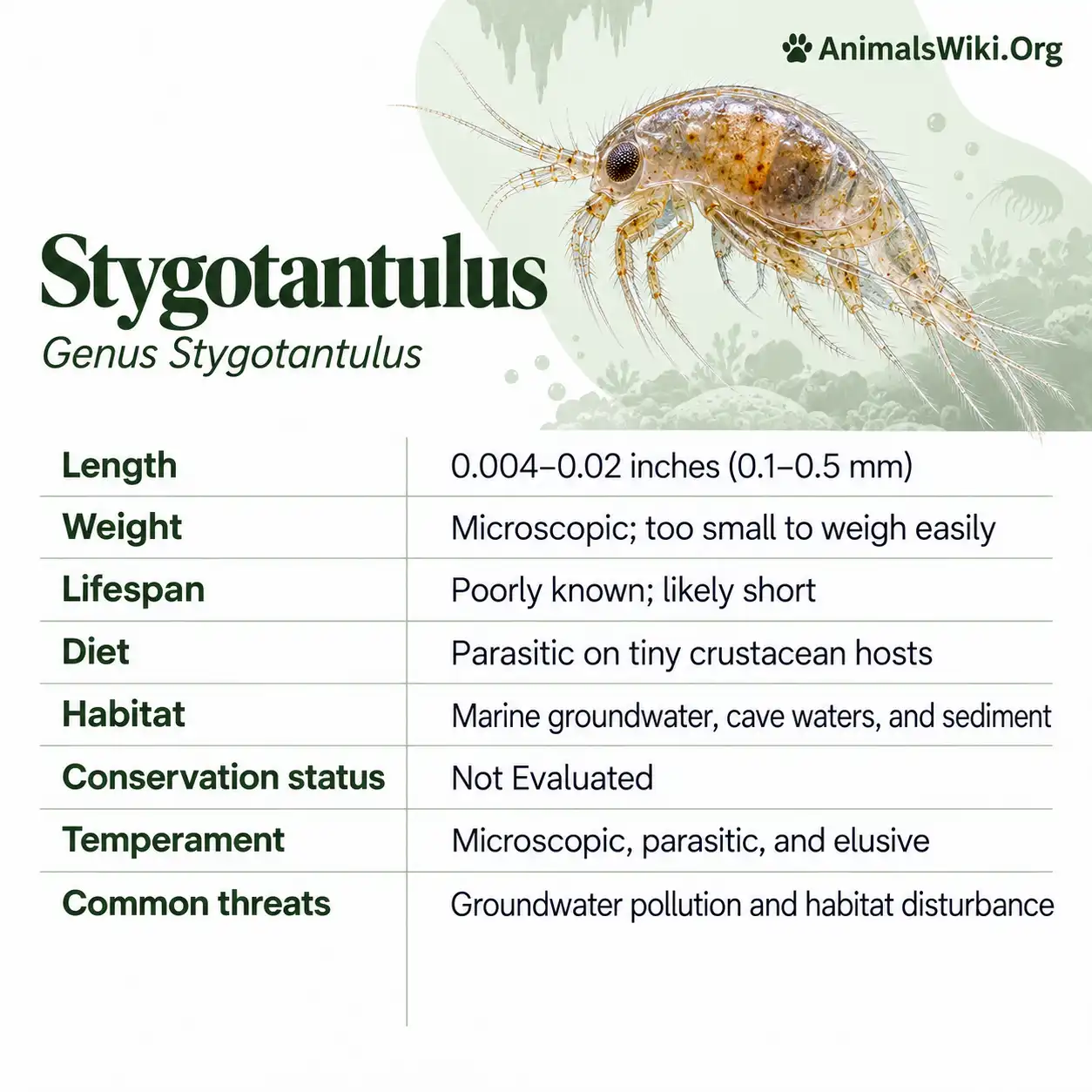
Stygotantulus, The Microscopic Parasitic Crustacean Among the World’s Smallest Arthropods
Stygotantulus is one of the smallest and most unusual animals ever described.
Unlike familiar crustaceans such as crabs, lobsters, shrimp, and crayfish, Stygotantulus is so tiny that it cannot be properly appreciated without a microscope.
The genus is represented by the species:
Stygotantulus stocki
It belongs to an extraordinary group of minute parasitic crustaceans known as the Tantulocarida.
Stygotantulus stocki lives as an ectoparasite, attaching to other tiny crustaceans known as harpacticoid copepods.
The animal is therefore a parasite living on a host that is itself extremely small.
The original scientific description of Stygotantulus stocki was published by crustacean researchers Geoffrey A. Boxshall and Rony Huys in 1989.
The material used to describe it came from an anchialine lava pool on Lanzarote in the Canary Islands.
Anchialine habitats are unusual coastal aquatic systems that have subterranean connections with the sea.
The original type locality was a lava pool separated from the ocean by lava and pumice but still influenced by tides through underground connections.
One of the most extraordinary characteristics of Stygotantulus is its size.
The original description reported a tantulus larva approximately 94 micrometers long.
That equals only:
0.094 millimeters
Other references describe Stygotantulus stocki at roughly 97 micrometers, or approximately 0.097 millimeters, and it has consequently been cited as a candidate for the title of the world’s smallest arthropod.
For comparison, one millimeter equals 1,000 micrometers.
That means an approximately 0.1-millimeter Stygotantulus could fit roughly ten times end-to-end within a single millimeter.
Its extraordinary miniaturization is even more impressive because Stygotantulus is not a single-celled organism.
It is an arthropod with a structured body containing distinct regions and appendages.
The tantulus larva described by Boxshall and Huys possesses:
- A cephalon
- Six thoracic segments bearing limbs
- A seven-segmented abdomen
- Thoracic appendages
- Caudal structures
- A specialized attachment apparatus
At the front of the body is a specialized cephalic stylet associated with attachment to its host.
The original researchers considered the complexity of this stylet particularly distinctive.
Its parasitic lifestyle is equally remarkable.
Rather than swimming through the environment as a large free-living crustacean, Stygotantulus attaches to tiny harpacticoid copepods.
The original specimens were associated with hosts belonging to at least two different harpacticoid families.
One specimen was attached to an antennular sensory structure of its host.
Another was attached to the ventral surface near the host’s anal segment.
Tantulocarids possess one of the more unusual developmental systems among crustaceans.
Their infective stage, called the tantulus larva, attaches to a crustacean host.
Subsequent development can involve formation of a sac-like structure while the parasite remains associated with the host.
The adult male described for Stygotantulus stocki developed within such a trunk sac.
This microscopic animal therefore demonstrates an important principle of evolution:
An animal does not need to be large or visually spectacular to possess extraordinary biological complexity.
At less than a tenth of a millimeter in one described larval stage, Stygotantulus stocki has evolved a highly specialized parasitic life cycle, complex attachment structures, segmented anatomy, and an intimate ecological relationship with another microscopic crustacean.
This comprehensive guide explores Stygotantulus facts, Stygotantulus stocki, size, classification, anatomy, habitat, anchialine pools, parasitism, hosts, harpacticoid copepods, tantulus larvae, attachment, life cycle, reproduction, discovery, scientific importance, miniaturization, Tantulocarida, smallest arthropods, and everything currently known about this extraordinary microscopic crustacean.
Stygotantulus Facts
| Feature | Information |
|---|---|
| Genus | Stygotantulus |
| Known Species | Stygotantulus stocki |
| Animal Type | Microscopic crustacean |
| Phylum | Arthropoda |
| Subphylum | Crustacea |
| Class/Group | Tantulocarida |
| Family | Basipodellidae |
| Lifestyle | Ectoparasitic |
| Known Hosts | Harpacticoid copepods |
| Tantulus Larva Length | About 94 μm in original description |
| Frequently Reported Size | Under 0.1 mm |
| Habitat of Type Material | Anchialine lava pool |
| Type Locality | Lanzarote, Canary Islands |
| Described | 1989 |
| Authors | Geoffrey A. Boxshall and Rony Huys |
| Famous For | Extreme miniaturization |
| Possible Record | Often cited among the world’s smallest arthropods |
| Conservation Status | Not meaningfully assessed in the way familiar vertebrates are |
| Lifespan | Not established |
| Exact Diet | Poorly documented; parasitic nutrition is associated with its host |
| Human Danger | None known |
What Is Stygotantulus?
Stygotantulus is a genus of extremely small parasitic crustaceans belonging to Tantulocarida.
Its recognized species is:
Stygotantulus stocki
It is an ectoparasite of tiny crustaceans called harpacticoid copepods.
Unlike large crustaceans that can be observed directly, Stygotantulus requires microscopic examination.
Is Stygotantulus an Animal?
Yes.
Despite its microscopic size, Stygotantulus is a multicellular animal.
It belongs to:
Kingdom Animalia
It should not be confused with:
- Bacteria
- Protozoans
- Single-celled algae
Its body is organized into multiple segments and specialized structures.
Is Stygotantulus an Arthropod?
Yes.
It belongs to the phylum:
Arthropoda
This enormous animal group also contains:
- Insects
- Spiders
- Scorpions
- Crabs
- Shrimp
- Lobsters
- Centipedes
- Millipedes
Stygotantulus represents the extreme miniature end of arthropod body size.
Is Stygotantulus a Crustacean?
Yes.
It is a crustacean.
However, its body looks dramatically different from familiar crustaceans such as:
- Crabs
- Lobsters
- Shrimp
because its tiny size and parasitic lifestyle have produced extreme specialization.
Scientific Classification of Stygotantulus
A simplified classification is:
| Classification | Name |
|---|---|
| Kingdom | Animalia |
| Phylum | Arthropoda |
| Subphylum | Crustacea |
| Class/Group | Tantulocarida |
| Family | Basipodellidae |
| Genus | Stygotantulus |
| Species | Stygotantulus stocki |
Taxonomic concepts surrounding major crustacean lineages have changed over time, so older publications may use classifications that differ from modern treatments.
What Is Stygotantulus stocki?
Stygotantulus stocki is the species for which the genus Stygotantulus was established.
It was formally described in 1989 by:
Geoffrey A. Boxshall and Rony Huys
The description was based on specimens associated with harpacticoid copepods collected from an anchialine lava pool on Lanzarote.
Why Is Stygotantulus Famous?
Stygotantulus is primarily famous for three reasons:
- Its extraordinary microscopic size
- Its specialized parasitic lifestyle
- Its unusual anatomy and developmental biology
It has frequently been cited as one of the smallest arthropods known.
How Small Is Stygotantulus?
The original description gave the tantulus larva a total body length of approximately:
94 micrometers
A micrometer is one-millionth of a meter.
Therefore:
94 μm = 0.094 mm
Other references commonly give a figure close to:
97 μm = 0.097 mm
Either way, the animal is less than one-tenth of a millimeter long in the tiny stage for which these measurements are reported.
Is Stygotantulus Smaller Than 1 Millimeter?
Yes.
Dramatically smaller.
At roughly 0.1 mm, the tiny tantulus stage is approximately one-tenth of a millimeter long.
Can You See Stygotantulus With the Naked Eye?
Not in useful biological detail.
At around one-tenth of a millimeter, it is near the extreme lower range where a tiny speck might theoretically be perceived under ideal circumstances.
However, identifying the animal and examining its anatomy requires:
microscopy
Is Stygotantulus the Smallest Animal in the World?
No.
Many animals and animal life stages are smaller.
Microscopic animals include tiny:
- Rotifers
- Gastrotrichs
- Nematodes
- Parasitic forms
The important claim associated with Stygotantulus concerns arthropods, not all animals.
Is Stygotantulus the Smallest Arthropod?
It is frequently cited as a candidate for or example of the smallest known arthropods, particularly based on the tiny size of its tantulus larva.
However, “smallest arthropod” claims require caution.
Body size may refer to:
- Adult
- Larva
- Male
- Female
- Total length
- Different measurement methods
New species discoveries can also change record claims.
It is therefore safest to describe Stygotantulus stocki as:
one of the smallest known arthropods and a frequently cited contender for the smallest.
What Does Stygotantulus Look Like?
To the unaided eye, its detailed anatomy is effectively invisible.
Under magnification, the tantulus larva has a highly organized segmented body.
The original description identified:
- A cephalon
- Six limb-bearing thoracic somites
- Seven abdominal segments
- Thoracic appendages
- Caudal rami
- An oral disc
- A specialized stylet
Despite its extreme size reduction, its anatomy is remarkably elaborate.
Stygotantulus Cephalon
The cephalon is the anterior body region.
In the described larva, it is covered by a dorsal shield.
The original researchers described fine:
- Longitudinal
- Transverse
surface structures on this shield.
Stygotantulus Oral Disc
An oral disc is located on the ventral surface of the cephalon.
The original description reported it at approximately:
9 micrometers in diameter.
This structure is associated with the parasite’s attachment apparatus.
Stygotantulus Stylet
One of the most distinctive structures is the:
cephalic stylet
The original specimen’s stylet was approximately:
27 micrometers long.
That is remarkable considering the entire larva measured only around 94 micrometers.
The stylet has specialized features associated with its parasitic lifestyle.
Why Does Stygotantulus Have a Stylet?
The stylet forms part of the specialized system associated with attachment to and exploitation of the host.
Parasitic tantulocarids attach firmly to other crustaceans and obtain resources through their intimate host association.
The exact physiological details should not be oversimplified because much remains unknown about these extremely difficult-to-study animals.
Stygotantulus Body Segments
The tantulus larva described in the original study consists of:
- Cephalon
- Six thoracic somites bearing appendages
- Seven-segmented abdomen
The seven abdominal segments were particularly important because they distinguished Stygotantulus from other known tantulocarid genera at the time.
Why Are Its Seven Abdominal Segments Important?
Taxonomists identify and classify tiny crustaceans partly through detailed anatomical characters.
The seven-segmented abdomen of the tantulus larva was considered distinctive enough to help diagnose the new genus.
Does Stygotantulus Have Legs?
The tantulus larva possesses thoracic appendages called:
thoracopods
The original description identified six pairs associated with its thoracic segments.
Their structure differs among the segments.
Does Stygotantulus Have a Skeleton?
Like other arthropods, crustaceans possess an external body covering rather than an internal bony skeleton like vertebrates.
At microscopic scale, Stygotantulus retains the basic arthropod principle of an external cuticular body covering.
Where Does Stygotantulus Live?
The type specimens of Stygotantulus stocki came from:
Lanzarote, Canary Islands
More specifically, they were collected from an:
anchialine lava pool
near Playa de Montaña Bermeja.
What Is an Anchialine Pool?
An anchialine pool is a landlocked or semi-isolated coastal body of water that maintains underground connections with the sea.
Such systems may:
- Experience tidal influence
- Contain saline or brackish water
- Lack an obvious surface connection to the ocean
- Support unusual subterranean or marine-derived organisms
These habitats can contain highly specialized species.
What Was the Stygotantulus Type Habitat Like?
The original locality was an anchialine lava pool approximately:
50–100 meters from the sea.
A ridge of lava and pumice separated it from the ocean.
Nevertheless, tidal activity could be detected because seawater communicated with the pool through underground connections.
When Was Stygotantulus Collected?
The material used in the original description was collected in:
May 1985
The species was formally described several years later in:
1989
Who Discovered Stygotantulus?
The scientific description was produced by Geoffrey A. Boxshall and Rony Huys.
The copepod hosts carrying the parasite had been collected by Professor:
Jan Hendrik Stock
The species name stocki honors him.
Why Is It Called Stygotantulus?
The original authors explained that the generic name incorporates a reference to:
Styx / stygo
associated with the “lower world,” together with tantulus, referencing Tantulocarida.
This was appropriate for an organism discovered in an unusual, partly subterranean anchialine environment.
Why Is It Called Stygotantulus stocki?
The species epithet:
stocki
honors Professor Jan Stock, who collected the copepod hosts on which the parasite was discovered.
Is Stygotantulus a Parasite?
Yes.
It is an:
ectoparasite
meaning it attaches externally to its host rather than living freely as an ordinary planktonic or bottom-dwelling crustacean.
What Does Stygotantulus Parasitize?
Known specimens were found on:
harpacticoid copepods
The original study reported hosts representing at least two copepod families.
What Is a Copepod?
A copepod is a small crustacean.
Copepods are extraordinarily abundant in aquatic ecosystems.
They occur in:
- Oceans
- Lakes
- Rivers
- Groundwater
- Sediments
- Specialized aquatic habitats
Some are planktonic, while others live on or near substrates.
What Is a Harpacticoid Copepod?
Harpacticoid copepods are generally small copepods frequently associated with:
- Sediments
- Algae
- Seafloors
- Interstitial habitats
- Subterranean aquatic systems
They are themselves often tiny.
This means Stygotantulus is a microscopic parasite living on an already microscopic crustacean host.
Where Does Stygotantulus Attach to Its Host?
The original specimens demonstrated at least two attachment locations.
One was attached to an:
aesthetasc on the host’s antennule
while another was attached ventrally to the:
anal somite
of a copepod developmental stage.
This suggests attachment is not necessarily restricted to one exact body location.
What Does Stygotantulus Eat?
Its nutrition is intimately connected to parasitism of its copepod host.
However, detailed statements about exactly which host tissues or fluids Stygotantulus stocki consumes should be made cautiously because its feeding physiology has not been studied nearly as extensively as that of familiar parasites.
The safest description is:
It obtains nutrition through its parasitic association with its crustacean host.
Does Stygotantulus Hunt?
No evidence suggests that it behaves like a free-living predator chasing prey.
Its known biology is based on:
parasitism
rather than active hunting.
Does Stygotantulus Drink Blood?
There is no good basis for describing it as a “blood-drinking” parasite.
Crustacean internal fluids and tantulocarid feeding mechanisms should not simply be equated with vertebrate blood-feeding.
Stygotantulus Life Cycle
Tantulocarids have a highly unusual life cycle.
An important stage is the:
tantulus larva
This is an infective stage capable of attaching to a crustacean host.
After attachment, subsequent development can proceed while the parasite remains associated with that host.
What Is a Tantulus Larva?
The tantulus larva is the characteristic infective stage of Tantulocarida.
It is extremely small and specialized for:
- Finding or contacting a host
- Attaching to the host
- Initiating parasitic development
The famous microscopic measurements of Stygotantulus stocki refer particularly to this stage.
What Happens After the Larva Attaches?
Tantulocarid development is extraordinary.
After attachment, developmental pathways can involve formation of a sac behind the attached larval head.
In the male pathway described for Stygotantulus stocki, the developing male formed inside a:
trunk sac
while remaining connected with the attached larval cephalon.
Stygotantulus Adult Male
The original study described an adult male developing within the trunk sac.
Importantly, this male was considerably larger than the approximately 94-micrometer tantulus larva.
The researchers reported the developing adult male at approximately:
400 micrometers
or:
0.4 millimeters
in total body length.
Therefore, statements that “Stygotantulus is 0.1 mm long” need qualification.
The famous sub-0.1-mm measurement refers to the tiny tantulus larva, not necessarily every developmental stage.
Why Is This Size Difference Important?
It demonstrates why “smallest animal” records can be complicated.
Different stages of one species may have dramatically different dimensions.
For Stygotantulus stocki:
tantulus larva ≈ 94 μm
while the described developing:
adult male ≈ 400 μm
The larva is therefore several times shorter than the described male.
Stygotantulus Male Anatomy
The male described by Boxshall and Huys possessed:
- A cephalothorax
- Thoracic segments
- Thoracic appendages
- Two abdominal segments
- Caudal rami
- A median reproductive organ
Its anatomy was scientifically important for interpreting relationships among crustacean groups.
Stygotantulus Female
Tantulocarids have highly modified female developmental forms.
However, the amount of species-specific information available for Stygotantulus stocki is limited.
It is therefore inappropriate to invent detailed measurements, reproductive output, or behavior for females where direct observations are lacking.
How Does Stygotantulus Reproduce?
Its reproductive biology belongs to the unusual tantulocarid developmental system.
Sexual forms occur, but many fine details of S. stocki reproduction remain poorly documented.
Unlike familiar crustaceans, its life cycle cannot be summarized accurately as simply:
egg → juvenile → adult.
Parasitism and dramatic developmental transformation make the process substantially more specialized.
How Many Eggs Does Stygotantulus Lay?
There is no reliable species-specific number that should be presented as established fact.
How Long Does Stygotantulus Live?
Its lifespan is not well established.
Giving a precise number of:
- Hours
- Days
- Weeks
- Months
- Years
would be speculative.
How Fast Does Stygotantulus Move?
Reliable species-specific movement-speed measurements are not available.
Its tiny scale and parasitic biology make conventional animal speed comparisons largely meaningless.
Can Stygotantulus Swim?
The infective larval stage must function within an aquatic environment, but detailed swimming performance measurements for S. stocki are not well established.
It should not be described as a powerful swimmer without evidence.
Does Stygotantulus Have Eyes?
The original species description emphasizes microscopic cephalic structures and does not support treating Stygotantulus as possessing prominent conventional eyes comparable with those of familiar crustaceans.
Extreme miniaturization and parasitic specialization have greatly modified its anatomy.
Does Stygotantulus Have a Brain?
As a tiny arthropod, it possesses nervous organization appropriate to its body plan, but detailed species-specific neuroanatomy is poorly documented.
It would be misleading to assign complex cognitive capabilities to it.
Is Stygotantulus Intelligent?
There is no scientific basis for discussing intelligence in Stygotantulus in the way we discuss intelligence in:
- Mammals
- Birds
- Cephalopods
Its nervous system is specialized for an extremely small parasitic lifestyle.
Stygotantulus Adaptations
Despite limited research, several obvious adaptations are associated with its lifestyle.
Extreme Miniaturization
Its tiny body allows it to parasitize microscopic crustaceans.
Specialized Attachment Structures
The cephalic region includes structures enabling intimate attachment to the host.
Cephalic Stylet
A specialized stylet forms part of its parasitic apparatus.
Simplified and Specialized Development
Its life cycle is radically modified around parasitism.
Host-Associated Development
Major developmental changes occur while attached to another crustacean.
Microscopic Body Organization
Despite extreme size reduction, it retains distinct body segments and appendages.
Why Is Stygotantulus So Small?
Parasitism on extremely small hosts places powerful constraints on body size.
A parasite living on a copepod cannot function like a centimeter-long crab.
Extreme miniaturization allows Stygotantulus to exploit a biological niche unavailable to larger crustaceans.
Advantages of Being Microscopic
Potential evolutionary advantages include:
- Access to tiny hosts
- Exploitation of microscopic habitats
- Reduced resource requirements
- Ability to occupy tiny spaces
However, miniaturization also imposes major anatomical and physiological constraints.
Challenges of Extreme Miniaturization
As animals become extremely small, they face challenges involving:
- Organ size
- Cell size
- Reproductive structures
- Nervous-system organization
- Locomotion
- Surface-area relationships
The existence of Stygotantulus demonstrates how far arthropod body plans can be miniaturized.
Stygotantulus vs. Copepod
Stygotantulus and copepods are both crustaceans, but their relationship is especially interesting because:
Stygotantulus parasitizes copepods.
| Feature | Stygotantulus | Harpacticoid Copepod |
|---|---|---|
| Animal Type | Crustacean | Crustacean |
| Lifestyle | Parasitic | Usually free-living in relevant hosts |
| Size | Extremely microscopic | Small, but host is larger than parasite |
| Relationship | Parasite | Host |
| Group | Tantulocarida | Copepoda |
Stygotantulus vs. Mite
Both can be microscopic arthropods.
However:
- Stygotantulus is a crustacean.
- Mites are arachnids.
Therefore, they belong to very different branches of Arthropoda.
Stygotantulus vs. Flea
Fleas are insects.
Stygotantulus is a crustacean.
Although both can be parasites, their:
- Anatomy
- Hosts
- Evolution
- Life cycles
- Body sizes
are dramatically different.
Stygotantulus vs. Louse
Lice are parasitic insects.
Stygotantulus belongs to Tantulocarida and parasitizes other crustaceans.
This is an excellent example of parasitism evolving independently in very different arthropod groups.
Stygotantulus vs. Crab
A crab and Stygotantulus are both crustaceans, but the resemblance is minimal.
Crabs are generally macroscopic animals with:
- Large appendages
- Robust exoskeletons
- Complex visible body structures
Stygotantulus is an extraordinarily miniaturized parasite.
Is Stygotantulus Dangerous to Humans?
No evidence indicates that Stygotantulus stocki poses any threat to humans.
Its known hosts are microscopic crustaceans.
It does not parasitize people.
Can Stygotantulus Live on Humans?
There is no evidence that it can.
Its known biology is specialized around crustacean hosts.
Does Stygotantulus Cause Disease?
It is a parasite of copepods, but there is no known human disease associated with it.
Does Stygotantulus Have Predators?
Specific predators of Stygotantulus stocki have not been well documented.
At such a tiny scale, potential mortality could result from:
- Host death
- Other microscopic predators
- Environmental disturbance
- Failure to locate a suitable host
But species-specific predator claims would be speculative.
Ecological Importance of Stygotantulus
Its direct ecosystem-wide impact is poorly understood.
However, scientifically it demonstrates that parasitic interactions occur even among extremely small members of aquatic communities.
Food webs and ecological relationships do not stop at animals visible to humans.
A copepod can itself participate in a microscopic ecological network while simultaneously serving as the habitat and food resource of an even smaller parasite.
Why Is Stygotantulus Important to Science?
It is valuable for understanding:
- Crustacean evolution
- Arthropod miniaturization
- Parasitism
- Body segmentation
- Tantulocarid development
- Host-parasite evolution
- Anchialine biodiversity
Its anatomy also contributed historically to debates about relationships among major crustacean groups.
Stygotantulus and Crustacean Evolution
When Stygotantulus stocki was described, its unusual number of body segments provided researchers with important information for reconsidering traditional ideas about crustacean body organization.
The original authors devoted substantial attention to the evolutionary interpretation of its segmentation and male reproductive anatomy.
Stygotantulus Conservation Status
There is no widely used species-level conservation assessment comparable with those available for famous mammals and birds.
This does not mean the species is necessarily secure.
It means there is insufficient information for confident statements about:
- Population size
- Population trend
- Geographic range
- Threat level
Is Stygotantulus Endangered?
It cannot responsibly be labeled endangered simply because it is rare in collections.
Scientific rarity and conservation rarity are not the same thing.
An organism may be rarely recorded because:
- It is genuinely rare
- It is microscopic
- Its habitat is difficult to sample
- Its host is poorly studied
- Few researchers search for it
More information would be required to establish population status.
Why Is Stygotantulus So Poorly Known?
Studying an organism less than a millimeter long that parasitizes another tiny crustacean is extraordinarily difficult.
Researchers must:
- Sample the correct habitat.
- Collect the appropriate host.
- Detect a microscopic parasite on that host.
- Prepare the specimen without destroying it.
- Examine it under high magnification.
- Distinguish it from related microscopic parasites.
This helps explain why basic questions that are easy to answer for large animals remain unresolved.
40 Interesting Stygotantulus Facts
- Stygotantulus is an animal.
- It is an arthropod.
- It is a crustacean.
- It belongs to Tantulocarida.
- Its known species is Stygotantulus stocki.
- It was formally described in 1989.
- Geoffrey A. Boxshall and Rony Huys described it.
- Its type material came from Lanzarote.
- Lanzarote is one of the Canary Islands.
- It was found in an anchialine lava pool.
- The pool had subterranean connections with the sea.
- The species is an ectoparasite.
- Its known hosts are harpacticoid copepods.
- Copepods are themselves crustaceans.
- Stygotantulus is therefore a crustacean parasite of another crustacean.
- The original tantulus larva measured about 94 μm long.
- That equals approximately 0.094 mm.
- It is frequently cited among the world’s smallest arthropods.
- The famous sub-0.1-mm measurement refers to its tiny larval stage.
- A described developing adult male was much larger, at roughly 0.4 mm.
- Its infective stage is called a tantulus larva.
- The tantulus larva has a cephalon.
- It possesses six limb-bearing thoracic segments.
- The described larva has seven abdominal segments.
- Those seven segments helped distinguish the genus.
- It possesses a specialized cephalic stylet.
- The described stylet was roughly 27 μm long.
- Its oral disc was approximately 9 μm across.
- One specimen was attached to an antennular structure of a copepod.
- Another was attached near the host’s anal segment.
- Male development occurs through an extraordinary trunk-sac stage.
- The developing male remains connected with the attached larval cephalon.
- Its life cycle is dramatically different from that of familiar crustaceans.
- Its precise lifespan is not well established.
- Its detailed feeding physiology remains poorly understood.
- It is not a human parasite.
- It is not known to cause human disease.
- Its population size is unknown.
- Its biology helps scientists investigate extreme arthropod miniaturization.
- Stygotantulus demonstrates that some of Earth’s most complex biological relationships occur at microscopic scales.
Did You Know?
One of the world’s tiniest known arthropods is itself a parasite of another tiny crustacean.
This creates an extraordinary sense of biological scale.
Imagine a copepod.
To a human, the copepod is already tiny.
Many copepods require magnification for detailed examination.
Now imagine another multicellular animal living as a parasite on that copepod.
That is the world of Stygotantulus.
The original Stygotantulus stocki tantulus larva measured only around:
94 micrometers long.
Yet within that microscopic body, researchers could distinguish:
- A head region
- Six thoracic segments
- Seven abdominal segments
- Multiple appendages
- An attachment disc
- A specialized stylet
- Tail structures
Its stylet alone measured around 27 micrometers.
This means a structure occupying a substantial portion of an animal less than one-tenth of a millimeter long is specialized for the parasite’s interaction with its host.
And the story becomes even stranger.
After attachment, development does not simply resemble a tiny crab growing larger.
Tantulocarids undergo extraordinary transformations associated with sac-like developmental structures.
A male can develop inside a trunk sac while connected to the attached larval head.
The resulting male described for Stygotantulus stocki was roughly 0.4 millimeters long—several times the length of the infective larva.
This tiny parasite therefore contains an evolutionary story involving:
miniaturization, parasitism, metamorphosis, segmentation, host specialization, and reproductive transformation.
To humans, a tenth of a millimeter looks like almost nothing.
To Stygotantulus, it contains an entire world.
Frequently Asked Questions About Stygotantulus
What is Stygotantulus?
Stygotantulus is a genus of extremely small parasitic crustaceans belonging to Tantulocarida.
What is Stygotantulus stocki?
It is the species for which the genus Stygotantulus was established.
Is Stygotantulus an animal?
Yes.
Is Stygotantulus a crustacean?
Yes.
Is Stygotantulus an arthropod?
Yes.
Is Stygotantulus an insect?
No.
Is Stygotantulus a parasite?
Yes.
Is Stygotantulus an ectoparasite?
Yes. It attaches externally to its crustacean host.
What does Stygotantulus parasitize?
Known specimens parasitize harpacticoid copepods.
What is a harpacticoid copepod?
It is a small crustacean belonging to the copepod group, many members of which live near aquatic substrates.
How small is Stygotantulus?
The originally described tantulus larva was about 94 μm, or 0.094 mm, long.
Is Stygotantulus smaller than a millimeter?
Yes, by a large margin.
Is Stygotantulus smaller than 0.1 mm?
The described tantulus larva was slightly below 0.1 mm.
Is Stygotantulus the smallest arthropod?
It is frequently cited among the smallest known arthropods and as a contender for the smallest, but such records depend on life stage and measurement criteria.
Is Stygotantulus the smallest animal?
No.
Can you see Stygotantulus without a microscope?
Meaningful identification and anatomical study require magnification.
Does Stygotantulus have legs?
The tantulus larva possesses thoracic appendages.
Does Stygotantulus have body segments?
Yes.
How many thoracic segments does its larva have?
The original description identified six limb-bearing thoracic somites.
How many abdominal segments does the larva have?
Seven.
Why are the seven abdominal segments important?
They were an important diagnostic feature distinguishing the genus from other known tantulocarids.
Does Stygotantulus have a mouth?
It possesses specialized cephalic structures associated with parasitic attachment and feeding, including an oral disc and stylet.
What is the Stygotantulus stylet?
It is a specialized cephalic structure associated with the parasite-host relationship.
How long is its stylet?
The original description reported approximately 27 μm in the tantulus larva.
What does Stygotantulus eat?
It obtains nutrition through its parasitic association with its crustacean host; the detailed species-specific feeding physiology remains poorly documented.
Does Stygotantulus drink blood?
There is no good basis for calling it a blood-feeding animal.
Does Stygotantulus hunt?
Its known lifestyle is parasitic rather than active predation.
Where does Stygotantulus live?
The type material came from an anchialine lava pool on Lanzarote in the Canary Islands.
What is an anchialine habitat?
It is a coastal aquatic habitat with subterranean connections to seawater despite lacking a normal open surface connection to the ocean.
Does Stygotantulus live in the ocean?
The known habitat was an anchialine system connected underground to the sea rather than ordinary open ocean water.
Where is Lanzarote?
Lanzarote is part of Spain’s Canary Islands in the Atlantic Ocean.
When was Stygotantulus discovered?
The type material was collected in 1985.
When was Stygotantulus scientifically described?
Who described Stygotantulus?
Geoffrey A. Boxshall and Rony Huys.
Why is it called stocki?
The species was named in honor of Professor Jan Stock, who collected the copepod hosts.
What does the name Stygotantulus mean?
Its generic name incorporates a reference to Styx/the lower world together with a name element associated with Tantulocarida.
What is a tantulus larva?
It is the tiny infective stage characteristic of tantulocarid crustaceans.
What does a tantulus larva do?
It attaches to a suitable crustacean host and initiates the parasitic phase of development.
Is the adult Stygotantulus also 0.1 mm long?
Not necessarily. The original description reported a developing male around 0.4 mm long.
How big is an adult male Stygotantulus?
The described developing adult male was approximately 400 μm, or 0.4 mm, long.
Why is the male larger than the tantulus larva?
Major developmental transformation occurs after the tiny infective stage attaches to a host.
Does Stygotantulus undergo metamorphosis?
Tantulocarids undergo highly unusual developmental transformations that can reasonably be described as extreme metamorphic reorganization.
How does a male Stygotantulus develop?
The described male developed within a trunk sac associated with the attached tantulus stage.
Does Stygotantulus lay eggs?
Tantulocarids reproduce through specialized reproductive stages, but precise species-specific egg numbers and reproductive details for S. stocki remain insufficiently known.
How many offspring does Stygotantulus have?
A reliable species-specific number is not established.
How long does Stygotantulus live?
Its lifespan is not known with useful precision.
Can Stygotantulus swim?
Its infective stage functions in an aquatic environment, but species-specific swimming performance is poorly documented.
How fast can Stygotantulus move?
No meaningful standardized speed is established.
Does Stygotantulus have eyes?
Its highly reduced anatomy does not support comparison with the prominent eyes of familiar crustaceans, and detailed species-specific sensory biology remains limited.
Does Stygotantulus have a brain?
It has nervous organization appropriate to a microscopic arthropod, but detailed neuroanatomical information is limited.
Is Stygotantulus intelligent?
There is no useful scientific basis for applying conventional animal-intelligence comparisons to it.
Is Stygotantulus dangerous?
Not to humans.
Can Stygotantulus bite humans?
No evidence indicates that it can.
Can Stygotantulus infect humans?
There is no evidence that humans are hosts.
Does Stygotantulus cause disease in humans?
No known human disease is associated with it.
Is Stygotantulus venomous?
There is no evidence that it is venomous.
Is Stygotantulus poisonous?
It is not known as a poisonous animal.
What animals eat Stygotantulus?
Specific predators are poorly documented.
How does Stygotantulus protect itself?
Its survival strategy is centered on microscopic size, host attachment, and specialized parasitic development rather than familiar defenses such as claws or armor.
Why is Stygotantulus so tiny?
Its extreme miniaturization is associated with specialization for parasitizing very small crustacean hosts.
Is Stygotantulus smaller than a flea?
Yes. A flea is enormous by comparison with a roughly 0.1-mm tantulus larva.
Is Stygotantulus smaller than a mite?
Many mites are considerably larger, although mites themselves span a wide range of sizes.
Is Stygotantulus smaller than a copepod?
Its known hosts are copepods large enough to carry the parasite externally, so the infective parasite is smaller than its host.
Is Stygotantulus related to crabs?
Both are crustaceans, but they belong to very different crustacean lineages.
Is Stygotantulus related to shrimp?
Both belong broadly within Crustacea, but they are very distantly related within that enormous group.
Is Stygotantulus related to barnacles?
Tantulocarids have historically been discussed in relation to thecostracan crustaceans, the broader lineage containing barnacles, although crustacean phylogenetic classification has evolved considerably.
Is Stygotantulus rare?
It is rarely recorded, but rarity in scientific collections does not automatically prove biological rarity.
Why is Stygotantulus difficult to find?
It is microscopic, parasitic, associated with tiny hosts, and known from a specialized aquatic habitat.
Is Stygotantulus endangered?
Its conservation status is insufficiently characterized for a confident statement.
How many Stygotantulus are left?
There is no meaningful population estimate.
Does Stygotantulus have an IUCN status?
It is not a species for which a familiar global population assessment is generally available.
Why do scientists study Stygotantulus?
It provides insights into parasitism, miniaturization, crustacean anatomy, development, segmentation, and evolution.
Why is Stygotantulus scientifically important?
Its unusual anatomy and body segmentation contributed to research on the evolutionary relationships of microscopic crustacean groups.
Is Stygotantulus one of the smallest creatures on Earth?
It is an exceptionally small animal, but many organisms—and some animals—are smaller. Its strongest size claim concerns arthropods.
What is the most amazing fact about Stygotantulus?
An infective larva measuring less than one-tenth of a millimeter can possess a segmented multicellular body and parasitize another tiny crustacean.
Conclusion
Stygotantulus reveals a world of animal life that exists almost entirely beyond normal human perception.
At first glance, an animal measuring around:
0.1 millimeter
might seem too small to contain much biological complexity.
Yet Stygotantulus stocki proves otherwise.
Within its microscopic body are recognizable:
- Body regions
- Segments
- Appendages
- Attachment structures
- Reproductive specializations
Its tantulus larva possesses six limb-bearing thoracic segments and an extraordinary seven-segmented abdomen.
At its front is a specialized apparatus that allows it to establish an intimate relationship with another animal.
And that host is not a fish, mammal, or other large creature.
It is itself a tiny crustacean:
a harpacticoid copepod.
This creates an ecosystem operating at a scale humans rarely consider.
A coastal lava pool on Lanzarote contains tiny copepods.
Those copepods can carry even tinier parasites.
And those parasites possess their own anatomy, development, reproductive biology, and evolutionary history.
The life cycle makes Stygotantulus even more extraordinary.
Its infective tantulus larva is extraordinarily small.
After attaching to its host, development can proceed through dramatic transformations.
The male described in the original scientific study developed inside a trunk sac and reached a body length several times greater than that of the infective larva.
This distinction is important.
Calling Stygotantulus simply “a 0.1-mm animal” hides much of its biology.
Its dimensions change with development.
Its body reorganizes.
Its relationship with its host changes.
And much remains unknown.
Scientists still cannot provide the sort of detailed natural-history profile available for animals such as lions, dolphins, or squirrels.
We do not have a reliable wild population estimate.
We cannot provide a confident lifespan.
We cannot describe every aspect of its feeding physiology.
We cannot map its complete ecological role.
But these gaps make Stygotantulus scientifically interesting rather than unimportant.
They remind us that enormous portions of animal biodiversity remain poorly understood.
The most spectacular organisms are not always the largest.
Sometimes one of evolution’s most remarkable designs is attached to another microscopic animal in a tiny pool, measuring less than the width of a fine grain visible to the human eye.
Stygotantulus stocki is therefore remarkable not simply because it is small.
It is remarkable because so much animal complexity has been compressed into so little space.



