Mantella Frog, The Tiny Jewel-Colored Frogs of Madagascar’s Forests
The Mantella frog is a tiny, brilliantly colored amphibian found naturally only on the remarkable island of Madagascar.
Mantella frogs belong to the genus:
Mantella
and the family:
Mantellidae
At first glance, some Mantella frogs look remarkably similar to the famous poison dart frogs of Central and South America.
They may display spectacular combinations of:
- Bright yellow
- Golden orange
- Fiery red
- Vivid green
- Jet black
- Blue-green
- Bronze
These colors are not simply decorative.
In several species, conspicuous coloration functions as warning coloration, or aposematism, advertising chemical defenses that can make the frogs unpleasant or potentially harmful to predators.
Yet Mantella frogs are not poison dart frogs.
The resemblance is a striking example of unrelated groups evolving similar appearances and defensive strategies under similar ecological pressures.
Poison dart frogs evolved in the Americas.
Mantella frogs evolved independently in:
Madagascar.
They therefore provide an excellent example of convergent evolution.
Mantella frogs are also remarkably small.
Depending on the species and sex, many adults measure only a few centimeters long.
Despite their miniature bodies, they are among Madagascar’s most visually distinctive amphibians.
Unlike many frogs that are primarily active after dark, numerous Mantella species are largely diurnal, meaning they are active during daylight.
They spend their time moving through humid environments such as:
- Rainforest leaf litter
- Mossy ground
- Stream margins
- Swampy vegetation
- Wet forest floors
- Moist montane habitats
Their diet consists largely of tiny invertebrates.
Common prey can include:
- Ants
- Mites
- Small flies
- Springtails
- Tiny beetles
- Other minute arthropods
This diet is especially interesting because Mantella frogs do not necessarily manufacture all of their defensive chemicals entirely by themselves.
Like poison dart frogs, they can acquire or modify biologically active compounds obtained through their natural diet.
This helps explain why captive-bred Mantella frogs fed ordinary captive invertebrates generally lose much of the chemical defense associated with wild individuals.
Mantella frogs also possess fascinating reproductive behavior.
Males can produce repeated advertisement calls to attract females and establish reproductive presence.
Eggs are generally deposited in moist terrestrial locations rather than simply being released directly into open water.
After development begins, rain or rising water can help newly hatched larvae reach aquatic environments where the tadpoles continue developing.
Some species have evolved even more specialized reproductive strategies.
Unfortunately, the same ecological specialization that makes Mantella frogs fascinating also makes many of them vulnerable.
Madagascar has experienced extensive:
- Deforestation
- Habitat fragmentation
- Agricultural expansion
- Wetland degradation
- Mining pressure
- Fire
- Pollution
- Other environmental changes
Because some Mantella species occupy very restricted geographic ranges, destruction of even a relatively small area can affect a significant proportion of their available habitat.
One particularly famous species is the spectacular:
golden mantella (Mantella aurantiaca)
Its brilliant yellow-orange coloration has made it an icon of Madagascar’s threatened amphibian biodiversity.
But the golden mantella is only one member of a diverse genus.
Other notable species include:
- Mantella baroni
- Mantella betsileo
- Mantella cowanii
- Mantella crocea
- Mantella expectata
- Mantella laevigata
- Mantella madagascariensis
- Mantella milotympanum
- Mantella nigricans
- Mantella pulchra
- Mantella viridis
Together, these tiny frogs demonstrate how Madagascar’s long geographic isolation produced extraordinary evolutionary diversity.
This comprehensive guide explores Mantella frog facts, species, scientific classification, size, colors, poisonous defenses, habitat, Madagascar distribution, diet, hunting, behavior, calls, reproduction, eggs, tadpoles, lifespan, predators, adaptations, golden mantellas, Mantella vs poison dart frogs, convergent evolution, conservation, threats, and much more.
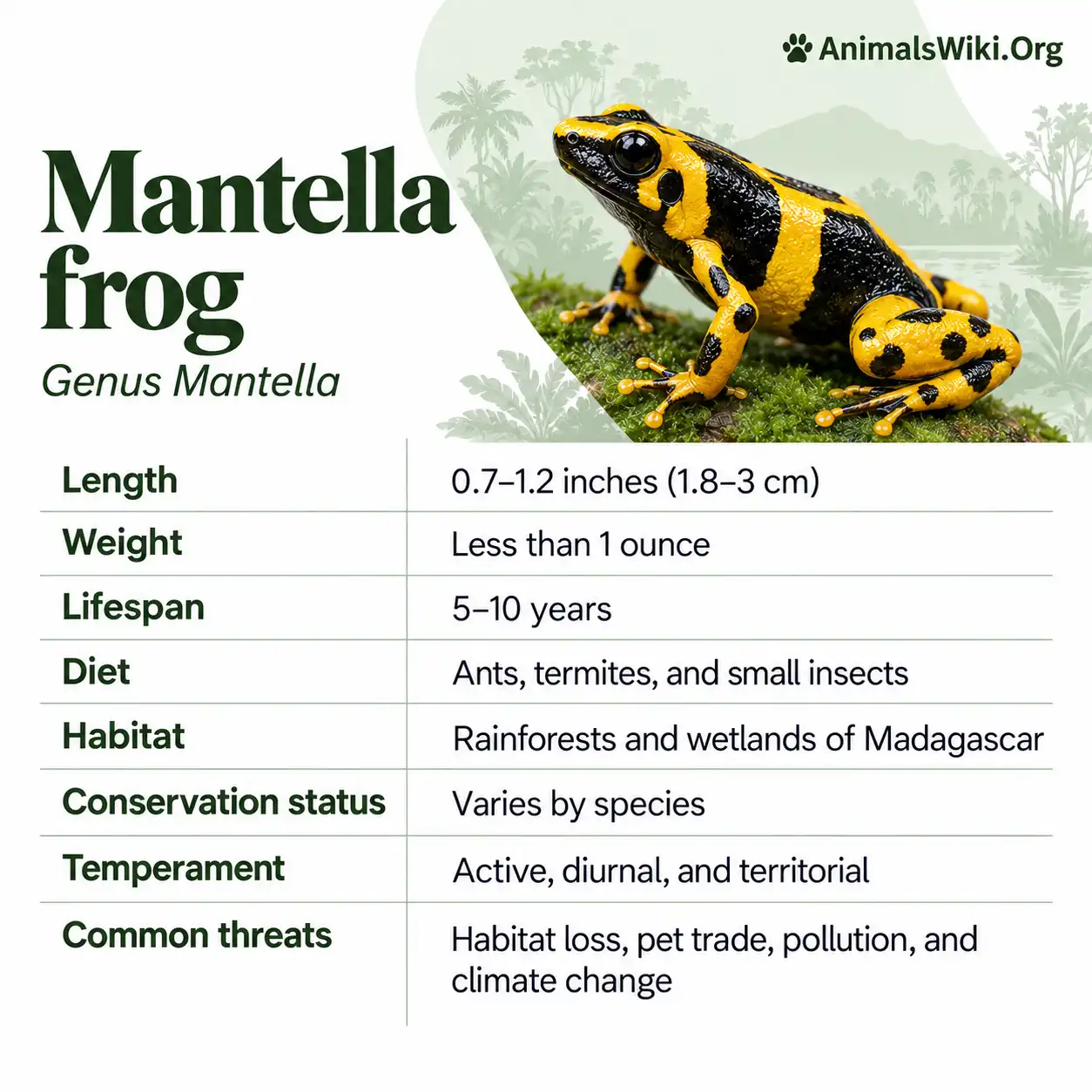
Mantella Frog Facts
| Feature | Information |
|---|---|
| Common Name | Mantella frog |
| Genus | Mantella |
| Family | Mantellidae |
| Animal Type | Amphibian |
| Order | Anura |
| Native Range | Madagascar |
| Habitat | Mainly humid forests, wetlands, stream margins and moist terrestrial habitats |
| Typical Size | Usually only a few centimeters |
| Diet | Small invertebrates |
| Activity | Many species primarily diurnal |
| Reproduction | Egg-laying |
| Young | Tadpole |
| Famous Feature | Brilliant warning coloration |
| Chemical Defense | Present in several wild species |
| Main Threat | Habitat loss and degradation |
| Famous Species | Golden mantella |
| Golden Mantella | Mantella aurantiaca |
What Is a Mantella Frog?
A Mantella frog is a small amphibian belonging to the genus Mantella.
These frogs are endemic to Madagascar, meaning their natural wild distribution is restricted to that island.
They are especially famous for their:
- Small size
- Bright colors
- Daytime activity
- Chemical defenses
- Restricted habitats
Is Mantella Frog One Species?
No.
This is an important distinction.
“Mantella frog” commonly refers to frogs belonging to the genus:
Mantella
The genus contains multiple species.
Therefore, characteristics such as:
- Color
- Size
- Habitat
- Range
- Reproduction
- Conservation status
can differ among species.
Scientific Classification of Mantella Frogs
| Classification | Name |
|---|---|
| Kingdom | Animalia |
| Phylum | Chordata |
| Class | Amphibia |
| Order | Anura |
| Family | Mantellidae |
| Genus | Mantella |
The exact species name depends on which Mantella frog is being discussed.
Where Are Mantella Frogs Found?
Mantella frogs occur naturally in:
Madagascar
Madagascar lies in the Indian Ocean off southeastern Africa.
Its long geographic isolation has produced exceptionally high levels of endemism.
Are Mantella Frogs Found Anywhere Else Naturally?
No naturally occurring native populations are known outside Madagascar.
Captive populations exist elsewhere through the amphibian hobby, zoos, breeding programs and research collections.
Why Does Madagascar Have So Many Unique Animals?
Madagascar has been geographically isolated for tens of millions of years.
This isolation allowed many organisms to evolve independently.
The island is famous for endemic animals such as:
- Lemurs
- Tenrecs
- Mantella frogs
- Numerous chameleons
- Many geckos
- Unique birds
- Specialized insects
Mantella frogs form part of this exceptional evolutionary heritage.
What Does a Mantella Frog Look Like?
Mantella frogs generally have:
- Compact bodies
- Relatively smooth skin
- Prominent eyes
- Four limbs
- Short heads
- Bright or contrasting colors in many species
Their exact appearance varies dramatically between species.
Mantella Frog Colors
Depending on species, colors can include:
- Yellow
- Orange
- Red
- Green
- Black
- Brown
- Bronze
- Blue-green
Some species are almost uniformly bright.
Others possess striking combinations of dark and vivid colors.
Why Are Mantella Frogs So Colorful?
Bright coloration can function as:
aposematic coloration
or warning coloration.
The visual message effectively tells potential predators:
This animal may be chemically defended and is not a good meal.
Are Mantella Frogs Poisonous?
Wild Mantella frogs can possess biologically active alkaloid compounds in their skin.
These compounds can provide chemical defense against predators.
However, toxicity varies among:
- Species
- Populations
- Individuals
- Diets
It is therefore misleading to assume every Mantella frog possesses identical toxicity.
Are Mantella Frogs Venomous?
No.
Poisonous and venomous are not the same.
A venomous animal actively delivers toxins through structures such as:
- Fangs
- Stingers
- Spines
Mantella frogs do not possess a venom-injection apparatus.
Their chemical defenses are associated with skin secretions.
Therefore:
poisonous/chemically defended ≠ venomous
Where Does Mantella Frog Poison Come From?
A fascinating aspect of Mantella biology is that many defensive alkaloids are associated with their diet.
Wild frogs consume tiny arthropods that can provide chemical compounds that the frogs sequester in their skin.
Likely dietary contributors include certain:
- Ants
- Mites
- Other small arthropods
Are Captive Mantella Frogs Poisonous?
Captive-bred Mantella frogs generally lack the same alkaloid-rich natural diet available in Madagascar.
Consequently, their defensive skin chemistry is greatly reduced or absent compared with wild frogs.
This resembles what occurs in many captive poison dart frogs.
Mantella Frog vs. Poison Dart Frog
Mantella frogs are often confused with poison dart frogs because both can be:
- Tiny
- Diurnal
- Brightly colored
- Chemically defended
- Insect-eating
But they evolved independently.
| Feature | Mantella Frog | Poison Dart Frog |
|---|---|---|
| Native Region | Madagascar | Central & South America |
| Main Family | Mantellidae | Dendrobatidae and related groups |
| Famous Colors | Yellow, orange, green, black, red | Blue, yellow, orange, red, green, black |
| Chemical Defense | Yes in wild populations of several species | Yes in many wild species |
| Diet-Linked Alkaloids | Yes | Yes |
| Relationship | Not poison dart frogs | Separate evolutionary lineage |
Convergent Evolution
The resemblance between Mantella frogs and poison dart frogs is an excellent example of:
convergent evolution
Convergent evolution occurs when unrelated organisms independently develop similar characteristics because they face similar ecological pressures.
Both groups independently evolved combinations of:
- Daytime activity
- Bright warning coloration
- Small body size
- Chemical defense
despite evolving on different continents.
How Big Are Mantella Frogs?
Mantella frogs are small.
Many adults are approximately:
2–3 centimeters
in body length, although exact size varies among species and individuals.
Some may be somewhat larger or smaller.
How Much Does a Mantella Frog Weigh?
They weigh only a few grams or less depending on:
- Species
- Sex
- Age
- Body condition
Precise weights are less commonly reported than snout-to-vent lengths.
Golden Mantella
The golden mantella is one of the most famous Mantella species.
Scientific name:
Mantella aurantiaca
It is famous for its intense:
- Yellow
- Golden
- Orange
coloration.
Where Does the Golden Mantella Live?
The golden mantella has a highly restricted distribution in eastern-central Madagascar.
It is associated with humid environments including seasonal wetlands and surrounding forest.
Its limited range makes habitat destruction particularly serious.
Is the Golden Mantella Actually Golden?
Individuals can range from:
- Yellow
- Yellow-orange
- Golden orange
- Deep orange
The intense coloration makes the species extremely distinctive.
Other Mantella Frog Species
The genus contains a variety of striking species.
Baron’s Mantella
Mantella baroni
Often displays combinations of:
- Black
- Green
- Yellow
- Orange
Cowan’s Mantella
Mantella cowanii
A highly distinctive species with dark coloration and contrasting red-orange markings.
Green Mantella
Mantella viridis
Often predominantly green or yellow-green.
Beautiful Mantella
Mantella pulchra
A colorful species with contrasting dark and greenish or bronze coloration.
Madagascar Mantella
Mantella madagascariensis
A strikingly patterned species endemic to Madagascar.
Blue-Legged Mantella
Mantella expectata
Known for dramatic contrasting coloration that can include blue-toned limbs.
Black-Eared Mantella
Mantella milotympanum
Recognized by characteristic coloration including dark areas around the tympanic region.
Climbing Mantella
Mantella laevigata
Particularly interesting because its reproductive biology differs from the more typical Mantella pattern.
Mantella Frog Habitat
Mantella habitats vary among species but can include:
- Tropical rainforest
- Humid forest
- Swamp forest
- Wetlands
- Stream margins
- Mossy areas
- Leaf litter
- Moist grasslands
- Seasonal pools
- Montane environments
Moisture is critically important because amphibians have permeable skin.
Forest Floor Habitat
Many Mantella frogs spend considerable time close to the ground.
The forest floor provides:
- Moisture
- Leaf litter
- Invertebrate prey
- Shelter
- Breeding sites
- Cover from predators
Are Mantella Frogs Aquatic?
Adults are primarily terrestrial or semi-terrestrial rather than fully aquatic.
However, water is crucial to reproduction because tadpoles generally develop in aquatic environments.
Can Mantella Frogs Swim?
Yes.
Like other frogs, they can move through water.
However, most species are not specialized as permanently aquatic frogs.
Are Mantella Frogs Tree Frogs?
Generally no.
They are primarily ground-associated frogs.
However, behavior varies by species, and some can climb vegetation.
Climbing Mantella
Mantella laevigata is particularly interesting because it can use elevated structures and plant cavities associated with reproduction.
Its ecology demonstrates that the genus contains more behavioral diversity than its tiny body size might suggest.
What Do Mantella Frogs Eat?
Mantella frogs are carnivorous insectivores.
Their diet consists mainly of tiny invertebrates.
Potential prey includes:
- Ants
- Mites
- Springtails
- Small flies
- Tiny beetles
- Termites
- Other small arthropods
Are Mantella Frogs Carnivores?
Yes.
More specifically, they are primarily:
insectivorous/invertebrate-eating predators.
Do Mantella Frogs Eat Ants?
Yes.
Ants can form an important component of the diet of some Mantella species.
They may also contribute alkaloids used in chemical defense.
Do Mantella Frogs Eat Mites?
Yes.
Tiny mites can form part of their natural diet and may contribute defensive chemical compounds.
Do Mantella Frogs Eat Mosquitoes?
They may consume suitably small flying insects, potentially including tiny mosquitoes, but it would be misleading to describe Mantella frogs primarily as mosquito specialists.
How Do Mantella Frogs Hunt?
Mantella frogs visually detect tiny moving prey.
When an appropriate invertebrate comes within striking distance, the frog can rapidly capture it.
Their feeding strategy combines:
- Visual detection
- Short approaches
- Rapid strikes
When Are Mantella Frogs Active?
Many Mantella frogs are primarily:
diurnal
meaning active during daylight.
This distinguishes them from many frog species that are primarily nocturnal.
Why Are Mantella Frogs Active During the Day?
Daytime activity works particularly well with visual warning coloration.
Bright colors are most useful as warnings when potential predators can clearly see them.
Mantella Frog Behavior
Mantella frogs may:
- Forage through leaf litter
- Move among wet vegetation
- Call during breeding periods
- Defend small areas
- Seek moist refuges
- Interact with potential mates
Behavior varies among species.
Are Mantella Frogs Social?
They can occur relatively close together in suitable habitat, particularly around breeding areas.
However, they should not be considered socially organized in the same way as mammals living in structured family groups.
Are Male Mantella Frogs Territorial?
Males of several species can maintain calling or reproductive areas and may interact aggressively with rival males.
Territorial behavior varies among species and environmental conditions.
Mantella Frog Calls
Male Mantella frogs produce advertisement calls.
These calls help:
- Attract females
- Advertise presence
- Communicate with competing males
Calls vary between species and can help researchers identify frogs.
Do Female Mantella Frogs Call?
The prominent reproductive advertisement calls are primarily associated with males.
Mantella Frog Reproduction
Mantella frogs reproduce sexually.
During favorable wet conditions, male calling activity increases.
A receptive female can approach a male and breeding follows.
Where Do Mantella Frogs Lay Eggs?
In many species, eggs are deposited in moist terrestrial sites near water rather than directly into open water.
Locations may include:
- Damp leaf litter
- Moss
- Moist cavities
- Vegetation near pools
Why Don’t They Always Lay Eggs Directly in Water?
Terrestrial egg deposition can reduce exposure to some aquatic predators.
However, the developing offspring still generally need access to water after hatching.
Mantella Frog Eggs
Eggs are small and surrounded by gelatinous material.
Moisture is essential because amphibian eggs lack the hard protective shells of bird or reptile eggs.
Mantella Frog Tadpoles
After hatching, larvae enter water and continue development as:
tadpoles
The tadpoles gradually undergo metamorphosis.
Mantella Frog Life Cycle
The general life cycle is:
Egg → Tadpole → Metamorph → Juvenile Frog → Adult
This transformation involves major changes.
The developing frog:
- Grows legs
- Reshapes its body
- Develops adult feeding structures
- Reduces the tail
- Transitions toward terrestrial life
Mantella Frog Metamorphosis
Metamorphosis transforms the aquatic tadpole into a miniature frog.
The process is controlled by complex hormonal and developmental mechanisms.
Baby Mantella Frog
After metamorphosis, a tiny juvenile emerges.
Young frogs resemble miniature adults but continue growing and developing their mature coloration.
Climbing Mantella Reproduction
The climbing mantella, Mantella laevigata, has particularly fascinating reproductive behavior.
Females may deposit eggs in small water-filled cavities, including tree or plant-associated holes.
Its reproductive ecology differs from the more typical ground-associated pattern seen in many relatives.
This demonstrates the evolutionary flexibility of the genus.
How Long Do Mantella Frogs Live?
Exact lifespan differs among species and between wild and captive environments.
Captive individuals under appropriate conditions can live for several years, with some surviving well beyond five years.
Wild lifespan is harder to measure because individuals face:
- Predation
- Disease
- Drought
- Competition
- Habitat changes
Mantella Frog Predators
Potential predators may include:
- Snakes
- Birds
- Larger frogs
- Small mammals
- Arthropod predators
Chemical defenses and warning coloration can reduce predation risk.
How Do Mantella Frogs Defend Themselves?
Their defenses can include:
- Bright warning coloration
- Toxic or distasteful skin compounds
- Small size
- Rapid movement
- Hiding among vegetation and leaf litter
Aposematism
Aposematism is the biological term for warning signals that advertise danger or unprofitability to predators.
The bright colors of many Mantella frogs are classic examples.
A predator that experiences an unpleasant encounter with a chemically defended frog may learn to avoid similarly colored frogs in the future.
Are All Mantella Frogs Brightly Colored?
No.
Color intensity and patterns vary greatly.
Some species are extraordinarily bright.
Others display more subdued combinations of:
- Brown
- Bronze
- Black
- Green
Mantella Frog Skin
Like other amphibians, Mantella frogs possess permeable skin.
This allows important physiological exchange but also makes them sensitive to environmental conditions.
Their skin can absorb substances from their surroundings.
Do Mantella Frogs Drink Water?
Frogs can absorb substantial amounts of water directly through specialized areas of their skin.
They do not rely solely on drinking water through the mouth in the same manner as mammals.
Can Mantella Frogs Breathe Through Their Skin?
Cutaneous gas exchange contributes to respiration in amphibians.
Mantella frogs also possess lungs as adults.
Why Do Mantella Frogs Need Humidity?
Their permeable skin makes dehydration a major concern.
Humid environments help maintain:
- Hydration
- Skin function
- Egg survival
- Suitable prey populations
Mantella Frog Adaptations
Mantella frogs possess several impressive adaptations.
Bright Warning Colors
Advertise chemical defenses.
Skin Alkaloids
Can make wild frogs distasteful or toxic to predators.
Small Body Size
Allows movement through dense leaf litter and tiny refuges.
Diurnal Activity
Supports visual communication and warning coloration.
Specialized Diet
Provides both nutrition and, in some species, chemical compounds used for defense.
Moisture-Dependent Reproduction
Synchronizes breeding with environmental conditions favorable for eggs and tadpoles.
Terrestrial Egg Deposition
Can protect developing embryos from some aquatic dangers.
Mantella Frog vs. Poison Dart Frog
Their similarities are remarkable.
Both independently evolved:
- Tiny bodies
- Bright colors
- Daytime activity
- Alkaloid defenses
- Diets rich in small arthropods
But they live thousands of kilometers apart and belong to different evolutionary lineages.
This makes them one of the most interesting amphibian examples of convergent evolution.
Mantella Frog vs. Tree Frog
| Feature | Mantella Frog | Typical Tree Frog |
|---|---|---|
| Main Lifestyle | Mostly terrestrial | Often arboreal |
| Body Size | Usually very small | Highly variable |
| Toe Pads | Less specialized in typical Mantella | Often highly developed |
| Activity | Many diurnal | Many nocturnal |
| Famous Defense | Warning colors and alkaloids | Highly variable |
| Distribution | Madagascar | Worldwide in suitable regions |
Mantella Frog vs. Toad
Mantella frogs are true frogs within Anura, while “toad” usually refers to certain more terrestrial frog lineages, especially Bufonidae.
Mantella frogs generally have:
- Small bodies
- Relatively smooth skin
- Bright colors in many species
rather than the heavily textured appearance associated with many familiar toads.
Mantella Frog Conservation
Conservation is one of the most important topics surrounding the genus.
Because Mantella frogs are endemic to Madagascar, they cannot simply relocate to another continent when habitat disappears.
Several species have restricted ranges.
Main Threats to Mantella Frogs
Threats vary among species but can include:
- Deforestation
- Agricultural expansion
- Forest fires
- Mining
- Wetland drainage
- Habitat fragmentation
- Pollution
- Climate change
- Collection for the pet trade
- Introduced species
- Disease
Habitat Loss
Habitat destruction is especially dangerous for species with tiny geographic ranges.
If a frog exists in only a handful of wetlands or forest patches, destruction of one site can remove a substantial portion of its habitat.
Mantella Frogs and the Pet Trade
Their spectacular coloration has made Mantella frogs desirable in the exotic-pet trade.
Captive breeding can help reduce pressure on wild populations when conducted responsibly.
However, unsustainable or illegal collection can threaten localized wild populations.
Captive Breeding
Zoos, conservation organizations, and experienced amphibian breeders can maintain captive populations of some Mantella species.
Captive breeding may contribute to:
- Education
- Research
- Assurance populations
- Reduced demand for wild-caught frogs
It should complement, rather than replace, protection of natural habitat.
Climate Change and Mantella Frogs
Changes in:
- Rainfall
- Temperature
- Wet-season timing
- Water availability
could affect breeding and habitat quality.
Amphibians with small geographic ranges can be particularly vulnerable to rapid environmental change.
Why Mantella Frogs Matter
Mantella frogs contribute to Madagascar’s ecosystems as:
predators
of tiny invertebrates and as:
prey
for other animals.
They also have exceptional scientific value for research into:
- Evolution
- Chemical ecology
- Convergent evolution
- Amphibian reproduction
- Conservation biology
40 Interesting Mantella Frog Facts
- Mantella frogs are amphibians.
- They belong to the genus Mantella.
- They belong to the family Mantellidae.
- Mantella frogs occur naturally only in Madagascar.
- The genus contains multiple species.
- Many species are only a few centimeters long.
- Mantella frogs can be yellow, orange, red, green, black, bronze or combinations of these colors.
- Bright coloration can warn predators.
- This warning strategy is called aposematism.
- Several wild Mantella species possess defensive skin alkaloids.
- Their defensive chemistry is strongly influenced by diet.
- Ants can contribute dietary alkaloids.
- Mites can also contribute chemical compounds.
- Captive frogs generally lose much of the wild-type chemical defense when deprived of alkaloid-containing prey.
- Mantella frogs are not poison dart frogs.
- Poison dart frogs evolved in the Americas.
- Mantella frogs evolved in Madagascar.
- Their similarity is an example of convergent evolution.
- Many Mantella species are active during daylight.
- They hunt tiny invertebrates.
- Springtails can form part of their diet.
- Ants are eaten by several species.
- They can also consume mites and tiny insects.
- Many species live among moist forest-floor vegetation.
- Leaf litter provides shelter and prey.
- Males produce advertisement calls.
- Calls help attract females.
- Mantella frogs reproduce by laying eggs.
- Many species deposit eggs in moist terrestrial locations.
- Tadpoles develop in water.
- Tadpoles undergo metamorphosis.
- The golden mantella is Mantella aurantiaca.
- Golden mantellas can be brilliant yellow-orange.
- The climbing mantella is Mantella laevigata.
- Mantella species differ significantly in coloration and ecology.
- Their permeable skin makes moisture important.
- Habitat loss threatens several species.
- Some Mantella frogs have extremely restricted distributions.
- Captive breeding can contribute to conservation.
- Mantella frogs are among Madagascar’s most striking examples of amphibian evolution.
Did You Know?
Mantella frogs and poison dart frogs independently evolved remarkably similar survival strategies on opposite sides of the world.
Poison dart frogs occur naturally in:
Central and South America.
Mantella frogs occur naturally in:
Madagascar.
Their ancestors were separated by enormous geographic and evolutionary distances.
Yet natural selection produced animals that can look astonishingly similar.
Both groups contain species that are:
- Tiny
- Active during daylight
- Brilliantly colored
- Predators of small arthropods
- Chemically defended
Even more remarkably, both groups can obtain important defensive alkaloids through their diets.
A tiny ant or mite may contain chemical compounds.
A frog eats the arthropod.
Instead of simply destroying every compound during digestion, the frog can sequester certain alkaloids and incorporate them into its own chemical defense system.
The result is essentially:
food becoming armor.
Now bright coloration becomes useful.
A predator can see the frog easily.
Normally, being brightly colored would seem dangerous.
But if attacking the frog produces an unpleasant chemical experience, the predator may learn:
bright frog = bad meal.
Natural selection can then favor even more conspicuous warning coloration.
What makes the story especially fascinating is that evolution arrived at a broadly similar solution independently in two distant frog lineages.
Mantella frogs did not need to be closely related to poison dart frogs.
They simply faced ecological conditions where similar adaptations were advantageous.
This is why Mantella frogs are more than beautiful amphibians.
They are living demonstrations of how evolution can repeatedly discover similar solutions to similar biological problems.
Frequently Asked Questions About Mantella Frogs
What is a Mantella frog?
A Mantella frog is a small Malagasy amphibian belonging to the genus Mantella.
Is Mantella a frog?
Yes.
Is Mantella one species?
No. Mantella is a genus containing multiple frog species.
Where do Mantella frogs come from?
Madagascar.
Are Mantella frogs endemic to Madagascar?
Yes.
Are Mantella frogs found in Africa?
Biogeographically Madagascar lies off Africa, but wild Mantella frogs are endemic specifically to Madagascar rather than mainland Africa.
What family do Mantella frogs belong to?
Mantellidae.
What order do Mantella frogs belong to?
Anura.
Are Mantella frogs amphibians?
Yes.
Are Mantella frogs reptiles?
No.
How big is a Mantella frog?
Many species are approximately 2–3 cm long, although size varies.
Are Mantella frogs tiny?
Yes.
What colors are Mantella frogs?
Depending on species, they may be yellow, orange, red, green, black, brown, bronze or multicolored.
Why are Mantella frogs brightly colored?
In chemically defended species, bright coloration can warn predators.
What is aposematism?
Aposematism is warning coloration or another conspicuous signal advertising that an animal is dangerous, toxic or otherwise unprofitable to attack.
Are Mantella frogs poisonous?
Several wild species possess defensive alkaloids in their skin.
Are Mantella frogs venomous?
No.
What is the difference between poisonous and venomous?
Poison acts when touched, ingested or otherwise absorbed, whereas venom is actively delivered through specialized structures such as fangs or stingers.
Can a Mantella frog poison a human?
Their defensive compounds warrant careful handling, but Mantella frogs are not aggressive animals that inject poison into people.
Do Mantella frogs bite humans?
They are tiny and pose essentially no meaningful biting threat to humans.
Can you touch a Mantella frog?
Handling should be minimized. Amphibian skin is delicate and permeable, and substances on human hands can harm the frog.
Are captive Mantella frogs poisonous?
Captive-bred animals generally lack the alkaloid-rich natural diet responsible for much of the chemical defense seen in wild frogs.
Why do captive Mantella frogs lose their poison?
Their captive diet generally does not contain the same alkaloid-bearing arthropods found in Madagascar.
Do Mantella frogs make their own poison?
Much of their defensive alkaloid chemistry is associated with compounds obtained through diet rather than being synthesized entirely from scratch.
What do Mantella frogs eat?
Tiny invertebrates such as ants, mites, springtails and small insects.
Are Mantella frogs carnivores?
Yes.
Are Mantella frogs insectivores?
Primarily, yes, although their prey includes various small arthropods beyond insects.
Do Mantella frogs eat ants?
Yes.
Do Mantella frogs eat mites?
Yes.
Do Mantella frogs eat springtails?
Yes.
Do Mantella frogs eat mosquitoes?
They may take suitably small insects, but they are not specialized mosquito predators.
How do Mantella frogs catch food?
They visually locate tiny prey and capture it with rapid feeding movements.
Are Mantella frogs nocturnal?
Many species are primarily diurnal.
What does diurnal mean?
Active mainly during daylight.
Why are Mantella frogs active during the day?
Daylight supports visual foraging and makes warning coloration highly visible to predators.
Where do Mantella frogs live?
Habitats include humid forests, wetlands, leaf litter, stream margins and other moist environments.
Do Mantella frogs live in rainforests?
Several species occur in rainforest or humid forest environments.
Do Mantella frogs live in trees?
Most are primarily terrestrial, although some species can climb and use elevated microhabitats.
Can Mantella frogs climb?
Yes, particularly some species such as the climbing mantella.
Can Mantella frogs swim?
Yes.
Are Mantella frogs aquatic?
Adults are generally terrestrial or semi-terrestrial rather than permanently aquatic.
Do Mantella frogs need water?
Yes. Moisture is essential to their physiology and reproduction.
Do Mantella frogs drink water?
Like other frogs, they can absorb water through their permeable skin.
Can Mantella frogs breathe through their skin?
Cutaneous respiration contributes to gas exchange.
Do Mantella frogs have lungs?
Adults possess lungs.
Do Mantella frogs have teeth?
Frog dental anatomy varies among lineages, but tiny teeth may occur in mantellid frogs; they are not chewing structures like mammalian teeth.
Do Mantella frogs jump?
Yes.
Can Mantella frogs climb walls?
Their climbing ability depends on surface texture and species; they are not specialized adhesive tree frogs.
Do Mantella frogs make sounds?
Yes. Males produce advertisement calls.
Why do male Mantella frogs call?
Primarily to attract females and communicate reproductive presence.
Do Mantella frogs croak?
Their vocalizations can loosely be called croaks, but actual calls vary by species and may sound like clicks or repeated notes.
How do Mantella frogs reproduce?
They reproduce sexually and lay eggs.
Where do Mantella frogs lay eggs?
Many species place eggs in moist terrestrial locations near water.
Do Mantella frogs lay eggs in water?
Many species lay eggs outside open water, although reproductive strategies vary.
What happens after the eggs hatch?
Larvae generally reach water and continue development as tadpoles.
Do Mantella frogs have tadpoles?
Yes.
What do Mantella tadpoles become?
They undergo metamorphosis and become juvenile frogs.
What is a baby Mantella frog called?
After metamorphosis it can be called a froglet or juvenile.
How long do Mantella frogs live?
They can live for several years, with longevity depending on species and environmental conditions.
What eats Mantella frogs?
Potential predators include snakes, birds, larger amphibians and other suitable predators.
How do Mantella frogs protect themselves?
Bright warning colors and defensive skin chemicals are important defenses in several species.
Are all Mantella frogs poisonous?
Chemical defenses differ among species, populations and diets.
Are all Mantella frogs brightly colored?
No. Color and pattern vary considerably among species.
What is a golden mantella?
The golden mantella is Mantella aurantiaca, a brilliantly colored species from Madagascar.
Is the golden mantella a Mantella frog?
Yes.
Why is the golden mantella orange?
Its intense coloration functions as a conspicuous visual signal associated with chemical defense.
What is the scientific name of the golden mantella?
Mantella aurantiaca.
What is a green mantella?
The green mantella is Mantella viridis.
What is a climbing mantella?
The climbing mantella is Mantella laevigata.
What is Cowan’s mantella?
It is Mantella cowanii, a distinctive Malagasy Mantella species.
Are Mantella frogs poison dart frogs?
No.
Why do Mantella frogs look like poison dart frogs?
Convergent evolution produced similar combinations of warning coloration, chemical defense and daytime activity.
Are Mantella frogs related to poison dart frogs?
They are both frogs but belong to separate evolutionary lineages.
Where do poison dart frogs live?
Naturally in Central and South America.
Where do Mantella frogs live?
Naturally only in Madagascar.
Which is more poisonous, Mantella or poison dart frog?
Toxicity varies greatly among species and individuals, so a simple genus-wide comparison is not scientifically meaningful.
Are Mantella frogs endangered?
Conservation status differs among species, and several face significant habitat-related threats.
Why are Mantella frogs threatened?
Major pressures include habitat destruction, fragmentation, wetland degradation and other environmental changes.
Does deforestation affect Mantella frogs?
Yes. Forest-dependent species can lose critical habitat through deforestation.
Does mining threaten Mantella frogs?
Mining and associated habitat alteration can threaten localized populations in some areas.
Does climate change affect Mantella frogs?
Changes in rainfall, temperature and wetland availability may affect suitable habitat and breeding conditions.
Are Mantella frogs protected?
Protection varies by species, locality and national/international regulations.
Can Mantella frogs be bred in captivity?
Yes, several species have been successfully bred in captivity.
Do zoos keep Mantella frogs?
Yes. Some zoological and conservation institutions maintain them.
Can Mantella frogs be pets?
Some species are maintained by experienced amphibian keepers where legal, but their specialized environmental requirements make proper husbandry essential.
Why are Mantella frogs important?
They contribute to Madagascar’s biodiversity, regulate small invertebrate populations, provide prey for other animals and offer valuable insights into amphibian evolution and chemical ecology.
What is the most interesting fact about Mantella frogs?
They independently evolved a combination of bright warning colors, daytime activity and diet-derived chemical defenses remarkably similar to those of American poison dart frogs.
Conclusion
The Mantella frog demonstrates that some of the most remarkable amphibians on Earth can fit comfortably within the palm of a human hand.
These tiny frogs evolved on:
Madagascar
one of the world’s greatest centers of biological endemism.
Millions of years of isolation allowed their ancestors to develop into a distinctive radiation of frogs found nowhere else naturally.
Among their most spectacular evolutionary achievements is their coloration.
A brilliant orange golden mantella does not attempt to disappear into the forest floor.
Instead, it can advertise its presence.
Its coloration sends a warning.
For chemically defended species, a predator sees an animal that may be:
small but costly to attack.
The chemistry behind this defense makes the story even more fascinating.
Tiny arthropods eaten by wild Mantella frogs can provide alkaloids that become incorporated into the frogs’ defensive system.
Their prey therefore contributes not only:
energy
but also:
chemical protection.
This connection between diet and defense becomes obvious when Mantella frogs are raised in captivity.
Without the same alkaloid-rich natural prey, much of the defensive chemistry associated with wild frogs disappears.
And thousands of kilometers away, poison dart frogs independently evolved a remarkably similar ecological strategy.
The resemblance is not evidence that Mantella frogs are Malagasy poison dart frogs.
Instead, it demonstrates something even more interesting:
convergent evolution.
Different evolutionary histories produced similar solutions.
Small body.
Daytime activity.
Bright warning colors.
Arthropod-based diet.
Chemical defense.
Yet the future of these frogs depends on something much larger than their own remarkable adaptations:
the survival of Madagascar’s habitats.
For a widespread animal, losing one forest may represent only a small reduction in its total range.
For a Mantella species restricted to a handful of wetlands or forest fragments, the consequences can be far greater.
Protecting:
- Forests
- Wetlands
- Streams
- Leaf-litter ecosystems
- Breeding pools
therefore protects not simply individual frogs but entire evolutionary lineages found nowhere else on Earth.
From the golden-orange Mantella aurantiaca to the dramatically patterned Mantella cowanii, these tiny amphibians represent millions of years of evolutionary experimentation.
The Mantella frog may measure only a few centimeters.
But in terms of color, chemistry, evolutionary biology, ecological specialization and conservation importance, it is one of Madagascar’s true amphibian treasures.