
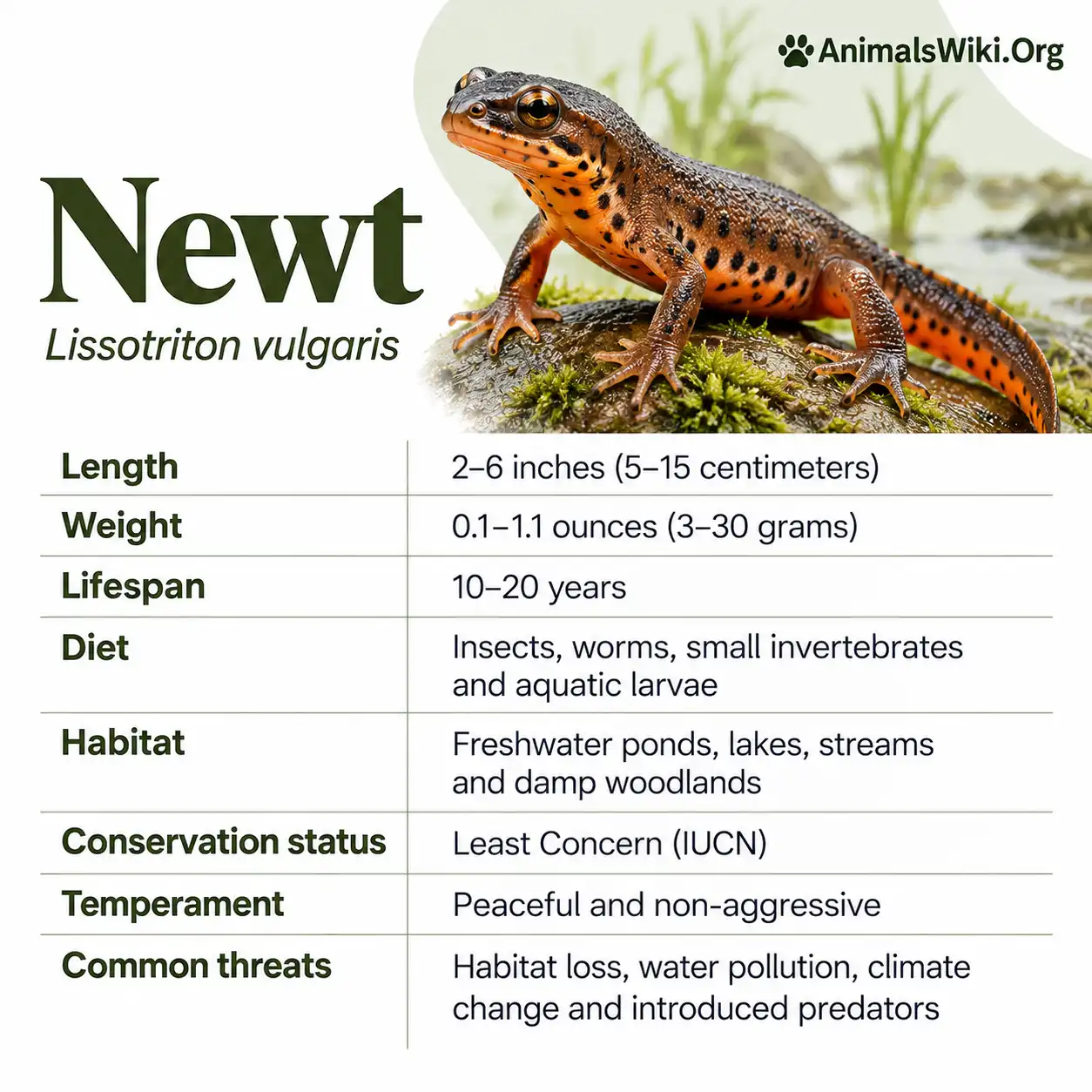
Newt Facts
| Feature | Details |
|---|---|
| Common Name | Newt |
| Scientific Name | Subfamily Pleurodelinae (true newts), family Salamandridae |
| Family | Salamandridae |
| Order | Caudata (Urodela) |
| First Described | 1758 (Smooth Newt, by Carl Linnaeus) |
| Native Habitat | Ponds, slow streams, damp woodland, grassland (terrestrial phase) |
| Geographic Range | North America, Europe, Asia, North Africa |
| Average Size | 7–20 cm depending on species |
| Average Weight | 2–40 g depending on species |
| Lifespan | 6–15 years (wild); up to 20+ years for some species (captivity) |
| Diet | Carnivore — insects, worms, small invertebrates, amphibian larvae |
| Conservation Status | Ranges from Least Concern to Critically Endangered depending on species |
| Defining Feature | Extraordinary limb, tail, and organ regeneration ability; biphasic aquatic-terrestrial life cycle; toxic skin secretions in many species; dramatic breeding-season transformation |
| Number of Species | Roughly 100+ true newt species across the subfamily Pleurodelinae |
1. Newt Species Overview & Classification
On a mild spring evening, as the first warm rain of the season soaks into the leaf litter of a European woodland, a small, slick-skinned creature emerges from beneath a rotting log where it has spent the winter months in a state of low-activity dormancy. It moves with a slow, deliberate, side-to-side undulation — a gait that seems to echo, in miniature, the earliest tetrapods that first hauled themselves onto land hundreds of millions of years ago — making its way steadily downhill toward the pond where it was born. By the time it reaches the water’s edge days or weeks later, its body will have transformed: its skin will have taken on a smoother, more brightly patterned breeding coloration, and along the male’s back, a spectacular undulating crest will rise like a tiny dragon’s fin, rippling with each swimming stroke through the shallows. This is the newt — one of the most biologically remarkable, and most quietly underappreciated, amphibians in the world, an animal whose modest size belies genuinely extraordinary physiological abilities that continue to fascinate biomedical researchers today.
The newt is a group of small, semi-aquatic amphibians belonging to the subfamily Pleurodelinae within the broader salamander family Salamandridae — commonly referred to as “true newts” to distinguish them from certain other amphibians that share the common name “newt” in some regional usage but belong to different taxonomic groups. Newts are found across the temperate regions of North America, Europe, Asia, and North Africa, and are distinguished from most of their broader salamander relatives by a distinctive biphasic life cycle, in which many species alternate between an aquatic breeding phase, during which adults return to ponds or slow-moving water to mate and lay eggs, and a terrestrial phase, during which the same individuals live on land, often for the majority of the year, foraging through damp woodland, grassland, and leaf litter.
Newts occupy a genuinely unique position in the broader story of vertebrate biology: they possess, among all vertebrate animals, one of the most extraordinary capacities for tissue and organ regeneration on Earth — the ability to fully regrow not only lost limbs and tails, but in some documented cases portions of the heart, spinal cord, and even lens of the eye, a capability that has made newts, and particularly certain highly studied species, subjects of intense ongoing biomedical research interest, given the potentially transformative implications of understanding this regenerative capacity for human medicine. Beyond their remarkable regenerative biology, newts also possess, in many species, genuinely potent toxic skin secretions — in at least one extreme case, among the most lethal toxins found in any animal on Earth relative to body size — making the newt a genuinely fascinating combination of unassuming appearance and extraordinary underlying biological capability.
Species Classification Table
| Classification Level | Details |
|---|---|
| Kingdom | Animalia |
| Phylum | Chordata |
| Class | Amphibia |
| Order | Caudata (also called Urodela) |
| Family | Salamandridae |
| Subfamily | Pleurodelinae (“true newts”) |
| Described By | Carl Linnaeus, 1758 (Smooth Newt) |
| Closest Relatives | Other salamandrids (fire salamanders and relatives) |
Notable Newt Species
| Species | Scientific Name | Range | Notes |
|---|---|---|---|
| Smooth (Common) Newt | Lissotriton vulgaris | Widespread across Europe | Most widely distributed European newt |
| Great Crested Newt | Triturus cristatus | Northern/central Europe, UK | Largest European newt; strictly protected in UK/EU |
| Alpine Newt | Ichthyosaura alpestris | Central/southern Europe | Vividly colored orange belly |
| Eastern (Red-Spotted) Newt | Notophthalmus viridescens | Eastern North America | Famous for its bright orange terrestrial “eft” stage |
| Rough-Skinned Newt | Taricha granulosa | Pacific Northwest, North America | Produces one of the most lethal toxins of any animal relative to body size |
| Japanese Fire-Bellied Newt | Cynops pyrrhogaster | Japan | Popular in the international pet trade |
The Name “Newt”
The word “newt” has a somewhat unusual linguistic origin, arising from a historical linguistic process called “metanalysis” or “rebracketing” — the Middle English word for the animal was originally “an ewt” (or “eft”), and over time, through common misdivision of the spoken phrase, “an ewt” gradually became reanalyzed and pronounced as “a newt,” with the “n” migrating from the indefinite article to the front of the noun itself — a linguistic evolution shared by a small number of other English words (a similar process, in reverse, gave English “an apron” from an original “a napron”).
Did You Know? Newts possess one of the most extraordinary regenerative abilities of any vertebrate animal on Earth. An adult newt can fully regrow an amputated limb — not just a partial regrowth or scar tissue, but a complete, fully functional new limb with bone, muscle, nerves, and blood vessels — a capability essentially unmatched among adult vertebrates and one that continues to be intensively studied by biomedical researchers hoping to eventually unlock comparable regenerative potential in human medicine.
2. Newt Physical Description & Unique Features
The newt’s body reflects its distinctive biphasic aquatic-terrestrial lifestyle, along with a suite of genuinely extraordinary physiological capabilities — regeneration and, in many species, potent chemical defense — that place the group among the most biologically remarkable amphibians in the world.
Size and Build
Newt size varies considerably across species, though the group as a whole is characterized by a modest, elongated body plan:
- Body length: Typically 7–20 cm (2.75–8 inches) depending on species, with most commonly encountered species falling in the 9–15 cm range
- Weight: Generally modest, ranging from approximately 2–40 g depending on species and life stage
- Body proportions: A long, slender body; a distinct, elongated tail (typically laterally flattened, particularly during the aquatic breeding phase, to aid swimming); four legs of relatively modest size, with the front legs bearing four toes and the hind legs bearing five — a useful distinguishing feature separating newts and salamanders more broadly from lizards, which typically have five toes on all four feet
Sexual dimorphism: Often pronounced, particularly during the breeding season, when many male newt species develop dramatic secondary sexual characteristics described below, considerably exceeding females in visual ornamentation even when overall body size is broadly similar between the sexes
The Biphasic Life Cycle and Its Effect on Appearance
One of the most distinctive features of newt biology is the dramatic physical transformation many species undergo between terrestrial and aquatic life phases:
Terrestrial phase appearance: During the terrestrial portion of the life cycle, many newt species display drier, rougher, more granular skin texture (sometimes described as “warty” in comparison to the smoother skin of the aquatic phase), and generally more subdued coloration suited to camouflage within leaf litter and woodland substrate
Aquatic/breeding phase appearance: Upon returning to water for the breeding season, many newt species undergo a genuinely dramatic transformation, including:
- Skin texture change — skin typically becomes smoother and glossier, an adaptation suited to the aquatic environment
- Vivid breeding coloration — many species develop notably brighter, more contrasted coloration and patterning during the breeding season, often including striking ventral (belly) coloration in oranges, yellows, or reds
- Dorsal crest development (males) — in several prominent species, particularly the Great Crested Newt and related Triturus species, breeding males develop a spectacular, undulating dorsal crest running along the back and tail, used extensively in courtship display described in the Reproduction section, and giving the animal a genuinely dragon-like silhouette while swimming
- Tail fin enlargement — the tail typically becomes more laterally flattened and fin-like during the aquatic phase, improving swimming efficiency
Skin and Toxin Production
Glandular, often toxic skin: Newt skin contains numerous specialized glands, and in many species — though notably not all — these glands produce genuinely potent toxic or unpalatable secretions as a chemical defense mechanism, discussed in detail in the Predators section
Warning (aposematic) coloration: Many toxic newt species display bright, contrasting warning coloration, particularly on the belly or underside — a classic example of aposematic signaling, in which vivid coloration serves to warn potential predators of the animal’s toxicity, discussed further in the Predators section
Extraordinary Regenerative Capability — A Defining Biological Feature
As introduced in the Species Overview section, newts possess a genuinely remarkable capacity for tissue and organ regeneration, considerably exceeding that of nearly all other vertebrate animals, including most other amphibians:
- Limb regeneration: An adult newt that loses a limb — whether through predator attack, injury, or experimental amputation in a research context — is capable of fully regenerating a complete, functional replacement limb, including properly organized bone, muscle, nerve tissue, and blood vessels, over a period typically spanning several weeks to a few months depending on species and environmental conditions
- Tail regeneration: Similarly, newts can fully regenerate a lost or autotomized tail, a capability shared more broadly with many lizards but combined in newts with the additional, more unusual capacity for limb and organ regeneration described here
- Lens and retina regeneration: In certain species, particularly well studied in some Cynops and Notophthalmus species, newts have demonstrated the ability to regenerate the lens of the eye if surgically removed — a capability essentially unknown in any other adult vertebrate
- Heart tissue regeneration: Research has documented some newt species’ capacity to regenerate damaged cardiac muscle tissue following experimentally induced injury, a finding of particular interest given the very limited natural regenerative capacity of damaged heart tissue in humans and most other mammals
- The scientific significance: This suite of regenerative abilities has made newts — and in particular several specific, intensively studied laboratory species — subjects of substantial ongoing biomedical research interest, as scientists work to understand the specific cellular and genetic mechanisms underlying newt regeneration, with the eventual, long-term goal of potentially applying insights from this research toward improving tissue repair and regenerative medicine capabilities in humans
3. Newt Habitat & Geographic Range
Newts occupy a distinctive dual habitat niche reflecting their biphasic life cycle, requiring both suitable aquatic breeding habitat and adequate terrestrial habitat for the remainder of the year, a combination that makes newts particularly sensitive to habitat fragmentation and the loss of either component.
Preferred Habitat Features
Still or slow-moving freshwater — the essential aquatic breeding habitat requirement; newts favor ponds, small lakes, slow-moving streams, ditches, and other still or gently flowing freshwater bodies, generally avoiding fast-flowing rivers or streams where eggs and larvae would be at greater risk of being swept away
Aquatic vegetation — submerged and emergent vegetation within breeding ponds provides essential structure for egg-laying (described in the Reproduction section), shelter for larvae, and foraging habitat for adults during the aquatic breeding phase
Damp woodland and grassland (terrestrial phase habitat) — during the terrestrial portion of the life cycle, newts require damp, sheltered habitat offering adequate moisture retention and cover, commonly including deciduous woodland leaf litter, rough grassland, hedgerows, and similar sheltered, moisture-retaining terrestrial environments
Hibernation sites — in temperate regions, newts require suitable overwintering sites — typically underground refuges such as burrows, beneath logs or rocks, or within loose soil — offering protection from freezing temperatures during the winter dormancy period
Terrestrial-aquatic habitat connectivity — given the newt’s biphasic life cycle, the connectivity and proximity between suitable terrestrial habitat and breeding ponds is a critical habitat quality consideration; newts undertaking their spring migration to breeding ponds must be able to safely traverse the intervening terrestrial landscape, making habitat fragmentation (particularly from roads, described further in the Conservation section) a genuinely significant conservation concern
Habitat Types Occupied
| Habitat | Primary Newt Use | Season | Key Features |
|---|---|---|---|
| Ponds and small lakes | Breeding, egg-laying, larval development | Spring–early summer | Still water; aquatic vegetation |
| Deciduous woodland | Terrestrial foraging, shelter | Summer–autumn | Leaf litter; damp, sheltered ground |
| Rough grassland/hedgerows | Terrestrial foraging, migration corridor | Summer–autumn | Cover and moisture retention |
| Underground refuges | Overwintering (hibernation) | Winter | Frost protection |
| Garden ponds (modern/urban) | Breeding (increasingly significant) | Spring–early summer | Growing importance in fragmented landscapes |
Geographic Range
Current range by region:
| Region | Key Countries | Notable Species | Population Status |
|---|---|---|---|
| Europe | UK, France, Germany, and across the continent | Smooth Newt, Great Crested Newt, Alpine Newt, Palmate Newt | Generally stable to declining in intensively farmed/developed regions |
| North America (eastern) | United States, Canada | Eastern (Red-Spotted) Newt | Generally stable |
| North America (western) | United States (Pacific coast) | Rough-Skinned Newt, California Newt | Generally stable |
| East Asia | Japan, China, Korea | Japanese Fire-Bellied Newt, various Cynops and Paramesotriton species | Variable; some species significantly threatened |
| North Africa | Morocco, Algeria, Tunisia | North African Newt (Pleurodeles relatives) | More limited range; localized populations |
Garden Ponds — An Increasingly Significant Modern Habitat
In several parts of the newt’s range, particularly the United Kingdom and other parts of densely populated Western Europe, garden ponds have become an increasingly significant substitute or supplementary breeding habitat as traditional agricultural ponds and other natural wetland features have been lost to land-use change and development — a dynamic that has elevated the ecological significance of private garden wildlife pond creation as a genuinely meaningful, individually accessible conservation action for newt populations in heavily developed landscapes, discussed further in the How You Can Help section.
4. Newt Diet & Feeding Behavior
Newts are carnivorous predators throughout both the larval and adult stages of their life cycle, though the specific diet composition and hunting strategy shift somewhat between the aquatic and terrestrial life phases.
What Newts Eat
Aquatic phase diet:
- Aquatic invertebrates — including insect larvae (particularly mosquito, midge, and mayfly larvae), small crustaceans, and various other small aquatic invertebrates, forming the dietary foundation during the breeding season aquatic phase
- Amphibian eggs and larvae — newts are documented predators of the eggs and larvae of other amphibians, including frogs and toads sharing the same breeding pond, as well as, in some cases, the eggs and larvae of their own or other newt species
- Small aquatic worms and mollusks — consumed opportunistically within the pond environment
Terrestrial phase diet:
- Insects and other terrestrial invertebrates — including beetles, ants, various insect larvae, and other small invertebrates encountered while foraging through leaf litter and damp ground cover
- Earthworms — a significant dietary component for many terrestrial-phase newts, particularly larger species
- Slugs and snails — consumed by several species, contributing to the newt’s broader ecological role as a natural control on garden and woodland invertebrate populations, discussed further in the Ecosystem Role section
Larval diet: Newt larvae, which hatch and develop entirely within the aquatic environment before metamorphosis, are similarly carnivorous from a very early stage, consuming small aquatic invertebrates and, as they grow larger, increasingly substantial prey including other amphibian larvae
Hunting and Feeding Behavior
Ambush and active pursuit: Newts employ a combination of ambush predation (remaining still and striking at passing prey) and more active searching and pursuit, depending on species, life stage, and available prey
Visual and chemical prey detection: Newts rely on a combination of vision and chemical/olfactory cues to locate prey, particularly important during nocturnal or low-visibility foraging, and in the often turbid water of many breeding ponds
Feeding mechanics: Newts capture prey using a rapid forward strike of the head and jaws, typically swallowing prey whole rather than employing extensive chewing, consistent with the broader feeding pattern observed across most salamander and newt species
Feeding Behavior Patterns
Nocturnal and crepuscular activity: Newts, particularly during the terrestrial phase, are predominantly active during nighttime and around dawn and dusk, when humidity is higher and desiccation risk (given the newt’s permeable, moisture-dependent skin) is correspondingly reduced
Reduced feeding during breeding season (in some species/contexts): Some newt species show reduced feeding intensity during the most active phases of the breeding season, when reproductive behavior and energy expenditure take behavioral priority, though this pattern varies by species and specific circumstances
Hibernation and dormancy: During the winter overwintering period described in the Habitat section, newts enter a state of significantly reduced metabolic activity and cease feeding entirely for an extended period, relying on fat reserves accumulated during the preceding active season.
5. Newt Reproduction & Life Cycle
Newt reproduction is centered on an elaborate aquatic courtship process, external or internally-transferred fertilization depending on species, and a genuinely striking biphasic life cycle involving complete metamorphosis from an aquatic larval form to either a terrestrial or continued aquatic adult form.
Sexual Maturity
Newts typically reach sexual maturity at approximately 2–4 years of age, varying by species and environmental conditions, including water temperature and food availability during the juvenile growth period.
Courtship — An Elaborate Aquatic Display
Newt courtship, occurring within the breeding pond during the aquatic phase of the life cycle, is often a genuinely elaborate, visually striking process, particularly well documented in several European species:
- Male display behavior: Males of many species perform an elaborate courtship display directly in front of a chosen female, involving vigorous tail-fanning and vibration, positioning the body to display the dramatic breeding-season crest and coloration described in the Physical Description section, and releasing chemical pheromone signals believed to influence female mate selection
- Spermatophore transfer: Unlike frogs and toads, which typically employ external fertilization, most newt species reproduce through internal fertilization achieved indirectly — following successful courtship display, the male deposits a small, specialized packet of sperm called a spermatophore onto the pond substrate, which the female then picks up using her cloaca, achieving fertilization without direct physical mating contact between the two individuals — a genuinely distinctive reproductive mechanism among vertebrates more broadly
Egg-Laying
- Individual egg placement: Unlike frogs and toads, which typically lay eggs in large, undifferentiated clumps or strings, female newts characteristically lay eggs individually, carefully wrapping each egg within a folded leaf of aquatic vegetation using her hind legs — a distinctive, methodical egg-laying behavior that offers individual eggs a degree of physical protection and camouflage not available to the mass-spawned eggs of many other amphibians
- Clutch size: Total egg production across a breeding season can range from several dozen to several hundred eggs per female, depending on species, though the individual, dispersed placement described above means these eggs are laid gradually over an extended period rather than in a single mass event
- Incubation period: Newt eggs typically hatch within 2–4 weeks, depending on species and water temperature
Newt Larval Development
Newly hatched newt larvae are fully aquatic, resembling small, gilled, limbless or minimally-limbed creatures at the earliest stage, and undergo a gradual, well-documented developmental process:
| Stage | Timing | Development |
|---|---|---|
| Hatching | Day 0 | Small, aquatic; external gills; minimal or no limbs |
| Early larval growth | Weeks 1–6 | Front legs develop first, followed by hind legs |
| Continued larval development | 2–4 months | Growing body size; continued limb development |
| Metamorphosis | ~3–4 months (species/temperature dependent) | Gill loss; lung development; skin texture change |
| Juvenile terrestrial phase (eft stage in some species) | Following metamorphosis | Often terrestrial for 1–3+ years before sexual maturity |
| Sexual maturity | 2–4 years | Reproductive capability; many species return to water |
The “Eft” Stage — A Distinctive Feature of Some Species
In several notable newt species, particularly the Eastern (Red-Spotted) Newt of North America, the life cycle includes a distinctive extended terrestrial juvenile stage known as the “eft” stage, during which the recently metamorphosed juvenile — often displaying a strikingly bright orange or red coloration serving as an aposematic (warning) signal, described in the Predators section — lives an entirely terrestrial existence, sometimes for several years, before eventually returning to water, undergoing a further physical transformation, and settling into the fully aquatic adult breeding phase of the life cycle; this eft stage represents one of the more visually dramatic and biologically distinctive features of newt life history among the various salamander family members.
Variation in Adult Life History
Not all newt species follow an identical life-cycle pattern; some species remain primarily or entirely aquatic as adults, returning to terrestrial habitat only briefly or not at all, while others follow the more classically biphasic pattern described throughout this section, spending the majority of the adult year on land and returning to water specifically for the breeding season — a degree of life-history variation reflecting the genuinely broad ecological diversity present across the more than 100 recognized true newt species.
Lifespan of Newt
- Wild: Typically 6–15 years, varying considerably by species and environmental conditions
- Captivity: Some newt species have been documented living 20 years or more under well-managed captive care conditions, reflecting the group’s generally notable longevity relative to many other small amphibians.
6. Social Behavior & Communication
Newt social behavior is generally modest in complexity compared to many of the more overtly social vertebrates covered elsewhere in this guide series, though the group displays genuine, well-documented courtship communication behavior and some degree of aggregation and territorial interaction, particularly during the breeding season.
Solitary Terrestrial Existence
During the terrestrial phase of the life cycle, newts generally lead a largely solitary existence, foraging and sheltering independently without forming persistent social groups, broadly consistent with the solitary lifestyle common among most terrestrial salamander and newt species outside the breeding season.
Aquatic Breeding Aggregations
During the breeding season, by contrast, newts congregate in considerably greater density at suitable breeding ponds, creating temporary but significant seasonal aggregations that provide the social context for the courtship behaviors described in the Reproduction section, along with a degree of associated competitive and territorial interaction among males vying for mating opportunities.
Courtship Communication
As detailed extensively in the Reproduction section, newt courtship communication centers substantially on visual display (tail-fanning, crest presentation, and body positioning) combined with chemical/pheromone signaling, representing the most behaviorally elaborate and well-studied social communication context in typical newt biology.
Male Competitive Interaction
Where multiple males converge on a single breeding pond or attempt to court the same female, competitive interaction can occur, generally expressed through continued or intensified display behavior rather than direct physical combat, though some limited physical jostling for favorable courtship positioning has been documented in certain species.
Limited Vocalization
Unlike frogs and toads, which are famous for extensive and often loud vocal communication, newts are largely non-vocal animals, lacking the specialized vocal sac and calling apparatus characteristic of anurans (frogs and toads); newt communication instead relies predominantly on the visual and chemical signaling channels described above, a significant behavioral distinction from the more vocally expressive amphibian groups covered in broader amphibian biology.
Aggregation at Overwintering Sites
Beyond breeding-season aquatic aggregation, newts in many populations also show a tendency to aggregate, sometimes in significant numbers, at suitable overwintering (hibernation) sites, reflecting the shared, limited availability of adequate frost-protected refuge locations within a given local landscape rather than any deeper social bonding between the specific individuals sharing a hibernation site.
7. Predators & Defense Mechanisms
Newts, particularly during their vulnerable aquatic larval and egg stages, face substantial predation pressure across their range, and their defense strategy relies heavily on a combination of camouflage, escape behavior, and, in a great many species, genuinely significant chemical toxicity.
Natural Predators
Fish — a significant predator of newt eggs and larvae in breeding ponds where fish are present, and one of the key reasons newt breeding success is often notably higher in fish-free ponds, an important consideration in conservation pond management discussed further in the How You Can Help section
Aquatic insects and their larvae — including dragonfly nymphs and diving beetle larvae, significant predators of newt eggs and smaller larvae within the pond environment
Birds — various bird species, including herons and other wading birds, prey on newts, particularly during the vulnerable breeding-season aquatic aggregation period when newts are more concentrated and accessible
Grass snakes and other snake species — significant terrestrial and semi-aquatic predators of adult newts across much of the group’s European and North American range
Small mammals — including shrews and other small carnivorous mammals, prey on newts encountered during the terrestrial phase of the life cycle
Defense Strategies — Toxicity as the Newt’s Signature Defense
Toxic skin secretions: As introduced in the Physical Description section, many newt species produce genuinely potent toxic or distasteful skin secretions, representing the group’s most significant and biologically distinctive defense mechanism:
- The Rough-Skinned Newt — an extreme case: The Rough-Skinned Newt of the North American Pacific Northwest produces tetrodotoxin, the same extraordinarily potent neurotoxin found in pufferfish, at concentrations that make this species — relative to its modest body size — one of the most toxic animals in the world; a single Rough-Skinned Newt can, in principle, carry sufficient toxin to be lethal to numerous adult humans if ingested, though actual human poisoning incidents are exceedingly rare given the species’ modest size and the fact that the toxin poses genuine danger primarily through ingestion rather than casual skin contact
- Evolutionary arms race with garter snakes: The Rough-Skinned Newt’s extreme toxicity is understood by evolutionary biologists to be the product of a genuine, well-documented coevolutionary arms race with a specific predator — certain populations of common garter snake, which have evolved increasing physiological resistance to tetrodotoxin in a geographically matched escalation against correspondingly increasing newt toxicity, representing one of the most frequently cited and scientifically well-documented examples of coevolutionary “arms race” dynamics in modern evolutionary biology
- Widespread but variable toxicity across the broader newt group: While the Rough-Skinned Newt represents an extreme case, milder toxic or distasteful skin secretions are documented across a considerable proportion of true newt species more broadly, generally sufficient to deter or sicken smaller predators without necessarily posing significant danger to larger animals or humans
Aposematic (warning) coloration: As described in the Physical Description and Reproduction sections, many toxic newt species display bright, contrasting warning coloration — vivid orange, yellow, or red patterning, particularly on the belly or during the distinctive eft terrestrial stage described in the Reproduction section — serving to visually communicate toxicity to potential predators and reduce the likelihood of attack
The “unken reflex” defensive posture: Several newt and salamander species display a distinctive defensive posture, sometimes called the “unken reflex,” in which the animal arches its back, tilts its head downward, and curls its tail forward over its body, prominently displaying brightly colored warning coloration on the underside and limbs — a specific defensive behavioral display directly reinforcing the aposematic warning signal described above
Autotomy and regeneration as a defense-recovery mechanism: As detailed extensively in the Physical Description section, a newt’s extraordinary capacity to fully regenerate a lost tail or limb — whether lost through predator attack or, in some species, deliberately shed as an escape mechanism — represents a genuinely significant defensive advantage relative to most other vertebrate animals, allowing an individual newt to survive and fully recover from an injury that would represent a permanent, life-altering impairment in nearly any other vertebrate species
Camouflage: Beyond toxicity-based defense, many newts, particularly during the more subdued-colored terrestrial phase, rely on camouflage against leaf litter and woodland substrate as an additional layer of predator avoidance
8. Relationship with Humans
Historical Folklore and Cultural Perception
Newts, along with salamanders more broadly, have held a genuinely distinctive and often mixed place in human folklore and cultural perception across various historical periods and cultures, discussed further in the Myths and Culture section, frequently associated historically with fire, transformation, and, in some traditions, witchcraft or supernatural significance — associations likely reflecting both the animal’s genuinely striking metamorphic life cycle and various historical misunderstandings regarding its biology and behavior.
The Pet Trade
Several newt species, particularly the Japanese Fire-Bellied Newt and various Cynops and related species, have become genuinely popular in the international exotic pet and aquarium trade, valued for their relatively modest care requirements, interesting biphasic or aquatic lifestyle, and visually striking coloration — a popularity that has driven both dedicated captive breeding programs and, in some cases, ongoing conservation concern regarding wild collection pressure for certain more range-restricted or threatened species.
Scientific and Biomedical Research Significance
As detailed extensively in the Physical Description section, newts hold genuinely outsized significance within modern biomedical and developmental biology research, given their extraordinary regenerative capabilities:
- Model organism status: Several newt species, particularly certain Notophthalmus and Cynops species, have become established model organisms within regenerative medicine and developmental biology research, studied intensively to understand the specific cellular and molecular mechanisms underlying their remarkable capacity for limb, tissue, and organ regeneration
- Long-term research significance: Newt regeneration research is widely regarded within the scientific community as holding genuine, if still substantially unrealized, long-term potential relevance to human regenerative medicine — including potential future applications in areas such as improved wound healing, tissue repair following injury, and, more speculatively, approaches to addressing degenerative conditions affecting tissues that in humans currently show very limited natural regenerative capacity, such as cardiac muscle and central nervous system tissue
Conservation Legal Protection
Given the significant habitat pressures and, in some cases, genuinely severe conservation status facing various newt species (discussed extensively in the Conservation section), several prominent species — most notably the Great Crested Newt across much of its European range, including notably strict protection under United Kingdom and broader European Union wildlife legislation — receive formal legal protection, including specific development and land-use planning requirements designed to protect breeding ponds and associated terrestrial habitat from disturbance or destruction, making newt habitat surveys a genuinely routine and legally significant consideration in construction and development planning across much of the species’ protected range.
Garden Wildlife Pond Culture
As referenced in the Habitat section, the deliberate creation and maintenance of wildlife-friendly garden ponds specifically intended to support newt breeding, alongside other native pond wildlife, has become a genuinely significant and popular grassroots conservation and gardening practice, particularly in the United Kingdom and other parts of densely populated Western Europe, reflecting both growing public conservation awareness and genuine personal enjoyment among garden pond owners of observing newts and other pond wildlife directly within their own outdoor space.
9. Newt Conservation Status & Threats
Conservation Status Overview
Newt conservation status varies considerably across the more than 100 recognized true newt species, ranging from genuinely secure, widespread species facing minimal conservation concern to severely threatened, often highly range-restricted species facing genuine extinction risk:
| Species (Representative Examples) | IUCN Status |
|---|---|
| Smooth Newt | Least Concern |
| Eastern (Red-Spotted) Newt | Least Concern |
| Great Crested Newt | Least Concern (though significant regional/national protection reflects local decline concerns) |
| Various range-restricted Asian and Mediterranean species | Vulnerable to Critically Endangered (species-dependent) |
Current Threats
1. Habitat Loss and Fragmentation
Given the newt’s distinctive biphasic life cycle requirement for both suitable aquatic breeding habitat and adequate connected terrestrial habitat, described extensively in the Habitat section, agricultural intensification, wetland drainage, and urban and suburban development represent a significant, sustained threat across much of the newt’s range, both through direct loss of breeding ponds and through fragmentation of the terrestrial habitat corridors newts require to move between breeding and non-breeding habitat.
2. Road Mortality
Given the seasonal migratory movement many newt populations undertake between terrestrial habitat and breeding ponds, described in the Species Overview and Habitat sections, road mortality during these migrations represents a genuinely significant and well-documented threat in many populated regions, particularly where roads bisect traditional migration routes between hibernation sites and breeding ponds — a concern that has, in several countries, prompted the establishment of dedicated seasonal “toad and newt patrol” volunteer programs and, in some locations, permanent wildlife tunnel infrastructure specifically designed to allow safe road-crossing passage for migrating amphibians.
3. Fish Introduction to Breeding Ponds
As noted in the Predators section, the introduction of fish — whether deliberately for ornamental or angling purposes, or incidentally through connected waterway systems — to previously fish-free ponds represents a significant threat to newt breeding success, given fish predation pressure on newt eggs and larvae, and is a specific, well-documented consideration in newt-focused pond conservation management.
4. Water Pollution and Agricultural Runoff
Pesticide, fertilizer, and other agricultural chemical runoff into breeding ponds and the broader landscape newts inhabit represents a significant threat, both through direct toxicity to newts (whose highly permeable skin makes them particularly vulnerable to environmental chemical exposure, a vulnerability shared broadly across amphibians) and through broader degradation of aquatic invertebrate prey populations and pond water quality.
5. Disease — Chytrid Fungus and Bsal
Amphibians worldwide, including newts, face significant and growing threat from fungal pathogens, particularly the well-documented chytrid fungus (Batrachochytrium dendrobatidis, or Bd), which has caused severe population declines across numerous amphibian species globally, and the more recently identified, specifically salamander-and-newt-targeting pathogen Batrachochytrium salamandrivorans (Bsal), first identified in the 2010s and considered a particularly severe emerging threat to newt and salamander populations, especially in parts of Europe where the pathogen has caused documented, severe local population crashes; Bsal is believed to have originated in Asia and spread internationally, likely substantially through the international amphibian pet trade, prompting significant biosecurity and trade regulation concern and response across affected and at-risk regions.
6. Overcollection for the Pet Trade
While captive breeding has reduced pressure for some popular pet trade species, ongoing wild collection for the international pet trade remains a genuine conservation concern for certain more range-restricted or already vulnerable newt species, particularly in parts of Asia.
7. Climate Change
Shifting precipitation and temperature patterns associated with climate change pose a longer-term threat consideration across newt range, potentially affecting breeding pond water availability and timing, hibernation conditions, and the broader phenological (seasonal timing) synchronization between newt breeding activity and the availability of suitable environmental conditions and prey resources.
10. Famous Newts Around the World
The Great Crested Newt of UK Planning Law
While not an individual celebrity animal, the Great Crested Newt has achieved a distinctive and somewhat unusual form of public and media prominence in the United Kingdom specifically through its status as one of the most strictly legally protected species under UK and EU wildlife law, frequently referenced — sometimes with a degree of exasperated or humorous commentary in UK news media and public discourse — in the context of construction and development projects delayed or modified specifically to accommodate mandatory newt habitat surveys and protection measures, making the Great Crested Newt one of the more culturally recognizable individual species (if not individual animals) within British public conversation around conservation law and land development.
“Notophthalmus” Research Populations
While not individually named celebrity animals in the conventional sense, the extensively studied laboratory populations of Eastern (Red-Spotted) Newts (Notophthalmus viridescens) maintained across numerous research institutions worldwide deserve recognition as, collectively, among the most scientifically significant individual amphibian research populations in the world, given their foundational and ongoing contribution to regenerative biology and developmental science research described extensively in the Human Relationships section.
Wildlife Documentary Newt Stars
Individual newts, particularly displaying dramatic breeding-season crest development and courtship display behavior, have featured prominently in numerous BBC and other wildlife documentary productions covering European pond and woodland wildlife, with the Great Crested Newt’s courtship display sequence in particular representing one of the more visually memorable and frequently featured amphibian behavior sequences in British natural history broadcasting.
11. Role in Ecosystem & Food Chain
Newts as Pest and Invertebrate Population Regulators
Through their significant predation on insects, slugs, snails, and other invertebrates, described extensively in the Diet section, newts play a genuinely meaningful ecological role in regulating invertebrate populations across both the aquatic and terrestrial habitats they occupy, including a widely appreciated practical benefit for garden and small-scale agricultural pest management in areas supporting healthy newt populations.
Mosquito Larvae Control
Newt predation on mosquito larvae within breeding ponds and other freshwater habitat represents a genuinely valuable, if often underappreciated, ecological service, contributing to natural mosquito population control in areas supporting healthy newt populations — a benefit increasingly recognized and cited in discussions of the broader ecological value of maintaining and creating wildlife-friendly ponds, including the garden pond context described in the Habitat and Human Relationships sections.
Newts as Prey — Supporting the Broader Food Web
As detailed extensively in the Predators section, newts — across their eggs, larvae, and adult life stages — form a significant prey resource for a considerable range of aquatic and terrestrial predators, representing an important intermediate trophic link connecting invertebrate prey populations to larger vertebrate predators including fish, birds, snakes, and small mammals across the pond and woodland ecosystems they inhabit.
Indicator Species Status
Given their notably permeable, moisture-dependent skin and their dependence on both healthy aquatic and terrestrial habitat components, newts — like amphibians more broadly — are widely recognized by ecologists as valuable indicator species for overall environmental and water quality health; the presence, absence, or breeding success of newt populations at a given site is frequently used as a meaningful signal of broader ecosystem condition, including water quality, pesticide exposure levels, and general habitat connectivity and health.
12. Newt Discovery & Evolution Timeline
~170–200 million years ago — The broader order Caudata (Urodela), encompassing all modern salamanders and newts, begins diversifying in the fossil record, representing one of the older living lineages among modern amphibian groups.
~90–100 million years ago — Fossil and molecular evidence places the divergence of the family Salamandridae — the lineage that includes both true newts and fire salamanders and their relatives — within the broader salamander evolutionary tree.
Historical era (pre-modern Europe) — Newts and salamanders become deeply embedded in European folk tradition, particularly regarding their long-standing, historically inaccurate but culturally persistent association with fire, described extensively in the Myths and Culture section.
1606 (approximate composition date) — William Shakespeare’s Macbeth is first performed, including the now-famous “eye of newt” witches’ cauldron reference that would become one of the most enduring literary mentions of the animal in the English language.
1758 — Carl Linnaeus formally describes the Smooth Newt in the 10th edition of Systema Naturae, among the earliest formal scientific descriptions within the modern newt group.
19th century — Continued taxonomic and field research across Europe, North America, and Asia progressively documents and formally describes the considerable diversity of true newt species now recognized within the subfamily Pleurodelinae.
Early-mid 20th century — Early scientific research begins documenting and studying the newt’s extraordinary regenerative capabilities in greater experimental detail, laying foundational groundwork for the substantial modern biomedical research field described in the Human Relationships section.
1970s–1980s — Research on garter snake resistance to Rough-Skinned Newt tetrodotoxin, and the broader coevolutionary “arms race” dynamic between the two species, begins to be documented and studied in increasing scientific detail, becoming one of the most frequently cited case studies in modern coevolutionary biology.
1990s–2000s — Growing scientific and conservation concern regarding global amphibian decline, including newt populations, driven substantially by the emerging recognition of chytrid fungus (Batrachochytrium dendrobatidis) as a major contributing factor to worldwide amphibian population crashes.
2010s — Identification and formal scientific description of Batrachochytrium salamandrivorans (Bsal), the salamander-and-newt-specific fungal pathogen described in the Conservation section, alongside mounting evidence of its likely international spread via the amphibian pet trade, prompting significant new biosecurity and trade regulation concern, particularly across Europe.
2010s–2020s — Substantial continued growth in newt regenerative biology research as a significant, well-funded area of biomedical and developmental biology science, alongside strengthened legal protection measures for the Great Crested Newt and other threatened European newt species under updated national and EU conservation legislation.
2022–2026 — Ongoing monitoring and management response to Bsal spread across affected and at-risk European newt and salamander populations, continued expansion of newt regenerative biology research applications toward potential future human regenerative medicine relevance, and continued growth in garden wildlife pond creation as a grassroots conservation practice supporting newt populations across increasingly fragmented and developed landscapes.
13. Newt Comparison with Similar Species
| Feature | Newt (Pleurodelinae) | Salamander (broader Caudata) | Frog/Toad (Anura) | Axolotl (Ambystoma mexicanum) |
|---|---|---|---|---|
| Order | Caudata (subgroup) | Caudata | Anura | Caudata (different family) |
| Life cycle | Biphasic (aquatic/terrestrial) in most species | Varies widely by species | Biphasic (aquatic larva/terrestrial adult) | Neotenic — remains aquatic/larval-form for life |
| Regeneration ability | Exceptional — full limb/organ regrowth | Varies; generally strong among salamanders broadly | Limited/minimal | Exceptional — among the most studied regenerators |
| Vocalization | Minimal/largely non-vocal | Minimal/largely non-vocal | Extensive; loud calling | Minimal/non-vocal |
| Skin | Often glandular; frequently toxic | Often glandular; frequently toxic | Moist, glandular; often toxic | Moist, permeable |
| Toes | 4 front / 5 hind | 4 front / 5 hind (typical) | 4 front / 5 hind (typical) | 4 front / 5 hind |
| Range | N. America, Europe, Asia, N. Africa | Worldwide (temperate-heavy) | Worldwide | Native only to Xochimilco, Mexico (wild) |
| Conservation | Varies widely by species | Varies widely by species | Varies widely by species | Critically Endangered (wild) |
| Closest relative in this guide | Fire salamander and relatives | Newt | N/A (different order) | Newt (shared regenerative fame) |
14. Best Places to See Newts in the Wild
Europe
- 🇬🇧 Various nature reserves and wildlife trust sites, United Kingdom — including numerous Wildlife Trust-managed ponds specifically protecting Great Crested Newt breeding populations, with organized “newt walks” and public viewing events offered by several regional wildlife trusts during peak spring breeding season
- 🇫🇷/🇩🇪 Rural pond and woodland networks across France and Germany — supports substantial Smooth Newt and Alpine Newt populations, particularly in traditionally managed agricultural pond landscapes
- 🇮🇹 Alpine and pre-Alpine pond habitats, Italy/Switzerland/Austria — good Alpine Newt viewing opportunities, particularly at higher elevation, cooler-water breeding sites
North America
- 🇺🇸 Deciduous forest regions of the eastern United States — widespread opportunities to encounter the distinctive orange “eft” terrestrial stage of the Eastern (Red-Spotted) Newt while hiking through damp woodland, particularly following rain
- 🇺🇸 Pacific Northwest forest and pond habitats, Oregon/Washington/California — good Rough-Skinned Newt viewing opportunities, particularly during the species’ notable and sometimes locally spectacular mass breeding-season pond migrations
Asia
- 🇯🇵 Rural pond and paddy field networks, Japan — supports populations of the popular Japanese Fire-Bellied Newt, particularly in traditional agricultural landscape settings
Practical Note for Newt-Watching
Given the newt’s generally nocturnal or crepuscular activity pattern and often cryptic, well-camouflaged terrestrial-phase appearance, the most reliable newt-viewing opportunities typically occur either during the concentrated spring breeding-season aquatic aggregation period at known breeding ponds, or during nighttime or damp-weather searches of suitable woodland leaf litter habitat, often most successful with the aid of a flashlight during or shortly after rainfall.
15. Fun Facts About Newts
- A newt can fully regrow an amputated limb — complete with bone, muscle, nerves, and blood vessels — a capability essentially unmatched among adult vertebrateSome newt species can even regenerate the lens of the eye and portions of damaged heart tissue, capabilities of intense ongoing interest to biomedical researchers
- The Rough-Skinned Newt of the Pacific Northwest produces tetrodotoxin — the same lethal poison found in pufferfish — making it, relative to its body size, one of the most toxic animals in the world
- The word “newt” originated from a linguistic mix-up — the Middle English “an ewt” gradually became misheard and re-divided as “a newt” over time
- Unlike frogs and toads, newts reproduce through an unusual indirect method: males deposit a sperm packet called a spermatophore on the pond floor, which the female then picks up herself
- Female newts individually wrap each egg in a folded leaf of aquatic plant material, rather than laying eggs in large clumps like most frogs
- The Eastern Newt of North America has a distinctive bright orange terrestrial juvenile stage called an “eft,” which can last for several years before the animal returns to water as an adult
- Newts are largely non-vocal animals, unlike the loudly calling frogs and toads they’re often grouped with in casual conversation
- A specific population of common garter snake has evolved genuine physiological resistance to newt toxin, in one of the most famous documented examples of a predator-prey “evolutionary arms race”
- The “eye of newt” from Shakespeare’s Macbeth almost certainly refers to a traditional folk name for a plant, not an actual amphibian body part
- The Great Crested Newt is so strictly protected under UK and EU law that its presence can significantly delay or reshape construction and development projects
- A newly identified fungal disease called Bsal, believed to have spread partly through the pet trade, poses a serious emerging threat specifically to newt and salamander populations, particularly in parts of Europe
18. Frequently Asked Questions About Newts
Q1: What is the difference between a newt and a salamander?
“Newt” and “salamander” are not entirely separate biological categories — all true newts are, in fact, a specific subgroup (subfamily Pleurodelinae) within the broader salamander family Salamandridae, meaning all newts are salamanders, but not all salamanders are newts. The common name “newt” is generally used specifically for members of this particular subfamily, distinguished from other salamanders primarily by their characteristic biphasic life cycle, in which many species alternate between a fully aquatic breeding phase and an extended terrestrial phase, along with certain shared anatomical and reproductive characteristics described throughout this guide.
Q2: Can a newt really regrow a lost leg?
Yes, genuinely — this is one of the most scientifically remarkable and well-documented facts about newt biology. An adult newt that loses a limb is capable of fully regenerating a complete, functional replacement, including properly organized bone, muscle, nerve tissue, and blood vessels, typically over a period of several weeks to a few months depending on species and conditions. This capability is essentially unmatched among adult vertebrate animals and has made newts a genuinely significant model organism for biomedical researchers studying regenerative medicine, with the long-term goal of eventually understanding whether comparable regenerative mechanisms might someday be harnessed or replicated in human medicine.
Q3: Are newts poisonous or dangerous to touch?
Many newt species do produce toxic or distasteful skin secretions as a natural defense mechanism, and one species in particular — the Rough-Skinned Newt of the Pacific Northwest — produces tetrodotoxin, an extremely potent neurotoxin, at levels making it one of the most toxic animals in the world relative to body size. However, the primary danger from most newt toxins comes through ingestion rather than casual skin contact, and actual serious human poisoning incidents remain exceedingly rare. That said, it’s generally good practice to wash your hands after handling any wild newt and to avoid touching your face, eyes, or mouth during or shortly after handling, and to never attempt to eat any wild newt or other unfamiliar wild amphibian.
Q4: Why do newts return to water to breed?
Newts, like most amphibians, require water for the critical early stages of reproduction and development: eggs must be laid in an aquatic environment to prevent desiccation, and newly hatched newt larvae are entirely aquatic, breathing through external gills and developing gradually over a period of months before metamorphosing into a form capable of terrestrial life (in species that undergo this transition). This dependence on standing or slow-moving freshwater for breeding is why suitable, connected breeding ponds represent such a critical and often limiting habitat requirement for newt populations, and why the loss or fragmentation of pond habitat represents such a significant modern conservation threat.
Q5: What is the “eft” stage in a newt’s life cycle?
The “eft” stage is a distinctive, extended terrestrial juvenile life stage found in several newt species, most famously the Eastern (Red-Spotted) Newt of North America. After hatching and developing as an aquatic larva, the newly metamorphosed juvenile — often displaying a strikingly bright orange or red warning coloration — leaves the water entirely and lives a fully terrestrial existence, sometimes for several years, before eventually returning to water, undergoing a further physical transformation, and settling into the species’ typical fully aquatic adult breeding phase. This distinctive three-stage life cycle (aquatic larva → terrestrial eft → aquatic adult) represents one of the more visually dramatic and biologically distinctive variations found among true newt species.
Q6: Why is the Great Crested Newt such a big deal in UK construction and planning law?
The Great Crested Newt receives particularly strict legal protection under both UK domestic wildlife law and broader European Union conservation legislation, reflecting historical population decline concerns and the species’ significant habitat sensitivity. This protected status means that construction and development projects in the UK are legally required to conduct newt habitat surveys and, where the species or its breeding ponds are found to be present, to implement specific mitigation measures — which can include project delays, design modifications, or the creation of replacement habitat — before development can proceed. This legal requirement has made the Great Crested Newt a recurring, sometimes humorously referenced fixture of British news coverage and public discourse around development, planning permission, and environmental regulation.
Q7: What is Bsal, and why is it a threat to newts?
Batrachochytrium salamandrivorans, commonly abbreviated Bsal, is a fungal pathogen specifically targeting salamanders and newts, first formally identified and described in the 2010s. Believed to have originated in Asia, Bsal is thought to have spread internationally in significant part through the global amphibian pet trade, and has caused documented, severe local population crashes in affected wild newt and salamander populations, particularly in parts of Europe. Bsal represents one of the most significant and closely monitored emerging disease threats to newt conservation today, alongside the broader, earlier-recognized chytrid fungus (Batrachochytrium dendrobatidis) affecting amphibians more generally, prompting increased biosecurity measures and pet trade regulation in affected and at-risk regions.
Q8: How long do newts live, and how can you tell males from females?
Wild newts typically live 6–15 years, with some species documented living 20 years or more in well-managed captive care, making newts genuinely long-lived relative to many other small amphibians. Distinguishing males from females is often most straightforward during the breeding season, when males of many species develop dramatic secondary sexual characteristics — most notably the spectacular undulating dorsal crest seen in species such as the Great Crested Newt, along with generally more vivid breeding coloration compared to females; outside the breeding season, when this crest and enhanced coloration typically recede, distinguishing the sexes visually can be considerably more difficult and may require closer examination of cloacal anatomy or other subtler physical characteristics.



