
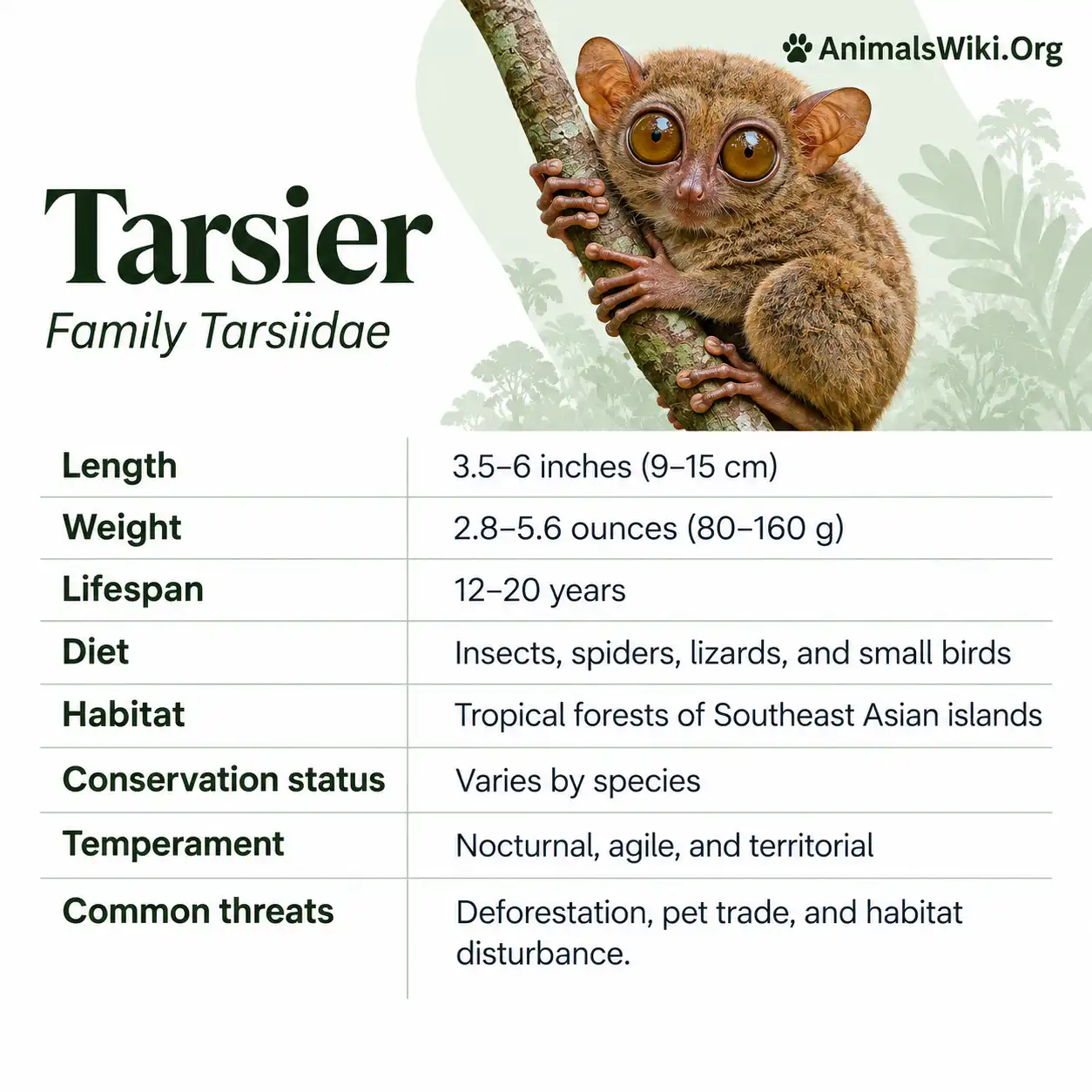
Tarsier, The Tiny Big-Eyed Primates of Southeast Asia’s Tropical Forests
The tarsier is one of the strangest and most captivating primates on Earth.
Small enough to fit comfortably on a human hand, a tarsier combines:
- Enormous forward-facing eyes
- Oversized mobile ears
- Long fingers
- Powerful hind legs
- An extremely long tail
- Remarkable jumping ability
- Nocturnal hunting behavior
Its appearance can make it look almost like a miniature combination of:
monkey, owl and frog.
But tarsiers are none of these.
They belong to their own ancient branch of the:
primate family tree.
Wild tarsiers occur naturally only in parts of:
Southeast Asia.
They are especially associated with:
- Indonesia
- Malaysia
- Brunei
- The Philippines
depending on species.
Their enormous eyes are among their most famous adaptations.
Relative to body size, tarsiers have some of the largest eyes of any mammal.
Each eye can be approximately as large as—or in some comparisons heavier than—the animal’s brain.
Those enormous eyes help collect light in the dim forest at night.
But there is a trade-off.
Unlike human eyes, a tarsier’s eyes cannot move freely around inside their sockets.
To compensate, the animal can rotate its head dramatically from side to side, allowing it to scan its surroundings while clinging vertically to a branch.
Then there are the legs.
The name tarsier refers to the elongated:
tarsal bones of the feet.
These elongated ankle and foot structures contribute to the animal’s spectacular jumping ability.
A tarsier can cling vertically to a tree trunk, detect prey in the darkness and suddenly launch itself through the forest.
Its target may be:
- Beetles
- Moths
- Grasshoppers
- Crickets
- Cockroaches
- Spiders
- Other arthropods
- Small vertebrates
Unlike most primates, tarsiers are highly specialized predators.
They are often described as the world’s only primates that are:
entirely or almost entirely faunivorous/carnivorous.
They do not live primarily on fruit and leaves like many monkeys and apes.
They hunt.
This makes a tarsier less like a tiny fruit-eating monkey and more like:
a miniature nocturnal ambush predator.
Their survival, however, depends heavily on healthy forest habitat.
Deforestation, habitat fragmentation, agriculture, mining, infrastructure, disturbance and illegal capture threaten various tarsier populations.
Some species have extremely restricted distributions, meaning the loss of even a relatively small area of habitat can have serious consequences.
This comprehensive guide explores Tarsier facts, species, scientific classification, enormous eyes, eyesight, head rotation, ears, size, weight, Southeast Asian distribution, forest habitat, diet, carnivorous feeding, hunting, jumping, long legs, fingers, tail, behavior, communication, reproduction, babies, lifespan, adaptations, predators, danger to humans, conservation, and why Tarsiers are among the world’s most extraordinary primates.
Tarsier Facts
| Feature | Information |
|---|---|
| Common Name | Tarsier |
| Animal Type | Mammal |
| Group | Primate |
| Infraorder | Tarsiiformes |
| Living Family | Tarsiidae |
| Native Region | Southeast Asia |
| Famous Locations | Philippines, Indonesia, Malaysia, Brunei |
| Habitat | Tropical forests and related wooded habitats |
| Activity | Primarily nocturnal |
| Diet | Animal prey, especially insects |
| Feeding Type | Faunivorous/carnivorous |
| Body Size | Very small primate |
| Famous Feature | Enormous forward-facing eyes |
| Eyes | Extremely large relative to body size |
| Movement | Vertical clinging and leaping |
| Hind Legs | Exceptionally elongated and powerful |
| Fingers | Long, adapted for gripping |
| Tail | Usually very long |
| Social Behavior | Varies among species |
| Young | Infant |
| Typical Birth | Usually one infant |
| Main Threat | Habitat loss and fragmentation |
| Danger to Humans | Essentially harmless |
What Is a Tarsier?
A tarsier is a small nocturnal primate native to:
Southeast Asia.
Tarsiers belong to the family:
Tarsiidae.
They represent an ancient primate lineage distinct from:
- Monkeys
- Apes
- Lemurs
- Lorises
Is a Tarsier a Monkey?
No.
Tarsiers are primates, but they are:
not monkeys.
Monkeys belong to different branches of the primate evolutionary tree.
Is a Tarsier a Lemur?
No.
Lemurs belong to the strepsirrhine primates and are naturally associated with Madagascar.
Tarsiers belong to a different lineage.
Is a Tarsier an Ape?
No.
Apes include:
- Gibbons
- Orangutans
- Gorillas
- Chimpanzees
- Bonobos
- Humans
Tarsiers are much smaller and belong to a much older separate branch.
Are Tarsiers Primates?
Yes.
This is one of the most important tarsier facts.
Despite their unusual appearance, they are true:
primates.
Scientific Classification of Tarsiers
| Classification | Name |
|---|---|
| Kingdom | Animalia |
| Phylum | Chordata |
| Class | Mammalia |
| Order | Primates |
| Suborder | Haplorhini |
| Infraorder | Tarsiiformes |
| Family | Tarsiidae |
Living tarsiers are divided among several species and genera.
How Many Tarsier Species Are There?
There are multiple recognized living tarsier species, and taxonomy continues to develop as scientists study:
- Genetics
- Vocalizations
- Geography
- Morphology
For SEO and general educational writing, it is safer to describe tarsiers as a multi-species group rather than treating every tarsier as one species.
Main Groups of Tarsiers
Living tarsiers can broadly be discussed as:
Philippine Tarsiers
Found in parts of the:
Philippines.
Western Tarsiers
Associated with:
- Borneo
- Sumatra
- Nearby islands
Sulawesi Tarsiers
Found on:
Sulawesi and nearby Indonesian islands.
Sulawesi supports particularly high tarsier diversity.
Philippine Tarsier
One of the best-known species is the:
Philippine tarsier — Carlito syrichta.
It is native to several islands in the Philippines.
What Does a Tarsier Look Like?
A tarsier typically has:
- Huge round eyes
- Small body
- Rounded head
- Large ears
- Short soft fur
- Long fingers
- Elongated hind limbs
- Long tail
- Gripping hands and feet
The combination gives it one of the most recognizable faces among mammals.
Why Are Tarsier Eyes So Big?
Tarsiers are primarily:
nocturnal.
Their enormous eyes help collect limited light at night.
Large eyes improve visual sensitivity in:
- Moonlight
- Starlight
- Dim forest conditions
This is particularly useful for locating moving prey.
How Big Are Tarsier Eyes?
A tarsier’s eyes are enormous relative to its skull and body.
Each eye can be roughly:
around 1.5 cm across
in some species.
The precise measurement varies among species and individuals.
Are Tarsier Eyes Bigger Than Their Brain?
A popular tarsier fact states that each eye is:
approximately as large as, or can outweigh, the brain.
The exact comparison depends on species and how measurements are made, but the underlying point is accurate:
their eyes are extraordinarily large relative to their head and brain.
Can Tarsiers Move Their Eyes?
Not much.
Their enormous eyes are relatively fixed within the sockets.
They cannot scan their surroundings by moving their eyeballs as freely as humans can.
How Do Tarsiers Look Around?
They compensate by turning their:
head.
Their neck is exceptionally flexible.
Can a Tarsier Turn Its Head 360 Degrees?
No.
This is a common exaggeration.
A tarsier cannot rotate its head completely around.
However, it can rotate its head approximately:
180 degrees in either direction
for an impressive overall range.
This allows the animal to look behind itself without moving its entire body.
Is a Tarsier Like an Owl?
They are unrelated, but the comparison makes sense visually.
Both possess:
- Large eyes
- Strong night vision
- Flexible neck movement
- Predatory lifestyles
This is an example of unrelated animals evolving somewhat similar solutions to similar challenges.
Tarsier Ears
Tarsiers have relatively large, thin ears.
The ears can move to help detect:
very faint sounds.
This is extremely useful for locating insects moving through vegetation at night.
Can Tarsiers Hear Ultrasound?
Some tarsier species are remarkable for their ability to communicate and hear at:
ultrasonic frequencies
above the normal upper limit of human hearing.
This may help with:
- Communication
- Hunting
- Avoiding interference from lower-frequency forest noise
Not every detail should automatically be generalized identically to every tarsier species.
Tarsier Fur
Tarsier fur is generally:
- Soft
- Dense
- Grayish
- Brownish
- Buff
- Reddish-brown
depending on species.
These colors help them blend into:
- Bark
- Branches
- Shadowed vegetation
How Big Is a Tarsier?
Tarsiers are tiny.
Depending on species, head-and-body length is often roughly:
9–16 centimeters.
The tail may be substantially longer than the body.
How Much Does a Tarsier Weigh?
Many tarsiers weigh only around:
80–160 grams
although size differs among species and sexes.
That means some adults weigh less than:
a typical smartphone.
Are Male Tarsiers Bigger Than Females?
Sexual size differences vary among species.
In several species, males are somewhat larger than females.
Tarsier Tail
The tail can be:
longer than the head and body combined.
It helps with:
- Balance
- Positioning
- Leaping
- Vertical clinging
Tail characteristics vary among species.
Does a Tarsier Have Fur on Its Tail?
The amount of tail hair varies.
Some tarsiers have relatively bare tails with more hair toward the:
tip.
Tarsier Fingers
Tarsiers have long fingers and specialized gripping pads.
These help them hold:
- Tree trunks
- Vertical stems
- Branches
with remarkable control.
Why Does a Tarsier Have Long Fingers?
Long fingers improve:
- Grip
- Climbing
- Landing
- Prey capture
Their hands are especially useful when jumping between narrow supports.
Tarsier Legs
Tarsiers possess extremely elongated:
hind limbs.
Their hind legs are much longer and more powerful than their forelimbs.
Why Is It Called a Tarsier?
The name refers to the elongated:
tarsal region
of the hind foot.
These elongated bones are a major component of their jumping system.
How Far Can a Tarsier Jump?
Tarsiers can leap distances many times their own body length.
Depending on species and circumstances, leaps of:
several meters
are possible.
For an animal with a body only around 10–15 cm long, this is extraordinary.
Why Can Tarsiers Jump So Far?
Their jumping ability comes from:
- Elongated ankle bones
- Long hind limbs
- Powerful leg muscles
- Lightweight body
- Strong gripping hands and feet
- Excellent depth perception
How Do Tarsiers Move?
Their characteristic locomotion is called:
vertical clinging and leaping.
A tarsier may cling upright to a tree trunk and then suddenly leap to another vertical support.
Can Tarsiers Walk?
Yes, but their anatomy is far better adapted to:
clinging and leaping
than ordinary four-legged walking.
On the ground, movement can appear unusual.
Where Do Tarsiers Live?
Wild tarsiers occur naturally in:
Southeast Asia.
Important regions include:
- Philippines
- Indonesia
- Malaysia
- Brunei
Do Tarsiers Live in the Philippines?
Yes.
The Philippine tarsier is one of the country’s most famous native mammals.
Do Tarsiers Live in Indonesia?
Yes.
Indonesia contains numerous tarsier species, particularly around:
Sulawesi.
Do Tarsiers Live in Borneo?
Yes.
Western tarsiers occur on Borneo.
Do Tarsiers Live in Malaysia?
Yes.
Tarsiers occur in Malaysian Borneo.
Do Tarsiers Live in Thailand?
Tarsiers are not characteristic members of modern mainland Thai primate fauna.
Their current natural range is centered farther south and east in island Southeast Asia.
Tarsier Habitat
Tarsiers inhabit tropical environments including:
- Primary forest
- Secondary forest
- Lowland forest
- Montane forest
- Scrub
- Bamboo
- Dense secondary vegetation
Habitat preferences differ among species.
Do Tarsiers Live in Rainforests?
Yes.
Many species are strongly associated with:
tropical forest ecosystems.
Do Tarsiers Live in Trees?
Yes.
Tarsiers are highly:
arboreal.
They depend on trunks, branches, saplings and vertical vegetation for:
- Resting
- Hunting
- Traveling
- Escaping predators
Where Do Tarsiers Sleep?
During daylight, tarsiers may sleep in:
- Dense vegetation
- Tangled vines
- Tree cavities
- Bamboo
- Sheltered forest sites
depending on species.
Are Tarsiers Nocturnal?
Yes.
Most tarsiers are strongly:
nocturnal.
They rest during the day and become active around:
dusk.
What Do Tarsiers Eat?
Tarsiers are highly unusual among primates because their natural diet is dominated by:
animal prey.
They eat:
- Grasshoppers
- Crickets
- Beetles
- Moths
- Cockroaches
- Cicadas
- Spiders
- Other arthropods
Larger prey may sometimes include small:
- Lizards
- Frogs
- Birds
- Bats
depending on species and opportunity.
Are Tarsiers Carnivores?
Tarsiers are often described as the only living primates with an:
entirely faunivorous diet.
More precisely, they are highly specialized predators whose natural diet consists overwhelmingly of animal prey.
Do Tarsiers Eat Fruit?
Unlike many primates, fruit is not a major natural component of the tarsier diet.
Their digestive and hunting ecology are centered on:
animal prey.
Do Tarsiers Eat Insects?
Yes.
Insects make up a major part of their diet.
Do Tarsiers Eat Birds?
They can occasionally capture small birds.
This is not necessarily an everyday meal, but tarsiers are capable predators.
Do Tarsiers Eat Lizards?
Yes.
Small lizards can be taken.
Do Tarsiers Eat Frogs?
Small frogs may be eaten.
Do Tarsiers Eat Bats?
There are observations of some tarsiers taking small vertebrate prey, potentially including bats.
Such prey should be viewed as opportunistic rather than the universal daily diet of every tarsier.
How Do Tarsiers Hunt?
A tarsier may sit almost motionless while:
- Listening
- Watching
- Turning its head
- Tracking movement
Once prey is located, it launches itself toward the target.
The hands seize the prey.
The tarsier then kills and eats it.
Do Tarsiers Catch Prey in Midair?
They can make spectacular leaps toward insects and other prey.
Their coordination allows them to:
attack while jumping.
Why Are Tarsiers Good Hunters?
Their hunting equipment includes:
- Huge eyes
- Excellent depth perception
- Sensitive ears
- Flexible neck
- Powerful legs
- Long fingers
- Quick reactions
Together these create an effective:
nighttime ambush predator.
Do Tarsiers Drink Water?
Yes.
They obtain water from:
- Drinking
- Moisture in prey
and their environment.
Tarsier Behavior
Tarsiers are:
- Nocturnal
- Arboreal
- Highly alert
- Territorial to varying degrees
- Predatory
- Excellent jumpers
Social organization differs among species.
Are Tarsiers Solitary?
Some species spend considerable time alone.
Others maintain:
- Pairs
- Family groups
- Social associations
Therefore, calling every tarsier strictly solitary would be inaccurate.
Do Tarsiers Live in Groups?
Some do.
Social structure varies among the different tarsier lineages.
Are Tarsiers Territorial?
Many defend or advertise home ranges using:
- Calls
- Scent
- Social behavior
Territorial patterns vary by species.
Tarsier Communication
Tarsiers communicate using:
- Vocal calls
- Scent
- Body posture
- Facial signals
- Physical contact
Some species are particularly famous for complex:
duet calls.
What Is a Tarsier Duet?
In some species, male and female tarsiers perform coordinated vocalizations.
These duets may help:
- Maintain pair bonds
- Advertise territory
- Identify groups
- Communicate location
Do Tarsiers Sing?
Some species produce elaborate calls that can reasonably be described as:
song-like or duet-like.
Can Humans Hear Tarsier Calls?
Many calls are audible.
But certain tarsiers can also produce extremely high-frequency vocalizations beyond normal human hearing.
Tarsier Reproduction
Reproductive patterns vary among species.
Tarsiers generally reproduce relatively slowly compared with small rodents.
How Many Babies Do Tarsiers Have?
A female generally gives birth to:
one infant at a time.
Twins are uncommon.
What Is a Baby Tarsier Called?
The safest term is:
infant tarsier.
“Baby tarsier” is also perfectly correct.
How Long Is Tarsier Pregnancy?
Gestation is relatively long for such a small mammal.
Depending on species, pregnancy lasts roughly:
around six months.
This reflects substantial prenatal investment.
Why Is a Tarsier Baby So Developed at Birth?
Tarsier infants are unusually:
well developed
for such small mammals.
They are born:
- Fur-covered
- With open eyes
- Relatively strong
- Capable of clinging
This condition is called:
precocial development.
Can Baby Tarsiers Climb?
They develop climbing and clinging abilities very early.
The mother still provides:
- Milk
- Protection
- Guidance
while the infant develops.
Do Tarsier Mothers Carry Babies?
Mothers may carry young, but infants can also be left temporarily on vegetation while the mother forages.
This behavior is sometimes described as:
infant parking.
What Is Infant Parking?
The mother leaves her infant clinging safely to vegetation while she searches for food nearby.
She later returns to:
- Nurse
- Move
- Protect
the infant.
Do Male Tarsiers Care for Babies?
The amount of male involvement varies among species and social systems.
Maternal care remains essential.
Tarsier Lifespan
Exact lifespan varies by species and is difficult to measure in wild populations.
Tarsiers can potentially live:
well over a decade
under suitable conditions, with some captive records extending considerably longer.
A single exact lifespan should not be applied automatically to every species.
Tarsier Adaptations
Enormous Eyes
Collect light for nocturnal vision.
Forward-Facing Vision
Provides strong depth perception for jumping and hunting.
Flexible Neck
Compensates for limited eye movement.
Mobile Ears
Detect faint prey sounds.
Long Hind Limbs
Generate explosive jumping power.
Elongated Tarsal Bones
Increase effective hind-limb length.
Long Fingers
Provide secure grip during landing.
Gripping Pads
Help hold narrow branches and vertical trunks.
Long Tail
Improves balance and stability.
Camouflaged Fur
Blends with bark and vegetation.
High-Frequency Hearing
Helps some species communicate and potentially detect prey.
Why Don’t Tarsiers Move Their Eyes?
Their enormous eyeballs fit tightly within their skull.
Instead of moving their eyes significantly, tarsiers turn their:
head.
This is similar in principle to the strategy used by owls, although the animals are completely unrelated.
Do Tarsiers Have Night Vision?
Yes.
Their huge eyes are strongly adapted to:
low-light vision.
Can Tarsiers See in Total Darkness?
No eye can form a normal visual image without photons.
In complete darkness, tarsiers must rely more heavily on:
- Hearing
- Smell
- Touch
Their eyes are optimized for extremely dim light, not literally zero light.
What Predators Eat Tarsiers?
Potential predators include:
- Owls
- Snakes
- Monitor lizards
- Civets
- Cats
- Raptors
- Other forest predators
The exact predator community depends on location.
Do Owls Eat Tarsiers?
Yes, nocturnal raptors can potentially prey on tarsiers.
Do Snakes Eat Tarsiers?
Yes.
Tree-climbing snakes can threaten:
- Adults
- Juveniles
- Infants
How Do Tarsiers Escape Predators?
They rely on:
- Camouflage
- Alertness
- Excellent hearing
- Rapid jumping
- Dense vegetation
- Nighttime activity
Their explosive leaps can quickly move them away from danger.
Are Tarsiers Dangerous to Humans?
No.
Tarsiers are tiny wild primates and do not regard humans as prey.
However, wild animals should not be:
- Handled
- Chased
- Restrained
- Harassed
Can Tarsiers Bite?
Yes.
Like other mammals with teeth, a frightened tarsier can bite defensively.
Its bite does not make it a dangerous predator of humans.
Are Tarsiers Venomous?
No.
Are Tarsiers Poisonous?
No.
Can You Keep a Tarsier as a Pet?
Tarsiers are:
not suitable pets.
Their needs are highly specialized.
They require:
- Live animal prey
- Appropriate forest structure
- Vertical jumping space
- Correct temperature and humidity
- Dark nighttime conditions
- Low stress
- Species-appropriate social conditions
A household cannot adequately reproduce their natural ecology.
Are Tarsiers Sensitive to Stress?
Yes.
Tarsiers can be extremely sensitive to:
- Capture
- Handling
- Noise
- Crowding
- Inappropriate enclosures
- Human disturbance
This is one reason responsible wildlife tourism is important.
Do Tarsiers Commit Suicide?
This is a widely repeated internet claim that requires caution.
Highly stressed captive tarsiers may injure themselves by:
- Crashing into enclosure surfaces
- Attempting escape
- Repetitive stress behavior
But describing this as deliberate human-like “suicide” assigns an intention that cannot be scientifically demonstrated.
A more accurate statement is:
severe stress can cause dangerous self-injurious behavior in captive tarsiers.
Why Should You Not Touch a Tarsier?
Handling can:
- Stress the animal
- Disrupt normal behavior
- Cause injury
- Increase disease transmission risk
Wildlife encounters should prioritize the animal’s welfare rather than obtaining close photographs.
Are Tarsiers Endangered?
Conservation status:
varies by species.
Some species face serious threats and have very restricted distributions.
It is therefore inaccurate to give all tarsiers one universal conservation category.
What Threatens Tarsiers?
Major threats can include:
- Deforestation
- Forest fragmentation
- Agriculture
- Mining
- Roads
- Development
- Illegal capture
- Hunting
- Disturbance
- Inappropriate tourism
Threat intensity differs across species and islands.
Why Is Habitat Fragmentation Dangerous?
A tarsier needs connected vegetation for:
- Jumping
- Hunting
- Finding mates
- Avoiding predators
- Reaching sleeping sites
When forest becomes isolated patches, movement becomes more difficult.
Do Tarsiers Live in Secondary Forest?
Some species can use disturbed or secondary vegetation.
This adaptability does not mean:
habitat destruction is harmless.
Suitable vegetation structure and prey must still remain.
How Many Tarsiers Are Left?
There is no single meaningful worldwide number because:
tarsier refers to multiple species.
Some species have broader populations.
Others are restricted to very small islands or geographic areas.
Population estimates should therefore be given:
species by species.
Tarsier Conservation
Conservation strategies include:
- Protecting forests
- Maintaining habitat corridors
- Preventing illegal capture
- Regulating tourism
- Supporting local communities
- Researching poorly known species
- Monitoring populations
- Protecting island ecosystems
Why Are Island Tarsiers Vulnerable?
Island species can have extremely restricted ranges.
If a species occurs only on:
one small island
then a major disturbance can affect a large percentage of its entire habitat.
This makes island endemics particularly vulnerable to:
- Deforestation
- Fire
- Mining
- Development
- Climate-related change
Why Are Tarsiers Important?
Tarsiers are predators of:
- Insects
- Spiders
- Other small animals
They therefore contribute to forest food webs.
They are also scientifically important because they represent:
a distinctive branch of primate evolution.
Tarsiers and Human Evolution
Tarsiers are not human ancestors in the simple sense.
However, studying them helps scientists understand the evolution of:
haplorhine primates
—the larger evolutionary group that also contains monkeys, apes and humans.
Are Humans Related to Tarsiers?
Yes.
Humans and tarsiers are both:
primates
and share an ancient common ancestor.
But their evolutionary lineages separated an extremely long time ago.
Tarsier vs. Lemur
| Feature | Tarsier | Lemur |
|---|---|---|
| Main Range | Southeast Asia | Madagascar |
| Major Lineage | Haplorhine | Strepsirrhine |
| Activity | Mostly nocturnal | Varies |
| Eyes | Extremely large | Often large |
| Diet | Animal prey | Highly varied |
| Movement | Vertical clinging/leaping | Highly varied |
| Tail | Long | Often long |
Tarsier vs. Slow Loris
| Feature | Tarsier | Slow Loris |
|---|---|---|
| Movement | Fast explosive leaps | Slow deliberate climbing |
| Diet | Strongly faunivorous | Omnivorous |
| Eyes | Enormous | Large |
| Venom | No | Slow lorises have a toxic/venomous defensive system |
| Hind Legs | Extremely elongated | Not similarly specialized |
| Primate Lineage | Haplorhine | Strepsirrhine |
Tarsier vs. Monkey
| Feature | Tarsier | Monkey |
|---|---|---|
| Size | Tiny | Highly variable |
| Diet | Mostly animal prey | Usually mixed/plant-heavy |
| Eyes | Extremely large | Proportionally smaller |
| Movement | Clinging/leaping | Highly varied |
| Classification | Tarsiiform | Simiiform |
| Monkey? | No | Yes |
Tarsier vs. Owl
They are not closely related at all.
A tarsier is a:
mammal and primate.
An owl is a:
bird.
Their similarities—large eyes, flexible necks and nocturnal predation—arose independently.
50 Interesting Tarsier Facts
- Tarsiers are primates.
- They are mammals.
- They are not monkeys.
- They are not lemurs.
- They are not rodents.
- Wild tarsiers occur only in Southeast Asia.
- They occur in the Philippines.
- They occur in Indonesia.
- They occur on Borneo.
- Sulawesi has numerous tarsier species.
- Tarsiers have enormous eyes.
- Their eyes are among the largest relative to body size among mammals.
- Each eye can approach the size or mass of the brain in some comparisons.
- Their eyeballs have very limited movement.
- They compensate by rotating their heads.
- They cannot rotate their heads a full 360 degrees.
- They can turn the head dramatically to each side.
- Tarsiers are mainly nocturnal.
- Their large eyes collect light at night.
- They have large mobile ears.
- Their hearing is extremely sensitive.
- Some species communicate ultrasonically.
- Tarsiers are predators.
- They primarily eat animal prey.
- Insects form a major part of their diet.
- They eat grasshoppers.
- They eat beetles.
- They eat moths.
- They may eat spiders.
- They can capture small vertebrates.
- They are extraordinary jumpers.
- Their hind legs are much longer than their forelimbs.
- Their name comes from elongated tarsal bones.
- They use vertical clinging and leaping.
- Some leaps span many times their body length.
- They have long fingers.
- Their hands and feet provide powerful grip.
- Their tails help with balance.
- They are primarily arboreal.
- Social behavior differs among species.
- Some species perform vocal duets.
- Females generally produce one infant.
- Pregnancy lasts surprisingly long for such a small mammal.
- Newborns are unusually well developed.
- Infants can cling at a young age.
- Mothers may temporarily park infants on vegetation.
- Tarsiers are highly sensitive to stress.
- They are poor choices for pets.
- Habitat destruction threatens several species.
- Tarsiers represent one of the most distinctive surviving branches of primate evolution.
Did You Know?
A tarsier is essentially a tiny nighttime predator built around two enormous eyes and a pair of biological springs.
Imagine a Southeast Asian forest after sunset.
A tarsier clings vertically to a thin trunk.
It barely moves.
Its enormous eyes face forward.
Its ears rotate.
For a moment, the forest appears quiet.
Then:
a leaf moves.
The tarsier hears something.
Perhaps a grasshopper.
Its head rotates.
The body remains almost completely still.
The eyes lock onto the target.
Forward-facing vision allows the tarsier to judge:
distance.
That is critical.
It is not going to walk toward its prey.
It is going to:
launch itself through the air.
The hind legs compress.
These legs contain elongated bones that make them enormous relative to the tarsier’s tiny body.
Muscles contract.
The animal explodes away from the trunk.
For an animal barely larger than a human hand, the leap is enormous.
Its fingers open.
The prey is captured.
Another branch approaches.
The tarsier grips it.
Within moments, the animal is vertical again.
Waiting.
Listening.
Watching.
This explains why almost every exaggerated-looking part of the tarsier’s body actually makes sense.
Huge eyes?
Find prey in dim light.
Large ears?
Hear prey moving.
Flexible neck?
Look around when giant eyes cannot move freely.
Long legs?
Launch across gaps.
Long fingers?
Catch prey and grip landing sites.
Long tail?
Maintain balance.
The tarsier may look bizarre to humans.
Evolution sees something different:
a remarkably specialized nocturnal hunter.
Frequently Asked Questions About Tarsiers
What is a tarsier?
A tarsier is a small nocturnal primate native to Southeast Asia.
Is a tarsier a mammal?
Yes.
Is a tarsier a primate?
Yes.
Is a tarsier a monkey?
No.
Is a tarsier an ape?
No.
Is a tarsier a lemur?
No.
Is a tarsier a rodent?
No.
Is a tarsier a marsupial?
No.
Where do tarsiers live?
Southeast Asia.
Do tarsiers live in the Philippines?
Yes.
Do tarsiers live in Indonesia?
Yes.
Do tarsiers live in Malaysia?
Yes, particularly Malaysian Borneo.
Do tarsiers live in Borneo?
Yes.
Do tarsiers live in Sulawesi?
Yes. Sulawesi is particularly important for tarsier diversity.
Do tarsiers live in rainforests?
Yes.
Are tarsiers arboreal?
Yes. They spend much of their lives in trees and dense vegetation.
Are tarsiers nocturnal?
Yes, most are primarily active at night.
What do tarsiers do during the day?
They rest in sheltered vegetation, cavities or other protected sleeping sites.
Why do tarsiers have huge eyes?
Their enormous eyes improve vision in very dim light.
How big are tarsier eyes?
They are enormous relative to body size and may measure roughly around 1.5 cm across in some species.
Are tarsier eyes bigger than their brain?
Each eye can be comparable to the brain in size or mass in some commonly cited anatomical comparisons.
Can tarsiers move their eyes?
Their eyeballs have very limited movement.
Why can’t tarsiers move their eyes much?
The enormous eyes fit tightly within their sockets.
How do tarsiers look sideways?
They turn their heads.
Can tarsiers turn their heads 360 degrees?
No.
How far can a tarsier turn its head?
It can rotate its head dramatically—roughly 180 degrees toward either side is commonly described.
Why can tarsiers turn their heads so far?
The flexible neck compensates for limited eyeball movement.
Do tarsiers have night vision?
Yes. Their eyes are highly adapted to dim nighttime conditions.
Can tarsiers see in complete darkness?
No. Vision still requires light.
Do tarsiers have big ears?
Yes.
Why are tarsier ears so large?
Large mobile ears help detect prey.
Can tarsiers hear ultrasound?
At least some species can detect and produce ultrasonic frequencies.
Can humans hear tarsiers?
Many calls are audible, while some high-frequency communication is beyond normal human hearing.
Why do tarsiers jump?
Leaping is their principal method of moving rapidly between vertical supports.
How far can tarsiers jump?
They can jump several meters under suitable conditions, many times their own body length.
Why are tarsiers such good jumpers?
Their long hind limbs, elongated ankle bones and powerful muscles generate exceptional propulsion.
Why is it called a tarsier?
The name refers to the elongated tarsal region of its feet.
Can tarsiers walk?
Yes, but their anatomy is much better suited to clinging and jumping.
Can tarsiers climb?
Yes.
Can tarsiers swim?
They can cope with water when necessary, but swimming is not their defining form of movement.
What do tarsiers eat?
Mostly insects and other animal prey.
Are tarsiers carnivores?
They are highly specialized faunivorous predators.
Are tarsiers insectivores?
Insects make up a major part of their diet.
Do tarsiers eat fruit?
Fruit is not considered a major component of their natural diet.
Do tarsiers eat grasshoppers?
Yes.
Do tarsiers eat beetles?
Yes.
Do tarsiers eat spiders?
Yes, they can consume arthropods such as spiders.
Do tarsiers eat lizards?
Yes, small lizards may be captured.
Do tarsiers eat frogs?
They can capture small frogs.
Do tarsiers eat birds?
Some tarsiers can prey opportunistically on small birds.
How do tarsiers hunt?
They detect prey with vision and hearing and then leap rapidly toward it.
Are tarsiers fast?
Their explosive leaps are extremely fast, although they are not long-distance runners.
Are tarsiers intelligent?
As primates, they possess sophisticated sensory processing, learning and behavioral flexibility, although intelligence should not be reduced to a simple ranking.
Are tarsiers social?
Social behavior differs among species.
Do tarsiers live alone?
Some spend substantial time alone, while others form pairs or social groups.
Do tarsiers communicate?
Yes.
Do tarsiers sing?
Some species perform elaborate vocal duets.
Why do tarsiers make calls?
Calls can communicate territory, identity, location and social information.
How many babies do tarsiers have?
Usually one infant.
What is a baby tarsier called?
An infant.
How long are tarsiers pregnant?
Gestation is approximately six months in several species.
Are baby tarsiers born blind?
No. Tarsier infants are relatively well developed and are born with open eyes.
Do baby tarsiers have fur?
Yes.
Can baby tarsiers climb?
They develop clinging and climbing ability very early.
Do tarsier mothers carry their babies?
Yes, but some mothers also leave infants temporarily clinging to vegetation while foraging.
What is infant parking?
It is temporarily leaving an infant safely attached to vegetation while the mother searches for food.
How long do tarsiers live?
They can live for more than a decade, with lifespan varying by species and conditions.
What eats tarsiers?
Potential predators include snakes, owls, monitor lizards, civets and other forest predators.
Do snakes eat tarsiers?
Yes.
Do owls eat tarsiers?
Owls can potentially prey on them.
How do tarsiers protect themselves?
They use camouflage, vigilance, rapid jumping and dense vegetation.
Are tarsiers dangerous to humans?
No.
Do tarsiers bite?
A frightened or restrained tarsier can bite defensively.
Are tarsiers venomous?
No.
Are tarsiers poisonous?
No.
Can tarsiers be pets?
They are not suitable pets.
Why can’t tarsiers be pets?
They require specialized prey, forest structure, nocturnal conditions and low-stress environments.
Do tarsiers die from stress?
Severe stress can cause major health and behavioral problems and may contribute to injury or death.
Do tarsiers commit suicide?
Claims of deliberate suicide anthropomorphize the animal. Severe captivity stress can instead cause dangerous self-injurious behavior.
Should tourists touch tarsiers?
No. Responsible viewing should minimize handling, noise and disturbance.
Are tarsiers endangered?
Conservation status differs among species.
Why are tarsiers endangered?
Habitat loss, fragmentation and other human pressures threaten several species.
How many tarsiers are left?
There is no single worldwide population number because multiple tarsier species exist.
What is the Philippine tarsier?
It is a tarsier native to the Philippines, scientifically known as Carlito syrichta.
Is the Philippine tarsier endangered?
Its conservation situation requires ongoing protection, but conservation categories should be checked species by species rather than generalized across all tarsiers.
What is the smallest tarsier?
Body-size comparisons depend on which measurements and species are considered; several tarsier species are extraordinarily small.
Is a tarsier smaller than a monkey?
Most tarsiers are smaller than most monkey species.
Is a tarsier related to humans?
Yes. Both are primates and share a distant common ancestor.
Is a tarsier closer to monkeys or lemurs?
Evolutionarily, tarsiers belong to Haplorhini, the broader lineage that also includes monkeys and apes, rather than the strepsirrhine lineage containing lemurs and lorises.
Why are tarsiers important to evolution?
They represent an ancient surviving branch of haplorhine primate evolution.
Why are tarsiers important to forests?
They prey on insects and other small animals and form part of tropical forest food webs.
What is the most interesting tarsier fact?
Its enormous eyes cannot move much inside their sockets, so the tiny nocturnal primate compensates with a remarkably flexible neck while using elongated hind legs to launch itself between trees.
Conclusion
The tarsier is a perfect example of what happens when evolution pushes an animal toward extreme specialization.
Its body is tiny.
But its eyes are:
enormous.
Its arms are relatively small.
But its hind legs are:
extraordinarily long.
Its eyeballs barely move.
But its neck compensates by:
turning dramatically.
It looks delicate.
Yet every night it becomes:
a predator.
While many primates search for:
- Fruit
- Leaves
- Seeds
the tarsier waits for something to:
move.
An insect rustles.
The ears detect it.
The eyes locate it.
The brain calculates the distance.
The legs compress.
Then a tiny primate launches itself through a dark tropical forest.
That sequence explains the tarsier.
Its strange anatomy is not random.
Every exaggerated feature has a purpose.
Large eyes collect light.
Large ears collect sound.
Long legs generate power.
Long fingers secure landings.
A long tail stabilizes movement.
Together, these features create one of the most specialized nocturnal hunters among primates.
But specialization can also create vulnerability.
Tarsiers depend heavily on:
forest structure.
Remove the trees and they lose more than shelter.
They lose:
- Hunting platforms
- Jumping routes
- Sleeping sites
- Territory
- Protection
- Prey
And because some species occur only within extremely small geographic ranges, destroying one forest can mean far more than losing one patch of habitat.
It can threaten:
an entire evolutionary lineage found nowhere else on Earth.
Protecting tarsiers therefore means protecting the tropical forests that shaped them.
The tarsier may weigh little more than a handful of fruit.
But hidden behind those enormous eyes is something much larger:
millions of years of primate evolution.



