
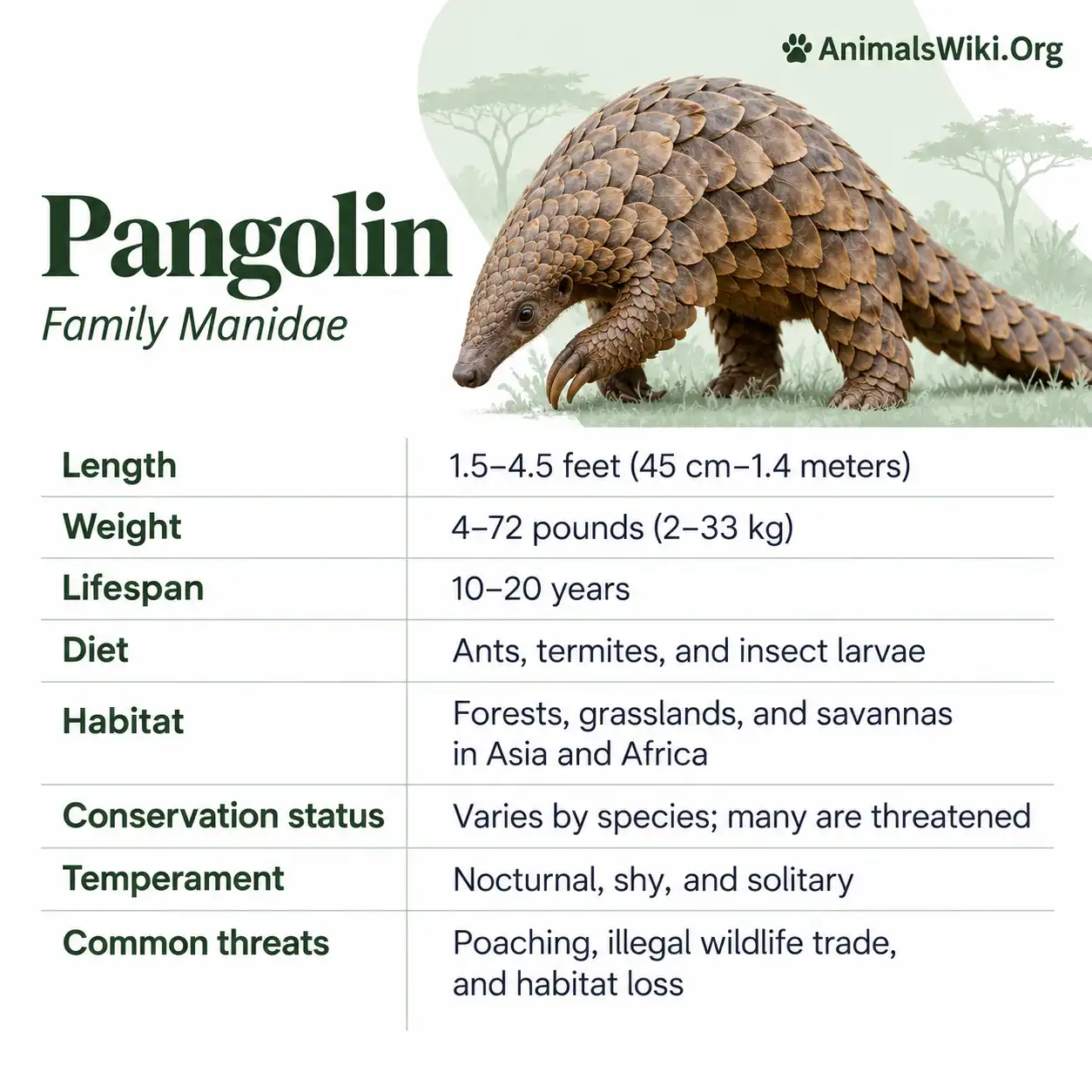
Pangolin, The Remarkable Scaly Mammals of Africa & Asia
The pangolin is one of the most unusual mammals on Earth.
Covered from head to tail in overlapping protective scales, it can look more like a:
reptile or walking pine cone
than a mammal.
But underneath those scales, the pangolin is unmistakably mammalian.
Pangolins:
- Have hair
- Give birth to live young
- Produce milk
- Nurse their babies
- Are warm-blooded
Their most extraordinary feature is their armor.
Pangolins are the only living mammals covered in large, overlapping:
keratin scales.
Keratin is the same structural protein found in human:
- Fingernails
- Hair
and in animal:
- Claws
- Hooves
- Horn coverings
When threatened, many pangolins curl tightly into a ball.
Their vulnerable:
face, belly and limbs
disappear inside.
The predator is left facing a nearly complete exterior of hard scales.
This defensive strategy works remarkably well against many natural predators.
Unfortunately, it is far less effective against:
humans.
A person can simply pick up a curled pangolin.
That vulnerability has contributed to a devastating illegal wildlife trade.
Pangolins have been hunted for:
- Meat
- Scales
- Traditional medicine markets
- Illegal international trafficking
Their scales are sometimes falsely believed to possess special medicinal properties.
Biologically, however, pangolin scales are made primarily from:
keratin.
Pangolins are also extraordinary insect hunters.
They have:
no teeth.
Instead, they possess a remarkably long, sticky tongue that can be inserted deep inside:
- Ant nests
- Termite mounds
- Rotten wood
- Underground insect tunnels
Powerful claws break open the colony.
The tongue enters.
Insects stick to its surface.
Then the pangolin swallows them.
This feeding strategy has evolved so extensively that the pangolin’s anatomy differs dramatically from that of most mammals.
There is also no single animal simply called “the pangolin” in a taxonomic sense.
There are:
eight living pangolin species.
Four occur naturally in:
Asia
and four occur naturally in:
Africa.
Together, they belong to the mammalian order:
Pholidota.
Some species spend much of their lives on the ground.
Others are excellent climbers and spend substantial time in trees.
Some have long prehensile tails.
Others are heavier terrestrial animals.
All, however, share the unmistakable scaled body that makes pangolins unlike any other living mammal.
This comprehensive guide explores Pangolin facts, species, scientific classification, scales, size, weight, habitat, distribution, diet, tongue, claws, teeth, digestion, behavior, climbing, swimming, defensive ball, reproduction, babies, lifespan, predators, ecological importance, illegal wildlife trade, pangolin scales, conservation, and why Pangolins are among the world’s most threatened mammals.
Pangolin Facts
| Feature | Information |
|---|---|
| Common Name | Pangolin |
| Animal Type | Mammal |
| Order | Pholidota |
| Family | Manidae |
| Living Species | 8 |
| Native Continents | Africa and Asia |
| Main Habitat | Forests, woodlands and savannas |
| Diet | Primarily ants and termites |
| Feeding Type | Specialized insectivore |
| Teeth | None |
| Famous Feature | Large overlapping scales |
| Scale Material | Keratin |
| Tongue | Extremely long and sticky |
| Main Defense | Curling into an armored ball |
| Claws | Large and powerful |
| Activity | Mostly nocturnal |
| Lifestyle | Solitary |
| Young | Pangopup or pangolin pup; usually simply called a baby/young pangolin |
| Typical Birth | Usually one young |
| Major Threat | Illegal hunting and wildlife trafficking |
| Ecological Role | Insect predator and soil disturbance |
| Conservation Concern | Extremely high |
What Is a Pangolin?
A pangolin is a specialized insect-eating mammal belonging to the order:
Pholidota.
Living pangolins belong to the family:
Manidae.
They occur naturally only in:
Africa and Asia.
Is a Pangolin a Mammal?
Yes.
Despite being covered in scales, pangolins are:
mammals.
They:
- Give birth to live young
- Produce milk
- Have hair
- Regulate their body temperature internally
Is a Pangolin a Reptile?
No.
The scales create a reptile-like appearance, but pangolins are not:
- Lizards
- Armadillos
- Reptiles
They belong to their own distinctive mammalian lineage.
What Does the Word Pangolin Mean?
The English word “pangolin” is generally traced to a Malay word associated with the animal’s ability to:
roll up.
This refers to its famous defensive posture.
Scientific Classification of Pangolins
| Classification | Name |
|---|---|
| Kingdom | Animalia |
| Phylum | Chordata |
| Class | Mammalia |
| Order | Pholidota |
| Family | Manidae |
The eight living species belong to several genera within the family Manidae.
How Many Pangolin Species Are There?
There are:
eight living species.
They are divided between:
- 4 Asian species
- 4 African species
Asian Pangolin Species
The four Asian species are:
- Chinese Pangolin — Manis pentadactyla
- Indian Pangolin — Manis crassicaudata
- Sunda Pangolin — Manis javanica
- Philippine Pangolin — Manis culionensis
African Pangolin Species
The four African species are:
- Temminck’s Ground Pangolin — Smutsia temminckii
- Giant Ground Pangolin — Smutsia gigantea
- White-Bellied Pangolin — Phataginus tricuspis
- Black-Bellied Pangolin — Phataginus tetradactyla
Are All Pangolins the Same Size?
No.
Pangolins vary substantially in:
- Body length
- Weight
- Tail length
- Scale structure
- Habitat
- Climbing ability
The giant ground pangolin is much larger than the smaller tree-dwelling species.
What Does a Pangolin Look Like?
A typical pangolin has:
- Long tapered head
- Small eyes
- No external-looking prominent teeth
- Long sticky tongue
- Powerful front claws
- Overlapping scales
- Long tail
- Relatively small ears or ear openings
- Soft unscaled belly
Its overall appearance is unlike that of any other living mammal.
Pangolin Scales
The scales cover much of the:
- Head
- Back
- Sides
- Limbs
- Tail
They overlap in a pattern resembling:
- Roof tiles
- Artichoke leaves
- Pine cones
The underside remains much softer.
What Are Pangolin Scales Made Of?
Pangolin scales consist mainly of:
keratin.
This is the same structural protein found in:
- Human fingernails
- Human hair
- Mammalian claws
- Hooves
Are Pangolin Scales Bone?
No.
They are not external bone plates.
They are:
keratinous structures.
Do Pangolin Scales Grow Back?
Scales can continue growing from their bases and undergo wear during the animal’s life.
However, serious injuries or removal can cause major trauma.
Are Pangolin Scales Sharp?
The edges of the scales can be:
hard and relatively sharp.
When curled defensively, the scales create a formidable protective barrier.
Do Pangolins Have Hair?
Yes.
Hair occurs on unscaled areas and between scales to varying degrees.
This is another reminder that pangolins are genuine mammals.
Why Do Pangolins Have Scales?
Their scales function primarily as:
armor.
When threatened, the pangolin curls up so that most vulnerable body parts are protected inside.
Why Do Pangolins Curl Into a Ball?
Curling protects:
- Face
- Belly
- Limbs
- Soft tissues
The predator encounters a hard shell-like exterior instead.
How Tight Can a Pangolin Curl?
A frightened pangolin can form an extremely compact ball.
Strong muscles help hold the body in this position.
Trying to force open a tightly curled pangolin can be difficult and can injure the animal.
Can Lions Open a Pangolin?
Large predators may investigate or attack pangolins, but the armor can make them difficult prey.
Predators may:
- Bite
- Paw
- Roll
- Wait
for an opportunity to reach the softer underside.
Can Pangolins Use Their Tail as a Weapon?
The muscular, scaled tail can contribute to defense.
A pangolin may move or swing it forcefully when threatened.
However, its primary defensive strategy remains:
curling into a protected ball.
Do Pangolins Spray Like Skunks?
Pangolins possess scent glands near the anus.
They can release a strong-smelling secretion during:
- Defense
- Communication
This is sometimes compared with a skunk, although the anatomy and behavior are not identical.
Do Pangolins Have Teeth?
No.
Adult pangolins are:
toothless.
This is one of their most remarkable feeding adaptations.
How Do Pangolins Eat Without Teeth?
They swallow insects largely:
whole.
Food is mechanically processed farther inside the digestive system.
What Do Pangolins Eat?
Pangolins specialize primarily in:
- Ants
- Termites
They may consume:
- Adults
- Larvae
- Eggs
depending on the colony and species.
Are Pangolins Carnivores?
Their diet consists largely of animals, so ecologically they are:
specialized insectivores.
Taxonomically, however, they do not belong to the order Carnivora.
Do Pangolins Eat Plants?
Plant material may occasionally enter the digestive system incidentally, but pangolins are highly specialized for eating:
social insects.
How Does a Pangolin Find Ants?
It uses a powerful sense of:
smell.
Pangolins can locate colonies hidden:
- Underground
- Inside wood
- Beneath vegetation
Pangolin Tongue
The pangolin’s tongue is one of its most extraordinary adaptations.
It is:
- Very long
- Narrow
- Sticky
- Highly extensible
The tongue can extend far beyond the mouth.
How Long Is a Pangolin’s Tongue?
Tongue length varies by species and body size.
In large pangolins, the tongue apparatus can be extraordinarily long relative to the animal’s head and body.
Rather than assigning one universal number to all eight species, the important fact is:
pangolins possess one of the most proportionally remarkable tongues among mammals.
Where Is a Pangolin’s Tongue Attached?
The tongue musculature extends unusually far into the body.
Unlike a human tongue, the pangolin’s feeding apparatus is associated with structures extending deep toward the:
chest and abdominal region.
This allows extraordinary protrusion.
Why Is a Pangolin’s Tongue Sticky?
Sticky saliva helps insects adhere to the tongue.
The pangolin inserts it into an insect colony and rapidly retrieves:
- Ants
- Termites
- Larvae
How Does a Pangolin Eat Termites?
The process usually involves:
- Smelling a termite colony.
- Digging with powerful claws.
- Opening a small section.
- Inserting the long tongue.
- Allowing insects to stick to it.
- Pulling the tongue back into the mouth.
- Swallowing the insects.
Why Doesn’t a Pangolin Destroy the Whole Termite Mound?
Pangolins often open only part of a colony.
This can allow the insect colony to:
repair itself.
As a result, the same general feeding area may remain useful in the future.
Pangolin Claws
Pangolins have powerful claws, especially on the front feet.
These are used for:
- Digging
- Opening termite nests
- Tearing dead wood
- Excavating burrows
- Climbing in arboreal species
How Do Pangolins Walk With Such Large Claws?
Some terrestrial pangolins protect their large front claws while walking by placing weight differently on the forefeet.
Their gait can therefore look:
unusual or awkward.
Can Pangolins Walk on Two Legs?
Some ground pangolins can move short distances with the front limbs held partly off the ground, creating a surprisingly:
bipedal-looking posture.
The heavy tail helps with balance.
They are not truly habitual human-like bipeds.
Where Do Pangolins Live?
Wild pangolins occur naturally in:
Africa and Asia.
Different species inhabit different regions.
Asian Pangolin Range
Asian pangolins occur across parts of:
- South Asia
- Southeast Asia
- Southern China
- The Philippines
depending on species.
African Pangolin Range
African species occur across parts of:
- West Africa
- Central Africa
- East Africa
- Southern Africa
depending on species.
Pangolin Habitat
Collectively, pangolins inhabit environments including:
- Tropical rainforest
- Dry forest
- Woodland
- Savanna
- Grassland
- Scrub
- Agricultural mosaics
Habitat varies greatly among species.
Do Pangolins Live in Rainforests?
Yes.
Several species inhabit tropical forests.
Do Pangolins Live in Savannas?
Yes.
Ground pangolins can inhabit:
- Savannas
- Woodlands
- Grassier environments
Do Pangolins Live Underground?
Some species dig or use:
burrows.
Burrows provide:
- Shelter
- Resting sites
- Protection
- Stable temperature
Arboreal species may instead use:
- Tree cavities
- Dense vegetation
- Hollow trunks
Can Pangolins Climb Trees?
Yes.
Several pangolin species are excellent climbers.
Tree pangolins use:
- Curved claws
- Strong limbs
- Long tails
to move through branches.
Do Pangolins Have Prehensile Tails?
Some arboreal species have highly functional tails capable of gripping and supporting the animal while climbing.
Can Pangolins Swim?
Yes.
Pangolins are capable of swimming.
Some species may cross:
- Rivers
- Streams
- Flooded habitats
when necessary.
Are Pangolins Nocturnal?
Most pangolins are primarily:
nocturnal.
They commonly leave shelters after dark to search for insects.
Activity patterns can vary by species, season and environment.
What Do Pangolins Do During the Day?
They often rest in:
- Burrows
- Tree hollows
- Dense vegetation
- Other protected shelters
Are Pangolins Solitary?
Yes.
Most adult pangolins are largely:
solitary.
They usually meet primarily for:
- Mating
- Mother-young interactions
Are Pangolins Territorial?
Individuals occupy home ranges.
They use scent and other signals to communicate presence and reproductive information.
How Do Pangolins Communicate?
Communication may involve:
- Scent marking
- Chemical signals
- Body posture
- Limited vocalizations
Smell is particularly important.
Do Pangolins Make Sounds?
They can make sounds such as:
- Hisses
- Snorts
- Other defensive or social noises
But they are generally quiet animals.
Do Pangolins Have Good Eyesight?
Their vision is not considered their dominant sense.
Pangolins rely heavily on:
smell.
Do Pangolins Have Good Hearing?
They can hear, but their sensory world is strongly influenced by:
- Smell
- Touch
especially while locating insects.
Pangolin Reproduction
Pangolins reproduce relatively slowly.
This is one reason heavy hunting can be devastating.
Unlike rodents that may produce numerous offspring rapidly, pangolins generally invest heavily in:
very few young.
How Many Babies Do Pangolins Have?
Most pangolin species typically produce:
one young at a time.
Twins can occur in some species but are not the general rule.
What Is a Baby Pangolin Called?
A baby pangolin is sometimes informally called a:
pangopup
or simply:
pangolin pup.
“Baby pangolin” is also perfectly acceptable.
Are Baby Pangolins Born With Scales?
Yes.
Newborn pangolins possess scales, but they are initially:
softer.
The scales harden as the youngster develops.
How Big Is a Baby Pangolin?
Size depends on species.
A newborn giant ground pangolin is naturally much larger than the newborn of a small tree pangolin.
Do Pangolin Mothers Carry Their Babies?
Yes.
One of the most memorable pangolin behaviors is a baby riding on its mother’s:
back or tail.
The youngster grips the mother’s scales while she moves.
What Happens When a Mother Pangolin Is Threatened?
A mother may curl around her young, helping protect the baby within her armored body.
This creates a remarkable defensive shield.
Do Male Pangolins Raise Babies?
Parental care is primarily provided by:
the mother.
Pangolin Lifespan
Wild lifespan remains poorly documented for several pangolin species.
Reliable lifespan data are difficult to obtain because pangolins are:
- Secretive
- Nocturnal
- Difficult to track
- Difficult to maintain successfully in captivity
Some individuals have survived for many years, but one exact lifespan should not be applied universally to all eight species.
Why Are Pangolins Difficult to Keep in Captivity?
Pangolins have specialized requirements involving:
- Diet
- Gut physiology
- Stress sensitivity
- Temperature
- Humidity
- Natural foraging
- Shelter
- Behavior
Historically, many captive pangolins have been difficult to maintain successfully.
Modern specialist facilities have improved husbandry knowledge, but pangolins remain challenging animals to care for.
Pangolin Adaptations
Keratin Scales
Protect the body against predators.
Defensive Curl
Hides vulnerable areas inside an armored ball.
Long Sticky Tongue
Collects ants and termites.
No Teeth
Reflects extreme specialization for swallowing small insects.
Powerful Claws
Open insect colonies and dig shelters.
Strong Sense of Smell
Locates hidden prey.
Long Tail
Supports balance, defense and climbing depending on species.
Thick Eyelids
Help protect the eyes while feeding around biting insects.
Closable Openings
Specialized anatomy helps protect sensitive areas from invading ants and termites.
Strong Stomach
Helps mechanically process swallowed insects.
How Does a Pangolin Digest Food Without Chewing?
Pangolins swallow small stones, sand and other hard particles incidentally or deliberately.
Their muscular stomach helps grind food.
This system performs part of the mechanical processing that teeth normally provide.
Can Ants Hurt Pangolins?
Ants and termites can:
- Bite
- Sting
- Swarm
Pangolins possess protective adaptations around sensitive areas.
Their scales also shield much of the body.
What Predators Eat Pangolins?
Natural predators can include:
- Lions
- Leopards
- Hyenas
- Tigers
- Large pythons
depending on geographic region and pangolin species.
Are Pangolins Easy for Predators to Kill?
Not always.
Curling into a ball makes a pangolin extremely difficult for many predators to access.
Its armor can withstand substantial:
- Biting
- Clawing
- Pawing
What Is the Pangolin’s Greatest Predator?
Today, the most serious threat is:
humans.
Illegal hunting and trafficking have caused enormous pressure on pangolin populations.
Are Pangolins Dangerous to Humans?
No.
Pangolins are generally:
- Shy
- Non-aggressive
- Toothless
They do not hunt humans.
Can a Pangolin Bite?
Because pangolins lack teeth, they cannot deliver a conventional toothed bite like a dog or big cat.
Are Pangolins Venomous?
No.
Are Pangolins Poisonous?
No.
Can Pangolin Scales Cut You?
The scales can have hard edges, so rough handling could potentially scratch or injure.
Wild pangolins should not be handled unnecessarily.
Pangolins and Humans
Humans have interacted with pangolins for centuries.
Unfortunately, modern commercial exploitation has placed enormous pressure on the animals.
Pangolins have been hunted for:
- Meat
- Scales
- Traditional medicine
- Luxury consumption
- Wildlife trafficking
Why Are Pangolins Trafficked?
Demand has historically come from several markets.
Pangolin meat may be consumed as:
- Bushmeat
- A luxury food
while scales have been sold for use in:
traditional medicine.
Do Pangolin Scales Have Medicinal Properties?
Pangolin scales are made primarily of:
keratin.
There is no credible biological basis for many extraordinary medicinal claims made about them.
Using pangolin scales also contributes directly to:
wildlife exploitation and conservation decline.
Are Pangolin Scales Like Human Fingernails?
They are made largely from the same structural protein:
keratin.
However, a pangolin scale is a specialized biological structure and is not literally identical in form to a human fingernail.
Why Doesn’t Curling Protect Pangolins From Poachers?
The same behavior that protects a pangolin from many natural predators becomes a disadvantage around humans.
When frightened, a pangolin may:
curl up instead of fleeing.
A poacher can then pick up the entire animal.
An adaptation that worked against predators for millions of years offers little protection from:
human hands.
Are Pangolins the Most Trafficked Mammals?
Pangolins are widely described as being among the:
most heavily trafficked wild mammals in the world.
However, measuring illegal trade precisely is difficult because trafficking is hidden and seizure records represent only detected activity.
How Many Pangolins Are Trafficked?
There is no reliable way to count every illegally traded pangolin worldwide.
Seizures have involved:
- Live animals
- Dead animals
- Frozen meat
- Large quantities of scales
and likely represent only part of the actual trade.
Are Pangolins Endangered?
All eight species face conservation concerns.
Their exact threat categories differ by species.
Several Asian pangolins are among the most severely threatened.
Therefore, an article should not assign one identical conservation category to:
all pangolins.
Why Are Pangolins Endangered?
Major threats include:
- Illegal hunting
- Wildlife trafficking
- Demand for scales
- Meat consumption
- Habitat destruction
- Forest fragmentation
- Road mortality
The importance of each threat varies by species and region.
Habitat Loss
Pangolins also lose habitat through:
- Deforestation
- Agriculture
- Plantations
- Roads
- Mining
- Urban expansion
Habitat destruction can reduce:
- Shelter
- Insect prey
- Burrowing areas
- Tree cavities
- Safe movement corridors
How Many Pangolins Are Left?
There is no reliable exact worldwide population number for all pangolins.
Estimating populations is extremely difficult because they are:
- Mostly nocturnal
- Solitary
- Secretive
- Often found in dense habitat
- Difficult to detect directly
Any website claiming a simple exact worldwide total should therefore be treated cautiously.
Pangolin Conservation
Conservation measures include:
- Anti-poaching enforcement
- International trade restrictions
- Wildlife trafficking investigations
- Habitat protection
- Rescue and rehabilitation
- Community conservation
- Demand reduction
- Research
- Population monitoring
International Protection
International commercial trade in wild pangolins is subject to very strong restrictions.
Protecting them requires cooperation between:
- Source countries
- Transit countries
- Consumer markets
- Customs authorities
- Conservation organizations
- Local communities
Pangolin Rescue
Trafficked pangolins may arrive at rescue centers suffering from:
- Dehydration
- Malnutrition
- Injuries
- Stress
- Disease
Rehabilitation is difficult because of their specialized biology.
Whenever possible, successfully rehabilitated animals may be returned to:
suitable protected habitat.
Why Are Pangolins Important?
Pangolins can consume enormous numbers of:
ants and termites.
This helps influence insect populations.
Their digging also:
- Turns soil
- Mixes nutrients
- Creates small habitats
- Alters soil structure
Are Pangolins Ecosystem Engineers?
They can be considered important:
soil-disturbing ecosystem participants.
Their burrows and excavations may provide shelter or microhabitats for other organisms.
Pangolin vs. Armadillo
These animals are often confused.
| Feature | Pangolin | Armadillo |
|---|---|---|
| Native Range | Africa & Asia | Americas |
| Armor | Keratin scales | Bony plates with keratin covering |
| Order | Pholidota | Cingulata |
| Teeth | None | Usually present |
| Main Food | Ants & termites | Varies |
| Curling | Several species curl tightly | Some species curl |
| Relationship | Not closely related | Not closely related |
Their similar appearance evolved independently.
This is an example of:
convergent evolution.
Pangolin vs. Anteater
| Feature | Pangolin | Anteater |
|---|---|---|
| Native Range | Africa & Asia | Americas |
| Scales | Yes | No |
| Teeth | None | None |
| Tongue | Very long | Very long |
| Diet | Ants & termites | Ants & termites |
| Relationship | Distant | Distant |
Again, similar diets produced similar adaptations independently.
Pangolin vs. Aardvark
| Feature | Pangolin | Aardvark |
|---|---|---|
| Scales | Yes | No |
| Teeth | None | Specialized teeth |
| Diet | Ants & termites | Ants & termites |
| Main Range | Africa & Asia | Africa |
| Body Form | Armored | Thick-skinned |
| Order | Pholidota | Tubulidentata |
Pangolin vs. Reptile
A pangolin may resemble a reptile because of its scales, but it is:
100% mammal.
Its scales represent a mammalian adaptation rather than evidence of reptilian ancestry.
50 Interesting Pangolin Facts
- Pangolins are mammals.
- They are not reptiles.
- They belong to the order Pholidota.
- There are eight living pangolin species.
- Four species live in Asia.
- Four species live in Africa.
- Pangolins are the only living mammals covered in large overlapping scales.
- Their scales are made mainly of keratin.
- Human fingernails also contain keratin.
- Pangolins have no teeth.
- They possess extremely long tongues.
- Their tongues are coated with sticky saliva.
- Pangolins primarily eat ants and termites.
- They have powerful digging claws.
- Their sense of smell helps locate insect colonies.
- Most species are mainly nocturnal.
- Most adult pangolins are solitary.
- Pangolins can curl into a ball.
- Curling protects the soft belly.
- The scales form defensive armor.
- Some pangolins live mainly on the ground.
- Others are highly arboreal.
- Tree pangolins are excellent climbers.
- Some use their tails while climbing.
- Pangolins can swim.
- Ground species can dig burrows.
- Tree species may use tree cavities.
- Pangolins have scent glands.
- They can release strong-smelling secretions.
- Some ground pangolins can look almost bipedal while walking.
- Their unusual gait helps protect their front claws.
- Pangolins usually produce one baby.
- Babies are born with relatively soft scales.
- The scales harden as they grow.
- Young pangolins can ride on their mothers.
- Mothers provide milk.
- A mother may curl protectively around her baby.
- Pangolins do not attack humans for food.
- They are not venomous.
- They are not poisonous.
- Lions can prey on African pangolins.
- Tigers can potentially prey on Asian pangolins.
- Leopards can attack pangolins.
- Humans are their greatest modern threat.
- Pangolins are heavily affected by wildlife trafficking.
- Their scales have been traded for traditional medicine.
- Their scales do not contain a magical medicinal substance; they are primarily keratin.
- Pangolins help regulate insect communities.
- Their digging changes soil and creates microhabitats.
- Protecting pangolins also protects forests, savannas and the ecosystems surrounding them.
Did You Know?
The pangolin’s greatest natural defense can become its greatest weakness when humans appear.
Imagine a pangolin walking through a forest after sunset.
Its nose detects:
termites.
It follows the scent to a mound.
The front claws begin digging.
Soil breaks apart.
A tunnel opens.
Thousands of termites rush toward the disturbance.
For most mammals, entering a swarm of biting insects would be uncomfortable.
But the pangolin is built for this.
Its eyes are protected.
Much of its body is armored.
Then its long sticky tongue enters the tunnel.
In.
Out.
In.
Out.
Each movement collects insects.
The pangolin eats without:
chewing a single termite.
It has no teeth.
Later, the animal detects something very different.
A predator.
Perhaps a leopard.
Running may not be the best option.
So the pangolin lowers its head.
Its muscles contract.
Its body curls.
Its face disappears.
Its belly disappears.
Its legs disappear.
Seconds later, the mammal has transformed into:
an armored ball.
The leopard sees almost nothing except hard overlapping scales.
Biting becomes difficult.
Clawing produces little access to vulnerable flesh.
For millions of years, this strategy helped pangolins survive encounters with predators.
Then a new predator appeared.
A human does not need to bite through the scales.
The human simply:
picks up the ball.
The pangolin’s instinct tells it:
“Stay curled. Your armor will protect you.”
But the defense evolved against:
teeth and claws—not wildlife trafficking.
That is one of the tragedies of pangolin conservation.
One of evolution’s most impressive defensive systems becomes almost useless against a species capable of carrying the entire animal away.
Saving pangolins therefore does not require changing the pangolin.
It requires changing:
human behavior.
Frequently Asked Questions About Pangolins
What is a pangolin?
A pangolin is a scale-covered insect-eating mammal native to Africa and Asia.
Is a pangolin a mammal?
Yes.
Is a pangolin a reptile?
No.
Is a pangolin a lizard?
No.
Why is a pangolin sometimes called a scaly anteater?
Because it has scales and specializes in eating ants and termites, although it is not a true anteater.
How many pangolin species are there?
Eight living species.
How many pangolin species live in Asia?
Four.
How many pangolin species live in Africa?
Four.
What order do pangolins belong to?
Pholidota.
What family do pangolins belong to?
Manidae.
Where do pangolins live?
Africa and Asia.
Do pangolins live in Africa?
Yes.
Do pangolins live in Asia?
Yes.
Do pangolins live in India?
Yes. The Indian pangolin occurs in the region, and the Chinese pangolin occurs in parts of the broader South Asian region.
Do pangolins live in China?
Historically and currently in greatly reduced populations, particularly the Chinese pangolin.
Do pangolins live in Southeast Asia?
Yes.
Do pangolins live in rainforests?
Several species do.
Do pangolins live in savannas?
Some African species do.
Do pangolins live underground?
Some use or excavate burrows.
Do pangolins live in trees?
Several species are highly arboreal.
Can pangolins climb?
Yes.
Can pangolins swim?
Yes.
Are pangolins nocturnal?
Most are primarily nocturnal.
Are pangolins solitary?
Generally yes.
What do pangolins eat?
Mostly ants and termites.
Are pangolins carnivores?
They are specialized insectivores that consume animal prey.
Do pangolins eat plants?
Plants are not their primary food.
Do pangolins eat ants?
Yes.
Do pangolins eat termites?
Yes.
How do pangolins find termites?
Primarily through their strong sense of smell.
Do pangolins have teeth?
No.
How can pangolins eat without teeth?
They swallow insects and process them using a specialized muscular digestive system.
Do pangolins chew food?
They do not chew with teeth because they have none.
Do pangolins swallow stones?
Hard particles can assist mechanical processing within the digestive system.
Why do pangolins have long tongues?
To reach insects inside narrow nests and tunnels.
Is a pangolin’s tongue sticky?
Yes.
How long is a pangolin’s tongue?
It varies among species, but it is extraordinarily long relative to the head.
Where is a pangolin’s tongue attached?
Its tongue apparatus extends deep into the body rather than being restricted to the mouth and throat like ours.
What are pangolin scales made from?
Keratin.
Are pangolin scales made of bone?
No.
Are pangolin scales like fingernails?
They contain the same major structural protein, keratin.
Do pangolin scales grow?
Yes, they grow from their bases and undergo wear.
Are pangolin scales sharp?
Their edges can be hard and sharp.
Why do pangolins have scales?
For protection.
Are pangolins born with scales?
Yes, but newborn scales are softer.
Why do pangolins roll into balls?
To protect vulnerable body parts from predators.
Can every pangolin curl into a ball?
Curling ability and defensive behavior vary somewhat by species, but it is a characteristic pangolin defense.
Can a pangolin uncurl itself?
Yes, when it feels safe.
Can predators open a curled pangolin?
Large predators may sometimes succeed, but the armor makes access difficult.
Can lions eat pangolins?
Yes, although the scales can make them challenging prey.
Do leopards eat pangolins?
Yes, leopards are potential predators.
Do tigers eat pangolins?
They can prey on Asian pangolins.
Do hyenas eat pangolins?
They may attempt to prey on them.
Do snakes eat pangolins?
Large snakes may potentially prey on smaller individuals.
What is a baby pangolin called?
It may be called a pangolin pup or informally a pangopup.
How many babies do pangolins have?
Usually one at a time.
Do baby pangolins ride on their mothers?
Yes.
Do pangolin mothers produce milk?
Yes. Pangolins are mammals.
Do male pangolins care for babies?
Maternal care is the primary form of parental care.
How long do pangolins live?
Exact lifespan varies and remains poorly established for several species.
Are pangolins dangerous?
No. They are generally shy and defensive.
Can a pangolin bite?
They have no teeth and are not equipped for a conventional biting attack.
Can pangolins scratch?
Their powerful claws can potentially cause injury, although they primarily use them for digging and climbing.
Are pangolins venomous?
No.
Are pangolins poisonous?
No.
Do pangolins smell bad?
They can release strong-smelling secretions from scent glands.
Can pangolins spray predators?
They can release odorous secretions, though not exactly like the specialized spray of a skunk.
Why do pangolins walk strangely?
Large digging claws influence how terrestrial species place their front feet.
Can pangolins walk on two legs?
Some can move for short distances in a posture that appears partly bipedal.
Why are pangolins endangered?
Illegal hunting, wildlife trafficking and habitat loss are major threats.
Are all pangolin species endangered?
All face conservation concern, but their official threat categories differ among species.
How many pangolins are left?
No reliable exact worldwide number exists.
Why are pangolins difficult to count?
They are nocturnal, solitary, secretive and often live in dense habitats.
Why are pangolins hunted?
Primarily for meat, scales and illegal wildlife trade.
Why are pangolin scales valuable?
Illegal markets create demand because of traditional medicinal beliefs and commercial trade.
Do pangolin scales cure diseases?
Extraordinary medicinal claims about pangolin scales are not supported by credible biological evidence.
Are pangolin scales the same as rhino horns?
Both contain substantial keratin, but they are anatomically different structures.
Are pangolins the most trafficked mammals?
They are widely described as among the world’s most heavily trafficked wild mammals.
Why are pangolins easy for poachers to catch?
When frightened, they often curl into a ball rather than fleeing, allowing a person to pick them up.
Is pangolin trade illegal?
International commercial trade in wild pangolins is subject to stringent restrictions, and national laws also protect pangolins across much of their range.
Can pangolins be pets?
No. They are specialized wild animals with difficult husbandry requirements and serious conservation concerns.
Can pangolins live in zoos?
Specialist institutions can maintain some pangolins, but they are notoriously challenging to keep successfully.
Why are pangolins difficult to keep?
Their specialized diet, stress sensitivity and environmental requirements make husbandry difficult.
Are pangolins related to armadillos?
Not closely.
Why do pangolins look like armadillos?
Convergent evolution produced similar protective body armor in unrelated mammals.
Are pangolins related to anteaters?
Not closely.
Why are pangolins like anteaters?
Both independently evolved adaptations for eating ants and termites.
Are pangolins related to aardvarks?
Only distantly as fellow mammals.
What is the biggest pangolin?
The giant ground pangolin is the largest living species.
What is the smallest pangolin?
The smaller African tree pangolins are among the smallest members of the group, with exact comparisons depending on sex and measurement.
Which pangolin species lives in India?
The Indian pangolin, Manis crassicaudata, is the most widely recognized Indian species; Chinese pangolins also occur in parts of the northeastern South Asian region.
Which pangolin lives in the Philippines?
The Philippine pangolin, Manis culionensis.
Which pangolin lives in Southeast Asia?
The Sunda pangolin, among others depending on location.
What is the Chinese pangolin?
Manis pentadactyla, a severely threatened Asian pangolin species.
What is a giant pangolin?
The giant ground pangolin, Smutsia gigantea, is the largest living pangolin.
Why are pangolins important?
They consume social insects, disturb soil and contribute to ecosystem processes.
Do pangolins control termites?
Their feeding influences termite and ant populations.
Do pangolins help soil?
Yes. Digging mixes and aerates soil and creates disturbances used by other organisms.
What would happen if pangolins disappeared?
Ecosystems would lose a highly specialized insect predator and important digging mammal, while an entire unique branch of mammalian evolution would be diminished.
What is the most interesting pangolin fact?
Pangolins are the only living mammals covered in large overlapping keratin scales, and when threatened they can transform their bodies into an almost completely armored ball.
Conclusion
The pangolin looks as though evolution combined several unrelated animals.
It has:
the scales of something reptilian.
The claws of:
a powerful digger.
The feeding strategy of:
an anteater.
The curling defense of:
an armadillo-like animal.
And yet the pangolin is none of those things.
It belongs to its own remarkable mammalian lineage:
Pholidota.
Its anatomy revolves around one of the most abundant food resources on Earth:
social insects.
The nose finds them.
The claws expose them.
The tongue collects them.
The muscular digestive system processes them.
And when a predator arrives:
the scales defend the animal.
It is an elegant evolutionary system.
But it contains one devastating weakness.
A pangolin’s defense evolved against:
- Teeth
- Claws
- Jaws
It did not evolve against:
human exploitation.
A leopard may struggle to open a tightly curled pangolin.
A human can simply pick it up.
That difference has helped turn one of the world’s best-armored mammals into one of the animals most vulnerable to illegal wildlife trafficking.
And because pangolins reproduce slowly, populations cannot simply replace enormous numbers of animals removed from the wild.
There are eight surviving species.
Four in Africa.
Four in Asia.
Each represents a different part of the same extraordinary evolutionary story.
Protecting them requires:
stopping illegal hunting, reducing demand, disrupting wildlife trafficking, protecting habitat, and supporting the people who share landscapes with pangolins.
A pangolin does not have the size of an elephant.
It does not have the speed of a cheetah.
It does not have the teeth of a tiger.
Instead, it survives with:
scales, claws, a tongue, and an extraordinary ability to curl into a ball.
For millions of years, that was enough.
Whether it remains enough in the modern world now depends largely on:
us.



