
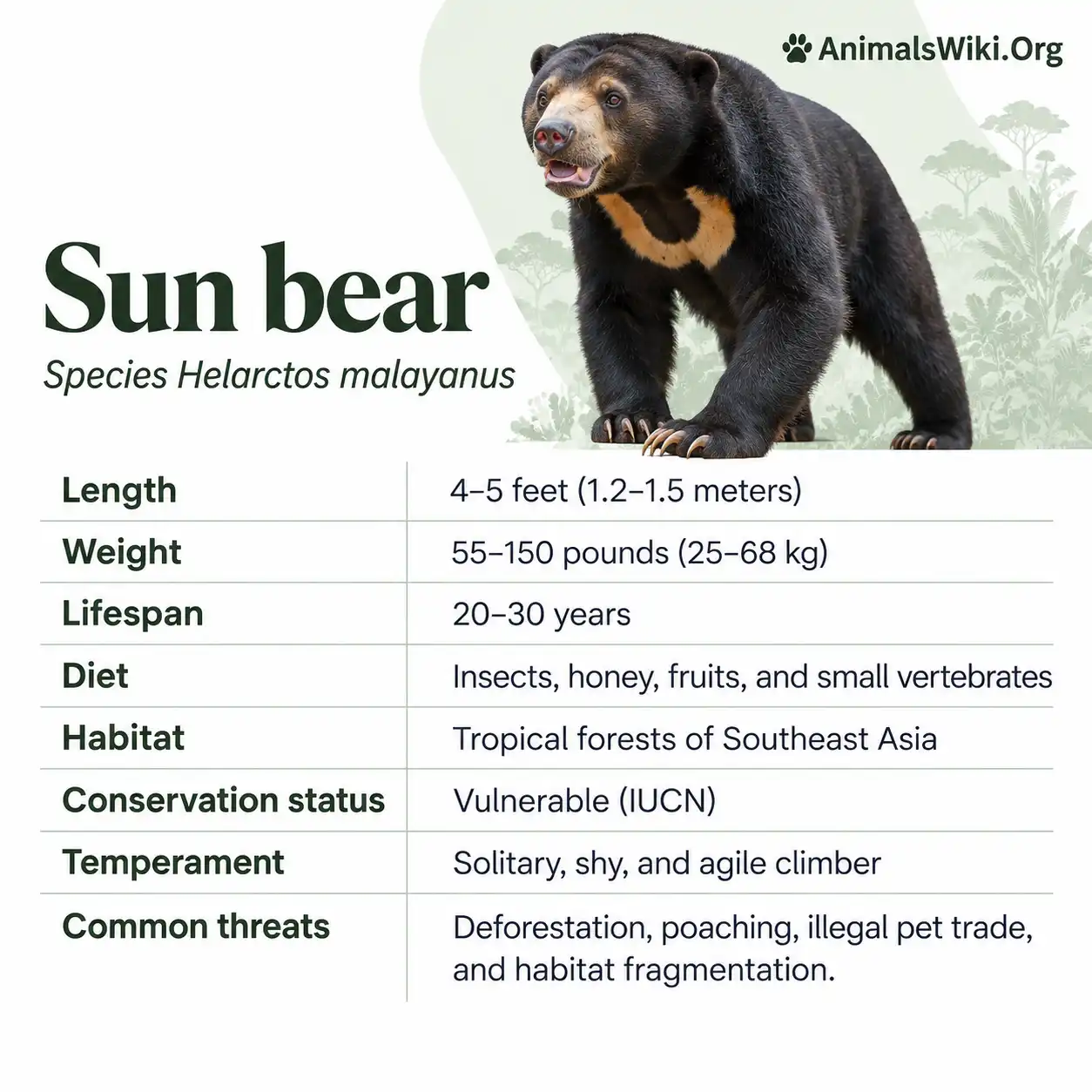
Sun Bear, The Smallest Bear of Southeast Asia’s Tropical Forests
The sun bear is the smallest living bear species and one of the most distinctive mammals of Southeast Asia’s tropical forests.
Its scientific name is:
Helarctos malayanus
and it is instantly recognizable by the pale, often crescent-shaped patch on its chest.
This marking can appear:
- Yellow
- Cream
- Pale orange
- Whitish
against an otherwise dark coat.
The marking is traditionally compared with the:
rising sun
which helped give the species its common name.
But the chest patch is only one of the sun bear’s remarkable features.
Sun bears also possess:
- An exceptionally long tongue
- Powerful curved claws
- Strong forelimbs
- Large paws
- Loose skin
- Short black fur
- Excellent climbing ability
- Strong sense of smell
These adaptations help the bear survive in tropical forests where food may be found:
above the ground, beneath the ground, and inside trees.
A sun bear can rip open decaying wood to reach insects.
It can dig into soil.
It can climb trees searching for fruit.
And it can use its remarkably long tongue to obtain:
- Honey
- Insects
- Larvae
from narrow cavities.
This feeding behavior has given the sun bear another famous name:
honey bear.
Yet sun bears are not simply honey specialists.
They are opportunistic:
omnivores.
Their diet can include:
- Fruits
- Figs
- Insects
- Termites
- Ants
- Beetle larvae
- Honey
- Small vertebrates
- Eggs
- Other available foods
Because they consume large quantities of fruit and insects, sun bears can influence tropical forest ecosystems through:
- Seed dispersal
- Insect predation
- Digging
- Breaking open dead wood
- Creating cavities
Despite being the smallest bear, the sun bear is powerful.
Its long claws and muscular forelimbs allow it to:
climb exceptionally well.
Sun bears can rest and feed high in trees, sometimes constructing or using branch platforms.
Their arboreal ability distinguishes them from the stereotypical image of a heavy bear spending nearly all its time on the ground.
Sun bears also differ from northern bears in another important way:
they do not normally need a long winter hibernation.
Their tropical habitats remain productive throughout the year, although food availability still changes seasonally.
Unfortunately, these forests are disappearing.
Sun bears face serious threats from:
- Deforestation
- Agricultural expansion
- Forest fragmentation
- Illegal hunting
- Wildlife trafficking
- Human-bear conflict
- Demand for bear body parts
Some sun bears have also suffered in the bear bile trade and illegal pet trade.
Cubs may be captured after their mothers are killed.
A young sun bear can appear small and manageable, but it grows into a strong wild carnivore with complex physical and behavioral needs.
It is not a suitable pet.
Today, protecting sun bears requires more than protecting individual animals.
It requires protecting the tropical forests on which they depend.
This comprehensive guide explores Sun Bear facts, scientific classification, appearance, chest markings, size, weight, long tongue, claws, climbing, Southeast Asian distribution, rainforest habitat, diet, honey feeding, behavior, reproduction, cubs, lifespan, adaptations, predators, hibernation, danger to humans, bile farming, illegal wildlife trade, conservation, and why the Sun Bear is the smallest bear species in the world.
Sun Bear Facts
| Feature | Information |
|---|---|
| Common Name | Sun Bear |
| Scientific Name | Helarctos malayanus |
| Animal Type | Mammal |
| Family | Ursidae |
| Order | Carnivora |
| Native Region | Southeast Asia |
| Habitat | Tropical and subtropical forests |
| Diet | Omnivorous |
| Famous Foods | Fruit, insects and honey |
| Body Length | Roughly 1–1.5 m |
| Shoulder Height | Roughly 60–70 cm |
| Weight | Approximately 25–65+ kg |
| Famous Distinction | Smallest living bear |
| Coat | Short, dark black to brown-black |
| Chest | Pale yellow/orange/cream patch |
| Tongue | Exceptionally long |
| Claws | Long and strongly curved |
| Climbing Ability | Excellent |
| Hibernation | Generally does not hibernate |
| Young | Cub |
| Typical Litter | Usually 1–2 cubs |
| Major Threats | Habitat loss and illegal hunting/trade |
| Conservation | Threatened and declining in many areas |
What Is a Sun Bear?
The sun bear is a small tropical bear native to Southeast Asia.
Its scientific name is:
Helarctos malayanus.
It belongs to the family:
Ursidae
which includes all living bears.
Why Is It Called a Sun Bear?
The name comes from the pale patch on its chest.
This marking is often shaped somewhat like:
- A crescent
- Horseshoe
- U
- Irregular semicircle
and is traditionally compared with the:
rising sun.
What Is Another Name for the Sun Bear?
Sun bears are sometimes called:
honey bears
because of their ability to locate and consume honey.
In parts of their range, various local names are also used.
Scientific Classification of the Sun Bear
| Classification | Name |
|---|---|
| Kingdom | Animalia |
| Phylum | Chordata |
| Class | Mammalia |
| Order | Carnivora |
| Family | Ursidae |
| Genus | Helarctos |
| Species | Helarctos malayanus |
Is a Sun Bear a Real Bear?
Yes.
Despite its small size and unusual appearance, the sun bear is a genuine member of the bear family.
It is related to:
- Brown bears
- Polar bears
- American black bears
- Asian black bears
- Sloth bears
- Spectacled bears
- Giant pandas
Is the Sun Bear the Smallest Bear?
Yes.
The sun bear is generally recognized as the:
smallest living bear species.
It is dramatically smaller than the largest brown bears and polar bears.
What Does a Sun Bear Look Like?
A sun bear has:
- Compact body
- Short black coat
- Pale chest patch
- Small rounded ears
- Broad head
- Short muzzle
- Powerful forelegs
- Long curved claws
- Large paws
Its body appears relatively sleek compared with heavily furred northern bears.
Sun Bear Fur
Sun bears possess relatively:
short, sleek fur.
This is appropriate for life in hot, humid tropical forests.
A thick polar-bear-like coat would be unnecessary and potentially disadvantageous.
Sun Bear Chest Patch
The chest marking is one of the species’ most recognizable features.
It may be:
- Cream
- Yellow
- Orange-yellow
- Pale
and varies in:
- Shape
- Size
- Symmetry
between individuals.
Does Every Sun Bear Have the Same Chest Mark?
No.
Chest patterns differ.
The markings can help researchers distinguish individual animals in photographs.
Sun Bear Face
The face may appear lighter around:
- Muzzle
- Eyes
- Forehead
depending on the individual.
Its relatively short muzzle gives it a different facial profile from some other bear species.
How Big Is a Sun Bear?
Adults are generally around:
1–1.5 meters long.
At the shoulder they stand roughly:
60–70 centimeters high.
This makes them surprisingly compact for a bear.
How Much Does a Sun Bear Weigh?
Weight varies according to:
- Sex
- Age
- Geography
- Nutrition
- Individual condition
Adults commonly fall somewhere around:
25–65 kilograms, with some large males potentially exceeding this range.
Male vs. Female Sun Bear
Males are generally:
larger and heavier
than females.
However, both sexes retain the species’ characteristic:
- Dark coat
- Chest patch
- Long claws
- Compact body
How Tall Is a Sun Bear Standing Up?
A sun bear standing upright can appear much taller than its normal shoulder height.
However, bears do not normally walk long distances upright like humans.
Standing may be used to:
- Investigate
- Smell
- Observe
- Defend
- Reach objects
Sun Bear Tongue
One of the most famous sun bear adaptations is its:
extremely long tongue.
The tongue can extend approximately:
20–25 centimeters
in some descriptions.
Why Does the Sun Bear Have Such a Long Tongue?
The tongue allows the bear to reach into narrow spaces containing:
- Honey
- Bees
- Termites
- Ants
- Insect larvae
This works particularly well after the bear has opened wood using its claws and teeth.
Does a Sun Bear Eat Honey?
Yes.
Sun bears are famous for eating honey.
But honey represents only:
one part of a diverse diet.
Why Is the Sun Bear Called a Honey Bear?
Because it:
- Searches for bee nests
- Breaks open cavities
- Consumes honey
- Uses its long tongue to reach inside
However, calling it a honey bear should not imply that honey is its only or even always its main food.
Sun Bear Claws
Sun bears have:
long, curved claws.
These claws are useful for:
- Climbing
- Digging
- Opening logs
- Tearing bark
- Accessing insect colonies
- Defense
Are Sun Bears Good Climbers?
Yes.
They are among the most arboreal of bears.
Their:
- Powerful forelimbs
- Large paws
- Curved claws
- Relatively small body size
make them excellent climbers.
Why Do Sun Bears Climb Trees?
They climb to:
- Find fruit
- Search for honey
- Eat insects
- Rest
- Escape danger
- Explore feeding sites
Do Sun Bears Sleep in Trees?
They can rest in trees and may create or use platforms of branches.
However, not every sun bear spends every resting period above ground.
Can Sun Bears Climb Better Than Other Bears?
Several bear species are capable climbers, especially when young.
But the sun bear is particularly well adapted for arboreal activity.
Where Do Sun Bears Live?
Sun bears are native to:
Southeast Asia.
Their distribution has historically included parts of:
- Myanmar
- Thailand
- Laos
- Cambodia
- Vietnam
- Malaysia
- Indonesia
- Brunei
and nearby parts of mainland Southeast Asia.
Their modern distribution is fragmented in many places.
Do Sun Bears Live in India?
Sun bear range has historically approached parts of northeastern South Asia, but their principal modern distribution is Southeast Asian.
They should not be confused with the:
sloth bear, which is widespread in India.
Do Sun Bears Live in China?
Their historical northern range reached parts of southern China, although modern distribution there is extremely restricted or uncertain.
Do Sun Bears Live in Malaysia?
Yes.
Malaysia is an important part of the species’ range.
The scientific species name:
malayanus
reflects the region historically associated with the bear.
Do Sun Bears Live in Indonesia?
Yes.
They occur in parts of Indonesia, particularly on:
- Sumatra
- Borneo
Do Sun Bears Live in Borneo?
Yes.
Borneo supports an important sun bear population.
Sun Bear Habitat
Sun bears primarily inhabit:
tropical forests.
Habitats can include:
- Lowland rainforest
- Evergreen forest
- Montane forest
- Peat swamp forest
- Logged forest
- Secondary forest
Their ability to use modified forest does not mean they can thrive without adequate habitat.
Do Sun Bears Live in Rainforests?
Yes.
Tropical rainforest is one of their characteristic habitats.
Do Sun Bears Live in Caves?
They are not specialized cave-dwelling bears.
They may use sheltered areas, but trees and forest cover are central to their ecology.
Are Sun Bears Nocturnal?
Sun bear activity patterns are flexible.
Depending on:
- Habitat
- Food
- Human disturbance
they may be active during:
- Day
- Night
- Twilight
In areas with heavy human pressure, they may become more nocturnal.
What Do Sun Bears Eat?
Sun bears are:
omnivores.
Their diet can include:
- Fruits
- Figs
- Seeds
- Insects
- Termites
- Ants
- Beetle larvae
- Honey
- Bees
- Eggs
- Small vertebrates
- Other available foods
What Is a Sun Bear’s Favorite Food?
There is no single universal favorite.
Food choice changes according to availability.
However, they are particularly famous for:
fruit, insects and honey.
Do Sun Bears Eat Termites?
Yes.
Termites can be an important source of animal protein.
The bear may:
- Tear open termite-infested wood.
- Expose the colony.
- Use its tongue and mouth to collect insects.
Do Sun Bears Eat Ants?
Yes.
Do Sun Bears Eat Bees?
They may consume:
- Honey
- Bee larvae
- Adult insects
while raiding nests.
Do Sun Bears Get Stung by Bees?
They can be exposed to stings while raiding nests.
Their fur and tough skin provide some protection, but they are not magically immune to bee stings.
Do Sun Bears Eat Fruit?
Yes.
Fruit can make up a major part of the diet when abundant.
Do Sun Bears Eat Figs?
Yes.
Figs are important forest foods for many Southeast Asian mammals, including sun bears.
Do Sun Bears Eat Meat?
Yes, occasionally.
They may consume:
- Small vertebrates
- Carrion
- Eggs
- Invertebrates
But they are not specialized large-prey hunters like big cats.
Do Sun Bears Hunt Deer?
Large ungulates are not their normal primary prey.
Their diet is much more strongly associated with:
- Fruit
- Insects
- Honey
- Small animal foods
How Do Sun Bears Find Food?
Their powerful sense of smell helps locate:
- Fruit
- Insect colonies
- Honey
- Carrion
- Other foods
Once food is located, their:
claws + teeth + tongue
form an effective feeding toolkit.
Do Sun Bears Have a Good Sense of Smell?
Yes.
Like other bears, they rely heavily on:
olfaction.
Their sense of smell is far more important than humans’ for navigating the environment and locating food.
Sun Bear Behavior
Sun bears are generally:
- Solitary
- Forest-dwelling
- Strong climbers
- Curious
- Opportunistic feeders
Adult males and females normally spend much of their time independently outside reproductive interactions.
Do Sun Bears Live in Groups?
Usually no.
They are primarily solitary.
The most obvious social unit is:
a mother with her cub or cubs.
Are Sun Bears Territorial?
Individuals use home ranges that may overlap.
Their spatial behavior varies according to:
- Sex
- Habitat quality
- Food availability
- Population density
Do Sun Bears Hibernate?
Generally:
no.
Sun bears live in tropical environments where severe winter food shortages do not occur in the same way as in northern temperate regions.
Why Don’t Sun Bears Hibernate?
Hibernation is an adaptation that helps some bears survive:
- Cold winters
- Food shortages
- Snow-covered landscapes
Tropical Southeast Asia does not experience this type of prolonged winter.
Do Sun Bears Make Sounds?
Yes.
Sun bears can produce:
- Grunts
- Snorts
- Roars
- Growls
- Other vocalizations
Cubs and mothers also communicate acoustically.
Are Sun Bears Intelligent?
Yes.
Bears generally possess strong:
- Memory
- Learning ability
- Problem-solving skills
- Environmental awareness
Sun bears need to remember changing forest food resources across large areas.
Sun Bear Reproduction
Sun bears reproduce slowly compared with many smaller mammals.
Females invest heavily in a small number of offspring.
How Long Is a Sun Bear Pregnant?
Reported gestation is roughly:
three months or somewhat longer, although reproductive timing can vary and implantation biology complicates comparisons among bears.
How Many Cubs Does a Sun Bear Have?
A female usually gives birth to:
one or two cubs.
Larger litters are uncommon.
What Is a Baby Sun Bear Called?
A baby is called a:
cub.
What Does a Sun Bear Cub Look Like?
Newborn cubs are:
- Very small
- Vulnerable
- Poorly developed
- Dependent on their mother
They gradually develop:
- Dark fur
- Chest marking
- Strong claws
- Climbing ability
Do Sun Bear Mothers Care for Cubs?
Yes.
Maternal care is extensive.
The mother provides:
- Milk
- Protection
- Warmth
- Guidance
- Opportunities to learn foraging skills
Do Male Sun Bears Raise Cubs?
Males generally do not participate significantly in raising offspring.
How Long Do Cubs Stay With Their Mother?
Young sun bears remain with their mothers long enough to learn important survival skills.
They need to develop:
- Climbing
- Foraging
- Food recognition
- Predator awareness
before becoming independent.
Sun Bear Lifespan
Exact maximum lifespan in the wild is difficult to establish.
Under managed conditions, sun bears can live:
more than 20 years
and some individuals have survived into their 20s or beyond.
Wild lifespan may be shortened by:
- Hunting
- Habitat loss
- Conflict
- Injury
- Disease
Sun Bear Adaptations
Long Tongue
Reaches honey and insects inside narrow cavities.
Curved Claws
Support climbing, digging and tearing wood.
Powerful Forelimbs
Help open logs and climb trees.
Short Coat
Suitable for a hot tropical climate.
Large Paws
Improve climbing and manipulation.
Strong Sense of Smell
Locates scattered food resources.
Loose Skin
Can provide some protection and flexibility during fights or predator encounters.
Compact Body
Makes movement through dense forest and trees easier.
Omnivorous Diet
Allows the bear to exploit many seasonal foods.
Why Does the Sun Bear Have Loose Skin?
Loose skin can provide flexibility.
If another animal grabs the bear, some skin mobility may help it:
- Twist
- Turn
- Defend itself
However, claims that loose skin makes sun bears effectively impossible for predators to hold are exaggerated.
What Predators Eat Sun Bears?
Adult sun bears have relatively few natural predators because they are:
- Strong
- Armed with claws
- Capable climbers
Potential predators can include large carnivores such as:
- Tigers
- Leopards
- Clouded leopards
Young cubs are more vulnerable.
Can Tigers Kill Sun Bears?
Yes.
Where their ranges overlap, a tiger is powerful enough to kill a sun bear.
However, predation is not the main modern cause of sun bear decline.
Can Pythons Eat Sun Bears?
Very large pythons could potentially threaten small cubs or young individuals.
Healthy adult bears are much more difficult prey.
Are Sun Bears Dangerous to Humans?
Potentially:
yes.
A sun bear is small compared with a polar bear, but it remains a powerful wild carnivore.
It possesses:
- Long claws
- Strong jaws
- Powerful muscles
A frightened, trapped, injured or defensive bear can seriously injure a person.
Do Sun Bears Attack Humans?
Attacks are possible but humans are not normal prey.
Risk increases when a bear is:
- Cornered
- Surprised
- Defending cubs
- Injured
- Habituated to human food
Are Sun Bears Aggressive?
It is misleading to label the entire species aggressive.
Like most wild bears, they generally prefer avoiding dangerous encounters when escape is available.
Can a Sun Bear Kill a Human?
A sun bear is physically capable of causing severe or potentially fatal injuries.
Its small size compared with other bears should never be mistaken for harmlessness.
Can You Keep a Sun Bear as a Pet?
No.
Sun bears are:
- Wild
- Powerful
- Conservation-sensitive
- Behaviorally complex
They require forest-scale environmental complexity that a household cannot provide.
Sun Bears and the Illegal Pet Trade
Cubs are sometimes captured for illegal sale.
This can involve killing the mother first.
As cubs grow, their:
- Strength
- Claws
- Teeth
- Behavioral needs
make them extremely difficult and dangerous to keep.
Sun Bear Bile Farming
One of the most disturbing threats affecting bears in Asia is demand for:
bear bile.
Bile contains compounds used in some traditional medicinal products.
Sun bears have been captured and kept under poor conditions for bile extraction.
What Is Bear Bile?
Bile is a digestive fluid produced by the:
liver
and stored in the:
gallbladder.
It helps digest fats.
Why Is Bear Bile Collected?
Bear bile has historically been used in some traditional medicine practices.
However, synthetic and non-bear alternatives to its principal bile acid compounds exist.
Are Sun Bears Killed for Body Parts?
Yes.
Illegal wildlife trade can involve:
- Gallbladders
- Paws
- Other body parts
- Live cubs
This adds pressure to populations already affected by forest loss.
Deforestation and Sun Bears
Habitat destruction is one of the species’ greatest long-term threats.
Forests are cleared or degraded for:
- Agriculture
- Plantations
- Logging
- Roads
- Settlements
- Infrastructure
Palm Oil and Sun Bears
Conversion of tropical forest to large agricultural plantations, including oil-palm landscapes, can remove or fragment sun bear habitat.
The conservation issue is primarily:
how and where agricultural expansion occurs.
Protecting high-value forests and improving land-use practices are important for sun bears and many other Southeast Asian species.
Forest Fragmentation
Even when some forest remains, roads and plantations can divide it into isolated patches.
Fragmentation can:
- Restrict movement
- Reduce food
- Increase human contact
- Increase hunting access
- Isolate populations
Human-Sun Bear Conflict
When natural food becomes scarce or forests are fragmented, bears may enter:
- Farms
- Plantations
- Orchards
- Villages
This can lead to retaliation.
Reducing conflict requires both:
bear protection and practical support for local communities.
Why Are Sun Bears Important to Forests?
Sun bears can influence forest ecology in several ways.
Seed Dispersal
Fruit-eating bears can transport seeds.
Insect Control
They consume large quantities of social insects and larvae.
Deadwood Excavation
Tearing open logs changes microhabitats.
Cavity Creation
Digging and feeding activities can create openings later used by:
- Insects
- Small mammals
- Reptiles
- Other organisms
They can therefore function partly as:
ecosystem engineers.
Sun Bear vs. Sloth Bear
These species are frequently confused.
| Feature | Sun Bear | Sloth Bear |
|---|---|---|
| Scientific Name | Helarctos malayanus | Melursus ursinus |
| Main Range | Southeast Asia | Indian subcontinent |
| Size | Smallest bear | Larger |
| Fur | Short | Long and shaggy |
| Chest Mark | Pale crescent/patch | Usually pale V/U mark |
| Tongue | Very long | Highly specialized for insects |
| Climbing | Excellent | Capable, especially young |
| Famous Food | Fruit, insects, honey | Termites and ants |
Sun Bear vs. Asian Black Bear
| Feature | Sun Bear | Asian Black Bear |
|---|---|---|
| Size | Smaller | Larger |
| Coat | Short | Longer |
| Ears | Small | Relatively large |
| Chest Mark | Yellow/orange crescent | Usually white V-shaped patch |
| Climate | Mostly tropical | Tropical to temperate |
| Hibernation | Usually no | Some populations den |
Sun Bear vs. Black Bear
The American black bear and sun bear are completely different species.
American black bears live in:
North America.
Sun bears live in:
Southeast Asia.
Sun Bear vs. Polar Bear
| Feature | Sun Bear | Polar Bear |
|---|---|---|
| Habitat | Tropical forest | Arctic sea ice/coasts |
| Size | Smallest bear | Largest bear contender |
| Fur | Short and dark | Dense and pale |
| Diet | Omnivorous | Strongly carnivorous |
| Climbing | Excellent | Adults not arboreal |
| Hibernation | Generally no | Pregnant females den |
They represent almost opposite extremes of bear adaptation.
Is a Sun Bear Smaller Than a Panda?
Yes.
Adult giant pandas are considerably heavier than sun bears.
Is a Sun Bear Smaller Than an American Black Bear?
Yes.
Sun bears are significantly smaller on average.
Is a Sun Bear Smaller Than a Sloth Bear?
Yes.
Why Is the Sun Bear So Small?
Its body size evolved under tropical forest conditions where:
- Arboreal feeding is important
- Food is distributed in complex ways
- Large seasonal fat reserves for winter are unnecessary
Smaller size can also assist climbing.
Are Sun Bears Endangered?
Sun bears face serious conservation pressures and are internationally recognized as a threatened species.
Their populations have declined because of:
- Forest loss
- Hunting
- Trade
- Fragmentation
How Many Sun Bears Are Left?
There is:
no reliable exact global population count.
Their forest habitat and secretive behavior make large-scale censuses difficult.
It is better to describe their population as:
declining and poorly quantified
rather than inventing a precise worldwide number.
Why Are Sun Bears Difficult to Count?
They are:
- Solitary
- Forest-dwelling
- Often secretive
- Widely dispersed
- Sometimes nocturnal
Dense tropical vegetation makes direct observation difficult.
Researchers therefore use techniques such as:
- Camera traps
- Sign surveys
- Genetic sampling
- Occupancy models
- Field observations
Sun Bear Conservation
Important conservation actions include:
- Protecting tropical forests
- Preventing poaching
- Combating wildlife trafficking
- Reducing bear bile exploitation
- Maintaining habitat corridors
- Improving land-use planning
- Reducing human-bear conflict
- Supporting local communities
- Rehabilitating rescued bears
Sun Bear Rehabilitation
Rescue centers care for bears confiscated from:
- Illegal pet ownership
- Wildlife trafficking
- Captivity
- Exploitative facilities
Rehabilitation may involve:
- Veterinary treatment
- Natural climbing opportunities
- Foraging enrichment
- Social assessment
- Behavioral recovery
Not every rescued bear can safely return to the wild.
Why Saving Sun Bears Matters
Protecting sun bears also helps protect:
Southeast Asian tropical forests.
Those forests support enormous biodiversity, including:
- Orangutans
- Gibbons
- Hornbills
- Clouded leopards
- Elephants
- Tigers
- Countless insects and plants
Saving the sun bear therefore contributes to protecting an entire ecosystem.
50 Interesting Sun Bear Facts
- The sun bear is a real bear.
- Its scientific name is Helarctos malayanus.
- It lives in Southeast Asia.
- It is the smallest living bear species.
- Adults can weigh only a few dozen kilograms.
- Males are generally larger than females.
- Sun bears have short dark fur.
- They have a pale chest patch.
- The chest marking differs between individuals.
- The marking inspired the name sun bear.
- Sun bears are also called honey bears.
- They eat honey.
- Honey is not their only food.
- They are omnivores.
- They eat fruit.
- They eat figs.
- They eat termites.
- They eat ants.
- They eat beetle larvae.
- They may eat small vertebrates.
- Their tongues are exceptionally long.
- The tongue helps extract insects and honey.
- Sun bears have powerful claws.
- Their claws are strongly curved.
- They are excellent climbers.
- They frequently forage in trees.
- They can rest above the ground.
- They have a powerful sense of smell.
- They are mostly solitary.
- Mothers live with their cubs.
- Females usually have one or two cubs.
- A baby sun bear is called a cub.
- Sun bears generally do not hibernate.
- They live in tropical climates.
- Their short coat helps prevent overheating.
- They can be active during day or night.
- Human disturbance can influence their activity schedule.
- Tigers can potentially prey on sun bears.
- Humans are a much greater modern threat.
- Habitat loss is a major conservation problem.
- Forest fragmentation increases conflict.
- Sun bears are illegally hunted.
- Some are captured for the pet trade.
- Some have been exploited for bear bile.
- Cubs may be orphaned when mothers are killed.
- Sun bears help disperse seeds.
- Their digging alters forest microhabitats.
- Exact global population size is unknown.
- Protecting sun bears protects tropical forest habitat.
- The world’s smallest bear is one of its best tree climbers.
Did You Know?
A sun bear’s feeding equipment is almost like a built-in forest tool kit.
Imagine a sun bear moving through a Southeast Asian rainforest.
It stops beside an old tree.
To a human, nothing seems unusual.
But the bear smells something.
There are insects hidden:
inside the wood.
First come the claws.
The bear hooks its long curved claws into the tree.
Its powerful forelimbs pull.
Bark tears away.
Wood breaks.
Now a narrow cavity is exposed.
But the food is still too deep for the bear’s mouth.
So the next tool appears:
the tongue.
The sun bear extends an extraordinarily long tongue into the cavity.
Ants, termites, larvae, honey or other edible material can be collected from spaces its muzzle could never reach.
Later, the same bear may climb high into a fruiting tree.
The claws that tore apart wood now become:
climbing hooks.
The forelimbs pull the bear upward.
The relatively small body moves among branches.
Fruit becomes dinner.
Then the bear descends and walks through the forest.
In a single night or day, the same animal can:
- Dig soil
- Tear open logs
- Raid insect colonies
- Climb trees
- Eat fruit
- Search for honey
This versatility helps explain why the sun bear has survived in tropical forests containing constantly changing food resources.
It does not depend on one meal.
Its body is designed to:
search, climb, dig, tear, lick and explore.
The world’s smallest bear may lack the enormous mass of a grizzly or polar bear.
But in a tropical forest, it does not need it.
Its greatest advantages are:
mobility and versatility.
Frequently Asked Questions About Sun Bears
What is a sun bear?
A sun bear is a small tropical bear native to Southeast Asia.
What is the scientific name of the sun bear?
Helarctos malayanus.
Is a sun bear a real bear?
Yes.
Is the sun bear the smallest bear?
Yes. It is generally recognized as the smallest living bear species.
Why is it called a sun bear?
Because of the pale crescent or sun-like marking on its chest.
What is another name for the sun bear?
Honey bear.
Why is it called a honey bear?
Because it readily eats honey and raids bee nests.
Where do sun bears live?
Southeast Asia.
Do sun bears live in Malaysia?
Yes.
Do sun bears live in Indonesia?
Yes.
Do sun bears live in Borneo?
Yes.
Do sun bears live in Sumatra?
Yes.
Do sun bears live in Thailand?
Yes, although populations are threatened and fragmented.
Do sun bears live in Cambodia?
Yes.
Do sun bears live in Vietnam?
They historically occur in the region, though populations have suffered severe pressure.
Do sun bears live in rainforests?
Yes.
Do sun bears live in the jungle?
They inhabit tropical forest environments often popularly described as jungle.
Do sun bears live in trees?
They spend substantial time climbing and foraging in trees but also use the ground.
Can sun bears climb trees?
Yes, extremely well.
Why are sun bears good climbers?
Their curved claws, strong limbs and relatively small body provide excellent climbing ability.
Do sun bears sleep in trees?
They can rest on branches and tree platforms.
How big is a sun bear?
Roughly 1–1.5 meters long.
How tall is a sun bear?
Approximately 60–70 cm at the shoulder.
How much does a sun bear weigh?
Commonly around 25–65 kg, with individual variation.
Are male sun bears bigger?
Yes, males are generally larger.
What color is a sun bear?
Usually black or dark brown-black.
What is the yellow mark on a sun bear?
It is a naturally occurring chest patch characteristic of the species.
Does every sun bear have the same chest mark?
No. Patterns vary.
Why does a sun bear have short fur?
Short fur is well suited to a hot, humid tropical environment.
Why does a sun bear have a long tongue?
To extract insects and honey from narrow cavities.
How long is a sun bear’s tongue?
It is commonly described as extending roughly 20–25 cm.
What do sun bears eat?
Fruit, insects, honey, seeds, eggs and other available foods.
Are sun bears carnivores?
Taxonomically they belong to Carnivora, but ecologically they are omnivores.
Are sun bears omnivores?
Yes.
Do sun bears eat fruit?
Yes.
Do sun bears eat honey?
Yes.
Do sun bears eat bees?
They can consume bees and bee larvae while raiding nests.
Do sun bears eat termites?
Yes.
Do sun bears eat ants?
Yes.
Do sun bears eat meat?
They can consume animal foods but are not specialized large-prey hunters.
Do sun bears hunt humans?
No. Humans are not their normal prey.
Do sun bears have good eyesight?
Their senses are suited to forest life, but smell is particularly important.
Do sun bears have a good sense of smell?
Yes.
Are sun bears nocturnal?
They can be active at night, but activity varies according to habitat and disturbance.
Are sun bears active during the day?
Yes, in suitable conditions.
Do sun bears hibernate?
Generally no.
Why don’t sun bears hibernate?
Their tropical habitat does not experience the severe winter conditions that trigger hibernation or denning in some northern bears.
Are sun bears solitary?
Mostly.
Do sun bears live in packs?
No.
Do sun bears live in families?
Mothers live with dependent cubs, but adults are otherwise largely solitary.
How many babies do sun bears have?
Usually one or two.
What is a baby sun bear called?
A cub.
Are sun bear cubs born small?
Yes. Like other bears, newborn cubs are very small and dependent.
Do sun bear mothers protect their cubs?
Yes.
Do male sun bears raise cubs?
Generally no.
How long do sun bears live?
They can survive for more than 20 years under managed conditions.
What predators eat sun bears?
Potential predators include tigers and other large carnivores, particularly for younger bears.
Do tigers eat sun bears?
Tigers are capable of killing them where ranges overlap.
Can leopards kill sun bears?
Large leopards could potentially threaten young or smaller individuals.
Are sun bears dangerous?
They can be dangerous when threatened.
Do sun bears attack people?
Attacks can occur, especially if an animal is cornered, surprised or defending itself.
Can a sun bear kill a person?
It is physically capable of causing severe or potentially fatal injuries.
Are sun bears aggressive?
They should not be stereotyped as naturally aggressive; defensive behavior is more relevant.
Can sun bears be pets?
No.
Why can’t sun bears be pets?
They are powerful wild animals with complex ecological, behavioral and welfare needs.
Are sun bears endangered?
They are a threatened species experiencing significant population decline and habitat loss.
How many sun bears are left?
There is no reliable exact worldwide count.
Why are sun bears declining?
Major causes include habitat loss, hunting, wildlife trafficking and human-bear conflict.
Are sun bears hunted?
Yes.
Why are sun bears hunted?
They may be targeted for body parts, bile, food or the illegal wildlife trade.
What is sun bear bile farming?
It refers to keeping bears for extraction of bile from the gallbladder or biliary system for commercial use.
Are sun bears used in traditional medicine?
Bear bile and other body parts have historically been used in some traditional medicine markets.
Are sun bear cubs sold as pets?
Illegal trafficking of cubs occurs.
Does palm oil affect sun bears?
Conversion of tropical forests to agricultural plantations can destroy and fragment their habitat.
Are sun bears important to forests?
Yes.
Do sun bears spread seeds?
Fruit-eating sun bears can contribute to seed dispersal.
Are sun bears ecosystem engineers?
Their digging and breaking of wood can create or modify microhabitats used by other organisms.
Is a sun bear smaller than a sloth bear?
Yes.
Is a sun bear smaller than a panda?
Yes.
Is a sun bear smaller than an American black bear?
Yes.
Is a sun bear related to the sloth bear?
Yes. Both belong to the bear family, but they are different genera and species.
How can you tell a sun bear from a sloth bear?
Sun bears are smaller with short fur and compact bodies; sloth bears have longer shaggy coats and a different overall appearance.
Is a sun bear a black bear?
No. It is a separate species.
Is a sun bear related to polar bears?
Yes, as fellow members of Ursidae, but they represent very different bear lineages and ecological adaptations.
Can sun bears swim?
Bears are generally capable swimmers, and sun bears can enter and cross water, although swimming is not their defining adaptation.
Can sun bears stand on two legs?
Yes, temporarily.
Do sun bears walk on two legs?
They normally walk on four limbs.
Why do sun bears sometimes look human when standing?
Their relatively loose skin, body proportions and upright posture can appear surprisingly human-like in photographs, but their anatomy is entirely normal for a bear.
Are sun bears intelligent?
Yes. They display learning, memory and problem-solving abilities.
What makes the sun bear unique?
Its combination of tiny bear size, tropical forest lifestyle, exceptional climbing ability, long tongue, curved claws and distinctive chest marking makes it unique.
What is the most interesting sun bear fact?
The world’s smallest bear is an excellent tree climber equipped with long claws and an extraordinarily long tongue that helps it extract insects and honey from inside trees.
Conclusion
The sun bear proves that being a successful bear does not require being:
enormous.
A polar bear survives partly through massive size, thick insulation and the ability to hunt across an Arctic environment.
A grizzly can dominate landscapes through extraordinary strength.
The sun bear evolved for a completely different world.
Its world is:
a tropical forest.
Here, food may be hidden inside a rotten log.
It may be buried beneath soil.
It may be hanging high above the ground.
It may be inside a bee nest.
Or it may appear briefly when a particular tree produces fruit.
To survive in that world, the sun bear became:
versatile.
Its claws dig.
Its claws climb.
Its forelimbs break wood.
Its nose finds hidden food.
Its tongue reaches into narrow cavities.
Its teeth process a wide range of meals.
And its relatively small body can move through a forest in ways that would be more difficult for a giant bear.
The result is the:
smallest living bear species.
But small does not mean weak.
A sun bear remains a powerful wild carnivore capable of defending itself with formidable claws and jaws.
Its greatest modern enemy, however, is not a tiger.
It is the transformation of its habitat.
When tropical forest becomes:
- Roads
- Farms
- Plantations
- Settlements
- Fragmented patches
the bear loses more than trees.
It loses feeding sites.
It loses climbing habitat.
It loses shelter.
It loses safe routes between populations.
And when hunting and wildlife trafficking are added to habitat loss, recovery becomes increasingly difficult.
Protecting sun bears therefore requires protecting:
forests.
And protecting those forests benefits far more than one bear.
It protects countless species sharing the same ecosystem.
The sun bear may be the smallest bear on Earth.
But its conservation represents something much larger:
the future of Southeast Asia’s tropical forests.



