Blobfish, The Misunderstood Deep-Sea Fish of the Southwest Pacific
The blobfish is one of the most famous—and most misunderstood—deep-sea animals in the world.
Its scientific name is:
Psychrolutes marcidus
and it is associated with the deep waters of the:
Southwest Pacific Ocean.
The blobfish became an internet celebrity because of photographs showing an animal with:
- A drooping face
- Bulbous nose
- Soft pinkish body
- Downturned mouth
- Gelatinous appearance
Those photographs helped earn it an unofficial reputation as:
“the world’s ugliest animal.”
But there is a major problem with that image.
The famous blobfish does not normally look exactly like that at the bottom of the ocean.
Blobfish live hundreds of meters beneath the surface, where the surrounding water pressure is dramatically greater than atmospheric pressure at sea level.
When a deep-sea fish is rapidly brought to the surface, the enormous reduction in pressure can severely distort its body.
Its soft tissues can:
- Expand
- Sag
- Deform
- Lose their natural proportions
Therefore, the famous “sad blob” represents a blobfish affected by the journey from its deep-sea environment to the surface.
In its natural habitat, the animal looks considerably more like:
a normal, soft-bodied bottom-dwelling fish.
This does not mean a living deep-water blobfish looks sleek like a tuna.
It is still a soft-bodied fish adapted to cold, dark, high-pressure environments.
But the exaggerated gelatinous face familiar from memes is not a fair representation of its normal underwater appearance.
The blobfish’s strange biology makes sense once its environment is understood.
Deep beneath the ocean surface:
- Sunlight is absent or extremely weak.
- Water is cold.
- Pressure is enormous.
- Food can be unpredictable.
- Conserving energy is extremely important.
Unlike many active fishes, blobfish do not depend on powerful swimming muscles for constant movement.
Their bodies are relatively soft and low-density.
They spend much of their lives close to the seafloor, where they can obtain small animals and edible material without wasting large amounts of energy chasing fast prey.
The blobfish therefore is not a badly designed fish.
It is almost the opposite.
It is an animal specialized for a world so different from ours that removing it from that world makes its anatomy appear abnormal.
This comprehensive guide explores Blobfish facts, scientific classification, appearance, size, weight, deep-sea habitat, depth, pressure adaptations, diet, feeding, swimming, reproduction, eggs, lifespan, predators, gelatinous body, lack of a conventional swim bladder, threats, conservation, and why Blobfish look so different when brought to the surface.
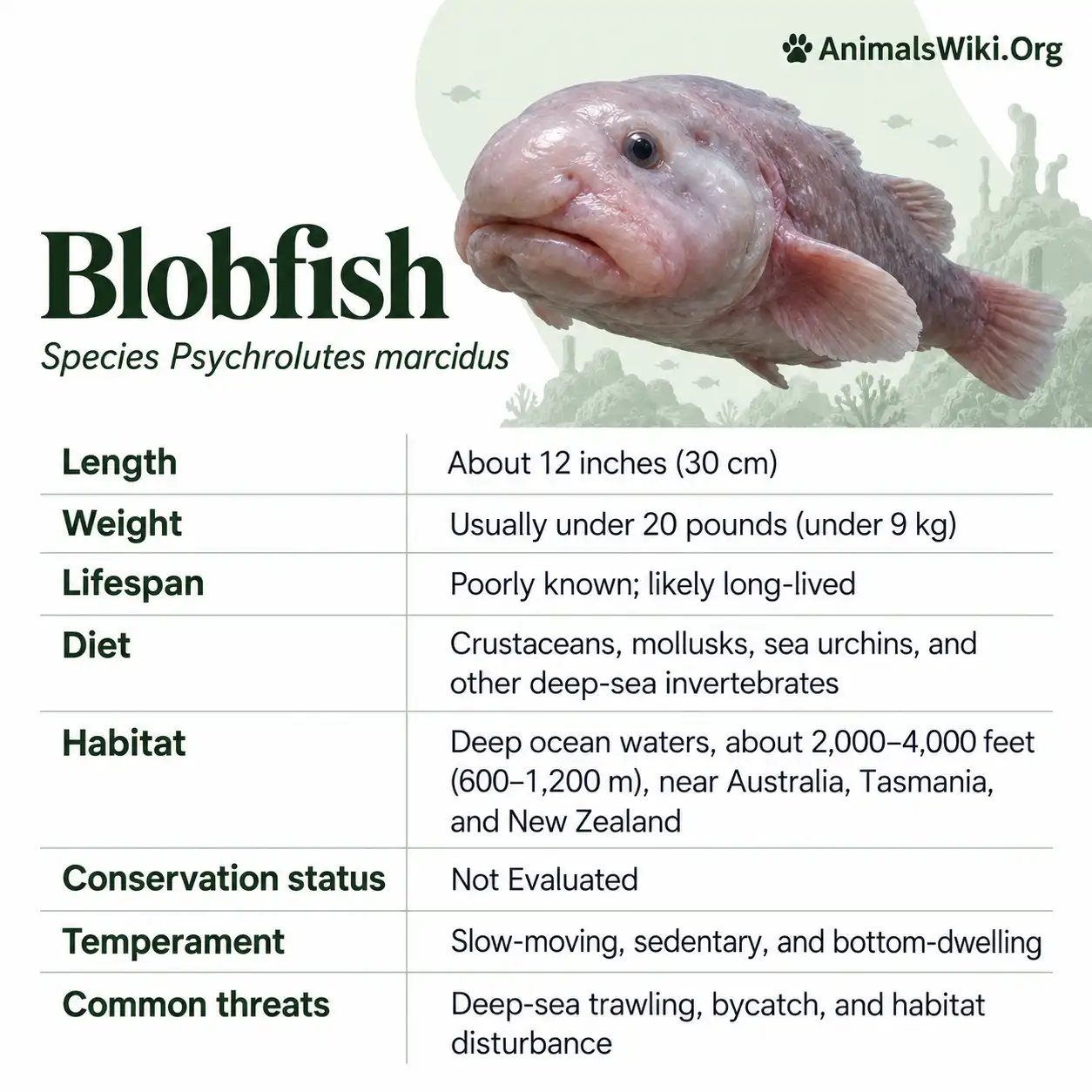
Blobfish Facts
| Feature | Information |
|---|---|
| Common Name | Blobfish |
| Scientific Name | Psychrolutes marcidus |
| Animal Type | Fish |
| Family | Psychrolutidae |
| Group | Sculpin relatives |
| Habitat | Deep marine waters near the seafloor |
| Region | Southwest Pacific |
| Famous Locations | Waters around Australia and nearby regions |
| Typical Depth | Hundreds of meters below the surface |
| Body Length | Often around 30 cm, with variation |
| Body Type | Soft-bodied |
| Diet | Small benthic animals and other available food |
| Feeding Style | Energy-efficient opportunistic feeding |
| Activity | Relatively slow-moving |
| Famous Trait | “Blob-like” surface appearance |
| Natural Appearance | More compact and fish-like under deep-sea pressure |
| Swim Bladder | Lacks the typical gas-filled system used by many shallow-water fishes |
| Reproduction | Egg-laying |
| Major Human Threat | Accidental capture in deep-water fishing gear |
| Danger to Humans | Essentially harmless |
What Is a Blobfish?
A blobfish is a deep-sea fish belonging to the family:
Psychrolutidae.
The species most famously associated with the name is:
Psychrolutes marcidus.
Blobfish belong to a broader group of fishes related to:
sculpins.
Is Blobfish One Species?
The name “blobfish” can be used somewhat broadly for several related soft-bodied deep-sea fishes.
However, the famous species seen in widely circulated photographs is generally identified as:
Psychrolutes marcidus.
This distinction is important because not every fish casually called a blobfish is necessarily the same species.
Scientific Classification of the Blobfish
| Classification | Name |
|---|---|
| Kingdom | Animalia |
| Phylum | Chordata |
| Class | Actinopterygii |
| Order | Perciformes / sculpin-related classification depending on taxonomic treatment |
| Family | Psychrolutidae |
| Genus | Psychrolutes |
| Species | Psychrolutes marcidus |
Taxonomic ranks above the family level can vary between modern classification systems, so the most useful stable identifiers are:
Psychrolutidae → Psychrolutes → Psychrolutes marcidus.
What Does a Blobfish Really Look Like?
In its natural deep-sea environment, the blobfish looks much more like a conventional fish than famous surface photographs suggest.
It has:
- Large head
- Broad body
- Tapering rear body
- Soft tissues
- Large mouth
- Eyes positioned on the head
- Fins
- Loose skin
Its natural appearance is still unusual, but it is not normally the dramatically collapsed “sad face” seen in the most famous image.
Why Does the Blobfish Look Like a Blob?
The answer is:
pressure change.
Blobfish are adapted to the intense pressure of deep water.
When one is hauled rapidly upward, external pressure decreases enormously.
The fish’s delicate tissues are no longer supported by the environmental conditions under which they normally function.
As a result, the body can become:
- Distorted
- Swollen
- Loose
- Droopy
The famous appearance is therefore strongly influenced by:
decompression and tissue damage.
Does a Blobfish Look Ugly Underwater?
“Ugly” is subjective.
A living blobfish in its natural environment appears more compact and recognizably fish-like.
It does not normally have the same exaggerated sagging face seen in decompressed specimens.
Is the Famous Blobfish Photo Real?
Yes.
The famous photograph depicts a real animal.
But it does not represent how a healthy blobfish normally appears in its deep-sea habitat.
That distinction is essential.
Why Is the Blobfish Pink?
Specimens brought to the surface can appear:
- Pink
- Pale
- Grayish
- Beige
Color can be affected by:
- Species
- Lighting
- Tissue condition
- Preservation
- Decompression
Deep-sea animals do not need the same bright visual camouflage patterns seen in shallow, sunlit environments.
Does the Blobfish Have Bones?
Yes.
Blobfish are vertebrates and possess an internal skeleton.
The idea that they are simply boneless lumps of jelly is incorrect.
Does the Blobfish Have Muscles?
Yes.
But its musculature is not developed for continuous high-speed swimming like that of:
- Tuna
- Mackerel
- Marlin
Blobfish are adapted to a much more energy-efficient deep-sea lifestyle.
Is the Blobfish Made of Jelly?
No.
The description “gelatinous” refers to the unusually soft, low-density nature of its tissues.
It is still a real vertebrate fish with:
- Bones
- Muscles
- Internal organs
- Gills
- Fins
- Nervous system
How Big Is a Blobfish?
The famous blobfish species is often described as reaching roughly:
around 30 centimeters in length, sometimes somewhat larger depending on the specimen.
That is approximately:
12 inches.
How Much Does a Blobfish Weigh?
Reliable species-wide weight data are limited.
Body mass varies with:
- Length
- Sex
- Individual condition
- Species identification
It is better not to assign an overly precise universal weight when robust measurements are limited.
Where Do Blobfish Live?
Blobfish are associated with deep waters of the:
Southwest Pacific Ocean.
They are particularly known from waters around:
- Southeastern Australia
- Tasmania
- Nearby deep-ocean regions
Related psychrolutid fishes occur elsewhere.
How Deep Do Blobfish Live?
Blobfish inhabit depths of roughly:
600–1,200 meters
in many commonly cited descriptions of their habitat.
That is approximately:
2,000–3,900 feet below the surface.
Depth ranges vary according to species and records.
Do Blobfish Live on the Ocean Floor?
They are:
demersal or benthic-associated fishes.
This means they live on or near the seafloor rather than spending their lives near the ocean surface.
Does Sunlight Reach Blobfish?
At the depths where blobfish occur, sunlight is:
extremely weak or absent.
Below roughly 1,000 meters, the ocean is essentially permanently dark apart from biological light sources.
Is the Blobfish a Deep-Sea Fish?
Yes.
It is a genuine deep-water fish adapted to:
- Darkness
- Cold
- High pressure
- Limited food availability
What Is Water Pressure Like Where Blobfish Live?
Pressure increases by approximately:
one atmosphere for every 10 meters of seawater.
At 1,000 meters depth, an animal experiences roughly:
100 times the atmospheric pressure experienced at sea level.
Deep-sea organisms have evolved cellular and anatomical adaptations allowing them to function under these conditions.
Would Deep-Sea Pressure Crush a Blobfish?
No.
A blobfish is adapted to the pressure.
Its internal tissues exist in pressure equilibrium with the surrounding environment.
The problem occurs when an organism adapted to deep pressure is:
rapidly transported toward the surface.
Would a Human Survive at Blobfish Depth?
An unprotected human could not survive.
The environment involves:
- Enormous pressure
- Darkness
- Cold temperatures
- No breathable air
Specialized deep-sea submersibles are required for humans to visit such depths safely.
How Is the Blobfish Adapted to High Pressure?
Its adaptations include:
- Soft tissues
- Reduced reliance on gas-filled spaces
- Low-density body structure
- Relatively energy-efficient lifestyle
- Deep-sea-adapted physiology
These traits allow survival where conventional shallow-water anatomy can become problematic.
Does the Blobfish Have a Swim Bladder?
Blobfish lack the conventional gas-filled swim bladder used by many shallower-water fishes.
This is important.
At great depth, maintaining a large gas-filled organ is difficult because gases are strongly compressed by pressure.
What Is a Swim Bladder?
A swim bladder is a gas-filled organ that helps many fishes control:
buoyancy.
By adjusting the amount of gas, a fish can change its position in the water without constantly swimming.
Deep-sea fishes often use different strategies.
How Does a Blobfish Float Without a Swim Bladder?
Its soft body has a density relatively close to that of seawater.
This reduces the amount of muscular effort needed to remain near the seafloor.
It does not need to constantly swim like a highly active pelagic fish.
Can Blobfish Swim?
Yes.
Blobfish have fins and can move through the water.
However, they are not built for:
high-speed pursuit.
Their lifestyle emphasizes energy conservation.
How Fast Can a Blobfish Swim?
A reliable maximum swimming speed for Psychrolutes marcidus has not been well established.
Claims assigning a precise speed should therefore be treated cautiously.
It is clearly not specialized as a fast-swimming predator.
Are Blobfish Lazy?
“Lazy” is not scientifically appropriate.
Their low-energy lifestyle is an:
adaptation.
In the deep sea, food can be scarce.
Wasting energy on unnecessary movement could reduce survival.
What Do Blobfish Eat?
Blobfish are thought to consume small animals and organic material available near the seafloor.
Possible foods include:
- Small crustaceans
- Mollusks
- Other benthic invertebrates
- Small edible organisms
Detailed dietary information for wild Psychrolutes marcidus remains limited.
Is the Blobfish a Carnivore?
It is primarily considered a:
carnivorous or opportunistic benthic feeder.
Does the Blobfish Hunt?
Not in the manner of a shark or tuna.
It is generally thought to consume prey that becomes available within reach rather than engaging in long high-speed pursuits.
Does a Blobfish Have Teeth?
Blobfish have a mouth capable of taking animal prey, but they are not famous for large, threatening teeth.
Their feeding system is suited to relatively small prey.
How Does a Blobfish Find Food in Darkness?
Deep-sea fishes use combinations of:
- Smell
- Touch
- Mechanosensory systems
- Vision where useful
- Opportunistic encounters
The precise sensory ecology of Psychrolutes marcidus has not been studied as extensively as that of many shallow-water fishes.
Do Blobfish Have Eyes?
Yes.
They possess functional eyes.
Can Blobfish See?
Yes, although their visual environment is extremely dark.
Their senses are adapted to conditions very different from bright surface waters.
Does a Blobfish Have a Nose?
The famous “nose” in surface photographs is not a human-style nose.
Fish primarily breathe through:
gills.
Their chemical sensing structures differ from mammalian noses.
How Do Blobfish Breathe?
Blobfish breathe using:
gills.
Water passes over the gills, allowing dissolved oxygen to enter the bloodstream.
Can Blobfish Breathe Air?
No.
They are aquatic fishes and depend on extracting oxygen from water.
Blobfish Behavior
Very little direct behavioral information is available because blobfish live at depths that are difficult and expensive for humans to observe.
They are generally believed to be:
- Slow-moving
- Bottom-associated
- Energy-efficient
- Opportunistic feeders
Scientists should be careful not to invent detailed social behavior that has never been adequately observed.
Are Blobfish Solitary?
Their social organization is not sufficiently understood to confidently describe a complex social system.
They are not known for forming enormous schools.
Do Blobfish Sleep?
Fish can enter reduced-activity resting states, but detailed sleep behavior specifically in blobfish is poorly documented.
Do Blobfish Make Sounds?
There is no strong evidence that Psychrolutes marcidus possesses a famous or elaborate sound-based communication system.
Blobfish Reproduction
The reproductive biology of blobfish remains less well studied than that of many familiar fish.
They reproduce by:
laying eggs.
Some psychrolutid fishes show parental care associated with egg masses.
Do Blobfish Lay Eggs?
Yes.
Blobfish reproduce through eggs rather than giving birth to mammal-like live young.
Where Do Blobfish Lay Eggs?
Eggs are associated with the seafloor.
Females may lay groups of eggs in suitable benthic areas.
Do Blobfish Guard Their Eggs?
Observations of related deep-sea psychrolutid fishes indicate that adults can remain near egg masses, suggesting:
parental guarding behavior.
However, behavior documented in related species should not automatically be attributed in every detail to Psychrolutes marcidus without direct evidence.
How Many Eggs Does a Blobfish Lay?
Exact clutch size for Psychrolutes marcidus is not well established enough to confidently provide one universal number.
Large egg masses have been observed among related deep-sea fishes, but online claims about exact blobfish egg numbers often mix information from different species.
What Is a Baby Blobfish Called?
A young fish can be called:
- Larva during early development
- Juvenile after later development
“Baby blobfish” is an informal term.
What Does a Baby Blobfish Look Like?
Detailed development of Psychrolutes marcidus is not widely documented.
Young individuals would gradually develop the characteristic anatomy of the adult as they mature.
How Long Does a Blobfish Live?
The exact lifespan of Psychrolutes marcidus is:
not well established.
Some deep-sea fishes are long-lived because of:
- Cold temperatures
- Slow metabolism
- Slow growth
But it would be misleading to turn that general pattern into a precise blobfish lifespan without adequate evidence.
Can Blobfish Live 100 Years?
There is no solid basis for confidently claiming that Psychrolutes marcidus routinely lives 100 years.
Its maximum lifespan remains poorly known.
Blobfish Adaptations
Soft Body
Reduces dependence on dense, energetically expensive musculature.
Low-Density Tissues
Help the fish maintain position without constant swimming.
Reduced Gas Spaces
Useful under extreme deep-sea pressure.
Energy-Efficient Lifestyle
Conserves calories where food can be scarce.
Bottom-Dwelling Behavior
Allows exploitation of benthic prey.
Large Head and Mouth
Help capture available food.
Deep-Sea Physiology
Allows cells and proteins to function under high pressure.
Why Doesn’t a Blobfish Need Strong Muscles?
It does not chase prey across long distances at high speed.
Deep-sea energy economics favor:
efficiency rather than athletic performance.
Maintaining large amounts of active muscle requires energy.
A slower lifestyle can therefore be advantageous.
What Predators Eat Blobfish?
Specific predators of Psychrolutes marcidus are poorly documented.
Potential deep-sea predators could include:
- Larger fishes
- Sharks
- Other predatory marine animals
But exact predator-prey relationships should not be overstated.
Are Blobfish Dangerous to Humans?
No.
Blobfish pose essentially:
no danger to humans.
They:
- Live far below normal swimming depths
- Are not aggressive toward humans
- Lack dangerous venom
- Are not large predators
Are Blobfish Poisonous?
No evidence suggests that blobfish are poisonous to touch in the way certain toxic animals are.
Are Blobfish Venomous?
No.
They do not possess a known venom-delivery system.
Can a Blobfish Bite a Human?
A blobfish is not considered a meaningful biting hazard to humans.
Encounters with living wild individuals are extraordinarily unlikely because of their depth.
Can You Eat Blobfish?
Blobfish are not a normal commercial food fish.
They may be caught accidentally as bycatch, but they are not a typical target species for human consumption.
Why Are Blobfish Caught?
They can be accidentally captured by:
deep-water bottom fishing gear.
Fishing vessels targeting commercially valuable deep-sea species may unintentionally bring blobfish to the surface.
What Is Bycatch?
Bycatch refers to animals unintentionally captured while fishermen are targeting:
other species.
A blobfish may therefore be caught even though nobody intended to catch it.
Can a Blobfish Survive Being Brought to the Surface?
Rapid ascent can cause severe physiological and physical damage to deep-sea organisms.
A blobfish brought up from hundreds of meters may be badly affected by:
decompression.
Returning such a damaged animal to the ocean surface does not necessarily mean it can simply swim back down unharmed.
Why Does Decompression Damage Deep-Sea Animals?
As external pressure falls:
- Gases expand
- Tissue relationships change
- Internal structures can be disrupted
- Soft tissues may deform
Different deep-sea species respond differently depending on anatomy.
Is the Blobfish Endangered?
The conservation situation is less certain than many viral articles imply.
The blobfish is often casually described online as:
endangered
but reliable population information for Psychrolutes marcidus is limited.
It is therefore safer to say that its exact population trend and conservation situation are:
not well quantified.
How Many Blobfish Are Left?
Nobody has a reliable exact global count.
Claims such as:
“only 420 blobfish remain”
should not be repeated without strong scientific evidence.
Deep-sea population surveys are extremely difficult.
Why Is It Hard to Count Blobfish?
Their habitat is:
- Deep
- Dark
- Remote
- Expensive to survey
- Difficult to observe directly
Scientists cannot simply perform ordinary visual counts like they might with large terrestrial animals.
What Threats Do Blobfish Face?
Potential threats include:
- Deep-sea fishing
- Accidental bycatch
- Seafloor disturbance
- Broader changes to deep-ocean ecosystems
However, the magnitude of these pressures on Psychrolutes marcidus specifically is not known with high precision.
Does Bottom Trawling Threaten Blobfish?
It can potentially affect blobfish through:
- Accidental capture
- Disturbance of benthic habitat
Deep-water bottom trawling is therefore a plausible conservation concern for bottom-associated fishes.
Are Blobfish Extinct?
No.
Blobfish are not extinct.
Are Blobfish Rare?
They are rarely encountered by humans, but:
rarely seen does not automatically mean biologically rare.
Because they live in inaccessible deep water, even a reasonably distributed species may seldom be observed.
The World’s Ugliest Animal
The blobfish became globally famous after being associated with the title:
“world’s ugliest animal.”
The title was connected to a public campaign by the Ugly Animal Preservation Society.
But scientifically, “ugliness” has no biological meaning.
The fish’s appearance is the product of:
- Evolution
- Habitat
- Pressure
- Anatomy
Furthermore, the most famous image shows an animal outside the environmental conditions for which its body evolved.
The Famous Blobfish “Mr Blobby”
One particular specimen became the iconic image associated with blobfish.
The specimen is popularly known as:
Mr Blobby.
It was collected during a scientific expedition off Australia in the early 2000s.
Its unusual decompressed appearance became internationally famous.
Why Is Mr Blobby Important?
Mr Blobby helped transform an obscure deep-sea fish into:
- An internet meme
- A conservation mascot
- A popular science subject
- A symbol of unusual animals
Ironically, the world’s most famous blobfish became famous for an appearance it would not naturally display at depth.
Blobfish vs. Normal Fish
| Feature | Blobfish | Typical Active Shallow-Water Fish |
|---|---|---|
| Habitat | Deep sea | Often shallow/open water |
| Pressure | Extremely high | Much lower |
| Body | Very soft | Often firmer/more muscular |
| Swim Bladder | Conventional gas bladder absent | Often present |
| Swimming | Slow/energy-efficient | Often more active |
| Surface Appearance | Can become distorted | Usually remains recognizable |
| Human Encounters | Very rare | Often common |
Blobfish vs. Pufferfish
They are completely different.
Pufferfish:
- Inflate defensively
- Often inhabit shallower waters
- Belong to different families
- May contain potent toxins
Blobfish:
- Do not deliberately inflate
- Live at great depth
- Become distorted through decompression
- Are not famous for tetrodotoxin
Blobfish vs. Anglerfish
Both can inhabit the deep sea, but they are very different.
Anglerfish often possess:
- Large teeth
- Specialized predatory adaptations
- In some species, a bioluminescent lure
Blobfish are:
- Soft-bodied
- Bottom-associated
- Relatively passive feeders
- Not known for luminous fishing lures
Blobfish vs. Jellyfish
Despite its gelatinous reputation, a blobfish is not related to a jellyfish.
Blobfish are:
vertebrate fishes.
Jellyfish are:
invertebrate cnidarians.
Blobfish vs. Octopus
A blobfish is a vertebrate fish with:
- Backbone
- Fins
- Gills
An octopus is a mollusk with:
- Eight arms
- No backbone
- Highly different anatomy
Why Is the Blobfish Important?
Blobfish represent the extraordinary adaptations required for life in the:
deep sea.
They also remind us that animals should be understood within the environmental conditions in which they evolved.
Judging a deep-sea fish from a decompressed surface specimen is like judging a terrestrial animal after exposing it to an environment its body was never designed to tolerate.
50 Interesting Blobfish Facts
- Blobfish are real fish.
- The famous species is Psychrolutes marcidus.
- It belongs to the family Psychrolutidae.
- Blobfish are related to sculpin-like fishes.
- They live in the deep sea.
- They are associated with the Southwest Pacific.
- They are especially known from waters near Australia.
- They also occur around Tasmania.
- They live hundreds of meters underwater.
- Some records occur around 600–1,200 meters deep.
- Water pressure at those depths is enormous.
- Blobfish are adapted to high pressure.
- Their bodies are unusually soft.
- They possess bones.
- They possess muscles.
- They are not literally blobs of jelly.
- They have fins.
- They can swim.
- They are not fast swimmers.
- Their lifestyle conserves energy.
- They live near the seafloor.
- They eat small marine animals.
- Small crustaceans may form part of their diet.
- They breathe through gills.
- They cannot breathe air.
- They have eyes.
- They live in extremely dark environments.
- They lack a typical gas-filled swim bladder.
- Their low-density body helps with buoyancy.
- Their famous surface appearance is misleading.
- Decompression can distort their bodies.
- A healthy deep-water blobfish looks more fish-like.
- They do not intentionally turn into blobs.
- The famous “nose” is exaggerated after decompression.
- Blobfish lay eggs.
- Some related psychrolutids guard egg masses.
- Exact blobfish lifespan is poorly known.
- Exact wild population size is unknown.
- There is no reliable global blobfish census.
- Claims of an exact tiny remaining population should be treated skeptically.
- Deep-water fishing can accidentally catch blobfish.
- Accidental capture is called bycatch.
- Rapid ascent can badly damage deep-sea fishes.
- Blobfish are harmless to humans.
- They are not venomous.
- They are not known as poisonous fish.
- One famous specimen is called Mr Blobby.
- Blobfish became an internet meme.
- They were famously labeled the world’s ugliest animal.
- Their bizarre reputation mostly comes from seeing them outside their natural environment.
Did You Know?
The world’s most famous blobfish photograph is essentially a picture of a deep-sea animal in the wrong physical environment.
Imagine a blobfish resting near the ocean floor.
Above it are hundreds of meters of seawater.
That water weighs an enormous amount.
At around 1,000 meters deep, pressure is roughly:
100 times atmospheric pressure at sea level.
But the blobfish does not feel as though something is crushing it.
Its body evolved there.
Its cells work there.
Its soft tissues function there.
Its anatomy makes sense there.
Now imagine a fishing net catches the animal.
The net rises.
At 800 meters, pressure has already fallen.
At 500 meters, it falls further.
At 100 meters, the environment is dramatically different.
Then the fish reaches the surface.
The pressure surrounding its body has dropped enormously.
The soft tissues that functioned under deep-ocean conditions are now outside their normal physical environment.
The body distorts.
The head sags.
The skin becomes loose.
The face appears swollen.
And suddenly:
the internet’s blobfish appears.
A photograph is taken.
Millions of people see it.
They laugh at the “world’s ugliest fish.”
But imagine reversing the situation.
Take a surface animal and instantly transport it into an environment where the pressure is around one hundred times greater.
It would not look or function normally either.
The blobfish is therefore not an evolutionary failure.
It is:
a deep-sea specialist.
Its soft body reduces the energetic cost of movement.
Its lack of a conventional gas-filled swim bladder makes sense under enormous pressure.
Its slow lifestyle helps conserve calories where food can be unpredictable.
What looks strange at the surface can be perfectly useful at depth.
The blobfish’s greatest lesson may therefore have little to do with ugliness.
It teaches us something much more interesting:
an animal’s body only makes complete sense when you understand the world it evolved to live in.
Frequently Asked Questions About Blobfish
What is a blobfish?
A blobfish is a soft-bodied deep-sea fish belonging to the family Psychrolutidae.
What is the scientific name of the blobfish?
The famous species is Psychrolutes marcidus.
Is a blobfish actually a fish?
Yes.
Is a blobfish a mammal?
No.
Is a blobfish an invertebrate?
No. It is a vertebrate.
Does a blobfish have a backbone?
Yes.
Does a blobfish have bones?
Yes.
Is a blobfish made of jelly?
No. Its tissues are unusually soft, but it is a complete vertebrate fish.
Why is it called a blobfish?
The name reflects the gelatinous, blob-like appearance of specimens brought to the surface.
Where do blobfish live?
In deep marine waters, particularly in the Southwest Pacific.
Do blobfish live near Australia?
Yes.
Do blobfish live near Tasmania?
Yes, they are particularly associated with deep waters around the region.
Do blobfish live in the Atlantic Ocean?
The famous Psychrolutes marcidus is associated with the Southwest Pacific, although related psychrolutid fishes occur in other regions.
Do blobfish live on the seafloor?
They live on or close to the bottom.
How deep do blobfish live?
Often hundreds of meters deep, with roughly 600–1,200 meters commonly cited for the famous species.
Is it dark where blobfish live?
Yes.
Is it cold where blobfish live?
Yes. Deep ocean water is generally cold.
How much pressure does a blobfish experience?
At around 1,000 meters, pressure is roughly 100 atmospheres.
Why doesn’t pressure crush a blobfish?
Its body is adapted to high pressure and contains relatively few problematic gas-filled spaces.
Why does a blobfish look weird?
Its famous appearance is strongly exaggerated by decompression after being brought to the surface.
What does a real blobfish look like underwater?
More compact, structured and recognizably fish-like than the famous drooping surface specimen.
Does a blobfish naturally have a huge nose?
Not in the exaggerated form familiar from viral surface photographs.
Is the famous blobfish picture fake?
No. It shows a real fish, but one affected by removal from its natural high-pressure environment.
Is Mr Blobby real?
Yes. Mr Blobby is the nickname given to the famous preserved blobfish specimen.
Why does Mr Blobby look so strange?
Because the animal was brought from deep water to the low-pressure surface environment.
Is the blobfish the ugliest animal in the world?
That is a humorous human judgment, not a scientific classification.
Who called the blobfish the world’s ugliest animal?
The blobfish became associated with the title through a public campaign by the Ugly Animal Preservation Society.
What does a blobfish eat?
Small bottom-dwelling animals such as crustaceans and other available invertebrates.
Is a blobfish a carnivore?
It is generally considered a carnivorous or opportunistic feeder.
Does a blobfish hunt?
It likely feeds opportunistically rather than chasing prey at high speed.
Does a blobfish have teeth?
It has feeding structures suitable for taking small prey but is not known for enormous predatory teeth.
Can a blobfish swim?
Yes.
Is a blobfish a good swimmer?
It is adapted for slow, energy-efficient movement rather than speed.
How fast can a blobfish swim?
No dependable species-specific maximum speed is well established.
Why is a blobfish so slow?
Energy conservation is valuable in the food-limited deep sea.
Does a blobfish have a swim bladder?
It lacks the conventional gas-filled swim bladder common in many shallower-water fishes.
How does a blobfish float?
Its soft, relatively low-density tissues help reduce the energy required to maintain position.
Can a blobfish float to the surface?
Its normal lifestyle is associated with deep benthic waters, not surface floating.
How does a blobfish breathe?
Through gills.
Can blobfish breathe air?
No.
Do blobfish have eyes?
Yes.
Can blobfish see in the dark?
Their eyes function in a very low-light environment, although detailed visual biology is not extensively studied.
Do blobfish glow?
Psychrolutes marcidus is not known for famous bioluminescent organs like those of many other deep-sea animals.
Are blobfish blind?
No evidence supports describing them simply as blind.
Do blobfish sleep?
Detailed resting behavior is poorly studied.
Are blobfish social?
Their social system is not well understood.
Do blobfish live in schools?
They are not known for forming large schools.
Do blobfish lay eggs?
Yes.
How many eggs do blobfish lay?
A reliable universal clutch size for Psychrolutes marcidus is not well established.
Do blobfish guard eggs?
Parental guarding has been observed in related psychrolutid fishes, but species-specific details should be treated cautiously.
What is a baby blobfish called?
Young stages can be called larvae and later juveniles.
What does a baby blobfish look like?
Detailed developmental information for the famous species is limited.
How long do blobfish live?
Their exact lifespan is not well established.
Do blobfish live 100 years?
There is insufficient evidence to state that as a normal lifespan.
What eats blobfish?
Specific natural predators are poorly documented, though larger deep-sea predators may consume them.
Do sharks eat blobfish?
It is possible that larger predatory fishes or sharks could consume them, but specific predator relationships are not well documented.
Are blobfish dangerous?
No.
Can blobfish attack humans?
They pose essentially no threat to people.
Can a blobfish bite?
It is not considered a dangerous biting animal.
Is a blobfish poisonous?
It is not known as a poisonous fish.
Is a blobfish venomous?
No known venom-delivery system exists.
Can humans eat blobfish?
They are not a normal commercial food species.
Do people fish for blobfish?
They are generally not targeted commercially.
Why are blobfish caught?
They can be captured accidentally in deep-water fishing operations.
What is blobfish bycatch?
It means a blobfish is accidentally caught while fishermen are targeting other species.
Can a blobfish survive at the surface?
Rapid decompression can cause serious damage, so a deep-water blobfish is not adapted for normal life at surface pressure.
Can you put a blobfish in an aquarium?
An ordinary aquarium cannot reproduce the immense pressure of its natural habitat.
Could a special aquarium keep a blobfish alive?
In principle, specialized pressurized systems can maintain deep-sea organisms, but doing so is technologically difficult and far beyond a normal aquarium.
Are blobfish kept in zoos?
Live Psychrolutes marcidus are not ordinary public-aquarium animals because maintaining deep-sea pressure conditions is extremely challenging.
Are blobfish endangered?
Their population status is not well quantified enough to support many of the confident claims circulated online.
How many blobfish are left?
There is no reliable exact global population count.
Are there only 420 blobfish left?
There is no strong scientific basis for treating such a precise internet number as an established global population estimate.
Are blobfish extinct?
No.
Are blobfish rare?
They are rarely encountered by humans, but that alone does not establish their true abundance.
What threatens blobfish?
Potential threats include deep-water fishing, bycatch and disturbance of benthic habitat.
Does bottom trawling kill blobfish?
Deep-water trawling can accidentally capture bottom-dwelling fishes, including blobfish.
Why don’t scientists know more about blobfish?
Their habitat is deep, dark, remote and expensive to study directly.
Is a blobfish related to a jellyfish?
No.
Is a blobfish related to a pufferfish?
Not closely.
Is a blobfish an anglerfish?
No.
Is a blobfish a sculpin?
It belongs to the family Psychrolutidae within the broader sculpin-related radiation.
Why is the blobfish important?
It provides a remarkable example of how fish anatomy can become specialized for high-pressure deep-sea environments.
What is the most interesting blobfish fact?
The iconic sagging “blob” appearance is largely a consequence of seeing a deep-sea fish after it has been removed from the enormous pressure of its natural habitat.
Conclusion
The blobfish may be one of the best examples of an animal judged unfairly because humans encountered it:
in the wrong environment.
Hundreds of meters beneath the ocean surface, the rules are different.
There is little or no sunlight.
The water is cold.
Food may be scarce.
And above every animal is an enormous column of seawater producing pressure that would make the surface world seem physically alien.
The blobfish evolved there.
Its soft body is not a mistake.
Its relatively weak musculature is not a failure.
Its lack of a conventional gas-filled swim bladder is not a defect.
These features help it survive in an environment where:
saving energy can mean survival.
Then humans brought one to the surface.
The pressure disappeared.
Its delicate tissues changed shape.
Its body sagged.
Its face became distorted.
A photograph spread across the world.
And suddenly the blobfish became famous for being:
ugly.
But the deeper scientific story is much better.
The blobfish is not an animal that evolution forgot to finish.
It is an animal evolution designed for conditions most humans will never experience directly.
At depth, its anatomy makes sense.
At the surface, that anatomy becomes distorted because:
the surface is not its world.
So perhaps the most important blobfish fact is not that it looks strange.
It is that understanding an animal requires understanding:
where that animal belongs.
And the blobfish belongs far beneath the waves, in the cold, dark, high-pressure world of the deep ocean.