Cuttlefish, The Intelligent Ocean Camouflage Master With Three Hearts and W-Shaped Pupils
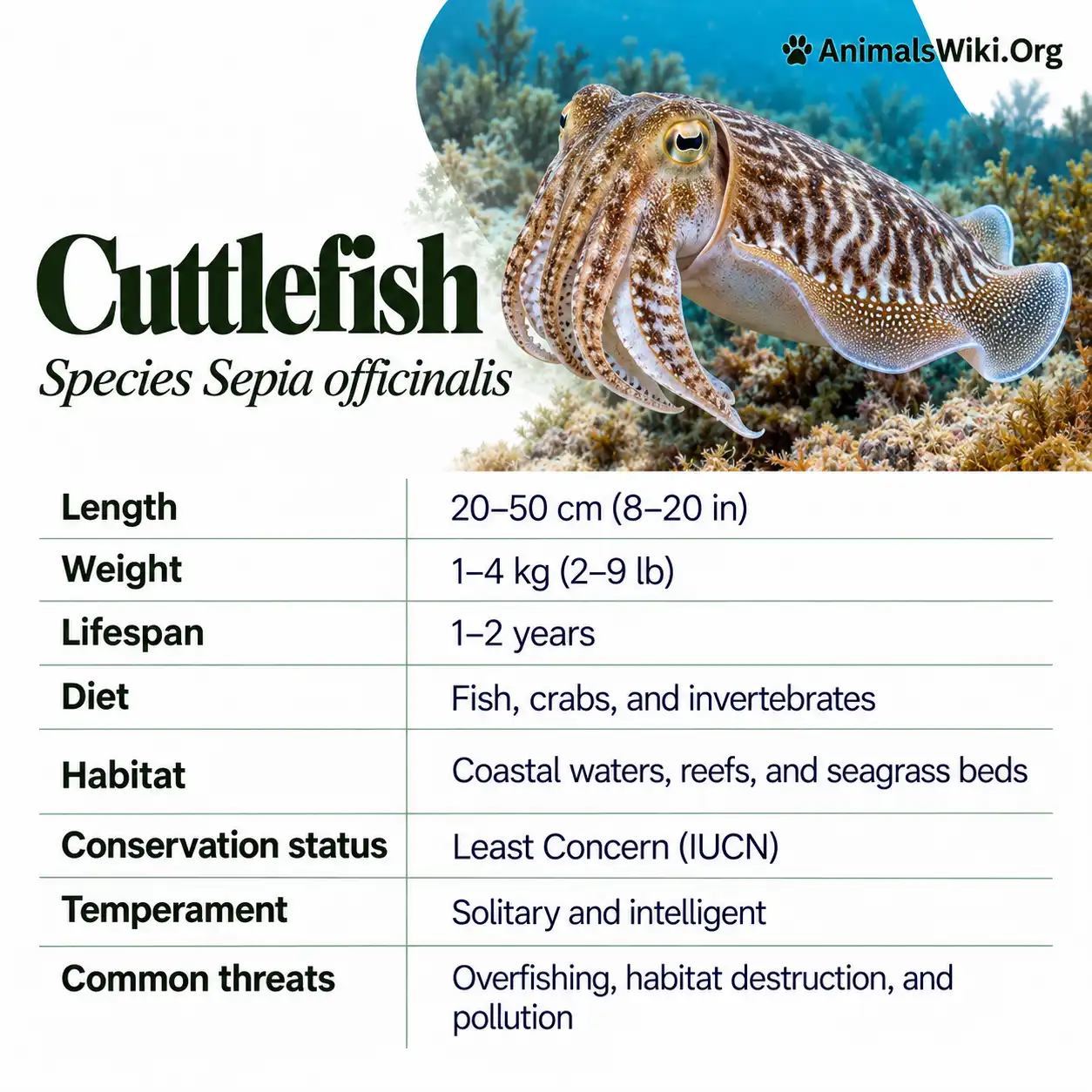
The cuttlefish is one of the most intelligent, fascinating, and visually extraordinary animals living in the ocean. Famous for its remarkable ability to change color, texture, and body patterns within seconds, this unusual marine creature is often described as one of nature’s greatest camouflage artists.
Despite its name, the cuttlefish is not a fish.
It is a marine cephalopod mollusk closely related to octopuses, squids, and nautiluses.
Cuttlefish belong to the order Sepiida, a group of soft-bodied marine invertebrates known for their sophisticated nervous systems, specialized hunting tentacles, and internal buoyancy structures called cuttlebones.
Their appearance is distinctive.
A cuttlefish has a broad, flattened body surrounded by undulating fins, eight arms, two specialized feeding tentacles, and large eyes with unusual W-shaped pupils.
These eyes help the animal detect movement, contrast, and polarized light in its underwater environment.
Cuttlefish also possess three hearts and blue, copper-based blood.
However, their most famous ability is their extraordinary camouflage.
Specialized skin cells allow cuttlefish to produce rapidly changing patterns of light and dark, while muscular structures can alter the skin’s texture.
A cuttlefish resting on a sandy seabed may appear almost invisible.
Moments later, it can display bold stripes, flashing patterns, or contrasting colors.
These visual changes are used for camouflage, communication, courtship, and interactions with rivals.
Cuttlefish are also skilled predators.
They feed on shrimp, crabs, fish, and other marine animals.
When hunting, they may approach prey slowly before launching their two specialized tentacles with remarkable speed.
Their intelligence has attracted scientific attention.
Researchers have documented learning, memory, visual discrimination, and flexible decision-making in cuttlefish.
Some studies suggest that cuttlefish can delay gratification under certain experimental conditions.
Cuttlefish are found primarily in the eastern Atlantic, Mediterranean, Indian Ocean, and western Pacific regions, with different species occupying coastal and deeper marine habitats.
This comprehensive guide explores cuttlefish facts, scientific classification, species, anatomy, size, habitat, distribution, diet, camouflage, intelligence, vision, reproduction, lifespan, predators, adaptations, conservation, and frequently asked questions.
Cuttlefish Facts
| Feature | Information |
|---|---|
| Common name | Cuttlefish |
| Scientific order | Sepiida |
| Phylum | Mollusca |
| Class | Cephalopoda |
| Order | Sepiida |
| Animal type | Marine cephalopod mollusk |
| Closest relatives | Squids, octopuses, and other cephalopods |
| Habitat | Coastal waters, sandy seabeds, seagrass areas, reefs, and deeper marine environments |
| Distribution | Mainly eastern Atlantic, Mediterranean, Indian Ocean, and western Pacific |
| Body shape | Broad, flattened mantle with lateral fins |
| Arms | Eight |
| Feeding tentacles | Two |
| Total appendages | Ten |
| Eyes | Large eyes, often with W-shaped pupils |
| Hearts | Three |
| Blood color | Blue |
| Internal shell | Cuttlebone |
| Feeding type | Carnivorous predator |
| Diet | Crustaceans, fish, and other marine animals |
| Movement | Undulating fins and jet propulsion |
| Camouflage | Rapid color, pattern, and texture changes |
| Reproduction | Sexual reproduction |
| Eggs | Attached to underwater surfaces |
| Lifespan | Commonly around one to two years; varies by species |
| Main predators | Fish, sharks, dolphins, seals, and other marine predators |
| Human danger | Generally not dangerous |
| Conservation | Varies by species and population |
What Is a Cuttlefish?
A cuttlefish is a marine cephalopod mollusk belonging to the order Sepiida.
It possesses a soft body, eight arms, two feeding tentacles, and an internal shell called a cuttlebone.
Cuttlefish are closely related to squids and octopuses.
Is a Cuttlefish a Fish?
No.
Is a Cuttlefish a Mollusk?
Yes.
Is a Cuttlefish a Cephalopod?
Yes.
Is a Cuttlefish an Invertebrate?
Yes. It has no backbone.
Is a Cuttlefish Related to an Octopus?
Yes.
Scientific Classification of Cuttlefish
| Classification | Name |
|---|---|
| Kingdom | Animalia |
| Phylum | Mollusca |
| Class | Cephalopoda |
| Subclass | Coleoidea |
| Superorder | Decapodiformes |
| Order | Sepiida |
| Example family | Sepiidae |
| Example genus | Sepia |
| Example species | Sepia officinalis |
What Does Sepiida Mean?
Sepiida is the scientific order containing true cuttlefish.
What Is the Scientific Name of a Cuttlefish?
There is no single scientific species name for all cuttlefish.
One familiar species is Sepia officinalis, the common cuttlefish.
Are Cuttlefish Related to Squids?
Yes.
Are Cuttlefish Related to Nautiluses?
Yes. Both belong to Cephalopoda.
Types and Species of Cuttlefish
There are numerous cuttlefish species with differences in size, coloration, habitat, and behavior.
1. Common Cuttlefish
Scientific name: Sepia officinalis
The common cuttlefish occurs in the eastern Atlantic and Mediterranean Sea.
It is widely studied for its camouflage, vision, learning, and reproductive behavior.
2. Broadclub Cuttlefish
Scientific name: Sepia latimanus
This large Indo-Pacific species is famous for its impressive body size and dramatic color displays.
3. Flamboyant Cuttlefish
Scientific name: Metasepia pfefferi
The flamboyant cuttlefish is known for its striking yellow, purple, red, and white patterns.
It often moves along the seabed using its arms and fins.
4. Reaper Cuttlefish
Scientific name: Sepia mestus
This species occurs in Australian waters.
5. Pharaoh Cuttlefish
Scientific name: Sepia pharaonis
This Indo-Pacific cuttlefish is commercially important in some fisheries.
6. Giant Australian Cuttlefish
Scientific name: Sepia apama
This species is famous for its large size and seasonal breeding aggregations in southern Australia.
7. Dwarf Cuttlefish
Scientific name: Sepia bandensis
This smaller Indo-Pacific species is known for its compact size and active camouflage behavior.
What Does a Cuttlefish Look Like?
Cuttlefish possess a broad body with a flattened mantle.
Their anatomy includes:
- Mantle
- Head
- Eight arms
- Two feeding tentacles
- Suckers
- Beak
- Radula
- Eyes
- Lateral fins
- Siphon
- Cuttlebone
- Ink sac
- Chromatophores
- Iridophores
- Leucophores
- Muscular skin papillae
What Is the Mantle?
The mantle is the muscular body covering that surrounds major internal organs.
What Is the Cuttlebone?
The cuttlebone is a porous internal shell that helps regulate buoyancy.
Do Cuttlefish Have Bones?
They have no vertebrate bones, but possess an internal cuttlebone.
Do Cuttlefish Have Beaks?
Yes. They have a strong, sharp beak used to process prey.
Cuttlefish Arms and Tentacles
Cuttlefish possess eight arms and two specialized feeding tentacles.
Do Cuttlefish Have Ten Arms?
They have ten appendages in total: eight arms and two tentacles.
What Are Cuttlefish Tentacles Used For?
They are used primarily to capture prey.
Do Cuttlefish Have Suckers?
Yes.
Can Cuttlefish Regenerate Arms?
Some cephalopods can regenerate damaged appendages, although recovery varies by species and injury.
Cuttlefish Size and Weight
Cuttlefish vary greatly in size.
How Big Is a Cuttlefish?
Many species have mantle lengths of approximately 10–30 centimeters, while larger species can grow substantially bigger.
What Is the Largest Cuttlefish?
The giant Australian cuttlefish, Sepia apama, is generally recognized as the largest living cuttlefish species.
How Much Does a Giant Cuttlefish Weigh?
Large individuals can weigh several kilograms, with exceptional specimens reaching around 10 kilograms or more.
Are All Cuttlefish Large?
No. Some species are relatively small.
Cuttlefish Colors
Cuttlefish can display extraordinary colors and patterns.
These include:
- Brown
- White
- Yellow
- Orange
- Red
- Purple
- Black
- Iridescent shades
Can Cuttlefish Change Color?
Yes.
How Fast Can Cuttlefish Change Color?
They can alter patterns in fractions of a second.
Why Do Cuttlefish Change Color?
For camouflage, communication, courtship, and other behavioral purposes.
How Do Cuttlefish Change Color?
Cuttlefish possess specialized skin structures.
Chromatophores
Pigment-containing organs that expand and contract to change visible coloration.
Iridophores
Reflective cells that produce iridescent optical effects.
Leucophores
Structures that scatter or reflect ambient light.
Skin Papillae
Muscular structures that alter skin texture.
Together, these systems allow cuttlefish to create highly complex visual displays.
Cuttlefish Camouflage
Cuttlefish are among the ocean’s most sophisticated camouflage specialists.
Can Cuttlefish Match Their Background?
They can produce patterns that resemble surrounding textures and contrasts.
Can Cuttlefish Become Invisible?
No. Their camouflage can make them difficult to detect, but they do not literally disappear.
Can Cuttlefish Change Skin Texture?
Yes.
Do Cuttlefish Camouflage While Hunting?
Yes.
Cuttlefish Eyes and Vision
Cuttlefish possess highly developed eyes.
Why Do Cuttlefish Have W-Shaped Pupils?
Their unusual pupil shape contributes to how light enters the eye.
Can Cuttlefish See Color?
Evidence suggests many cuttlefish have limited or absent conventional color vision, despite their remarkable color-changing abilities.
Can Cuttlefish Detect Polarized Light?
Yes.
Do Cuttlefish Have Good Eyesight?
Yes. Vision is important for hunting, camouflage, and communication.
Cuttlefish Intelligence
Cuttlefish are among the most cognitively sophisticated invertebrates.
Are Cuttlefish Intelligent?
Yes. They demonstrate learning, memory, and flexible behavior.
Can Cuttlefish Remember Things?
Yes.
Can Cuttlefish Solve Problems?
They can perform certain learning and discrimination tasks.
Can Cuttlefish Delay Gratification?
Experiments with common cuttlefish have demonstrated waiting behavior under controlled conditions.
Are Cuttlefish Smarter Than Fish?
Intelligence is difficult to compare across different animal groups using a single scale.
Where Do Cuttlefish Live?
Cuttlefish inhabit several major ocean regions.
Their distribution includes:
- Eastern Atlantic Ocean
- Mediterranean Sea
- Indian Ocean
- Western Pacific Ocean
- Australian coastal waters
- Southeast Asian waters
- Parts of the Red Sea
Do Cuttlefish Live in Australia?
Yes.
Do Cuttlefish Live in the Mediterranean?
Yes.
Do Cuttlefish Live in the Atlantic Ocean?
Yes, particularly the eastern Atlantic.
Do Cuttlefish Live in the Pacific Ocean?
Yes, particularly the western Pacific.
Do Cuttlefish Live in Freshwater?
No.
Cuttlefish Habitat
Cuttlefish occupy a range of marine habitats.
These include:
- Sandy seabeds
- Seagrass meadows
- Coral reefs
- Rocky reefs
- Coastal lagoons
- Continental shelves
- Deeper marine habitats
Do Cuttlefish Live on Coral Reefs?
Some species do.
Do Cuttlefish Live in Sand?
Yes.
Do Cuttlefish Live in Deep Water?
Some species inhabit deeper marine environments.
Do Cuttlefish Live in Cold Water?
Some occur in cooler temperate waters.
What Do Cuttlefish Eat?
Cuttlefish are carnivorous predators.
Their diet includes:
- Shrimp
- Crabs
- Small fish
- Other crustaceans
- Marine worms
- Small mollusks
Do Cuttlefish Eat Fish?
Yes.
Do Cuttlefish Eat Shrimp?
Yes.
Do Cuttlefish Eat Crabs?
Yes.
Are Cuttlefish Carnivores?
Yes.
How Do Cuttlefish Hunt?
Cuttlefish use a combination of vision, camouflage, and rapid tentacle movements.
Step 1: Detect Prey
The cuttlefish locates prey using its eyes.
Step 2: Approach Slowly
It may use camouflage to reduce detection.
Step 3: Position Its Body
The cuttlefish aligns its head and tentacles toward the prey.
Step 4: Launch Feeding Tentacles
The two specialized tentacles extend rapidly.
Step 5: Capture Prey
Suckers grip the prey.
Step 6: Bring Prey to the Beak
The arms hold the prey while the beak processes it.
Cuttlefish Movement
Cuttlefish move using lateral fins and jet propulsion.
Can Cuttlefish Swim?
Yes.
How Do Cuttlefish Swim?
They undulate their fins and expel water through a siphon.
Are Cuttlefish Fast Swimmers?
They can accelerate rapidly when necessary.
Can Cuttlefish Move Backward?
Yes. Jet propulsion allows movement in different directions.
Cuttlefish Buoyancy
The cuttlebone helps regulate buoyancy.
How Does a Cuttlebone Work?
Its internal chambers contain gas and fluid, helping control the animal’s buoyancy.
Do All Cuttlefish Have Cuttlebones?
True cuttlefish possess an internal shell, although its structure varies.
Can Cuttlefish Float?
They can maintain controlled positions in the water.
Cuttlefish Ink
Cuttlefish possess ink sacs.
Can Cuttlefish Squirt Ink?
Yes.
Why Do Cuttlefish Release Ink?
To confuse predators and assist escape.
Is Cuttlefish Ink Poisonous?
It is not generally regarded as a dangerous poison to humans in normal culinary use, but direct exposure should still be avoided.
Cuttlefish Hearts and Blood
Cuttlefish possess three hearts.
Why Do Cuttlefish Have Three Hearts?
Two branchial hearts pump blood toward the gills, while a systemic heart circulates oxygenated blood through the body.
Why Is Cuttlefish Blood Blue?
Their blood uses copper-containing hemocyanin to transport oxygen.
Do Cuttlefish Have Red Blood?
No. Their oxygen-carrying pigment differs from human hemoglobin.
Cuttlefish Reproduction
Cuttlefish reproduce sexually.
Males transfer sperm packets to females.
Do Cuttlefish Lay Eggs?
Yes.
Are Cuttlefish Hermaphrodites?
No. They generally have separate sexes.
How Do Cuttlefish Mate?
Males use specialized arms to transfer spermatophores.
Do Cuttlefish Have Courtship Displays?
Yes. Many species use visual signals.
Cuttlefish Eggs
Cuttlefish eggs are often attached to underwater surfaces.
What Do Cuttlefish Eggs Look Like?
Egg appearance varies, but some resemble dark grapes.
How Many Eggs Do Cuttlefish Lay?
Numbers vary by species and female size.
Do Cuttlefish Guard Their Eggs?
Parental behavior varies, but prolonged guarding is not typical of many cuttlefish species.
Cuttlefish Life Cycle
Stage 1: Courtship
Adults communicate using visual displays.
Stage 2: Mating
Sperm is transferred.
Stage 3: Egg Laying
Females attach eggs to suitable surfaces.
Stage 4: Embryonic Development
Young cuttlefish develop inside eggs.
Stage 5: Hatching
Juveniles emerge.
Stage 6: Juvenile Growth
Young cuttlefish begin hunting and developing their camouflage skills.
Stage 7: Adult Cuttlefish
Adults reproduce.
Most true cuttlefish develop directly rather than passing through a typical free-swimming larval stage.
Baby Cuttlefish
Baby cuttlefish resemble miniature adults.
What Is a Baby Cuttlefish Called?
A juvenile or hatchling.
Can Baby Cuttlefish Change Color?
Yes. Camouflage abilities develop early.
Can Baby Cuttlefish Hunt?
Yes. They begin feeding independently after hatching.
How Long Do Cuttlefish Live?
Many cuttlefish species live approximately one to two years.
Some species have shorter or longer lifespans.
Can Cuttlefish Live for Five Years?
Most familiar species do not typically reach this age.
Are Cuttlefish Short-Lived?
Yes, compared with many vertebrates.
Do Cuttlefish Die After Reproduction?
Many species are semelparous or have reproduction concentrated near the end of life, although reproductive patterns vary.
Cuttlefish Adaptations
Rapid Camouflage
Helps avoid predators.
Skin Texture Changes
Improves background matching.
Specialized Tentacles
Capture prey quickly.
Sharp Beak
Processes prey.
Cuttlebone
Controls buoyancy.
Jet Propulsion
Enables rapid escape.
Ink Release
Confuses predators.
Advanced Vision
Supports hunting and communication.
Three Hearts
Support circulation.
Learning and Memory
Allow flexible behavior.
What Animals Eat Cuttlefish?
Predators include:
- Large fish
- Sharks
- Dolphins
- Seals
- Other cephalopods
- Marine birds in some environments
Do Sharks Eat Cuttlefish?
Yes.
Do Dolphins Eat Cuttlefish?
Yes.
Do Fish Eat Cuttlefish?
Yes.
How Do Cuttlefish Escape Predators?
They use camouflage, ink, and rapid movement.
Cuttlefish vs. Squid
| Feature | Cuttlefish | Squid |
|---|---|---|
| Scientific group | Sepiida | Multiple squid lineages |
| Body shape | Broad and flattened | Usually elongated |
| Internal support | Cuttlebone | Often a pen or other reduced internal structure |
| Arms | Eight | Eight |
| Feeding tentacles | Two | Usually two |
| Movement | Fins and jet propulsion | Jet propulsion and fins |
| Camouflage | Highly developed | Highly developed in many species |
| Habitat | Coastal and deeper marine environments | Coastal to open-ocean and deep-sea habitats |
Cuttlefish vs. Octopus
Cuttlefish possess eight arms and two feeding tentacles.
Octopuses possess eight arms without a separate pair of feeding tentacles.
Cuttlefish have cuttlebones.
Most octopuses lack an internal shell.
Cuttlefish vs. Nautilus
Cuttlefish possess an internal shell.
Nautiluses possess an external chambered shell.
Both are cephalopods.
Cuttlefish vs. Flamboyant Cuttlefish
The flamboyant cuttlefish is a particular cuttlefish species.
It is famous for its vivid warning-like coloration and unusual seabed movement.
Its defensive chemistry has attracted scientific interest.
Are Cuttlefish Dangerous to Humans?
Cuttlefish are generally not dangerous to humans.
Can Cuttlefish Bite?
Yes. They have sharp beaks.
Can Cuttlefish Sting?
They do not possess stingers like jellyfish.
Are Cuttlefish Venomous?
Cephalopod saliva can contain biologically active compounds, but most cuttlefish are not considered medically dangerous to humans.
Can You Touch a Cuttlefish?
Avoid handling wild cuttlefish because it can cause stress or injury.
Are Cuttlefish Endangered?
Conservation status varies among species.
Some populations face fishing pressure and habitat-related threats.
What Threatens Cuttlefish?
Potential threats include:
- Overfishing
- Habitat degradation
- Marine pollution
- Ocean warming
- Ocean acidification
- Coastal development
- Changes in prey availability
Are Cuttlefish Important in Fisheries?
Yes. Several species are commercially harvested.
Why Are Cuttlefish Important?
Cuttlefish contribute to marine food webs as predators and prey.
They are also valuable for studying:
- Animal intelligence
- Camouflage
- Vision
- Communication
- Evolution
- Neural control
- Marine ecology
- Cephalopod biology
50 Interesting Cuttlefish Facts
- Cuttlefish are marine mollusks.
- They belong to Cephalopoda.
- They belong to the order Sepiida.
- They are not fish.
- They are invertebrates.
- They are related to squids.
- They are related to octopuses.
- They are related to nautiluses.
- They possess eight arms.
- They have two specialized feeding tentacles.
- They have ten appendages in total.
- They possess a sharp beak.
- They have a radula.
- They possess an internal cuttlebone.
- The cuttlebone helps regulate buoyancy.
- They have three hearts.
- Their blood is blue.
- They use hemocyanin to transport oxygen.
- Many have W-shaped pupils.
- They possess highly developed eyes.
- They can detect polarized light.
- They can change color rapidly.
- They can change skin patterns.
- They can alter skin texture.
- Chromatophores help produce color changes.
- Iridophores produce reflective effects.
- Leucophores scatter light.
- They use camouflage to avoid predators.
- They also use visual displays for communication.
- They are carnivorous.
- They eat shrimp.
- They eat crabs.
- They eat fish.
- They capture prey with specialized tentacles.
- They swim using lateral fins.
- They also use jet propulsion.
- They can release ink.
- They possess sophisticated nervous systems.
- They can learn and remember.
- Some studies demonstrate delayed gratification.
- They reproduce sexually.
- Females lay eggs.
- Juveniles resemble miniature adults.
- Many species live around one to two years.
- The giant Australian cuttlefish is the largest living species.
- Flamboyant cuttlefish display striking colors.
- Sharks prey on cuttlefish.
- Dolphins also eat cuttlefish.
- Several species are commercially harvested.
- Their combination of intelligence, camouflage, and sophisticated vision makes them among the most remarkable marine invertebrates.
Did You Know?
The Ocean Animal That Can Change Its Appearance in an Instant
Imagine diving above a sandy seabed in the Mediterranean Sea.
The water is clear.
Small fish move between patches of seagrass.
A crab slowly walks across the sand.
Nearby, an unusual animal rests almost motionless.
Its body is broad and flattened.
Its color closely matches the sandy bottom.
Its skin displays subtle patterns that resemble the surrounding environment.
At first, it is difficult to notice.
But this is not a rock.
It is a cuttlefish.
The animal watches the crab with its large eyes.
Its unusual W-shaped pupils help it process visual information.
The cuttlefish begins moving.
Its lateral fins undulate gently.
Its body glides forward.
As it approaches the crab, its skin patterns change.
Light and dark patches appear.
The cuttlefish adjusts its appearance while positioning itself for an attack.
Then something remarkable happens.
Two specialized feeding tentacles shoot forward.
The tentacles capture the crab.
The cuttlefish pulls the prey toward its arms.
Its sharp beak begins processing the meal.
But the hunt is not the end of the story.
A larger predatory fish approaches.
The cuttlefish detects the danger.
Its skin changes again.
Bold patterns appear.
Then it releases a cloud of ink.
Using jet propulsion, it rapidly escapes.
Within moments, the cuttlefish has demonstrated several extraordinary adaptations.
It used camouflage to approach prey.
It used sophisticated vision to judge distance.
It captured prey with specialized tentacles.
It changed its appearance almost instantly.
And it escaped danger using ink and rapid movement.
Scientists are particularly fascinated by how the cuttlefish nervous system controls these complex behaviors.
Specialized skin organs are coordinated to create patterns that match different environments.
Even more remarkably, cuttlefish can perform these visual transformations despite evidence that their conventional color vision is limited.
Their abilities demonstrate how evolution can produce sophisticated visual camouflage through sensory systems very different from those of humans.
The cuttlefish proves that an animal without a backbone can possess remarkable intelligence, advanced vision, extraordinary camouflage, and some of the most sophisticated hunting abilities found in the ocean.
Frequently Asked Questions About Cuttlefish
What is a cuttlefish?
A cuttlefish is a marine cephalopod mollusk belonging to the order Sepiida.
Is a cuttlefish a fish?
No.
Is a cuttlefish a mollusk?
Yes.
Is a cuttlefish a cephalopod?
Yes.
Is a cuttlefish an invertebrate?
Yes.
What is the scientific name of cuttlefish?
Cuttlefish belong to Sepiida.
What is the scientific name of the common cuttlefish?
Sepia officinalis.
Are cuttlefish related to squid?
Yes.
Are cuttlefish related to octopuses?
Yes.
Are cuttlefish related to nautiluses?
Yes.
How many arms does a cuttlefish have?
Eight arms.
How many tentacles does a cuttlefish have?
Two specialized feeding tentacles.
Do cuttlefish have ten appendages?
Yes.
Do cuttlefish have suckers?
Yes.
Do cuttlefish have beaks?
Yes.
Do cuttlefish have bones?
They possess an internal cuttlebone but no vertebrate skeleton.
What is a cuttlebone?
A porous internal shell used for buoyancy regulation.
Do all cuttlefish have cuttlebones?
True cuttlefish possess internal cuttlebones.
How big are cuttlefish?
Size varies, with many species measuring approximately 10–30 centimeters in mantle length.
What is the largest cuttlefish?
The giant Australian cuttlefish, Sepia apama.
How much does a giant cuttlefish weigh?
Large individuals can weigh several kilograms, with exceptional specimens around 10 kilograms or more.
Can cuttlefish change color?
Yes.
How fast can cuttlefish change color?
They can alter patterns in fractions of a second.
Why do cuttlefish change color?
For camouflage, communication, courtship, and other behaviors.
Can cuttlefish change skin texture?
Yes.
Can cuttlefish become invisible?
No, but their camouflage can make them difficult to detect.
What are chromatophores?
Pigment-containing organs that help produce rapid color changes.
What are iridophores?
Reflective cells that produce iridescent effects.
What are leucophores?
Structures that scatter or reflect light.
Do cuttlefish have eyes?
Yes.
Why do cuttlefish have W-shaped pupils?
Their pupil shape influences how light enters the eye.
Can cuttlefish see color?
Evidence suggests limited or absent conventional color vision in many species.
Can cuttlefish detect polarized light?
Yes.
Are cuttlefish intelligent?
Yes.
Can cuttlefish remember things?
Yes.
Can cuttlefish solve problems?
They demonstrate learning and flexible behavior.
Can cuttlefish delay gratification?
Some experiments show they can wait for preferred food under controlled conditions.
Do cuttlefish have brains?
Yes. They possess sophisticated centralized nervous systems.
Do cuttlefish have three hearts?
Yes.
Why is cuttlefish blood blue?
It contains copper-based hemocyanin.
Where do cuttlefish live?
In marine environments, especially the eastern Atlantic, Mediterranean, Indian Ocean, and western Pacific.
Do cuttlefish live in Australia?
Yes.
Do cuttlefish live in the Mediterranean?
Yes.
Do cuttlefish live in the Atlantic Ocean?
Yes.
Do cuttlefish live in the Pacific Ocean?
Yes.
Do cuttlefish live in freshwater?
No.
Do cuttlefish live on coral reefs?
Some species do.
Do cuttlefish live in sand?
Yes.
Do cuttlefish live in deep water?
Some species do.
What do cuttlefish eat?
Shrimp, crabs, fish, and other marine animals.
Are cuttlefish carnivores?
Yes.
Do cuttlefish eat fish?
Yes.
Do cuttlefish eat shrimp?
Yes.
Do cuttlefish eat crabs?
Yes.
How do cuttlefish hunt?
They use vision, camouflage, and rapid feeding tentacles.
Can cuttlefish swim?
Yes.
How do cuttlefish swim?
Using lateral fins and jet propulsion.
Can cuttlefish move backward?
Yes.
Can cuttlefish release ink?
Yes.
Why do cuttlefish release ink?
To confuse predators and escape.
How do cuttlefish reproduce?
Sexually.
Are cuttlefish hermaphrodites?
No. They generally have separate sexes.
Do cuttlefish lay eggs?
Yes.
What do cuttlefish eggs look like?
Some resemble dark grapes.
What is a baby cuttlefish called?
A hatchling or juvenile.
Can baby cuttlefish change color?
Yes.
How long do cuttlefish live?
Many species live approximately one to two years.
Do cuttlefish die after reproduction?
Many have reproduction concentrated near the end of life.
What animals eat cuttlefish?
Large fish, sharks, dolphins, seals, and other predators.
Do sharks eat cuttlefish?
Yes.
Do dolphins eat cuttlefish?
Yes.
Are cuttlefish dangerous?
Generally not.
Can cuttlefish bite?
Yes, using their beaks.
Can cuttlefish sting?
They do not possess jellyfish-like stingers.
Are cuttlefish venomous?
Their saliva may contain bioactive compounds, but most are not medically dangerous to humans.
Can you touch a cuttlefish?
Avoid handling wild cuttlefish.
Are cuttlefish endangered?
Conservation status varies among species.
What threatens cuttlefish?
Overfishing, habitat degradation, pollution, and environmental change.
Why are cuttlefish important?
They are important marine predators and valuable subjects for research into intelligence, vision, and camouflage.
What is the most interesting cuttlefish fact?
Cuttlefish can change their skin color, patterns, and texture almost instantly, even though evidence suggests they lack conventional color vision.
Conclusion
Cuttlefish are among the most intelligent and extraordinary marine invertebrates in the ocean.
Their advanced camouflage, unusual W-shaped pupils, specialized hunting tentacles, and sophisticated nervous systems distinguish them from many other animals.
Despite their name, cuttlefish are not fish.
They are cephalopod mollusks closely related to octopuses and squids.
Their ability to change color, pattern, and texture allows them to blend into their surroundings, communicate, and approach prey.
Their internal cuttlebone helps regulate buoyancy, while their lateral fins and jet propulsion provide flexible movement.
Cuttlefish also demonstrate remarkable learning and memory abilities.
Their intelligence and camouflage systems continue to attract scientific research.
Understanding cuttlefish helps reveal the complexity of marine life and the extraordinary evolutionary adaptations of cephalopods.
The cuttlefish proves that an animal without a backbone can possess advanced intelligence, extraordinary vision, sophisticated hunting abilities, and one of the most remarkable camouflage systems in the natural world.
SEO Information
Primary keyword: Cuttlefish
Secondary keywords: Cuttlefish facts, Cuttlefish scientific name, Sepiida, Sepia officinalis, Cuttlefish species, types of Cuttlefish, Common Cuttlefish, Giant Australian Cuttlefish, Flamboyant Cuttlefish, Broadclub Cuttlefish, Cuttlefish anatomy, Cuttlefish arms, Cuttlefish tentacles, Cuttlebone, Cuttlefish size, Cuttlefish weight, Cuttlefish colors, Cuttlefish camouflage, Cuttlefish chromatophores, Cuttlefish intelligence, Cuttlefish eyes, W-shaped pupils, Cuttlefish habitat, where do Cuttlefish live, Cuttlefish diet, what do Cuttlefish eat, Cuttlefish hunting, Cuttlefish ink, Cuttlefish reproduction, Cuttlefish eggs, Cuttlefish life cycle, baby Cuttlefish, Cuttlefish lifespan, Cuttlefish predators, Cuttlefish adaptations, Cuttlefish vs Squid, Cuttlefish vs Octopus, Cuttlefish vs Nautilus, are Cuttlefish dangerous, Cuttlefish conservation.
SEO meta title: Cuttlefish Facts: Camouflage, Intelligence & Habitat
Meta description: Discover Cuttlefish facts, including amazing camouflage, three hearts, W-shaped pupils, intelligence, ocean habitats, diet, reproduction, and lifespan.
Suggested URL slug: cuttlefish-facts
Suggested image alt text: Ultra-realistic common cuttlefish with W-shaped pupils, detailed camouflage patterns, and gently undulating fins hovering above a sandy Mediterranean seafloor.
Suggested article category: Marine Animals / Cephalopods
Suggested tags: Cuttlefish, Sepiida, Sepia officinalis, Cephalopods, Marine Mollusks, Ocean Camouflage, Animal Intelligence, Cuttlebone, Marine Biology, Ocean Wildlife
Editorial note: Cuttlefish include multiple species with substantial differences in size, lifespan, habitat, behavior, and conservation status. Many species live approximately one to two years, but this is not universal. Claims about color blindness should distinguish conventional color vision from polarized-light sensitivity and other possible visual mechanisms. The giant Australian cuttlefish is generally regarded as the largest living true cuttlefish. Species-specific biological measurements should be verified before publication.