
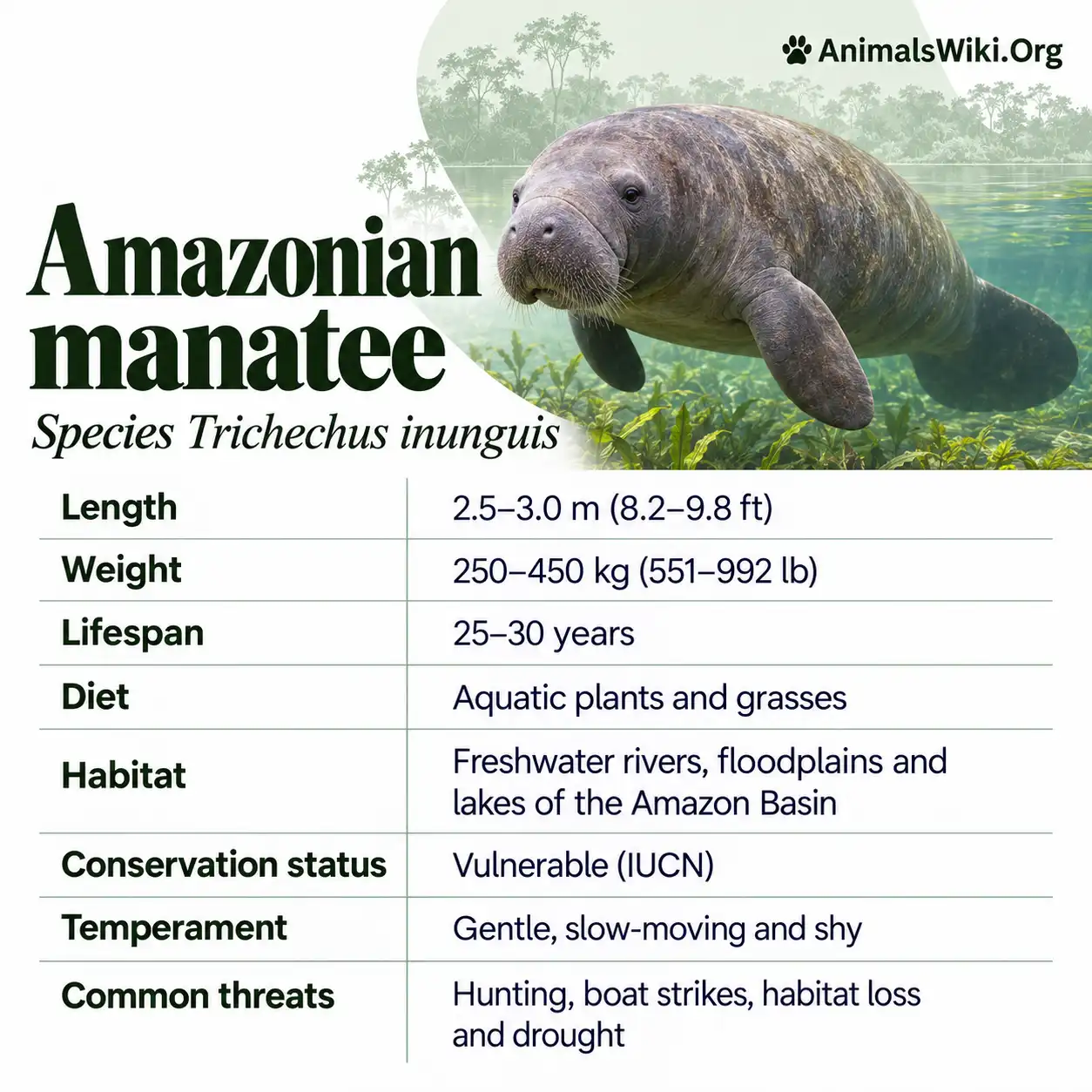
Amazonian Manatee, The Gentle Freshwater Giant of the Amazon Basin
The Amazonian manatee is a large aquatic mammal that lives in the rivers, lakes, and flooded habitats of the Amazon Basin. With its rounded body, paddle-shaped tail, flexible muzzle, and quiet movements, it is one of South America’s most distinctive freshwater animals.
Although it is sometimes called a “sea cow,” this species lives in freshwater. It feeds on aquatic vegetation and depends on a landscape that changes dramatically as rivers rise and fall.
During high water, the Amazon expands into surrounding floodplains, opening new feeding areas. When water levels drop, manatees must use remaining channels, lakes, and deeper refuges. Their survival is therefore closely tied to the timing and connectivity of the river system.
The Amazonian manatee is also difficult to observe. Much of its body remains hidden beneath turbid water, and a brief breath at the surface may be the only visible sign of its presence.
That secretive lifestyle can make conservation problems easy to overlook. Hunting, accidental capture, habitat changes, and severe low-water conditions threaten an animal that reproduces slowly and invests heavily in each calf.
This guide explores its appearance, habitat, diet, behavior, reproduction, ecological importance, and the work helping protect it.
Amazonian Manatee Facts
| Feature | Information |
|---|---|
| Common name | Amazonian manatee |
| Scientific name | Trichechus inunguis |
| Brazilian common name | Peixe-boi-da-Amazônia |
| Animal type | Aquatic mammal |
| Order | Sirenia |
| Family | Trichechidae |
| Main habitat | Freshwater rivers, lakes, channels, and flooded areas |
| Distribution | Amazon Basin |
| Diet | Primarily aquatic and waterside vegetation |
| Tail | Broad and rounded |
| Distinctive feature | Flippers lack nails |
| Reproduction | Usually one calf per pregnancy |
| Maternal care | Prolonged nursing and close mother–calf association |
| Global conservation category | Vulnerable |
1. What Is an Amazonian Manatee?
An Amazonian manatee is a fully aquatic mammal belonging to the order Sirenia.
Manatees and dugongs are the living representatives of this group. Their plant-eating habits have contributed to the familiar nickname “sea cows.”
The Amazonian species is unusual because it is restricted to freshwater.
Its scientific name is Trichechus inunguis. It belongs to Trichechidae, the manatee family.
Despite its fish-like setting, it does not have gills. It breathes air, gives birth to live young, and feeds its calf milk.
It also has sparse hair, another mammalian feature that may be difficult to see in photographs.
The animal remains in water throughout its normal life. Unlike a sea lion, it does not climb onto a beach to rest or reproduce.
Its anatomy, behavior, and feeding strategies are adapted to a life spent moving through rivers and floodplain habitats rather than alternating between land and water.
2. What Does an Amazonian Manatee Look Like?
The Amazonian manatee has a rounded, elongated body that tapers toward a broad tail.
Its head is relatively small compared with its body, and the muzzle carries thick lips and bristles.
The skin is generally gray to nearly black. Many individuals have pale pink or white patches on the chest or belly, although the markings vary.
Its body carries a sparse covering of fine hairs.
Two front flippers help with maneuvering and interacting with the surroundings. There are no external hind limbs.
The rounded tail is one of the clearest features separating manatees from dugongs, whose tails have distinct flukes.
Amazonian manatees also have relatively smooth skin compared with the more wrinkled appearance often associated with other manatees.
Most observations in the wild reveal much less than a full body. A muzzle, back, or patch of disturbed water may be all an observer sees before the animal disappears again.
3. How Big Do Amazonian Manatees Get?
The Amazonian manatee is generally considered the smallest living manatee species, but it is still a substantial animal.
Brazil’s National Institute for Amazonian Research describes individuals reaching approximately 3 meters in length and 450 kilograms.
Those figures represent large animals rather than a standard measurement for every adult.
Age, sex, nutrition, and individual history influence size.
A young animal undergoing rehabilitation can look very different from a mature adult with a full, rounded body.
| Life stage | General appearance |
|---|---|
| Newborn calf | Small relative to the mother and dependent on milk |
| Growing juvenile | Increasing body length and mass while developing feeding independence |
| Adult | Large, rounded body supported entirely by water |
| Large adult | May approach the upper measurements reported for the species |
Body condition matters as much as length. An animal can be long but underweight, so professional health assessments consider more than its overall dimensions.
4. Why Do Its Flippers Have No Nails?
The absence of nails is a useful identifying feature of the Amazonian manatee.
Its scientific name, inunguis, refers to this characteristic.
Other manatees commonly have small nails on their flippers, while the Amazonian species lacks them.
This difference should not be interpreted as a sign that the flippers are incomplete or poorly developed.
They remain functional limbs used in steering, positioning, and interacting with the environment.
A manatee’s flipper contains modified skeletal structures inherited from land-dwelling mammalian ancestors.
Over evolutionary time, those limbs became adapted to aquatic life.
Visible features such as nails are therefore only one part of a much larger anatomical transformation.
For identification, however, the feature is practical: a clear view of the flipper can help distinguish an Amazonian manatee from related species.
In the wild, obtaining that view may be difficult because water conditions often conceal the animal’s underside.
5. Amazonian Manatee vs Dugong: What Is the Difference?
Manatees and dugongs are related, but they are not the same animal.
The most useful visible difference is the tail.
Manatees have a broad, rounded paddle. Dugongs have a fluked tail with a different outline.
Their usual habitats also differ. The Amazonian manatee occupies inland freshwater systems, while dugongs are associated with coastal marine habitats.
| Feature | Amazonian manatee | Dugong |
|---|---|---|
| Family | Trichechidae | Dugongidae |
| Tail shape | Rounded paddle | Fluked |
| Main environment | Freshwater Amazon habitats | Coastal marine habitats |
| Typical vegetation setting | Rivers, lakes, and floodplains | Seagrass habitats |
| Geographic association | South America | Parts of the Indo-Pacific |
Both belong to Sirenia, but their feeding environments and conservation challenges are distinct.
A photograph labeled simply “sea cow” may therefore show either a manatee or a dugong.
Checking the tail and location helps establish which animal is being described.
6. Is It Related to Dolphins, Whales, or Elephants?
The Amazonian manatee shares an aquatic lifestyle with dolphins and whales, but similarity in habitat does not mean the closest evolutionary relationship.
Manatees belong to Sirenia, while dolphins and whales belong to a different mammalian lineage.
Sirenians are part of a broader evolutionary group that also includes elephants.
This does not mean a manatee descended from a modern elephant.
Instead, the lineages share ancient ancestors.
The comparison illustrates convergent adaptation: different mammal groups independently developed bodies suited to life in water.
A manatee’s rounded tail, flippers, and reduced external limbs support swimming, but its evolutionary history differs from that of a river dolphin.
Its feeding is also different. Amazonian manatees primarily consume plants, while Amazon river dolphins hunt animal prey.
Understanding that distinction helps prevent the common assumption that all large aquatic mammals have similar diets, behavior, or ancestry.
7. Where Do Amazonian Manatees Live?
Amazonian manatees are native to the Amazon Basin.
They occur in river systems associated with countries including Brazil, Peru, Colombia, and Ecuador.
Their distribution follows freshwater habitat rather than political boundaries.
A suitable area must provide more than water alone. Food, access to deeper refuges, and routes between seasonal habitats all influence its usefulness.
The species occurs in an immense and difficult-to-survey region, so distribution knowledge is still being improved.
Its secretive behavior also complicates interpretation. Failure to see a manatee during a short visit does not prove that the species is absent.
Conversely, one sighting does not establish the size or security of a local population.
Researchers increasingly combine local observations with tracking, acoustics, and genetic methods to improve the picture.
Protecting the species therefore requires cooperation across a river basin containing many different communities, landscapes, and management systems.
8. What Freshwater Habitats Does It Use?
Amazonian manatees use a changing combination of rivers, lakes, channels, floodplain waters, and seasonally flooded areas.
Different habitats become accessible at different water levels.
A shallow connection that an animal can cross during high water may become unusable as the river falls.
Similarly, a productive feeding area may disappear beneath a much smaller dry-season water surface.
This makes habitat quality dynamic.
A location cannot be evaluated only by looking at it during one season.
Researchers studying seasonal movement have emphasized the relationship between feeding habitats and low-water refuges.
The animal needs both, along with a way to travel between them.
A lake containing food is less useful if it becomes isolated before the manatee can leave.
Conservation planning therefore needs to consider the entire annual cycle and the waterways connecting important places, rather than protecting isolated patches without their seasonal links.
9. Why Is the Amazon’s Flood Cycle So Important?
The Amazon’s seasonal rise and fall reorganizes the landscape.
As water spreads across floodplains, it connects places that are separated during low water.
For a manatee, that expansion can open access to additional vegetation and feeding grounds.
When the water retreats, the animal must adjust again.
The same route can change from a broad passage into a narrow channel or a disconnected pool.
Seasonal movement research describes this as a trade-off between access to feeding habitat and the need to reach safer low-water areas.
The pattern is not simply “wet season good, dry season bad.”
Both are normal parts of the environment to which the species is adapted.
Problems arise when routes are disrupted, low water becomes unusually severe, or human pressures intensify at predictable gathering points.
The flood cycle shapes the manatee’s movements, feeding opportunities, exposure to hunters, and access to refuge.
10. What Happens During High Water?
High water expands access to aquatic and semi-aquatic vegetation.
Manatees can move into feeding areas that were unavailable when water levels were lower.
This creates opportunities to consume growing plants and build energy reserves.
The exact food available differs among places.
Plant communities change with water type, local geography, and the extent of flooding.
Research in the Mamirauá and Amanã reserves has examined those seasonal feeding patterns rather than assuming the same diet everywhere.
The ability to use newly accessible habitat is important, but it depends on suitable connections.
An animal must be able to reach the feeding area and later leave as conditions change.
High-water habitat is therefore part of a larger seasonal network.
Its value cannot be separated from the channels, lakes, and refuges used during the rest of the year.
11. What Happens During Low Water?
As water recedes, feeding areas and travel routes can contract.
Manatees may move toward deeper waters that remain available through the low-water period.
Such refuges are important because becoming trapped in unsuitable shallow habitat can be dangerous.
Low water can also make animals easier for people to locate.
Research on seasonal migration warns that predictable movements and concentration in restricted waters can increase hunting vulnerability.
This creates a conservation challenge: the same refuge that helps an animal survive falling water may expose it to additional human pressure.
A useful protected area therefore needs appropriate management, not merely a boundary on a map.
The timing of protection matters as well.
Disturbance or illegal hunting at a low-water refuge can affect animals that depend on that location for a critical part of the annual cycle.
Maintaining refuge habitat and safe access to it is central to conservation.
12. Can Amazonian Manatees Go Without Food?
Amazonian manatees can tolerate periods of reduced feeding, and seasonal fasting has been an important subject of research.
They can draw on stored energy when food becomes difficult to obtain.
Their relatively low metabolic demands are relevant to that ability.
However, this should not be simplified into a claim that every manatee stops eating for a fixed number of months each year.
Conditions differ among habitats and individuals.
The amount of food available, the animal’s reserves, and the length of the difficult period all matter.
Research has examined how feeding and fasting influence metabolism and ventilation.
The key idea is flexibility within limits.
An adaptation that helps an animal survive normal seasonal shortage does not guarantee survival through an unusually severe drought.
Prolonged food restriction can become more serious when combined with isolation, disturbance, or poor initial body condition.
13. What Do Amazonian Manatees Eat?
Amazonian manatees are primarily herbivores.
Their diet includes aquatic and semi-aquatic plants such as grasses, floating vegetation, and other plants growing in or beside water.
Researchers have identified food plants by comparing fragments in digestive material or feces with reference collections.
One study documented numerous plant species and found differences between high-water and low-water diets.
This demonstrates that the species does not depend on one plant everywhere.
| Food type | Why it matters |
|---|---|
| Aquatic grasses | Important vegetation in suitable feeding habitats |
| Floating plants | Accessible food in lakes and sheltered waters |
| Semi-aquatic vegetation | Available along flooded margins |
| Seasonally accessible plants | Expand feeding options during high water |
Availability influences choice.
A plant that is abundant during one part of the year may become scarce or inaccessible later.
Diet therefore reflects both feeding preference and the changing landscape through which the animal moves.
14. How Does It Gather and Process Plants?
The Amazonian manatee has a flexible muzzle with thick lips and bristles.
These structures help it investigate and gather vegetation.
Food is then processed by cheek teeth adapted for grinding rather than by the sharp cutting teeth of a predator.
Its feeding apparatus fits a lifestyle based on consuming plant material from an aquatic environment.
The animal may encounter vegetation floating at the surface, growing along a margin, or available in flooded habitat.
Different feeding positions require controlled movement of the head and body.
The flippers and tail help maintain position while the mouth handles food.
This coordinated behavior is easy to overlook when the animal is hidden by water.
A slow-moving manatee is still performing a demanding task: selecting, gathering, and processing enough vegetation to meet its energy needs.
Its quiet appearance should not be mistaken for an absence of specialized feeding adaptations.
15. Why Are Its Teeth So Unusual?
Amazonian manatees have an unusual system of horizontal tooth replacement.
New teeth develop toward the rear of the jaw and move forward over time.
Older teeth at the front are eventually lost.
This differs from the familiar mammalian pattern of replacing a juvenile set with one adult set.
The arrangement helps maintain a working grinding surface despite wear.
Researchers have studied the movement and replacement of teeth directly in Amazonian manatees, making this more than a general assumption based on relatives.
The system is especially relevant to an animal that processes substantial quantities of vegetation.
Abrasive particles and repeated grinding can wear down teeth.
Continued replacement helps address that long-term problem.
It is one of the clearest examples of an anatomical feature connected to the demands of herbivory.
The manatee’s mouth is therefore not simply soft lips at the front; it also contains a specialized mechanism for sustaining food processing through life.
16. How Does an Amazonian Manatee Breathe?
An Amazonian manatee breathes air through nostrils near the top of its muzzle.
It surfaces to exchange air, then submerges again.
The interval between breaths changes with activity and other conditions.
A resting adult does not necessarily breathe on the same schedule as an active calf.
INPA notes that young animals need to breathe more frequently because of their faster metabolism.
This dependence on access to air explains why entanglement can become life-threatening even when it does not produce a visible wound.
An animal held below the surface can drown.
Breathing also helps explain why manatees can be difficult to count.
A brief appearance at the surface reveals only a small part of the body, and the observer may not know whether repeated breaths belong to one individual or several.
The animal’s basic physiology therefore influences both its vulnerabilities and the challenges of studying it.
17. Does It Have the Same Diving Physiology as a Seal?
Not exactly.
Different aquatic mammals manage oxygen and circulation in different ways.
It is unsafe to assume that every mammal diving underwater uses an identical response.
Research on Amazonian manatees has measured heart rate and gas exchange during voluntary submergence.
In those observations, the animals maintained relatively constant heart rates while diving, with a modest increase associated with breathing.
That differs from the simplified description of a dramatic heart-rate drop often used for diving mammals.
The finding illustrates why species-specific research matters.
A manatee is not a seal with a different body shape.
Its feeding, movement, metabolism, and breathing occur within a distinct evolutionary and ecological setting.
For readers, the practical lesson is to avoid transferring impressive diving statistics or physiological claims from whales, sea lions, or other manatees without checking that they apply to the Amazonian species.
18. Do Amazonian Manatees Make Sounds?
Yes. Amazonian manatees are vocal animals.
They produce underwater sounds used in communication, including interactions between mothers and calves.
Their calls are not usually obvious to a person standing on the riverbank.
Hydrophones allow researchers to record and study them.
Acoustic and anatomical research has investigated how manatees produce those sounds.
Evidence points to structures associated with the larynx, including tissue consistent with vocal folds.
This is important because the animal’s quiet public image can obscure its acoustic life.
A manatee may be communicating beneath water that looks still from above.
Sounds can help maintain contact when visibility is limited.
That makes communication particularly relevant in turbid freshwater habitats where animals cannot always rely on seeing one another clearly.
Studying those calls also creates opportunities for conservation monitoring without needing to observe the whole animal.
19. Why Are Mother–Calf Calls Important?
A calf needs to remain close to the individual providing milk and guidance.
Underwater calls can help support that contact.
Research comparing manatee calf vocalizations has found differences associated with species and body size.
The structure of calls can also change as an animal develops.
These findings show that communication is not necessarily identical across all manatees or all life stages.
A young calf’s needs differ from those of an increasingly independent juvenile.
The ability to maintain contact matters in an environment where vegetation, water clarity, and movement can interfere with visibility.
However, a recorded call does not automatically reveal everything about the animal producing it.
Researchers need appropriate reference data before using sound to infer age, size, or identity.
The strongest conclusions connect acoustic measurements with observations of known animals rather than relying on assumptions about what a particular sound means.
20. Are Amazonian Manatees Social?
Amazonian manatees may occur alone or in small groups, depending on habitat and circumstances.
Mother–calf pairs form an especially important association.
Groups can also develop where food or suitable water brings animals together.
However, seeing several animals in one place does not establish a permanently organized herd.
Seasonal concentration and social preference are different processes.
The species remains difficult to observe, so many details of its wild social life are less well documented than those of highly visible coastal mammals.
That uncertainty should not be filled with comparisons to sea lion colonies or dolphin groups.
Amazonian manatees have their own ecology.
Their social behavior unfolds within rivers and lakes where researchers may only detect brief surfacing events, acoustic signals, or indirect evidence.
Understanding relationships therefore requires repeated observations and careful identification rather than a single encounter with several animals.
21. How Do Amazonian Manatees Reproduce?
Amazonian manatees have a slow reproductive cycle.
Females usually produce one calf per pregnancy.
Pregnancy is lengthy, and maternal care continues well beyond birth.
This creates a substantial investment in each offspring.
Research on female reproductive anatomy describes the species as uniparous, meaning that a single young is the normal reproductive outcome.
The slow cycle has important conservation consequences.
A population cannot quickly replace large numbers of adults lost to hunting or other mortality.
Losing a reproductive female can also affect a dependent calf and remove future breeding opportunities.
Reproduction therefore needs to be considered over several years rather than measured only through the number of newborns in one season.
Protecting adults, calves, and the habitat supporting maternal care all contributes to the same long-term process: allowing enough offspring to survive and eventually reproduce.
22. How Long Is Pregnancy?
Pregnancy is commonly described as lasting around thirteen months, with published accounts giving some variation.
The precise timing has been investigated through reproductive hormone monitoring.
A 2024 study examined progesterone measurements during pregnancy to improve understanding of gestation in the species.
This kind of work is valuable because many reproductive events are difficult to document in the wild.
A female may spend most of the period out of view, and a calf may first be seen some time after birth.
Carefully followed animals can therefore provide information that field sightings alone cannot supply.
Nevertheless, figures from managed care should be interpreted with their study context.
The useful broad conclusion is that pregnancy is long and reproduction is slow.
That investment continues into nursing, making successful calf rearing dependent on the mother’s health and access to suitable habitat.
23. What Is a Baby Amazonian Manatee Called?
A baby Amazonian manatee is called a calf.
It begins life in water and relies on its mother’s milk.
The close association between mother and calf is central to early survival.
The calf must breathe, remain in contact, grow, and gradually develop the ability to feed independently.
Its mother provides more than calories.
Remaining with an experienced adult also places the young animal within the seasonal movements and habitat choices of the species.
This matters in a landscape where suitable routes and feeding areas change with water level.
A calf separated prematurely may lose both nutritional support and access to that association.
For this reason, rescue organizations take orphaned young seriously.
However, members of the public should not assume that every small manatee seen without an immediately visible adult is abandoned. Assessment requires knowledge of the circumstances and trained observation.
24. How Long Does a Calf Stay With Its Mother?
Nursing can continue for approximately two years, although development varies among individuals.
The transition to independence is gradual.
A calf may investigate or consume vegetation while still receiving milk.
This overlap allows feeding skills to develop before maternal support ends completely.
The long association also helps explain the species’ slow reproductive pace.
A female investing in a dependent calf cannot be treated as though she produces a fully independent replacement every year.
Conservation education by the Mamirauá Institute highlights pregnancy length and prolonged nursing when explaining why hunting can have lasting effects.
The loss of one animal may therefore affect more than one generation.
Protecting a mother–calf pair preserves a relationship that has already required substantial time and resources.
That investment becomes valuable to the population only if the calf survives and eventually enters the breeding population.
25. How Long Do Amazonian Manatees Live?
The species can live for decades, but precise lifespan in the wild is difficult to establish.
Many general sources repeat estimates without explaining whether they describe maximum longevity, average survival, or observations in managed care.
Those are different measurements.
A longevity database records a wild-born Amazonian manatee still alive in captivity at forty years of age.
That demonstrates the potential for a long life, but it does not establish the average lifespan of wild animals.
Field conditions include risks that differ from those in managed care.
Long-term identification and monitoring are needed to understand survival more accurately.
For conservation, the important point is that this is a long-lived, slowly reproducing mammal.
The loss of an adult can remove many potential years of reproduction, while the successful survival of a young animal represents a long investment before it contributes offspring of its own.
26. Why Is the Amazonian Manatee Ecologically Important?
Amazonian manatees are large freshwater herbivores.
By consuming vegetation and releasing waste, they participate in the movement and recycling of material through aquatic habitats.
Their feeding also links different plant communities across seasonal movements.
Researchers have begun examining additional ecological roles, including the possible transport of seeds.
A recent study used fecal material collected during exceptional low-water conditions to investigate these relationships.
Such research helps move beyond the simple image of a manatee as an animal that merely removes plants.
Its ecological effects depend on what it eats, how food is processed, and where material is deposited afterward.
Those processes connect the animal with vegetation, water movement, and other organisms.
The strength of particular effects still requires investigation.
Nevertheless, protecting the manatee preserves a distinctive ecological role: a large mammalian grazer adapted to the changing freshwater landscape of the Amazon floodplain.
27. Is the Amazonian Manatee Endangered?
Its current global IUCN category is Vulnerable.
In everyday language, people may use “endangered” to mean that an animal faces extinction risk, but the formal IUCN categories have specific meanings.
Vulnerable is a threatened category, distinct from Endangered and Critically Endangered.
National legal classifications may also differ from the global assessment.
| Term | Meaning in this context |
|---|---|
| Threatened | A broad conservation grouping that includes several risk categories |
| Vulnerable | The Amazonian manatee’s global IUCN category |
| Endangered | A different formal IUCN category, or a term used under particular national systems |
| Protected | A legal designation that does not by itself establish population security |
Using the correct category improves clarity.
It also prevents confusion when older publications, national laws, and global assessments use different wording.
Regardless of terminology, the species faces significant pressures and requires continued conservation.
28. How Has Hunting Affected It?
Hunting has had a major influence on Amazonian manatee populations.
Historical exploitation included meat and hides, and commercial demand intensified pressure in some periods.
The species’ slow reproduction makes repeated removal especially consequential.
A review of its biology and conservation described how exploitation, combined with low reproductive rates, reduced populations.
Historical information remains useful for understanding that legacy, but it should not be treated as a precise description of current abundance.
Present-day conservation must consider local circumstances and changing pressures.
It should also avoid portraying river communities as a single uniform group.
Many residents contribute essential knowledge, rescue reports, monitoring, and protection.
Effective responses combine enforcement against illegal killing with locally appropriate education and participation.
A lasting solution depends on understanding both the biological vulnerability of the animal and the human setting in which conservation takes place.
29. Why Are Fishing Nets Dangerous?
A manatee caught in a net may be unable to reach the surface.
Because it breathes air, restricted access can lead to drowning.
Young animals can be especially vulnerable when they cannot break free from strong material.
Fishing interactions can also separate calves from mothers or produce injuries requiring rehabilitation.
Researchers working with Amazonian communities have emphasized accidental capture as an important concern.
The problem is not solved simply by recognizing that nets exist.
Conservation requires understanding where, when, and how interactions occur.
Local fishers often have the best knowledge of those circumstances.
Their observations can help identify risky locations and improve responses.
Reporting entanglements quickly can also matter, although handling a large aquatic mammal requires trained personnel.
Reducing harmful interactions protects manatees while supporting safer, more workable relationships between wildlife conservation and the people using river resources.
30. How Do Severe Droughts Affect Amazonian Manatees?
Normal seasonal low water is part of the manatee’s environment.
An extreme drought can push conditions beyond the usual pattern.
Waterways may become shallower, connections can disappear, and animals may be concentrated in fewer remaining areas.
That can restrict access to food and increase exposure to people.
Reports from the 2024 drought period described concern about increased hunting vulnerability as rivers receded.
This does not mean that every manatee experiences the same outcome.
Local depth, access to refuges, body condition, and human activity all influence risk.
The important distinction is between adaptation to seasonal change and unlimited tolerance of environmental extremes.
A species able to survive ordinary low-water periods can still be threatened when those periods become exceptionally severe or prolonged.
Conservation planning needs to identify the refuges and routes most important during difficult years, not only during average conditions.
31. Why Does River Connectivity Matter?
Connectivity describes the ability to move between parts of a freshwater system.
For Amazonian manatees, that can mean access between feeding areas, channels, lakes, and deeper refuges.
A habitat may remain physically present while becoming functionally unavailable if the route to it is lost.
Broader research on Amazon freshwater ecosystems identifies dams, land-use change, mining, and climate pressures as influences on river integrity.
The exact consequence for manatees needs local evidence, but the underlying requirement for connected habitat is clear.
Protecting isolated locations without considering travel routes can miss an essential part of the life cycle.
A seasonal corridor may be especially important even if animals do not occupy it year-round.
Conservation therefore needs a landscape perspective.
It must consider not only where manatees are observed, but also how they reach those places and what conditions they encounter while moving between them.
32. Why Are Amazonian Manatees Difficult to Count?
Several factors make surveys challenging.
The animals spend most of their time submerged, often in water with limited visibility.
They may surface briefly without revealing enough of the body for identification.
Large areas are remote and difficult to access.
A low number of sightings can therefore reflect low detectability rather than low abundance alone.
Researchers need methods that account for those limitations.
Combining observations with acoustic recordings, tracking, and genetic detection can improve understanding.
However, detecting a species is different from estimating how many individuals are present.
A positive record establishes evidence of occurrence, not a complete population count.
This distinction is especially important when reading dramatic claims about exact totals.
Reliable conservation assessment depends on repeated, carefully designed work rather than treating a handful of sightings as a census of an enormous river basin.
33. How Can Environmental DNA Help?
Animals release genetic material into their surroundings through biological processes.
Environmental DNA, or eDNA, methods look for traces of that material in water samples.
Researchers have applied this approach to Amazonian manatees in different parts of the Amazon system.
It offers a way to investigate occurrence without needing to see or capture the animal.
That is particularly useful for a species living beneath turbid water.
However, interpretation requires care.
Failure to detect DNA does not automatically prove absence, and detecting it does not directly establish the number of animals.
Water movement, sampling conditions, and laboratory methods influence results.
The strongest applications use appropriate controls and combine eDNA with other information.
As a conservation tool, it can help identify areas requiring further attention and improve knowledge of distribution in places where conventional observation is difficult.
34. Can Sound Recordings Help Researchers Find Them?
Yes. Passive acoustic monitoring records underwater sound without requiring continuous visual observation.
Researchers can search recordings for manatee vocalizations.
The Mamirauá Institute has reported work combining acoustic monitoring with machine-learning methods to improve detection in difficult-to-access areas.
This approach is promising because a hydrophone can collect information while animals remain hidden.
It can also extend monitoring beyond the limited time a researcher is physically present.
The technology still requires validation.
Other sounds can be confused with the target signal, and a quiet animal may go undetected.
A call record also does not automatically reveal the number of individuals.
Nevertheless, combining acoustic and visual or genetic evidence can strengthen conservation research.
For the Amazonian manatee, listening beneath the surface opens a window into a life that is otherwise difficult to observe.
35. Can Rescued Amazonian Manatees Return to the Wild?
Some rescued manatees can be rehabilitated and released.
The process may involve treatment, appropriate feeding, growth monitoring, and preparation for natural conditions.
A 2026 study of rescued animals in Peru found that intake weight and weight gain during care were associated with survival.
It also highlighted problems linked to inappropriate diets before rescue.
This is one reason untrained feeding can be harmful.
Rehabilitation is not simply keeping an animal alive until a convenient release date.
Teams must assess health, behavior, age, and suitability for the intended environment.
Some programs use a transitional period in semi-natural conditions.
In April 2026, AMPA reported that its partnership with INPA had reached a cumulative total of 59 Amazonian manatees returned to the wild.
Those releases represent sustained technical and community effort, rather than a single act of opening a gate.
36. What Happens After Release?
Post-release monitoring helps establish whether a manatee adapts successfully.
Reaching open water is only the beginning.
The animal must find food, use suitable habitat, move safely, and cope with seasonal changes.
Research in Peru followed rehabilitated animals with radio telemetry after release.
Their movements and habitat use provided evidence about adaptation to free-living conditions.
Such studies can also reveal differences among individuals.
A release that works for one animal may need adjustments for another.
Choosing an appropriate location and season is therefore important.
Monitoring turns rehabilitation into a learning process, improving future decisions.
It also helps distinguish an encouraging release event from evidence of longer-term success.
The most meaningful outcome is an animal that resumes a sustainable life in the river system, rather than merely surviving its first day outside managed care.
37. Why Are Local Communities Essential to Conservation?
River communities encounter the habitats, seasonal changes, and human activities affecting manatees.
Their knowledge can identify travel routes, feeding signs, unusual mortality, and animals needing assistance.
Conservation organizations have worked with residents through education, monitoring, and community-based rehabilitation initiatives.
The Mamirauá Institute’s work illustrates the value of combining scientific information with local experience.
This partnership is more effective than treating conservation as an activity carried out only by visiting researchers.
Residents can contribute observations across seasons and respond to changes that a short expedition would miss.
Their participation also helps develop practical measures suited to local conditions.
Successful conservation must account for livelihoods and access to river resources while reducing harmful activities.
Protecting the Amazonian manatee is therefore both a biological and a social task: it depends on understanding the animal and building workable relationships with the people sharing its environment.
38. What Should You Do If You Encounter One?
Observe calmly and avoid interfering with the animal’s movement.
Do not chase, surround, feed, or attempt to touch it.
Keep boat activity from blocking access to open water or separating a calf from an adult.
If an animal appears injured, entangled, stranded by falling water, or genuinely orphaned, contact the appropriate local wildlife authority or established rescue organization.
Provide the location, time, visible condition, and photographs taken without approaching.
Do not improvise a diet for a calf or attempt to transport a large manatee independently.
Specialist care matters because incorrect handling or feeding can create additional problems.
A brief observation also may not reveal the whole situation, particularly when a mother is submerged nearby.
The most useful public response is accurate reporting combined with space for trained personnel to assess the animal and decide what assistance is appropriate.
Frequently Asked Questions About Amazonian Manatees
1. What is the scientific name of the Amazonian manatee?
Its scientific name is Trichechus inunguis. It belongs to Trichechidae, the manatee family, within the order Sirenia.
2. Is an Amazonian manatee a fish?
No. It is a mammal. It breathes air, produces milk, has hair, and gives birth to live young despite spending its normal life in water.
3. Does it live in the ocean?
The Amazonian manatee is restricted to freshwater. Its main habitats are rivers, lakes, channels, and seasonally flooded areas within the Amazon Basin.
4. Why is it called a sea cow?
“Sea cow” is a common nickname for sirenians because of their grazing habits. For the Amazonian species, the word “sea” is misleading because it lives in freshwater.
5. Is it the smallest manatee?
It is generally considered the smallest living manatee species. However, a large adult is still an animal measuring several meters and weighing hundreds of kilograms.
6. How can you recognize it?
Useful features include a rounded tail, relatively smooth dark skin, nail-free flippers, and pale chest or belly markings in many individuals. Not every marking is identical.
7. Do all Amazonian manatees have white bellies?
No. Pale markings vary. Many have white or pinkish patches on the chest or belly, but the extent and appearance differ among individuals.
8. Why does it have no flipper nails?
Nail-free flippers are a characteristic feature of this species. The scientific name inunguis refers to that trait.
9. What does it eat?
It primarily eats aquatic and semi-aquatic vegetation. The plants consumed vary among places and seasons as water levels change access to food.
10. Does it eat fish?
The Amazonian manatee is primarily herbivorous. Fish are not its normal dietary focus, unlike the prey-based diets of river dolphins and giant otters.
11. How do its teeth work?
New teeth develop at the rear and move forward, replacing older worn teeth. This horizontal replacement system helps maintain the surfaces used to grind vegetation.
12. Can it breathe underwater?
No. It must surface for air. Any situation that prevents access to the surface, including entanglement, can become life-threatening.
13. Does it migrate?
It makes seasonal movements associated with water levels, feeding habitat, and access to low-water refuges. These movements differ from long-distance ocean migrations.
14. Can it survive without eating?
It can tolerate periods of reduced feeding by using stored energy. That ability has limits and should not be interpreted as unlimited resistance to drought or food shortage.
15. What is a baby manatee called?
A baby is called a calf. It depends on maternal milk and remains closely associated with its mother while developing toward independence.
16. How long is pregnancy?
Pregnancy is commonly described as lasting around thirteen months, with some variation in published accounts. Hormone studies have helped improve knowledge of reproductive timing.
17. How many calves does a female usually have?
A female usually produces one calf per pregnancy. Long pregnancy and prolonged care contribute to the species’ slow reproductive rate.
18. How long do calves nurse?
Nursing can continue for approximately two years. The transition toward independence is gradual, and vegetation feeding can overlap with maternal milk.
19. Do Amazonian manatees make sounds?
Yes. They produce underwater vocalizations, including sounds involved in mother–calf communication. Researchers use hydrophones to record and study them.
20. Are they related to elephants?
Sirenians belong to an evolutionary group that also includes elephants. They share ancient ancestry rather than descending from modern elephants.
21. How long can they live?
They can live for decades. A documented managed-care record includes an animal alive at forty, but that does not establish average lifespan in the wild.
22. Are Amazonian manatees endangered?
Their formal global IUCN category is Vulnerable, which is a threatened category. National legal classifications may use different terminology.
23. What are their main threats?
Important pressures include hunting, accidental capture, habitat disruption, and severe low-water conditions. Their slow reproduction makes sustained losses difficult to replace.
24. Can rescued manatees be released?
Some can, following rehabilitation and assessment. Preparation, release-site selection, seasonal timing, and post-release monitoring all contribute to the outcome.
25. Should you feed an apparently orphaned calf?
No. Incorrect diets can cause serious problems. Keep disturbance low and contact trained wildlife responders who can assess whether rescue and specialist feeding are needed.
Amazonian Manatees and the Future of Freshwater Conservation
The Amazonian manatee is adapted to a world defined by moving water.
Its feeding opportunities expand with floods, its movements follow changing connections, and its survival depends on reaching suitable habitat as the landscape contracts again.
Its life also unfolds slowly. Pregnancy is long, calves require extended care, and adults can survive for decades.
Those characteristics make protection especially important. Preventing the loss of a reproductive female or preserving a crucial seasonal route can have benefits extending far beyond a single year.
Research, rehabilitation, community participation, and healthy river systems all contribute to the same goal: allowing this distinctive freshwater herbivore to continue moving through the Amazon’s changing waters.



