
Galapagos Sea Lion, The Remarkable Marine Mammal of Ecuador’s Islands
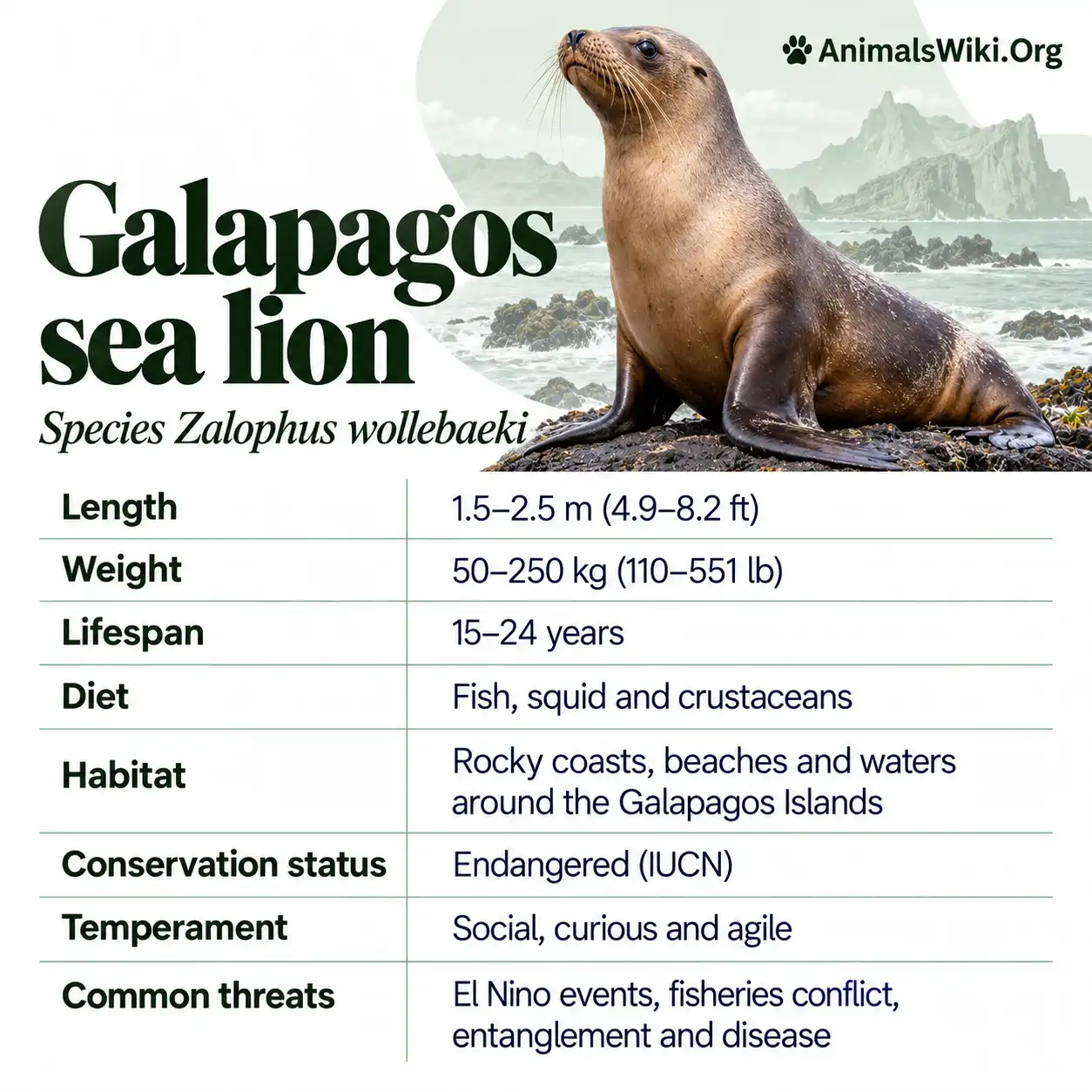
The Galapagos sea lion, more formally written as the Galápagos sea lion, is one of the most recognizable animals of the Galápagos Islands. Visitors encounter it resting on beaches, moving across volcanic rocks, swimming through shallow bays, and sometimes occupying waterfront spaces near island communities.
Its relaxed appearance can be misleading. Beneath the surface, this animal is a capable predator with varied hunting strategies. Within a colony, it participates in a social world shaped by familiar neighbors, maternal relationships, territorial competition, and repeated reunions between mothers and young.
The Galápagos sea lion is a separate species from the California sea lion. Although closely related, the two animals have distinct evolutionary histories and live under different environmental conditions.
For Galápagos sea lions, survival depends on an ocean that can change dramatically. Productive waters may provide abundant food, while unusually warm conditions can make feeding much more difficult. Mothers must respond to those changes while supporting young that may remain dependent for years.
Despite being easy to see in some places, the species is classified as Endangered. Its visibility along popular shorelines should not be confused with long-term security.
This guide explores its identity, appearance, habitat, diet, behavior, reproduction, ecological importance, and conservation.
Galapagos Sea Lion Facts
| Feature | Information |
|---|---|
| Common name | Galápagos sea lion |
| Scientific name | Zalophus wollebaeki |
| Spanish common name | Lobo marino |
| Animal type | Marine mammal |
| Family | Otariidae, the eared seal family |
| Main distribution | Galápagos Islands, Ecuador |
| Additional breeding occurrence | Isla de la Plata, off mainland Ecuador |
| Typical adult appearance | Brown or grayish coat, external ear flaps, long front flippers |
| Sex differences | Males are larger and develop a prominent forehead crest |
| Main foods | Fish and other marine prey |
| Reproduction | Usually one pup per pregnancy |
| Maternal care | Prolonged and highly variable |
| Conservation category | Endangered |
| Important threats | Changing food conditions, disease, fishing interactions, plastic pollution, and disturbance |
1. What Is a Galapagos Sea Lion?
A Galápagos sea lion is an air-breathing marine mammal belonging to Otariidae, the family containing sea lions and fur seals.
Its small external ear flaps distinguish it from true seals, which have ear openings without projecting flaps.
It is also a pinniped, part of the broader group that includes true seals, fur seals, sea lions, and walruses.
Like other mammals, it produces milk for its young and maintains its body temperature. Its marine lifestyle does not remove the need to breathe air, so it must return to the surface between dives.
The animal’s body is adapted for swimming, but land remains essential. Shorelines provide places to rest, reproduce, give birth, and nurse.
This combination creates a life divided between two environments. Food comes from the ocean, while much of the most visible social and reproductive activity occurs ashore.
Understanding both settings is necessary to understand the species. A beach colony reveals only the land-based portion of a much larger ecological story.
2. Is It Different From the California Sea Lion?
Yes. The Galápagos sea lion and California sea lion are separate species.
Their scientific names are:
| Species | Scientific name |
|---|---|
| Galápagos sea lion | Zalophus wollebaeki |
| California sea lion | Zalophus californianus |
Older references sometimes describe the Galápagos animal as a subspecies of the California sea lion.
Genetic research helped establish their separation, showing distinct evolutionary lineages rather than one interchangeable population.
This distinction matters for conservation. Recovery in California cannot compensate for the loss of the Galápagos species.
It also matters when researching natural history. A feeding schedule, migration pattern, or reproductive detail documented in California should not automatically be applied to animals in Ecuador.
They share important anatomical features, but related species can respond differently to their environments.
For readers checking older books or websites, scientific names provide a useful way to identify which classification a source follows and whether its information refers specifically to Galápagos animals.
3. What Does a Galapagos Sea Lion Look Like?
Galápagos sea lions have streamlined bodies, noticeable necks, long front flippers, external ears, and whiskered muzzles.
Their coats vary from lighter brown and tan to darker brown or grayish shades.
Wetness changes their appearance. An animal emerging from the sea may look considerably darker than one that has been drying on a beach.
Mature males develop thicker necks, heavier shoulders, and a pronounced forehead crest.
Females are more slender and lack the same strongly developed head profile.
Pups begin life with darker coats and change in appearance as they grow.
These differences make age and sex important during identification. A small female, dark pup, and large bull can look surprisingly unlike one another.
The most useful approach is to consider several features together rather than relying only on coat color.
Head shape, neck proportions, external ears, and body size provide a more complete identification than any single visual clue.
4. How Big Do Galapagos Sea Lions Get?
Male Galápagos sea lions are substantially larger than females.
Adult females are commonly around 1.5 meters long, while males are often around 2 meters. Larger individuals can exceed those approximate measurements.
Body mass varies considerably with sex, age, and condition.
A mature male carries much more bulk around the neck, chest, and shoulders than a female.
| Feature | Adult female | Adult male |
|---|---|---|
| General build | Slender | Heavy and muscular |
| Typical length | Around 1.5 meters | Around 2 meters |
| Forehead crest | Not prominently developed | Pronounced in mature animals |
| Neck and shoulders | Relatively narrow | Thick and substantial |
These figures are useful guides, not exact limits.
A young male may resemble a female before reaching full size. Seasonal changes in feeding and reproduction also affect weight.
When comparing measurements, distinguish typical adults from exceptional maximum records. Otherwise, the largest documented male can be mistaken for the size of every animal in a colony.
5. Galapagos Sea Lion vs Galapagos Fur Seal
The Galápagos Islands support two resident eared seals: the Galápagos sea lion and Galápagos fur seal.
They can be difficult to distinguish, especially when observing pups or partially submerged animals.
| Feature | Galápagos sea lion | Galápagos fur seal |
|---|---|---|
| General adult size | Larger | Smaller |
| Body outline | More elongated | Often appears stockier |
| Coat | Less dense underfur | Thick, dense fur |
| Eyes | Less conspicuously large | Large and prominent |
| External ears | Visible | Often more conspicuous |
| Common resting setting | Beaches and varied coastal surfaces | Frequently shaded, rocky areas |
Size is helpful, but age complicates the comparison. A sea lion pup can be smaller than an adult fur seal.
The face often provides better clues. Fur seals have relatively large eyes and projecting ears.
Both species belong to Otariidae, so the presence of ear flaps separates neither from the other.
Instead, combine facial proportions, coat, body shape, and habitat. These features together provide a more reliable answer.
6. Where Do Galapagos Sea Lions Live?
The species is centered on Ecuador’s Galápagos Archipelago in the eastern Pacific.
Sea lions occupy suitable coastal areas across the islands, using beaches, rocky shores, and sheltered waterfronts.
Their distribution is closely connected to the availability of resting habitat and access to productive feeding waters.
Although strongly associated with the Galápagos, they should not be described as occurring exclusively within the archipelago.
Breeding also occurs on Isla de la Plata, off mainland Ecuador.
This additional occurrence does not change the importance of the Galápagos as the species’ main stronghold.
The surrounding marine environment is equally important. Oceanographic conditions support the food webs on which breeding colonies depend.
A map of beaches alone therefore gives an incomplete picture of habitat.
The animals connect coastal sites with feeding areas that vary among individuals and through time, making marine protection an essential part of conserving this island-associated mammal.
7. What Makes a Good Sea Lion Resting Site?
A useful resting site provides more than dry ground.
Access to water, manageable terrain, shade, nearby pools, and the presence of other animals can influence where a sea lion settles.
The preferred setting can differ among males, females, and young.
A female with a small pup faces different practical needs from an adult male resting away from a breeding area.
Research on habitat use has shown that temperature regulation, movement costs, and social interactions help shape these choices.
Consequently, animals are not distributed randomly across a beach.
A shaded patch or convenient route to the water may be valuable, and repeated use can create recognizable patterns.
To a visitor, two nearby surfaces may look equally suitable. To a sea lion, they may differ in heat exposure, access, crowding, or disturbance.
Protecting coastal habitat requires attention to these small-scale features as well as the broader coastline.
8. Why Do Some Live Close to Towns?
In parts of the Galápagos, sea lions share waterfronts with people.
Puerto Baquerizo Moreno on San Cristóbal is an important example, with a substantial colony located within an urban setting.
This proximity makes the animals highly visible, but it also creates management challenges.
People need access to public spaces, boats, and coastal infrastructure. Sea lions need resting areas and unobstructed routes to the water.
Successful coexistence depends on planning rather than repeated close encounters.
An updated San Cristóbal conservation management plan for 2025–2030 addresses these issues through coordinated work involving authorities, researchers, communities, and other stakeholders.
The goal is to reduce human impacts while maintaining the species’ ecological and cultural importance.
An urban colony is therefore not simply a tourist attraction. It is wildlife habitat embedded within a working community.
The way that habitat is managed can influence both animal welfare and the quality of everyday life for residents.
9. How Can Sea Lions Live Near the Equator?
The Galápagos lie near the equator, but their marine environment is not uniformly warm.
Ocean currents and local upwelling bring productive conditions that support marine life.
This helps sustain predators such as sea lions despite their location in a tropical region.
Conditions differ among islands and change through the year.
A sea lion’s experience therefore depends on where it feeds, which prey it targets, and how ocean conditions affect those prey.
Warm air on shore also creates a separate challenge from feeding in the sea.
The animal must avoid excessive heat while resting, then maintain an appropriate body temperature during swimming and diving.
Its success depends on moving between different microhabitats and using behavior to manage those conditions.
The Galápagos sea lion is a reminder that latitude alone does not determine habitat quality. Local oceanography can make an equatorial island system very different from the tropical environment a visitor might expect.
10. Do Galapagos Sea Lions Migrate?
Galápagos sea lions generally remain strongly connected to the archipelago and familiar coastal sites rather than undertaking the broad seasonal migrations associated with many male California sea lions.
However, attachment to a region does not mean an animal stays beside one beach continuously.
Feeding trips can involve substantial movement, and individuals use marine habitat differently.
Scientists studying fine-scale site fidelity have found repeated use of particular areas within colonies.
That familiarity can help create stable opportunities for social contact.
Movement therefore operates at several scales: traveling to feed, choosing a resting location, and maintaining a broader connection to a colony or island region.
Calling the species “nonmigratory” should not erase that mobility.
The animals still need access to a network of suitable places.
A disturbance or habitat change at one heavily used site may matter because it affects a location repeatedly used by identifiable individuals, not merely an interchangeable stretch of shore.
11. What Do Galapagos Sea Lions Eat?
Galápagos sea lions are carnivores that feed on marine animals, especially fish.
Their diet varies among colonies and individuals.
Research has identified trophic specialization, meaning that different animals or groups can rely on different prey resources rather than using one uniform diet.
This is important in an island system with varied underwater habitats.
Some feeding opportunities occur in open water, while others are associated with the seabed or particular coastal features.
A general description such as “fish eater” is correct but incomplete.
Scientists also investigate which fish are consumed, their nutritional value, and the effort required to obtain them.
A prey species may remain present but become harder to catch if it moves deeper or becomes more dispersed.
Diet therefore connects the sea lion’s immediate meal with larger questions about habitat, environmental change, and reproductive success.
For mothers, food also supplies the energy that will later be transferred to young through milk.
12. Do All Galapagos Sea Lions Hunt the Same Way?
No. Individual Galápagos sea lions can use different feeding strategies.
Research has identified animals specializing in bottom-oriented diving, open-water diving, and nighttime feeding.
These differences show that a population contains more behavioral variety than an average dive depth or diet list suggests.
An individual may repeatedly use a familiar strategy because it works well under the conditions it encounters.
Specialization can reduce direct overlap among animals, but it can also create different vulnerabilities.
A change affecting bottom-associated prey may not influence an open-water hunter in exactly the same way.
This makes individual behavior relevant to conservation.
Understanding only the average animal could overlook the needs of a significant part of the population.
The most complete studies therefore consider variation within colonies as well as differences between islands.
Galápagos sea lions are not simply interchangeable hunters. Their feeding histories and repeated choices help shape how they use the surrounding ocean.
13. Can Galapagos Sea Lions Hunt Cooperatively?
Yes. Cooperative hunting has been documented in this species.
A study of hunts targeting amberstripe scad described sea lions performing complementary actions while driving fish toward a cove.
Some animals helped direct the school, while others participated as the fish became concentrated.
These observations reveal more than several predators happening to feed in the same place.
Positioning and coordinated movement can influence the behavior of prey and improve access to it.
However, cooperation does not mean every participant contributes equally.
Researchers also described opportunistic involvement, where additional animals benefited from an existing hunt.
The distinction is useful because real wildlife behavior can contain both coordination and individual advantage.
These hunts demonstrate the flexible use of local geography. A cove becomes part of the hunting opportunity when predators can guide fish toward it.
They also show how patient observation can reveal behavior that a brief encounter with swimming animals would miss.
14. Do They Hunt Large Fish Such as Tuna?
Galápagos sea lions have been documented attacking large pelagic fish, including yellowfin tuna.
Such events are striking because the prey can be fast-moving and substantial.
Research describing these hunts expands the familiar image of a sea lion feeding only on small schooling fish.
It also shows that local behavior can differ from the broad dietary pattern of the species.
An unusual or specialized hunt should not be presented as the ordinary meal of every sea lion.
The strongest interpretation is that some animals exploit particular opportunities using coordinated movement and local knowledge.
These observations raise interesting questions about how hunting methods develop, whether experienced animals perform different roles, and how younger animals encounter the behavior.
They also emphasize the value of preserving feeding habitat.
A productive coastal feature may support a repeated hunting opportunity that depends on both prey behavior and the sea lions’ ability to use the site effectively.
15. How Deep Do Galapagos Sea Lions Dive?
Galápagos sea lions can make dives extending hundreds of meters below the surface.
Their routine behavior, however, varies strongly among individuals.
Some search at relatively shallow depths, while others use deeper water or repeatedly visit the bottom.
Scientists distinguish between benthic dives associated with the seabed and pelagic dives within the water column.
These strategies create different travel and feeding costs.
A deep dive may reach a valuable prey resource, but it requires time and energy for descent and ascent.
A shallow dive may be cheaper while offering a different kind of reward.
Research on feeding efficiency therefore measures more than depth alone.
It examines the relationship between effort, prey capture, and energy gained.
The central question is whether the animal obtains enough food to justify its investment.
A maximum depth demonstrates capability; repeated dive patterns reveal the habitat an individual actually depends on.
16. Why Does Feeding Efficiency Matter?
A sea lion can be busy hunting without obtaining enough food.
Feeding efficiency describes the relationship between the energy gained from prey and the effort spent finding and capturing it.
This distinction is particularly important for nursing females.
A mother must support her own body, complete feeding trips, and return with enough resources to produce milk.
Research comparing hunting strategies has found differences in prey capture, energy intake, and expenditure.
A strategy with higher returns may also require greater effort.
Consequently, there is no universal rule that deeper, longer, or more active feeding is automatically better.
The value of a hunting method depends on the local environment and the animal using it.
When food conditions deteriorate, simply working harder may not fully solve the problem.
Understanding feeding efficiency helps explain why changes in prey distribution can affect growth and reproduction even before a dramatic decline in prey abundance is obvious.
17. Do Sea Lions and Fur Seals Compete for Food?
Galápagos sea lions and fur seals share parts of the same marine environment.
Their feeding niches differ, but they also overlap.
Research comparing individual strategies has found overlap in feeding areas, timing, and depths.
The amount depends partly on which sea lions are being compared with the fur seals.
This illustrates why species-wide averages can hide important details.
One sea lion strategy may overlap strongly with fur seal feeding, while another uses a different part of the environment.
Overlap does not automatically prove harmful competition.
To establish competition, researchers need evidence that sharing a resource limits one or both species.
Nevertheless, knowing where overlap occurs is valuable.
It identifies the situations in which changes in prey or ocean conditions could affect both animals simultaneously.
Conserving the two species therefore requires understanding their differences as well as the marine resources they share.
18. What Is Colony Life Like?
A Galápagos sea lion colony contains much more social structure than first appears.
Individuals rest, nurse, call, compete, and move through areas used repeatedly by familiar neighbors.
Research using social-network analysis has identified layers of association within colonies.
This does not mean every animal belongs to a permanent family group.
Instead, patterns emerge from repeated proximity, relationships, and the use of particular spaces.
Mother–offspring bonds are especially important, but other associations also contribute to colony organization.
To a visitor, the animals may look like an untidy gathering on sand and rocks.
To a researcher following identified individuals, the same scene contains recurring relationships.
This changes how disturbance should be understood.
Moving animals from a favored resting area may interrupt more than a moment of sleep. It can affect the spatial setting in which familiar interactions repeatedly occur.
A colony is both physical habitat and a social environment.
19. Are Their Social Groups Connected to Relatedness?
Some research has examined whether social associations within a colony correspond with genetic relationships.
Work on Galápagos sea lions has found structure involving space, social communities, and relatedness.
Mother–offspring relationships contribute strongly to that pattern.
However, a social community should not automatically be described as one extended family.
Animals can associate because they share preferred habitat or repeatedly occupy nearby locations.
Genetic and behavioral evidence are needed to separate those influences.
This is why researchers combine observations with biological samples and identification records.
The result is a more detailed view of how colony organization develops.
Relatedness, familiarity, and habitat use may all contribute without having identical roles.
For readers, the important point is that a dense wildlife aggregation need not be socially anonymous. Individual history and repeated contact can produce recognizable organization within what appears to be a crowd.
20. How Do Mothers and Pups Recognize Each Other?
Individual recognition is essential when a mother repeatedly leaves a crowded colony to feed.
Galápagos sea lion mothers and pups use sensory cues to reconnect after separation.
Research has investigated the roles of vocalizations and close-range recognition.
Calls help individuals locate one another, while additional inspection can help confirm identity.
This matters because milk production is a substantial maternal investment.
A female benefits from directing that investment toward her own offspring.
The pup likewise needs to distinguish the individual that provides nourishment.
Their reunion is therefore a practical task rather than simply an affectionate interaction.
It must work despite surf, wind, neighboring animals, and movement through the colony.
What sounds to a visitor like a collection of similar calls can contain meaningful identity information for the animals.
The recognition system helps make repeated maternal feeding trips possible without permanently separating mothers from their young.
21. How Do Males Compete During Breeding?
Mature male Galápagos sea lions compete for territories associated with access to females.
This is different from imagining a male personally controlling a fixed group that never moves.
Females use habitat according to their own needs, and males compete within that setting.
A successful territory can provide repeated mating opportunities.
Maintaining it requires time, condition, and responses to rivals.
Not every mature male succeeds.
Some males remain outside the main breeding areas or use different resting locations.
The competitive system contributes to the pronounced differences between males and females.
It also helps explain why the distribution of animals across a colony changes with breeding activity.
Research on habitat use shows that social interactions, including competition and avoidance, can influence where different classes of animals rest.
The beach is therefore not divided only by temperature or terrain. Reproductive behavior also shapes access to space.
22. When Do Galapagos Sea Lions Breed?
Galápagos sea lions have a prolonged breeding period, and timing varies across the archipelago.
This differs from the impression of a single short season occurring identically on every island.
Local conditions influence the timing and distribution of births.
Females generally produce one pup per pregnancy.
The birth of a pup begins a demanding period of care rather than completing the reproductive investment.
A mother must obtain food while supporting growth through milk.
Because maternal dependence can continue for a long time, reproduction is not always well represented by a simple annual schedule.
The presence of older dependent offspring can also influence the mother’s circumstances when another pup arrives.
Visitors may therefore encounter young animals of noticeably different sizes.
Those differences reflect age, development, and varied reproductive timing rather than necessarily indicating that several species are present.
23. What Are Newborn Pups Like?
A newborn Galápagos sea lion pup begins life on land and depends on maternal milk.
Its dark coat and small size distinguish it from the larger adults nearby.
Early survival requires more than being born successfully.
The pup must remain in contact with its mother, tolerate her absences, and cope with the physical and social conditions of the colony.
Body condition at the start of life can influence the ability to withstand later difficulties.
Researchers studying maternal care therefore examine growth and survival rather than relying only on birth counts.
Pups also develop within a changing environment.
A season with good feeding conditions for mothers can provide a different start from a season in which prey becomes difficult to obtain.
That connection is easy to miss because the pup remains visible on shore while the mother experiences the feeding environment at sea.
The colony and surrounding ocean are linked through every nursing visit.
24. Why Do Mothers Leave Their Young Ashore?
A sea lion mother cannot remain beside her offspring continuously because she must feed.
She alternates time at sea with visits to nurse.
The young animal remains in the colony during those absences.
This pattern is a normal part of maternal care.
Seeing a pup alone therefore does not establish that it has been abandoned.
The length and outcome of feeding trips depend on food conditions and individual behavior.
Recent conservation research has used chemical information in pup whiskers to investigate changes in maternal feeding areas through the year.
These findings suggest that mothers shift among feeding zones as they respond to variable conditions.
Such flexibility can help support offspring in an unpredictable environment.
However, flexibility has limits. A mother still needs to obtain sufficient food and maintain a workable cycle between hunting and care.
That repeated balancing act is central to the species’ reproductive biology.
25. How Long Do Young Galapagos Sea Lions Nurse?
Maternal care is unusually prolonged and variable.
Young Galápagos sea lions may begin catching some food while still returning to nurse.
This makes weaning a process rather than a single obvious event.
Research published in 2026 used long-term observations and statistical models to examine the transition more precisely.
In the studied population, the main weaning window extended from approximately 1.5 to 4.5 years.
These figures should be interpreted as a result from the study, rather than a rigid timetable for every animal.
Environmental conditions and the interval before another offspring were associated with variation in weaning.
The finding highlights how different this species can be from simplified accounts of sea lion development.
A large young animal nursing is not necessarily behaving abnormally.
Its feeding history may include a long overlap between maternal support and increasing independence.
26. Can Older Offspring Return to Nursing?
Yes. Researchers have documented repeated nursing after an offspring had apparently passed through weaning.
A 2026 study described known mother–offspring pairs returning to this behavior over time.
The observation complicates the idea that maternal feeding ends once and never resumes.
It also demonstrates the value of following identified animals for many years.
A brief sighting could be interpreted incorrectly if the observer did not know the animal’s age and previous history.
The biological meaning is still being investigated.
Repeated nursing may involve nutritional support, a continuing relationship, or several influences operating together.
It should not be assumed that every older offspring depends completely on milk.
The important finding is that the boundary between dependence and independence can be flexible.
Galápagos sea lions provide an especially interesting example of maternal investment extending beyond the neat categories often used in general wildlife descriptions.
27. How Do Young Sea Lions Become Skilled Hunters?
Young animals must develop diving ability, prey-capture skills, and knowledge of feeding habitat.
These capacities emerge through growth and experience.
Research on Galápagos sea lions has shown that age, body mass, and environmental variation influence the development of feeding behavior.
A juvenile does not immediately perform like an experienced adult simply because it can swim.
It must learn where prey can be found and how to capture enough to meet its needs.
Maternal support can overlap with this learning period.
That overlap may be especially valuable in a variable environment where feeding opportunities change.
The process also creates a vulnerable stage. If conditions deteriorate while an animal is developing independence, its limited experience may become more consequential.
Understanding juvenile development helps explain why conservation monitoring needs more than adult counts.
The future breeding population depends on young animals surviving the transition from receiving food through milk to obtaining it successfully for themselves.
28. How Long Do Galapagos Sea Lions Live?
Galápagos sea lions are relatively long-lived mammals.
General conservation summaries commonly give a lifespan of approximately fifteen to twenty years.
That figure should not be treated as the age reached by every animal.
Many die earlier, while some survive through numerous reproductive seasons.
Potential longevity, average survival, and remaining life expectancy at a particular age are different measurements.
Early-life survival is particularly important because many years pass before an animal can contribute fully to reproduction.
Long-term monitoring allows researchers to investigate those stages by following known individuals.
It also reveals relationships that short studies cannot capture, including prolonged maternal care and changes in breeding history.
A sea lion’s life is therefore best understood as a sequence of changing challenges.
Pup dependence, juvenile learning, adult feeding, reproduction, and aging each contribute to the pattern of survival seen across the population.
29. What Role Do They Play in Island Ecosystems?
Galápagos sea lions connect marine food webs with life on land.
They obtain food at sea and return to coastal colonies, transporting marine-derived nutrients through waste and other biological material.
Research has investigated how this nutrient transfer influences terrestrial ecosystems.
The process can affect the conditions experienced by plants and other organisms near colonies.
This means sea lions influence more than the prey they consume.
Their repeated movement between sea and shore creates a pathway through which ocean productivity reaches island habitats.
The effect varies with colony location and local geography.
A concentrated colony can produce a different nutrient pattern from a small, scattered resting group.
These connections help explain why conserving a predator also protects ecological processes.
The sea lion is part of a network involving fish, coastal vegetation, soil nutrients, scavengers, and many less conspicuous organisms sharing the islands.
30. Why Are Galapagos Sea Lions Endangered?
The species is classified as Endangered because of its conservation history and the pressures affecting its relatively restricted population.
Important concerns include changing food conditions, environmental extremes, disease, human interactions, and pollution.
Its visibility can conceal the seriousness of those concerns.
A crowded waterfront may represent a concentration of animals rather than evidence that the entire species is secure.
Population assessments also need to distinguish total animals from mature individuals and direct counts from estimated abundance.
These are different measurements.
Older figures should not be presented as exact current totals.
Conservation planning therefore relies on repeated surveys and updated information rather than the apparent abundance at one popular site.
The Galápagos sea lion illustrates why familiarity is not the same as resilience.
A species can be easy to encounter locally while still facing substantial risk across the larger system that supports it.
31. How Does El Niño Affect Galapagos Sea Lions?
El Niño can bring warmer conditions and major changes in marine productivity around the islands.
Those changes affect prey availability and the ability of sea lions to feed.
Historical research on severe events documented major consequences for young animals and subsequent reproduction.
The important mechanism is not simply that the water becomes warmer.
Food may become less abundant, less nutritious, or harder to reach.
Mothers then face greater difficulty supporting themselves and their offspring.
Young animals learning to feed independently can face additional challenges.
Different events vary in severity, and colonies do not necessarily respond identically.
Nevertheless, the historical evidence shows that environmental extremes can influence several stages of the life cycle at once.
Understanding El Niño therefore helps explain both short-term distress and longer-term population changes.
A difficult year can affect the young animals that would otherwise have contributed to breeding many years later.
32. How Does Plastic Pollution Threaten Them?
Plastic pollution creates several potential pathways of harm.
Large debris can entangle animals, while smaller particles can enter marine food webs.
Research in the Galápagos has identified interactions between wildlife and plastic through both ingestion and entanglement.
Sea lions are among the animals requiring targeted attention.
A loop of line or packaging material can tighten as an animal grows, causing injury even while it remains able to move.
Microplastic studies ask different questions, including whether particles are being ingested and how exposure varies geographically.
Detecting plastic does not automatically establish its effect on survival.
However, it confirms that isolation does not protect the islands from marine pollution.
Waste can arrive through local activities and material transported across the ocean.
Effective conservation therefore includes preventing waste at its source, improving management, and monitoring how debris interacts with wildlife over time.
33. Can Domestic Animals Affect Sea Lion Health?
Domestic animals can contribute to disease concerns where they share coastal environments with wildlife.
Canine distemper virus is especially important in discussions of Galápagos sea lion conservation.
Research has documented evidence of exposure in sea lions and outbreaks among dogs in the islands.
These findings support attention to the interface between domestic animals and wildlife.
They do not establish that every sick sea lion was infected by a dog or that exposure always produces severe disease.
Transmission pathways and consequences require investigation.
The practical conservation response includes responsible domestic-animal management, veterinary surveillance, and reducing uncontrolled contact.
Disease prevention is particularly important for a species with a restricted distribution.
A colony can bring many animals into close proximity, potentially creating opportunities for infection to spread.
Protecting sea lions therefore involves more than managing marine habitat. Health measures within human communities can also contribute to wildlife conservation.
34. What About Avian Influenza?
Highly pathogenic avian influenza has become an important concern for marine wildlife internationally.
Severe outbreaks in other pinniped populations have raised concern about the vulnerability of Galápagos sea lions and fur seals.
Scientific discussion has emphasized the need for surveillance and preparedness.
A potential threat should not be confused with a confirmed mass outbreak in a particular Galápagos colony.
Accurate reporting must distinguish documented infections, suspected cases, and projections based on events elsewhere.
The conservation concern remains significant because geographically restricted populations can be vulnerable to new disease pressures.
Monitoring unusual illness or mortality, following biosecurity measures, and limiting unnecessary contact are therefore important.
Visitors should follow current instructions from park authorities and guides, especially if temporary restrictions are introduced.
Disease surveillance works best when observations are assessed by trained personnel rather than interpreted through rumors or assumptions based on an animal’s appearance.
35. How Do Scientists Monitor Galapagos Sea Lions?
Researchers combine population surveys with studies of diet, movement, reproduction, and health.
Counts reveal where animals are concentrated, while repeated identification helps establish survival and reproductive histories.
Diet can be investigated through fecal samples and chemical information in tissues such as whiskers.
These methods answer different questions.
A count alone cannot explain whether a change reflects mortality, movement, or differences in attendance at the colony.
Likewise, a health measurement becomes more useful when compared with age, condition, and environmental circumstances.
Conservation projects have emphasized the need for consistent surveys across colonies because gaps in recent information make priorities harder to identify.
The strongest understanding comes from connecting several lines of evidence.
It can reveal not only that a population has changed, but also which stages of life or environmental conditions may be contributing to that change.
Long-term research is particularly valuable for an animal whose development and maternal relationships extend across years.
36. How Should Visitors Behave Around Galapagos Sea Lions?
Give sea lions space and allow them to continue their normal activities.
The Charles Darwin Foundation’s published park guidance advises observing wildlife from at least two meters away and avoiding touching or feeding.
That distance is a minimum, not a reason to remain close when an animal appears uncomfortable.
Follow guide instructions, site restrictions, and any updated biosecurity measures.
Keep routes to the water clear and avoid surrounding resting animals.
A curious sea lion approaching a swimmer does not require the swimmer to engage physically.
Observe calmly and maintain space.
Do not attempt to make animals move for a photograph.
If you encounter an injured, entangled, or unusually unwell animal, inform an authorized guide or the appropriate local authority.
Responsible behavior protects both wildlife and visitors while preserving the opportunity to observe natural movement, feeding, rest, and maternal care.
Frequently Asked Questions About Galapagos Sea Lions
1. What is the scientific name of the Galapagos sea lion?
Its scientific name is Zalophus wollebaeki. It belongs to the eared seal family, Otariidae, alongside other sea lions and fur seals.
2. Is it a separate species from the California sea lion?
Yes. Genetic research supports recognizing them as separate species. Older publications sometimes use a subspecies classification, so checking scientific names helps avoid confusion.
3. Are Galapagos sea lions true seals?
No. They are eared seals. Their external ear flaps and ability to rotate the hind flippers beneath the body distinguish them from members of the true seal family.
4. Do they live only in the Galápagos Islands?
Their main population is associated with the Galápagos Archipelago, but breeding also occurs on Isla de la Plata off mainland Ecuador. “Only in the Galápagos” is therefore too absolute.
5. How can you recognize an adult male?
A mature male has a heavy neck and shoulders, a larger body, and a pronounced forehead crest. Females have a slimmer outline and lack the same prominent crest.
6. What color are they?
Their coats include brown, tan, and grayish shades. Age, sex, lighting, and wetness influence appearance. Pups are darker than many adults.
7. Are sea lions and Galapagos fur seals the same?
No. They are separate species sharing the islands. Fur seals are generally smaller, have denser fur, and possess relatively larger eyes and more conspicuous ears.
8. Why are sea lions found near towns?
Some waterfronts overlap with useful resting habitat. Sea lions need coastal space and access to water, while communities need safe ways to share those areas.
9. What do Galapagos sea lions eat?
They eat marine prey, especially fish. Diet differs among colonies and individuals, and some animals repeatedly specialize in particular feeding strategies.
10. Can they hunt together?
Yes. Researchers have documented coordinated hunts in which animals perform complementary actions to concentrate fish. Opportunistic animals may also join and benefit.
11. Do they eat tuna?
Attacks on yellowfin tuna have been documented. Such observations demonstrate behavioral flexibility but should not be presented as the routine diet of every Galápagos sea lion.
12. Do all of them dive to the same depth?
No. Some use shallow water, others dive deeper, and some repeatedly search near the seabed. Individual strategy and prey distribution strongly influence diving behavior.
13. Can they breathe underwater?
No. They are mammals and must surface for air. Underwater hunting involves managing breath-holding, movement, feeding time, and recovery.
14. Do they migrate like California sea lions?
They generally remain more closely associated with the Galápagos region and familiar colonies. Feeding trips still involve movement, so regional attachment does not mean remaining beside one beach.
15. What is a baby Galapagos sea lion called?
A baby is called a pup. It initially depends on milk and gradually develops the abilities needed to hunt independently.
16. How many pups does a female have?
A female usually gives birth to one pup per pregnancy. Raising that offspring involves a prolonged investment, and reproductive schedules vary.
17. Why might a pup be alone?
Its mother may be feeding at sea. Temporary separation is normal, so an unattended pup should not automatically be treated as abandoned.
18. How do mothers recognize their young?
Vocal and close-range sensory cues help mothers and offspring reconnect. Individual recognition allows maternal investment to be directed toward the correct young animal.
19. How long do young animals nurse?
Nursing is unusually variable and can continue for years. A 2026 study identified a main weaning window of approximately 1.5–4.5 years in its study population.
20. Can older offspring return to nursing?
Yes. Researchers have documented repeated nursing after apparent weaning. This does not necessarily mean the older animal relies entirely on milk.
21. Are Galapagos sea lions friendly?
Some are curious or accustomed to seeing people, but they remain wild animals. Familiarity and curiosity should not be interpreted as permission to touch, feed, or approach them.
22. Are they endangered?
Yes. The species is classified as Endangered. Its visibility at popular visitor sites does not establish that the population is secure.
23. Why does El Niño affect them?
El Niño can change marine productivity and prey availability. That can make feeding harder for adults and reduce the support available to dependent young.
24. How close can visitors get?
Published Galápagos guidance advises at least two meters from wildlife. Follow local instructions and give more space whenever animals react or conditions require it.
25. What should you do if one looks injured?
Keep your distance and notify an authorized guide or the appropriate local authority. Do not feed, handle, restrain, or attempt to move the animal yourself.
Galapagos Sea Lions and the Future of the Islands
The Galápagos sea lion combines specialized marine abilities with a flexible and unusually prolonged social life.
Its story includes coordinated hunting, individual feeding strategies, recognizable relationships, and maternal care that can continue for years.
Those traits help it survive in an unpredictable environment, but they do not remove the pressures created by food shortages, disease, pollution, and human activity.
Protecting the species requires attention to both sides of its life: the ocean where it feeds and the coastal places where it rests and raises young.
Consistent research, thoughtful community management, and respectful visitors all contribute to that effort.
The familiar animal lying on a beach is part of a much larger system—one connecting island communities, marine food webs, and the changing Pacific Ocean.



