
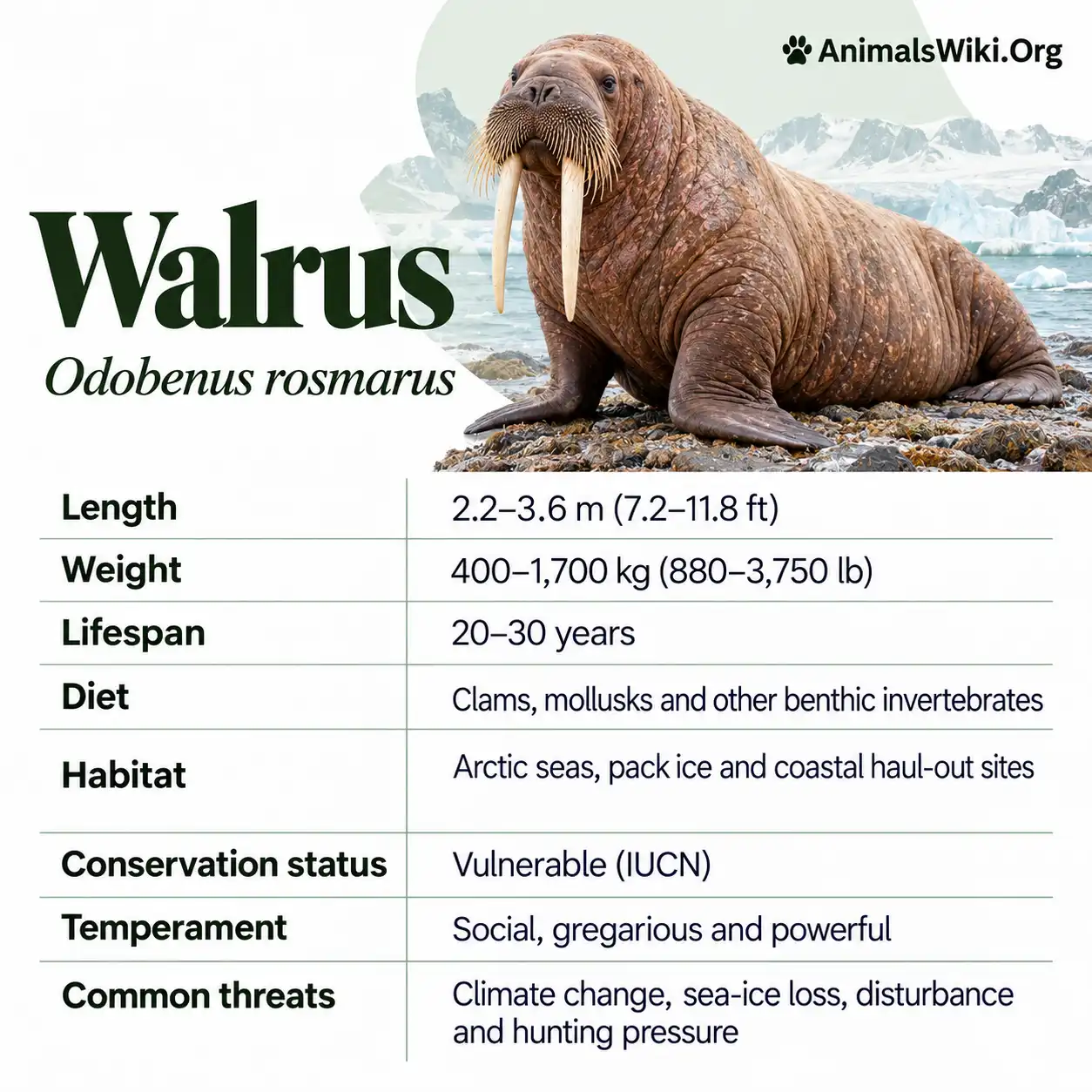
Walrus, The Tusked Giant of the Arctic Seas
The walrus is one of the Arctic’s most recognizable animals. Its long tusks, bristly whiskers, broad muzzle, and massive body make it easy to distinguish from seals and sea lions. Beneath that unmistakable appearance is a marine mammal with a highly specialized way of feeding and a complex social life.
Despite its size, a walrus obtains much of its food from relatively small animals living on or beneath the seabed. Sensitive whiskers help it investigate the bottom, while powerful suction allows it to extract soft prey from shells.
Walruses also depend on a close relationship between feeding grounds and resting places. Sea ice can provide a platform above productive waters, while coastal beaches and islands offer alternative haul-outs. These surfaces are useful in different ways, and losing one does not necessarily mean the other can replace it without consequences.
The species is globally classified as Vulnerable. Climate change, disturbance, and other pressures create conservation concerns, although conditions differ between Atlantic and Pacific populations.
This guide explores walrus identification, tusks, habitat, feeding, reproduction, calves, social behavior, and conservation. It also explains why some familiar assumptions—such as walruses digging up clams with their tusks—do not accurately describe their usual feeding method.
Walrus Facts
| Feature | Information |
|---|---|
| Common name | Walrus |
| Scientific name | Odobenus rosmarus |
| Animal group | Mammal |
| Family | Odobenidae |
| Broader group | Pinnipeds |
| Main forms | Atlantic walrus and Pacific walrus |
| Distribution | Arctic and adjoining subarctic seas |
| Adult size | Males are generally larger than females |
| Large adult male weight | Can exceed 1,000 kilograms |
| Main foods | Clams and other bottom-dwelling invertebrates |
| Tusks | Enlarged upper canine teeth |
| Tusks present in | Both males and females |
| Young | Usually one calf |
| Maternal care | Commonly continues for two years or longer |
| Lifespan | Can reach approximately 40 years |
| Global conservation status | Vulnerable |
1. What Is a Walrus?
A walrus is an air-breathing marine mammal belonging to the species Odobenus rosmarus. It is the only living member of the family Odobenidae.
Walruses belong to the broader group called pinnipeds, which also includes true seals, sea lions, and fur seals. However, a walrus is not simply an unusually large seal with tusks. It represents its own surviving family within that group.
Like other mammals, it maintains its internal temperature, gives birth to live young, and nourishes its offspring with milk. Its limbs are modified into flippers, allowing it to move through water and support itself on solid surfaces.
The species combines aquatic feeding with a need for resting platforms. It must therefore use both the sea and the surfaces available above it.
That combination is central to its ecology. Productive water alone is insufficient if the animal cannot reach a suitable place to rest between feeding trips.
2. Atlantic Walrus and Pacific Walrus
Two main walrus subspecies are generally recognized:
- Atlantic walrus: Odobenus rosmarus rosmarus
- Pacific walrus: Odobenus rosmarus divergens
They occupy different parts of the northern marine world and differ in aspects of size, appearance, population history, and habitat use.
Pacific walruses are associated particularly with the Bering and Chukchi seas. Atlantic walruses occur in northern Atlantic and adjoining Arctic regions, including parts of Canada, Greenland, and the Barents Sea region.
Some older sources discuss a separate Laptev walrus. Its classification has been debated, so lists of walrus forms do not always look identical.
For a general account, the Atlantic–Pacific distinction provides the clearest starting point.
It also prevents population figures from being confused. An estimate for Pacific walruses is not the total number of walruses worldwide, and a recovery observed in one Atlantic region does not describe the condition of every population.
3. Walrus Size and Weight
Walruses are very large pinnipeds, and males generally grow larger than females.
Adult males have especially massive necks and shoulders. Their tusks are also usually thicker and heavier, contributing to their distinctive appearance.
Large bulls can exceed a metric ton, while females are smaller on average. Exact measurements differ between sources because they may describe different populations, typical animals, or exceptional individuals.
Age also matters. A sexually mature male may continue growing before reaching the size that allows it to compete effectively with older bulls.
Body condition adds another layer of variation. An animal carrying substantial energy reserves weighs more than one of similar length after a demanding period.
The most useful description therefore combines sex, age, and population.
A photograph of a huge adult male should not be used as a size guide for every walrus, especially females and young animals.
4. What Are Walrus Tusks?
Walrus tusks are enlarged upper canine teeth. Both males and females develop them.
They are not horns, antlers, or separate structures attached to the skull. Like other teeth, they are part of the animal’s dentition.
The exposed length varies with age, sex, growth, wear, and breakage. Male tusks generally become thicker and more imposing than female tusks, although individuals differ.
Young calves do not begin life with the long tusks associated with adults. Their tusks emerge and become more noticeable as they develop.
This means tusk size provides useful information, but it cannot reveal an animal’s exact age by itself.
A short tusk may belong to a young animal, or it may have been damaged. A comparison also needs to consider the individual’s body size and sex.
The tusks are among the walrus’s most important tools for interacting with its physical and social environment.
5. What Do Walruses Use Their Tusks For?
Walrus tusks serve several purposes, including social display, fighting, defense, and assistance when hauling out.
A walrus can use them to gain purchase against ice or another surface while moving its body upward.
Tusks also influence social interactions. Their size and presentation can help communicate the strength of an animal before a dispute becomes a physical fight.
When fights occur, the tusks can inflict wounds. Scars on large adults provide visible evidence that these structures are more than decorative.
Their social role has been examined in behavioral research, including studies of males at summer haul-outs.
One common misconception needs correcting: tusks are not the walrus’s main tools for digging up food.
The usual feeding process relies much more heavily on the muzzle, whiskers, flippers, and suction. Understanding that distinction reveals how specialized the walrus’s face and mouth really are.
6. Walrus Whiskers: A Sensitive Feeding System
The dense whiskers on a walrus’s muzzle are called vibrissae.
They are sensitive structures connected to nerves and muscles, allowing the animal to gather tactile information while investigating the seabed.
This is particularly valuable when feeding disturbs sediment and reduces visibility. A walrus does not need a clear view of every item to investigate what lies in front of its mouth.
Underwater observations have documented vigorous whisker use during feeding.
The muzzle can be directed close to the bottom while the animal examines potential prey and manipulates the surrounding sediment.
This makes the whiskers functional equipment rather than a cosmetic feature.
Their role also explains why the walrus’s broad face is so important to its ecology. The animal’s ability to locate small prey depends on a coordinated system involving touch, movement, and the feeding mechanics of its mouth.
7. Walrus Skin, Hair, and Shoulder Bumps
A walrus has thick, tough skin and a relatively sparse coat, especially as an adult.
Older males can develop conspicuous bumps on the neck and shoulders, often called bosses. These contribute to the rugged appearance of a mature bull.
The skin is particularly substantial in areas exposed during encounters with other walruses.
Hair is generally denser on young animals than on older adults. Consequently, a calf can look noticeably different from a large male even before tusks and body size are considered.
Walruses also replace their hair, but the process is gradual. They do not undergo the same dramatic, sheet-like skin shedding associated with some other marine mammals.
Their appearance therefore changes through growth, wear, and seasonal processes.
Thick skin should not be confused with invulnerability. Walruses can still suffer wounds, disturbance, and physiological stress despite their formidable exterior.
8. How Walruses Stay Warm
Walruses rely heavily on blubber, a layer of fat beneath the skin, to reduce heat loss.
Blubber also stores energy and contributes to body shape. Its role therefore extends beyond insulation.
Blood circulation helps regulate heat exchange. In cold water, reduced blood flow near the surface limits heat loss. When the animal needs to release heat, increased surface circulation can make the skin appear pinker.
This explains why walruses can look different in color under different conditions.
A pale animal is not necessarily a different species or age class from a pinker one nearby.
The balance between retaining and releasing heat is important because a large, well-insulated animal can also become too warm.
Behavior provides additional options. Entering water, changing position, and selecting resting conditions allow the walrus to respond to its immediate environment.
9. How Walruses Move on Land and in Water
Walruses use alternating strokes of their hind flippers to generate much of their swimming propulsion. Their foreflippers contribute to steering and maneuvering.
On land, they can rotate the hind flippers beneath the body, allowing movement supported by all four limbs.
This differs from the movement of true seals, which cannot bring their hind flippers underneath themselves in the same way.
Their enormous weight still makes terrestrial movement look laborious. However, appearance should not encourage close approaches.
A walrus can move with considerable purpose, especially when alarmed or defending a calf.
In water, buoyancy supports the body and allows more fluid movement.
The contrast illustrates how the same animal uses two environments differently: powerful swimming and maneuvering at sea, with shorter movements across resting surfaces between aquatic periods.
10. Where Do Walruses Live?
Walruses inhabit the Arctic and adjoining subarctic seas.
Their distribution is discontinuous rather than forming one uninterrupted population around the North Pole.
Pacific walruses mainly use the shallow continental shelf waters of the Bering and Chukchi seas, while Atlantic walruses occupy several northern regions on the other side of the Arctic.
They do not naturally inhabit Antarctica.
This geographic distinction is important because images of tusked animals on ice are sometimes treated as generic “polar wildlife.”
Their presence also depends on more than low temperature. Walruses need suitable food on the seabed, access to water, and resting surfaces within a workable distance of feeding areas.
A cold region without productive bottom habitat may therefore be less useful than a relatively warmer area with abundant prey.
Their range reflects a combination of oceanography, food, ice, and coastal geography.
11. Why Shallow Seas Are Important
Walruses obtain much of their food from the seabed, making water depth especially important.
Large areas of continental shelf can provide accessible bottom habitat where clams and other invertebrates occur.
Deep ocean water presents a different problem. Even if floating ice is available above it, the seabed may be too deep for ordinary feeding trips.
This is why an ice platform cannot be judged useful solely because it exists.
Its position relative to feeding habitat matters.
A productive walrus environment usually combines suitable bottom sediments, prey, access to water, and nearby resting opportunities.
These requirements create a relatively specialized ecological niche.
The walrus’s great size does not mean it can use every part of the ocean equally. Its success depends on reaching large quantities of relatively small prey without spending more energy than those meals can replace.
12. Why Walruses Use Sea Ice
Sea ice can provide a resting surface near feeding grounds.
For Pacific walruses moving through productive shelf waters, this can reduce the distance between places to rest and places to eat.
Ice also supports important stages of reproduction and early calf care.
A floating platform moves with the marine environment, offering opportunities that a fixed beach cannot reproduce exactly.
However, sea ice is useful only when it remains suitably located. If it retreats beyond shallow feeding habitat, the animals may no longer be able to use it efficiently.
This creates a more complicated conservation problem than simply counting how much ice remains.
Researchers examine where ice is located, how long it persists, and how walrus behavior changes when it becomes unavailable.
The relationship is practical: resting habitat and feeding habitat must remain connected within the animal’s energetic limits.
13. Seasonal Walrus Movements
Pacific walrus movements broadly follow seasonal changes in ice.
Many females and young animals move north toward the Chukchi Sea during spring and summer, then return south as ice forms again.
Many adult males remain farther south and use coastal haul-outs during summer.
This means a group on one beach may not represent the full age and sex composition of the wider population.
Atlantic walrus movements vary among regions and should not automatically be assigned the same pattern.
Seasonal movement connects several needs: breeding, feeding, resting, and raising young.
It is also responsive to conditions. The location of usable ice can differ substantially between years.
A migration map therefore describes a broad pattern rather than a fixed route followed identically by every animal.
Understanding these differences helps explain why counts at individual haul-outs can change without providing a complete picture of population growth or decline.
14. What Is a Walrus Haul-Out?
A haul-out is a place where walruses leave the water to rest.
It may be an ice floe, beach, island, or another suitable coastal surface.
Walruses can gather in tightly packed groups, with bodies pressed against one another. Large aggregations are among the most striking sights in the Arctic.
However, hauling out on land is not itself proof of an emergency. Coastal haul-outs are part of walrus natural history.
The conservation question concerns changes in their use: which animals are coming ashore, how many gather, how far they must travel to feed, and what risks they encounter.
A traditional resting site used by males can differ from a massive aggregation containing females and calves.
The visible crowd therefore needs ecological context.
The same basic behavior can occur under different circumstances and carry different consequences for the animals involved.
15. What Do Walruses Eat?
The walrus diet is dominated by bottom-dwelling invertebrates, especially bivalve mollusks such as clams.
Other foods can include worms, snails, crustaceans, and additional organisms living on or beneath the seabed.
This differs from the fish-centered diet commonly associated with many seals.
A large walrus can meet its needs by consuming substantial numbers of relatively small prey, provided they occur in suitable concentrations.
The exact diet varies with location and available bottom communities.
Research from Bristol Bay has examined contemporary diets and found evidence relevant to changes in the benthic environment.
That relationship makes feeding studies useful beyond identifying a menu.
They can also provide information about the habitat supporting the walruses.
A change in what animals consume may reflect a change in prey availability, although identifying the cause requires comparison with conditions on the seabed.
16. How Walrus Suction Feeding Works
Walruses are specialized suction feeders.
Their mouth structure, muscular tongue, and lips allow them to generate suction that helps draw soft prey into the mouth.
When feeding on bivalves, they can remove soft tissues while leaving much of the shell behind.
This is different from crushing and swallowing every shell whole.
Underwater observations show walruses investigating sediment, uncovering prey, and feeding close to the bottom.
The process can involve movements of the muzzle and foreflippers, as well as water movement that helps expose buried organisms.
The tusks may be near the seabed during feeding, but that does not make them the primary excavation tools.
The distinction is important because the animal’s most obvious feature is not necessarily the feature doing the most work during a meal.
Its less conspicuous lips, tongue, and whiskers are central to feeding success.
17. How Much Food Does a Walrus Need?
A walrus needs a substantial energy supply, but there is no single daily food quantity that accurately describes every animal.
Requirements change with body size, growth, activity, reproductive condition, and the energy content of prey.
A feeding animal may consume large numbers of clams during repeated dives, yet the number of prey alone does not reveal the amount of usable energy obtained.
Different prey sizes and tissue contents matter.
Researchers therefore study energy expenditure as well as food consumption.
Measurements of resting and swimming metabolism help explain how changes in behavior might alter feeding requirements.
For example, additional travel between a beach and feeding area creates demands beyond the feeding dive itself.
The practical question is whether the animal can obtain sufficient energy while meeting the costs of reaching food, resting, maintaining body temperature, and supporting reproduction.
18. Do Walruses Eat Seals?
Some walruses consume other marine mammals, including seals.
This behavior is documented, but it should not replace the general description of walruses as predators primarily feeding on bottom-dwelling invertebrates.
Individual feeding strategies can differ considerably.
An animal capable of taking a seal is not evidence that every walrus regularly hunts seals.
The distinction between species-level diet and individual specialization is important.
It also prevents unusual behavior from becoming a misleading headline.
Walruses can be opportunistic, and their size and feeding apparatus allow a broader range of interactions than the familiar clam-eating image suggests.
However, the ecological importance of mammal consumption depends on its frequency, location, and the particular animals involved.
A balanced account includes this behavior while keeping it in proportion to the species’ dominant feeding strategy.
19. How Walruses Change the Seabed
Walrus feeding can disturb the sediments in which prey live.
As animals uncover food, they create furrows and patches of altered seabed, moving sediment and affecting the organisms around their feeding tracks.
Scientists call the disturbance and mixing caused by living organisms bioturbation.
Research on Pacific walruses has examined how this activity influences bottom communities and nutrient exchange.
The effects extend beyond the prey immediately consumed.
Disturbed areas can create opportunities for scavengers and influence subsequent recolonization.
This makes walruses active participants in shaping their habitat.
Their ecological role is therefore more complex than subtracting clams from a population.
By moving through and feeding within sediments, they alter physical conditions and biological interactions on the bottom.
The seabed beneath a walrus feeding area is a changing habitat partly influenced by the animals using it.
20. How Deep Can a Walrus Dive?
Walruses usually make relatively shallow feeding dives compared with the deepest-diving pinnipeds.
That pattern reflects the location of their principal prey on continental shelves.
It does not mean they are incapable of deeper dives. Considerably deeper and longer submergences have been recorded, including observations from the Svalbard region.
The difference between routine behavior and maximum ability is essential.
A walrus gains little by diving far beyond the depth where useful food occurs.
Repeated access to suitable prey is more important than reaching an impressive record.
Depth also influences travel time within each dive. Descending and ascending reduce the time available near the bottom.
For that reason, the shape of the seabed and distribution of prey help determine how an animal allocates its underwater effort.
Walrus diving is best understood as a response to feeding opportunities rather than a competition for depth.
21. How Walruses Manage Energy Underwater
A walrus must balance oxygen use with the work of swimming, diving, and feeding.
Like other diving mammals, it has physiological adaptations that support activity while holding its breath.
Researchers have also measured the energetic costs of specific behaviors.
A study involving adult female Pacific walruses in professional care examined stationary diving and underwater swimming, providing information about the costs of those activities under controlled conditions.
Such research helps build a more realistic picture of the animal’s energy budget.
It also shows why one simple assumption—such as treating every minute in the water as equally expensive—can be misleading.
Floating, traveling, and feeding involve different demands.
Those differences become relevant when environmental change alters how much time walruses spend in each activity.
Understanding behavior and physiology together helps explain the consequences of losing convenient resting surfaces.
22. Where Do Walruses Sleep?
Walruses can sleep on solid surfaces and in water.
Behavioral studies have documented aquatic sleep in animals under human care, including resting at the surface and in other supported positions.
The same research shows that activity and rest can be distributed unevenly rather than following a simple daily schedule.
However, findings from a small captive study should not be turned into a universal timetable for every wild walrus.
The important natural-history point is that sleep and rest are flexible parts of a semiaquatic lifestyle.
Resting on ice or land still has value even though aquatic sleep is possible.
A place to haul out can support extended rest without the same immediate demands of remaining in the water.
This helps explain why access to resting habitat remains important throughout the species’ range and why repeated disturbance at haul-outs can matter.
23. Walrus Herds and Social Life
Walruses are highly social animals that frequently rest in close physical contact.
Their aggregations can range from relatively small groups to enormous coastal herds.
Close spacing does not mean every interaction is peaceful.
Individuals compete for space and preferred positions, and displays or physical encounters can occur within the crowd.
Body size, tusks, and aggressiveness influence social interactions.
Groups also differ in composition. Males and females are often separated outside the breeding period, while mothers and calves have their own social setting.
Research has examined differences in aggression between animals of different sexes and reproductive conditions.
The result is a dynamic social environment rather than an undifferentiated pile of resting bodies.
A haul-out can contain animals sleeping, shifting position, defending space, tending calves, or preparing to enter the water, all within a tightly packed area.
24. Walrus Sounds and Communication
Walruses communicate with a varied repertoire of sounds above and below water.
Reported sounds include barks, grunts, knocks, and bell-like underwater signals.
Their use depends on context, including social contact, aggression, reproductive display, and communication between mothers and calves.
Studies of captive Pacific walruses have examined how vocal signals accompany social interactions.
These observations show that communication is part of everyday group life, not only something that occurs during mating.
The underwater setting also changes what people can observe.
A resting group may appear relatively quiet while nearby submerged animals produce signals beyond the hearing of shore-based observers.
Acoustic research helps reveal that hidden activity.
It is especially useful when combined with behavioral observations, because a sound recording alone does not necessarily identify the caller or explain the circumstances in which the signal was produced.
25. Walrus Breeding Behavior
Walrus mating takes place in water, with much reproductive activity occurring during winter.
Males display near groups of receptive females using both sound and visible behavior.
Underwater signals can include sequences of knocks and bell-like sounds.
Large adult males compete for opportunities, and encounters between rivals can produce injuries.
Sexual maturity does not necessarily mean immediate breeding success.
A younger male may be physically capable of reproduction while still unable to compete effectively with older, larger animals.
This distinction helps explain the importance of growth and social competition.
The breeding system is therefore shaped by both physiology and behavior.
It also makes direct observation difficult because important interactions occur underwater, near ice, and in remote locations.
Scientific descriptions are built from a combination of field observations and the evidence available from animals during the reproductive season.
26. Pregnancy and Delayed Implantation
Walrus pregnancy includes a period of delayed implantation.
After fertilization, the early embryo does not immediately continue through the full sequence of active fetal growth.
This delay contributes to a long interval between mating and birth, commonly described as approximately 15–16 months.
The distinction between total pregnancy duration and active development is important when comparing figures.
A source describing the entire interval is measuring something different from one discussing only later fetal growth.
Walruses also have a relatively slow reproductive schedule.
Females do not normally produce a calf every year, partly because pregnancy and prolonged care overlap with substantial energetic demands.
This life history influences recovery.
When adult females or dependent calves are lost, the population cannot replace them as rapidly as a species that matures early and produces many young.
Protecting survival is therefore important alongside monitoring births.
27. What Is a Baby Walrus Like?
A baby walrus is called a calf.
Females normally give birth to one calf, usually during spring or early summer, with timing varying geographically.
Newborns are already substantial animals, commonly weighing several dozen kilograms. Published measurements differ between populations and accounts, so no single birth weight describes every calf.
They have short fur and a darker appearance than many older adults.
They do not resemble the fluffy white newborns of harp seals.
Calves must quickly function in an environment divided between water and resting platforms, but they remain strongly dependent on maternal care.
Their size at birth should not be mistaken for independence.
A calf needs milk, protection, and time to develop the abilities required to find enough food.
The early mother–calf relationship is therefore central to walrus survival and very different from the short nursing system of some true seals.
28. Nursing and Long Maternal Care
Walrus calves commonly nurse for approximately two years, and some continue longer.
This is an extended period compared with the brief nursing schedules of grey seals or harp seals.
Calves accompany their mothers and can nurse in the water.
They begin consuming solid food before milk dependence has completely ended, making weaning a gradual transition rather than one abrupt event.
The mother’s role also includes protection and continued association during movement and feeding.
This long relationship gives the calf time to develop physical abilities and gain experience in its environment.
It also places substantial demands on the female.
The reproductive schedule must accommodate the needs of an existing calf while future breeding may also occur.
Walrus life history therefore emphasizes prolonged investment in a small number of offspring, with survival depending on sustained care rather than rapid production of many young.
29. How Mothers and Calves Recognize Each Other
Dense groups create an obvious challenge: a mother and calf must maintain contact among many nearby animals.
Researchers have investigated this through playback experiments with Atlantic walruses.
The work demonstrated the importance of vocal communication in the mother–calf relationship.
Recognition matters because visual contact may be interrupted by other bodies, water, or movement within the group.
Sound provides another way to locate and identify a familiar animal.
This does not mean a call solves every problem caused by separation.
Physical access, distance, background noise, and the animal’s condition still influence reunion.
The communication system works within a wider relationship involving proximity and protection.
Understanding it also explains why disturbance can have consequences beyond making animals move. A panicked group can disrupt the connections on which dependent calves rely, even when no immediate injury is visible.
30. Walrus Lifespan and Slow Population Recovery
Walruses can live for approximately 40 years, and their life history involves delayed maturity and prolonged parental care.
Females produce calves at intervals rather than maintaining an annual birth schedule.
Those traits mean population growth can be relatively slow.
A species with long adult life and substantial investment in each young animal depends heavily on continued survival.
Losing breeding females affects more than the current year’s count because those animals would otherwise have contributed calves over future years.
Likewise, a calf that survives its first months still requires time before it can reproduce.
These delays are important when interpreting recovery after historical exploitation.
A reduction in pressure does not guarantee an immediate rebound.
Monitoring must continue long enough to distinguish short-term fluctuations from meaningful demographic change and to determine whether young animals are surviving into the breeding population.
31. What Predators Eat Walruses?
Polar bears and killer whales can prey on walruses.
Young, weak, or isolated animals are generally more vulnerable than a healthy, fully grown adult.
Large walruses are difficult prey because of their size, strength, tusks, and defensive behavior.
Mothers protect calves, and animals may respond collectively to a threat.
However, defense is not always successful, particularly when conditions place young animals at a disadvantage.
Predation should also be distinguished from mortality caused indirectly by panic within a herd.
A predator approaching a haul-out can trigger rapid movement even if it does not directly capture an animal.
The resulting crowding may injure calves.
The relationship between walruses and predators therefore includes direct attacks, defensive behavior, and the consequences of disturbance within densely packed groups.
32. Walruses and Indigenous Communities
Walruses are important to many Arctic Indigenous communities as sources of food, materials, cultural knowledge, and social connection.
Their significance extends far beyond a commercial resource.
Knowledge of movements, ice conditions, body condition, and seasonal availability is built through long experience in the same marine environments used by the animals.
In Alaska, the Eskimo Walrus Commission represents coastal walrus-hunting communities in co-management.
Collaborative work includes harvest monitoring, biological sampling, and efforts to reduce disturbance at haul-outs.
Such partnerships connect scientific methods with community priorities and Indigenous knowledge.
They also improve access to information across remote regions where conventional research alone has limitations.
Conservation is stronger when people who depend on walruses participate in defining questions and interpreting change.
The relationship is therefore one of stewardship, knowledge, and continued use, rather than a simple opposition between wildlife protection and human activity.
33. Historical Hunting and Atlantic Walrus Recovery
Walruses experienced substantial historical exploitation in parts of their range.
Different populations have different histories, and some formerly occupied areas lost much of their walrus presence.
Restrictions and protection have allowed recovery in certain regions, but recovery is not uniform.
Atlantic walruses remain divided among geographic populations and management stocks.
Their condition must therefore be evaluated regionally rather than inferred from one growing aggregation.
A returning group can represent an encouraging development without proving that all historical habitat has been restored or that every population is secure.
Scientists examine abundance, distribution, reproduction, and human removals together.
Historical context is useful because it shows how present numbers can reflect both old losses and recent change.
The modern distribution is not necessarily a complete picture of where walruses once occurred or where they could recover under suitable conditions.
34. Are Walruses Endangered?
The walrus is globally classified as Vulnerable on the IUCN Red List.
Vulnerable is a threatened category, but it is different from the formal category Endangered.
The distinction matters because everyday use of “endangered” can obscure the actual assessment.
Global status also differs from national legal protection and regional evaluations.
A population may receive particular management attention even when it is not listed under a specific country’s endangered-species law.
For walruses, concern is strongly linked to changes in habitat quality and the uncertainty surrounding future population responses.
The species remains widespread across several northern regions, yet its specialized relationship with feeding grounds and resting surfaces creates vulnerability.
An accurate account therefore recognizes both continued abundance in some areas and the pressures that could reduce that abundance over time.
35. How Many Walruses Are There?
There is no single precise, current count covering all walruses worldwide.
Pacific walrus research has produced estimates using genetic mark–recapture and satellite methods.
A study using data collected during 2013–2017 estimated approximately 257,000 Pacific walruses.
More recent satellite research produced a minimum population estimate of about 250,000, using observations and corrections for animals not visible at haul-outs.
These figures are not interchangeable: a minimum estimate and an estimate of total abundance answer different questions.
Neither number represents the Atlantic walrus population.
Researchers also caution against comparing old surveys without considering differences in geographic coverage and methods.
A number can appear smaller because fewer areas were surveyed, rather than because the population declined.
Reliable interpretation requires the population, study period, method, and uncertainty to remain attached to the estimate.
36. Climate Change and the Loss of Useful Ice
Climate change affects walruses partly by changing the location and persistence of sea ice.
For Pacific walruses, summer retreat can move ice beyond the shallow shelf where much feeding occurs.
Animals may then rely more heavily on coastal resting sites and travel farther to reach food.
That shift can alter the balance between resting, traveling, and feeding.
The concern is therefore not that walruses are physically incapable of resting on land.
It is that land-based alternatives may create additional energetic and social costs.
Research examining activity in relation to ice availability helps quantify these changes.
The outcome also depends on prey conditions, the position of the coast, and the composition of the herd.
Different populations may face different combinations of effects, so local observations are essential alongside the broader evidence of Arctic environmental change.
37. Why Disturbance Can Be Dangerous at Haul-Outs
A walrus haul-out may appear calm, but a sudden disturbance can cause many animals to move toward the water simultaneously.
In a densely packed herd, calves and yearlings can be crushed or separated from their mothers.
Boats, aircraft, drones, people, and predators can contribute to alarm.
Repeated disturbance may also change how animals use a resting site.
This means the effect of a close approach is not limited to the nearest walrus.
A response can spread through the group.
The U.S. Fish and Wildlife Service advises observers to recognize warning signs such as many animals raising their heads, increased vocal activity, and movement toward the water.
The appropriate goal is to prevent those changes rather than wait for a stampede.
Protecting quiet resting conditions is a practical conservation measure with immediate value for vulnerable animals.
38. Harmful Algal Blooms and Other Emerging Concerns
Walrus feeding connects the species to processes occurring within its prey.
Some harmful algae produce toxins that can move through marine food webs.
Researchers have detected algal toxins in Pacific walruses as part of broader studies of Alaskan marine mammals.
Detection does not automatically establish that a particular animal became ill or that population-level effects have occurred.
Nevertheless, exposure is relevant because changing ocean conditions may alter the frequency, distribution, and intensity of harmful blooms.
The issue also matters to communities that rely on marine resources.
Researchers therefore monitor both exposure and environmental conditions while working to understand consequences.
This adds another dimension to walrus conservation: habitat change affects more than the physical surface of the sea.
It can also influence the biological processes beneath the water that determine food quality and animal health.
39. How Walruses Can Be Protected
Walrus conservation requires action across several connected areas.
Reducing climate pressures addresses the long-term loss of useful ice habitat. Protecting haul-outs reduces immediate disturbance and injury risks.
Monitoring helps determine whether populations are changing and whether management remains appropriate.
Collaboration with Indigenous communities supports locally informed decisions and responsible stewardship.
Observers also have a role: keep a substantial distance, avoid drones over herds, follow site-specific guidance, and never attempt to move or feed animals.
A close photograph is not worth causing a large group to enter the water.
The most useful conservation approach recognizes the full life cycle.
Walruses need productive feeding areas, suitable resting surfaces, successful calf development, and survival over many years.
Protecting only one of those elements cannot ensure the others remain available.
Frequently Asked Questions About Walruses
1. What is the scientific name of the walrus?
The walrus is Odobenus rosmarus. It is the only living member of the family Odobenidae and belongs to the pinniped group alongside seals and sea lions.
2. Is a walrus a seal?
A walrus is a pinniped, but it belongs to its own family, Odobenidae. True seals belong to Phocidae, while sea lions and fur seals belong to Otariidae.
3. Where do walruses live?
They inhabit Arctic and adjoining subarctic seas. Pacific walruses are strongly associated with the Bering and Chukchi seas, while Atlantic walruses occupy several northern Atlantic regions.
4. Do walruses live in Antarctica?
No. Walruses are Northern Hemisphere animals. They do not naturally occur in Antarctica, where different marine mammals occupy the ice and surrounding seas.
5. How big can a walrus grow?
Large adult males can exceed 1,000 kilograms and measure several meters long. Females are generally smaller, and measurements vary between populations and individual animals.
6. What do walruses eat?
They mainly eat bottom-dwelling invertebrates, particularly clams. Other foods include worms, snails, crustaceans, and occasionally larger animals.
7. Do walruses eat fish?
Fish are not the foundation of their usual diet in the way they are for many seals. Walruses are primarily adapted to feeding on benthic invertebrates.
8. Do walruses eat seals?
Some individuals consume seals and other marine animals. This is documented behavior, but it should not be presented as the feeding strategy of every walrus.
9. What are walrus tusks made from?
Tusks are enlarged upper canine teeth composed of dental tissues commonly called ivory. They are not horns or antlers.
10. Do female walruses have tusks?
Yes. Both males and females develop tusks. Male tusks generally become thicker and more imposing, although age, wear, and damage also affect appearance.
11. Do walruses dig for clams with their tusks?
Their usual feeding relies mainly on whiskers, muzzle movements, flippers, and suction. Tusks are not their principal tools for excavating buried prey.
12. Why do walruses have so many whiskers?
Their sensitive vibrissae help them investigate the seabed and locate small prey. Touch is especially valuable when feeding stirs sediment and reduces visibility.
13. How do walruses remove clams from shells?
They use specialized suction feeding to draw in soft tissues. Their lips, tongue, and mouth structure are important parts of this process.
14. What is a baby walrus called?
A baby walrus is called a calf. Females normally give birth to one calf and provide prolonged care rather than a brief nursing period.
15. How much does a newborn walrus weigh?
Newborns commonly weigh several dozen kilograms. Published measurements vary by population and source, so one exact figure should not be applied to every calf.
16. How long do walrus calves stay with their mothers?
They commonly remain associated for two years or longer. Nursing and solid feeding overlap, making independence a gradual transition.
17. Can walrus calves swim?
Yes. Calves develop swimming abilities early, but they still depend on their mothers for milk, protection, and continued care.
18. How long is walrus pregnancy?
Total gestation is commonly described as approximately 15–16 months. This includes delayed implantation, so active fetal development does not occupy that entire interval.
19. Do walruses give birth every year?
Normally, no. Their long pregnancy and extended calf care produce a slower reproductive schedule than an annual birth cycle.
20. How long do walruses live?
Walruses can reach approximately 40 years. Potential longevity is different from the average survival of all calves born in a population.
21. Can walruses sleep in water?
Yes. Studies have documented aquatic sleep. However, the ability to sleep in water does not eliminate the value of secure places to haul out and rest.
22. What animals prey on walruses?
Polar bears and killer whales can take walruses, particularly calves or vulnerable individuals. Large adults are difficult prey because of their size, tusks, and defensive behavior.
23. Are walruses endangered?
The species is globally classified as Vulnerable, a threatened Red List category. This is different from the formal category Endangered and from particular national legal listings.
24. Why do walruses need ice if they can rest on beaches?
Ice can provide resting platforms close to productive feeding grounds. Beaches may require longer travel and can concentrate animals into crowded groups, creating additional risks.
25. Are walruses dangerous to people?
They are powerful wild animals that can defend themselves and their calves. Keep a substantial distance, avoid disturbing herds, and follow local wildlife guidance.



