
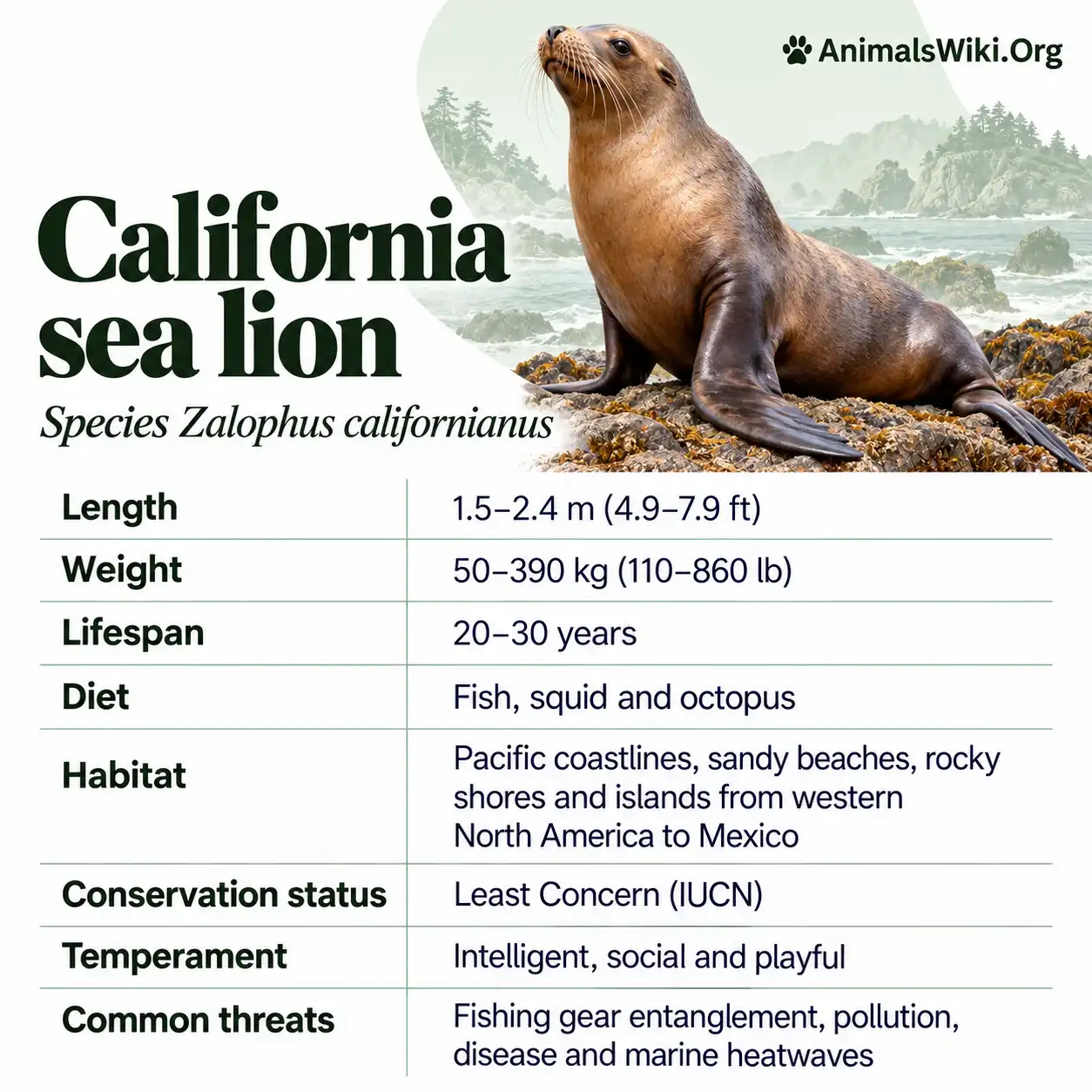
California Sea Lion, The Clever, Barking Marine Mammal
The California sea lion is one of the most recognizable marine mammals along the western coast of North America. Its loud barking, visible ear flaps, long front flippers, and confident movements across docks make it a familiar sight in coastal towns and wildlife areas.
However, there is much more to this animal than its noisy public appearances. California sea lions are capable hunters, skilled divers, attentive mothers, and remarkably flexible learners. Their daily lives connect crowded resting places with feeding grounds that may lie far beyond the shoreline.
Despite their name, they do not live only in California. Their distribution extends along a much larger section of the eastern North Pacific, including waters off Mexico, the northwestern United States, and Canada.
Their success also comes with challenges. Changing ocean conditions can reduce access to food, toxic algal blooms can affect their health, and fishing gear can cause serious injuries. An abundant species can still experience difficult conditions in particular places or years.
This guide explains what California sea lions look like, how they live, what they eat, how they raise their pups, and why their health provides useful information about the ocean.
California Sea Lion Facts
| Feature | Information |
|---|---|
| Common name | California sea lion |
| Scientific name | Zalophus californianus |
| Animal type | Marine mammal |
| Family | Otariidae, the eared seal family |
| Main distribution | Eastern North Pacific |
| Typical male appearance | Large, dark brown body with a prominent forehead crest |
| Typical female appearance | Smaller, slender body with tan or golden-brown fur |
| Diet | Fish, squid, and other marine prey |
| Swimming propulsion | Primarily the front flippers |
| Reproduction | Usually one pup per pregnancy |
| Social behavior | Often gathers in large groups |
| Familiar sound | Loud barking |
| Global conservation category | Least Concern |
| Important threats | Food shortages, harmful algal toxins, disease, entanglement, and human disturbance |
1. What Is a California Sea Lion?
A California sea lion is an air-breathing marine mammal belonging to the eared seal family, Otariidae. Its scientific name is Zalophus californianus.
It is a pinniped, part of the broader group containing sea lions, fur seals, true seals, and walruses.
The word “eared” refers to the small external ear flaps visible on either side of its head. True seals have ear openings but lack these projecting flaps.
California sea lions spend much of their lives feeding and traveling in water, yet they remain strongly connected to land. They come ashore to rest, breed, give birth, and nurse their young.
Their limbs are modified into flippers, but they can still support themselves and move on all fours.
Like other mammals, they maintain their body temperature and nourish their young with milk. They must return to the surface to breathe between dives.
The animal sometimes described as a “trained seal” in older entertainment settings is often actually a California sea lion.
2. What Does a California Sea Lion Look Like?
California sea lions have streamlined bodies, long necks, pointed muzzles, prominent whiskers, and large front flippers.
Their appearance changes considerably with age and sex.
Adult males are usually dark brown and develop a pronounced raised area on the forehead called a sagittal crest. Lighter hair may appear around the top of the head as they mature.
Females and younger males are generally lighter, often appearing tan or golden brown.
Newborn pups have dark coats that change as they grow.
Wet fur can make an animal look much darker than it appears after drying. This means photographs taken under different conditions may show what seems like a dramatic color difference within the same species.
A reliable identification combines several characteristics: external ears, body shape, muzzle, flippers, and the male’s forehead profile.
Color alone is less dependable, particularly when an animal is partly submerged or photographed in shadow.
3. How Big Do California Sea Lions Get?
California sea lions show strong sexual size differences. Adult males are substantially larger and heavier than females.
Broad adult ranges commonly given by educational sources are:
| Sex | Approximate length | Approximate weight |
|---|---|---|
| Adult male | 2–2.5 meters | 200–400 kilograms |
| Adult female | 1.5–2 meters | 50–110 kilograms |
These ranges describe typical variation rather than a fixed size reached by every animal.
Age and body condition matter. A young male may resemble a large female before developing the bulk and head shape associated with mature adulthood.
Season also influences weight. An animal that has been feeding successfully may carry greater reserves than one that has been fasting or experiencing poor food conditions.
The size difference is especially striking when a mature male rests beside females or juveniles.
For comparisons, it is important to distinguish average adult measurements from exceptional maximum records. Mixing those figures can make closely related species appear more different—or more similar—than they really are.
4. California Sea Lion vs Seal: How Can You Tell?
California sea lions are frequently confused with harbor seals because both occur along many of the same coastlines.
Several visible features help separate them.
| Feature | California sea lion | Harbor seal |
|---|---|---|
| External ear flaps | Present | Absent |
| Front flippers | Long and prominent | Relatively short |
| Movement on land | Can support itself on four limbs | Moves with a more undulating body motion |
| Typical vocal impression | Frequently barks loudly | Usually less conspicuous vocally |
| Body appearance | Often relatively upright when resting | Commonly rests low against the ground |
Sea lions can rotate their hind flippers underneath the body. Harbor seals cannot do this in the same way.
That difference explains why a sea lion can move across a dock with an almost walking motion.
In water, sea lions primarily use their front flippers for propulsion, while true seals rely more heavily on their hindquarters.
A combination of ears, flippers, and movement usually provides a clearer answer than body color or size alone.
5. California Sea Lion vs Steller Sea Lion
California and Steller sea lions overlap along parts of the North American Pacific coast.
Steller sea lions are generally larger and often have paler adult coats. Their heads look broad and substantial, particularly in mature males.
California sea lions usually have a narrower muzzle. Adult males develop a noticeable raised forehead crest.
Their voices provide another clue. California sea lions produce familiar repeated barks, whereas Steller sea lions are more associated with deep roars, growls, and bellows.
However, identification requires attention to age and sex. A juvenile Steller sea lion may be smaller than an adult male California sea lion.
Mixed groups can make these comparisons easier because animals are visible side by side.
When observing a distant colony, listen as well as look. Sound may indicate that more than one species is present.
Local wildlife guides are especially helpful because they focus on the species and age classes likely to occur in that particular area.
6. Where Do California Sea Lions Live?
California sea lions inhabit the eastern North Pacific.
Their overall distribution extends from waters off Mexico northward along the western United States and into Canadian and southeastern Alaskan waters.
Their main breeding range is more restricted than their full distribution. Important breeding areas occur on islands off southern California and Mexico.
This distinction explains why a sea lion seen far north may not be close to the place where it was born.
Different parts of the range serve different purposes. Some locations support large breeding colonies, while others function mainly as seasonal feeding or resting areas.
The species also occurs in the Gulf of California, where local environmental conditions differ from those along the outer Pacific coast.
Its common name therefore describes only part of its geographic story.
Understanding the whole range helps explain seasonal sightings, regional conservation differences, and the need for cooperation across national boundaries.
7. Why Do They Rest on Docks, Buoys, and Jetties?
California sea lions use both natural and human-made resting places.
Rocky shores, beaches, and sheltered coves provide natural haul-out habitat. Docks, navigation buoys, and jetties can offer additional surfaces above the water.
A suitable haul-out allows animals to rest between feeding trips.
The presence of sea lions on a dock does not necessarily mean they are trapped, sick, or unable to return to the ocean.
Their ability to climb and move across solid surfaces makes these structures accessible.
However, sharing coastal infrastructure can create difficulties. People may need access to boats, and sea lions can react defensively if approached or cornered.
The practical solution is to maintain separation and follow local management arrangements.
A place used for resting is also not automatically a breeding colony. Breeding sites, called rookeries, have a different role in the life cycle.
Recognizing that difference helps explain why some docks hold many animals but no newborn pups.
8. Do California Sea Lions Migrate?
Many male California sea lions travel north after the breeding season.
They use feeding and resting areas off Oregon, Washington, British Columbia, and sometimes farther north.
Females generally remain more closely connected to breeding regions while raising dependent pups, although movements vary with environmental conditions.
This produces an uneven distribution of sexes and ages across the coastline.
A group observed at a northern haul-out may therefore contain mainly males rather than a balanced sample of the entire population.
Migration should not be imagined as every animal following one identical route on the same date.
Individuals differ in destination, timing, and the sites they use along the way.
Wildlife agencies in Oregon describe these seasonal movements as a major reason California sea lions appear in local waters.
Their presence connects coastal regions: an animal resting near a northern harbor may later return hundreds of kilometers south for breeding.
9. How Do California Sea Lions Swim?
California sea lions move through water using powerful strokes of their front flippers.
Their streamlined bodies help reduce resistance, while their flexible necks and bodies support rapid turns.
Swimming includes a combination of active propulsion and gliding. The balance between those phases changes with speed, depth, and buoyancy.
Research on diving California sea lions shows that movement costs are influenced by body density and the depth of a dive.
Near the surface, air in the lungs contributes to buoyancy. As an animal descends and pressure increases, the situation changes.
This means swimming downward and swimming upward do not always require the same effort.
Their underwater movements are therefore more sophisticated than simply paddling continuously.
Efficient travel matters because hunting requires an energy investment. A sea lion must obtain enough food to cover the cost of reaching prey, pursuing it, and returning to the surface.
Its swimming style helps make that process possible across a wide range of feeding conditions.
10. How Deep Can California Sea Lions Dive?
California sea lions can dive much deeper than older summaries sometimes suggest.
Research literature reports adult females diving beyond 500 meters, although many routine dives are far shallower.
A maximum depth is a measure of capability, not a description of every feeding trip.
Diving behavior varies with prey, location, season, individual strategy, and reproductive responsibilities.
Some animals search in the water column, while others repeatedly visit the seabed.
A dive also has several stages: descent, searching or feeding, ascent, and recovery at the surface.
Depth alone cannot describe how demanding it was. Duration, swimming effort, and the time available to capture prey all matter.
For this reason, modern studies use multiple measurements rather than relying only on the deepest recorded point.
The important ecological question is which depths an animal must use regularly to obtain enough food.
Deep-diving ability is impressive, but successful feeding depends on making those dives profitable.
11. How Do They Hold Their Breath?
California sea lions store oxygen in their lungs, blood, and muscles.
The oxygen-binding protein myoglobin helps supply muscles during submergence.
Their ability to manage oxygen develops with age, which is important when young animals begin feeding independently.
Research comparing age and sex classes has found differences in total oxygen stores and calculated diving capacity.
A juvenile does not necessarily possess the same physiological capacity as a fully grown adult.
Breath-holding also involves balancing several demands. Swimming faster uses energy, while remaining submerged longer delays the next opportunity to breathe.
A sea lion must manage those competing needs during each dive.
This is one reason feeding conditions matter so much. If prey becomes deeper or harder to locate, the animal may need to work harder for the same reward.
Its physiology supports underwater hunting, but it does not remove the limits imposed by oxygen, recovery time, and the need to find food efficiently.
12. How Do California Sea Lions Stay Warm or Cool?
California sea lions use blubber, circulation, and behavior to regulate their temperature.
Blubber beneath the skin reduces heat loss and stores energy.
Their flippers provide an important surface for exchanging heat because they are less insulated than the main body.
A floating animal may raise one or more flippers above the water. Depending on conditions, this can help it absorb or release heat.
On land, sea lions can change position, seek shade, lie on damp surfaces, or return to the water.
This flexibility matters because the thermal conditions on a sunny beach differ greatly from those during an underwater feeding trip.
A behavior that looks strange to a visitor may therefore serve a practical purpose.
Raised flippers are not automatically evidence of injury or entanglement.
The entire situation should be considered before interpreting an animal’s posture, especially when no fishing line or other restriction is visible.
13. What Do California Sea Lions Eat?
California sea lions are carnivores with a varied diet.
Common prey include:
- Anchovies
- Sardines
- Herring
- Hake
- Mackerel
- Rockfish
- Squid
- Octopus
The importance of each food changes among regions and seasons.
They are opportunistic predators, meaning they can use different feeding opportunities rather than depending on one prey species everywhere.
However, flexibility has limits. Available prey must still be accessible and provide sufficient energy.
Small prey may be swallowed whole, while larger items can be torn into manageable pieces.
Their teeth are useful for grasping prey, but their feeding does not resemble the prolonged chewing associated with many land mammals.
Food also supplies much of the water they require.
A simple list of prey therefore captures only part of their feeding ecology. Researchers also need to know how much food is available, how far away it is, and how much effort is required to obtain it.
14. Why Is Prey Quality So Important?
A sea lion’s energy intake depends on more than the number of fish it catches.
Different prey contain different amounts of energy, and prey distribution influences the effort required to capture them.
This becomes especially important for nursing females, which must support their own bodies while producing milk.
Research off central and southern California has linked changes in forage resources with the weight of dependent pups.
The connection is indirect but powerful: the mother encounters feeding conditions at sea, and the pup experiences the consequences through maternal milk.
A beach can appear to contain plenty of mothers and pups while difficult feeding conditions are developing offshore.
This explains why scientists measure pup growth as well as count births.
Successful reproduction requires more than producing a newborn. The mother needs enough resources to keep that young animal growing.
Prey quality, abundance, location, and accessibility all contribute to that outcome.
15. How Do Their Whiskers Help Them Hunt?
The long whiskers around a California sea lion’s muzzle are sensitive sensory structures.
They help the animal investigate objects and detect movements in water.
An animal swimming through water leaves disturbances behind it. These hydrodynamic trails can contain information that remains after the object itself has passed.
Experiments have shown that a California sea lion can follow such trails under controlled conditions.
This ability is useful because underwater visibility is not always clear.
Tactile and water-movement information can supplement sight, especially when prey moves through dark or murky surroundings.
The whiskers are also actively controlled rather than behaving like passive hairs.
Researchers studying coordinated tasks have documented deliberate changes in whisker position.
These findings reveal an animal gathering information through several channels at once.
Its face is therefore more than a recognizable feature for photographers: it carries part of the sensory equipment supporting feeding and movement in a challenging environment.
16. Can California Sea Lions See and Hear Underwater?
Yes. California sea lions use vision and hearing in the marine environment.
Their eyes are adapted to underwater focusing and changing light conditions.
Hearing also supports communication and awareness of their surroundings.
The importance of each sense changes with circumstances. Clear water, low light, heavy surf, or a noisy colony create different sensory challenges.
There is no established evidence that California sea lions use dolphin-like echolocation.
Their ability to hunt effectively should not be confused with the specialized sonar system of toothed whales.
Instead, sight, hearing, touch, experience, and movement work together.
This combination helps explain why an animal can remain effective when one kind of information is limited.
A prey item hidden from view may still produce water movement, while a familiar call can help locate another sea lion within a crowd.
Their sensory world includes signals that human observers may not notice at all.
17. Why Do California Sea Lions Bark?
Barking is a major part of California sea lion communication.
Males use vocalizations during territorial interactions, while females and pups exchange calls that help maintain contact.
Their repertoire includes more than the familiar bark. Growls, grunts, and other sounds occur in different social situations.
A noisy colony contains signals related to identity, position, threat, and reunion.
During breeding, a male may vocalize frequently while establishing or defending his territory.
A mother returning from sea produces calls that prompt responses from her pup.
This exchange helps guide them toward one another.
The sounds can seem repetitive to human ears, but they are not necessarily interchangeable to the animals.
Recognizing the social function of vocalizations changes how a colony is understood. Its noise is part of the organization of daily life.
The barking that makes California sea lions famous also supports the relationships and boundaries on which successful breeding depends.
18. Are California Sea Lions Social Animals?
California sea lions are highly social, especially when resting on land.
They may gather in dense groups, lying close together or partly on top of one another.
However, a crowded haul-out should not be mistaken for a permanently organized family group.
Relationships and spacing change with season, age, sex, and breeding activity.
During the nonbreeding period, group organization is comparatively flexible.
Breeding colonies involve stronger territorial behavior and additional interactions around pups.
Social life also includes conflict. Animals compete for space, and larger individuals can displace smaller ones.
At the same time, resting together is a normal part of the species’ behavior.
A brief argument on a dock is therefore not automatically evidence of a problem requiring intervention.
The colony is a dynamic place where individuals repeatedly negotiate access to preferred surfaces, respond to neighbors, and move between land and water according to their own needs.
19. How Intelligent Are California Sea Lions?
California sea lions have demonstrated substantial learning and memory abilities in controlled studies.
Researchers have investigated how they recognize relationships among symbols, transfer learned rules, and remember concepts.
These experiments go beyond showing that an animal can perform a practiced movement for food.
They ask whether learning can be applied to new combinations or situations.
Work on long-term memory has shown that California sea lions can retain information about learned concepts across extended periods.
Such findings are especially interesting because they reveal abilities that may not be obvious during ordinary wildlife observation.
However, animal intelligence is not a single score.
Memory, sensory discrimination, movement control, and social recognition are different capacities.
A sea lion’s success at one task does not establish that it understands everything a human understands.
The strongest conclusions describe exactly what was tested and demonstrated, while appreciating the flexibility needed to learn in a changing coastal environment.
20. Can a California Sea Lion Keep a Musical Beat?
Research involving a California sea lion named Ronan has provided remarkable evidence of rhythmic ability.
She learned to synchronize head movements with repeating sounds and transferred the behavior to new tempos and musical stimuli.
Later research examined her performance after years of intermittent experience.
The results contributed to scientific discussion about how rhythm perception and coordinated movement develop across species.
This does not mean wild sea lions naturally organize musical performances.
It means that a carefully studied individual demonstrated the ability to coordinate movement with an external rhythm.
The distinction makes the finding more meaningful.
Rather than relying on an entertaining appearance, researchers measured timing and tested whether the behavior generalized beyond a memorized routine.
Ronan’s work illustrates how research with marine mammals can challenge assumptions about which animals possess particular cognitive abilities.
It also shows why an apparently playful movement can become scientifically informative when examined through controlled experiments.
21. How Do California Sea Lions Reproduce?
California sea lions usually breed in colonies on islands and other suitable coastal sites.
Their mating system is polygynous: successful males may mate with multiple females.
Males establish territories and compete through vocalizations, displays, and sometimes physical encounters.
A male may reach sexual maturity before he is large or experienced enough to become a successful territorial breeder.
This creates a difference between physical reproductive capability and actual breeding opportunity.
Females generally return to breeding areas and give birth before mating again later in the season.
Breeding activity is strongly seasonal, although timing varies geographically.
The arrangement creates a busy colony where birth, nursing, courtship, and territorial defense can overlap.
It also places different demands on the sexes. Males invest heavily in competition, while females invest in pregnancy and maternal care.
The survival of the next generation depends on both reproductive events and the feeding conditions that support mothers afterward.
22. What Is Delayed Implantation?
California sea lion reproduction includes delayed implantation.
After fertilization, the developing embryo does not immediately implant and continue through an uninterrupted pregnancy.
There is a pause before active development proceeds.
This helps coordinate the annual timing of births and breeding.
The overall interval from mating to birth is approximately eleven months, but that period includes the delay.
It is therefore useful to distinguish the complete reproductive interval from the portion involving active fetal growth.
A female can also face overlapping demands from nursing and pregnancy.
Her energy budget must cover her own maintenance while supporting offspring at different developmental stages.
Delayed implantation provides a timing mechanism, but it does not remove the need for adequate nutrition.
Successful reproduction still depends on the mother’s condition, feeding opportunities, and ability to return regularly to her dependent pup after trips to sea.
23. What Are California Sea Lion Pups Like?
A newborn California sea lion pup has a dark coat and depends on its mother’s milk.
It begins life on land, where it must cope with weather, neighboring animals, and the uneven surfaces of the rookery.
Most females give birth to one pup.
During the early period after birth, the mother stays close, establishing the relationship that will later allow repeated separations and reunions.
As the pup develops, its movement, coordination, and interest in the surrounding environment increase.
Swimming and diving ability emerge gradually rather than appearing at full adult capacity immediately.
The coat also changes as the animal grows and molts.
Young animals can look very different from the large dark males familiar from harbor photographs.
For this reason, identifying a small stranded sea lion requires attention to age as well as species.
A pup is not simply a miniature adult; it has different needs, abilities, and risks during its first months.
24. How Does a Mother Find Her Pup?
A mother returning from a feeding trip may face hundreds of other animals at the colony.
She uses recognizable vocalizations to locate her own pup.
The pup responds, creating an exchange that helps bring them together.
At close range, scent provides another important check.
This combination reduces the chance of mistaking an unrelated pup for her own.
The process demonstrates how communication supports a practical survival task.
A female invests heavily in producing milk, so identifying the correct offspring matters.
The pup also benefits from recognizing the individual that provides food and protection.
To a visitor, the colony can seem like a confusing mass of similar animals. For mother and pup, it contains familiar voices and smells.
Their reunion is one of the clearest examples of how specialized behavior makes life in a crowded breeding colony possible.
25. Why Are Pups Sometimes Left Alone?
California sea lion mothers must leave the colony to obtain food.
While the mother feeds at sea, her pup remains ashore.
She later returns to nurse, then repeats the cycle.
A temporary absence is therefore a normal feature of maternal care, not automatic evidence of abandonment.
The pup must tolerate intervals without feeding while relying on the energy supplied during nursing visits.
This system works best when the mother can find food efficiently.
If prey becomes difficult to locate, feeding trips may become more demanding, and the consequences can reach the waiting pup.
Members of the public should avoid feeding or handling a lone young sea lion.
An animal showing visible injury, entanglement, or unusual distress should be reported to trained responders.
The absence of a nearby adult should be considered alongside the full situation rather than treated as sufficient reason to attempt a rescue.
26. When Do Young Sea Lions Become Independent?
Independence develops through a combination of growth, experience, and physiological maturation.
A young sea lion must learn to locate prey, capture it, dive effectively, and return to suitable resting places.
These abilities do not all mature at the same rate.
Research on oxygen stores shows that young California sea lions have different diving capacities from adults.
This creates a challenging transition when maternal support ends.
The juvenile must obtain enough food while still developing the capabilities needed to hunt efficiently.
Poor feeding conditions can make this stage especially difficult.
Large numbers of stranded juveniles during past events have highlighted the importance of the transition from milk dependence to independent feeding.
Their survival affects the population years later, when those young animals would otherwise enter the breeding population.
Counting newborn pups is therefore only one part of understanding reproductive success. Researchers also need to know how many survive the difficult stages that follow.
27. How Long Do California Sea Lions Live?
California sea lions can live for two decades or more, and some individuals reach approximately thirty years.
However, potential longevity is different from average survival.
Many animals die before adulthood, while others survive through numerous breeding seasons.
Early mortality can involve food shortages, illness, separation, or environmental hazards.
Adults face additional risks from disease, toxins, fishing gear, predators, and human activity.
A single lifespan figure therefore needs context.
“Can live thirty years” does not mean every newborn has a thirty-year life expectancy.
Researchers studying known individuals can investigate survival across ages and changing conditions.
This approach provides more useful information than relying only on the oldest recorded animal.
Longevity also influences conservation: a long-lived female may contribute offspring over several seasons, so changes in adult survival can have consequences extending well beyond one year’s pup count.
28. What Eats California Sea Lions?
Natural predators include killer whales and large sharks.
The risk depends on location, age, body size, and the circumstances of an encounter.
A young sea lion may face different dangers from a large adult male.
Predation is a normal part of marine ecosystems. It links sea lions with larger predators and helps position them within the broader food web.
That natural process should be distinguished from avoidable harm caused by discarded gear, illegal injury, or disturbance.
Sea lions themselves are effective predators, but being a hunter does not make them invulnerable.
Their behavior at sea reflects the need to obtain food while remaining alert to danger.
For wildlife observers, the presence of predators should be understood in ecological context rather than described automatically as a conservation failure.
The important question is how natural mortality interacts with other pressures and whether populations continue to replace the animals lost.
29. Are California Sea Lions Endangered?
The California sea lion is globally classified as Least Concern.
This reflects its overall status, but it does not mean every local population is increasing or that conservation work is unnecessary.
Research documenting the recovery of the U.S. population has described a major improvement following protection under the Marine Mammal Protection Act.
However, population growth cannot continue indefinitely.
Available food, habitat, and environmental conditions influence how many animals an area can support.
Recovery also creates new management challenges where sea lions encounter people, fishing operations, or vulnerable fish populations.
The most accurate description recognizes both achievements and continuing pressures.
A recovered population can experience temporary setbacks, while a globally abundant species can decline in part of its range.
Conservation categories summarize risk at a particular scale. They should not replace attention to regional trends, animal health, and changing ocean conditions.
30. Why Do Population Trends Differ by Region?
California sea lions in different regions encounter different food webs, temperatures, and environmental histories.
A favorable trend along one coastline does not guarantee the same outcome elsewhere.
Research in the Gulf of California has linked population changes with long-term variation in sea-surface temperature.
Other work comparing Mexican and U.S. populations has investigated why their trajectories differ.
The underlying influences can include prey quality, prey distribution, local oceanography, and reproductive performance.
This makes regional monitoring essential.
A single worldwide total can hide local declines, especially when growth elsewhere offsets them.
Similarly, a well-known crowded dock is not a reliable indicator of conditions at a distant breeding colony.
Understanding population change requires repeated observations across multiple sites and years.
The California sea lion provides a useful example of a broader ecological principle: members of the same species can experience very different fortunes because they depend on different local environments.
31. How Do Warm Oceans Affect California Sea Lions?
Warm ocean conditions can alter the abundance, distribution, and quality of prey.
The effect on sea lions often appears through their ability to obtain food rather than through temperature alone.
During difficult periods, mothers may struggle to provide enough milk, and newly independent animals may fail to find sufficient prey.
California’s environmental monitoring has documented changes in pup growth, mortality, and strandings associated with ocean conditions.
The 2014–2016 marine heatwave was especially important in understanding these relationships.
A mother may continue using a familiar rookery while the feeding environment around it changes substantially.
Her pup experiences those offshore changes through reduced growth or poorer condition.
This is why scientists examine physical ocean measurements alongside biological data.
Temperature records become more informative when connected to prey surveys, maternal movements, pup weights, and survival.
Together, they reveal how a changing ocean affects animals at several stages of the life cycle.
32. What Is Domoic Acid Poisoning?
Domoic acid is a toxin produced by certain marine algae.
It can move through the food web when contaminated prey are eaten by larger animals.
California sea lions may be exposed through fish they consume.
Poisoning can affect the nervous system, causing disorientation, seizures, and other serious problems.
The Marine Mammal Center identified a major outbreak in California sea lions in 1998 and has continued researching the condition.
Not every algal bloom produces the same toxin, and a visibly green or discolored ocean is not required for exposure to occur.
Diagnosis depends on professional evaluation rather than appearance alone.
Research also examines longer-term effects and the consequences for reproduction.
A sea lion behaving unusually on a beach should be given space and reported to trained responders.
Attempting to handle an affected animal can increase stress and create danger for both the sea lion and nearby people.
33. What Is Leptospirosis in Sea Lions?
Leptospirosis is a bacterial disease that can damage the kidneys.
It is an important cause of illness in California sea lions and has produced recurring outbreaks among animals admitted for rehabilitation.
The disease affects fluid balance and normal kidney function.
Veterinary teams use examination, laboratory testing, and treatment to evaluate affected animals.
Because leptospirosis can also affect people and dogs, direct contact with sick wildlife should be avoided.
That does not mean every sea lion resting on shore is infectious or unwell.
The useful response is to maintain distance and report concerns rather than attempting to make a diagnosis.
Research on this disease also benefits from following animals after treatment.
Learning whether released sea lions resume normal movement and feeding helps evaluate rehabilitation outcomes and improve understanding of recovery.
Their health offers information about both individual disease and the conditions experienced by wildlife along busy coastlines.
34. Why Do Scientists Study Cancer in California Sea Lions?
California sea lions are important subjects in research on wildlife cancer.
Scientists have investigated relationships among urogenital cancer, a herpesvirus, and exposure to persistent contaminants.
These studies examine how infection and environmental factors can interact.
A crucial distinction is that findings from stranded or necropsied animals do not automatically describe the cancer rate in every wild sea lion.
Animals admitted to a rehabilitation center are not a random sample of the entire population.
Keeping that limitation clear prevents dramatic statistics from becoming misleading.
The research remains valuable because it identifies processes that can affect wildlife health and raises questions about long-lasting pollutants in marine ecosystems.
Contaminants may persist long after their original release.
Studying exposed predators helps reveal how those materials continue moving through food webs.
The California sea lion is therefore both a patient receiving care and a source of evidence about environmental health.
35. How Do Fishing Gear and Marine Debris Harm Them?
California sea lions can become caught in netting, line, packing bands, and other material.
An entanglement may restrict movement, interfere with feeding, or cut into tissue.
Young animals face an additional problem: material that initially fits loosely can tighten as they grow.
A sea lion may remain mobile despite a serious injury, making the severity easy to underestimate.
Professional responders sometimes need specialized equipment and repeated attempts to remove dangerous material.
Research has documented California sea lions surviving for years after successful disentanglement, showing the value of intervention in suitable cases.
However, rescue is difficult and cannot address every affected animal.
Preventing debris from entering the water is essential.
Securing waste, disposing of fishing line correctly, and reducing lost gear help remove hazards before wildlife encounters them.
Members of the public should report entangled animals rather than trying to cut material from a powerful, frightened sea lion themselves.
36. Why Do Sea Lions Sometimes Cause Conflict With Fisheries?
California sea lions and people often target the same fish.
Some animals take fish from lines or concentrate near locations where fish movement is restricted.
These situations can create economic concerns and conservation problems, particularly where vulnerable fish populations are involved.
Management in the Columbia River Basin provides a prominent example.
The circumstances are specific: agencies consider the location, fish populations, sea lion behavior, and legal authorization.
These cases should not be turned into a claim that all sea lions everywhere are responsible for declining fish stocks.
Likewise, the presence of fishing activity does not establish that every sea lion problem is caused by fisheries.
Useful management depends on identifying the actual interaction and measuring its consequences.
Reducing opportunities for animals to associate people with easy meals is also important.
Feeding wildlife can create behavior that later becomes difficult to manage safely.
37. What Do Scientists Learn From Stranded Sea Lions?
Stranded animals provide information about disease, nutrition, injury, and environmental change.
Veterinarians can investigate why an animal came ashore, while researchers compare cases across places and years.
During the 2013–2016 California sea lion unusual mortality event, thousands of juveniles stranded along the California coast.
Investigators identified ecological changes affecting prey as important contributors.
The event demonstrated how problems offshore can become visible through animals arriving on beaches.
However, stranded animals require careful interpretation.
A rehabilitation center sees individuals experiencing difficulty, not a complete cross-section of all healthy and unhealthy sea lions.
The strongest assessments combine stranding records with field surveys, pup measurements, prey information, and environmental data.
This approach helps distinguish a localized problem from a broader population concern.
It also improves preparedness by showing which conditions have preceded major increases in the need for rescue and treatment.
38. How Can You Watch California Sea Lions Responsibly?
Watch from a distance that allows the animals to continue their normal behavior.
Use binoculars or a zoom lens rather than approaching for a closer photograph.
Keep dogs away, avoid feeding, and do not block access to the water.
Follow posted restrictions and local guidance, particularly around breeding colonies.
NOAA generally advises remaining at least 50 yards from seals and sea lions, although regional rules or conditions may require more space.
An animal’s reaction matters as well as the measured distance.
If it repeatedly watches your approach, shifts away, or begins moving toward the water, increase your distance.
Resting animals do not need to be made active for a better picture.
If a sea lion appears injured, entangled, or seriously unwell, record the location and contact the appropriate response organization.
Responsible observation allows people to enjoy these animals while protecting the resting, feeding, and maternal behavior that supports their survival.
Frequently Asked Questions About California Sea Lions
1. Is a California sea lion a mammal?
Yes. It breathes air, maintains its body temperature, gives birth to live young, and feeds its pups milk. Its aquatic lifestyle does not change its classification as a mammal.
2. What is its scientific name?
The scientific name is Zalophus californianus. California sea lions belong to Otariidae, the family containing sea lions and fur seals.
3. Are California sea lions the same as Galápagos sea lions?
No. They are separate species. Older references sometimes grouped them differently, so scientific names are useful when checking which animal a source describes.
4. Do California sea lions live only in California?
No. They occur along a much larger portion of the eastern North Pacific, including Mexican waters and coastal areas north of California. Breeding distribution and seasonal distribution differ.
5. How can you recognize an adult male?
Adult males are large and usually dark brown. They develop a prominent forehead crest and may have lighter hair around the top of the head.
6. Why are females smaller than males?
The species has pronounced sexual size differences associated with its breeding system. Males invest heavily in competition, while females have different growth and reproductive demands.
7. Do California sea lions have ears?
Yes. They have small external ear flaps. These are a useful way to distinguish sea lions from true seals, which lack projecting ear flaps.
8. Can they walk on land?
They can rotate their hind flippers underneath the body and move on four limbs. Their movement differs from a land mammal’s gait but allows effective travel across suitable surfaces.
9. Do they have tails?
Yes. California sea lions have a small tail between their hind flippers. It is much less conspicuous than the broad flippers used for swimming and movement.
10. What do they eat?
They eat fish, squid, and other marine prey. The main foods vary geographically and seasonally, reflecting local availability and feeding opportunities.
11. Are California sea lions herbivores?
No. They are carnivores. Their food comes from other animals rather than seaweed, grass, or other plants.
12. Do they chew fish?
They commonly swallow small prey whole and may tear larger items into pieces. Their feeding does not involve the extensive chewing typical of many land mammals.
13. Can they breathe underwater?
No. They hold their breath during dives and return to the surface for air. Oxygen stored in the lungs, blood, and muscles supports underwater activity.
14. How deep can they dive?
Research reports adult females diving beyond 500 meters. Many ordinary feeding dives are much shallower, depending on prey, habitat, and individual strategy.
15. Why do they bark?
Barking and other vocalizations communicate information during territorial interactions, social encounters, and mother–pup reunions. Different sounds occur in different contexts.
16. Are California sea lions intelligent?
They have demonstrated flexible learning, memory, and sensory discrimination in controlled studies. Intelligence involves several abilities, so precise research findings are more useful than a simple ranking.
17. Can they recognize their pups?
Yes. Mothers use vocal and scent information to identify their own offspring. This is especially important when returning from feeding trips to a crowded colony.
18. What is a baby California sea lion called?
A baby is called a pup. It initially depends on milk and gradually develops the skills needed to swim, dive, and obtain food independently.
19. Is a pup alone on shore abandoned?
Not necessarily. Its mother may be feeding at sea. Temporary separation is normal, and intervention should depend on professional assessment rather than the absence of an adult alone.
20. Why do they rest on docks?
Docks can provide convenient haul-out surfaces between feeding trips. Resting on a human-made structure does not automatically mean an animal is sick or unable to return to the water.
21. Are they dangerous to people?
They can bite and cause serious injury if approached, cornered, or handled. They are powerful wild animals, and respectful distance is essential.
22. Can you feed a California sea lion?
No. Feeding can change natural behavior and encourage risky interactions with people and fishing gear. It is also prohibited under relevant U.S. marine mammal protections.
23. Are they endangered?
They are globally classified as Least Concern. However, regional declines, disease outbreaks, food shortages, and other threats still make monitoring and protection important.
24. What causes seizures in sea lions?
Domoic acid poisoning is one possible cause, but abnormal behavior requires professional evaluation. Observers should keep their distance and report the animal rather than attempting a diagnosis.
25. What should you do if one is entangled?
Note the location, observe from a safe distance, and contact the appropriate marine mammal response organization. Do not attempt to restrain the animal or remove gear yourself.
California Sea Lions and the Health of the Coast
California sea lions combine adaptability, intelligence, and specialized marine skills.
Their lives link island rookeries, urban harbors, coastal feeding grounds, and deeper offshore waters. A mother’s hunting success influences her pup’s growth, while changes in prey can affect survival across an entire season.
Their recovery in parts of their range demonstrates the value of protection. Their continuing exposure to toxins, disease, entanglement, and changing food conditions shows why abundance alone does not remove the need for attention.
Watching a colony offers a glimpse of this larger story. Behind the barking and crowded resting places are animals making repeated decisions about food, energy, reproduction, and survival.
Giving them space and maintaining healthy marine habitats helps preserve one of the Pacific coast’s most familiar and engaging wildlife experiences.



