
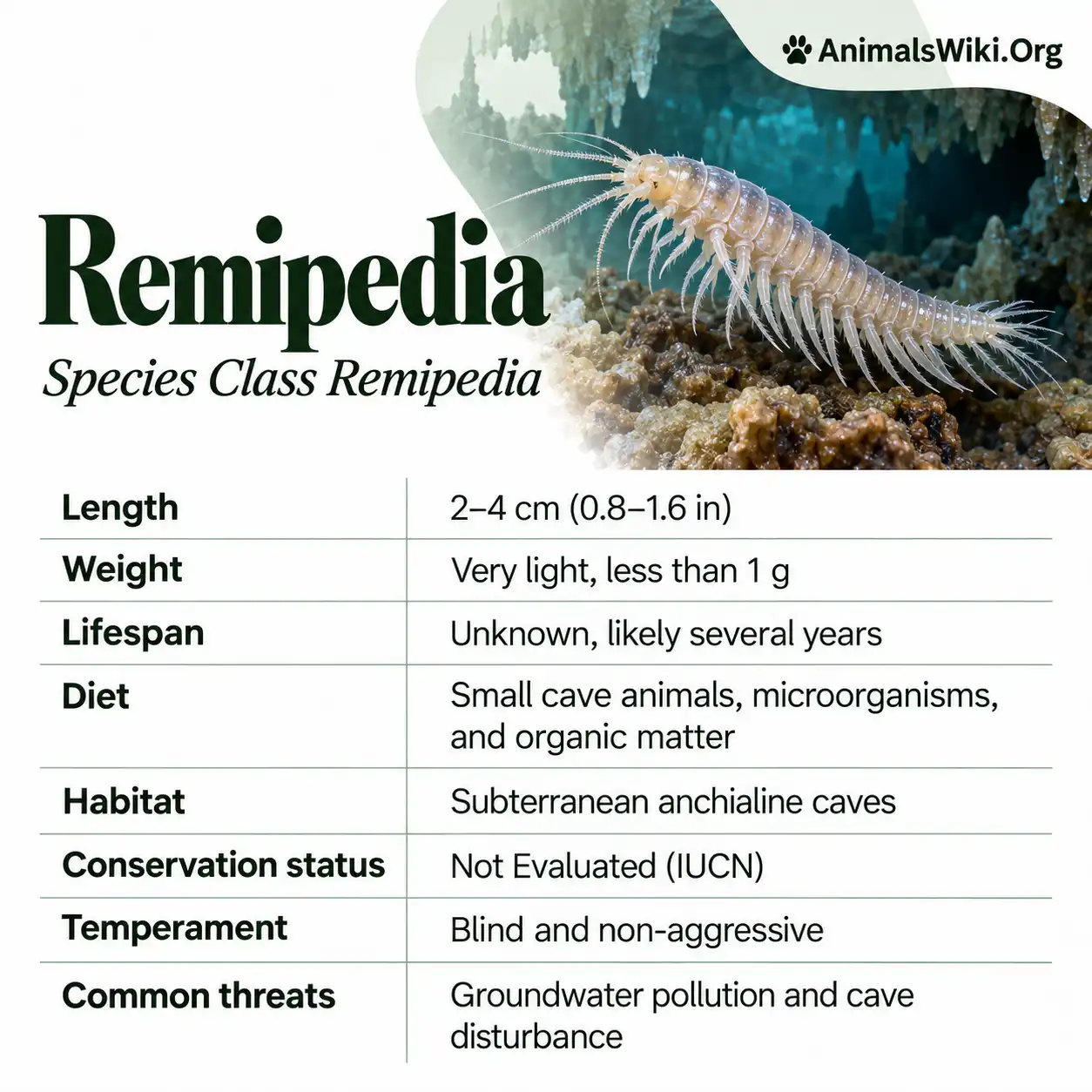
Remipedia, The Blind, Venomous Crustaceans Living in Underwater Caves
Remipedia is a small class of aquatic crustaceans whose living members inhabit submerged caves. These animals, individually called remipedes, have pale bodies, no eyes, and long trunks lined with swimming limbs. Their appearance often reminds people of centipedes, but their anatomy and evolutionary relationships place them among crustaceans.
Their underground world is difficult to imagine from the surface. A quiet pool or coastal opening can lead into passages where fresh water meets seawater, sunlight disappears, and food arrives through complicated underground pathways. Within these dark habitats, remipedes swim, detect chemical signals, and capture or collect food.
They are especially remarkable because research established them as the first conclusively demonstrated venomous crustaceans. However, describing them only as venomous predators overlooks much of their biology. Studies suggest that at least some remipedes also collect suspended particles, and their relationships with cave microbes may be more important than scientists once realized.
Remipedia also matters far beyond cave biology. Modern evolutionary research places these animals close to the lineage containing insects, making them valuable for understanding how some of the planet’s most diverse animals are related.
This guide explores what remipedes are, where they live, how their bodies work, what researchers have discovered, and which questions remain unanswered.
Remipedia Facts
| Feature | Information |
|---|---|
| Common name | Remipedes |
| Scientific group | Remipedia |
| Taxonomic rank | Class |
| Animal type | Aquatic crustaceans |
| Phylum | Arthropoda |
| Living order | Nectiopoda |
| General appearance | Pale, elongated, segmented, and eyeless |
| Adult size | Approximately 9–45 millimeters in a published review; varies by species |
| Main habitat | Submerged caves, particularly coastal anchialine systems |
| Distribution | Greater Caribbean region, Canary Islands, and Western Australia |
| Movement | Coordinated beating of paired swimming limbs |
| Feeding | Predation, with particle feeding and other food sources also investigated |
| Venom | Demonstrated through anatomical and molecular research |
| Reproduction | Hermaphroditic anatomy; reproductive behavior remains incompletely understood |
| Early development | Includes naupliar and later larval stages |
| Lifespan | Not reliably established across the class |
| Scientific description | Remipedia was formally described in 1981 |
1. What Is Remipedia?
Remipedia is a class of crustaceans adapted to life in underwater caves. The word refers to the entire scientific group, while “remipede” refers to an individual animal belonging to it.
This distinction matters. Asking about Remipedia is similar to asking about a larger animal group rather than one named species. Its members share recognizable features, but they also differ in size, detailed anatomy, geographic range, and probably aspects of ecology that have not yet been fully studied.
Remipedes are invertebrates, meaning they lack a backbone. Like other arthropods, they possess jointed appendages and an external skeleton. Their limbs and body covering connect them to a broad assemblage that includes crabs, shrimp, insects, spiders, and centipedes.
However, a remipede is neither an insect nor a centipede. Its many similar trunk segments and repeated swimming appendages create a distinctive body plan within crustaceans.
For readers encountering the animal for the first time, the most useful description is a small, pale, eyeless cave crustacean with numerous paired limbs. That description identifies its essential features without turning its unusual appearance into a misleading claim about its ancestry.
2. Discovery and Scientific History
The history of Remipedia shows that major zoological discoveries can occur in habitats that remain difficult to explore.
Scientist and cave diver Jill Yager collected the first recognized living remipedes in the Bahamas in 1979. Her scientific description followed in 1981. The animal she described, Speleonectes lucayensis, had a combination of characteristics sufficiently distinctive to justify recognition of a new crustacean class.
Discovering a new species is already significant. Establishing a new class means recognizing a much broader anatomical distinction than the differences normally separating closely related species.
The discovery did not mean remipedes had recently appeared. It meant scientists had finally reached, collected, and examined animals that had previously escaped formal recognition.
Underwater cave exploration was essential to that process. An animal living beyond a submerged entrance, inside dark passages, cannot be surveyed with the same methods used on a beach or shallow reef.
The story also explains why the group remains incompletely understood. Formal recognition came only decades ago, and each new observation requires access to a demanding environment. Knowledge has grown through repeated expeditions rather than continuous, easy observation.
3. Classification and Scientific Names
A simplified classification helps place Remipedia within the animal kingdom.
| Classification level | Group |
|---|---|
| Kingdom | Animalia |
| Phylum | Arthropoda |
| Broad evolutionary grouping | Pancrustacea |
| Class | Remipedia |
| Order containing living species | Nectiopoda |
Scientific classification is a working explanation of biological relationships. As researchers examine new specimens and compare genetic information, they sometimes revise the boundaries or names of families and genera.
That has happened within Remipedia. An animal named Speleonectes tulumensis in older research is now commonly treated as Xibalbanus tulumensis. Readers may therefore encounter two names for the same species when comparing publications.
Species totals also require caution. Taxonomic databases can differ because they incorporate revisions at different times or follow different treatments. A live database total may not match an older introductory paragraph on the same website.
For a general article, describing Remipedia as a small class containing a few dozen recognized living species is more useful than presenting an undated number as permanently correct.
The scientific name Remipedia should also remain distinct from the common plural “remipedes.” One names the class; the other describes its members.
4. What Do Remipedes Look Like?
A remipede has a recognizable head followed by an elongated trunk. The trunk consists of numerous segments that look broadly similar to one another.
This repeated arrangement contrasts with familiar crustaceans such as crabs, whose bodies are strongly reorganized into compact regions. A remipede’s outline is longer and more evenly segmented.
Its pale or translucent appearance is another striking feature. Depending on the specimen, lighting, and background, internal structures may be partly visible through the body covering. Photographs can make these animals appear almost glasslike.
Living remipedes lack eyes. Their heads instead carry prominent antennae and specialized feeding appendages. These structures help explain how an animal can function effectively without visual information.
The trunk limbs are adapted for swimming rather than walking across dry ground. Their repeated arrangement produces the impression of a miniature underwater centipede, but that resemblance is superficial.
The rear of the body bears paired terminal structures known as caudal rami. These should not be confused with a venomous tail or a scorpion-like stinger.
A photograph alone usually cannot reveal the details needed for species identification. Researchers often examine tiny features of the mouthparts, antennae, and other appendages under magnification.
5. Remipedia Size and Number of Legs
Remipedes are small animals. A major review reported adult body lengths ranging from approximately 9 millimeters in smaller species to around 45 millimeters in larger ones.
These figures provide a useful scale: many remipedes are only a few centimeters long. Images taken at high magnification can make them appear much larger than they are.
There is no single leg count that applies to every member of the class. The number of trunk segments varies, and the segments bear paired swimming appendages.
Furthermore, crustacean appendages are not always equivalent to the simple walking legs people imagine. Remipede trunk limbs are branched structures with multiple components, and specialized head appendages perform different functions.
Counting visible projections in a photograph can therefore produce an inaccurate answer.
Their growth pattern adds another complication. Research has interpreted posterior limb buds as evidence that remipedes can continue adding trunk segments as they grow.
The safest answer to “How many legs does a remipede have?” is that it has many paired swimming limbs, with the exact number depending on its segmentation and developmental condition.
Size, segment count, and limb details are useful biological measurements, but they should always be tied to a particular specimen or species.
6. Remipedia Habitat: Understanding Anchialine Caves
Most discussions of Remipedia begin with the word anchialine.
An anchialine system is a coastal water body with an underground connection to the sea. Its surface opening may appear isolated from the ocean, but submerged passages, cracks, or permeable rock allow water exchange.
Such systems can contain both fresh water and seawater. Water supplied from land may form an upper layer, while denser saline water occupies deeper portions.
For a remipede, the important habitat extends beyond the visible pool. The animal may inhabit submerged spaces that continue far beneath the surrounding landscape.
Many anchialine caves occur in limestone, where water has enlarged fractures and dissolved passages over long periods. However, cave settings are not identical everywhere. Remipedes are also known from a volcanic cave environment in the Canary Islands.
A cave entrance is therefore only a small visible part of a much larger habitat.
This distinction is important for conservation. Protecting the opening while allowing pollution into the groundwater feeding the cave may leave its animal community exposed. The biological system includes the water supply, underground connections, and surrounding land as well as the accessible chamber.
7. Where Are Remipedes Found?
Known living remipedes have a geographically scattered distribution.
The greater Caribbean region contains much of their documented diversity. Important locations include the Bahamas and nearby island groups, as well as parts of the Caribbean region associated with Mexico and neighboring areas.
Other remipedes occur far away in the Canary Islands and Western Australia.
This pattern is called a disjunct distribution: related animals occupy separated regions rather than one continuous, well-documented range.
A scattered map does not provide a simple explanation of how they arrived in each location. Researchers must consider geological history, habitat connections, evolutionary divergence, and the possibility that suitable caves remain unexplored.
An absence of records can have several meanings. A species may truly be absent, the habitat may not exist, or researchers may not have adequately sampled the area.
Remipedes are especially difficult to survey because suitable underground water passages are not equally accessible.
Their known distribution should therefore be treated as a map of confirmed observations, not a complete map of every place where they could potentially occur.
At the same time, it would be unjustified to assume they inhabit every tropical coastal cave.
8. Water Layers and Conditions Inside Their Caves
An underwater cave can contain environmental boundaries that are invisible from the surface.
One important boundary is the halocline, a transition between water layers of different salinity. Where fresh and saline water meet, mixing can create a shimmering or blurred appearance for an observer.
Oxygen, temperature, and chemical composition may also change with depth and position inside a cave. An animal moving a short distance can therefore encounter a different set of conditions.
Many remipede records come from saline water beneath a halocline. However, not every species or observation follows exactly the same pattern.
Some caves also contain sulfide-rich layers or conspicuous microbial growth. These features are part of the local chemistry and food web, rather than decorations surrounding the animals.
Calling remipedes “deep-sea creatures” can be misleading. A cave may be completely dark without lying thousands of meters beneath the ocean.
Darkness and depth are separate characteristics. Rock can block sunlight in a relatively shallow submerged passage.
Understanding that difference helps explain why an animal can possess extreme cave adaptations while living much closer to the surface than an abyssal octopus or a trench-dwelling fish.
9. How Remipedes Survive Without Eyes
Living remipedes are eyeless, but the absence of vision does not mean they cannot detect their surroundings.
An animal’s sensory world depends on the information available in its habitat. In permanent darkness, chemical signals and physical disturbances can provide information that light cannot.
Remipedes possess sensory structures associated with their antennae. These detect features of the surrounding water and send information to the nervous system.
A useful comparison is to imagine entering a dark room. Human vision becomes less useful, while sound and touch become relatively more important. A remipede’s situation is more specialized because its entire biology has developed within an environment where sunlight is absent.
It is inaccurate to say individual remipedes simply stopped using their eyes and lost them during their own lifetimes. Evolutionary changes in cave lineages occur across generations.
Researchers investigate both the disappearance of visual structures and the development or retention of other sensory systems.
The result is an animal that looks visually limited from a human perspective but possesses a different way of receiving environmental information.
Its lack of eyes should be understood as one part of a complete cave-adapted body.
10. How Do Remipedes Swim?
Remipedes swim using repeated, coordinated movements of their trunk appendages.
Because many similar limbs are arranged along the body, their movement can resemble a traveling wave. Each appendage contributes to the overall interaction between the animal and the water.
This system differs from the powerful tail flick associated with some shrimp. A remipede’s many swimming limbs provide a distributed means of propulsion.
Studies of trunk muscles and limb joints show that this movement depends on an organized mechanical system. The apparent simplicity of repeated segments should not be mistaken for an absence of specialized anatomy.
Observing a swimming animal also raises questions beyond propulsion. Researchers can examine how it holds its body, changes direction, moves near surfaces, and positions its antennae and feeding structures.
However, a short video cannot reveal everything about normal activity. The specimen may be responding to a diver, a light, collection, or unfamiliar conditions.
Laboratory observations are valuable because they allow repeated study. Field observations are equally important because they provide environmental context.
Combining the two gives a stronger understanding of behavior than treating either a brief cave encounter or an aquarium observation as the complete picture.
11. What Does Remipedia Eat?
Remipede feeding is more varied than the label “cave predator” suggests.
Researchers have observed predation, including attacks on other crustaceans. Specialized feeding appendages and the discovery of venom support an important role for animal prey.
However, a laboratory study of six remipedes over 76 days suggested that they were not obligatory carnivores. Particle collection or filtering appeared to be a prominent feeding activity under the observed conditions.
That finding does not make the animals harmless grazers or erase the evidence for hunting. It means their feeding strategy may be flexible.
A predator can obtain energy through more than one route. The relative importance of captured prey, suspended material, carrion, or microbes may depend on species and circumstances.
This is particularly relevant in caves, where food availability can be uneven.
A useful description is that remipedes can be predatory, while at least some also use additional feeding opportunities.
Claims that every remipede eats exactly the same prey, hunts continuously, or survives entirely on one food source go beyond the evidence.
For readers, the interesting lesson is that an impressive hunting apparatus does not necessarily reveal an animal’s complete diet.
12. Remipedia Venom: What Scientists Discovered
Remipedes became especially notable when researchers provided conclusive evidence for a venom system in a crustacean.
The evidence involved more than finding an unfamiliar chemical. Scientists examined a delivery apparatus and investigated the genes expressed in venom glands.
A three-dimensional reconstruction showed how the studied remipede could inject secretions through specialized feeding structures. Molecular work identified candidate components associated with venom function, including enzymes and a probable neurotoxin.
This combination mattered because venom is actively delivered through a specialized mechanism. It differs from a harmful substance that affects another animal only when eaten or touched.
Later research demonstrated that remipede venom was more chemically complex than the initial investigation suggested.
The discovery expanded the known distribution of venom among major arthropod groups. It also challenged the assumption that such systems were absent from crustaceans.
However, evidence from a studied species should not be stretched into a claim that every remipede has an identical venom mixture.
Differences between species, developmental stages, and biological circumstances remain subjects for investigation.
Their venom is best understood as a biological tool associated with feeding, rather than a dramatic feature intended for encounters with people.
13. How Does Remipede Venom Help With Feeding?
Venom can help a small predator overcome problems that its body size alone cannot solve.
Potential prey may struggle, possess a protective outer covering, or be difficult to process. A combination of injected compounds can affect several parts of that challenge.
Research on Xibalbanus tulumensis identified a mixture containing enzymes and diverse peptides. Investigators detected 32 candidate venom protein families through transcriptomic work, with 19 supported by their proteomic analysis.
These two methods examine different evidence. Transcriptomics investigates expressed genetic instructions, while proteomics examines proteins present in a sample.
Using both reduces the risk of assuming that every expressed candidate is necessarily present in the delivered venom.
Some components are consistent with tissue processing, while others have structures suggesting neurotoxic roles. Their precise activities require appropriate experimental confirmation.
Popular descriptions sometimes reduce the entire process to “liquefying prey.” That phrase captures one proposed aspect but oversimplifies a complex secretion.
The broader lesson is that remipede venom can contain multiple kinds of molecules with potentially different functions.
Its importance lies in that coordinated biological mixture, not merely in whether it can be described as strong or weak.
14. Are Remipedes Dangerous to Humans?
Remipedes should not be presented as established public-health threats.
They are small animals living in specialized submerged habitats, and their venom research concerns feeding biology and evolution. They are not familiar biting pests encountered in homes, gardens, or ordinary swimming areas.
However, “not recognized as a common human threat” is different from “proven safe to handle.”
There is no reason for an untrained person to collect or manipulate one. Doing so could harm the animal, interfere with research, or damage a sensitive habitat.
The environment itself is the more important practical concern for anyone imagining an encounter. Submerged caves require specialized training, equipment, and planning.
A cave containing water should never be treated as an ordinary pool that can be casually explored.
Scientific reports describing specimens collected by trained divers are accounts of professional fieldwork, not instructions for recreational collection.
For most readers, responsible observation means viewing research photographs, museum material, or documented video.
Remipedes are fascinating because of their biology. Their significance does not depend on exaggerating their danger or encouraging people to approach them.
15. The Remipede Brain and Sensory System
Remipedes show why the appearance of an animal cannot reliably predict the complexity of its nervous system.
Their repeated trunk segments may look simple, but research has revealed a well-organized brain with substantial structures associated with chemical information.
Studies describe prominent olfactory regions and pathways linking sensory input to other brain areas.
In everyday language, this means processing chemical signals is an important part of the remipede’s nervous system.
“Smell” underwater involves detecting dissolved substances rather than airborne odors. Such information may help an animal locate food or respond to changing surroundings.
Researchers also distinguish chemical sensitivity from mechanosensation: detecting physical contact, movement, or disturbances.
These are different information channels, even when their receptors occur on related structures.
Detailed brain comparisons are useful for two reasons. They help explain how remipedes function in darkness, and they provide anatomical evidence relevant to evolutionary relationships.
However, a complex brain should not automatically be interpreted as human-like intelligence.
The appropriate conclusion is that remipedes possess specialized neural organization suited to their sensory world, with important questions about behavior still open.
16. How Do Remipedes Cope With Low Oxygen?
Some remipedes inhabit cave waters with low dissolved oxygen. That creates a physiological challenge because aquatic animals still need oxygen for normal cellular processes.
Low oxygen is not the same as no oxygen. Articles that describe remipedes as living entirely without oxygen make a stronger claim than the evidence supports.
Researchers have identified hemocyanin in a studied remipede. Hemocyanin is a respiratory protein associated with oxygen transport in several arthropod and molluscan groups.
Its discovery in Remipedia was important both physiologically and evolutionarily. Comparing its molecular structure with those of other animals provided information about possible relationships.
However, identifying a respiratory protein does not explain every aspect of oxygen tolerance.
A complete understanding would also involve oxygen uptake, circulation, activity, metabolic demand, and variation among habitats.
Different caves can have different oxygen profiles, and the conditions experienced by one species may not describe the whole class.
The careful conclusion is that remipedes include animals capable of occupying low-oxygen environments, with known respiratory machinery and remaining physiological questions.
Their survival is a functioning biological process, not evidence that they escape the basic energy requirements shared by other animals.
17. Remipedia Reproduction
Remipedes have hermaphroditic reproductive anatomy, meaning an individual possesses both male and female reproductive structures.
This is one of their notable biological characteristics, but it is often misunderstood.
Hermaphroditism does not automatically mean self-fertilization. It does not show that an animal can reproduce without another individual, nor does it explain the sequence of mating and fertilization.
Those questions require observations and anatomical evidence specific to the species.
In remipedes, reproductive openings occur at different positions along the trunk. Researchers use these features to describe reproductive organization, but understanding the structures is not the same as observing the entire reproductive process.
The difficulty of watching animals in submerged caves contributes to these gaps.
A scientist might collect an adult with clearly identifiable reproductive organs without ever seeing courtship, transfer of reproductive material, egg release, or hatching.
For this reason, detailed claims about mating seasons, partner choice, or routine self-fertilization should be treated cautiously unless tied to direct research.
The most accurate general description is that remipedes possess both reproductive functions, while important aspects of their reproductive behavior and complete life cycles remain incompletely documented.
18. Larvae and Early Development
The discovery of remipede larvae provided a major advance in understanding their life history.
Researchers collected several developmental stages from an anchialine cave system in the Bahamas. These included early naupliar stages and a later post-naupliar form.
A nauplius is a type of early larval organization found among crustaceans. It differs considerably from the appearance of an adult remipede.
Studied remipede larvae were nonfeeding and relied on yolk reserves. The biological term for this is lecithotrophy.
Yolk is a stored resource supplied during early development. It allows a young animal to continue developing before it must obtain food independently.
This does not mean an adult remipede can survive indefinitely without feeding. It describes a particular stage and energy source.
Developmental studies are also valuable for comparing groups. Features that appear only temporarily in larvae may contain evolutionary information that is less obvious in adults.
However, discovering several larval stages does not necessarily reveal every transition from fertilized egg to reproductive adult.
Researchers still need complete developmental sequences, better species assignments, and observations linking early forms to the adults that produced them.
19. Growth, Molting, and Lifespan
Like other arthropods, remipedes grow within the constraints of an external skeleton.
An exoskeleton provides support and protection, but it cannot expand indefinitely in the way soft tissue does. Arthropod growth therefore involves molting, during which an older covering is replaced.
For a remipede, growth also relates to the repeated organization of the trunk. Researchers have investigated how segments and appendages develop and change along the body.
It would be misleading to describe every young remipede as a perfectly scaled miniature adult. Larval organization and later development involve structural changes.
Their lifespan is another area where caution matters. There is no well-established single lifespan that can be assigned confidently to the entire class.
Keeping a specimen alive for a period in a laboratory does not reveal its maximum natural longevity. The animal may already have been an adult when collected, and aquarium conditions may differ from its habitat.
Reliable longevity estimates would require carefully documented ages or long-term developmental studies.
Until such information is available for particular species, “not firmly established” is a more accurate answer than a convenient but unsupported number of years.
20. Remipedes in Cave Food Webs
Remipedes belong to communities rather than living as isolated curiosities.
Other cave inhabitants may include shrimp, copepods, isopods, amphipods, worms, and additional small organisms. Microbes also play important roles, even when they are less noticeable than swimming animals.
A food web describes the movement of energy and material through these connections.
In a sunlit pond, plants and algae provide an obvious starting point. In a dark cave, the picture can involve organic material entering from outside and microbial production within the underground environment.
The relative contribution of each source varies among systems.
Remipedes can influence this web through predation and other feeding activities. Their prey, in turn, may depend on smaller organisms or microbial resources.
This means protecting a remipede involves more than preserving the animal itself. Its survival may depend on maintaining several links below it in the food web.
A change in water chemistry could affect microbes, which could affect shrimp, which could alter food availability for a remipede.
The animal’s ecological importance therefore includes both direct interactions and indirect dependence on processes that are difficult to see.
21. Microbes and Food Production in Darkness
Darkness prevents ordinary photosynthesis in the deep interior of a cave, but it does not eliminate all biological production.
Some microbes obtain energy through chemical reactions rather than sunlight. The production of organic material using chemical energy is broadly described as chemosynthesis.
Research in Mexican anchialine caves has examined how this microbial production contributes to animal food webs.
Stable-isotope studies can help trace these pathways. Different food sources may leave distinguishable chemical patterns in the tissues of organisms that consume them.
A recent study highlighted a cave shrimp as an important connection between microbial production and the wider animal community.
Separate research reported evidence of chemosynthetic microbial associations with Xibalbanus tulumensis. The authors suggested that microbes might supplement its diet.
These findings should not be simplified into a statement that every remipede “farms bacteria” or that all of its food originates in chemosynthesis.
Instead, they reveal possible routes through which energy reaches animals in a habitat without sunlight.
They also show why a predator’s ecology cannot be understood only by watching an occasional attack. Chemical evidence and microscopic associations may reveal additional parts of the story.
22. Remipedia Evolution and Its Connection With Insects
One of the most surprising findings about Remipedia concerns its relationship with insects and their close relatives.
Several molecular and phylogenomic studies support Remipedia as the sister group of Hexapoda. Hexapoda includes insects and several other six-legged lineages.
A sister-group relationship means two lineages share an immediate common ancestral branch within the evolutionary reconstruction being considered.
It does not mean a modern remipede transformed into a modern insect. Both groups have undergone their own evolutionary histories since their shared ancestry.
The relationship also demonstrates why appearance can be deceptive. A many-legged aquatic cave animal may look more like a centipede than a butterfly, but superficial resemblance does not determine ancestry.
Researchers compare large amounts of molecular information and examine how different analytical methods affect the resulting trees.
A 2024 phylogenomic study continued to support the Remipedia–Hexapoda relationship while identifying uncertainty in other deep pancrustacean relationships.
This gives remipedes a scientific importance disproportionate to their small number of species.
Studying them can help researchers investigate the broader history of a lineage that includes some of Earth’s most diverse terrestrial animals.
23. Are Remipedes Living Fossils?
Remipedes are sometimes called “living fossils,” usually because their repeated segments appear ancient or because their evolutionary history is intriguing.
The phrase is easy to misunderstand.
Living remipedes are modern animals. Their lineages have continued evolving, and their present bodies reflect both inherited features and adaptations.
An apparently repetitive body does not prove that an animal has remained unchanged for hundreds of millions of years.
Similarly, living in a cave does not automatically make a species a direct survivor from the age of the dinosaurs.
Scientists distinguish the age of a lineage, the age of a particular species, and the age of its current habitat. Those are different questions.
A cave may have formed, flooded, or become connected to the sea at a different time from the origin of the animals now living there.
Historical explanations require evidence from geology, fossils, comparative anatomy, and molecular analyses.
The more informative description is that remipedes are evolutionarily significant crustaceans with a distinctive body plan and specialized living representatives.
That explains their scientific value without suggesting they are unchanged ancestors preserved outside the normal process of evolution.
24. Notable Remipedes and Why They Matter
Different remipedes have contributed different pieces of scientific knowledge.
| Remipede | Scientific significance |
|---|---|
| Speleonectes lucayensis | Associated with the original description establishing Remipedia |
| Xibalbanus tulumensis | Important in venom, molecular, and ecological research |
| Xibalbanus cozumelensis | Illustrates how similar-looking populations can represent genetically distinct species |
| Godzillius louriei | Described from a marine cave beneath the seafloor in the Bahamas |
| Kumonga exleyi | A geographically restricted Australian remipede of conservation interest |
These examples show why the class should not be described as one uniform animal.
The Cozumel species is particularly useful for understanding identification. Researchers compared both morphology and genetic information, finding that close visual similarity did not erase biological distinction.
Work on Godzillius also demonstrates that remipedes are not confined to the simplest picture of an inland pool over a saltwater layer. Some occupy submerged marine cave settings.
Names can change as classification improves, so older publications may use different combinations.
For readers, the name is a way to follow evidence through the scientific literature. It should be connected to a location, specimen, and study rather than treated as a decorative label.
25. Conservation: Why Remipedes Need Healthy Groundwater
Remipede conservation is closely connected to groundwater conservation.
A cave animal cannot remain secure if the water flowing through its habitat becomes unsuitable. This makes processes above ground relevant to communities that people rarely see.
Important threats to anchialine habitats include wastewater contamination, groundwater extraction, construction, mining, and physical disturbance.
Each can act differently. Pollution changes water quality. Excessive pumping can alter water levels or the balance between fresh and saline water. Construction may damage passages or modify drainage.
A population restricted to a small underground system may have limited opportunities to move elsewhere.
However, conservation status must be discussed at the correct level. It would be inaccurate to assign one threatened category to every remipede species.
Some species and communities have received formal recognition in particular jurisdictions. Others remain insufficiently studied.
Protecting them often requires habitat-based management: maintaining the water system and its ecological processes rather than focusing only on a single visible species.
The absence of a large, recognizable animal does not make groundwater biodiversity unimportant. Small cave organisms can represent unique evolutionary lineages with highly restricted distributions.
A Conservation Example From Western Australia
The Cape Range remipede, Kumonga exleyi, illustrates the importance of a small habitat.
Western Australian government material identifies it with Bundera Sinkhole, a stratified anchialine environment associated with fresh and saline water.
The same material recognizes the conservation significance of the remipede and its ecological community.
The lesson extends beyond one species. A single sinkhole may connect to an underground habitat of exceptional biological value.
Its small surface footprint does not measure its importance.
Management must consider groundwater conditions, associated organisms, and the connections sustaining the system. Protecting the opening alone cannot substitute for protecting the processes that make the habitat suitable.
26. How Scientists Study Remipedia
Research begins with a practical challenge: reaching the animals without compromising safety or the habitat.
Specialist cave divers can document locations, make observations, and collect carefully selected specimens under appropriate permissions.
After collection, different methods answer different questions.
Microscopy reveals structures too small to evaluate with the unaided eye. Genetic sequencing can distinguish lineages and test relationships. Chemical analyses can investigate food sources or venom composition.
Laboratory observation allows researchers to follow behavior repeatedly. However, captivity also changes the setting, so scientists must consider whether the observed activity reflects natural behavior.
Small sample sizes are a recurring limitation. A difficult expedition may yield only a few specimens, and those individuals cannot automatically represent every population.
Preserved specimens are especially valuable because they allow later re-examination. A newly developed method may extract information that was unavailable when the animal was collected.
Research on Remipedia therefore advances through several complementary forms of evidence.
A photograph may document an encounter, a microscope may reveal a diagnostic structure, and molecular data may change the interpretation of the animal’s relationships. No single method answers every biological question.
27. Common Misconceptions About Remipedia
| Misconception | More accurate explanation |
|---|---|
| Remipedia is one species. | It is a class containing multiple species. |
| Remipedes are underwater centipedes. | They are crustaceans with a superficially similar outline. |
| They live only in the deep ocean. | Their defining habitat is submerged caves, which need not be at abyssal depths. |
| Having no eyes means having poor senses overall. | They possess specialized nonvisual sensory systems. |
| Every meal is a venomous attack. | Particle feeding and other nutritional pathways have also been investigated. |
| Hermaphroditism proves self-fertilization. | Possessing both reproductive functions does not establish how fertilization occurs. |
| Every species has the same number of limbs. | Limb number relates to variable trunk segmentation and development. |
| Their lifespan is known precisely. | Reliable lifespan information remains limited. |
| They are unchanged ancestors of insects. | Modern remipedes and hexapods are distinct lineages with shared ancestry. |
| An isolated cave pool is ecologically disconnected. | Underground water movement can connect it to the sea and surrounding landscape. |
Correcting these ideas improves more than factual accuracy. It makes the animals more interesting.
Their real biology includes flexible feeding, specialized senses, complicated habitats, and unresolved questions. Those features provide a richer account than a collection of exaggerated superlatives.
28. Frequently Asked Questions About Remipedia
1. What is Remipedia in simple words?
Remipedia is a small class of crustaceans living in submerged caves. Its members are called remipedes. They have pale, eyeless bodies, many similar trunk segments, and paired swimming limbs. Although they resemble centipedes at first glance, their anatomy identifies them as aquatic crustaceans.
2. Is Remipedia a species or a class?
Remipedia is a class. It contains multiple species organized into smaller taxonomic groups. This distinction explains why one description cannot provide an exact body length, limb count, geographic range, or complete life history for every member. Species-specific evidence remains important.
3. Why are remipedes called crustaceans?
Their classification reflects anatomical and evolutionary evidence, including their appendages and molecular relationships. Their narrow, segmented bodies differ from the familiar shape of a crab, but crustaceans have many body plans. An animal does not need a broad shell or large claws to belong to the group.
4. Are remipedes related to centipedes?
They are both arthropods, so they share broad features such as jointed appendages and an external skeleton. However, they belong to different evolutionary groups. Their elongated, many-segmented appearance is not evidence that a remipede is a marine centipede or a direct ancestor of centipedes.
5. Where do remipedes live?
Living remipedes inhabit submerged cave environments. Many occur in coastal anchialine systems with underground connections to seawater. Confirmed locations include parts of the greater Caribbean region, the Canary Islands, and Western Australia. Their actual habitats extend beyond the visible entrance into underground water passages.
6. Do remipedes live in freshwater?
Many records involve saline cave water beneath an upper fresh or brackish layer. Finding a remipede beneath a freshwater-looking pool does not establish that it lives in fresh water. Researchers need measurements from the animal’s actual position, because water chemistry can change considerably within one cave.
7. Why do remipedes have no eyes?
Their eyeless condition is associated with life in habitats without sunlight. Across evolutionary time, cave lineages can lose visual structures while relying on other sensory information. This is a change across generations, not a process in which an individual animal voluntarily abandons its eyes.
8. Can remipedes detect food in complete darkness?
Their sensory anatomy supports the importance of chemical information. Structures associated with the antennae send signals to well-developed brain regions. Detecting dissolved substances gives an aquatic animal information without light. The exact performance of these systems still needs investigation under conditions relevant to each species.
9. What do remipedes eat?
They can consume animal prey, including other crustaceans, but their diet should not be reduced to hunting alone. Studies have also investigated particle feeding and microbial contributions. Different forms of evidence suggest that at least some remipedes use a broader range of nutritional opportunities than early descriptions implied.
10. Are remipedes venomous or poisonous?
Research has demonstrated a venom-delivery system in remipedes. “Venomous” refers to active delivery through specialized structures. “Poisonous” usually describes harm through ingestion, contact, or another exposure route. These terms describe different mechanisms and should not be used interchangeably when explaining remipede feeding.
11. Do all remipedes have identical venom?
That has not been established. Detailed research has concentrated on particular specimens and species. A demonstrated venom system does not prove that every member has the same compounds, proportions, delivery performance, or ecological use. Comparing venom across the class remains an important direction for research.
12. How large do remipedes grow?
A published review reported adults from approximately 9 to 45 millimeters long. That means their size is generally measured in millimeters or a few centimeters. A photograph may greatly enlarge the animal, so including a scale is important when illustrating it accurately.
13. How many legs does a remipede have?
There is no universal number. The trunk contains repeated segments bearing paired swimming appendages, and segment numbers differ. Growth and species identity also matter. Describing them as many-limbed is more accurate than assigning a single fixed leg count to the entire class.
14. How do remipedes reproduce?
They possess both male and female reproductive structures. However, anatomy alone does not reveal all details of mating, fertilization, egg release, or reproductive timing. Hermaphroditism should not be treated as proof of self-fertilization. Their complete reproductive behavior remains less understood than that of many familiar crustaceans.
15. Do baby remipedes look like adults?
Their early developmental stages differ from adults. Researchers have described naupliar and later larvae, including nonfeeding stages supported by yolk. Development therefore involves more than simple enlargement. The appearance and organization of the animal change as it progresses toward the adult body form.
16. How long do remipedes live?
A dependable lifespan cannot currently be assigned to Remipedia as a whole. The limited accessibility of their habitats makes long-term observation difficult. Laboratory survival records are useful but do not automatically establish natural longevity, especially when the age of a collected animal is unknown.
17. Are remipedes closely related to insects?
Several major molecular studies support Remipedia as the sister group of Hexapoda, which includes insects. This describes shared evolutionary ancestry. It does not mean that modern insects descended from a living remipede species or that the two groups should be treated as the same kind of animal.
18. Are remipedes endangered?
The answer depends on the species and the classification system being used. Some remipedes have highly restricted ranges and recognized conservation importance. Others lack enough population information for simple conclusions. It is more accurate to discuss specific species and habitats than label the entire class uniformly endangered.
19. Can remipedes live in a home aquarium?
They are unsuitable as ordinary aquarium animals. Their specialized environment, limited husbandry knowledge, and conservation concerns make casual collection inappropriate. Successfully maintaining a research specimen under controlled conditions does not establish that a species is suitable for the aquarium trade or routine home care.
20. Why are remipedes important?
They help scientists study venom evolution, cave ecology, sensory biology, crustacean development, and relationships among major animal lineages. Their importance also reflects the unique habitats they occupy. Protecting them helps preserve groundwater ecosystems that contain biological diversity largely hidden from everyday view.



