
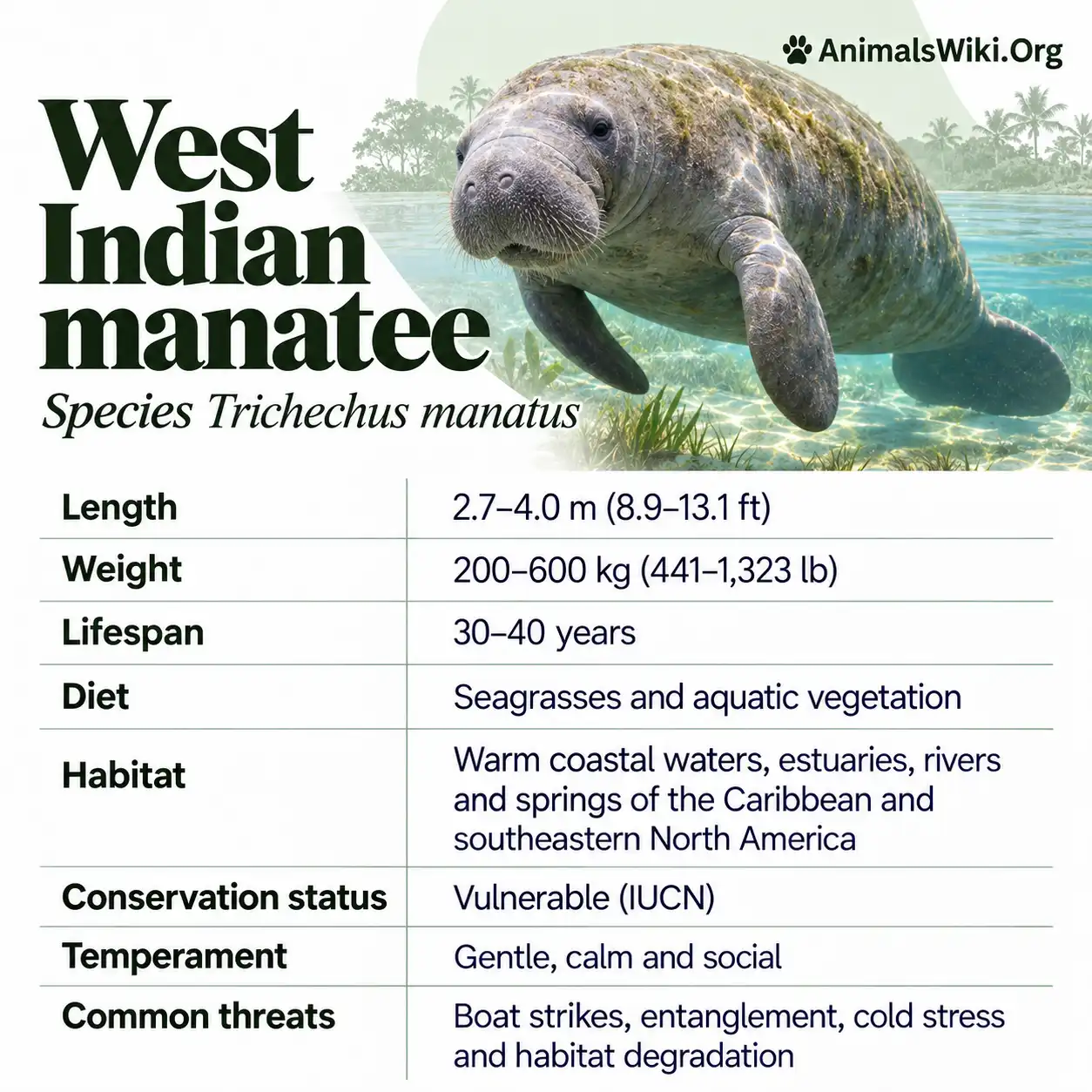
West Indian Manatee, The Gentle Grazer of Caribbean and American Waters
The West Indian manatee is a large aquatic mammal found in warm coastal waters, rivers, estuaries, and other connected habitats around parts of the Americas and Caribbean. Its rounded body, paddle-shaped tail, whiskered muzzle, and unhurried movements have made it one of the region’s most recognizable animals.
Often called a sea cow, the manatee spends much of its time feeding on vegetation, resting, and moving between places that provide food, suitable temperatures, and access to freshwater.
The name includes two subspecies: the Florida manatee and the Antillean manatee. They share many biological features but occupy different parts of the range and face different combinations of threats.
In Florida, winter access to warm water is especially important. Across the Caribbean and tropical American coast, habitat degradation, hunting, boat collisions, and fragmented populations create other conservation challenges.
Their calm appearance can conceal a complicated life. Manatees communicate underwater, use highly sensitive hairs to investigate their surroundings, replace worn teeth throughout life, and maintain close relationships between mothers and calves.
This guide explores their identity, appearance, habitat, diet, behavior, reproduction, and conservation, while explaining why protecting a manatee also means protecting the connected habitats it needs throughout the year.
West Indian Manatee Facts
| Feature | Information |
|---|---|
| Common name | West Indian manatee |
| Scientific name | Trichechus manatus |
| Animal type | Aquatic mammal |
| Order | Sirenia |
| Family | Trichechidae |
| Recognized subspecies | Florida manatee and Antillean manatee |
| Typical adult length | Around 3 meters |
| Typical adult weight | Several hundred kilograms |
| Main habitats | Coastal waters, estuaries, rivers, lagoons, and springs |
| Diet | Primarily aquatic vegetation |
| Tail | Broad, rounded paddle |
| Reproduction | Usually one calf |
| Maternal care | Calves commonly remain with their mothers for about two years |
| Global IUCN category | Vulnerable |
| Major threats | Watercraft collisions, habitat loss, food shortages, cold stress, entanglement, and harmful algal blooms |
1. What Is a West Indian Manatee?
A West Indian manatee is an air-breathing aquatic mammal belonging to the order Sirenia.
Sirenians include living manatees and dugongs. Their plant-eating habits have contributed to the familiar nickname “sea cows.”
The West Indian species belongs to the genus Trichechus, and its scientific name is Trichechus manatus.
Although often described as a marine mammal, it can use marine, brackish, and freshwater environments.
It does not have gills. Like other mammals, it breathes air, gives birth to live young, and produces milk.
Its normal life is entirely aquatic. Unlike a seal or sea lion, it does not come onto a beach to rest, reproduce, or nurse.
Instead, feeding, sleeping, birth, and maternal care all take place in water.
This makes access to suitable aquatic habitat essential at every life stage. A healthy population depends on more than one feeding area: it needs a connected system that supports movement, rest, reproduction, and survival during changing conditions.
2. What Are the Two Subspecies?
The West Indian manatee includes two recognized subspecies.
| Subspecies | Scientific name | Broad geographic association |
|---|---|---|
| Florida manatee | Trichechus manatus latirostris | Primarily the southeastern United States |
| Antillean manatee | Trichechus manatus manatus | Caribbean and tropical American coastal regions |
The Florida manatee occupies the northern part of the species’ range, where seasonal cold strongly influences distribution.
Antillean manatees live across a broad tropical region containing many separate coastal and river systems.
The distinction matters because the two subspecies are not exposed to identical conditions.
Winter warm-water access is a central issue in Florida. Elsewhere, the importance of hunting, coastal development, freshwater access, or boat traffic varies among locations.
A successful conservation measure in one region may therefore need adjustment before being applied elsewhere.
The subspecies also have different management needs, which is why conservation authorities assess them separately even while recognizing both within the same species.
3. What Does a West Indian Manatee Look Like?
A West Indian manatee has a large, rounded body that narrows toward a broad, paddle-shaped tail.
Its head is relatively small, with a blunt muzzle, small eyes, and nostrils positioned for breathing at the surface.
There are no external ear flaps.
Two front flippers help with maneuvering, positioning, and handling the surroundings. External hind limbs are absent.
The skin is generally gray or brownish gray. Algae and other surface growth can change how an individual looks, especially when it spends time in productive waters.
Sparse hairs occur across the body, with particularly noticeable bristles around the muzzle.
Scars can also become a prominent part of an animal’s appearance. Many surviving injuries leave recognizable patterns on the back or tail.
Those marks sometimes allow researchers to identify an individual years later, although their scientific usefulness should not obscure the harmful encounters that produced them.
4. How Big Do West Indian Manatees Get?
West Indian manatees are substantial animals, commonly measuring around 3 meters in length.
The Smithsonian gives a typical weight range of approximately 363–544 kilograms, although individuals vary considerably.
Exceptional adults can be much larger.
These measurements should be interpreted as guides rather than a fixed size reached by every manatee.
Age, nutrition, reproductive condition, and individual history all influence body size and mass.
| Measurement | General guide |
|---|---|
| Typical adult length | Around 3 meters |
| Typical adult mass | Several hundred kilograms |
| Large individuals | Can substantially exceed typical measurements |
| Newborn appearance | Much smaller and dependent on maternal care |
Their rounded shape is not simply an enormous layer of insulating fat.
Internal anatomy, including the digestive system, contributes to their body outline.
This matters when considering cold sensitivity. A manatee can look heavily insulated while still being vulnerable to prolonged exposure to cold water.
Body appearance and thermal protection are not the same thing.
5. West Indian Manatee vs Amazonian Manatee
The West Indian manatee and Amazonian manatee are separate species.
The Amazonian species, Trichechus inunguis, is restricted to freshwater habitats of the Amazon Basin.
West Indian manatees can use coastal marine waters, estuaries, and freshwater systems.
| Feature | West Indian manatee | Amazonian manatee |
|---|---|---|
| Scientific name | Trichechus manatus | Trichechus inunguis |
| Main range | Caribbean and parts of the American coast | Amazon Basin |
| Water types | Marine, brackish, and fresh | Freshwater |
| Flipper nails | Usually present | Absent |
| General adult size | Typically larger | Typically smaller |
| Pale belly markings | Less characteristic | Common in many individuals |
Both share a rounded tail and a mainly plant-based diet.
However, their seasonal challenges differ.
The Amazonian manatee responds strongly to changing river levels and floodplain access. Florida manatees must also respond to winter temperatures.
Information about one species should therefore be transferred cautiously to the other, even when their overall appearance seems similar.
6. West Indian Manatee vs Dugong
Manatees and dugongs belong to the same order, but they are different kinds of sirenians.
Tail shape provides one of the clearest visual distinctions.
A manatee has a rounded paddle-shaped tail. A dugong has a fluked tail with a more whale-like outline.
Their geographic distributions and feeding environments also differ.
Dugongs are associated with coastal marine habitats in parts of the Indo-Pacific. West Indian manatees occupy Atlantic and Caribbean regions of the Americas.
Both graze on aquatic vegetation, but the West Indian manatee can move into freshwater environments.
A photograph labeled simply “sea cow” can therefore be ambiguous.
The tail, location, and habitat usually help establish the animal’s identity.
The comparison also illustrates why common names should be used carefully. “Sea cow” describes a general impression of grazing behavior rather than a single species with one uniform range or lifestyle.
7. Where Do West Indian Manatees Live?
The species occurs across parts of the southeastern United States, Caribbean, Mexico, Central America, and northern South America.
Its southern distribution extends into northeastern Brazil.
This broad range contains very different environments: subtropical springs, tropical estuaries, coastal lagoons, mangrove-associated waterways, rivers, and seagrass habitats.
The population is not spread evenly through all those places.
Some regions support larger concentrations, while others contain small or fragmented groups.
Seasonal movement further changes the picture, especially in the United States.
A manatee observed far north during warm weather may be outside the area it uses during winter.
For conservation, a map showing the overall range is only a starting point.
Researchers also need to identify important feeding areas, freshwater sources, resting habitat, movement corridors, and seasonal refuges.
The species’ wide distribution should not be mistaken for equal security everywhere. Local populations can face serious problems within an otherwise extensive range.
8. What Is Special About the Florida Manatee?
Florida manatees live near the northern limit of conditions suitable for the species.
Their distribution changes with temperature.
During warmer months, some travel well beyond Florida, while falling temperatures draw them toward dependable warm-water sites.
This seasonal requirement makes habitat protection unusually complex.
An area that provides excellent summer feeding may be unsuitable during a cold period.
Likewise, a winter refuge may be warm but surrounded by poor feeding habitat.
The Florida subspecies faces a combination of watercraft collisions, food loss, cold stress, entanglement, and other human interactions.
Those threats can overlap.
An animal weakened by poor nutrition may be less able to cope with cold conditions, while disturbance at a refuge can force it into colder water.
Florida conservation therefore involves managing a network of habitats and risks rather than protecting one famous spring or counting animals at a single winter gathering.
9. What Is Special About the Antillean Manatee?
The Antillean manatee occupies a large tropical region containing many separate coastal populations.
Its range includes Caribbean islands and mainland areas from Mexico through Central America to northeastern South America.
These populations encounter different combinations of habitat loss, watercraft traffic, hunting, pollution, and fishing interactions.
The warm-water pattern familiar from Florida does not describe every part of Antillean life.
In tropical regions, freshwater access and the condition of estuaries or coastal feeding areas can be more relevant than winter spring use.
Conservation also crosses many national boundaries.
Research and protection may be strong in one location while neighboring areas have limited monitoring or resources.
This uneven setting makes cooperation particularly important.
A broad species assessment can hide local declines, especially where populations are small or disconnected.
Understanding Antillean manatees therefore requires regional information rather than treating Florida as a complete model for the entire species.
10. What Habitat Does a Manatee Need?
A useful manatee habitat supplies several connected resources.
Food is essential, but so are suitable water conditions, room to rest, safe movement routes, and access to other seasonal needs.
Shallow feeding areas are often associated with deeper channels that animals can use for travel or escape.
In Florida, managers emphasize both seagrass resources and warm-water habitat.
These resources do not always occur in the same place.
A manatee may need to leave a resting or wintering area to feed, creating repeated journeys through waterways shared with boats.
Habitat quality therefore includes the safety of the route, not just the condition of the destination.
Development, altered water flow, and declining vegetation can reduce the usefulness of a location even if open water remains.
Protecting the species requires attention to this whole network: what each site provides, when animals use it, and how they travel between important places.
11. Why Do Coastal Manatees Need Freshwater?
Living in saltwater does not mean freshwater is irrelevant.
Access to freshwater sources can influence where West Indian manatees occur and how they use coastal habitat.
Research has examined the combined importance of freshwater and seagrass availability when evaluating potential distribution under changing conditions.
This helps explain why a productive coastal feeding area may not meet every need.
A manatee’s habitat is assembled from different resources that must remain accessible.
Natural freshwater sources can therefore be conservation priorities alongside vegetation.
However, this should never be interpreted as a reason to offer water from a hose.
Artificially attracting manatees can alter behavior and bring animals close to docks, boats, or other hazards.
The ecological need is best addressed by maintaining natural habitat and water resources.
Human interaction is not a substitute for protecting the systems that allow manatees to meet those needs independently.
12. Do West Indian Manatees Migrate?
Many Florida manatees make seasonal movements between warmer-weather habitat and winter refuges.
Some travel considerable distances along coasts and connected waterways.
Their journeys are influenced by temperature, food, freshwater, and individual experience.
Antillean manatees also move between habitat areas, although their movement patterns should not automatically be described through the same winter-migration model.
A species-wide label such as “migratory” can hide substantial variation.
Some animals show strong connections to familiar places, while others range more widely.
Movement also changes exposure to threats.
A feeding area and a refuge may both be protected, yet the route between them can pass through busy boating waters.
Seasonal protection zones recognize that risk by changing restrictions when manatees are more likely to use particular areas.
Understanding movement therefore helps explain both the timing and location of practical conservation measures.
13. Why Are Manatees Sensitive to Cold?
Despite their large, rounded bodies, manatees are vulnerable to cold water.
Prolonged exposure can cause cold-stress syndrome, affecting health and potentially leading to death.
In Florida, water temperatures around or below 20°C are an important concern.
The effect depends on duration, the animal’s condition, and access to warmer water.
A brief temperature dip and prolonged exposure are not identical situations.
Research on cold-related mortality has examined those relationships rather than treating one temperature as an instant universal threshold.
Smaller animals and individuals in poor condition can be especially concerning during cold periods.
This is why winter refuges matter so much.
A warm-water site is not merely a comfortable gathering place. It can be essential habitat that allows animals to survive conditions they could not tolerate indefinitely in surrounding waters.
14. Why Do They Gather Near Springs and Power Plants?
Florida manatees use dependable warm-water sources when surrounding temperatures fall.
Natural springs provide one type of refuge.
Historically, warm-water discharges from some industrial facilities have provided another.
These sites can attract large concentrations during cold weather.
However, dependence on an artificial source creates a long-term management challenge.
If a facility changes operations or closes, the warm-water conditions may disappear.
Conservation planning must therefore consider future reliability, not simply present-day use.
Natural refuge protection involves its own issues, including spring flow, water quality, surrounding habitat, and disturbance.
An ideal refuge needs both suitable temperature and practical access to food.
If animals must travel far through cold water to feed, warmth alone may not solve the problem.
Protecting a resilient network of refuges is more useful than relying on a few highly concentrated sites whose conditions could change.
15. What Do West Indian Manatees Eat?
West Indian manatees primarily eat aquatic vegetation.
Their diet includes marine seagrasses and freshwater plants, depending on where they feed.
They can spend many hours gathering and consuming vegetation.
Common feeding environments include seagrass beds, river margins, sheltered waterways, and other areas supporting accessible plants.
| Feeding setting | Examples of available vegetation |
|---|---|
| Coastal seagrass habitat | Submerged marine grasses |
| Rivers and freshwater areas | Submerged, floating, and waterside plants |
| Estuaries | Plant communities associated with mixed salinity |
| Sheltered waterways | Locally available aquatic vegetation |
The diet varies with habitat and season.
A list of plants cannot fully describe feeding conditions because access and abundance matter as much as identity.
Vegetation may still exist in a region while being too sparse or difficult to reach to support enough feeding.
This distinction becomes important when habitat loss affects a large number of animals using the same general area.
16. How Can a Large Animal Live on Plants?
Manatees use an extensive digestive system to extract nutrients from vegetation.
Microorganisms help break down plant material through fermentation.
Research on West Indian manatee digestion identified the cecum and colon as important sites of microbial cellulose fermentation.
This process produces compounds that the animal can use as part of its energy supply.
The arrangement differs from the stomach-based fermentation familiar from cattle.
Calling a manatee a sea cow should therefore not imply identical digestion.
Plant-eating also requires time.
The animal must gather enough material and allow digestion to proceed.
Food quality, availability, and digestive function all influence whether intake meets its needs.
A decline in vegetation can therefore become a serious physiological problem rather than merely an inconvenience.
The system works when sufficient suitable food remains accessible; it cannot compensate indefinitely for the loss of the feeding habitat on which the animal depends.
17. Why Do Manatees Keep Replacing Their Teeth?
Manatees have a distinctive system of horizontal tooth replacement.
New grinding teeth develop toward the rear of the jaw and move forward over time.
Worn teeth near the front are eventually lost.
This helps maintain the surfaces used to process vegetation.
Plants can carry abrasive material such as sand, and repeated grinding gradually wears teeth down.
Instead of relying on one permanent adult set, a manatee continues replacing teeth through life.
Its flexible lips handle much of the initial food gathering, while the cheek teeth perform the grinding.
These adaptations work together.
The lips provide controlled handling, and the moving tooth series helps sustain processing over a long lifespan.
This is an especially useful example of anatomy matching ecology: an animal that repeatedly consumes large amounts of abrasive vegetation needs a way to preserve effective chewing surfaces year after year.
18. How Do Sensitive Hairs Help Them?
Manatees have sensory hairs called vibrissae.
They are especially developed around the face but also occur elsewhere on the body.
These hairs provide tactile information rather than functioning only as a visible coat.
Research on facial bristles has shown specialized anatomy supporting sensitive contact and the handling of plants.
Other experiments have demonstrated detection of water movement through the body’s sensory system.
This is valuable in habitats where visibility can be limited.
An animal moving through cloudy water cannot always rely on sight alone.
Its tactile system helps it investigate objects, handle vegetation, and detect changes around it.
The mouth region is therefore both a feeding apparatus and an information-gathering surface.
A slow-moving animal can still possess sophisticated sensory capabilities.
The manatee’s quiet behavior should not be mistaken for a simple or poorly developed relationship with its surroundings.
19. Can Manatees Hear Well?
Manatees can detect a broad range of underwater sounds.
Behavioral hearing studies have shown abilities that are more substantial than their small external ear openings might suggest.
They do not need projecting ear flaps to hear underwater.
However, hearing ability does not guarantee that an animal will detect and avoid every approaching boat.
Background noise can interfere with sound detection.
Researchers have studied how environmental noise affects the audibility of boat sounds and manatee vocalizations.
Sound propagation, vessel characteristics, and the surrounding acoustic environment all influence the situation.
This makes “they should simply hear the boat” an inadequate explanation of collision risk.
A manatee may detect a sound without having enough time or space to respond safely.
Understanding hearing is therefore one part of collision research, alongside vessel speed, water depth, movement behavior, and the places where boats and manatees overlap.
20. How Do West Indian Manatees Communicate?
West Indian manatees produce underwater vocalizations.
Calls are important in social interactions, including contact between mothers and calves.
Their sounds are not usually obvious to someone watching quietly from shore.
Hydrophones allow researchers to record the acoustic activity occurring below the surface.
Research involving Antillean manatees has examined relationships among hearing, vocal signals, and the surrounding sound environment.
This is useful because communication must function within real habitats containing boat noise, natural sounds, and changing acoustic conditions.
The significance of a call depends on context.
A sound from a calf near its mother may serve a different immediate role from one produced during another social interaction.
Careful studies connect recordings with identified animals and observed behavior.
The result is a richer picture than the idea of an almost silent grazer: manatees participate in an underwater acoustic world that helps maintain important relationships.
21. Are Manatees Social Animals?
Manatees can occur alone, in pairs, or in temporary groups.
The most persistent relationship is generally the bond between a mother and her calf.
Other gatherings may form around food, suitable temperatures, or reproductive activity.
A large winter concentration does not necessarily represent a permanent herd.
Animals may simply be sharing an essential resource.
During reproduction, several males may accompany a female in what is often called a mating herd.
That gathering should not automatically be interpreted as an animal needing rescue.
Normal reproductive activity can look vigorous or confusing to an observer unfamiliar with it.
The safest response is to watch without approaching and allow authorities to assess any genuine signs of distress.
Understanding the difference between temporary aggregation and lasting social bonds helps explain why manatee groups change as resources, temperatures, and reproductive circumstances change.
22. How Do West Indian Manatees Reproduce?
West Indian manatees reproduce slowly.
Pregnancy lasts roughly a year, commonly described as around twelve to fourteen months.
A female usually gives birth to one calf, although twins are possible.
The calf is born underwater and begins life dependent on its mother.
There is no land-based nursery, breeding beach, or haul-out colony.
The mother’s body, movements, and feeding success support development during the period of dependence.
Because pregnancy is long and care continues afterward, population growth is limited.
A female cannot rapidly replace repeated losses through large annual litters.
This makes adult survival especially important.
Protecting an experienced breeding female can preserve years of future reproductive contribution.
The same biology also explains why recovery may take a long time even after a threat is reduced.
Successful conservation needs patience and sustained protection across multiple generations.
23. What Is Life Like for a Manatee Calf?
A young manatee is called a calf.
It must breathe air from the beginning of life while remaining close to its mother.
Calves nurse from mammary glands located near the front flippers.
They gradually investigate and consume vegetation while maternal milk continues to support growth.
The mother–calf relationship commonly lasts about two years.
That association provides more than food.
A young animal accompanies an experienced adult through feeding areas, travel routes, and seasonal habitat changes.
This is especially meaningful in Florida, where access to dependable warm water can become essential during winter.
A calf seen without an adult immediately beside it is not automatically orphaned.
The mother may be submerged or out of view.
Trained responders assess the full situation before deciding whether intervention is needed, since unnecessary separation can disrupt a relationship central to the calf’s survival.
24. How Long Can West Indian Manatees Live?
West Indian manatees can live for many decades.
The Natural History Museum describes potential wild longevity around fifty or sixty years, while emphasizing that longer lives may be possible.
The well-known captive manatee Snooty lived to sixty-nine.
Such records demonstrate potential longevity rather than average survival from birth.
Many animals die much younger because of natural and human-related pressures.
It is therefore important to separate maximum age from typical life expectancy.
A long-lived species can still have serious population problems if too many adults die prematurely.
Longevity also gives long-term research special value.
An identified manatee may be observed across many years, allowing scientists to study movement, reproduction, injury history, and survival.
Those records reveal how individual experiences accumulate through life and influence the broader population.
25. Why Are Manatees Important to Aquatic Ecosystems?
Manatees are large grazers within freshwater and coastal food webs.
They consume vegetation and return material to the environment through waste, contributing to nutrient cycling.
Their feeding connects plant communities with the wider ecosystem.
Their conservation also requires attention to habitats used by many other organisms.
Seagrass beds, healthy estuaries, and functioning springs support more than manatees.
Fish, invertebrates, birds, and other wildlife benefit from those environments.
This does not mean every manatee automatically improves every plant community through grazing.
Ecological effects depend on local conditions, the vegetation involved, and the intensity of use.
The broader conservation benefit is clearer: maintaining the food, water quality, and connectivity required by manatees helps protect functioning aquatic systems.
The animal can therefore serve as a recognizable reason to address less visible environmental problems that affect an entire habitat.
26. What Is Their Current Conservation Status?
The West Indian manatee is globally classified as Vulnerable on the IUCN Red List.
That category is different from its legal classification under national legislation.
In the United States, the Fish and Wildlife Service’s current information describes the species-level listing as threatened.
A January 2025 proposal would replace that listing with separate subspecies listings: threatened for the Florida manatee and endangered for the Antillean manatee.
The agency materials reviewed for this article identify that action as a proposal.
| Assessment or action | Meaning |
|---|---|
| Global IUCN category | Vulnerable |
| U.S. species-level listing described by FWS | Threatened |
| Proposed Florida subspecies listing | Threatened |
| Proposed Antillean subspecies listing | Endangered |
A proposal should not be reported as an enacted rule.
Likewise, a legal downlisting does not mean that habitat loss, injuries, or mortality events have ceased.
Accurate reporting names the assessment system, population, and date.
27. Why Are Boat Collisions Such a Serious Threat?
Boats and manatees often use the same shallow coastal waterways.
Collisions can cause cutting injuries from propellers and blunt-force trauma from the vessel.
Both can be fatal.
An animal that survives may carry lasting damage, infection, or scars.
Research summarized by Florida wildlife authorities shows that injury patterns vary with life stage, sex, and region.
This means collision risk is not identical for every animal.
Habitat use influences exposure.
Repeated journeys through busy channels can place an individual at risk even if its feeding and resting destinations are otherwise suitable.
Reducing speed helps give operators more opportunity to notice animals and can reduce the severity of an impact.
Effective protection also includes habitat planning, monitoring, and enforcement.
The problem is larger than isolated careless encounters: it reflects the overlap between wildlife movement and human transportation in shared waterways.
28. How Does Seagrass Loss Affect Manatees?
Seagrass loss removes food from an animal that depends on repeated access to vegetation.
The consequences can extend from poor body condition to starvation.
Along Florida’s Atlantic coast, severe forage loss contributed to an unusual mortality event that began in 2020.
The event was administratively closed on March 14, 2025, after the period of exceptional mortality had subsided.
Closure of the event did not mean every habitat problem had been solved.
Recovery still depends on the condition of feeding resources and the animals using them.
A warm-water refuge can become a difficult choice if little food remains nearby.
Manatees may need warmth and nutrition at the same time, making the location of those resources important.
The episode demonstrates why animal rescue and habitat restoration address different parts of the same problem.
Treating weakened individuals helps them directly; restoring food availability reduces the likelihood that more animals will need treatment.
29. What Is Red Tide, and Why Does It Harm Them?
Some harmful algal blooms produce toxins that affect marine animals.
In Florida, Karenia brevis produces brevetoxins associated with red tide.
Manatees can be exposed through their environment and through contaminated food.
Florida wildlife researchers describe ingestion of toxin associated with seagrass as an important exposure pathway.
Affected animals may develop neurological problems and struggle to maintain normal behavior.
An animal unable to surface properly can face immediate danger.
However, unusual behavior alone does not establish red-tide poisoning.
Professional evaluation is needed to distinguish possible causes.
A bloom does not need to be visibly red for toxins to be present.
Understanding the issue therefore requires environmental monitoring as well as animal observations.
Red tide adds another layer to conservation because a feeding habitat may contain vegetation while still exposing animals to harmful conditions.
30. What Other Human Activities Affect Manatees?
Fishing line, ropes, traps, and discarded material can entangle manatees.
Animals may also ingest debris.
Water-control structures create different hazards, including entrapment or injury.
Coastal development can alter habitat, boat traffic, shoreline access, or water quality.
These pressures often interact rather than operating independently.
An animal using a degraded feeding area may travel farther and encounter additional traffic.
A calf separated by disturbance may face risks that an undisturbed mother–calf pair would avoid.
Conservation therefore needs to address the setting as well as the immediate incident.
Removing one piece of line helps an individual, while preventing line from entering the water reduces future encounters.
Protecting habitat and maintaining safer waterways can lower exposure before animals become injured.
That preventive work is less dramatic than a rescue but can have broader benefits.
31. Why Does Antillean Conservation Need Regional Action?
Antillean manatees occupy many countries and coastal systems.
Threats and resources differ among them.
In Belize, conservation work includes research, community education, and coordination of a marine mammal stranding network.
In northeastern Brazil, release programs have formed part of broader efforts to protect and restore manatee populations.
These examples show why conservation cannot depend on one national strategy alone.
A practical local program needs information about the animals, waterways, people, and pressures in that area.
Community participation is important because residents, fishers, and boat operators often encounter the habitats most frequently.
Regional cooperation helps share methods, improve response capacity, and maintain attention beyond well-known visitor sites.
The goal is not to make every place operate identically.
It is to ensure that conservation measures fit local needs while contributing to the survival of the subspecies across its wider range.
32. How Do Scientists Count Manatees?
Counting manatees is more difficult than counting animals standing in an open field.
Some are submerged, hidden by vegetation, or outside the surveyed area.
Weather, water clarity, and the timing of a survey influence detection.
A count is therefore not always the same as a population estimate.
Modern abundance studies use methods designed to account for imperfect observation and uncertainty.
This matters when comparing historical numbers.
A larger estimate can reflect population change, improved methods, or a combination of both.
Researchers also distinguish among total abundance, local attendance, and the number of animals observed during one flight.
Those measurements answer different questions.
Reliable assessment requires repeated surveys interpreted within their methodological context.
The purpose is not simply to produce a large or small number, but to understand population condition well enough to guide conservation decisions.
33. How Can Photographs Reveal a Manatee’s Life History?
Researchers identify many manatees through distinctive scar patterns and other visible features.
Photographs taken over time can establish a record of where an animal was seen and whether it was accompanied by a calf.
These records help estimate adult survival and investigate reproduction and movement.
Florida’s photo-identification programs combine contributions from several research organizations.
The technique is valuable because it can follow free-ranging individuals without repeatedly capturing them.
However, identification requires careful comparison.
New injuries may change an animal’s appearance, and poor photographs can create uncertainty.
A familiar-looking scar should not automatically be treated as definitive.
When used systematically, photo-identification turns separate sightings into a long-term biological record.
It also presents a difficult reminder: many recognizable features result from harmful encounters that conservation programs are trying to prevent.
34. Can Injured Manatees Be Rehabilitated?
Some injured, sick, or orphaned manatees can receive professional treatment and return to the wild.
Rescue teams assess the animal’s condition and determine whether intervention is appropriate.
Care may involve treatment of injuries, support for malnutrition, or specialist feeding for a dependent calf.
Not every animal can be released immediately or successfully.
Rehabilitation requires suitable facilities, veterinary expertise, and assessment of readiness.
Release planning also considers season and location.
A healthy animal still needs access to appropriate food, temperature, and habitat.
Florida rescue work involves cooperation among wildlife agencies, veterinarians, rehabilitation facilities, and other partners.
The process demonstrates how individual care and population conservation can support one another.
Rescue provides a second chance for an animal, while prevention and habitat protection reduce the number of future cases.
35. What Should Boaters Do Around Manatees?
Follow posted speed zones and remain alert in shallow waterways and other manatee habitat.
Use polarized sunglasses where conditions make them helpful.
Watch for an animal’s back, muzzle, tail, or the water disturbance created by movement below the surface.
Give animals space and avoid steering through groups.
Do not assume a manatee will move out of the way.
Its ability to respond depends on water depth, available space, the direction of approach, and whether it has detected the vessel.
Seasonal restrictions reflect changing habitat use, so familiar waterways may have different requirements at different times.
If an animal appears injured or distressed, report it to the appropriate wildlife authority.
Do not attempt to use a boat to push, herd, or separate animals.
Responsible operation protects wildlife while reducing the likelihood of a collision that can also endanger people or damage equipment.
36. How Should Visitors Observe Manatees?
The best encounter allows the animal to continue its normal behavior.
Watch quietly, keep your distance, and follow local restrictions.
Do not chase, corner, ride, or surround a manatee.
Avoid separating a mother and calf or blocking access to a warm-water refuge.
Never offer food or water to attract animals.
Florida wildlife guidance explains that provisioning changes natural behavior and is prohibited.
An animal approaching a person is not an invitation to pursue contact.
Resting manatees should be allowed to rest, especially during cold weather when unnecessary movement can carry a cost.
If a manatee appears unwell, provide a clear location and description to trained responders.
Accurate reporting is more helpful than an improvised rescue.
Respectful observation preserves the opportunity to see natural feeding, breathing, movement, and maternal behavior without turning the encounter into another pressure the animal must manage.
Frequently Asked Questions About West Indian Manatees
1. What is the scientific name of the West Indian manatee?
Its scientific name is Trichechus manatus. It belongs to the family Trichechidae and the order Sirenia.
2. Is a Florida manatee a West Indian manatee?
Yes. The Florida manatee is one of the two recognized subspecies. Its scientific name is Trichechus manatus latirostris.
3. What is the other subspecies?
The other is the Antillean manatee, Trichechus manatus manatus. It occurs across parts of the Caribbean and tropical American coast.
4. Is a manatee a fish?
No. It is a mammal. It breathes air, produces milk, gives birth to live young, and has hair.
5. Why is it called a sea cow?
The nickname refers to its grazing habits and large body. It does not mean that its digestion, behavior, or ancestry is identical to that of cattle.
6. Can West Indian manatees live in freshwater?
Yes. They use freshwater, brackish, and marine environments. Their movements connect different habitat types rather than being restricted to the open sea.
7. How big are they?
Typical adults are around 3 meters long and weigh several hundred kilograms. Exceptional individuals can be substantially larger than those general measurements.
8. Do manatees have teeth?
Yes. They have grinding teeth that are continually replaced through a horizontal process, with newer teeth moving forward from the rear.
9. What do they eat?
They primarily eat aquatic vegetation, including seagrasses and freshwater plants. Diet varies according to habitat and availability.
10. Do manatees eat fish?
They are primarily herbivores. Fish are not the normal focus of their feeding ecology, unlike the diets of dolphins, seals, and sea lions.
11. Can they breathe underwater?
No. They must surface for air. Their nostrils close during submergence, but they still rely on oxygen obtained through breathing.
12. How long can they hold their breath?
A resting manatee may remain submerged for up to about twenty minutes, while active animals usually breathe more frequently. The interval varies with circumstances.
13. Why do they go to springs in winter?
Springs can provide warmer water than surrounding areas. Florida manatees rely on suitable refuges to avoid prolonged exposure to dangerous cold.
14. Are manatees protected by a thick layer of fat?
Their rounded appearance can be misleading. They do not have the cold-water insulation associated with many polar marine mammals and remain vulnerable to cold stress.
15. Can manatees hear boats?
They can detect underwater sound, but hearing does not guarantee successful avoidance. Background noise, vessel approach, available space, and response time all affect risk.
16. What is a baby manatee called?
A baby is called a calf. It is born underwater and depends on its mother for milk and early care.
17. How long is pregnancy?
Pregnancy is commonly described as lasting approximately twelve to fourteen months. Females usually give birth to one calf.
18. How long do calves stay with their mothers?
The association commonly lasts about two years. Calves gradually begin eating vegetation while continuing to receive maternal support.
19. Why do groups gather around one manatee?
Some gatherings are mating herds, with several males accompanying a female. Others form around food or warm water. A group is not automatically a rescue situation.
20. How long can they live?
They can live for many decades. Potential wild longevity is commonly described around fifty or sixty years, and the captive manatee Snooty lived to sixty-nine.
21. Are West Indian manatees endangered?
Their global IUCN category is Vulnerable. U.S. legal terminology is different, and proposed subspecies changes must be distinguished from enacted listings.
22. Why do so many have scars?
Many scars come from nonfatal boat collisions or entanglement injuries. Researchers can sometimes use distinctive patterns to identify individuals over time.
23. Can you give a manatee drinking water?
Do not offer water from a hose or otherwise attract it. Provisioning can change behavior and place the animal near hazards; it is prohibited under Florida guidance.
24. What should you do if one looks injured?
Keep disturbance low, note the location, and contact the appropriate wildlife authority. Do not attempt to handle or move the animal independently.
25. What is the best way to help?
Protect habitat, follow boating restrictions, prevent debris from entering waterways, observe without interference, and report animals needing professional assistance.
West Indian Manatees and the Habitats They Depend On
The West Indian manatee combines a gentle feeding lifestyle with specialized anatomy, sensitive perception, and the ability to use several aquatic environments.
Its survival depends on more than the presence of water.
Food, freshwater access, safe travel routes, and suitable temperatures must remain available in the right places and seasons.
The needs of Florida and Antillean manatees overlap, but effective conservation recognizes their regional differences.
A protected spring, restored feeding area, safer boat route, or well-supported rescue program can each address part of the challenge.
Together, those efforts help preserve an animal whose long life and slow reproduction make every stage of survival important.



