
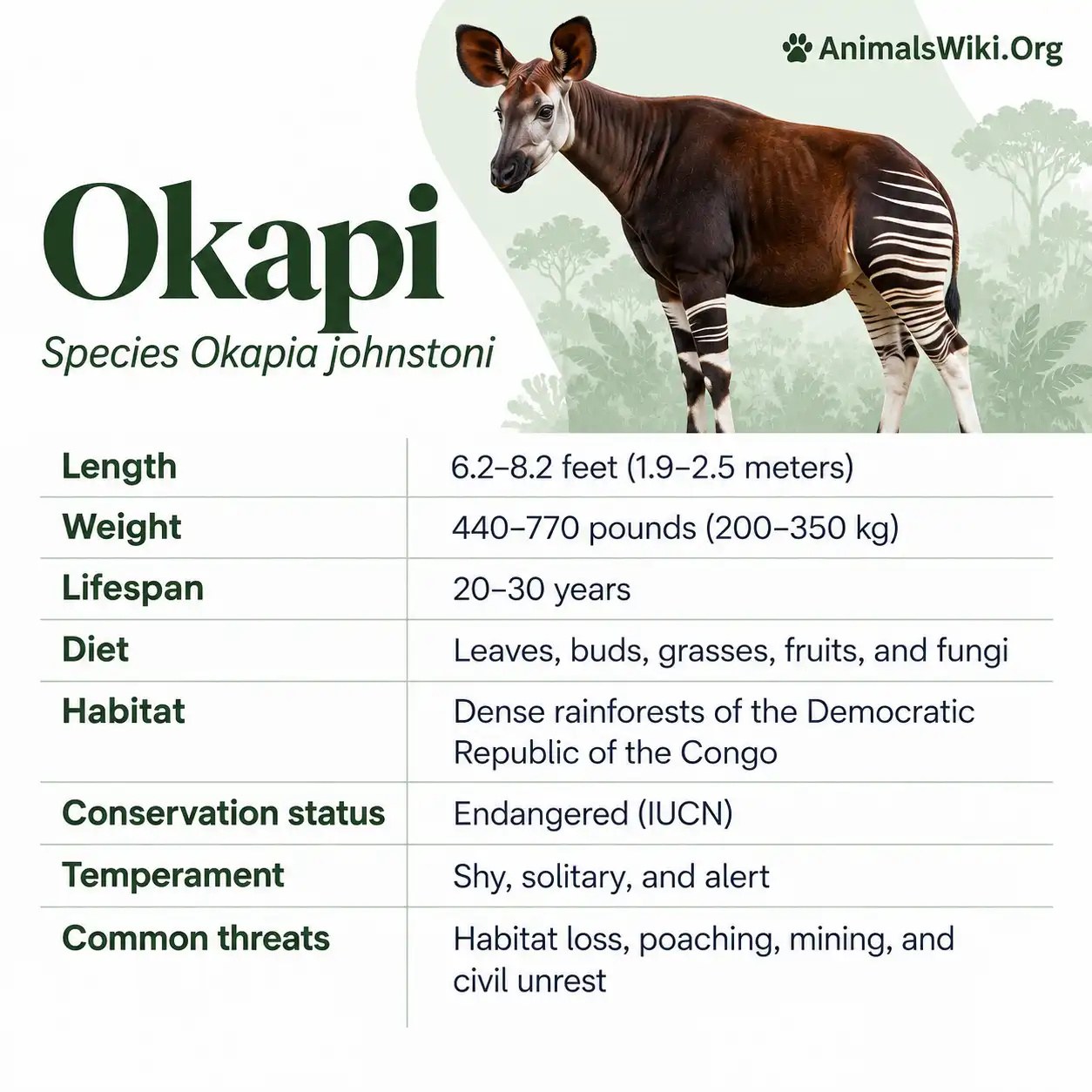
Okapi, The Secretive Forest Relative of the Giraffe in Central Africa
The okapi is one of Africa’s most unusual and secretive large mammals.
At first glance, it appears to have been assembled from several completely different animals.
Its body resembles a:
horse.
Its hindquarters and upper legs are covered with striking:
zebra-like stripes.
Its head carries a pair of short horn-like structures in adult males.
And its exceptionally long tongue looks remarkably similar to that of a:
giraffe.
That last similarity is no coincidence.
The okapi is not a zebra.
It is not a horse.
And despite sometimes being called the forest giraffe, it is not simply a short giraffe either.
The okapi, scientifically known as:
Okapia johnstoni
is one of the giraffe’s closest living relatives.
Together, the okapi and giraffes form the family:
Giraffidae.
But while giraffes evolved to exploit open African woodlands and savannas with their extraordinary height and long necks, the okapi evolved for a very different world:
the dense tropical forests of Central Africa.
Wild okapis occur naturally only in the:
Democratic Republic of the Congo.
They are particularly associated with the dense rainforests of the country’s northeastern and central-eastern regions, including the famous:
Ituri Forest.
This restricted natural distribution makes the okapi an important example of an:
endemic species.
Its dark reddish-brown body blends surprisingly well with the shadowy rainforest.
The bright-looking white stripes on its legs might seem as though they would make the animal easier to see.
Inside a forest filled with:
- Broken sunlight
- Tree trunks
- Leaves
- Shadows
- Patches of brightness
the striped pattern can help break up the outline of the animal.
The stripes may also play a role in:
visual recognition, particularly between a mother and her calf.
The okapi’s adaptations go far beyond camouflage.
Its large ears can rotate independently, helping detect sounds from different directions.
Its long dark tongue can grasp vegetation and is famously flexible enough to help clean parts of its:
face and ears.
Its narrow body allows it to move through dense vegetation.
Its cloven hooves carry it across the humid forest floor.
And its diet allows it to browse on a wide range of:
- Leaves
- Shoots
- Twigs
- Fruits
- Ferns
- Fungi
- Other plant material
Despite its size, the okapi remained poorly known outside its native region until around the beginning of the 20th century.
This led to its reputation as one of the most mysterious large mammals known to modern zoology.
Today, however, mystery is not the okapi’s greatest problem.
Its forest habitat faces pressure from:
- Deforestation
- Mining
- Human settlement
- Armed conflict
- Illegal hunting
- Habitat fragmentation
Because the entire wild population occurs within a single country and a relatively restricted region, protecting the okapi also means protecting some of the most biologically important rainforest remaining in Central Africa.
This comprehensive guide explores Okapi facts, scientific classification, relationship to giraffes, zebra-like stripes, appearance, size, weight, tongue, ossicones, ears, habitat, Congo rainforest distribution, diet, behavior, speed, reproduction, calves, lifespan, adaptations, predators, leopards, conservation, threats, and why the Okapi is one of Africa’s most remarkable forest mammals.
Okapi Facts
| Feature | Information |
|---|---|
| Common Name | Okapi |
| Scientific Name | Okapia johnstoni |
| Animal Type | Mammal |
| Order | Artiodactyla |
| Family | Giraffidae |
| Closest Famous Relative | Giraffe |
| Native Country | Democratic Republic of the Congo |
| Native Continent | Africa |
| Main Habitat | Dense tropical rainforest |
| Famous Region | Ituri Forest |
| Diet | Herbivorous browser |
| Body Length | Roughly 2–2.5 m |
| Shoulder Height | Roughly 1.5–1.7 m |
| Weight | Approximately 200–350 kg |
| Coat | Dark reddish-brown/chocolate |
| Legs | White horizontal stripes |
| Tongue | Long and prehensile |
| Male Head | Usually has ossicones |
| Activity | Mainly daytime/twilight, flexible |
| Social Behavior | Mostly solitary |
| Young | Calf |
| Typical Birth | One calf |
| Major Natural Predator | Leopard |
| Major Threats | Habitat loss, hunting and instability |
| Conservation Concern | High |
What Is an Okapi?
The okapi is a large forest-dwelling herbivorous mammal native to the:
Democratic Republic of the Congo.
Its scientific name is:
Okapia johnstoni.
It belongs to the same family as:
giraffes.
Is an Okapi a Giraffe?
Not exactly.
The okapi and modern giraffes are:
different genera and species.
However, both belong to the family:
Giraffidae.
They share an evolutionary ancestor and several anatomical features.
Is an Okapi Related to a Giraffe?
Yes.
This is one of the most important okapi facts.
The okapi is the giraffe’s only other living close family member within:
Giraffidae.
Is an Okapi a Zebra?
No.
Its striped legs create a superficial resemblance to a zebra, but okapis and zebras belong to very different mammal families.
A zebra belongs to:
Equidae
with horses and donkeys.
An okapi belongs to:
Giraffidae
with giraffes.
Is an Okapi a Horse?
No.
The body shape can appear somewhat horse-like, but okapis are not equids.
Why Is the Okapi Called the Forest Giraffe?
The nickname reflects:
- Its relationship to giraffes
- Its rainforest habitat
- Its browsing diet
- Its long tongue
- Its ossicones
But the okapi is a distinct species with its own evolutionary adaptations.
Scientific Classification of the Okapi
| Classification | Name |
|---|---|
| Kingdom | Animalia |
| Phylum | Chordata |
| Class | Mammalia |
| Order | Artiodactyla |
| Family | Giraffidae |
| Genus | Okapia |
| Species | Okapia johnstoni |
What Does an Okapi Look Like?
An okapi has:
- Dark reddish-brown body
- Velvety-looking coat
- White striped hindquarters
- Striped upper legs
- Long neck
- Large ears
- Long face
- Dark prehensile tongue
- Cloven hooves
- Short tail
Adult males normally possess:
ossicones.
What Color Is an Okapi?
The main body is usually:
- Dark reddish-brown
- Chocolate-brown
- Purplish-brown
The legs contain bold areas of:
- White
- Cream
- Dark brown or black
Why Does an Okapi Have Stripes?
The exact evolutionary functions of the stripes are still discussed.
Likely functions include:
Camouflage
In broken rainforest light, stripes can disrupt the animal’s outline.
Recognition
Individual patterns may help okapis identify one another.
Mother-Calf Communication
The conspicuous hind-leg pattern may help calves visually follow their mothers through dense vegetation.
It is best not to claim that the stripes evolved for only one proven purpose.
Does Every Okapi Have the Same Stripes?
No.
Stripe patterns differ between individuals.
This can help researchers recognize particular animals from:
photographs and camera traps.
Are Okapi Stripes Like Fingerprints?
Not literally.
But because stripe patterns vary individually, they can function as useful:
visual identifiers.
Why Does the Okapi Look Like a Zebra?
This resemblance is mostly caused by:
convergent visual appearance.
The okapi did not inherit zebra stripes because it is related to zebras.
Its closest living relative is the:
giraffe.
Okapi Ossicones
Adult male okapis usually possess two short structures on top of the head called:
ossicones.
These are related anatomically to the much more obvious ossicones of giraffes.
Are Okapi Ossicones Horns?
They are horn-like structures but are technically:
ossicones.
Ossicones are distinctive cranial appendages characteristic of giraffids.
Do Female Okapis Have Ossicones?
Females generally:
lack prominent exposed ossicones.
Instead, they may possess small knobby structures or hair-covered areas where comparable structures occur.
Okapi Ears
Okapis have:
large, mobile ears.
These are valuable in dense forest because visibility can be extremely limited.
A predator might be hidden behind vegetation long before it can be seen.
Sensitive ears help detect:
- Footsteps
- Vegetation movement
- Calls
- Potential predators
Can Okapis Move Their Ears?
Yes.
Their ears can rotate and orient toward sounds.
Okapi Tongue
One of the most famous okapi adaptations is its:
long, dark, prehensile tongue.
“Prehensile” means capable of grasping or manipulating objects.
How Long Is an Okapi’s Tongue?
The tongue can reach approximately:
30–35 centimeters
in length, although exact measurements vary.
It is remarkably long relative to the animal’s head.
Why Does an Okapi Have a Long Tongue?
The tongue helps:
- Pull leaves from vegetation
- Manipulate branches
- Select food
- Groom the face
It is an adaptation shared in general form with:
giraffes.
Can an Okapi Lick Its Own Ears?
Its tongue is famously long and flexible enough to clean parts of its:
- Face
- Muzzle
- Eyelids
- Ears
This ability is often highlighted as one of the strangest okapi facts.
Why Is an Okapi’s Tongue Dark?
Dark pigmentation may help protect exposed tongue tissue from environmental stresses while browsing, although simple claims that the color exists solely to prevent sunburn should be treated cautiously.
How Big Is an Okapi?
An adult okapi may reach approximately:
2–2.5 meters in body length.
At the shoulder, adults stand around:
1.5–1.7 meters.
How Much Does an Okapi Weigh?
Adults commonly weigh around:
200–350 kilograms.
Females can be larger and heavier than males.
Are Female Okapis Bigger Than Males?
Yes.
Okapis show:
female-biased sexual size dimorphism.
Adult females are generally somewhat:
- Taller
- Heavier
than adult males.
How Tall Is an Okapi Compared With a Human?
At the shoulder, a large okapi can approach the height of an adult human.
Its head and neck extend considerably above shoulder level.
Is an Okapi Smaller Than a Giraffe?
Yes.
Much smaller.
A giraffe is the tallest living land animal, while the okapi is adapted for moving through:
dense rainforest vegetation.
Where Do Okapis Live?
Wild okapis occur naturally only in:
the Democratic Republic of the Congo.
This makes the species:
endemic to the DRC.
Do Okapis Live Anywhere Else in the Wild?
No established natural wild population exists outside the Democratic Republic of the Congo.
Okapis in other countries are generally found in:
- Zoos
- Conservation institutions
Do Okapis Live in Africa?
Yes.
They are native to:
Central Africa.
Do Okapis Live in the Congo?
Yes.
The Democratic Republic of the Congo is the okapi’s only native country.
Do Okapis Live in the Congo Rainforest?
Yes.
They inhabit dense tropical forests within the Congo Basin region.
Do Okapis Live in the Ituri Forest?
Yes.
The Ituri Forest is one of the places most strongly associated with the species.
Okapi Habitat
Okapis inhabit:
dense tropical rainforest.
Important habitat features include:
- Thick vegetation
- Forest understory
- Canopy cover
- Streams
- Forest clearings
- Abundant browsing plants
Do Okapis Live in Savannas?
No.
Unlike giraffes, okapis are specialized primarily for:
forest environments.
Why Don’t Okapis Live on Open Savannas?
Their body and behavior are adapted to dense forest.
Features such as:
- Camouflage
- Large ears
- Solitary lifestyle
- Forest browsing
work particularly well in thick vegetation.
What Do Okapis Eat?
Okapis are:
herbivores.
Their diet includes:
- Leaves
- Buds
- Shoots
- Twigs
- Fruits
- Ferns
- Fungi
- Grasses
- Other forest plants
They are primarily:
browsers.
What Is a Browser?
A browser feeds mainly on:
- Leaves
- Shoots
- Twigs
- Woody vegetation
rather than depending mainly on grass.
Giraffes are also famous browsers.
Do Okapis Eat Grass?
They may consume some grasses and herbaceous vegetation, but they are better characterized as:
forest browsers.
Do Okapis Eat Fruit?
Yes.
Fruits can form part of their varied plant diet.
Do Okapis Eat Fungi?
Yes.
Fungi may be consumed as part of their forest diet.
Do Okapis Eat Poisonous Plants?
Okapis consume an impressive diversity of forest plants, including some that humans might consider chemically defended or unsuitable.
However, claims that okapis routinely eat “poisonous plants” without consequence should be treated carefully because:
toxicity depends on species, dose and physiology.
Do Okapis Eat Charcoal?
Wild okapis have been reported consuming:
- Charcoal
- Clay
- Mineral-rich material
Such behavior may help supplement:
minerals or salts.
Why Do Okapis Lick Clay?
Mineral-rich soil can provide nutrients that may be limited in a leaf-based diet.
This behavior is known broadly as:
geophagy
when animals intentionally consume soil.
How Does an Okapi Eat?
The okapi uses its long tongue to:
- Reach vegetation.
- Wrap around leaves or shoots.
- Pull plant material toward the mouth.
- Chew using specialized herbivore teeth.
Are Okapis Ruminants?
Yes.
Like giraffes and cattle, okapis are:
ruminants.
They possess a multi-compartment digestive system that allows microbial fermentation of plant material.
Do Okapis Chew Cud?
Yes.
Food can be:
- Swallowed.
- Fermented.
- Regurgitated.
- Chewed again.
- Swallowed again.
This helps extract nutrients from fibrous plants.
Okapi Behavior
Okapis are generally:
- Quiet
- Secretive
- Mostly solitary
- Forest-dwelling
- Alert
Their elusive nature makes them difficult to observe in the wild.
Are Okapis Solitary?
Yes.
Adult okapis are primarily:
solitary.
They generally do not form large herds like many grazing mammals.
Do Okapis Live in Herds?
No.
Temporary associations may occur, especially:
- Mother and calf
- Breeding encounters
but large stable herds are not typical.
Why Are Okapis Solitary?
Dense rainforest contains food spread across many locations.
A solitary browsing lifestyle may reduce:
- Competition
- Visibility to predators
- Need for large social groups
Are Okapis Territorial?
Individuals occupy home ranges.
Males generally range over larger areas that may overlap the ranges of several females.
They can communicate using:
- Scent
- Urine
- Glandular secretions
- Vocalizations
Are Okapis Shy?
They are often described as:
shy and elusive.
However, “shy” is a human description.
Scientifically, they are better characterized as:
secretive forest mammals that generally avoid unnecessary confrontation.
Are Okapis Nocturnal?
Okapis can be active during:
- Day
- Twilight
- Night
Activity varies with:
- Habitat
- disturbance
- individual behavior
They should not be described as strictly nocturnal.
Can Okapis Run Fast?
Yes.
Although built for forests rather than open-country sprinting, okapis can move rapidly when threatened.
Exact maximum-speed claims vary and should be treated cautiously.
How Do Okapis Walk Through Dense Forest?
Their relatively narrow body and carefully controlled movement allow them to navigate:
- Vegetation
- Tree trunks
- Understory
- Narrow forest pathways
with surprising quietness.
How Do Okapis Communicate?
Okapis use:
- Scent marking
- Body language
- Low-frequency sounds
- Audible vocalizations
Mothers and calves have especially important communication.
What Sounds Do Okapis Make?
They can produce sounds described as:
- Coughs
- Bleats
- Chuffs
- Low calls
Some communication may occur at frequencies difficult for humans to detect.
Can Okapis Communicate With Infrasound?
Very low-frequency communication has been reported between okapi mothers and calves.
Some signals may fall near or below the normal human hearing range.
This could be useful in dense forest where visual contact is limited.
Okapi Reproduction
Okapis reproduce relatively slowly.
Females usually invest in:
one calf at a time.
How Long Is an Okapi Pregnant?
Gestation lasts roughly:
14–16 months.
This is an unusually long pregnancy compared with many mammals.
How Many Babies Do Okapis Have?
Usually:
one calf.
Twins are rare.
What Is a Baby Okapi Called?
A baby okapi is called a:
calf.
What Does a Baby Okapi Look Like?
Calves resemble smaller versions of adults.
They have:
- Dark coat
- Striped legs
- Large ears
- Long limbs
Their stripes are already visible.
How Much Does a Baby Okapi Weigh?
Newborn weight varies, but calves can weigh roughly:
14–30 kilograms.
Can Baby Okapis Walk?
Yes.
Like many hoofed mammals, calves develop standing and walking ability:
soon after birth.
Do Okapi Calves Hide?
Yes.
Young calves can spend substantial periods hidden in:
dense vegetation.
This reduces the chance of detection by predators.
Why Does an Okapi Calf Stay Hidden?
The mother cannot physically fight every predator continuously.
Instead, the calf relies partly on:
- Camouflage
- Stillness
- Dense vegetation
- Low odor
- Maternal vigilance
Do Baby Okapis Poop?
Of course, but one remarkable adaptation is that very young calves may go for extended periods without defecating frequently.
This is thought to reduce:
scent cues
that might help predators locate them.
This unusual strategy is particularly useful during the hiding stage.
Does the Mother Stay With the Calf All Day?
Not necessarily.
The mother may leave the calf concealed while she:
feeds nearby
and returns periodically to nurse and care for it.
Do Male Okapis Raise Calves?
Maternal care is dominant.
Males do not normally play a major role in raising offspring.
Okapi Lifespan
Okapis can live for:
roughly two to three decades
under managed conditions.
Wild lifespan is harder to measure accurately because individuals are difficult to follow throughout their lives.
Okapi Adaptations
Striped Legs
Help disrupt the body outline in broken forest light and may assist visual recognition.
Dark Coat
Blends with deep rainforest shade.
Large Ears
Detect predators and other sounds through dense vegetation.
Long Prehensile Tongue
Grasps leaves and assists grooming.
Narrow Body
Helps movement through dense forest.
Strong Legs
Allow rapid escape when necessary.
Cloven Hooves
Provide effective movement over forest ground.
Ruminant Digestion
Extracts nutrients from fibrous vegetation.
Solitary Behavior
Reduces competition and visibility.
Calf Hiding Strategy
Helps protect vulnerable young from predators.
What Predators Eat Okapis?
The most important natural predator of adult and young okapis is the:
leopard.
Other predators may threaten young calves, but leopards are particularly significant.
Do Leopards Eat Okapis?
Yes.
The leopard is one of the principal natural predators of the okapi.
Dense forest provides excellent ambush habitat for leopards.
How Do Okapis Defend Themselves?
They rely on:
- Acute hearing
- Camouflage
- Running
- Powerful legs
- Kicking
An adult okapi can deliver a strong defensive kick.
Can an Okapi Kill a Leopard?
An adult okapi’s kicks can be dangerous to a predator.
However, leopards are skilled ambush hunters capable of killing large prey.
The outcome of an encounter depends on circumstances.
Are Okapis Dangerous to Humans?
Okapis are not predators and do not hunt people.
However, they are:
large, powerful wild mammals.
A frightened or cornered animal can potentially:
- Kick
- Strike
- Injure
a person.
Are Okapis Aggressive?
They are generally secretive rather than confrontational.
Aggression can occur during:
- Defense
- Competition
- Breeding
- Extreme stress
Can You Keep an Okapi as a Pet?
No.
Okapis require:
- Specialized diet
- Large forest-like environments
- Professional veterinary care
- Species-appropriate management
They are wild conservation-sensitive mammals, not domestic animals.
Discovery of the Okapi
The okapi was well known to Indigenous peoples of Central Africa long before it became formally known to Western science.
European and Western scientific awareness developed around the:
late 19th and early 20th centuries.
Was the Okapi Discovered in 1901?
The species was formally described scientifically around:
1901.
This is why it is sometimes described as a major zoological “discovery” of the 20th century.
However, saying humans discovered it in 1901 would be inaccurate.
Local people had known the animal:
for generations.
Why Was the Okapi Unknown to Western Science?
Its:
- Dense rainforest habitat
- Solitary behavior
- Camouflage
- Restricted range
made it difficult for outsiders to observe.
Who Was Sir Harry Johnston?
British colonial administrator and explorer Harry Johnston played a role in bringing specimens to the attention of Western zoologists.
The species name:
johnstoni
honors him.
However, local knowledge was crucial to the animal becoming known to Western science.
Why Is the Okapi Sometimes Called the African Unicorn?
Its historical elusiveness and unusual appearance have occasionally inspired comparisons with mythical animals.
But unlike a unicorn, the okapi is:
completely real.
Are Okapis Rare?
Yes.
They have a restricted geographic distribution and face significant conservation pressures.
However, “rare” does not mean that scientists know an exact global population.
How Many Okapis Are Left?
There is no precise, universally reliable census of every wild okapi.
Their dense rainforest habitat makes counting extremely difficult.
Population estimates should therefore be treated as:
approximations rather than exact totals.
Why Are Okapis Difficult to Count?
They are:
- Solitary
- Secretive
- Camouflaged
- Forest-dwelling
- Spread across difficult terrain
Researchers may use:
- Camera traps
- Dung surveys
- Tracks
- Genetic analysis
- Local observations
instead of relying only on direct visual counts.
Are Okapis Endangered?
The okapi is considered a species facing a significant risk of extinction and has suffered population decline.
Major threats include:
- Habitat destruction
- Illegal hunting
- Mining
- Armed conflict
- Human settlement
Why Are Okapis Threatened?
The problem is not one single threat.
Several pressures interact.
Habitat Loss
Forest is altered or cleared.
Mining
Mining activity can damage habitat and increase human access.
Hunting
Okapis may be illegally hunted for:
- Meat
- Skins
Armed Conflict
Instability makes wildlife protection extremely difficult.
Roads
Roads fragment habitat and increase access for hunting and settlement.
Does Mining Threaten Okapis?
Yes.
Mining can affect okapis by:
- Destroying habitat
- Polluting ecosystems
- Creating roads
- Increasing settlement
- Increasing hunting access
Illegal and poorly regulated mining can be especially damaging.
Does Deforestation Threaten Okapis?
Yes.
The okapi depends on:
forest.
Large-scale forest loss directly reduces its habitat.
Okapi Conservation
Important conservation strategies include:
- Protecting rainforest
- Preventing illegal hunting
- Controlling destructive mining
- Supporting protected areas
- Training wildlife rangers
- Supporting local communities
- Monitoring populations
- Maintaining habitat connectivity
Okapi Wildlife Reserve
One of the most important protected areas for the species is the:
Okapi Wildlife Reserve
in northeastern Democratic Republic of the Congo.
It protects important sections of:
Ituri rainforest habitat.
Why Is the Okapi Wildlife Reserve Important?
The reserve protects far more than okapis.
Its forests support extraordinary biodiversity, including:
- Primates
- Forest elephants
- Leopards
- Birds
- Reptiles
- Thousands of plant and invertebrate species
Protecting the okapi therefore helps protect an entire:
rainforest ecosystem.
Okapi vs. Giraffe
| Feature | Okapi | Giraffe |
|---|---|---|
| Family | Giraffidae | Giraffidae |
| Habitat | Tropical forest | Savanna/woodland |
| Neck | Moderately long | Extremely long |
| Legs | Zebra-like stripes | Patterned entire body |
| Tongue | Long and prehensile | Very long and prehensile |
| Ossicones | Mainly obvious in males | Present in both sexes |
| Lifestyle | Mostly solitary | Often social |
| Distribution | DRC | Multiple African countries |
Okapi vs. Zebra
| Feature | Okapi | Zebra |
|---|---|---|
| Family | Giraffidae | Equidae |
| Closest Famous Relative | Giraffe | Horse |
| Stripes | Mainly legs/hindquarters | Most of body |
| Diet | Browser | Mostly grazer |
| Habitat | Rainforest | Grassland/woodland |
| Hooves | Cloven | Single hoof |
| Social Life | Mostly solitary | Often social |
Okapi vs. Horse
Although its body may appear horse-like, an okapi differs fundamentally from a horse.
Horses possess:
one functional hoofed toe per foot.
Okapis have:
cloven hooves.
They are also ruminants, while horses use:
hindgut fermentation.
Okapi vs. Deer
Okapis may resemble large forest deer, but they are not members of:
Cervidae.
Their horn-like structures are:
ossicones, not deer antlers.
50 Interesting Okapi Facts
- The okapi is a mammal.
- Its scientific name is Okapia johnstoni.
- It belongs to the family Giraffidae.
- Its closest living relative is the giraffe.
- It is not a zebra.
- It is not a horse.
- It is not a deer.
- Wild okapis live only in the Democratic Republic of the Congo.
- They inhabit Central African rainforest.
- The Ituri Forest is famous for its okapis.
- Okapis have dark reddish-brown bodies.
- Their legs have white stripes.
- Stripe patterns vary between individuals.
- The stripes may help with camouflage.
- They may also aid recognition.
- Adult males usually have ossicones.
- Females generally lack prominent exposed ossicones.
- Okapis have large ears.
- Their ears are highly mobile.
- They possess excellent hearing.
- Okapis have long tongues.
- Their tongues are prehensile.
- The tongue helps grasp leaves.
- They can use the tongue for grooming.
- Okapis are herbivores.
- They are primarily browsers.
- They eat leaves.
- They eat shoots.
- They eat fruit.
- They may eat fungi.
- They sometimes consume mineral-rich soil or similar materials.
- Okapis are ruminants.
- They chew cud.
- Adult females are generally larger than males.
- Okapis are mostly solitary.
- They do not normally form large herds.
- Females usually produce one calf.
- Pregnancy lasts around 14–16 months.
- Calves can stand relatively soon after birth.
- Young calves hide in dense vegetation.
- Calves may defecate infrequently during their early hiding stage.
- Leopards are important natural predators.
- Adult okapis can defend themselves with powerful kicks.
- Okapis are naturally secretive.
- Their camouflage makes them difficult to see in forests.
- Local people knew of okapis long before Western science formally described them.
- The species was scientifically described around 1901.
- Habitat loss and illegal hunting threaten wild populations.
- The Okapi Wildlife Reserve protects important habitat.
- Saving the okapi also protects part of the Congo Basin rainforest.
Did You Know?
The okapi’s zebra-like stripes may actually help it disappear inside a rainforest.
At first, that sounds impossible.
White stripes seem:
bright.
Surely a completely brown animal would be better hidden.
But imagine standing inside a tropical rainforest.
The environment is not evenly dark.
Sunlight breaks through tiny openings in the canopy.
The forest floor becomes a mosaic of:
- Bright lines
- Dark shadows
- Leaves
- Vines
- Tree trunks
- Moving patches of light
Now place an okapi among them.
Its upper body is:
deep reddish-brown.
That blends with the shadowed vegetation and tree trunks.
Its legs are broken into alternating:
light and dark bands.
Instead of seeing four obvious legs, a predator may see a confusing series of disconnected light and dark shapes.
The animal’s outline becomes:
harder to interpret.
Then the okapi hears something.
Its enormous ears rotate.
A leopard may be moving through vegetation.
The okapi does not need to wait until the predator becomes visible.
Sound travels through the forest.
The ears provide warning.
The animal moves quietly between trees.
Its narrow body passes through vegetation.
The striped legs disappear among broken shafts of light.
Within moments, a mammal weighing hundreds of kilograms can become remarkably difficult to see.
That is the secret of the okapi.
It is not designed to dominate an open landscape like its towering giraffe relative.
It evolved to:
disappear inside a forest.
Frequently Asked Questions About Okapis
What is an okapi?
An okapi is a large forest-dwelling herbivorous mammal native to the Democratic Republic of the Congo.
What is the scientific name of the okapi?
Okapia johnstoni.
Is an okapi a mammal?
Yes.
Is an okapi a giraffe?
It is not a giraffe species, but it is a close living relative belonging to the same family.
Is an okapi related to giraffes?
Yes.
Is an okapi a zebra?
No.
Is an okapi related to zebras?
Only distantly as fellow hoofed mammals.
Is an okapi a horse?
No.
Is an okapi a deer?
No.
What family does the okapi belong to?
Giraffidae.
Why does an okapi look like a zebra?
Its striped legs create a superficial resemblance, but the similarity does not indicate close evolutionary relationship.
Why does an okapi have stripes?
Likely functions include camouflage and visual recognition.
Does every okapi have different stripes?
Patterns vary among individuals.
What color is an okapi?
Dark reddish-brown or chocolate with pale striped legs and hindquarters.
Do okapis have horns?
Adult males generally have short horn-like ossicones.
What are ossicones?
Ossicones are specialized skull structures characteristic of giraffids.
Do female okapis have ossicones?
Females generally lack prominent exposed ossicones.
How big is an okapi?
Approximately 2–2.5 meters in body length.
How tall is an okapi?
Around 1.5–1.7 meters at the shoulder.
How much does an okapi weigh?
Approximately 200–350 kg, depending on sex and individual.
Are female okapis larger than males?
Generally yes.
Where do okapis live?
The Democratic Republic of the Congo.
Are okapis found anywhere else in the wild?
Their natural wild range is restricted to the DRC.
Do okapis live in Africa?
Yes.
Do okapis live in the Congo?
Yes.
Do okapis live in rainforests?
Yes.
Do okapis live in the Amazon?
No.
Do okapis live in savannas?
They are primarily rainforest animals.
What is the Ituri Forest?
It is an important rainforest region in northeastern DRC strongly associated with okapi habitat.
What do okapis eat?
Leaves, shoots, buds, fruits, ferns, fungi and other plant material.
Are okapis herbivores?
Yes.
Are okapis browsers?
Yes.
Do okapis eat grass?
They may consume some herbaceous vegetation, but browsing is more characteristic.
Do okapis eat fruit?
Yes.
Do okapis eat fungi?
Yes.
Do okapis eat meat?
No. They are herbivores.
Are okapis ruminants?
Yes.
Do okapis chew cud?
Yes.
Why do okapis eat clay?
Mineral-rich soil can supplement nutrients and salts.
How long is an okapi’s tongue?
Approximately 30–35 cm is commonly cited.
Why is an okapi’s tongue so long?
It helps grasp leaves and manipulate vegetation.
Can an okapi lick its ears?
Its extremely long tongue can reach and clean parts of its face and ears.
Is an okapi’s tongue like a giraffe’s?
Yes. Both possess long prehensile tongues adapted for browsing.
Do okapis have good hearing?
Yes.
Why are okapi ears so large?
Large mobile ears help detect sounds in dense forest.
Are okapis nocturnal?
Not strictly. They can be active during different parts of the day and night.
Are okapis solitary?
Mostly.
Do okapis live in herds?
No, not normally.
Are okapis territorial?
They maintain home ranges and communicate through scent and other signals.
Do okapis make sounds?
Yes.
Can okapis use low-frequency calls?
Yes. Low-frequency communication has been reported, especially in mother-calf interactions.
Can humans hear every okapi sound?
Probably not; some communication may occur at frequencies difficult for humans to detect.
Can okapis run fast?
They can run rapidly when threatened, although precise maximum-speed claims vary.
Can okapis swim?
They are physically capable of moving through water, although swimming is not their primary adaptation.
How many babies do okapis have?
Usually one calf.
What is a baby okapi called?
A calf.
How long is an okapi pregnant?
Roughly 14–16 months.
Why is okapi pregnancy so long?
The calf undergoes substantial development before birth, as is common among large hoofed mammals.
Can a newborn okapi walk?
Yes, relatively soon after birth.
Do baby okapis hide?
Yes.
Why do okapi calves hide?
Hiding reduces detection by predators.
Do baby okapis really avoid pooping?
Young calves can defecate very infrequently during an early hiding period, which may help reduce scent cues to predators.
Does an okapi mother care for her calf?
Yes.
Do male okapis raise calves?
Maternal care is the primary form of parental care.
How long do okapis live?
They can live roughly two to three decades under managed conditions.
What predators eat okapis?
Leopards are their principal natural predators.
Do leopards eat okapis?
Yes.
Can okapis defend themselves?
Yes. Their powerful legs can deliver dangerous kicks.
Are okapis dangerous to humans?
They are not predators of humans but can injure people if frightened or cornered.
Are okapis aggressive?
They are generally secretive rather than aggressive.
Can okapis be pets?
No.
When was the okapi discovered?
Western science formally described it around 1901, although local peoples had known the species long before then.
Who discovered the okapi?
It should not be credited to one person as though nobody knew it existed. Indigenous communities knew the animal long before Western zoological description.
Why was the okapi hard for Western scientists to find?
It lives in dense rainforest, is solitary, camouflaged and naturally secretive.
Are okapis rare?
Yes, they have a restricted range and face significant threats.
Are okapis endangered?
They face a high risk of extinction and require active conservation.
Why are okapis endangered?
Habitat loss, illegal hunting, mining, human expansion and armed instability contribute to their decline.
How many okapis are left?
No exact reliable count of every wild okapi exists.
Why can’t scientists count every okapi?
Dense forest, difficult terrain and the animal’s secretive behavior make complete surveys impossible.
Does deforestation affect okapis?
Yes.
Does mining affect okapis?
Yes. Mining can destroy habitat and increase access for hunting and settlement.
Are okapis hunted?
Yes, illegal hunting is a conservation threat.
What is the Okapi Wildlife Reserve?
It is a major protected area in the DRC established to conserve important rainforest habitat, including habitat for okapis.
Why are okapis important?
They are native rainforest browsers and an irreplaceable component of Congo Basin biodiversity.
Is an okapi taller than a zebra?
They can be relatively tall at the shoulder, but body dimensions vary between species and individuals.
Is an okapi bigger than a horse?
Large okapis can approach some horses in overall mass, but they have very different proportions.
Is an okapi smaller than a giraffe?
Yes, dramatically.
Is an okapi closer to a giraffe or zebra?
Giraffe.
Why does the okapi have a shorter neck than a giraffe?
The two species evolved under very different ecological conditions. The okapi is adapted to dense forest browsing rather than reaching high savanna foliage.
What is the most interesting okapi fact?
Despite its zebra-striped legs and horse-like appearance, the okapi’s closest living relative is the giraffe.
Conclusion
The okapi is an animal built around a remarkable contradiction.
It is:
large enough to weigh hundreds of kilograms
yet difficult to see.
It has:
bright white stripes
yet is remarkably well camouflaged.
It resembles:
a zebra
yet its closest living relative is the giraffe.
It was formally described by Western science only around the beginning of the 20th century, yet people living within its native forests had known it:
for generations.
Every major feature of the okapi reflects its rainforest home.
The dark body disappears into shadow.
The striped legs break apart its outline.
The enormous ears listen through vegetation.
The long tongue reaches leaves.
The narrow body moves between trees.
The calf remains hidden.
The adult lives largely alone.
This is not a savanna animal trapped in a forest.
It is a:
specialist of the Congo rainforest.
And that makes the fate of the okapi inseparable from the fate of its habitat.
An okapi cannot simply move to another continent.
It cannot establish itself naturally in open grasslands.
Its entire wild existence is concentrated within:
one country.
The Democratic Republic of the Congo contains the only natural wild populations of one of the planet’s most distinctive large mammals.
When those forests are protected, the benefits extend far beyond the okapi.
Protection also helps conserve:
- Forest elephants
- Primates
- Leopards
- Birds
- Reptiles
- Plants
- Invertebrates
- Entire rainforest communities
The okapi may be famous because it looks like a strange combination of a:
horse, zebra and giraffe.
But it is none of those combinations.
It is something much more valuable:
a completely unique species shaped by millions of years of evolution inside the forests of Central Africa.



