
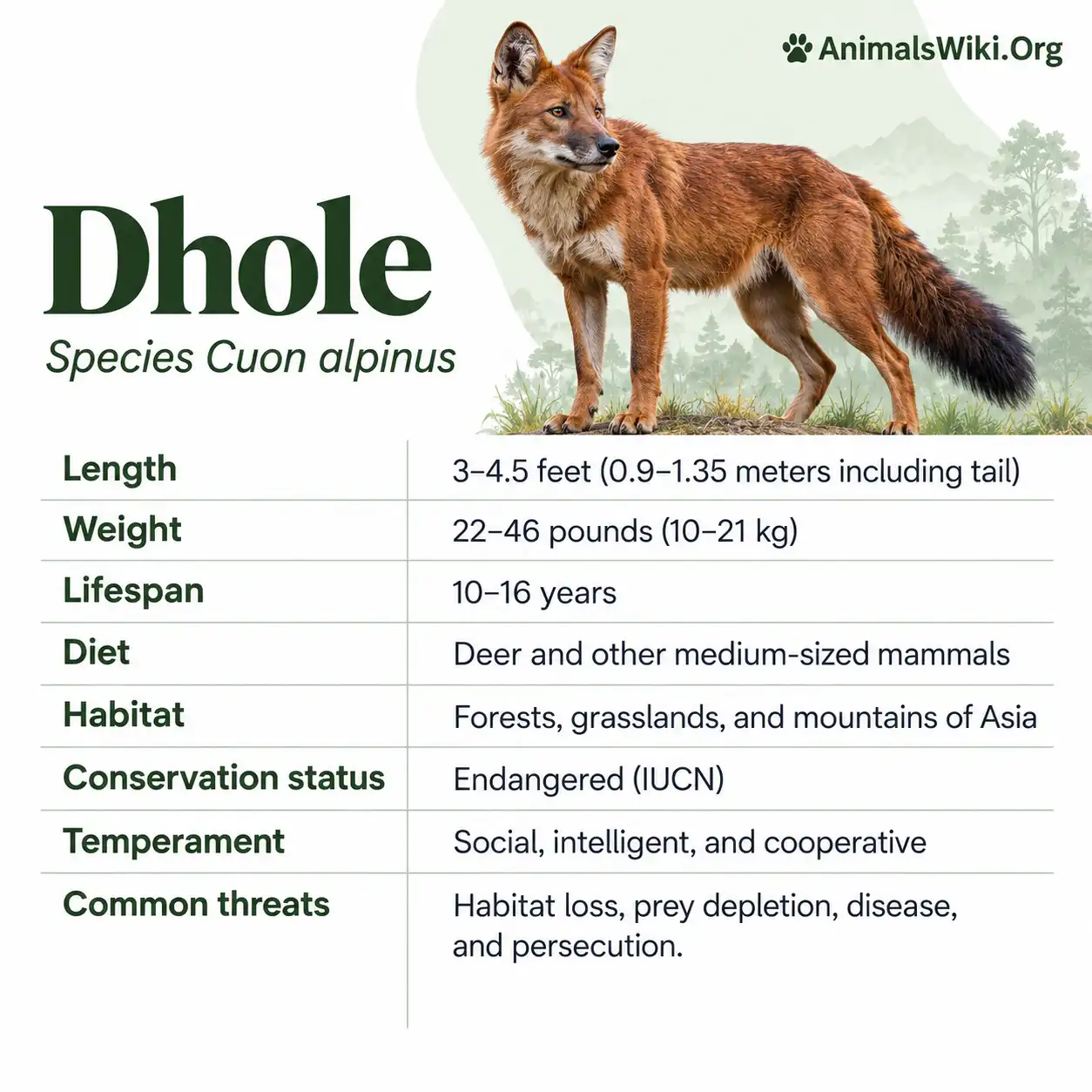
Dhole, The Remarkable Pack-Hunting Wild Dog of Asia
The dhole is one of Asia’s most remarkable—and least widely known—large predators.
With its:
- Reddish coat
- Rounded ears
- Bushy dark tail
- Slender body
- Powerful legs
it can look like a mixture of:
dog, fox and wolf.
But the dhole is none of these.
Scientifically known as:
Cuon alpinus
the dhole is a distinctive wild member of the dog family:
Canidae.
It is the only living species in the genus:
Cuon.
Dholes once occurred across an enormous portion of Asia, from parts of:
Central and South Asia
through:
China and Southeast Asia.
Today, their distribution is far more fragmented.
Important surviving populations occur in parts of:
- India
- Nepal
- Bhutan
- Bangladesh
- China
- Myanmar
- Thailand
- Malaysia
- Indonesia
and potentially other parts of their historical Asian range, although presence and population strength vary greatly by region.
The dhole is also known by names such as:
- Asian wild dog
- Asiatic wild dog
- Indian wild dog
- Red dog
- Whistling dog
The last nickname comes from one of its most fascinating behaviors.
Dholes can produce distinctive:
whistle-like calls.
These high-pitched sounds help pack members communicate while moving through forests and other habitats where vegetation can make visual contact difficult.
But communication is only one reason the dhole is remarkable.
Dholes are highly:
social predators.
They commonly live in packs built around cooperative relationships.
Together, pack members can:
- Travel
- Hunt
- Defend food
- Raise pups
- Communicate
- Maintain social bonds
Their prey can include:
- Deer
- Wild pigs
- Wild bovids
- Small mammals
- Other available vertebrates
depending on habitat and region.
A single dhole is relatively small compared with a tiger.
Even a leopard is substantially more powerful in a one-to-one physical confrontation.
But dholes do not depend solely on individual strength.
Their greatest advantage is:
cooperation.
A coordinated pack can pursue prey far larger than a single dhole.
This creates one of Asia’s most fascinating predator communities.
In some landscapes, dholes coexist with:
- Tigers
- Leopards
- Wolves
- Bears
- Crocodiles
and other formidable predators.
These animals may compete over:
- Prey
- Carcasses
- Territory
and direct encounters can sometimes become dangerous.
Despite being capable hunters, dholes themselves face a serious survival problem.
They have disappeared from substantial portions of their former range.
Major threats include:
- Habitat destruction
- Habitat fragmentation
- Declining wild prey
- Persecution
- Disease transmitted by domestic dogs
- Conflict around livestock
- Small and isolated populations
The dhole therefore represents something larger than an unusual wild dog.
It is an important part of Asia’s remaining:
large-predator ecosystems.
This comprehensive guide explores Dhole facts, scientific classification, appearance, size, weight, distribution, habitat, pack behavior, diet, hunting, speed, whistle communication, reproduction, pups, lifespan, adaptations, predators, Tigers, Leopards, Wolves, danger to humans, conservation, and the differences between Dholes, Wolves, Foxes and domestic dogs.
Dhole Facts
| Feature | Information |
|---|---|
| Common Name | Dhole |
| Scientific Name | Cuon alpinus |
| Other Names | Asian wild dog, Asiatic wild dog, red dog, whistling dog |
| Animal Type | Mammal |
| Order | Carnivora |
| Family | Canidae |
| Genus | Cuon |
| Living Species in Genus | 1 |
| Native Continent | Asia |
| Habitat | Forests, grasslands, scrub and montane habitats |
| Diet | Carnivorous |
| Main Prey | Deer, wild pigs and other mammals |
| Social Structure | Packs |
| Famous Feature | Whistling communication |
| Coat | Usually reddish or rusty brown |
| Tail | Bushy, often darker toward tip |
| Body Length | Roughly 90–110 cm |
| Weight | Commonly around 12–20 kg |
| Activity | Often diurnal/crepuscular; flexible |
| Hunting Strategy | Cooperative pack hunting |
| Young | Pups |
| Typical Litter | Several pups |
| Major Threats | Habitat loss, prey decline, persecution and disease |
| Ecological Role | Medium-to-large cooperative predator |
What Is a Dhole?
A dhole is a wild canid native to:
Asia.
Its scientific name is:
Cuon alpinus.
It belongs to the same mammalian family as:
- Wolves
- Coyotes
- Jackals
- Foxes
- Domestic dogs
That family is:
Canidae.
Is a Dhole a Dog?
A dhole is a member of the:
dog family
but it is not a domestic dog.
It represents its own evolutionary lineage.
Is a Dhole a Wild Dog?
Yes.
“Wild dog” is a useful general description, and Asian wild dog is one of its common names.
However, it should not be confused with the:
African wild dog, Lycaon pictus.
They are different species living on different continents.
Is a Dhole a Wolf?
No.
Dholes and wolves are both canids, but they belong to different genera.
Dhole:
Cuon alpinus
Gray wolf:
Canis lupus
Is a Dhole a Fox?
No.
Its reddish coat and bushy tail can make it look fox-like, but foxes belong to other canid lineages.
Scientific Classification of the Dhole
| Classification | Name |
|---|---|
| Kingdom | Animalia |
| Phylum | Chordata |
| Class | Mammalia |
| Order | Carnivora |
| Family | Canidae |
| Genus | Cuon |
| Species | Cuon alpinus |
Is the Dhole the Only Species of Cuon?
Yes.
The dhole is the only:
living species
in the genus Cuon.
Other members of the lineage existed in the past but are extinct.
What Does a Dhole Look Like?
A typical dhole has:
- Reddish-brown coat
- Pale underside
- Rounded ears
- Broad muzzle
- Strong jaws
- Slender athletic body
- Relatively short legs compared with some wolves
- Bushy tail
- Darker tail tip
Its appearance varies geographically.
What Color Is a Dhole?
Most have coats ranging from:
- Rusty red
- Reddish-brown
- Tawny
- Brown
The:
- Chest
- Belly
- Feet
may be lighter.
The tail often becomes:
darker toward the end.
Why Are Dholes Red?
Their coat coloration is a result of:
genetics and evolutionary adaptation.
Rusty and brown tones can also blend effectively with:
- Forest floor
- Dry vegetation
- Leaf litter
- Grassland
How Big Is a Dhole?
Adults generally have a head-and-body length of roughly:
90–110 centimeters.
The tail adds approximately another:
40–50 centimeters
depending on the individual and population.
How Tall Is a Dhole?
Adults stand approximately:
40–55 centimeters at the shoulder.
How Much Does a Dhole Weigh?
Many adults weigh approximately:
12–20 kilograms.
Large males can be heavier.
Body size varies geographically and between sexes.
Are Male Dholes Bigger Than Females?
Males are generally somewhat:
larger and heavier
than females.
However, the difference is not extreme compared with some other mammals.
Is a Dhole Bigger Than a Wolf?
No.
A gray wolf can be considerably:
- Taller
- Heavier
- More powerfully built
than a dhole.
Dholes compensate partly through:
pack cooperation.
Is a Dhole Bigger Than a Fox?
Usually yes.
Dholes are generally substantially larger and more robust than most familiar fox species.
Dhole Teeth
One of the dhole’s interesting anatomical features is its unusual dentition.
Most canids have:
42 adult teeth.
Dholes typically have:
40.
They have one fewer lower molar on each side compared with many members of the dog family.
Why Do Dholes Have Fewer Teeth?
Their dentition reflects their distinctive evolutionary history and adaptation toward:
carnivory.
Their teeth remain highly effective for:
- Gripping prey
- Cutting meat
- Processing flesh
Where Do Dholes Live?
Dholes are native to:
Asia.
Historically, their range was enormous.
Today, populations are fragmented.
Dhole Range
Current and recent populations occur across portions of:
- South Asia
- Southeast Asia
- East Asia
with strongholds particularly important in parts of:
India and Southeast Asia.
Do Dholes Live in India?
Yes.
India contains some of the world’s most important remaining dhole populations.
They occur in several protected landscapes, including parts of:
- Western Ghats
- Central India
- Eastern Ghats
- Northeastern India
Do Dholes Live in China?
They historically occurred widely in China, but their present distribution is greatly reduced and poorly understood in many regions.
Do Dholes Live in Russia?
Dholes historically occurred in portions of the Russian Far East, but their modern status there is extremely limited or uncertain.
Do Dholes Live in Southeast Asia?
Yes.
Remaining populations occur in parts of countries such as:
- Thailand
- Myanmar
- Malaysia
- Indonesia
and other areas where suitable habitat and prey persist.
Do Dholes Live in Indonesia?
Yes.
Dholes occur on:
Java and Sumatra, historically and/or currently depending on population and locality.
The Javan populations are particularly important.
Dhole Habitat
Dholes can inhabit a surprisingly wide variety of environments, including:
- Tropical forest
- Subtropical forest
- Dry deciduous forest
- Evergreen forest
- Grassland
- Scrub
- Montane habitat
They generally require sufficient:
wild prey and connected habitat.
Do Dholes Live in Rainforests?
Yes.
Some populations inhabit tropical forests.
Do Dholes Live in Grasslands?
Yes.
They can use grasslands, particularly when connected to:
- Forest
- Scrub
- Woodland
and rich prey populations.
Do Dholes Live in Mountains?
Yes.
Historically, dholes occurred across mountainous regions of Asia and can survive at substantial elevations.
Are Dholes Territorial?
Packs occupy home ranges that can cover:
large areas.
The size depends on:
- Prey availability
- Pack size
- Habitat
- Competition
- Season
Are Dholes Social?
Extremely.
Dholes are among the more social members of the:
dog family.
They live and hunt cooperatively.
What Is a Group of Dholes Called?
A group is usually called a:
pack.
How Many Dholes Are in a Pack?
Pack size varies considerably.
A pack may contain:
- A few individuals
- Around 5–12 members
- Occasionally substantially more
Large groups may temporarily split into smaller hunting units.
Can Dhole Packs Have 30 or More Animals?
Large aggregations have been reported historically.
However, typical observed packs are often:
considerably smaller.
Pack size depends heavily on ecology and population conditions.
Dhole Social Structure
A pack may contain:
- Breeding adults
- Related adults
- Subadults
- Juveniles
- Pups
Members cooperate in:
- Hunting
- Pup care
- Defense
- Communication
Do Dholes Have an Alpha?
The popular “alpha wolf” model is often oversimplified even for wolves.
Dhole packs have:
social hierarchies and breeding relationships, but their social organization should not automatically be described using simplistic dominance labels.
Are Dholes Cooperative?
Yes.
Cooperation is central to their success.
Pack members may cooperate to:
- Chase prey
- Surround prey
- Defend carcasses
- Feed pups
- Guard young
Dhole Communication
Dholes use:
- Whistles
- Squeaks
- Screams
- Growls
- Body language
- Scent marking
Their vocal repertoire is unusual among canids.
Why Are Dholes Called Whistling Dogs?
They produce distinctive:
high-pitched whistle-like calls.
These sounds can travel through vegetation and help separated pack members:
remain in contact.
Do Dholes Bark?
Dholes can produce various dog-like sounds, but conventional barking is not their most characteristic vocalization.
Their:
whistles
are much more famous.
Do Dholes Howl Like Wolves?
Their vocal communication differs from classic wolf howling.
Dholes rely heavily on:
- Whistles
- Squeals
- Other calls
Why Do Dholes Whistle?
Whistles may help:
- Locate pack members
- Coordinate movement
- Maintain contact in dense vegetation
- Communicate during hunting
What Do Dholes Eat?
Dholes are:
carnivores.
Their diet varies geographically.
Important prey includes:
- Deer
- Wild pigs
- Wild bovids
- Hares
- Rodents
- Other mammals
What Deer Do Dholes Hunt?
Depending on region, prey can include:
- Sambar
- Chital
- Muntjac
- Hog deer
- Other local deer species
Do Dholes Hunt Wild Boar?
Yes.
Wild pigs can be important prey.
Do Dholes Hunt Large Animals?
Yes.
A coordinated pack can attack animals much larger than:
a single dhole.
This is one of the main advantages of cooperative hunting.
Do Dholes Eat Small Animals?
Yes.
They can also consume:
- Rodents
- Hares
- Small ungulates
- Other available vertebrates
Do Dholes Eat Fruit?
They are strongly carnivorous, but dholes have occasionally been observed consuming:
plant material or fruit.
Meat remains the dominant component of their diet.
Do Dholes Scavenge?
Yes.
Like many carnivores, they may consume:
carrion
when opportunities arise.
However, they are highly capable active hunters.
How Do Dholes Hunt?
Dhole hunting often involves:
- Locating prey.
- Beginning pursuit.
- Multiple pack members joining.
- Maintaining pressure on the target.
- Attacking from different directions.
- Bringing the animal down.
- Feeding cooperatively.
The exact strategy depends on:
- Prey
- Terrain
- Pack size
Are Dholes Endurance Hunters?
They can pursue prey over significant distances.
Their hunting strategy relies more on:
cooperative pursuit and stamina
than the short explosive ambush used by a tiger.
How Fast Can a Dhole Run?
Dholes are fast and agile runners.
Maximum-speed figures online vary considerably, and reliable controlled measurements are limited.
It is safer to describe them as:
rapid, highly mobile pursuit predators
rather than assign an exaggerated exact speed.
Can Dholes Swim?
Yes.
Dholes are capable swimmers.
Water can become part of hunting encounters when prey attempts to escape into:
- Rivers
- Lakes
- Other water bodies
Are Dholes Good Hunters?
Yes.
Their:
- Stamina
- Cooperation
- Communication
- Agility
make them highly effective predators.
Do Dholes Hunt Alone?
They can capture small prey individually.
Larger prey is more efficiently hunted:
cooperatively.
How Do Dholes Kill Prey?
Multiple pack members may:
- Bite
- Hold
- Chase
- Tear
at prey during an attack.
Their hunting can appear intense to human observers, but it is a natural predatory behavior.
Do Dholes Eat Prey Alive?
Like many pack-hunting carnivores, dholes may begin feeding before large prey is completely dead.
This has contributed to exaggerated descriptions of them as unusually cruel.
Predators do not operate according to human concepts of:
cruelty.
Their behavior is shaped by survival and competition.
Do Dholes Let Pups Eat First?
Dhole packs show remarkable social tolerance around food.
Pups can receive priority access to food, and adults may:
regurgitate food
for young and other pack members.
Do Dholes Regurgitate Food?
Yes.
Adults can carry food internally and later regurgitate it for:
- Pups
- Nursing females
- Other pack members
This is an important cooperative behavior.
Dhole Reproduction
Dholes usually have a dominant or principal breeding female within the pack, although reproductive structure can vary.
Breeding is followed by intensive:
cooperative pup care.
How Long Is a Dhole Pregnant?
Gestation lasts roughly:
two months, often around 60–63 days.
How Many Babies Do Dholes Have?
A typical litter may contain approximately:
4–8 pups.
Larger litters can occur.
What Is a Baby Dhole Called?
A baby dhole is called a:
pup.
Where Are Dhole Pups Born?
Females give birth in:
dens.
Dens may be located in:
- Earth banks
- Rock crevices
- Natural cavities
- Enlarged burrows
Do Dholes Dig Dens?
They can modify existing holes or use natural shelters.
Dens may contain:
- Multiple entrances
- Chambers
- Connecting passages
Do Male Dholes Care for Pups?
Yes.
One of the remarkable features of dhole society is:
cooperative care.
Multiple pack members can help:
- Guard pups
- Feed pups
- Protect the den
Do Dhole Packs Feed Their Puppies?
Yes.
Adults can regurgitate meat for pups.
This allows individuals that remained near the den to benefit from a successful hunt elsewhere.
When Do Dhole Pups Leave the Den?
Pups gradually emerge and become more mobile as they develop.
Eventually they begin:
- Exploring
- Playing
- Following adults
- Learning social and hunting behavior
Why Is Play Important for Dhole Pups?
Play develops:
- Coordination
- Strength
- Bite control
- Social relationships
- Hunting skills
Dhole Lifespan
Wild dholes may live roughly:
around a decade, although exact lifespan varies and wild individuals are difficult to follow throughout life.
Individuals under managed care can sometimes live:
longer.
Dhole Adaptations
Pack Cooperation
Allows dholes to tackle larger prey.
Strong Stamina
Supports pursuit hunting.
Whistling Calls
Maintain communication through dense habitat.
Powerful Jaws
Help grip and process prey.
Specialized Teeth
Their dentition is strongly adapted toward carnivory.
Large Ears
Improve sound detection and communication.
Reddish Coat
Provides camouflage in many forest and dry habitats.
Bushy Tail
Supports communication and balance.
Social Pup Care
Improves the survival chances of young.
Flexible Diet
Allows populations to exploit different prey species.
What Animals Compete With Dholes?
Depending on region, dholes can compete with:
- Tigers
- Leopards
- Wolves
- Bears
- Jackals
- Other carnivores
The most famous interactions involve:
tigers and leopards.
Dhole vs. Tiger
A tiger is dramatically:
- Larger
- Stronger
- More powerful
than a single dhole.
A tiger can kill a dhole.
However, interactions become more complicated when a tiger encounters:
an entire pack.
Dholes may:
- Harass
- Mob
- Follow
- Avoid
large cats depending on circumstances.
Can Dholes Kill a Tiger?
Stories of dhole packs routinely hunting and killing healthy adult tigers are often:
exaggerated.
Large packs can mob and harass tigers, and violent encounters can occur.
But a healthy adult tiger is an extremely dangerous opponent capable of killing dholes.
Dholes do not normally specialize in hunting:
tigers.
Do Tigers Eat Dholes?
Tigers can kill dholes and may sometimes consume them.
Competition between predators can lead to:
intraguild predation.
Dhole vs. Leopard
Leopards can kill individual dholes.
However, a leopard facing an entire pack may be:
outnumbered.
Leopards can escape by climbing trees, something dholes cannot do effectively.
Do Dholes Chase Leopards Into Trees?
Pack encounters can cause leopards to seek refuge in:
trees.
This allows the leopard to escape the pack’s numerical advantage.
Dhole vs. Wolf
| Feature | Dhole | Gray Wolf |
|---|---|---|
| Scientific Name | Cuon alpinus | Canis lupus |
| Main Range | Asia | Eurasia & North America |
| Typical Size | Smaller | Larger |
| Coat | Often reddish | Highly variable |
| Social Unit | Pack | Pack |
| Famous Call | Whistle | Howl |
| Teeth | Typically 40 | Typically 42 |
| Hunting | Cooperative | Cooperative |
Dhole vs. African Wild Dog
| Feature | Dhole | African Wild Dog |
|---|---|---|
| Scientific Name | Cuon alpinus | Lycaon pictus |
| Range | Asia | Africa |
| Coat | Mostly reddish | Mottled |
| Ears | Rounded | Very large and rounded |
| Social | Highly social | Highly social |
| Main Strategy | Pack pursuit | Pack pursuit |
| Same Species? | No | No |
The similarities reflect the advantages of:
cooperative hunting in social canids.
Dhole vs. Fox
| Feature | Dhole | Fox |
|---|---|---|
| Typical Lifestyle | Highly social | Often solitary/small family units |
| Hunting | Cooperative for large prey | Usually individual |
| Size | Medium canid | Usually smaller |
| Diet | Strongly carnivorous | Often more omnivorous |
| Tail | Bushy | Bushy |
| Coat | Often reddish | Highly variable |
Dhole vs. Domestic Dog
Domestic dogs and dholes belong to:
different genera.
A dhole is not a feral domestic dog.
It is an independently evolved wild species.
What Predators Kill Dholes?
Potential threats include:
- Tigers
- Leopards
- Large pythons, especially to young
- Other large carnivores
Humans, however, have had the greatest impact on dhole populations through:
- Persecution
- Habitat alteration
- Prey depletion
Are Dholes Apex Predators?
They can function as major predators in ecosystems, but in landscapes containing:
tigers
they coexist with a substantially larger apex predator.
It is therefore often more useful to describe dholes as:
important large or mesopredatory pack hunters
rather than insist on one universal trophic label.
Are Dholes Dangerous to Humans?
Dholes are capable predators, but attacks on humans are:
extremely rare.
They generally avoid people.
Do Dholes Hunt Humans?
Humans are not normal dhole prey.
Can a Dhole Bite a Human?
Yes.
Any frightened or cornered wild carnivore can bite.
A dhole has:
- Sharp teeth
- Strong jaws
and should never be approached or handled.
Are Dholes Aggressive?
They are aggressive toward prey and can be defensive around:
- Dens
- Food
- Pack members
but this does not mean they normally seek conflict with humans.
Can Dholes Be Pets?
No.
Dholes are:
wild social predators.
They have complex requirements involving:
- Large territories
- Pack relationships
- Hunting behavior
- Specialized management
They should not be treated as exotic domestic dogs.
Can Dholes Breed With Domestic Dogs?
Dholes are evolutionarily distinct from domestic dogs.
Claims of routine dog-dhole hybridization should be treated cautiously.
They are not simply another breed or subspecies of domestic dog.
Are Dholes Endangered?
Yes.
The dhole is considered a highly threatened Asian carnivore.
Its population has declined substantially and become fragmented across much of its historical range.
Why Are Dholes Endangered?
Major causes include:
Habitat Loss
Forests and other wild landscapes are converted for:
- Agriculture
- Infrastructure
- Settlements
- Industry
Habitat Fragmentation
Remaining populations become separated.
Prey Decline
Human hunting can reduce deer and wild pigs.
Without enough prey:
dholes cannot survive.
Persecution
Dholes may be killed because of perceived or actual livestock losses.
Disease
Domestic dogs can transmit pathogens.
Small Populations
Isolated packs become increasingly vulnerable.
What Diseases Threaten Dholes?
Potential diseases transmitted by domestic or feral dogs include:
- Canine distemper
- Rabies
- Parvovirus
Disease outbreaks can be particularly damaging to social animals because close contact facilitates:
transmission.
Do Dholes Attack Livestock?
They can occasionally kill livestock, particularly where:
- Wild prey has declined
- Livestock enters forest habitat
- Human settlement overlaps dhole range
This can lead to retaliatory killing.
How Many Dholes Are Left?
There is no precise count of every dhole in the wild.
They are difficult to census because they:
- Occupy large territories
- Live in forests
- Travel extensively
- Occur in fragmented populations
Older conservation assessments have suggested only a few thousand mature individuals may remain, but exact current numbers should be verified against the latest species-level assessment before being presented as a precise total.
Dhole Conservation
Protecting dholes requires more than protecting the dogs themselves.
Conservation must also protect:
their prey and landscapes.
Important actions include:
- Protecting connected habitat
- Preventing illegal hunting
- Restoring prey populations
- Reducing livestock conflict
- Vaccinating domestic dogs near protected areas
- Controlling feral dog populations responsibly
- Monitoring dhole packs
- Supporting local communities
- Maintaining wildlife corridors
Why Are Wildlife Corridors Important?
A pack needs a large landscape.
If protected forests become isolated islands surrounded by:
- Roads
- Farms
- Cities
dholes may struggle to:
- Disperse
- Find mates
- Locate prey
- Establish new packs
Corridors connect populations.
Why Does Protecting Deer Help Dholes?
Predators cannot survive without:
prey.
Even a perfectly protected forest may fail to support dholes if humans remove most of its:
- Deer
- Wild pigs
- Other ungulates
Therefore, prey conservation is fundamental.
Ecological Importance of Dholes
Dholes influence ecosystems by hunting herbivores.
Predation can affect:
- Prey behavior
- Population density
- Habitat use
- Competition
- Carrion availability
Their kills also provide food for:
- Scavenging birds
- Insects
- Smaller carnivores
- Decomposers
Why Are Dholes Important?
A healthy dhole population can indicate that a landscape still contains:
- Large connected habitat
- Sufficient wild prey
- Functional predator communities
Protecting dholes can therefore benefit many other species sharing the same ecosystem.
50 Interesting Dhole Facts
- The dhole is a wild canid.
- Its scientific name is Cuon alpinus.
- It is the only living species in the genus Cuon.
- It is native to Asia.
- It is not a wolf.
- It is not a fox.
- It is not a domestic dog.
- It is different from the African wild dog.
- Dholes are sometimes called Asian wild dogs.
- They are also called whistling dogs.
- Their coats are often reddish-brown.
- Their tails are bushy.
- Tail tips are often dark.
- They have rounded ears.
- Dholes usually have 40 adult teeth.
- Many other canids have 42.
- Dholes are carnivores.
- Deer are important prey.
- Wild pigs can also be prey.
- Dholes can hunt animals larger than themselves.
- They achieve this through cooperation.
- Dholes live in packs.
- Pack size varies greatly.
- Dholes produce whistle-like calls.
- Whistles help pack members communicate.
- They do not rely on wolf-like howling as their signature call.
- Dholes can hunt cooperatively.
- They have good stamina.
- They can swim.
- They are highly social.
- Pack members help raise pups.
- Adults regurgitate food for pups.
- Pups may receive priority access around food.
- Females usually give birth in dens.
- A litter commonly contains several pups.
- Gestation lasts about two months.
- Dholes coexist with tigers.
- Tigers can kill dholes.
- Dholes can mob large cats.
- Leopards can escape dhole packs by climbing trees.
- Dholes do not normally hunt humans.
- Attacks on humans are extremely rare.
- Dholes should not be kept as pets.
- Habitat loss threatens them.
- Loss of wild prey threatens them.
- Domestic-dog diseases can threaten them.
- Human persecution has reduced populations.
- India contains important dhole populations.
- Wildlife corridors are important for their survival.
- Protecting dholes helps conserve entire Asian predator-prey ecosystems.
Did You Know?
A dhole pack can transform several relatively small predators into one formidable hunting force.
Imagine a forest in India just after sunrise.
A herd of deer moves through the trees.
Somewhere behind them:
a whistle sounds.
It does not sound like a wolf howl.
It is higher.
Sharper.
Almost bird-like.
Another whistle answers from farther through the forest.
The deer cannot see the predators.
But the dholes know where their pack members are.
One reddish animal appears between the trees.
Then another.
Then another.
Individually, none approaches the size or strength of a:
tiger.
But that is not how the dhole survives.
Its greatest weapon is not:
- Giant teeth
- Enormous body mass
- Powerful forelimbs
It is:
cooperation.
One dhole begins the pursuit.
Others follow.
The deer accelerates.
The pack spreads.
Forest vegetation makes perfect formation impossible, so communication becomes crucial.
A whistle passes between animals.
The chase changes direction.
The prey turns.
Another dhole appears.
What looked like several small reddish dogs has become:
a coordinated predatory system.
And the cooperation does not end after the hunt.
Back at the den, pups are waiting.
Some did not participate.
Yet adults can return and:
regurgitate food for them.
Other pack members may guard the den.
Young animals receive care from more than just their mother.
This explains the dhole’s survival strategy.
A dhole alone is:
a medium-sized predator.
A dhole pack is:
a cooperative society.
And in forests shared with tigers, leopards and other powerful carnivores, cooperation can make the difference between:
survival and disappearance.
Frequently Asked Questions About Dholes
What is a dhole?
A dhole is a social wild canid native to Asia.
What is the scientific name of the dhole?
Cuon alpinus.
What family does the dhole belong to?
Canidae.
Is a dhole a mammal?
Yes.
Is a dhole a dog?
It belongs to the dog family but is a distinct wild species.
Is a dhole a wild dog?
Yes. Asian wild dog is a common name for the species.
Is a dhole a wolf?
No.
Is a dhole a fox?
No.
Is a dhole a jackal?
No.
Is a dhole an African wild dog?
No.
What is another name for a dhole?
Asian wild dog, Asiatic wild dog, red dog and whistling dog are common names.
Why is the dhole called a whistling dog?
Because it produces distinctive whistle-like calls.
Where do dholes live?
Across fragmented portions of South, Southeast and East Asia.
Do dholes live in India?
Yes.
Do dholes live in Nepal?
Yes, although distribution is limited and fragmented.
Do dholes live in Bhutan?
Yes.
Do dholes live in Bangladesh?
They have occurred in suitable forest landscapes, although populations are highly restricted.
Do dholes live in China?
Yes historically, although their modern distribution is greatly reduced.
Do dholes live in Thailand?
Yes.
Do dholes live in Indonesia?
Yes, including important populations associated with Java and Sumatra.
Do dholes live in Africa?
No.
Do dholes live in Europe?
Not as a modern native population.
Do dholes live in North America?
No.
What habitat do dholes prefer?
They use forests, grasslands, scrub and montane habitats with sufficient prey.
Do dholes live in rainforests?
Yes.
Do dholes live in mountains?
Yes.
Are dholes social?
Yes, highly.
Do dholes live in packs?
Yes.
How many dholes live in a pack?
Often several individuals, although pack size can range from small groups to much larger aggregations.
Do dholes have alpha males?
Their social organization is more complex than a simplistic “alpha” label suggests.
Do dholes hunt together?
Yes.
What do dholes eat?
Primarily mammals such as deer and wild pigs, with smaller prey also taken.
Are dholes carnivores?
Yes.
Do dholes eat deer?
Yes.
Do dholes eat sambar deer?
Yes, sambar can be important prey where ranges overlap.
Do dholes eat chital?
Yes.
Do dholes eat wild boar?
Yes.
Do dholes eat monkeys?
They can potentially take primates or other medium-sized mammals when opportunities arise.
Do dholes eat rabbits?
Hares and other small mammals can be taken.
Do dholes eat fruit?
They may occasionally consume plant material, but they are predominantly carnivorous.
Do dholes scavenge?
Yes, opportunistically.
How do dholes hunt?
They use cooperative pursuit and coordinated attacks.
Do dholes hunt alone?
They can take small prey alone, but pack hunting is important for larger animals.
Are dholes good hunters?
Yes.
Are dholes fast?
Yes. They are fast, agile pursuit predators.
How fast can a dhole run?
Reliable maximum-speed measurements are limited, so exact internet figures should be treated cautiously.
Can dholes swim?
Yes.
Can dholes climb trees?
They are not specialized tree climbers.
Can dholes howl?
Their vocal repertoire differs from wolves; whistles are especially characteristic.
Do dholes bark?
They produce various vocalizations, although classic dog barking is not their signature sound.
Why do dholes whistle?
To maintain communication and contact, especially in dense vegetation.
Can humans hear dhole whistles?
Yes.
How many teeth does a dhole have?
Typically 40 adult teeth.
Why do dholes have only 40 teeth?
They lack one pair of lower molars present in many other canids.
How big is a dhole?
Roughly 90–110 cm in head-and-body length for many adults.
How tall is a dhole?
Approximately 40–55 cm at the shoulder.
How much does a dhole weigh?
Commonly around 12–20 kg, though body mass varies.
Are male dholes larger than females?
Generally somewhat larger.
Is a dhole bigger than a wolf?
No.
Is a dhole bigger than a fox?
Usually yes.
What is a baby dhole called?
A pup.
How many pups do dholes have?
Commonly several, often around 4–8.
How long are dholes pregnant?
Approximately two months.
Where do dholes give birth?
In dens.
Do dhole fathers care for pups?
Pack members, including males, can contribute to pup care.
Do dholes feed other pack members?
Yes. Regurgitating food is an important cooperative behavior.
Do dholes feed pups first?
Pups can receive preferential access to food.
How long do dholes live?
Wild individuals may live roughly around a decade, with variation.
What predators kill dholes?
Tigers and leopards can kill them, and young animals face additional predators.
Do tigers kill dholes?
Yes.
Do tigers eat dholes?
They can.
Do dholes attack tigers?
Packs may mob or harass tigers.
Can dholes kill a tiger?
Claims that dholes routinely hunt healthy adult tigers are exaggerated. Exceptional violent encounters can occur, but tigers are extremely dangerous to dholes.
Who would win, a tiger or a dhole?
A single dhole has virtually no physical advantage over an adult tiger. Pack encounters are more complicated, but tigers remain formidable predators.
Do leopards kill dholes?
Yes.
Can dholes kill leopards?
A pack can threaten a leopard, particularly on the ground, but outcomes vary.
Why do leopards climb trees around dholes?
Trees provide refuge from a pack that cannot follow effectively.
Do dholes fight wolves?
Competition can occur where their ranges overlap, but such interactions vary by region.
Are dholes dangerous to humans?
They generally avoid people, and attacks are extremely rare.
Do dholes eat humans?
Humans are not normal prey.
Can a dhole bite?
Yes.
Are dholes aggressive?
They are capable predators and can defend themselves, but they do not normally seek conflict with humans.
Can dholes be pets?
No. They are wild social carnivores.
Can dholes breed with dogs?
They are distinct wild canids, and claims of routine hybridization should be treated cautiously.
Are dholes endangered?
Yes, they are a highly threatened wild canid.
Why are dholes endangered?
Habitat loss, prey depletion, persecution, disease and population fragmentation are major causes.
How many dholes are left?
No exact current global count exists. Conservation estimates indicate only a relatively small number of mature animals remain.
Are dholes rarer than tigers?
Both are threatened, and direct comparisons depend on which population estimates and dates are used. Dholes receive much less public attention despite serious declines.
Does habitat loss affect dholes?
Yes.
Does hunting affect dholes?
Yes, both direct persecution and hunting of their prey can harm populations.
Can domestic dogs threaten dholes?
Yes.
How do domestic dogs threaten dholes?
Through disease transmission, competition and sometimes direct interactions.
What diseases can affect dholes?
Rabies, canine distemper and parvovirus are among important concerns.
Why are dholes important?
They help regulate prey populations and contribute to functioning Asian predator communities.
What is the difference between a dhole and an African wild dog?
They are different species on different continents, though both evolved highly cooperative pack hunting.
What is the difference between a dhole and a wolf?
Wolves are generally larger and belong to Canis, while dholes belong to Cuon and are famous for whistle-like communication.
What is the difference between a dhole and a fox?
Dholes are larger, more strongly pack-oriented and generally more specialized toward cooperative hunting.
What is the most interesting dhole fact?
Dholes communicate with distinctive whistle-like calls that help coordinated packs remain in contact while moving and hunting through dense Asian forests.
Conclusion
The dhole demonstrates that a predator does not need to be the largest animal in its ecosystem to become an extraordinarily successful hunter.
A dhole is smaller than:
a gray wolf.
Far smaller than:
a tiger.
And individually less powerful than:
a leopard.
But evolution gave the dhole something different:
cooperation.
One animal can chase.
Another can intercept.
Another can communicate.
Another can remain with the pups.
A successful hunter can return to the den and share food with animals that never participated in the chase.
This transforms a collection of medium-sized carnivores into:
a functioning social unit.
Their famous whistles reinforce that system.
In thick forest, pack members cannot always:
see one another.
So they communicate through sound.
A whistle through the trees can help maintain contact between hunters separated by vegetation.
Their:
- Teeth
- Legs
- Stamina
- Communication
- Social bonds
all contribute to the same survival strategy.
But even cooperation has limits.
A dhole pack cannot cooperate its way out of:
a disappearing forest.
It cannot hunt deer that have already been removed by humans.
It cannot easily escape an epidemic introduced by unvaccinated domestic dogs.
And fragmented populations cannot remain healthy indefinitely if animals are unable to move between:
protected landscapes.
That is why dhole conservation requires protecting much more than one species.
To save dholes, landscapes need:
prey.
They need:
forests and grasslands.
They need:
wildlife corridors.
And they need communities capable of living alongside predators without suffering unacceptable losses.
The tiger may be more famous.
The leopard may be more recognizable.
The wolf may dominate popular culture.
But hidden across the remaining wild landscapes of Asia is another extraordinary predator:
a reddish wild dog whose greatest strength is not the power of one animal, but the cooperation of the entire pack.



