
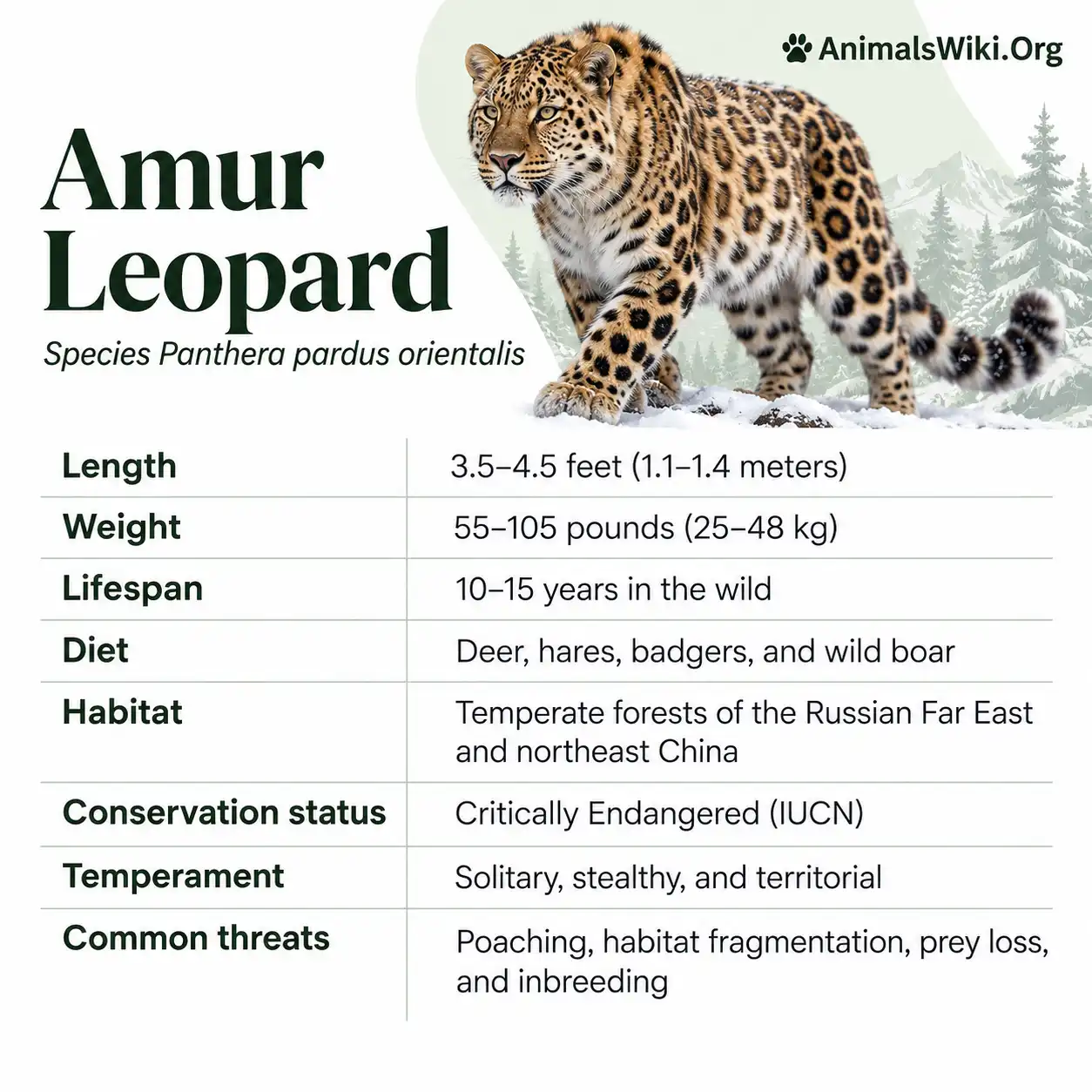
Amur Leopard, The Rare Spotted Hunter of the Russian Far East
The Amur leopard is one of the rarest and most remarkable big cats on Earth.
It is a leopard shaped by a landscape very different from the hot African savannas many people associate with the species.
Its home can experience:
- Deep snow
- Bitter winter temperatures
- Frozen forests
- Rocky mountain slopes
- Long cold seasons
To survive there, the Amur leopard has evolved an exceptionally:
thick, pale winter coat.
Its long fur protects the body against cold, while its widely spaced dark rosettes create camouflage among:
- Forest shadows
- Snow
- Rocks
- Tree trunks
- Dry vegetation
Scientifically, the Amur leopard has traditionally been classified as:
Panthera pardus orientalis.
It is part of the wider leopard species:
Panthera pardus.
The Amur leopard is also sometimes called the:
- Far Eastern leopard
- Manchurian leopard
- Korean leopard
Historically, its range extended across a much larger portion of northeastern Asia.
Today, its core wild population survives primarily around the borderlands of:
the Russian Far East and northeastern China.
This is also one of the few places on Earth where leopards share a landscape with:
Amur tigers.
The two cats occupy overlapping ecosystems and can hunt some of the same prey.
But they are very different predators.
The tiger relies heavily on:
enormous physical power.
The leopard survives through:
stealth, agility, adaptability and concealment.
Amur leopards usually live alone.
They silently patrol large home ranges.
Their prey can include:
- Roe deer
- Sika deer
- Wild boar
- Hares
- Badgers
- Raccoon dogs
- Other available animals
The leopard approaches using:
cover and patience.
Instead of chasing prey over enormous distances, it attempts to move close enough for a sudden:
ambush.
For decades, however, the Amur leopard itself became the animal in danger.
Its population was devastated by:
- Habitat loss
- Poaching
- Declining prey
- Forest disturbance
- Human development
- Small population size
- Inbreeding concerns
At one point, only a few dozen individuals were believed to remain in the core wild population.
The situation was so serious that the Amur leopard became an international symbol of:
big-cat extinction risk.
Yet its story is not only one of decline.
Intensive conservation involving:
- Protected areas
- Anti-poaching patrols
- Camera-trap monitoring
- Habitat protection
- Cross-border cooperation
- Prey conservation
has helped the population increase substantially from its historic low.
The Amur leopard remains extremely rare and conservation-dependent, but its recovery demonstrates an important principle:
even a big cat brought dangerously close to extinction can recover when enough habitat, prey and protection remain.
This comprehensive guide explores Amur Leopard facts, scientific classification, appearance, rosettes, winter coat, size, weight, Russian and Chinese distribution, habitat, diet, hunting, speed, climbing, behavior, reproduction, cubs, lifespan, adaptations, predators, Amur Tigers, conservation, population recovery, threats, and why the Amur Leopard remains one of the world’s rarest big cats.
Amur Leopard Facts
| Feature | Information |
|---|---|
| Common Name | Amur Leopard |
| Scientific Name | Panthera pardus orientalis |
| Species | Leopard, Panthera pardus |
| Family | Felidae |
| Genus | Panthera |
| Animal Type | Mammal |
| Native Region | Northeastern Asia |
| Core Modern Range | Russian Far East and northeastern China |
| Habitat | Temperate forest and mountainous woodland |
| Diet | Carnivore |
| Main Prey | Deer and medium-sized mammals |
| Activity | Flexible; often active around dusk/night |
| Social Structure | Mostly solitary |
| Coat | Pale with dark rosettes |
| Winter Fur | Long and dense |
| Main Hunting Method | Stealth and ambush |
| Climbing | Excellent |
| Swimming | Capable |
| Young | Cubs |
| Typical Litter | Commonly 2–3 cubs, but varies |
| Major Competitor | Amur tiger |
| Major Threats | Habitat pressure, poaching, prey loss and small population size |
| Conservation Importance | Extremely high |
What Is an Amur Leopard?
The Amur leopard is a cold-adapted leopard native to:
northeastern Asia.
It belongs to the species:
Panthera pardus.
Traditionally, it is recognized as the subspecies:
Panthera pardus orientalis.
Is the Amur Leopard a Leopard?
Yes.
It is not a separate type of cat unrelated to leopards.
It is part of the same species as other:
leopard populations.
Why Is It Called the Amur Leopard?
The name comes from the:
Amur region
of northeastern Asia, associated with the Amur River basin and surrounding landscapes.
Other Names for the Amur Leopard
It has also been called:
- Far Eastern leopard
- Manchurian leopard
- Korean leopard
“Amur leopard” is now the most widely recognized common name.
Scientific Classification of the Amur Leopard
| Classification | Name |
|---|---|
| Kingdom | Animalia |
| Phylum | Chordata |
| Class | Mammalia |
| Order | Carnivora |
| Family | Felidae |
| Genus | Panthera |
| Species | Panthera pardus |
| Traditional Subspecies | Panthera pardus orientalis |
What Does an Amur Leopard Look Like?
The Amur leopard has:
- Muscular body
- Broad paws
- Long legs
- Long tail
- Rounded ears
- Powerful jaws
- Pale coat
- Black rosettes
- Dense winter fur
Its overall appearance is unmistakably leopard-like but particularly well suited to:
cold northern forests.
What Color Is an Amur Leopard?
The coat ranges from:
- Pale yellow
- Creamy yellow
- Golden yellow
and can appear particularly pale during winter.
The body is covered with:
dark rosettes and spots.
What Are Leopard Rosettes?
Rosettes are dark markings that resemble:
irregular rings or rose-shaped patterns.
Unlike simple solid spots, many rosettes contain lighter fur in their centers.
Does Every Amur Leopard Have Different Spots?
Yes.
The arrangement of spots and rosettes is:
unique to each individual.
Researchers can use these patterns to identify specific leopards from camera-trap photographs.
How Do Scientists Count Amur Leopards?
Camera traps are one of the most important tools.
Scientists place cameras along:
- Trails
- Ridges
- Forest roads
- Travel routes
When a leopard passes, photographs can capture its unique coat pattern.
Researchers compare:
rosettes
to determine whether photographs show the same animal or different individuals.
Why Does the Amur Leopard Have Thick Fur?
It lives in a region with extremely:
cold winters.
Dense fur provides thermal insulation.
How Long Is Amur Leopard Fur?
Winter fur can grow to several centimeters in length and becomes substantially:
longer and denser
than the summer coat.
The belly and other areas can be especially well insulated.
Does an Amur Leopard Change Color in Winter?
Not dramatically like an Arctic fox.
However, the winter coat becomes:
- Longer
- Denser
- Often paler
creating a somewhat different seasonal appearance.
Why Is the Amur Leopard Pale?
A pale coat is well suited to a landscape containing:
- Snow
- Dry grasses
- Pale winter vegetation
- Rocks
- Forest shadows
Its rosettes further break up its outline.
How Big Is an Amur Leopard?
Adult Amur leopards are powerful medium-to-large cats.
Body length excluding the tail is commonly around:
1–1.4 meters, depending on sex and individual.
The long tail adds substantial additional length.
How Much Does an Amur Leopard Weigh?
Adult males can weigh roughly:
32–48 kilograms, with variation.
Females are generally smaller, often around:
25–43 kilograms.
Individual measurements vary, so these should be treated as approximate ranges rather than strict limits.
Are Male Amur Leopards Bigger Than Females?
Yes.
Males are generally:
- Heavier
- More muscular
- Larger-headed
than females.
Is an Amur Leopard Bigger Than a Snow Leopard?
Their sizes overlap.
Large male Amur leopards can outweigh many snow leopards, but individual variation is substantial.
They also have different body proportions and ecological adaptations.
Is an Amur Leopard Bigger Than a Tiger?
No.
An adult Amur tiger can be:
several times heavier
than an Amur leopard.
Where Do Amur Leopards Live?
The surviving wild population is centered in:
northeastern Asia.
The most important landscapes occur in:
- Southwestern Primorye in the Russian Far East
- Adjacent northeastern China
Do Amur Leopards Live in Russia?
Yes.
The Russian Far East contains one of the species’ most important strongholds.
Do Amur Leopards Live in China?
Yes.
Amur leopards also occur in:
northeastern China.
Cross-border habitat is therefore essential to their survival.
Do Amur Leopards Live in North Korea?
The species historically occurred on the Korean Peninsula.
Modern confirmed distribution there is much less clear.
Claims about a substantial current North Korean population should not be made without reliable evidence.
Do Amur Leopards Live in South Korea?
They historically occurred on the Korean Peninsula but are not considered an established modern wild population in South Korea.
Amur Leopard Habitat
Amur leopards inhabit landscapes containing:
- Temperate forest
- Mixed woodland
- Broadleaf forest
- Coniferous forest
- Mountain slopes
- Rocky terrain
- River valleys
They require sufficient:
cover and prey.
Do Amur Leopards Live in Snow?
Yes.
They are one of the leopard populations best adapted to:
cold, snowy environments.
Can Amur Leopards Survive Freezing Temperatures?
Yes.
Their:
- Thick coat
- Seasonal fur growth
- Body size
- Sheltered habitat
help them tolerate severe winter weather.
Do Amur Leopards Live in the Arctic?
No.
Their habitat is cold but not true:
Arctic tundra.
They live mainly in temperate forest landscapes.
What Do Amur Leopards Eat?
Amur leopards are:
carnivores.
Their prey can include:
- Roe deer
- Sika deer
- Wild boar
- Hares
- Badgers
- Raccoon dogs
- Small mammals
- Other available animals
What Is the Amur Leopard’s Favorite Food?
There is no single universal “favorite.”
Deer, especially:
roe deer and sika deer
are particularly important prey in much of their range.
Do Amur Leopards Hunt Deer?
Yes.
Deer form a major part of their diet.
Do Amur Leopards Eat Wild Boar?
Yes.
They can prey on:
- Piglets
- Young wild boar
- Vulnerable individuals
Large adult boars can be dangerous prey.
Do Amur Leopards Eat Rabbits?
They may take:
hares and similar smaller mammals.
Do Amur Leopards Eat Fish?
Fish are not a major component of their diet, although leopards are opportunistic predators.
Do Amur Leopards Eat Humans?
Humans are not normal prey.
Amur leopards generally avoid:
people.
How Do Amur Leopards Hunt?
They use:
stealth and ambush.
A typical hunt involves:
- Detecting prey.
- Approaching under cover.
- Remaining hidden.
- Moving as close as possible.
- Accelerating suddenly.
- Grabbing the prey.
- Delivering a killing bite.
Are Amur Leopards Ambush Predators?
Yes.
Unlike wolves and dholes, which may pursue prey cooperatively over distance, leopards generally depend on:
getting close without being detected.
Do Amur Leopards Hunt in Packs?
No.
Adults are primarily:
solitary hunters.
A mother may hunt while raising dependent cubs, but leopards do not form cooperative hunting packs.
How Fast Can an Amur Leopard Run?
Leopards can sprint rapidly over short distances.
Figures around:
50–60 km/h
are often cited for leopards generally.
However, their hunting success depends much more on:
stealth and acceleration
than sustained high-speed running.
Can Amur Leopards Climb Trees?
Yes.
They are excellent climbers.
Climbing can help with:
- Resting
- Scanning surroundings
- Escaping disturbance
- Protecting food
although tree use varies with habitat.
Can Amur Leopards Carry Prey Into Trees?
Leopards are famously strong and can haul prey upward.
However, Amur leopards live in landscapes containing:
Amur tigers, and interactions around kills can be complex.
Can Amur Leopards Swim?
Yes.
Like other leopards, they are capable swimmers.
Are Amur Leopards Nocturnal?
They can be active:
- At night
- Around dawn
- Around dusk
- During daylight
Activity changes according to:
- Prey
- Human disturbance
- Season
- Competition
They should not be described as exclusively nocturnal.
Are Amur Leopards Solitary?
Yes.
Adults generally live:
alone.
The main exceptions involve:
- Mating
- Mothers with cubs
Do Amur Leopards Have Territories?
They occupy home ranges and communicate through:
- Scent marking
- Scrapes
- Urine
- Feces
- Claw marks
- Vocalizations
Male ranges can overlap with those of several females.
How Do Amur Leopards Communicate?
They use:
- Scent
- Scratching
- Body language
- Vocalizations
Leopards can produce:
- Growls
- Hisses
- Roars
- Cough-like calls
- Raspy sawing calls
Do Amur Leopards Roar?
Yes.
Leopards belong to the genus:
Panthera
and can produce powerful vocalizations.
Their characteristic call is often described as a repetitive:
rasping or sawing sound.
Amur Leopard Reproduction
Amur leopards reproduce slowly compared with many smaller mammals.
Females invest heavily in:
a small number of cubs.
How Long Is an Amur Leopard Pregnant?
Gestation lasts approximately:
90–105 days.
How Many Cubs Do Amur Leopards Have?
A litter commonly contains around:
2–3 cubs, although litter size can vary.
What Is a Baby Amur Leopard Called?
A baby is called a:
cub.
Are Amur Leopard Cubs Born Blind?
Yes.
Like domestic kittens, newborn leopard cubs are:
- Small
- Vulnerable
- Blind or nearly blind
Their eyes open as they develop.
Where Are Amur Leopard Cubs Born?
A female selects a protected den site such as:
- Rock crevice
- Cave-like shelter
- Dense vegetation
- Hollow
- Sheltered terrain
Does the Male Raise the Cubs?
No.
The mother provides the primary parental care.
She:
- Nurses
- Protects
- Moves
- Feeds
- Teaches
the cubs.
How Do Cubs Learn to Hunt?
Young leopards gradually accompany their mother.
Through:
- Observation
- Play
- Stalking
- Following kills
- Practice
they develop hunting skills.
How Long Do Cubs Stay With Their Mother?
Young leopards can remain dependent for:
well over a year
before becoming independent.
Amur Leopard Lifespan
Wild leopards may live approximately:
10–15 years, although survival varies greatly.
Under managed care, some can live:
20 years or more.
Amur Leopard Adaptations
Thick Winter Fur
Insulates against freezing temperatures.
Pale Coat
Provides camouflage in snowy and dry winter landscapes.
Rosettes
Break up the body’s outline.
Powerful Legs
Support jumping, climbing and short-distance acceleration.
Broad Paws
Help movement across varied terrain and snow.
Long Tail
Provides balance during:
- Running
- Climbing
- Turning
- Jumping
Strong Jaws
Allow the leopard to kill relatively large prey.
Retractable Claws
Improve:
- Grip
- Climbing
- Prey capture
Excellent Night Vision
Supports hunting under low light.
Acute Hearing
Helps locate prey and detect danger.
Solitary Lifestyle
Reduces direct competition for food among adults.
How Far Can an Amur Leopard Jump?
Leopards are powerful jumpers capable of impressive:
- Horizontal leaps
- Vertical jumps
Exact maximum figures vary and are difficult to verify in wild animals.
Their jumping ability is nevertheless important for:
ambush, climbing and navigating rugged terrain.
Does an Amur Leopard Have Retractable Claws?
Yes.
Like most cats, its claws are normally kept:
retracted
when not needed.
This helps keep them sharp.
What Animals Compete With Amur Leopards?
The most important large competitor is the:
Amur tiger.
Other carnivores can also compete for prey and carcasses.
Amur Leopard vs. Amur Tiger
| Feature | Amur Leopard | Amur Tiger |
|---|---|---|
| Scientific Group | Panthera pardus | Panthera tigris |
| Body Size | Much smaller | Much larger |
| Pattern | Rosettes | Stripes |
| Hunting | Solitary ambush | Solitary ambush |
| Climbing | Excellent | Less arboreal as adults |
| Main Habitat | Forest/mountain landscape | Forest landscape |
| Range Overlap | Yes | Yes |
| Relative Strength | Lower | Much higher |
Do Amur Tigers Kill Amur Leopards?
Tigers can kill leopards.
Large carnivores often engage in:
intraguild competition.
An Amur leopard generally benefits from:
avoiding direct confrontation with a tiger.
Do Amur Tigers Eat Amur Leopards?
Predatory or competitive killing is possible, and consumption can occur.
However, leopards are not the tiger’s principal prey.
How Do Amur Leopards Avoid Tigers?
Possible strategies include differences in:
- Space use
- Prey selection
- Timing
- Terrain
Leopards may also exploit their superior:
tree-climbing ability.
Amur Leopard vs. Snow Leopard
| Feature | Amur Leopard | Snow Leopard |
|---|---|---|
| Species | Panthera pardus | Panthera uncia |
| Habitat | Temperate forests | High mountains |
| Coat | Pale yellow with rosettes | Gray-white with rosettes |
| Tail | Long | Exceptionally long and thick |
| Main Region | Russian Far East/China | Central & South Asia |
| Snow Adaptation | Strong | Extreme high-mountain specialization |
Amur Leopard vs. African Leopard
Both belong to:
Panthera pardus.
Major differences reflect their environments.
Amur leopards tend to possess:
- Paler coats
- Longer winter fur
- Cold-climate adaptations
African leopard populations inhabit environments ranging from:
- Savanna
- Woodland
- Forest
- Mountain
Amur Leopard vs. Jaguar
| Feature | Amur Leopard | Jaguar |
|---|---|---|
| Species | Panthera pardus | Panthera onca |
| Main Range | Northeastern Asia | Americas |
| Build | Slenderer | Stockier |
| Head | Smaller relative build | Broad and powerful |
| Rosettes | Usually smaller/denser | Often larger, sometimes with central spots |
| Bite | Powerful | Exceptionally powerful |
What Predators Eat Amur Leopards?
Healthy adult Amur leopards have few natural predators.
The greatest natural competitor capable of killing them is the:
Amur tiger.
Cubs are more vulnerable.
Are Humans the Greatest Threat to Amur Leopards?
Historically, human activities have caused the most serious population decline through:
- Poaching
- Habitat destruction
- Prey depletion
- Development
Are Amur Leopards Dangerous to Humans?
They are powerful wild predators and should always be treated with caution.
However, they generally:
avoid humans.
People are not normal prey.
Do Amur Leopards Attack Humans?
Attacks are exceptionally uncommon.
The extremely small wild population and avoidance of humans make encounters rare.
Can an Amur Leopard Kill a Human?
Physically, an adult leopard is capable of causing fatal injuries.
That does not mean Amur leopards routinely hunt people.
Can Amur Leopards Be Pets?
No.
They are:
- Powerful wild predators
- Conservation-sensitive animals
- Behaviorally unsuitable for domestication
They require specialized professional management.
Why Are Amur Leopards So Rare?
Their historic decline resulted from a combination of:
- Habitat loss
- Forest conversion
- Poaching
- Prey depletion
- Infrastructure
- Human disturbance
- Small population effects
Are Amur Leopards Endangered?
Yes.
The Amur leopard remains one of the world’s most threatened big-cat populations.
It has long been treated as:
Critically Endangered
under widely used conservation assessments.
Because conservation categories can be updated, current status should always be checked against the latest authoritative assessment when publishing time-sensitive population information.
How Many Amur Leopards Are Left?
The answer depends heavily on:
- Survey year
- Survey area
- Whether cubs are included
- Whether Russia and China are counted separately or jointly
- How cross-border individuals are identified
The population has increased substantially from the period when only:
a few dozen
were believed to remain in the core wild population.
Modern camera-trap surveys have documented:
well over 100 wild individuals across the broader transboundary landscape.
However, a precise current number should always be tied to a specific survey and year rather than presented as a timeless exact figure.
Were There Really Only 30 Amur Leopards Left?
Around the early 2000s, estimates suggested only approximately:
30–40 individuals
remained in the core Russian population.
This is why the Amur leopard became one of the world’s best-known examples of a big cat approaching extinction.
Is the Amur Leopard Population Increasing?
Conservation monitoring has shown substantial recovery from the extremely low numbers recorded decades ago.
This is:
encouraging.
But recovery from a few dozen animals does not mean the species is:
safe.
Its population remains small and geographically restricted.
Why Is a Small Population Dangerous?
Small populations face increased risks from:
- Inbreeding
- Disease
- Wildfire
- Habitat disruption
- Random demographic events
- Loss of genetic diversity
One severe event can affect a disproportionately large share of the population.
Is Inbreeding a Problem for Amur Leopards?
Genetic concerns are important because the population passed through a severe:
population bottleneck.
Maintaining connectivity and increasing population size are therefore important for long-term recovery.
Do Wildfires Threaten Amur Leopards?
Yes.
Frequent or severe fires can alter:
- Forest cover
- Prey habitat
- Hunting cover
and fragment suitable landscapes.
Does Poaching Threaten Amur Leopards?
Yes.
Leopards can be killed directly, while poaching of:
deer and wild boar
also removes their food.
Why Is Prey Poaching Dangerous?
A protected leopard cannot survive in a forest with:
nothing to hunt.
Therefore, anti-poaching programs must protect:
- The predator
- Its prey
Does Habitat Loss Threaten Amur Leopards?
Yes.
Roads, development, agriculture, fire and other landscape changes can reduce or fragment habitat.
Land of the Leopard National Park
One of the most important conservation developments has been the protection of habitat in Russia through:
Land of the Leopard National Park.
The protected landscape contains crucial habitat for:
- Amur leopards
- Amur tigers
- Deer
- Wild boar
- Many other species
Why Is Cross-Border Conservation Important?
Leopards do not recognize political borders.
An individual may move between:
Russia and China.
Therefore, effective conservation requires:
- Shared monitoring
- Habitat connectivity
- Coordinated anti-poaching
- Compatible protection policies
Amur Leopard Conservation
Major conservation actions include:
- Protected areas
- Anti-poaching patrols
- Camera-trap monitoring
- Prey protection
- Habitat restoration
- Fire management
- Genetic research
- Cross-border cooperation
- Wildlife corridors
- Public education
Why Are Camera Traps Important?
Amur leopards are:
- Solitary
- Secretive
- Wide-ranging
Direct counting is extremely difficult.
Camera traps allow researchers to identify animals through their:
unique rosette patterns.
Can Amur Leopards Recover?
Yes.
Their population increase from historic lows demonstrates that recovery is:
biologically possible.
Long-term recovery depends on maintaining:
- Habitat
- Prey
- Genetic diversity
- Protection
- Connectivity
Ecological Importance of the Amur Leopard
As a predator, the Amur leopard helps influence populations and behavior of prey species.
Predators contribute to complex food webs involving:
- Herbivores
- Smaller predators
- Scavengers
- Plants
- Decomposers
Protecting the leopard also protects a large area of:
temperate forest ecosystem.
50 Interesting Amur Leopard Facts
- The Amur leopard is a leopard.
- Its traditional scientific name is Panthera pardus orientalis.
- It belongs to the family Felidae.
- It belongs to the genus Panthera.
- It is native to northeastern Asia.
- Its modern core range includes the Russian Far East.
- It also occurs in northeastern China.
- It once had a much larger range.
- It is adapted to cold winters.
- It can live in snowy forests.
- Its winter fur becomes thick and long.
- Its coat is relatively pale.
- It has black rosettes.
- Each leopard has a unique rosette pattern.
- Researchers identify individuals from their spots.
- Camera traps are vital for monitoring.
- Males are generally larger than females.
- Amur leopards are carnivores.
- Roe deer are important prey.
- Sika deer are important prey.
- They can hunt wild pigs.
- They also take smaller mammals.
- They are ambush predators.
- They hunt primarily alone.
- They are excellent climbers.
- They can swim.
- They can sprint rapidly.
- Their long tail helps with balance.
- Their claws are retractable.
- They possess excellent low-light vision.
- Adults are mainly solitary.
- They communicate through scent marking.
- They also use scratches and vocalizations.
- Females usually produce a small litter.
- Cubs are born vulnerable.
- Mothers raise the cubs without help from males.
- Cubs learn hunting skills from their mother.
- Amur leopards share habitat with Amur tigers.
- Amur tigers are much larger.
- Tigers can kill leopards.
- Leopards generally avoid direct fights with tigers.
- Humans are not normal Amur leopard prey.
- Habitat loss contributed to their decline.
- Poaching contributed to their decline.
- Loss of prey also threatens them.
- Their population once fell to only a few dozen animals in the core range.
- Their numbers have increased substantially from that low point.
- More than 100 wild individuals have been documented across the broader modern landscape.
- Protected areas have been crucial to recovery.
- The Amur leopard demonstrates that conservation can reverse even an extremely severe big-cat decline.
Did You Know?
The spots on an Amur leopard can function almost like a natural identification card.
Imagine a camera hidden beside a snowy forest trail in the Russian Far East.
For days:
nothing happens.
Snow falls.
A deer walks past.
A wild boar appears.
Then, in the darkness, the camera detects movement.
A cat enters the frame.
It is pale.
Its winter coat is thick.
Black rosettes cover its body.
The photograph lasts only a moment.
The leopard disappears.
To most people, the picture simply shows:
an Amur leopard.
To a researcher, it can reveal:
which Amur leopard.
The scientist examines the rosettes.
One ring bends slightly near the shoulder.
Another dark cluster appears above the leg.
The pattern matches photographs from another camera several kilometers away.
The leopard has been identified.
No collar was required.
No animal had to be captured.
Its own coat provided the:
identification pattern.
Repeat this process across hundreds of cameras and scientists can begin reconstructing an invisible population.
One leopard appears here.
Another there.
A female is photographed with cubs.
A male moves across a large territory.
An individual crosses toward China.
Slowly, photographs transform into:
population data.
This technology helped reveal something extraordinary.
A big cat once reduced to only a few dozen individuals had begun:
recovering.
The Amur leopard remains rare.
Its future is not guaranteed.
But each new set of rosettes appearing on a camera trap represents something important:
another wild leopard still moving through the forests of northeastern Asia.
Frequently Asked Questions About Amur Leopards
What is an Amur leopard?
The Amur leopard is a rare, cold-adapted leopard from northeastern Asia.
What is the scientific name of the Amur leopard?
It is traditionally classified as Panthera pardus orientalis.
Is the Amur leopard a mammal?
Yes.
Is the Amur leopard a big cat?
Yes.
Is the Amur leopard a true leopard?
Yes.
Is the Amur leopard a separate species?
It is generally treated as part of the leopard species, Panthera pardus, traditionally as the subspecies P. p. orientalis.
Why is it called an Amur leopard?
Its name refers to the Amur region of northeastern Asia.
What is another name for the Amur leopard?
Far Eastern leopard is another common name.
Is the Amur leopard the same as the Korean leopard?
“Korean leopard” has historically been used for this leopard population/subspecies.
Where do Amur leopards live?
Primarily in the Russian Far East and adjacent northeastern China.
Do Amur leopards live in Russia?
Yes.
Do Amur leopards live in China?
Yes.
Do Amur leopards live in Korea?
They historically occurred on the Korean Peninsula, but modern confirmed populations are centered farther north.
Do Amur leopards live in Siberia?
They inhabit the Russian Far East; calling their entire habitat simply “Siberia” can be geographically imprecise.
Do Amur leopards live in snow?
Yes.
Do Amur leopards live in forests?
Yes.
Do Amur leopards live in the jungle?
Their principal habitat is temperate forest rather than the tropical jungle commonly associated with that word.
How cold can an Amur leopard survive?
They are adapted to severe below-freezing winters typical of the Russian Far East.
Why does the Amur leopard have thick fur?
For insulation against cold weather.
Why is the Amur leopard’s coat pale?
The pale coloration provides effective camouflage in its seasonal northern environment.
Does its fur change in winter?
The winter coat becomes longer, denser and often appears paler.
What are Amur leopard spots called?
Many are called rosettes.
Does every Amur leopard have different spots?
Yes, individual patterns are unique.
How do scientists identify Amur leopards?
By comparing unique rosette patterns in photographs.
How do scientists count Amur leopards?
Camera-trap surveys are particularly important.
How big is an Amur leopard?
Adults may reach roughly 1–1.4 m in body length excluding the tail.
How much does an Amur leopard weigh?
Males often weigh roughly 32–48 kg, while females are generally smaller.
Are male Amur leopards bigger than females?
Yes.
Is an Amur leopard bigger than a jaguar?
No. Jaguars are generally heavier and more robust.
Is an Amur leopard bigger than a tiger?
No.
Is an Amur leopard bigger than a snow leopard?
Their size ranges overlap, though large Amur leopards can be heavier than some snow leopards.
What do Amur leopards eat?
Mainly deer and other medium-sized mammals.
Do Amur leopards eat roe deer?
Yes.
Do Amur leopards eat sika deer?
Yes.
Do Amur leopards eat wild boar?
Yes, particularly younger or vulnerable animals.
Do Amur leopards eat rabbits?
They can eat hares and other small mammals.
Do Amur leopards eat humans?
Humans are not normal prey.
How do Amur leopards hunt?
They stalk prey silently and attack from close range.
Do Amur leopards hunt in packs?
No.
Are Amur leopards ambush predators?
Yes.
How fast can an Amur leopard run?
Leopards can sprint at roughly 50–60 km/h over short distances, although exact performance varies.
Can Amur leopards climb trees?
Yes.
Can Amur leopards swim?
Yes.
Can Amur leopards jump?
Yes. They are powerful jumpers.
Are Amur leopards nocturnal?
They can be active at night, twilight or during the day.
Are Amur leopards solitary?
Yes.
Do Amur leopards have territories?
They maintain large home ranges and scent-mark them.
Do Amur leopards roar?
They can produce powerful leopard vocalizations, including rasping calls.
How do Amur leopards communicate?
Through scent, scratches, visual signals and vocalizations.
How many cubs do Amur leopards have?
Often around two or three, although litter size varies.
What is a baby Amur leopard called?
A cub.
How long is an Amur leopard pregnant?
Approximately 90–105 days.
Are Amur leopard cubs born blind?
Yes.
Who raises Amur leopard cubs?
The mother.
Does the father help raise the cubs?
Normally no.
How long do cubs stay with their mother?
They may remain dependent for well over a year.
How long do Amur leopards live?
Wild individuals may live around 10–15 years, while managed animals can live longer.
What predators kill Amur leopards?
Adult Amur tigers are the most important natural predator capable of killing them.
Do Amur tigers kill Amur leopards?
Yes, it can occur.
Do Amur tigers eat leopards?
They can, although leopards are not their main prey.
How do Amur leopards avoid tigers?
They can separate themselves through habitat use, timing, prey selection and avoidance behavior.
Can an Amur leopard kill an Amur tiger?
A healthy adult tiger has an overwhelming size advantage. Direct confrontation strongly favors the tiger.
Are Amur leopards dangerous to humans?
They are powerful predators but generally avoid humans.
Do Amur leopards attack humans?
Such attacks are exceptionally rare.
Can Amur leopards be pets?
No.
Are Amur leopards endangered?
Yes. They remain among the world’s most threatened big-cat populations.
Are Amur leopards Critically Endangered?
They have long been classified as Critically Endangered under major conservation assessments; publication should use the latest authoritative assessment for current status.
Why are Amur leopards endangered?
Habitat loss, poaching, prey depletion, development and the consequences of a very small population contributed to their decline.
How many Amur leopards are left?
The population has risen substantially from its historic low, with well over 100 wild individuals documented across the broader transboundary landscape. Exact totals depend on survey year and methodology.
Were there only 30 Amur leopards left?
At their modern low point, surveys indicated roughly only a few dozen remained in the core Russian population.
Is the Amur leopard population growing?
Conservation monitoring has shown a major increase from those historic lows.
Does that mean Amur leopards are safe?
No. Their population remains small and restricted.
What is Land of the Leopard National Park?
It is a major protected landscape in the Russian Far East that safeguards important Amur leopard habitat.
Why are camera traps important?
They allow researchers to monitor elusive leopards without repeatedly capturing them.
Why is Russia-China cooperation important?
Amur leopards cross political borders, so their ecosystem must be managed as a connected landscape.
Does poaching still threaten Amur leopards?
Yes.
Why does deer poaching affect leopards?
Removing deer removes the leopard’s food supply.
Does wildfire threaten Amur leopards?
Frequent severe fires can damage habitat and prey populations.
Is inbreeding a concern?
Yes. The severe historical population bottleneck creates genetic concerns.
Can the Amur leopard recover completely?
Further recovery is possible if habitat, prey, genetic connectivity and protection are maintained.
Why are Amur leopards important?
They are major predators and symbols of the conservation value of northeastern Asian temperate forests.
What is the difference between an Amur leopard and a normal leopard?
The Amur leopard is a cold-adapted leopard population traditionally recognized as a subspecies, with especially long winter fur and a northeastern Asian distribution.
What is the difference between an Amur leopard and a snow leopard?
They are separate species with different ranges, anatomy and habitat specializations.
What is the difference between an Amur leopard and an Amur tiger?
The tiger is dramatically larger and striped; the leopard is smaller, spotted and a better climber.
What is the most interesting Amur leopard fact?
Its individual rosette patterns are unique enough that researchers can identify specific wild leopards from camera-trap photographs and use those images to monitor the recovery of one of the world’s rarest big cats.
Conclusion
The Amur leopard represents one of the most dramatic contrasts in big-cat conservation.
Biologically, it is extraordinarily capable.
It can survive:
freezing winters.
It can climb:
trees.
It can cross:
rugged mountains.
It can stalk prey almost:
silently.
It can live alongside an animal several times its size:
the Amur tiger.
Yet none of these adaptations protected it from the speed at which humans changed its environment.
Forests disappeared.
Prey declined.
Leopards were killed.
The population contracted until only:
a few dozen animals
were believed to remain in its core stronghold.
At that point, extinction appeared frighteningly possible.
But the story did not end there.
Protected habitat expanded.
Poaching control improved.
Camera traps monitored individuals.
Russia and China increased conservation efforts across a landscape that the leopards themselves had always treated as:
one ecosystem.
Then something remarkable happened.
More rosette patterns began appearing on cameras.
Females appeared.
Cubs appeared.
Animals dispersed.
The population began:
growing.
That does not mean the Amur leopard has been saved permanently.
A population recovering from an extreme bottleneck remains vulnerable to:
- Disease
- Inbreeding
- Fire
- Habitat loss
- Prey decline
- Poaching
- Random environmental disasters
But its recovery provides something conservation biology desperately needs:
evidence that protection can work.
The Amur leopard did not need humans to teach it how to survive winter.
Evolution had already done that.
It needed humans to stop removing:
the conditions that made survival possible.
Give a leopard enough:
- Forest
- Prey
- Space
- Connectivity
- Protection
and one of nature’s most adaptable predators can do the rest.
That may ultimately be the most important Amur leopard fact of all:
one of the world’s rarest big cats has shown that being close to extinction does not have to mean extinction is inevitable.



