
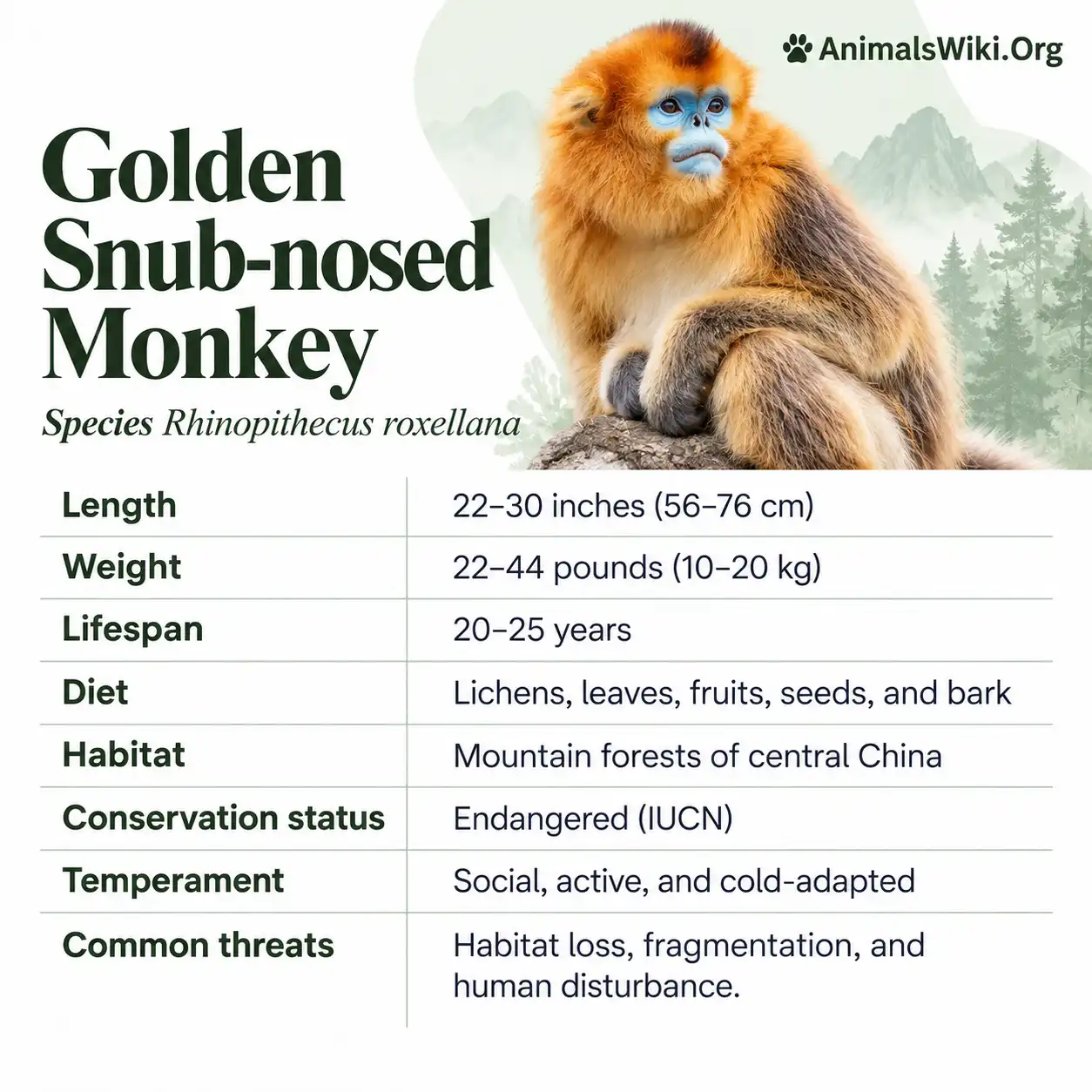
Golden Snub-nosed Monkey, The Cold-Adapted Golden Primate of China’s Mountain Forests
The Golden Snub-nosed Monkey is one of the world’s most extraordinary-looking primates.
Its appearance is almost impossible to confuse with another monkey.
An adult may have:
- Brilliant golden-orange fur
- A pale or bluish face
- Deep-set dark eyes
- A remarkably short, upturned nose
- Thick fur covering much of the body
- A long tail
- Powerful limbs adapted for climbing
Adult males can become particularly spectacular.
Their shoulders, back and head may develop long:
golden guard hairs
that create a dramatic mane-like appearance.
But the Golden Snub-nosed Monkey is remarkable for far more than its appearance.
Scientifically known as:
Rhinopithecus roxellana
it is a highly specialized Old World monkey found naturally only in:
China.
It inhabits mountainous forests across parts of central China, including populations associated with provinces such as:
- Sichuan
- Shaanxi
- Hubei
- Gansu
These mountains can become extraordinarily cold.
During winter, Golden Snub-nosed Monkeys may encounter:
- Snow
- Ice
- Freezing temperatures
- Strong winds
- Severe seasonal food shortages
This makes them unusual among primates.
Many people imagine monkeys living exclusively in:
warm tropical jungles.
The Golden Snub-nosed Monkey challenges that image completely.
Some populations live in temperate mountain forests at elevations where winter temperatures can fall far below freezing.
Their thick fur provides essential insulation.
But surviving winter requires more than:
a warm coat.
Food also changes dramatically with the seasons.
During warmer months, these monkeys can consume:
- Leaves
- Young shoots
- Fruits
- Seeds
- Flowers
- Bark
- Other plant foods
During the harsh winter, when fruits and fresh leaves become scarce, they rely much more heavily on:
lichens.
This seasonal flexibility is one of their most important adaptations.
Their social system is equally extraordinary.
Golden Snub-nosed Monkeys can gather into enormous communities containing:
hundreds of individuals.
These are not simply chaotic crowds.
Their society has multiple levels.
At the core are smaller family-like units, often containing:
- One adult male
- Several adult females
- Their young
Several of these units associate with one another to form larger bands.
Separate all-male groups can also occur.
Multiple units and bands can temporarily come together into enormous aggregations.
This structure is called a:
multilevel society.
Few primates organize their social lives on such an impressive scale.
The Golden Snub-nosed Monkey’s strange nose is another source of fascination.
Unlike monkeys with projecting muzzles and obvious noses, this species has a greatly reduced external nose with:
forward- or upward-facing nostrils.
The exact evolutionary explanation for this shape remains debated.
It is tempting to claim that the nose evolved specifically to prevent frostbite, but that explanation is not firmly established and should be treated cautiously.
Whatever its evolutionary origin, the snub nose has become the defining feature of an entire group of Asian monkeys.
Unfortunately, even thick fur, flexible feeding and complex social cooperation cannot protect these primates from every threat.
Golden Snub-nosed Monkeys have suffered from:
- Forest destruction
- Habitat fragmentation
- Historical hunting
- Human development
- Isolation of populations
Protecting them therefore requires protecting large connected areas of China’s:
mountain forests.
This comprehensive guide explores Golden Snub-nosed Monkey facts, scientific classification, appearance, golden fur, blue face, snub nose, size, weight, distribution in China, mountain habitat, diet, lichen feeding, behavior, huge social groups, communication, reproduction, babies, lifespan, cold-weather adaptations, predators, conservation, and why this remarkable monkey is one of Asia’s most distinctive primates.
Golden Snub-nosed Monkey Facts
| Feature | Information |
|---|---|
| Common Name | Golden Snub-nosed Monkey |
| Scientific Name | Rhinopithecus roxellana |
| Animal Type | Mammal |
| Order | Primates |
| Family | Cercopithecidae |
| Subfamily | Colobinae |
| Genus | Rhinopithecus |
| Native Country | China |
| Natural Distribution | Central China |
| Habitat | Temperate and montane forest |
| Diet | Primarily plant-based |
| Important Winter Food | Lichens |
| Famous Feature | Short upturned nose |
| Coat | Golden-orange with darker areas |
| Face | Pale to bluish |
| Tail | Long |
| Social System | Multilevel society |
| Group Size | From small units to aggregations of hundreds |
| Activity | Diurnal |
| Locomotion | Arboreal and terrestrial |
| Young | Infant |
| Typical Birth | Usually one infant |
| Major Threat | Habitat loss and fragmentation |
| Conservation Importance | High |
What Is a Golden Snub-nosed Monkey?
The Golden Snub-nosed Monkey is an Old World monkey native to:
China.
Its scientific name is:
Rhinopithecus roxellana.
It belongs to the family:
Cercopithecidae.
Within that family, it belongs to the leaf-monkey subfamily:
Colobinae.
Why Is It Called a Golden Snub-nosed Monkey?
The name describes two of its most obvious features:
Golden — because much of its coat can be bright golden-orange.
Snub-nosed — because the external nose is extremely short and the nostrils face forward or upward.
Scientific Classification
| Classification | Name |
|---|---|
| Kingdom | Animalia |
| Phylum | Chordata |
| Class | Mammalia |
| Order | Primates |
| Family | Cercopithecidae |
| Subfamily | Colobinae |
| Genus | Rhinopithecus |
| Species | Rhinopithecus roxellana |
Is the Golden Snub-nosed Monkey an Ape?
No.
It is a:
monkey.
Apes include:
- Humans
- Chimpanzees
- Bonobos
- Gorillas
- Orangutans
- Gibbons
Golden Snub-nosed Monkeys belong to a different primate lineage.
Is It an Old World Monkey?
Yes.
Golden Snub-nosed Monkeys are:
Old World monkeys.
Old World monkeys are native to:
- Africa
- Asia
and belong to the family Cercopithecidae.
What Does a Golden Snub-nosed Monkey Look Like?
Its appearance includes:
- Golden-orange coat
- Pale or bluish face
- Short nose
- Upturned nostrils
- Dark eyes
- Long tail
- Thick body fur
- Strong climbing limbs
Adult males are particularly striking.
Why Are Golden Snub-nosed Monkeys Golden?
Their fur contains pigments producing:
yellow, orange and golden coloration.
Color varies according to:
- Age
- Sex
- Body region
- Individual
Adult males often display the most spectacular golden fur.
Do They Really Have Blue Faces?
The facial skin can appear:
pale bluish or blue-gray.
The exact appearance varies with:
- Lighting
- Age
- Individual
- Skin pigmentation
Why Does the Golden Snub-nosed Monkey Have No Nose?
It does have a nose.
What is reduced is the projecting external structure.
Its nostrils remain fully functional for:
breathing and smelling.
What Is a Snub Nose?
A snub nose is:
short and flattened
rather than projecting strongly outward.
In snub-nosed monkeys, the nostrils are unusually exposed and oriented forward or upward.
Why Does It Have an Upturned Nose?
The precise evolutionary reason remains uncertain.
Possible explanations have involved adaptation to:
- Cold
- Moisture
- Mountain environments
but no simple explanation should be presented as conclusively proven.
Does the Short Nose Prevent Frostbite?
This is a popular idea.
A reduced projecting nose might theoretically reduce exposed tissue in severe cold.
However, scientists have not established this as the sole definitive explanation.
It is safer to say:
the exact evolutionary reason remains debated.
Golden Snub-nosed Monkey Fur
The species possesses:
dense insulating fur.
This is essential because some populations experience extremely cold winters.
Adult males may develop long golden fur around:
- Head
- Shoulders
- Back
creating a striking appearance.
Are Males More Colorful Than Females?
Yes.
Adult males tend to be:
- Larger
- More strongly colored
- More golden
- More heavily furred around the shoulders
Females are generally:
smaller and less dramatically colored.
Golden Snub-nosed Monkey Size
Adult males can reach approximately:
60–75 cm in head-and-body length, with a long tail that may approach or exceed the body length.
Females are considerably smaller.
How Much Does a Golden Snub-nosed Monkey Weigh?
Adult males commonly weigh approximately:
15–20 kg, sometimes more.
Females are much lighter, commonly around:
6–10 kg.
Exact measurements vary among populations and individuals.
Are Males Bigger Than Females?
Yes.
The species shows pronounced:
sexual dimorphism.
Adult males can be around twice the mass of adult females.
Why Are Male Golden Snub-nosed Monkeys So Large?
Large body size can provide advantages in:
- Competition
- Social status
- Protection
- Access to mates
Sexual selection has likely contributed to the difference.
Do Golden Snub-nosed Monkeys Have Tails?
Yes.
Unlike apes, they possess:
long tails.
The tail helps with balance while moving:
- Through trees
- Across branches
- Over uneven terrain
Can Their Tails Grab Branches?
No.
Their tails are not fully:
prehensile
like those of some New World monkeys.
They mainly assist with:
balance.
Where Do Golden Snub-nosed Monkeys Live?
They are endemic to:
China.
That means they naturally occur nowhere else in the wild.
What Parts of China Have Golden Snub-nosed Monkeys?
Wild populations occur primarily in mountainous areas of central China, including parts of:
- Sichuan
- Shaanxi
- Hubei
- Gansu
Do Golden Snub-nosed Monkeys Live in the Himalayas?
Not primarily.
They occupy mountainous regions of:
central China, rather than being a typical Himalayan species.
Golden Snub-nosed Monkey Habitat
They inhabit:
- Temperate forest
- Montane forest
- Broadleaf forest
- Mixed forest
- Coniferous forest
depending on elevation and location.
How High Do Golden Snub-nosed Monkeys Live?
They can occur at elevations of roughly:
1,500–3,400 meters
in many parts of their range, although local conditions vary.
Do Golden Snub-nosed Monkeys Live in Snow?
Yes.
Some populations regularly encounter:
deep winter snow.
Can Monkeys Really Live in Freezing Temperatures?
Yes.
The Golden Snub-nosed Monkey is one of the clearest examples.
Its mountain habitat can experience prolonged periods below:
0°C.
How Do Golden Snub-nosed Monkeys Survive Winter?
Important adaptations include:
- Thick fur
- Large body size
- Social behavior
- Seasonal diet changes
- Use of sheltered forest
- Ability to eat lichens
What Do Golden Snub-nosed Monkeys Eat?
They are primarily:
herbivorous, although their diet is flexible.
Foods include:
- Leaves
- Young leaves
- Shoots
- Buds
- Fruit
- Seeds
- Bark
- Flowers
- Lichens
Occasional animal matter may also be consumed.
Do Golden Snub-nosed Monkeys Eat Fruit?
Yes.
Fruit can be important when seasonally available.
Do They Eat Leaves?
Yes.
Leaves are an important component of the diet.
Do Golden Snub-nosed Monkeys Eat Lichens?
Yes.
This is one of their most important ecological adaptations.
During winter, when:
- Fruit disappears
- Young leaves become scarce
- Snow covers vegetation
lichens can become a major food source.
What Is Lichen?
A lichen is a complex association primarily involving:
fungi and photosynthetic partners such as algae or cyanobacteria.
Lichens can grow on:
- Tree bark
- Branches
- Rocks
and remain available when many other foods disappear.
Why Are Lichens Important to These Monkeys?
Because lichens can remain available through:
cold winters.
The ability to digest and survive on such fibrous seasonal foods allows the monkeys to inhabit environments that would be difficult for many other primates.
Do They Eat Meat?
They are not specialized predators.
Their diet is overwhelmingly:
plant-based.
Small amounts of insects or other animal material may occasionally be consumed.
Are Golden Snub-nosed Monkeys Leaf Monkeys?
They belong to the subfamily:
Colobinae, often called leaf-eating monkeys.
However, their diet includes much more than leaves.
How Do They Digest Leaves?
Colobine monkeys possess a specialized:
multi-chambered stomach.
Microbes help ferment plant material.
This allows them to extract nutrients from:
- Leaves
- Lichens
- Other fibrous foods
Is Their Stomach Like a Cow’s?
There is a functional similarity because both use:
microbial fermentation.
But their digestive anatomy is not identical to that of cattle.
Golden Snub-nosed Monkeys are:
foregut-fermenting primates.
Golden Snub-nosed Monkey Behavior
These monkeys are:
- Diurnal
- Social
- Mobile
- Skilled climbers
- Capable ground travelers
Their most remarkable behavioral feature is their:
complex social organization.
Are Golden Snub-nosed Monkeys Social?
Extremely.
They form some of the largest and most complex societies known among:
non-human primates.
How Many Golden Snub-nosed Monkeys Live Together?
Small social units may contain only a handful of individuals.
But larger bands and temporary aggregations can contain:
hundreds of monkeys.
Exceptional gatherings may be enormous.
Can 500 Golden Snub-nosed Monkeys Live Together?
Large aggregations numbering several hundred have been documented.
The key is that such gatherings are not simply one undifferentiated family.
They are composed of:
multiple social units.
What Is a Multilevel Society?
A multilevel society is organized into several nested layers.
For Golden Snub-nosed Monkeys, this can include:
- One-male family units.
- All-male units.
- Bands containing multiple units.
- Larger temporary herds or aggregations.
What Is a One-Male Unit?
A typical one-male unit may contain:
- One adult male
- Several adult females
- Juveniles
- Infants
It forms a fundamental social building block.
What Happens to Other Males?
Males without a breeding unit can form:
all-male groups.
These are sometimes called bachelor groups.
Do Males Fight?
Yes.
Competition can occur over:
- Access to females
- Social position
- Group membership
However, social interactions also involve:
- Grooming
- Play
- Tolerance
- Cooperation
Do Golden Snub-nosed Monkeys Groom Each Other?
Yes.
Grooming helps:
- Clean fur
- Remove parasites
- Maintain social relationships
- Reduce tension
Do They Play?
Yes.
Young monkeys frequently engage in:
- Chasing
- Wrestling
- Climbing
- Jumping
- Social play
Play helps develop physical and social skills.
Are Golden Snub-nosed Monkeys Arboreal?
They are skilled tree climbers and spend considerable time:
in trees.
However, they also travel:
on the ground.
Can Golden Snub-nosed Monkeys Walk on Snow?
Yes.
They may travel across snowy ground as they move between feeding and resting areas.
How Do Golden Snub-nosed Monkeys Communicate?
They communicate using:
- Calls
- Facial expressions
- Body posture
- Grooming
- Physical contact
Their social complexity requires a diverse communication system.
What Sounds Do They Make?
They produce a variety of:
- Calls
- Grunts
- Squeals
- Contact sounds
- Alarm signals
Different calls can function in different social contexts.
Are Golden Snub-nosed Monkeys Loud?
Large groups can become:
very vocal.
Calls help individuals remain aware of others in:
dense mountain forest.
Golden Snub-nosed Monkey Reproduction
Reproduction is closely linked to:
- Social organization
- Season
- Female condition
- Food availability
Females normally give birth to:
one infant.
How Long Is a Golden Snub-nosed Monkey Pregnant?
Gestation lasts roughly:
six to seven months.
How Many Babies Do They Have?
Usually:
one infant at a time.
Twins are uncommon.
What Is a Baby Golden Snub-nosed Monkey Called?
A baby monkey is called an:
infant.
What Do Baby Golden Snub-nosed Monkeys Look Like?
Newborns are much smaller and less dramatically colored than adults.
Their coat changes as they:
grow and mature.
Do Mothers Carry Their Babies?
Yes.
Young infants cling to:
their mothers.
The mother provides:
- Milk
- Warmth
- Protection
- Transportation
Do Other Monkeys Help With Babies?
Social relationships around infants can involve other females and group members.
This behavior is sometimes called:
allomaternal care when individuals other than the mother interact with or help care for an infant.
Do Fathers Protect the Young?
Adult males can play an important role in:
defending their social unit.
Male presence may provide protection against:
- Rival males
- Predators
- Social threats
How Long Do Babies Stay With Their Mothers?
Infants gradually become:
- More independent
- More mobile
- More socially active
over their first years.
Maternal relationships remain important during juvenile development.
Golden Snub-nosed Monkey Lifespan
Exact maximum lifespan in the wild is difficult to determine.
They can live for:
more than 20 years
under favorable conditions, with managed individuals potentially living longer.
Golden Snub-nosed Monkey Adaptations
Thick Fur
Provides insulation against mountain winters.
Large Body Size
Especially in males, larger bodies retain heat more efficiently than very small bodies.
Seasonal Diet
Allows them to switch foods as availability changes.
Lichen Feeding
Provides a winter food resource.
Specialized Stomach
Helps digest fibrous vegetation.
Strong Limbs
Support climbing and mountain travel.
Long Tail
Improves balance.
Social Living
Provides opportunities for:
- Protection
- Information sharing
- Social bonding
Multilevel Society
Allows flexible organization across large populations.
Why Is Thick Fur So Important?
Cold mountain forests can expose monkeys to:
- Snow
- Wind
- Ice
- Freezing temperatures
Dense fur traps insulating air near the body.
Do Golden Snub-nosed Monkeys Huddle for Warmth?
Close physical contact and social resting can help reduce heat loss, particularly during:
cold conditions.
What Predators Hunt Golden Snub-nosed Monkeys?
Potential predators include:
- Leopards
- Large birds of prey
- Other capable carnivores
Predator importance varies by location and age of the monkey.
Do Leopards Eat Golden Snub-nosed Monkeys?
Leopards can prey on monkeys where:
their ranges overlap.
Large social groups and vigilance may help monkeys detect approaching predators.
Do Eagles Hunt Golden Snub-nosed Monkeys?
Large raptors can pose a particular danger to:
- Infants
- Juveniles
although predation rates vary.
How Do Golden Snub-nosed Monkeys Defend Themselves?
They rely on:
- Group vigilance
- Alarm calls
- Trees
- Agility
- Escape
- Adult defense
Living in a large social system means:
many eyes can watch for danger.
Are Golden Snub-nosed Monkeys Dangerous to Humans?
They are wild primates and should not be approached.
However, they do not normally:
hunt or prey upon humans.
Can Golden Snub-nosed Monkeys Bite?
Yes.
Like other monkeys, they possess:
- Strong jaws
- Sharp canine teeth
and can bite defensively.
Can You Keep a Golden Snub-nosed Monkey as a Pet?
No.
They are:
- Wild primates
- Socially complex
- Conservation-sensitive
- Specialized in diet and habitat
Keeping one as an ordinary pet would be inappropriate and often illegal.
Are Golden Snub-nosed Monkeys Endangered?
The Golden Snub-nosed Monkey is a:
threatened primate.
Its conservation status reflects population decline and habitat pressures.
Because conservation assessments can change, the most recent authoritative listing should be checked when publishing a current status or population estimate.
Why Are Golden Snub-nosed Monkeys Threatened?
Major threats have included:
- Deforestation
- Forest fragmentation
- Historical hunting
- Infrastructure
- Agricultural expansion
- Human disturbance
- Isolation of populations
Does Deforestation Affect Golden Snub-nosed Monkeys?
Yes.
These monkeys depend on forests for:
- Food
- Shelter
- Travel
- Sleeping sites
- Protection
Removing forest can affect every part of their lives.
Why Is Habitat Fragmentation Dangerous?
Imagine one large forest being divided into:
five isolated forest islands.
Monkeys in one fragment may struggle to reach:
- Other groups
- Seasonal feeding grounds
- New breeding partners
This can reduce:
genetic connectivity.
Are Golden Snub-nosed Monkeys Hunted?
Historically, hunting contributed to declines.
Modern legal protection and conservation measures are therefore extremely important.
How Many Golden Snub-nosed Monkeys Are Left?
Estimates commonly place the total wild population in the:
tens of thousands rather than hundreds.
However, exact figures vary according to:
- Survey year
- Geographic coverage
- Population definition
A precise current total should therefore be linked to an up-to-date survey rather than treated as timeless.
Are Golden Snub-nosed Monkeys Rare?
Yes.
Although more numerous than some critically endangered primates, their entire natural distribution is:
restricted to China
and populations remain fragmented.
Golden Snub-nosed Monkey Conservation
Important conservation measures include:
- Protecting mountain forests
- Maintaining wildlife corridors
- Preventing hunting
- Restoring degraded habitat
- Monitoring populations
- Reducing human disturbance
- Supporting protected areas
- Genetic research
- Community-based conservation
Why Are Wildlife Corridors Important?
Corridors allow monkeys to move between forest populations.
This supports:
- Dispersal
- Gene flow
- Access to seasonal food
- Population recovery
Why Are Protected Areas Important?
Protected landscapes preserve not only the monkeys but also:
- Trees
- Lichens
- Predators
- Birds
- Other mammals
- Entire mountain ecosystems
Golden Snub-nosed Monkey vs. Other Snub-nosed Monkeys
The genus Rhinopithecus contains several remarkable Asian primates.
These include:
- Golden Snub-nosed Monkey
- Black-and-white Snub-nosed Monkey
- Gray Snub-nosed Monkey
- Tonkin Snub-nosed Monkey
- Myanmar Snub-nosed Monkey
They are related but:
different species.
Golden Snub-nosed Monkey vs. Black-and-white Snub-nosed Monkey
| Feature | Golden Snub-nosed Monkey | Black-and-white Snub-nosed Monkey |
|---|---|---|
| Scientific Name | R. roxellana | R. bieti |
| Main Color | Golden-orange | Black, white and gray |
| Range | Central China | Southwestern China |
| Habitat | Cold mountain forest | Very high mountain forest |
| Nose | Snubbed | Snubbed |
Golden Snub-nosed Monkey vs. Japanese Macaque
Both are famous for surviving:
cold climates.
But they are different monkeys.
| Feature | Golden Snub-nosed Monkey | Japanese Macaque |
|---|---|---|
| Scientific Name | R. roxellana | Macaca fuscata |
| Country | China | Japan |
| Coat | Golden-orange | Brown-gray |
| Nose | Strongly snubbed | Typical macaque nose |
| Social System | Multilevel | Multi-male/multi-female troops |
| Famous Winter Adaptation | Thick coat, lichens | Cold tolerance; hot-spring use in some populations |
Golden Snub-nosed Monkey vs. Golden Monkey
These names can cause confusion.
The African golden monkey, Cercopithecus kandti, is:
a completely different species.
The Golden Snub-nosed Monkey lives in:
China.
The golden monkey of Central Africa lives in:
the Albertine Rift region of Africa.
50 Interesting Golden Snub-nosed Monkey Facts
- The Golden Snub-nosed Monkey is a primate.
- Its scientific name is Rhinopithecus roxellana.
- It is an Old World monkey.
- It belongs to the family Cercopithecidae.
- It belongs to the subfamily Colobinae.
- It is native only to China.
- It inhabits mountain forests.
- Some populations live above 3,000 meters.
- They experience freezing winters.
- They can travel through snow.
- They possess thick insulating fur.
- Adult males can develop spectacular golden coats.
- Their faces can appear bluish.
- Their noses are extremely short.
- Their nostrils face forward or upward.
- The exact evolutionary reason for the snub nose is uncertain.
- Males are much larger than females.
- Adult males can weigh around 15–20 kg.
- They have long tails.
- Their tails are not fully prehensile.
- Golden Snub-nosed Monkeys are mainly plant eaters.
- They eat leaves.
- They eat fruit.
- They eat buds.
- They eat bark.
- They eat seeds.
- They eat lichens.
- Lichens become particularly important in winter.
- They are foregut fermenters.
- Their stomach microbes help digest fibrous plants.
- They are active during the day.
- They climb trees well.
- They also travel on the ground.
- They are highly social.
- Their society has multiple levels.
- One-male units form an important social layer.
- All-male groups also occur.
- Several units can combine into larger bands.
- Hundreds of monkeys may gather together.
- They communicate using many vocalizations.
- Grooming helps maintain social bonds.
- Young monkeys play extensively.
- Females usually have one infant.
- Infants cling to their mothers.
- Other group members may interact with infants.
- Leopards can prey on monkeys.
- Habitat fragmentation is a major conservation problem.
- Protecting forest corridors helps connect populations.
- Golden Snub-nosed Monkeys are not the same as African golden monkeys.
- They are among the most cold-adapted non-human primates on Earth.
Did You Know?
One of the strangest places to search for monkeys is a snow-covered mountain forest—but that is exactly where Golden Snub-nosed Monkeys can thrive.
Imagine a winter morning in central China.
Snow covers:
- Branches
- Rocks
- Fallen logs
- Mountain slopes
The temperature is below freezing.
There is no tropical fruit hanging everywhere.
There are no warm jungle vines.
Yet high in the trees sits:
a monkey.
Its body is wrapped in thick golden fur.
Its blue-gray face is surrounded by long hair.
Its strange upturned nose points into the cold mountain air.
Then another monkey appears.
Then another.
Soon the forest seems alive with:
golden bodies moving across snowy branches.
But winter creates a serious problem.
Keeping warm requires:
energy.
Energy requires:
food.
And winter has removed many of the foods available during summer.
Fruit becomes scarce.
Young leaves disappear.
Flowers vanish.
So the monkeys turn to something many animals would overlook:
lichens.
Lichens remain attached to trunks and branches through the winter.
The monkeys pull them from trees and digest them using a specialized digestive system supported by:
fermenting microbes.
Now imagine that this survival strategy belonged to only one monkey.
Finding enough food while also watching for predators would be difficult.
But Golden Snub-nosed Monkeys are extraordinarily:
social.
Family units travel near other units.
Those units form bands.
Bands can combine.
What begins as a few monkeys can become:
hundreds.
Across a frozen Chinese mountain forest, one of the world’s largest primate societies can move together in search of food.
That is what makes the Golden Snub-nosed Monkey so remarkable.
It did not merely survive outside the stereotypical tropical world of primates.
It evolved a combination of:
fur, digestion, diet and social organization
that allowed a monkey to make snowy mountain forests:
its home.
Frequently Asked Questions About Golden Snub-nosed Monkeys
What is a Golden Snub-nosed Monkey?
It is a cold-adapted Old World monkey native to the mountain forests of China.
What is its scientific name?
Rhinopithecus roxellana.
Is the Golden Snub-nosed Monkey a mammal?
Yes.
Is it a primate?
Yes.
Is it a monkey?
Yes.
Is it an ape?
No.
Is it an Old World monkey?
Yes.
What family does it belong to?
Cercopithecidae.
What genus does it belong to?
Rhinopithecus.
Why is it called Golden Snub-nosed Monkey?
Because of its golden fur and extremely short, upturned nose.
Is its fur really golden?
Yes, particularly in adult males.
Why is its face blue?
Its exposed facial skin can have pale blue or blue-gray pigmentation.
Does it have a nose?
Yes. The external nose is simply unusually short.
Why is its nose flat?
The exact evolutionary explanation remains uncertain.
Does its nose protect it from frostbite?
This has been proposed, but it should not be treated as a conclusively proven explanation.
Where do Golden Snub-nosed Monkeys live?
In mountainous regions of central China.
Are they found anywhere outside China naturally?
No. They are endemic to China.
Do they live in Sichuan?
Yes.
Do they live in Shaanxi?
Yes.
Do they live in Hubei?
Yes.
Do they live in Gansu?
Yes, in portions of their distribution.
Do they live in the Himalayas?
They are primarily associated with mountain systems of central China rather than the Himalayas proper.
Do Golden Snub-nosed Monkeys live in jungles?
They primarily inhabit temperate and montane forests rather than stereotypical tropical jungle.
Do they live in snow?
Yes.
Can they survive freezing temperatures?
Yes.
How do they survive cold winters?
Dense fur, dietary flexibility, behavior and physiological adaptations help them survive.
How high do they live?
Many populations occur roughly between 1,500 and 3,400 meters, with variation.
What do Golden Snub-nosed Monkeys eat?
Leaves, lichens, fruit, seeds, buds, bark, flowers and other plant foods.
Are they herbivores?
They are primarily herbivorous.
Do they eat fruit?
Yes.
Do they eat leaves?
Yes.
Do they eat lichens?
Yes, especially during food-scarce seasons.
Why do they eat lichens?
Lichens remain available during winter when many other foods disappear.
Do they eat meat?
Animal matter is not a major part of their diet.
Do they eat insects?
Small amounts may occasionally be consumed.
How do they digest leaves?
Their specialized stomach supports microbial fermentation.
Are they ruminants?
No. They are foregut fermenters, but they are not true ruminants like cattle.
How big are Golden Snub-nosed Monkeys?
Adult males can reach roughly 60–75 cm in body length, excluding the tail.
How much do males weigh?
Often around 15–20 kg.
How much do females weigh?
Often approximately 6–10 kg.
Are males larger than females?
Yes, considerably.
Do they have tails?
Yes.
Are their tails prehensile?
No.
Can Golden Snub-nosed Monkeys climb?
Yes.
Do they walk on the ground?
Yes.
Can they walk through snow?
Yes.
Are they active during the day?
Yes.
Are they nocturnal?
No. They are primarily diurnal.
Are Golden Snub-nosed Monkeys social?
Extremely.
How large are their groups?
Social units are small, but bands and aggregations can contain dozens or hundreds of monkeys.
Can hundreds live together?
Yes.
Do they have families?
Their multilevel society contains family-like one-male units.
What is a one-male unit?
A social group usually consisting of one adult male, several females and their offspring.
What happens to males without females?
They may live in all-male units.
What is a multilevel society?
A society in which small stable social units combine into progressively larger groups.
Do Golden Snub-nosed Monkeys groom each other?
Yes.
Why do monkeys groom?
Grooming helps maintain hygiene and social relationships.
Do they play?
Yes, particularly juveniles.
Do they communicate?
Yes, through vocalizations, facial expressions, posture and physical contact.
Are they loud?
Large groups can be very vocal.
How many babies do they have?
Usually one infant per birth.
What is a baby Golden Snub-nosed Monkey called?
An infant.
How long are females pregnant?
Roughly six to seven months.
Do mothers carry their babies?
Yes.
Do other females help with babies?
Other group members may interact with and sometimes help care for infants.
Do males protect infants?
Adult males can help defend their social units.
How long do Golden Snub-nosed Monkeys live?
They can live beyond 20 years under favorable conditions, though precise wild maximum lifespan is difficult to establish.
What predators eat Golden Snub-nosed Monkeys?
Potential predators include leopards and large birds of prey, among others.
Do leopards hunt them?
Leopards can prey on monkeys where ranges overlap.
Do eagles hunt them?
Large raptors may pose a threat, particularly to younger monkeys.
How do they avoid predators?
They use vigilance, alarm calls, group living, agility and trees.
Are Golden Snub-nosed Monkeys dangerous?
They are wild animals capable of defending themselves but do not normally attack humans.
Can they bite?
Yes.
Can Golden Snub-nosed Monkeys be pets?
No.
Are Golden Snub-nosed Monkeys endangered?
They are a threatened primate requiring substantial conservation protection.
Why are they threatened?
Habitat loss, fragmentation, historical hunting and human disturbance have contributed to declines.
Does deforestation threaten them?
Yes.
Why does forest fragmentation matter?
It separates populations and restricts movement and gene flow.
How many Golden Snub-nosed Monkeys are left?
The wild population is generally estimated in the tens of thousands, but exact totals depend on survey date and methodology.
Are they extinct?
No.
Are they rare?
Yes.
Are their populations protected?
Many populations occur within protected areas and benefit from conservation programs.
Why are wildlife corridors important?
They allow monkeys to move between otherwise isolated forest populations.
Are Golden Snub-nosed Monkeys the same as golden monkeys?
No. The African golden monkey is a different species.
Are they the same as Japanese snow monkeys?
No.
What is the difference between a Golden Snub-nosed Monkey and a Japanese macaque?
Golden Snub-nosed Monkeys are Chinese colobines with upturned noses and golden fur; Japanese macaques are macaques native to Japan.
Are Golden Snub-nosed Monkeys related to langurs?
Yes. Both belong to the colobine branch of Old World monkeys.
How many species of snub-nosed monkey exist?
Several species belong to the genus Rhinopithecus, including golden, black-and-white, gray, Tonkin and Myanmar snub-nosed monkeys.
What is the most interesting Golden Snub-nosed Monkey fact?
These monkeys can form enormous multilevel societies containing hundreds of individuals while surviving freezing, snow-covered mountain forests where lichens become a crucial winter food.
Conclusion
The Golden Snub-nosed Monkey challenges almost every stereotype people have about monkeys.
Imagine a typical monkey habitat and you might picture:
a hot tropical rainforest.
Now replace it with:
- Snow
- Frozen branches
- Mountain forests
- Subzero temperatures
and place hundreds of monkeys inside it.
That is the world of:
Rhinopithecus roxellana.
Its thick fur protects it from:
cold.
Its specialized digestive system allows it to process:
fibrous plants and lichens.
Its strong limbs carry it across:
trees and mountain terrain.
Its long tail provides:
balance.
And its complex social system connects individuals into communities that can become:
enormous.
Yet perhaps the most striking feature remains its face.
The:
blue-gray skin, dark eyes and dramatically upturned nose
make the species look almost unlike any other primate.
But its unusual appearance is not what makes it ecologically important.
The Golden Snub-nosed Monkey is part of a specialized mountain ecosystem that depends on:
large, connected forests.
When those forests become fragmented, the monkeys lose more than trees.
They lose:
- Feeding grounds
- Travel routes
- Sleeping sites
- Breeding connections
- Protection
That is why conserving this species means conserving the landscape around it.
The Golden Snub-nosed Monkey has already evolved to overcome some of the hardest conditions faced by any primate.
It can survive:
snow.
It can survive:
freezing temperatures.
It can survive:
winter food shortages.
What it cannot easily survive is the permanent disappearance of:
its forest.
Protect those mountain forests, and one of the world’s most spectacular primates has a far better chance of continuing to move in great golden communities through the snowy mountains of China.



