
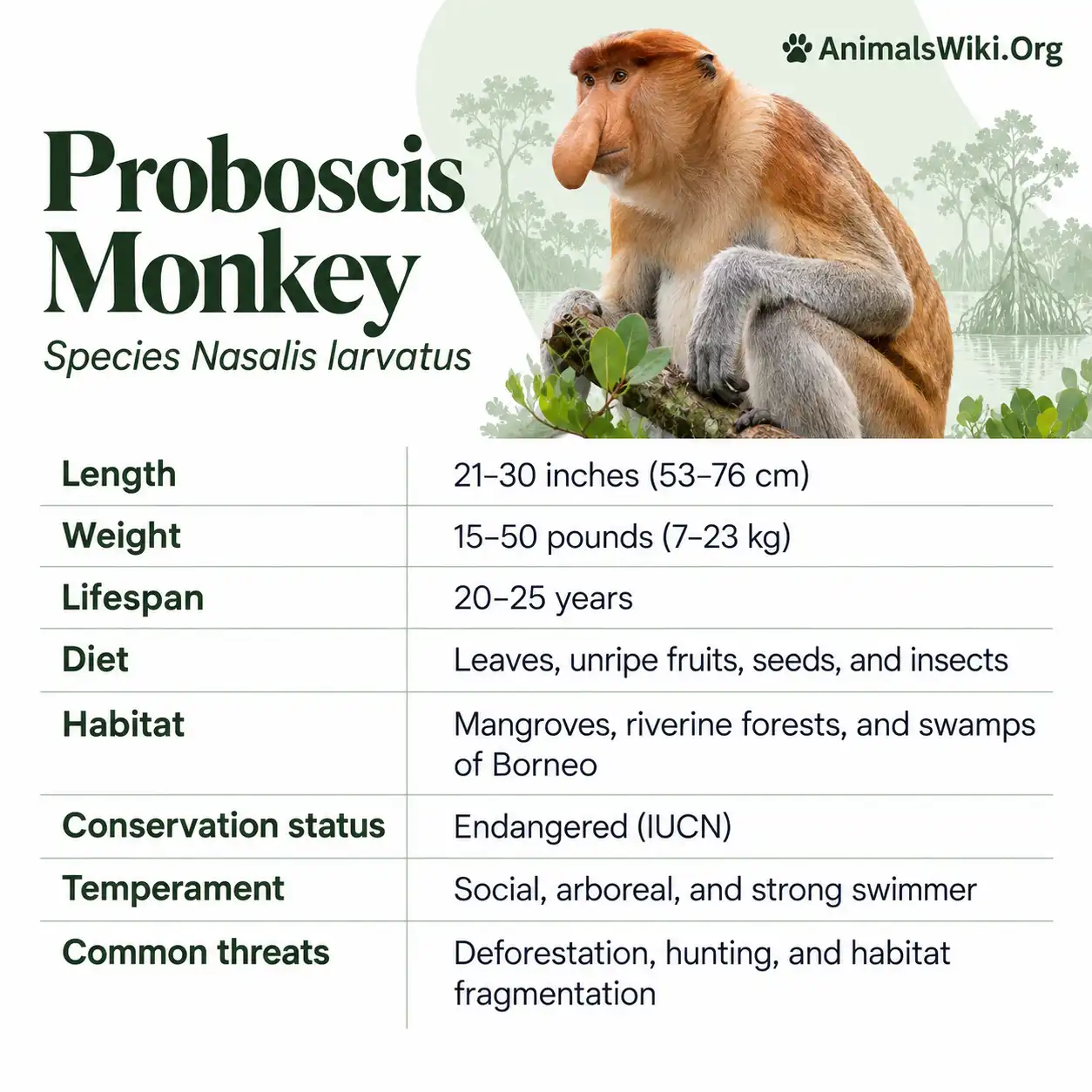
Proboscis Monkey, The Big-Nosed Primate of Borneo’s Mangrove Forests
The Proboscis Monkey is one of the most instantly recognizable primates on Earth.
An adult male possesses a feature so unusual that it seems almost exaggerated:
an enormous hanging nose.
In the largest males, this fleshy nose extends downward over the mouth, creating a profile unlike that of any other living monkey.
But the nose is only the beginning.
Proboscis Monkeys are also famous for their:
- Large rounded bellies
- Reddish-brown coats
- Pale limbs
- Long tails
- Partly webbed feet
- Excellent swimming ability
- River-dependent lifestyle
Scientifically known as:
Nasalis larvatus
the Proboscis Monkey is an Old World monkey found naturally only on:
Borneo.
Borneo is divided politically among:
- Indonesia
- Malaysia
- Brunei
and Proboscis Monkeys occur in suitable habitats across parts of the island.
They are particularly associated with landscapes containing:
- Mangrove forests
- Riverbanks
- Swamp forests
- Peat-swamp habitats
- Coastal forests
Few monkeys are as closely associated with:
water.
Proboscis Monkeys can swim remarkably well.
They may leap directly from tree branches into rivers and swim across channels to reach:
forest on the opposite bank.
Their hands and feet show adaptations that assist movement through water, and they can even:
dive beneath the surface.
This ability is valuable in Borneo’s riverine forests—but entering the water is not without danger.
The same rivers may contain:
crocodiles.
Proboscis Monkeys therefore live in a world where water functions simultaneously as:
- A travel route
- An escape route
- A barrier
- A source of danger
Their digestive system is just as unusual as their swimming ability.
The monkey’s famously large belly is not simply fat.
Inside is a specialized:
multi-chambered stomach
containing microorganisms that ferment difficult plant material.
This allows Proboscis Monkeys to consume large quantities of:
- Young leaves
- Mature leaves
- Seeds
- Unripe fruit
- Flowers
- Other plant foods
Their swollen abdomen therefore reflects one of their most important adaptations:
foregut fermentation.
The species also displays dramatic differences between males and females.
Adult males are substantially:
larger.
They also possess the enormous nose that gave the species its common name.
Females have:
much smaller, upturned noses.
Why did males evolve such extraordinary noses?
Research suggests the nose is associated with:
sexual selection and communication.
Larger males tend to possess larger noses, and the nose can influence the resonance of their calls.
A large nose may therefore function as an honest visual and acoustic signal advertising:
male body size and quality.
Proboscis Monkeys are highly social.
A typical group may contain:
- One adult male
- Several females
- Infants
- Juveniles
Other males can form:
all-male groups.
At feeding or sleeping areas, several groups may gather near one another, producing larger temporary communities.
Yet the species faces a serious problem.
The forests it depends upon are among the environments most heavily affected by:
- Logging
- Agricultural conversion
- Oil-palm development
- Fires
- Human settlement
- Habitat fragmentation
Because Proboscis Monkeys are strongly associated with riverine, mangrove and swamp habitats, losing these forests can rapidly isolate populations.
This comprehensive guide explores Proboscis Monkey facts, scientific classification, huge nose, appearance, size, weight, pot belly, Borneo distribution, mangrove habitat, swimming, diving, webbed feet, diet, digestion, behavior, social groups, reproduction, babies, lifespan, adaptations, predators, crocodiles, conservation, and why the Proboscis Monkey is one of the world’s most extraordinary primates.
Proboscis Monkey Facts
| Feature | Information |
|---|---|
| Common Name | Proboscis Monkey |
| Scientific Name | Nasalis larvatus |
| Animal Type | Mammal |
| Order | Primates |
| Family | Cercopithecidae |
| Subfamily | Colobinae |
| Genus | Nasalis |
| Native Island | Borneo |
| Countries | Indonesia, Malaysia & Brunei |
| Main Habitat | Mangrove, riverine & swamp forests |
| Diet | Primarily leaves, seeds and fruit |
| Digestive System | Foregut fermentation |
| Famous Feature | Huge male nose |
| Male Weight | Commonly around 16–22 kg |
| Female Weight | Commonly around 7–12 kg |
| Activity | Diurnal |
| Lifestyle | Arboreal and terrestrial |
| Swimming | Excellent |
| Diving | Yes |
| Social Structure | One-male groups and all-male groups |
| Young | Infant |
| Typical Birth | One infant |
| Major Aquatic Predator | Crocodile |
| Major Threat | Habitat destruction and fragmentation |
What Is a Proboscis Monkey?
The Proboscis Monkey is a large Old World monkey endemic to:
Borneo.
Its scientific name is:
Nasalis larvatus.
It belongs to the family:
Cercopithecidae
and the leaf-monkey subfamily:
Colobinae.
Why Is It Called a Proboscis Monkey?
“Proboscis” means an elongated:
nose or snout.
Adult males possess extraordinarily large noses, making the name especially appropriate.
Scientific Classification of the Proboscis Monkey
| Classification | Name |
|---|---|
| Kingdom | Animalia |
| Phylum | Chordata |
| Class | Mammalia |
| Order | Primates |
| Family | Cercopithecidae |
| Subfamily | Colobinae |
| Genus | Nasalis |
| Species | Nasalis larvatus |
Is the Proboscis Monkey an Ape?
No.
It is a:
monkey.
Apes do not possess tails, while Proboscis Monkeys have:
long tails.
Is the Proboscis Monkey an Old World Monkey?
Yes.
It belongs to the Old World monkey family:
Cercopithecidae.
Is the Proboscis Monkey a Leaf Monkey?
Yes.
It belongs to:
Colobinae, the same general evolutionary branch containing many langurs and leaf monkeys.
What Does a Proboscis Monkey Look Like?
Adults typically have:
- Reddish-brown upper body
- Pale gray or cream limbs
- Long tail
- Rounded belly
- Long arms and legs
- Small ears
- Distinctive nose
Adult males are particularly:
large and unmistakable.
Why Does the Proboscis Monkey Have Such a Big Nose?
This is one of the most famous questions about the species.
Evidence suggests the male nose is connected to:
sexual selection.
Larger noses are associated with larger males and can modify the sound of their vocalizations.
The nose may therefore signal:
- Body size
- Maturity
- Male quality
to other monkeys.
Do Females Prefer Males With Bigger Noses?
Research suggests nose size may provide information about male quality and may influence:
female choice and male competition.
However, it is better to describe this as part of a complex sexual-selection system rather than simply claim females always choose the biggest nose.
Does the Nose Make the Male’s Voice Louder?
The enlarged nose appears to affect:
vocal resonance.
It can help create the characteristic deep, resonant calls of adult males.
Do Female Proboscis Monkeys Have Big Noses?
Females have prominent noses, but they are:
much smaller
than those of adult males.
Their noses tend to be:
shorter and more upturned.
Do Baby Proboscis Monkeys Have Huge Noses?
No.
The dramatic hanging nose develops as males:
mature.
Why Are Proboscis Monkeys Pot-Bellied?
Their large abdomen is mainly related to their:
specialized digestive system.
They have a complex stomach containing microbes that ferment plant material.
The enlarged digestive tract creates the characteristic:
pot-bellied appearance.
Are Proboscis Monkeys Fat?
Their rounded abdomen should not automatically be interpreted as obesity.
Much of its size comes from:
- Large stomach compartments
- Fermenting plant material
- Digestive contents
Proboscis Monkey Digestive System
Proboscis Monkeys are:
foregut fermenters.
Microorganisms in their stomach break down:
- Cellulose
- Fibrous leaves
- Other difficult plant compounds
before the food reaches the intestines.
Is Their Stomach Like a Cow’s?
There are functional similarities because both depend on:
microbial fermentation.
But Proboscis Monkeys are not ruminants and do not have exactly the same digestive anatomy as cattle.
How Big Is a Proboscis Monkey?
Males are among the larger Old World monkeys.
Adult males may have a head-and-body length of approximately:
65–75 cm.
Females are generally around:
53–62 cm.
The tail may add another:
55–75 cm
or more.
How Much Does a Proboscis Monkey Weigh?
Adult males commonly weigh approximately:
16–22 kg.
Large males may exceed this.
Females are much smaller, commonly around:
7–12 kg.
Are Male Proboscis Monkeys Bigger Than Females?
Yes.
The species displays strong:
sexual dimorphism.
Males can weigh roughly:
twice as much
as females.
Why Are Males So Much Bigger?
Large male size probably evolved partly through:
sexual selection.
Males compete for:
- Social position
- Breeding opportunities
- Access to female groups
Where Do Proboscis Monkeys Live?
Wild Proboscis Monkeys naturally occur only on:
Borneo.
This makes them:
endemic to Borneo.
What Countries Have Proboscis Monkeys?
Borneo contains territory belonging to:
- Indonesia
- Malaysia
- Brunei
Proboscis Monkeys occur in suitable habitat within these political regions.
Do Proboscis Monkeys Live in Indonesia?
Yes.
They occur in:
Kalimantan, the Indonesian portion of Borneo.
Do Proboscis Monkeys Live in Malaysia?
Yes.
They occur in Malaysian Borneo, particularly in:
- Sabah
- Sarawak
where suitable habitat remains.
Do Proboscis Monkeys Live in Brunei?
Yes.
Suitable forests in Brunei also support the species.
Do Proboscis Monkeys Live Anywhere Outside Borneo?
Not naturally.
Wild Proboscis Monkeys are:
Bornean endemics.
Proboscis Monkey Habitat
Their habitats include:
- Mangrove forests
- Riverine forests
- Peat-swamp forests
- Freshwater swamp forests
- Coastal forests
They are strongly associated with:
waterways.
Why Do Proboscis Monkeys Live Near Rivers?
Riverine environments provide:
- Food
- Sleeping trees
- Travel routes
- Escape opportunities
- Suitable forest vegetation
Rivers are central to their ecology.
Do Proboscis Monkeys Live in Mangroves?
Yes.
Mangrove forests are among their best-known habitats.
Do Proboscis Monkeys Live in Rainforests?
Yes, particularly lowland and river-associated tropical forest environments.
Do Proboscis Monkeys Live High in Mountains?
No.
They are mainly associated with:
lowland coastal, riverine and swamp habitats.
Can Proboscis Monkeys Swim?
Yes.
They are:
exceptionally good swimmers.
This is one of their most remarkable adaptations.
Are Proboscis Monkeys the Best Swimming Monkeys?
They are certainly among the most:
aquatically capable primates.
Assigning one species the absolute title of “best swimming monkey” is difficult to prove, but Proboscis Monkeys are extraordinary swimmers.
Why Can Proboscis Monkeys Swim So Well?
Their riverine lifestyle has favored adaptations for moving through water.
They possess:
- Strong limbs
- Partially webbed digits
- Powerful swimming movements
Do Proboscis Monkeys Have Webbed Feet?
Yes.
Their toes show:
partial webbing.
This helps improve swimming efficiency.
Do Proboscis Monkeys Have Webbed Hands?
Some webbing occurs between digits and contributes to their aquatic abilities.
They are not webbed like ducks, but their hands and feet are more adapted to swimming than those of many other primates.
Can Proboscis Monkeys Dive?
Yes.
They can:
dive underwater.
They may enter the water from trees and swim beneath the surface.
How Far Can a Proboscis Monkey Swim?
They can cross substantial river channels.
Exact maximum distances vary and are difficult to generalize, but their swimming ability is strong enough to make river crossings a normal part of their ecology.
Can Proboscis Monkeys Swim Underwater?
Yes.
They can submerge themselves and travel:
underwater for short distances.
Why Do Proboscis Monkeys Jump Into Rivers?
Reasons may include:
- Crossing waterways
- Escaping disturbance
- Moving between feeding areas
- Avoiding threats
They can make impressive leaps from branches into water.
Are Rivers Dangerous for Proboscis Monkeys?
Yes.
The greatest danger is:
crocodiles.
Entering the water can expose a monkey to large aquatic predators.
What Do Proboscis Monkeys Eat?
Proboscis Monkeys are primarily:
folivorous and frugivorous.
Their diet includes:
- Young leaves
- Mature leaves
- Seeds
- Unripe fruit
- Flowers
- Shoots
Food choice changes with:
seasonal availability.
Do Proboscis Monkeys Eat Fruit?
Yes.
But they often favor:
unripe fruit
rather than relying heavily on very sweet ripe fruit.
Why Don’t Proboscis Monkeys Eat Lots of Ripe Fruit?
Their fermentation-based digestive system makes them vulnerable to digestive problems if they consume too much:
easily fermentable sugar.
A large quantity of sugary ripe fruit can disrupt gut fermentation.
Can Fruit Kill a Proboscis Monkey?
This claim is often exaggerated.
A diet containing inappropriate quantities of highly sugary foods can cause serious digestive problems in specialized leaf-eating primates.
But saying that eating a single ripe fruit will kill a Proboscis Monkey would be:
incorrect.
Do Proboscis Monkeys Eat Leaves?
Yes.
Leaves are a major part of their diet.
Do Proboscis Monkeys Eat Seeds?
Yes.
Seeds can be an important food source.
Do Proboscis Monkeys Eat Flowers?
Yes.
Flowers are eaten when available.
Do Proboscis Monkeys Eat Insects?
Their diet is primarily plant-based.
Small amounts of animal matter may be consumed incidentally, but they are not specialized insect hunters.
Do Proboscis Monkeys Eat Meat?
Meat is not a normal major component of their diet.
Proboscis Monkey Behavior
Proboscis Monkeys are:
- Diurnal
- Social
- Arboreal
- Skilled swimmers
- Occasionally terrestrial
They commonly spend the day feeding and traveling before gathering near:
riverbank sleeping sites.
Are Proboscis Monkeys Social?
Yes.
They live in organized social groups.
How Many Proboscis Monkeys Live Together?
Group size varies.
A typical one-male group may contain:
several females and their offspring.
Larger temporary gatherings can contain:
dozens of monkeys.
What Is a One-Male Group?
It usually consists of:
- One adult male
- Several adult females
- Infants
- Juveniles
Do Male Proboscis Monkeys Live Together?
Yes.
Males without a one-male breeding group may form:
all-male groups.
Can Different Groups Gather Together?
Yes.
Multiple groups may congregate near:
- Feeding areas
- Riverbanks
- Sleeping sites
forming larger temporary aggregations.
Do Proboscis Monkeys Fight?
Competition occurs, particularly between adult males.
However, much of their social life involves:
- Grooming
- Resting
- Feeding
- Traveling
- Communication
rather than constant fighting.
How Do Proboscis Monkeys Communicate?
They use:
- Vocalizations
- Facial expressions
- Body posture
- Grooming
- Physical displays
Adult males produce particularly:
deep resonant calls.
What Sounds Do Proboscis Monkeys Make?
Their vocal repertoire includes:
- Honks
- Roars
- Grunts
- Alarm calls
- Infant calls
The male’s large nose influences some vocal characteristics.
Do Proboscis Monkeys Sleep in Trees?
Yes.
They frequently select trees near:
rivers and waterways
as sleeping sites.
Why Do They Sleep Near Rivers?
Possible advantages include:
- Easy travel
- Reduced access for some terrestrial predators
- Open visibility
- Access to nearby feeding habitat
However, riverbanks can also expose them to:
crocodiles.
Are Proboscis Monkeys Good Climbers?
Yes.
Despite their large bellies, they move efficiently through:
trees and branches.
Do Proboscis Monkeys Walk on the Ground?
Yes.
They can move on the ground when necessary, although much of their activity occurs:
in trees.
Proboscis Monkey Reproduction
Females normally produce:
one infant.
Reproduction takes place within their complex social system.
How Long Is a Proboscis Monkey Pregnant?
Gestation is approximately:
five to six months.
How Many Babies Do Proboscis Monkeys Have?
Usually:
one infant at a time.
Twins are uncommon.
What Is a Baby Proboscis Monkey Called?
A baby is called an:
infant.
What Color Are Baby Proboscis Monkeys?
One of the most fascinating features of newborns is their:
dark bluish face.
The facial coloration changes as the infant develops.
Are Baby Proboscis Monkeys Born With Big Noses?
No.
The dramatic male nose develops with:
age and sexual maturity.
Do Mothers Carry Their Babies?
Yes.
Infants cling to their mothers during early development.
The mother provides:
- Milk
- Protection
- Warmth
- Transportation
Do Other Females Interact With Infants?
Yes.
Social females may show interest in and interact with:
young infants.
Do Male Proboscis Monkeys Protect Babies?
The resident male can help protect the social group from:
- Rival males
- Some predators
- Other threats
but mothers provide most direct infant care.
Proboscis Monkey Lifespan
Proboscis Monkeys can live for:
roughly two decades or more
under favorable conditions.
Exact maximum wild lifespan is difficult to establish.
Proboscis Monkey Adaptations
Huge Male Nose
Functions in sexual and acoustic signaling.
Multi-Chambered Stomach
Allows microbial fermentation of fibrous vegetation.
Large Belly
Accommodates the specialized digestive system.
Partially Webbed Feet
Improve swimming ability.
Strong Limbs
Support both climbing and swimming.
Long Tail
Provides balance in trees.
Riverine Lifestyle
Allows exploitation of mangrove and swamp habitats.
Social Living
Provides vigilance and reproductive organization.
Flexible Plant Diet
Allows food use to change with seasonal availability.
What Predators Eat Proboscis Monkeys?
Potential predators include:
- Crocodiles
- Clouded leopards
- Large pythons
- Large raptors
Predation risk varies according to:
- Age
- Habitat
- Location
Do Crocodiles Eat Proboscis Monkeys?
Yes.
Crocodiles are one of the most important dangers associated with river crossings.
A monkey entering the water may be vulnerable to an:
ambush from below.
What Crocodiles Hunt Proboscis Monkeys?
In Borneo, crocodile species capable of taking monkeys include the:
saltwater crocodile.
These enormous reptiles inhabit coastal and river environments.
Do Clouded Leopards Eat Proboscis Monkeys?
Sunda clouded leopards are potential predators of Proboscis Monkeys.
Their excellent climbing ability makes them dangerous predators in:
forest environments.
Do Pythons Eat Proboscis Monkeys?
Large pythons can potentially prey on monkeys, particularly:
- Juveniles
- Smaller individuals
Do Eagles Eat Proboscis Monkeys?
Large raptors can pose a threat, especially to:
young monkeys.
How Do Proboscis Monkeys Escape Predators?
They use:
- Group vigilance
- Alarm calls
- Tree climbing
- Rapid movement
- Swimming
- Diving
The appropriate escape strategy depends on:
where the predator is.
Why Is Swimming Both Helpful and Dangerous?
Water can help a monkey escape a predator on land or move between forest patches.
But the river may contain:
crocodiles.
Therefore, every crossing involves a trade-off.
Are Proboscis Monkeys Dangerous to Humans?
They are wild animals and should not be approached or handled.
However, they are not predators of humans.
Can Proboscis Monkeys Bite?
Yes.
Like other monkeys, they possess:
- Strong jaws
- Canine teeth
and may bite defensively.
Are Proboscis Monkeys Aggressive?
Adult males can behave aggressively during:
- Competition
- Defense
- Social conflict
but they do not normally seek conflict with humans.
Can Proboscis Monkeys Be Pets?
No.
They are extremely unsuitable pets because of their:
- Complex social needs
- Specialized digestive system
- Wild behavior
- Conservation status
- Habitat requirements
Are Proboscis Monkeys Endangered?
Yes.
The Proboscis Monkey is considered:
Endangered.
Its populations have declined substantially because of habitat destruction and fragmentation.
Why Are Proboscis Monkeys Endangered?
Major threats include:
Deforestation
Lowland forests are cleared or degraded.
Agricultural Conversion
Forests may be converted into:
- Oil-palm plantations
- Other agricultural land
Logging
Logging damages habitat structure.
Fire
Peat and swamp forests can be severely damaged by fires.
Habitat Fragmentation
Populations become isolated from one another.
Hunting
Hunting has affected some populations.
Human Development
Roads and settlements alter riverine landscapes.
Does Palm Oil Affect Proboscis Monkeys?
Conversion of natural Bornean forest into:
oil-palm plantations
has contributed to habitat loss and fragmentation in parts of their range.
The conservation issue is primarily the destruction or degradation of:
natural habitat, rather than the oil-palm plant itself.
Why Are Mangroves Important for Proboscis Monkeys?
Mangroves provide:
- Food
- Cover
- Travel routes
- Sleeping areas
They also support broader coastal ecosystems.
Why Are River Forests Important?
Proboscis Monkeys depend heavily on:
connected vegetation along waterways.
Removing narrow strips of riverbank forest can fragment otherwise suitable habitat.
How Many Proboscis Monkeys Are Left?
There is no perfect real-time census of every wild Proboscis Monkey.
Published estimates vary according to:
- Date
- Survey method
- Region
- Whether mature individuals or all animals are counted
Population estimates should therefore be tied to a specific scientific assessment rather than presented as an exact timeless number.
Are Proboscis Monkey Populations Declining?
Long-term population declines have been associated with extensive:
habitat loss and fragmentation.
Local trends can differ where strong habitat protection exists.
Proboscis Monkey Conservation
Important conservation measures include:
- Protecting mangrove forests
- Protecting riverbank forests
- Conserving peat swamps
- Preventing illegal hunting
- Restoring degraded habitat
- Maintaining wildlife corridors
- Reducing destructive fires
- Monitoring populations
- Supporting sustainable land management
- Protecting connected watersheds
Why Are Wildlife Corridors Important?
A population trapped in one small forest patch may eventually suffer from:
- Food shortages
- Isolation
- Reduced gene flow
Corridors allow animals to move between:
habitat fragments.
Why Is Protecting Rivers Not Enough?
A river without forested banks cannot provide the habitat Proboscis Monkeys require.
Conservation must therefore protect:
the river and the surrounding forest ecosystem.
Proboscis Monkey vs. Golden Snub-nosed Monkey
| Feature | Proboscis Monkey | Golden Snub-nosed Monkey |
|---|---|---|
| Scientific Name | Nasalis larvatus | Rhinopithecus roxellana |
| Native Area | Borneo | China |
| Climate | Tropical | Temperate/cold mountain |
| Famous Nose | Huge male nose | Short upturned nose |
| Coat | Reddish-brown | Golden-orange |
| Swimming | Exceptional | Not aquatic specialist |
| Main Habitat | River/mangrove forest | Mountain forest |
| Important Diet | Leaves, seeds, fruit | Leaves, lichens, fruit |
Proboscis Monkey vs. Orangutan
Both occur naturally on:
Borneo, but they are very different primates.
| Feature | Proboscis Monkey | Bornean Orangutan |
|---|---|---|
| Type | Monkey | Great ape |
| Tail | Present | Absent |
| Social Life | Group-living | Mostly semi-solitary |
| Main Habitat | Riverine/mangrove/swamp | Tropical forest |
| Famous Feature | Huge male nose | Long arms |
| Swimming | Strong swimmer | Generally avoids deep water |
Proboscis Monkey vs. Macaque
Macaques and Proboscis Monkeys are both Old World monkeys, but they belong to different evolutionary branches.
Proboscis Monkeys are specialized:
colobine foregut fermenters.
Macaques generally possess a more:
omnivorous digestive strategy.
50 Interesting Proboscis Monkey Facts
- The Proboscis Monkey is a primate.
- Its scientific name is Nasalis larvatus.
- It is an Old World monkey.
- It belongs to the family Cercopithecidae.
- It belongs to the subfamily Colobinae.
- It is found naturally only on Borneo.
- Borneo is shared by Indonesia, Malaysia and Brunei.
- Proboscis Monkeys live near rivers.
- They inhabit mangrove forests.
- They inhabit swamp forests.
- Adult males have enormous noses.
- Females have much smaller noses.
- The male nose grows with maturity.
- Nose size is associated with male body size.
- The nose influences vocal resonance.
- Males are much larger than females.
- Large males can exceed 20 kg.
- Proboscis Monkeys have long tails.
- They have large rounded bellies.
- The belly houses a specialized digestive system.
- They are foregut fermenters.
- Microbes help them digest leaves.
- Leaves are a major food.
- They also eat seeds.
- They eat fruit.
- Unripe fruit is often preferred.
- Too much sugary food can disrupt digestion.
- Proboscis Monkeys are excellent swimmers.
- They can swim across rivers.
- They can dive underwater.
- Their digits show partial webbing.
- They sometimes leap from trees into water.
- Crocodiles can prey on swimming monkeys.
- Sunda clouded leopards are potential predators.
- Large pythons can also threaten them.
- Proboscis Monkeys are active during the day.
- They are highly social.
- One-male groups are common.
- All-male groups also occur.
- Multiple groups can gather near sleeping sites.
- They often sleep in trees near rivers.
- Females usually produce one infant.
- Newborns can have dark bluish faces.
- Babies do not possess the enormous adult male nose.
- Mothers carry their infants.
- Proboscis Monkeys cannot be responsibly kept as ordinary pets.
- Habitat destruction is their greatest long-term threat.
- Oil-palm expansion has contributed to habitat conversion in Borneo.
- Protecting mangroves and river forests is essential for their survival.
- The Proboscis Monkey is one of the world’s most aquatic non-human primates.
Did You Know?
A Proboscis Monkey can escape one predator by jumping directly into the habitat of another.
Imagine a tropical river in Borneo.
Tall trees lean over the water.
A group of Proboscis Monkeys is moving through the canopy.
An enormous adult male sits among them.
His belly is round.
His fur is reddish.
And hanging over his mouth is:
one of the strangest noses in the animal kingdom.
Suddenly, something disturbs the group.
The monkeys begin moving rapidly through the branches.
Ahead of them is:
a river.
For many monkeys, this would create a serious barrier.
For a Proboscis Monkey, it can become:
an escape route.
One animal launches from a branch.
It falls toward the water.
Splash.
Another follows.
Then another.
Once underwater, powerful limbs begin moving.
Their partially webbed digits help push against:
the water.
They surface and continue toward the opposite bank.
But this escape strategy has a terrifying weakness.
Beneath the muddy river surface may be:
a crocodile.
The same water protecting them from one terrestrial threat can expose them to an aquatic ambush predator.
This explains why the Proboscis Monkey is such an extraordinary example of adaptation.
Its environment is not divided into:
forest and water.
For this monkey, both are part of:
one habitat.
It climbs through trees.
It feeds among leaves.
It sleeps beside rivers.
It leaps into water.
It swims.
It dives.
Then it climbs back into:
the forest.
The enormous nose may be the feature that made the Proboscis Monkey famous.
But its ability to live between the worlds of:
trees and rivers
is what makes it truly exceptional.
Frequently Asked Questions About Proboscis Monkeys
What is a Proboscis Monkey?
It is a large, unusual Old World monkey native to Borneo.
What is the scientific name of the Proboscis Monkey?
Nasalis larvatus.
Is a Proboscis Monkey a mammal?
Yes.
Is a Proboscis Monkey a primate?
Yes.
Is a Proboscis Monkey an ape?
No.
Is it an Old World monkey?
Yes.
Is it a leaf monkey?
Yes. It belongs to the colobine subfamily.
Why is it called a Proboscis Monkey?
Because adult males have an extremely enlarged nose, or proboscis.
Why do Proboscis Monkeys have big noses?
The male nose appears to function in sexual and acoustic signaling.
Why do male Proboscis Monkeys have bigger noses than females?
The extreme male nose is associated with sexual dimorphism and sexual selection.
Do females like males with bigger noses?
Evidence suggests nose size may signal male size and quality, potentially influencing female choice and competition.
Does the nose make their calls louder?
It affects the resonance and acoustic properties of male vocalizations.
Do female Proboscis Monkeys have big noses?
Their noses are much smaller and usually more upturned.
Are babies born with huge noses?
No.
Does the nose keep growing?
The male nose becomes much more prominent as the animal matures.
Why do Proboscis Monkeys have big bellies?
Their large digestive system contains chambers used for microbial fermentation.
Are Proboscis Monkeys fat?
Their pot-bellied appearance is largely associated with their specialized digestive tract.
Where do Proboscis Monkeys live?
On Borneo.
What countries have Proboscis Monkeys?
Indonesia, Malaysia and Brunei.
Do Proboscis Monkeys live in Indonesia?
Yes.
Do Proboscis Monkeys live in Malaysia?
Yes.
Do Proboscis Monkeys live in Brunei?
Yes.
Are Proboscis Monkeys found outside Borneo?
Not naturally.
Do Proboscis Monkeys live in rainforests?
Yes.
Do they live in mangroves?
Yes.
Do they live in swamps?
Yes.
Why do they live near rivers?
Riverine forests provide food, travel routes, sleeping sites and suitable habitat.
Can Proboscis Monkeys swim?
Yes, exceptionally well.
Can Proboscis Monkeys dive?
Yes.
Can they swim underwater?
Yes, for short distances.
Do Proboscis Monkeys have webbed feet?
Their toes have partial webbing that assists swimming.
Do they have webbed hands?
Their digits show adaptations that can assist movement through water.
How far can Proboscis Monkeys swim?
They can cross significant river channels, although there is no single reliable maximum distance applicable to every individual.
Why do Proboscis Monkeys jump into water?
To cross rivers, travel between habitats or escape threats.
Can Proboscis Monkeys drown?
Like any air-breathing mammal, they can drown, although they are excellent swimmers.
Do crocodiles eat Proboscis Monkeys?
Yes.
What crocodiles hunt them?
Large Bornean crocodiles, including saltwater crocodiles, can prey upon monkeys.
Do clouded leopards eat Proboscis Monkeys?
Sunda clouded leopards are potential predators.
Do pythons eat Proboscis Monkeys?
Large pythons can potentially prey on them.
Do eagles eat Proboscis Monkeys?
Large raptors may threaten young individuals.
What do Proboscis Monkeys eat?
Mainly leaves, seeds, fruits, flowers and other plant material.
Do Proboscis Monkeys eat leaves?
Yes.
Do they eat fruit?
Yes.
Why do they eat unripe fruit?
Their digestive system is better suited to certain fibrous foods than large quantities of sugary ripe fruit.
Can Proboscis Monkeys eat bananas?
In managed settings diets must be carefully controlled. A human-style fruit-heavy diet is inappropriate for a specialized foregut fermenter.
Can ripe fruit kill a Proboscis Monkey?
Not simply from one piece. However, excessive sugary food can disrupt their specialized fermentation system and cause serious digestive problems.
Do Proboscis Monkeys eat meat?
Not normally.
Do they eat insects?
They are primarily plant eaters, though small amounts of animal matter may occasionally be consumed.
Are Proboscis Monkeys herbivores?
They are primarily herbivorous.
How do Proboscis Monkeys digest leaves?
Microorganisms in their specialized stomach ferment fibrous plant material.
Are they ruminants?
No.
How big is a Proboscis Monkey?
Males may reach roughly 65–75 cm in head-and-body length, excluding the tail.
How much does a male Proboscis Monkey weigh?
Commonly around 16–22 kg, with some individuals heavier.
How much does a female weigh?
Often around 7–12 kg.
Are males bigger than females?
Yes, substantially.
Do Proboscis Monkeys have tails?
Yes.
How long is the tail?
It can be roughly comparable to the body in length.
Are Proboscis Monkeys good climbers?
Yes.
Do they walk on the ground?
Yes, when necessary.
Are Proboscis Monkeys nocturnal?
No. They are mainly diurnal.
Are Proboscis Monkeys social?
Yes.
How many live in a group?
Group size varies, but one-male groups usually contain several females and their young.
Do males live alone?
Some do temporarily, while others form all-male groups.
What is an all-male group?
A social group composed primarily of males without a breeding one-male unit.
Do different groups meet?
Yes.
Why do groups gather near rivers?
Riverbanks provide important sleeping and travel areas.
Where do Proboscis Monkeys sleep?
Usually in trees, often near waterways.
What sounds do Proboscis Monkeys make?
They produce honks, grunts, roars and other calls.
Do they groom each other?
Yes.
How many babies do Proboscis Monkeys have?
Usually one.
What is a baby Proboscis Monkey called?
An infant.
How long is a Proboscis Monkey pregnant?
Approximately five to six months.
What color is a baby Proboscis Monkey’s face?
Newborns can have dark bluish facial skin.
Do mothers carry babies?
Yes.
Does the father care for the baby?
The resident male may help protect the social group, while direct infant care is mainly maternal.
How long do Proboscis Monkeys live?
They may live around two decades or more under favorable conditions.
Are Proboscis Monkeys dangerous?
They are wild animals capable of defending themselves but do not normally attack humans.
Can a Proboscis Monkey bite?
Yes.
Can Proboscis Monkeys be pets?
No.
Are Proboscis Monkeys endangered?
Yes.
Why are Proboscis Monkeys endangered?
Habitat destruction, fragmentation, logging, agricultural expansion, fires and hunting have contributed to population decline.
Does palm oil threaten Proboscis Monkeys?
Conversion of natural forest to oil-palm plantations has contributed to habitat loss in parts of Borneo.
Does logging threaten Proboscis Monkeys?
Yes.
Do forest fires threaten them?
Yes, especially where swamp and peat habitats are degraded.
How many Proboscis Monkeys are left?
No exact real-time count exists; population estimates vary by survey and year.
Are Proboscis Monkey populations decreasing?
Long-term declines have occurred, particularly where habitat has been destroyed or fragmented.
Why are mangroves important?
Mangroves provide feeding, shelter and travel habitat.
Why are riverbank forests important?
They connect feeding and sleeping areas and form critical habitat corridors.
Can Proboscis Monkeys survive in palm-oil plantations?
Plantations cannot replace the ecological complexity of intact riverine, mangrove and swamp forests.
How can Proboscis Monkeys be protected?
By conserving connected Bornean forests, riverbanks, mangroves and swamps while reducing hunting and destructive land conversion.
What is the difference between a Proboscis Monkey and an orangutan?
Proboscis Monkeys are tailed Old World monkeys living socially near rivers; orangutans are tailless great apes with a mostly semi-solitary lifestyle.
What is the difference between a Proboscis Monkey and a Golden Snub-nosed Monkey?
Proboscis Monkeys are tropical Bornean swimming specialists with enlarged male noses, while Golden Snub-nosed Monkeys are cold-adapted Chinese mountain primates with short upturned noses.
What is the most interesting Proboscis Monkey fact?
Despite being highly adapted to life in trees, Proboscis Monkeys are exceptional swimmers that can leap into rivers, swim across channels and even dive underwater.
Conclusion
The Proboscis Monkey may initially seem famous for only one thing:
its nose.
And there is no denying how extraordinary that nose is.
In a mature male, it can become so large that it hangs:
over the mouth.
It can influence the sound of his calls.
It may advertise his:
size and quality.
But concentrating only on the nose overlooks an animal that is far more remarkable.
Inside its oversized belly is:
a fermentation chamber.
Microorganisms help turn difficult leaves into:
usable energy.
Its partially webbed digits assist movement through:
water.
Its powerful limbs allow it to move through:
trees.
Its long tail provides:
balance.
And its social system organizes males, females and young into complex:
groups and communities.
Most importantly, the Proboscis Monkey has evolved around a habitat where two worlds meet:
forest and water.
It feeds in trees.
It sleeps beside rivers.
It leaps from branches.
It swims across channels.
It dives beneath the surface.
Then it climbs back into the canopy.
That extraordinary lifestyle also explains its vulnerability.
Destroy a random patch of forest and a monkey might sometimes move elsewhere.
Destroy the:
riverbank forest
and a Proboscis Monkey may lose the corridor connecting its entire world.
Remove:
mangroves
and feeding habitat disappears.
Drain:
swamps
and another part of its ecosystem vanishes.
Fragment those habitats repeatedly and isolated populations become increasingly difficult to sustain.
The Proboscis Monkey therefore represents much more than one of nature’s strangest faces.
It represents the extraordinary biological richness of:
Borneo’s river forests, mangroves and wetlands.
Its giant nose may be what makes people stop and look.
But protecting the forests and waterways beneath that nose is what will determine whether future generations can continue to see one of the world’s most unusual primates:
swimming through the rivers of Borneo.



