
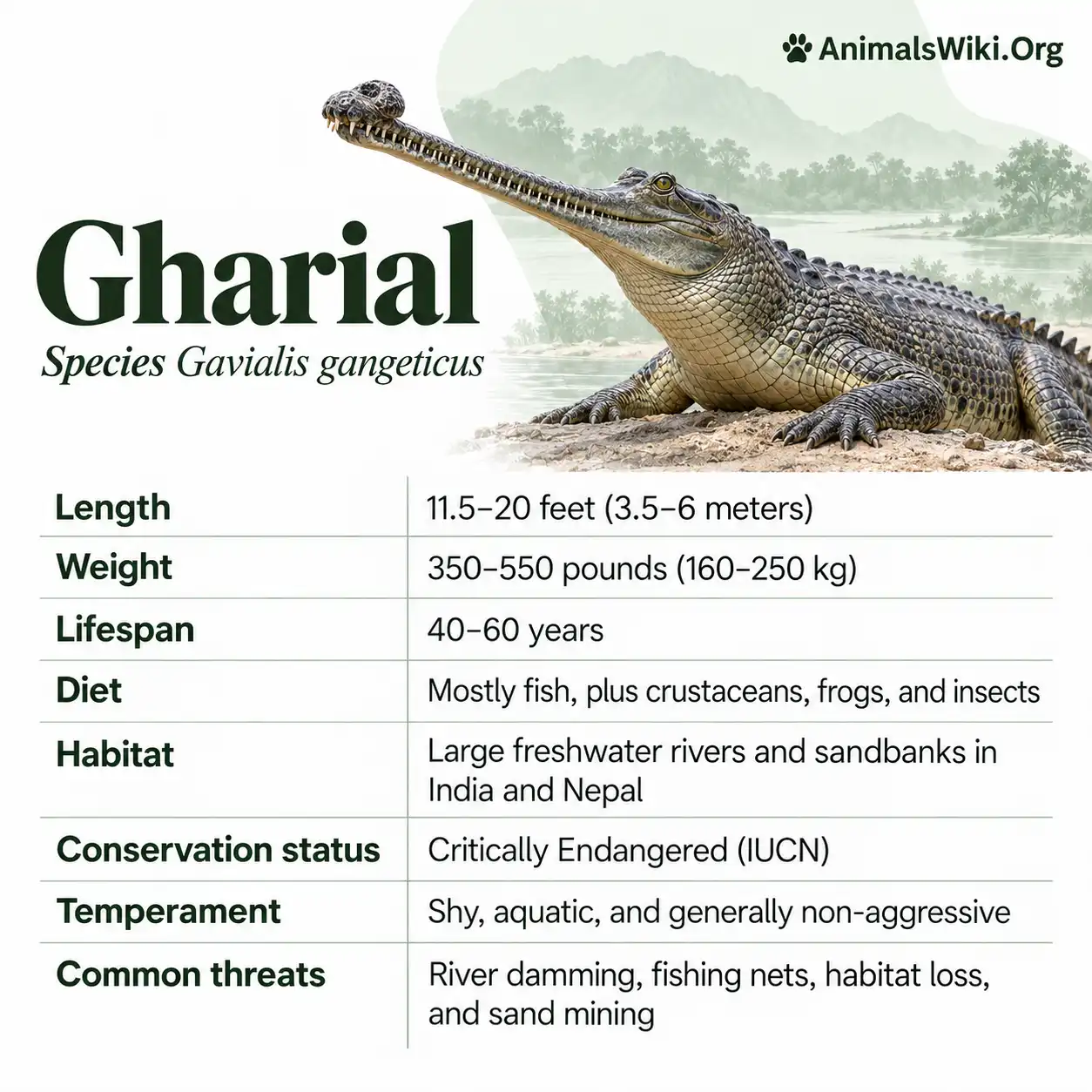
Gharial, The Long-Snouted Fish Hunter of South Asia’s Great Rivers
The Gharial is one of the strangest, most specialized and most endangered crocodilians on Earth.
At first glance, it resembles a crocodile.
Its body is:
- Long
- Armored
- Powerful
- Low to the ground
Its tail is muscular.
Its eyes and nostrils sit high on the head.
Its mouth is filled with:
dozens of sharp teeth.
But then there is the snout.
Instead of the broad, powerful jaws associated with many crocodiles, the Gharial possesses an extraordinarily:
long, narrow snout.
That unusual skull reveals exactly how this reptile makes its living.
The Gharial is a highly specialized:
fish hunter.
Its narrow jaws move rapidly through water with relatively little resistance, while numerous pointed teeth help seize slippery fish.
Scientifically known as:
Gavialis gangeticus
the Gharial is native to the river systems of:
the northern Indian subcontinent.
Today, its surviving breeding populations are concentrated primarily in:
- India
- Nepal
Historically, however, Gharials occupied a much wider network of major rivers across South Asia.
The species has another feature found in no other living crocodilian in quite the same form.
Mature males develop a bulbous growth on the tip of the snout.
It is called a:
ghara.
The name comes from its resemblance to a traditional rounded earthenware pot.
The ghara is not merely decorative.
It is associated with:
- Sexual maturity
- Visual display
- Sound production
- Courtship
and helps distinguish mature males from females.
Gharials are also among the:
largest living crocodilians by length.
Large males can exceed:
5 meters, although exceptionally large historical claims should be treated cautiously.
Despite their intimidating size and formidable teeth, Gharials are far less suited to attacking large terrestrial mammals than broad-snouted crocodiles.
Their delicate-looking jaws are optimized for:
catching fish, not crushing large prey.
Humans are therefore not normal Gharial prey.
This does not mean a large wild Gharial should ever be approached or handled.
It remains a powerful:
wild reptile.
Gharials spend far more of their lives in water than many other crocodilians.
Their bodies are beautifully adapted to:
large flowing rivers.
But that specialization has also made them vulnerable.
A Gharial cannot simply survive anywhere that contains water.
It needs functioning river ecosystems with:
- Deep pools
- Flowing channels
- Fish
- Sandbanks
- Nesting beaches
- Relatively undisturbed river sections
Dams, barrages, fishing nets, sand mining, river modification and habitat loss can therefore damage different stages of the Gharial’s life cycle simultaneously.
Once widespread across South Asia, the species suffered an enormous population collapse during the twentieth century.
Today, intensive conservation programs involving:
- Nest protection
- Captive breeding
- Head-starting
- Reintroduction
- River protection
- Population monitoring
- Community conservation
are helping prevent the disappearance of one of the world’s most extraordinary reptiles.
This comprehensive guide explores Gharial facts, scientific classification, long snout, ghara, teeth, size, weight, India and Nepal distribution, river habitat, fish diet, hunting, swimming, behavior, reproduction, eggs, hatchlings, lifespan, adaptations, predators, Gharial vs Crocodile, Gharial vs Alligator, danger to humans, conservation, and why the Gharial remains one of the world’s most threatened crocodilians.
Gharial Facts
| Feature | Information |
|---|---|
| Common Name | Gharial |
| Scientific Name | Gavialis gangeticus |
| Other Name | Gavial |
| Animal Type | Reptile |
| Order | Crocodylia |
| Family | Gavialidae |
| Genus | Gavialis |
| Main Modern Range | India & Nepal |
| Habitat | Large freshwater rivers |
| Diet | Primarily fish |
| Famous Feature | Extremely long, narrow snout |
| Male Feature | Ghara on snout |
| Adult Length | Commonly about 3–5 m depending on sex |
| Large Males | Can exceed 5 m |
| Activity | Aquatic river predator |
| Swimming | Excellent |
| Main Hunting Method | Rapid sideways capture of fish |
| Reproduction | Egg-laying |
| Nest Site | Sandy riverbanks |
| Typical Clutch | Often several dozen eggs |
| Conservation Status | Critically Endangered |
| Major Threats | River alteration, fishing, habitat loss & mortality in nets |
What Is a Gharial?
The Gharial is a highly aquatic crocodilian native to:
South Asia.
Its scientific name is:
Gavialis gangeticus.
It belongs to the family:
Gavialidae.
Is a Gharial a Crocodile?
It is a:
crocodilian, but it is not a true crocodile of the family Crocodylidae.
The order Crocodylia includes:
- Crocodiles
- Alligators
- Caimans
- Gharials
These animals are related but belong to different evolutionary branches.
Is Gharial Another Name for Gavial?
Yes.
Gavial is an alternative common name for the Gharial.
Why Is It Called a Gharial?
The name refers to the:
ghara
that develops on the tip of the snout of mature males.
“Ghara” refers to a traditional Indian earthenware pot whose shape resembles this bulbous structure.
Scientific Classification of the Gharial
| Classification | Name |
|---|---|
| Kingdom | Animalia |
| Phylum | Chordata |
| Class | Reptilia |
| Order | Crocodylia |
| Family | Gavialidae |
| Genus | Gavialis |
| Species | Gavialis gangeticus |
What Does a Gharial Look Like?
A Gharial has:
- Very long narrow jaws
- Numerous sharp teeth
- Elongated skull
- Long muscular tail
- Armored body
- Short legs
- Webbed feet
- Eyes high on the head
- Nostrils near the snout tip
Adult males develop the distinctive:
ghara.
Why Does the Gharial Have Such a Long Snout?
The long narrow snout is an adaptation for:
catching fish.
Moving a broad jaw rapidly sideways through water creates substantial resistance.
A narrow snout reduces that resistance.
This allows the Gharial to move its jaws rapidly through the water toward:
fast-moving prey.
Why Are Gharial Jaws So Thin?
Their jaws evolved for:
speed and precision underwater
rather than for overpowering large mammals.
This makes the Gharial one of the most specialized fish-eating crocodilians.
How Many Teeth Does a Gharial Have?
Gharials possess roughly:
more than 100 sharp teeth, with counts varying somewhat among individuals and descriptions.
The teeth are:
- Long
- Narrow
- Pointed
- Interlocking
and exceptionally well suited to holding slippery fish.
Why Are Gharial Teeth So Sharp?
Fish are:
slippery and fast.
Pointed teeth penetrate and grip prey, reducing its chance of escaping.
What Is the Ghara?
The ghara is a bulbous structure that develops at the tip of the snout in:
sexually mature males.
It forms around the nostril region.
Do Female Gharials Have a Ghara?
No.
The large developed ghara is characteristic of:
adult males.
This makes mature Gharials unusually easy to sex visually.
What Is the Ghara Used For?
The ghara appears to serve several functions associated with reproduction and communication.
It can:
- Enhance vocalizations
- Produce bubbling displays
- Advertise male maturity
- Assist courtship signaling
Does the Ghara Help a Gharial Breathe?
The nostrils remain involved in breathing, but the specialized structure is particularly associated with:
display and communication.
How Big Is a Gharial?
Gharials are among the longest living crocodilians.
Adult males commonly reach approximately:
4–5 meters.
Large males can exceed:
5 meters.
Females are generally smaller, often around:
3.5–4.5 meters.
Exact size varies among individuals.
What Is the Largest Gharial Ever Recorded?
Historical reports include extremely large animals exceeding:
6 meters.
However, old maximum-size claims are difficult to verify using modern scientific standards.
It is safer to state that exceptionally large males can exceed:
5 meters, while historical records suggest still greater lengths.
How Much Does a Gharial Weigh?
Large adults can weigh:
well over 100 kg, with the biggest males reaching several hundred kilograms.
Body mass varies greatly according to:
- Sex
- Length
- Age
- Physical condition
Are Male Gharials Bigger Than Females?
Yes.
Adult males generally become:
larger and heavier.
They are also recognizable by the:
ghara.
Are Gharials Bigger Than Crocodiles?
It depends on the crocodile species.
Gharials can become extremely long, but the largest:
saltwater crocodiles
are much heavier and more powerfully built.
Why Is the Gharial So Thin?
Its body is highly adapted for:
aquatic life.
Compared with many broad-bodied crocodiles, the Gharial has a relatively streamlined appearance.
Its snout is especially slender.
Where Do Gharials Live?
Modern wild breeding populations are concentrated mainly in:
India and Nepal.
They survive in only a fraction of their historic range.
Did Gharials Once Have a Larger Range?
Yes.
Historically they occurred across major river systems of the northern Indian subcontinent.
Their former distribution extended through areas associated with modern:
- Pakistan
- India
- Nepal
- Bangladesh
- Bhutan
- Myanmar
Their modern distribution is dramatically reduced.
Do Gharials Live in India?
Yes.
India contains the majority of the surviving wild population and several crucial breeding populations.
Do Gharials Live in Nepal?
Yes.
Nepal contains important surviving Gharial populations and conservation programs.
Do Gharials Live in Pakistan?
The species historically occurred in river systems extending into what is now Pakistan.
It is not regarded as having a significant established modern wild breeding population there.
Do Gharials Live in Bangladesh?
Historically, yes.
Today their viable breeding distribution is far more restricted.
Do Gharials Live in the Ganges River?
Historically, Gharials were associated with the Ganges and its tributaries.
Today they survive in selected river systems within the broader:
Ganges and neighboring drainage landscapes.
Gharial Habitat
Gharials favor:
large freshwater rivers.
Important habitat features include:
- Deep pools
- Flowing channels
- Sandbanks
- Sandy nesting beaches
- Abundant fish
- Relatively undisturbed river sections
Do Gharials Live in Lakes?
They are strongly adapted to:
river ecosystems.
They may occur in connected or river-like aquatic habitats, but large flowing rivers are their characteristic environment.
Do Gharials Live in Saltwater?
No.
They are primarily:
freshwater crocodilians.
They are not marine specialists like saltwater crocodiles.
Why Do Gharials Need Sandbanks?
Sandbanks are important for:
- Basking
- Resting
- Nesting
Females need suitable sandy areas above the waterline for:
egg laying.
Are Gharials Good Swimmers?
Yes.
They are superb swimmers and among the most:
aquatically specialized crocodilians.
What Makes a Gharial a Good Swimmer?
Important adaptations include:
- Powerful flattened tail
- Streamlined body
- Webbed feet
- Long narrow head
- Strong aquatic propulsion
The tail provides much of the swimming power.
Can Gharials Walk on Land?
Yes, but adults are poorly adapted for prolonged terrestrial movement compared with many crocodiles.
Their limbs are relatively weak for supporting their enormous bodies high above the ground.
Can Gharials Gallop Like Crocodiles?
No.
Some crocodiles can perform a high walk and even a galloping movement.
Adult Gharials are much more specialized for:
water.
Their movement on land is comparatively awkward.
Can Gharials Run?
Not effectively in the way many people imagine a crocodile running.
Their terrestrial locomotion is limited.
They are far more capable:
in water.
What Do Gharials Eat?
Adult Gharials primarily eat:
fish.
Young animals have a somewhat broader diet and may consume:
- Insects
- Frogs
- Crustaceans
- Small fish
As they mature, fish become increasingly dominant.
Are Gharials Carnivores?
Yes.
They are:
carnivorous reptiles.
Are Gharials Piscivores?
Yes.
Adults are strongly:
piscivorous, meaning specialized for eating fish.
Do Gharials Eat Humans?
Humans are not normal prey.
The Gharial’s narrow jaws are poorly suited for attacking and dismembering large terrestrial mammals.
Do Gharials Eat Deer?
Large mammals such as deer are not normal adult Gharial prey.
Their jaws are specialized for:
fish.
Do Gharials Eat Turtles?
Small aquatic animals may occasionally be consumed, particularly by younger Gharials, but adult feeding is strongly fish-focused.
Do Baby Gharials Eat Fish?
Young Gharials begin with relatively small prey such as:
- Insects
- Crustaceans
- Amphibians
- Small fish
and become increasingly fish-specialized as they grow.
How Does a Gharial Hunt?
The Gharial typically waits in the water and detects nearby fish.
When prey approaches, it can rapidly swing its:
long narrow jaws sideways.
The low-resistance snout cuts through the water.
The jaws snap shut.
Numerous pointed teeth trap the fish.
Does a Gharial Chew Its Food?
No.
Like other crocodilians, Gharials do not chew food in the mammalian sense.
Fish are usually:
swallowed.
How Fast Can a Gharial Swim?
Reliable standardized maximum swimming speeds are difficult to establish.
What matters biologically is that Gharials are:
fast and agile in water
and highly effective at making sudden movements toward fish.
How Long Can a Gharial Stay Underwater?
Gharials can remain submerged for extended periods when resting or hiding.
The exact duration depends on:
- Activity
- Temperature
- Stress
- Age
- Physiology
They must eventually surface because they breathe:
air.
Can Gharials Breathe Underwater?
No.
Gharials have lungs.
They must surface to:
breathe atmospheric oxygen.
Why Are Their Eyes on Top of Their Head?
High-positioned eyes allow a Gharial to keep most of its body underwater while still:
watching above the surface.
Why Are Their Nostrils on Top of the Snout?
This arrangement allows the animal to breathe while exposing very little of its body above:
the water.
Gharial Behavior
Gharials spend most of their lives:
in or beside rivers.
Typical behaviors include:
- Swimming
- Basking
- Hunting fish
- Social communication
- Courtship
- Resting on sandbanks
Do Gharials Bask in the Sun?
Yes.
As reptiles, Gharials are:
ectothermic.
They depend heavily on external environmental heat to regulate body temperature.
Basking helps warm the body.
Are Gharials Cold-Blooded?
Yes, in the everyday sense.
The more precise term is:
ectothermic.
Are Gharials Social?
They can gather at:
- Basking sites
- Breeding areas
- Suitable river habitats
Adult males may maintain breeding access to groups of females.
Do Male Gharials Fight?
Competition can occur between males during the breeding season.
Displays involving:
- Vocalizations
- Ghara
- Body posture
- Water movement
may help communicate dominance and reduce the need for severe physical combat.
What Sounds Do Gharials Make?
Gharials can produce:
- Hisses
- Growls
- Resonant calls
- Bubbling sounds
The mature male’s ghara modifies:
sound production.
Gharial Reproduction
Gharials reproduce by laying:
eggs.
Breeding is closely linked to seasonal river conditions.
Where Do Female Gharials Lay Eggs?
Females dig nests in:
sandy riverbanks.
The nest must be sufficiently high to avoid being immediately flooded.
How Many Eggs Does a Gharial Lay?
Females can lay approximately:
30–60 eggs, although clutch size varies.
Large females may produce substantial clutches.
Are Gharial Eggs Large?
Yes.
Gharial eggs are among the:
largest crocodilian eggs.
How Long Do Gharial Eggs Incubate?
Incubation lasts roughly:
two to three months, depending on environmental conditions.
What Is a Baby Gharial Called?
A baby crocodilian is commonly called a:
hatchling.
How Big Are Gharial Hatchlings?
Newly hatched Gharials are only a fraction of adult size, typically around:
30–40 cm long.
They grow dramatically over their lifetime.
Does the Mother Protect Her Nest?
Females can remain near nesting areas and show:
protective behavior.
Do Gharial Mothers Carry Babies in Their Mouths?
This is an important difference from many other crocodilians.
Broad-snouted crocodiles can gently carry hatchlings in their mouths.
The Gharial’s extremely narrow jaws are poorly suited to:
transporting babies this way.
Instead, mothers can guard and accompany hatchlings without routinely carrying them in the mouth.
Do Fathers Protect Gharial Babies?
Large males have been observed remaining around groups of young and females, suggesting a degree of:
social protection.
Crocodilian parental behavior is more complex than the stereotype of completely uncaring reptiles.
Why Do Baby Gharials Stay Together?
Groups can provide:
- Protection
- Parental supervision
- Suitable shallow-water habitat
Young Gharials remain vulnerable to many predators.
What Eats Baby Gharials?
Eggs and hatchlings may be vulnerable to:
- Monitor lizards
- Jackals
- Wild pigs
- Large birds
- Large fish
- Other predators
Only a fraction of hatchlings naturally survive to adulthood.
What Eats Adult Gharials?
A very large adult has relatively few natural predators.
Humans have historically been the species’ most important threat.
Gharial Lifespan
The exact maximum lifespan is not perfectly documented.
Like many large crocodilians, Gharials are believed to be:
long-lived reptiles
capable of surviving for several decades under favorable conditions.
Claims of extremely precise maximum ages should be treated cautiously.
Gharial Adaptations
Long Narrow Snout
Reduces water resistance while hunting fish.
Numerous Sharp Teeth
Grip slippery prey.
Powerful Tail
Provides swimming propulsion.
Webbed Feet
Assist aquatic movement.
High-Positioned Eyes
Allow vision while mostly submerged.
Elevated Nostrils
Allow breathing with minimal exposure.
Armored Skin
Provides physical protection.
Ghara
Supports reproductive communication in males.
Large Body
Reduces vulnerability to predators and supports dominance.
Aquatic Lifestyle
Allows specialization in large river ecosystems.
Gharial vs. Crocodile
| Feature | Gharial | Typical Crocodile |
|---|---|---|
| Snout | Extremely long and narrow | Broader |
| Main Diet | Fish | More varied |
| Land Movement | Relatively poor | Generally better |
| Aquatic Specialization | Extreme | Strong |
| Adult Male Ghara | Present | Absent |
| Large Mammal Hunting | Poorly adapted | Common in some species |
| Human Predation | Extremely uncommon | Important in some species |
Gharial vs. Mugger Crocodile
Gharials can share river systems with:
Mugger Crocodiles.
But the two occupy somewhat different ecological roles.
| Feature | Gharial | Mugger Crocodile |
|---|---|---|
| Scientific Name | Gavialis gangeticus | Crocodylus palustris |
| Snout | Very narrow | Broad |
| Diet | Mostly fish | Highly varied |
| Land Ability | Limited | Better |
| Human Danger | Low | Potentially dangerous |
| Ghara | Adult males | None |
| River Specialization | Very high | More generalist |
Gharial vs. Alligator
| Feature | Gharial | Alligator |
|---|---|---|
| Snout | Extremely narrow | Broad/U-shaped |
| Main Range | South Asia | USA/China |
| Main Diet | Fish | Diverse prey |
| Male Ghara | Yes | No |
| Family | Gavialidae | Alligatoridae |
| Land Movement | Limited | Better |
Gharial vs. False Gharial
The False Gharial, Tomistoma schlegelii, is a different crocodilian.
It lives primarily in:
Southeast Asia.
Both have elongated snouts, but they differ in:
- Skull anatomy
- Ecology
- Distribution
- Appearance
Despite the name “false gharial,” genetic studies have shown that Tomistoma is evolutionarily close to true Gharials.
Are Gharials Dangerous to Humans?
A large Gharial should always be respected.
However, humans are:
not normal prey.
The Gharial’s extremely narrow jaws are specialized for fish rather than large mammals.
Do Gharials Attack Humans?
Verified predatory attacks are extraordinarily uncommon compared with attacks by species such as:
- Saltwater crocodiles
- Nile crocodiles
- Mugger crocodiles
Can a Gharial Kill a Human?
A large Gharial is physically capable of causing serious injury.
But its anatomy and feeding ecology make deliberate predation on humans:
highly unlikely.
Why Have Human Remains Been Found in Gharials?
Historical reports of human material associated with Gharials have sometimes been interpreted incorrectly.
In parts of South Asia, human remains may enter rivers because of:
- Funeral practices
- Accidental drowning
- Flooding
Scavenging does not necessarily mean an animal:
killed the person.
Can You Keep a Gharial as a Pet?
No.
Gharials are:
- Huge
- Wild
- Aquatic
- Highly specialized
- Critically endangered
They require professional conservation facilities and enormous aquatic habitats.
Are Gharials Endangered?
Yes.
The Gharial is classified as:
Critically Endangered.
It is among the world’s most threatened crocodilians.
Why Are Gharials Critically Endangered?
Major threats include:
- River modification
- Dams
- Barrages
- Fishing nets
- Reduction of fish stocks
- Sand mining
- Loss of nesting beaches
- Pollution
- Human disturbance
- Historical hunting
How Did Gharials Become So Rare?
The species once occupied:
thousands of kilometers of South Asian rivers.
During the twentieth century, populations collapsed because rivers were increasingly:
- Dammed
- Altered
- Fished intensively
- Developed
- Disturbed
Adults were also historically killed.
By the 1970s, the species had reached an extremely dangerous population low.
Are Fishing Nets Dangerous to Gharials?
Yes.
Gharials can become:
entangled in fishing gear.
Because they breathe air, prolonged entanglement underwater can cause:
drowning.
Why Are Dams Dangerous to Gharials?
Dams can change:
- River flow
- Sediment movement
- Fish populations
- Sandbank formation
- Connectivity
A Gharial needs more than water.
It needs a functioning:
river system.
Why Is Sand Mining Dangerous?
Removing river sand can destroy:
- Basking banks
- Nesting beaches
- Egg-laying habitat
Without suitable sandbanks, females may struggle to reproduce successfully.
Does Pollution Affect Gharials?
Yes.
Pollution can affect:
- Water quality
- Fish
- Reproductive health
- Overall ecosystem condition
How Many Gharials Are Left?
The total wild population remains small and fragmented.
Modern assessments indicate that only:
several hundred mature individuals
survive in the wild, although the number of animals of all ages is larger.
Exact counts change as new surveys and conservation releases occur, so any precise current population figure should be tied to:
a specific year and authoritative survey.
Where Is the Largest Gharial Population?
One of the world’s most important Gharial strongholds is the:
Chambal River system in India.
The National Chambal Sanctuary protects crucial habitat for Gharials and other river wildlife.
Gharial Conservation
Major conservation actions include:
- Protecting nesting sites
- Protecting river habitat
- Captive breeding
- Head-starting hatchlings
- Releasing juveniles
- Reducing fishing-net deaths
- Preventing illegal hunting
- Monitoring nests
- Protecting sandbanks
- Working with fishing communities
- Restoring river connectivity
What Is Head-Starting?
Head-starting involves:
- Protecting or collecting vulnerable eggs.
- Hatching them under controlled conditions.
- Raising young animals through their most vulnerable stage.
- Releasing them into suitable wild habitat.
The goal is to increase:
juvenile survival.
Does Captive Breeding Save Gharials?
Captive breeding and release programs have played an important role.
But producing more Gharials is not enough if their rivers remain:
unsafe or unsuitable.
Long-term recovery ultimately requires healthy natural river ecosystems.
Why Are Gharials Important?
As large aquatic predators, Gharials form part of complex freshwater food webs.
Protecting them can also protect habitat used by:
- River dolphins
- Turtles
- Fish
- Waterbirds
- Other crocodilians
The Gharial therefore functions as an important:
flagship species for South Asian river conservation.
50 Interesting Gharial Facts
- The Gharial is a crocodilian.
- Its scientific name is Gavialis gangeticus.
- It belongs to the family Gavialidae.
- It is also called the Gavial.
- It is native to South Asia.
- Modern breeding populations occur mainly in India and Nepal.
- Gharials once occupied a much larger range.
- They are freshwater reptiles.
- They prefer large rivers.
- They are among the most aquatic crocodilians.
- Their snouts are extremely narrow.
- The narrow snout reduces resistance underwater.
- Adult Gharials primarily eat fish.
- They possess more than 100 sharp teeth.
- Their teeth are excellent for gripping fish.
- Mature males develop a ghara.
- Females do not develop the large male ghara.
- The ghara is involved in communication.
- It can modify male vocalizations.
- The species’ common name is linked to the ghara.
- Gharials are among the longest crocodilians.
- Large males can exceed 5 meters.
- Males are larger than females.
- Their tails are powerful swimming organs.
- Their feet are webbed.
- Adults are relatively awkward on land.
- They are much more agile in water.
- They cannot breathe underwater.
- Their eyes allow them to watch while mostly submerged.
- Gharials bask on sandbanks.
- They are ectothermic.
- Females nest in sand.
- A female can lay dozens of eggs.
- Gharial eggs are very large for crocodilian eggs.
- Hatchlings are roughly 30–40 cm long.
- Mothers guard nesting areas.
- Their narrow jaws make carrying hatchlings difficult.
- Young Gharials eat insects and other small aquatic prey.
- Their diet becomes increasingly fish-based as they mature.
- Humans are not normal Gharial prey.
- Gharials are less dangerous to people than several large crocodile species.
- Crocodiles and Gharials are not the same animal.
- The Mugger Crocodile has a much broader snout.
- Gharials are Critically Endangered.
- Fishing nets can drown them.
- Dams can fragment their habitat.
- Sand mining can destroy nesting beaches.
- The Chambal River is a major Gharial stronghold.
- Conservation breeding has helped prevent extinction.
- Protecting the Gharial also protects some of South Asia’s most important freshwater ecosystems.
Did You Know?
The strangest object on a Gharial’s face is also the feature that gave the animal its name.
Imagine a huge male Gharial floating almost motionless in an Indian river.
Most of his body is:
underwater.
Only the eyes, nostrils and top of the head remain visible.
Then you notice something strange at the end of his extremely long snout.
It looks almost like:
a small round pot.
This is the:
ghara.
Young males do not have one.
Females do not develop the enormous version.
It appears as a male reaches:
sexual maturity.
Now another Gharial is nearby.
The male raises his head.
Air moves through the nostril region and ghara.
A resonant sound travels across:
the water.
The structure can also contribute to bubbling displays.
What looks to humans like an almost comical bump is therefore part of a sophisticated system of:
communication and reproduction.
The rest of the Gharial’s face tells an entirely different evolutionary story.
Its jaws are extraordinarily:
thin.
Why?
Because water resists movement.
Try swinging your open hand sideways through water.
Now turn the hand so that the narrow edge moves first.
The difference is immediate.
The Gharial applies the same physical principle.
A fish moves beside its head.
The Gharial swings.
Its narrow snout slices through the water.
The jaws close.
Dozens of pointed teeth trap:
the slippery fish.
One end of the snout therefore tells the story of:
feeding.
The other tells the story of:
reproduction.
Together, they create one of the most specialized faces in the reptile world.
And that specialization explains both the Gharial’s success and its vulnerability.
For millions of years, evolution shaped it to dominate a particular environment:
large South Asian rivers.
Today, saving the Gharial means making sure those rivers continue to function as:
rivers.
Frequently Asked Questions About Gharials
What is a Gharial?
A Gharial is a large, fish-eating freshwater crocodilian native to South Asia.
What is the scientific name of the Gharial?
Gavialis gangeticus.
Is a Gharial a reptile?
Yes.
Is a Gharial a crocodilian?
Yes.
Is a Gharial a crocodile?
It belongs to the crocodilian order but is not a true crocodile of the family Crocodylidae.
Is a Gharial an alligator?
No.
Is Gavial another name for Gharial?
Yes.
Why is it called a Gharial?
The name refers to the pot-shaped ghara on the snout of adult males.
What is a ghara?
A bulbous growth that develops around the nostril region of mature males.
Do female Gharials have a ghara?
No.
What does the ghara do?
It helps with visual and acoustic sexual signaling.
Why does the Gharial have such a long nose?
The narrow snout reduces water resistance when catching fish.
Why are Gharial jaws so thin?
They are specialized for rapid underwater fish capture.
How many teeth does a Gharial have?
It possesses more than 100 slender pointed teeth.
Why are its teeth visible?
Its numerous interlocking teeth project prominently along its long jaws.
How big is a Gharial?
Adult males commonly reach around 4–5 meters, while females are generally smaller.
Can Gharials grow longer than 5 meters?
Yes. Large males can exceed 5 meters.
Can Gharials reach 6 meters?
Historical records describe individuals around or beyond this size, but extreme old measurements can be difficult to verify.
How much does a Gharial weigh?
Large adults can weigh well over 100 kg, with the largest males reaching several hundred kilograms.
Are male Gharials larger than females?
Yes.
Where do Gharials live?
Mainly in surviving river systems of India and Nepal.
Do Gharials live in India?
Yes.
Do Gharials live in Nepal?
Yes.
Do Gharials live in Pakistan?
They historically occurred there, but no major established modern breeding population is recognized.
Do Gharials live in Bangladesh?
Historically they occurred there, but their modern breeding range is much more restricted.
Do Gharials live in rivers?
Yes.
Do Gharials live in the ocean?
No. They are freshwater specialists.
Do Gharials live in lakes?
They are primarily adapted to large river systems.
Do Gharials live in the Ganges?
The species historically occupied the Ganges system and survives in parts of the broader northern Indian river network.
Why do Gharials need sandbanks?
For basking and nesting.
Can Gharials swim?
Yes, extremely well.
Can Gharials run?
They are poorly adapted for rapid terrestrial locomotion compared with many crocodiles.
Can Gharials gallop?
They are not known for the crocodilian gallop seen in some true crocodiles.
Can Gharials walk on land?
Yes, but large adults are awkward on land.
Why are Gharials bad at walking?
Their body and limbs are highly specialized for an aquatic lifestyle.
What do Gharials eat?
Adult Gharials primarily eat fish.
Do baby Gharials eat fish?
Yes, along with insects, crustaceans, amphibians and other small prey.
Are Gharials carnivores?
Yes.
Are Gharials piscivores?
Yes, particularly as adults.
Do Gharials eat humans?
Humans are not normal prey.
Do Gharials eat deer?
Large terrestrial mammals are not typical prey.
How do Gharials catch fish?
They rapidly swing their narrow jaws through the water and seize fish with pointed teeth.
Do Gharials chew?
No. Prey is generally swallowed rather than chewed.
Can Gharials breathe underwater?
No.
How do Gharials breathe?
With lungs, by surfacing and breathing through their nostrils.
Are Gharials cold-blooded?
Yes; more precisely, they are ectothermic.
Why do Gharials bask?
Basking allows them to regulate body temperature using environmental heat.
Are Gharials nocturnal?
Their activity can occur at different times depending on temperature and conditions; they should not be described as exclusively nocturnal.
Are Gharials social?
They can aggregate at suitable basking and breeding sites.
Do male Gharials fight?
Competition between males can occur.
What sounds do Gharials make?
They can hiss, growl and produce resonant breeding-related sounds.
Do Gharials lay eggs?
Yes.
Where do Gharials lay eggs?
In nests dug into sandy riverbanks.
How many eggs do Gharials lay?
Often roughly 30–60, though clutch size varies.
How long do Gharial eggs take to hatch?
Roughly two to three months, depending on conditions.
What is a baby Gharial called?
A hatchling.
How big is a newborn Gharial?
Approximately 30–40 cm long.
Do Gharial mothers protect their babies?
Yes. Females can guard nests and remain near hatchlings.
Do Gharials carry babies in their mouths?
Unlike many broad-snouted crocodilians, their extremely narrow jaws are poorly suited to carrying hatchlings.
Do fathers protect hatchlings?
Adult males have been observed around groups containing young and may contribute to group defense.
What eats Gharial eggs?
Potential predators include monitor lizards, wild pigs and other nest predators.
What eats baby Gharials?
Large fish, birds and other predators can kill young Gharials.
What eats adult Gharials?
Large adults have few natural predators; humans have historically posed the greatest threat.
How long do Gharials live?
They are long-lived reptiles that can survive for several decades, though precise maximum wild lifespan remains uncertain.
Are Gharials dangerous?
They are large wild reptiles and can cause injury, but they are not specialized for hunting humans.
Do Gharials attack people?
Predatory attacks are extraordinarily rare.
Can a Gharial kill a person?
A large individual could cause serious injury, but humans are not its normal prey.
Is a Gharial more dangerous than a crocodile?
Generally no, especially compared with large species such as saltwater, Nile and Mugger Crocodiles.
Why don’t Gharials hunt humans?
Their narrow jaws and feeding behavior are highly specialized for catching fish.
Can Gharials be pets?
No.
Are Gharials endangered?
Yes.
Are Gharials Critically Endangered?
Yes.
Why are Gharials endangered?
River modification, fishing, net entanglement, sand mining, habitat destruction, pollution and historical hunting have caused severe declines.
Are fishing nets dangerous to Gharials?
Yes. Entangled animals can drown.
Do dams affect Gharials?
Yes. Dams can alter flow, fish populations, sandbanks and river connectivity.
Does sand mining affect Gharials?
Yes. It can destroy nesting and basking sites.
How many Gharials are left?
Only several hundred mature wild Gharials are believed to survive, although total numbers including younger animals are higher and estimates change with surveys and releases.
Where are most Gharials found?
India supports the largest surviving populations.
What is the Chambal River?
The Chambal River system contains one of the world’s most important remaining Gharial populations.
Are Gharials protected?
Yes. They receive strong legal and conservation protection across important parts of their remaining range.
Are Gharials bred in captivity?
Yes.
Are captive-bred Gharials released into the wild?
Yes. Conservation programs have released captive-reared animals into suitable rivers.
What is Gharial head-starting?
It involves raising young Gharials through vulnerable early stages before releasing them.
Can captive breeding save Gharials?
It helps, but long-term survival also requires healthy wild rivers.
What is the difference between a Gharial and a crocodile?
The Gharial has an extremely narrow fish-catching snout and is much more specialized for aquatic life.
What is the difference between a Gharial and a Mugger Crocodile?
Muggers have broad jaws, diverse diets and better terrestrial movement, while Gharials have narrow jaws and specialize heavily in fish.
What is the difference between a Gharial and an alligator?
They belong to different families and differ dramatically in snout shape, range and ecology.
What is a False Gharial?
The False Gharial, Tomistoma schlegelii, is another long-snouted crocodilian found in Southeast Asia.
Is the False Gharial a true Gharial?
It is a distinct species, although genetic evidence shows a close evolutionary relationship with Gharials.
What is the most interesting Gharial fact?
Adult males grow a unique pot-shaped structure called a ghara on the tip of their extremely narrow fish-catching snout—something unlike the sexual ornament of any other living crocodilian.
Conclusion
The Gharial is an extraordinary example of what happens when evolution pushes an animal toward:
extreme specialization.
Take the basic crocodilian body.
Stretch the jaws.
Make them:
longer.
Make them:
narrower.
Fill them with more than:
100 pointed teeth.
Strengthen the tail.
Adapt the body increasingly toward:
water.
Then, in the adult male, place an extraordinary rounded structure on the end of the snout:
the ghara.
The result is:
Gavialis gangeticus.
Few reptiles are better designed for catching:
fish.
But specialization comes with a cost.
A Gharial cannot simply abandon a damaged river and live equally well:
anywhere else.
It needs:
- Fish
- Deep water
- Connected channels
- Sandbanks
- Nesting beaches
- Suitable seasonal flows
Change enough of those features and the river may still look like a river to us while no longer functioning as:
Gharial habitat.
That is exactly what happened across much of South Asia.
The animal that once occupied an enormous network of rivers disappeared from most of them.
By the twentieth century, the Gharial had moved frighteningly close to:
extinction.
Conservation programs responded.
Eggs were protected.
Young Gharials were raised.
Animals were released.
Nesting beaches were monitored.
Protected river sections became:
refuges.
Those efforts prevented an even greater catastrophe.
But breeding more Gharials addresses only half the problem.
The other half is:
keeping rivers alive.
A river is not simply moving water.
For a Gharial, a healthy river means:
fish below the surface, deep pools for refuge, flowing channels for movement and exposed sandbanks where the next generation can begin.
Protect those processes and the Gharial has a chance.
Lose them, and even thousands of captive-bred hatchlings cannot create a truly secure wild population.
The Gharial’s bizarre narrow face therefore tells us something larger about conservation.
When an animal becomes perfectly adapted to one ecosystem, protecting the animal and protecting that ecosystem become:
the same job.



